The Youth’s Instructor, Vol. 28, No. 7.

A FORTIFIED CITY

The Youth’s Instructor

Feb 11, 1880

S. D. A. Publishing Association · Battle Creek, Mich. · Feb 11, 1880

A FORTIFIED CITY.

In olden times, when governments were maintained at the point of the sword, and war and conquest was the order of the day, all the great cities of the world were strongly fortified. We read in the Bible of many fortified cities, the most notable of which was Babylon, with its massive walls and its “two-leaved gates” under which ran the river Euphrates.
In these modern days, walled cities are comparatively rare; yet a few of them still exist in the East, and one on the American continent has obtained quite a celebrity.

THE CITY OF QUEBEC,

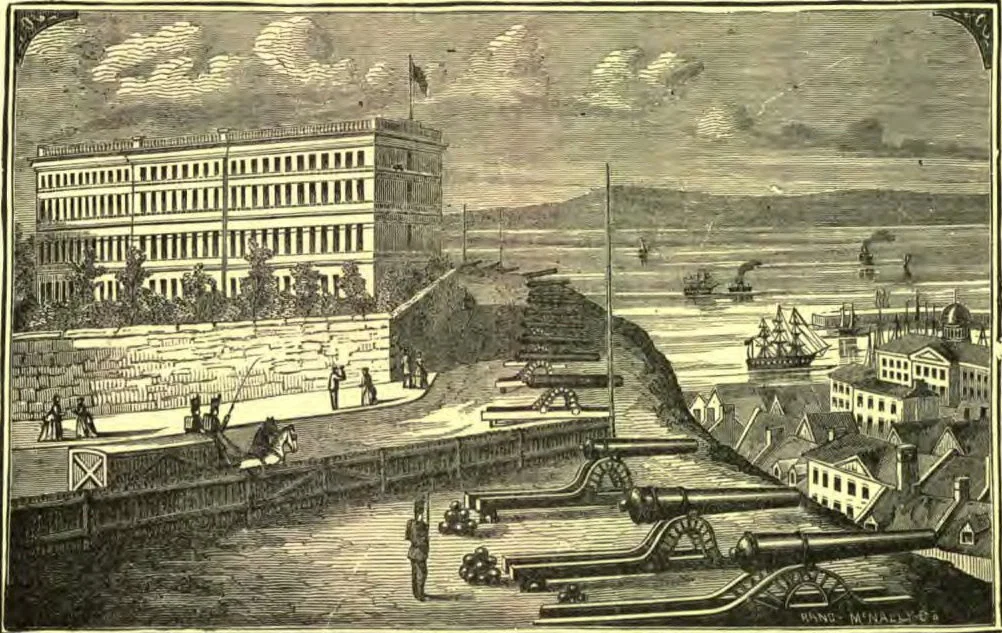
the citadel of which is shown in the engraving, is situated at the confluence of the St. Lawrence and St. Charles rivers, about 360 miles from the gulf of St. Lawrence, and 180 miles from Montreal. It is an object of much curiosity, and is visited annually by hosts of travelers. The city is divided into the upper and lower towns, the upper being surrounded by a wall nearly three miles in extent, mounted with cannon, and having five gates. The lower town is on the banks of the river, and is the seat of the principal business of the city, the commerce of which, by means of the river St. Lawrence, is very important.
The CITADEL is built upon the highland of the upper town, 345 feet above the level of the river, and covers about 40 acres. The view from its walls is magnificent, embracing a circuit of many miles in every direction, and its guns command the river at every point of approach. It has been styled the “Gibraltar of America,” and is considered well-nigh impregnable. To the west lie the plains of Abraham, the scene of the memorable battle in which Wolfe and Montcalm, the leaders of the opposing forces, both fell, mortally wounded. The approach from this direction is guarded by four strong towers.
Within the past few years the preservation of the walls, especially between the upper and lower towns, has been deemed of less consequence than formerly, and on the occasion of a visit by the writer a few years since, one of the massive gates was being leveled to the ground before the march of improvement. The citadel, however, will doubtless be cherished and preserved as a mark of the city’s greatness, and as a source of defense from invasion.
While gazing at the walls and towers, I was reminded of a walled city which is promised as the home of the saved, “Whose glittering towers the sun outshine,” whose walls are of precious stones, and whose gates are of pearl. Can we all say with the poet, “That heavenly mansion shall be mine”? It is our privilege, dear readers, one and all; and may we all meet in that blest abode, is my prayer.
W. C. G.

GIRLS, LOOK HERE!

“THERE is no lady deserving of the name,” says the Humane Journal, “who could witness without a feeling of horror the process of preparing for use the feathered beauties which form such conspicuous ornaments on women’s hats.
“If those who wear them knew the tortures to which these helpless little creatures are subjected, and the heartless cruelty with which the business is carried on, they would shrink from even indirect complicity with it.
“Of course the impression prevails, that all birds used for personal decoration are killed immediately when caught, and prepared in the ordinary way by taxidermists; but here is just where the mistake is made. The birds are taken alive, and while living the skin is skillfully stripped from their quivering, ghastly bodies. By this process, it is claimed, the feathers retain a firmer hold upon the skin. Such is the method by which all birds used in the decoration of ladies’ hats are prepared.
“Think of the exquisite humming bird, the blue-bird, the cardinal bird, the oriole, and numberless others of beautiful plumage, struggling beneath the knife of the heartless operator; think of this, tender-hearted ladies, as your admiring gaze rests on these ornaments now so fashionable. Hundreds of thousands of birds of the brightest plumage are literally flayed alive every year; and so long as our ladies will consent to wear such ornaments, just so long will this cruel business continue.”
The savages of the forests ornament themselves with the scalps of their deadly foes, but it is left for civilized and delicate Christian women and their daughters, who would faint at the sight of a drop of blood, or weep over a dead canary bird, to follow fashions which cause the wanton destruction of whole races of God’s beautiful creatures, and to deck themselves in the gaudy plumage torn from the quivering forms of little innocent birds which God has made to sing his praise.
Can any of our readers afford to proclaim themselves partakers in such horrible cruelties? Better banish every semblance of plumage from the dress than countenance in the least degree fashions which lead to such atrocities.—Christian.

THE OLD FORT.

Two hundred years the fort has stood— Gathered the moss on stone and wood— Its vigils kept from sun to sun, At even fired the signal gun.
Two hundred years! and yet the same Of which we read in storied fame; Proudly it stands, as if of yore It felt the weight of years no more.
Two hundred years! and overhead The same broad roof of blue is spread; But mortal man has run his race, And others rise and fill his place.
Two hundred years! still drifting on ’Neath winter’s wind and summer’s sun; The years they come and go away, Silently bringing eternity’s day.
V. A. M.

THE RIVER JORDAN.

A VERY remarkable river often mentioned in the Bible is the Jordan, which flows through nearly the center of Palestine from north to south, and is the chief and most celebrated river of that country.
The name Jordan, we are told, signifies “the descender.” This name is quite appropriate, whether we consider the rapid descent of the current, or the great depth of the valley through which it runs.
The most remarkable feature of this river is, that throughout nearly its entire course it is below the level of the sea, and finally empties its waters into a sea that has no outlet. In the upper part of its course, the Jordan flows through two small lakes; the first is the waters of Merom, now called Lake Huleh, and the second, nine miles below this, is Lake Gennesaret, or Chinnereth, also called the Sea of Tiberias or Galilee. Capernaum, the town where our Saviour lived, is on its banks; the most of his public life was spent near this sea, and it is hallowed by many scenes connected with his life. He stilled its waters by a word, when the fierce tempest swept over it, threatening to destroy his little bark. Here he called many of his disciples; and it was upon the waters of this lake that Peter tried to walk, and for lack of faith sank trembling in its waves, crying, “Lord, save me.” Matt. 14 : 25-33.
The Jordan issues from the Sea of Galilee close to the hills on the western side of the plain, and winds, in ceaseless coils, down the valley, “now touching one side and now another with its beautiful border of green foliage, looking all the greener from contrast with the desert above, till at last it is lost in the waters of the Dead Sea.”
The first mention of the Jordan you will find in the thirteenth chapter of Genesis, in the story of the separation of Abram and Lot, after they came up out of Egypt. Abram gave Lot his choice in the land before them, and “Lot beheld all the plain of Jordan, that it was well-watered everywhere, before the Lord destroyed Sodom and Gomorrah, even as the garden of the Lord.” “Then Lot chose him all the plain of Jordan.”
Travelers tell us that this plain is now a parched desert; then it was well watered everywhere. The curse had not yet come upon it; the fire of heaven had not passed over it; for you will remember that the cities of Sodom and Gomorrah were afterward destroyed by fire. See Gen. 19 : 24, 25, 28. It is plain that some great physical change was produced by the convulsion at the destruction of these cities; for now “the plain is coated with a nitrous crust like hoar frost, and not a tree, shrub, or blade of grass is seen except near fountains and rivulets.” E. D. ROBINSON.

WORK FOR ALL.

HERE are opportunities every day of our lives to work for the Master. There is work for all; no one need to stand idle. Even for the children the Master has work—little errands. At early morning, at the noontide, and when the shades of evening are gathering over hill and plain, the command is given, “Go ye also into the vineyard.”
Perhaps some may think that there is not much that they can do; but there is something, however trivial. An old Spanish proverb says that “there is no such thing as a trifle in the world;” and when we think how the lives of all mankind are tangled together, it seems as if every word or action had an influence on some one. How careful we should be to perform promptly and well the duties of life, even the smallest.
Every one has at least one talent, and in the great reckoning day, will have to give account of its use. It will not do to hide our light under a bushel, we must let it shine, for “There are many and many around us, Who follow wherever we go; If we thought that they walked in the shadow, Our lamps would burn brighter, I know.”
The time is short in which to work. Even if it were allotted to us to live to three-score and ten, the period of man’s life, the time would be none too long in which to work; for there are many all around us who know not Christ as a Saviour, and who are making no preparation for the future life. To be standing idle while one sinner lives to hear a warning voice, is a sin, and will debar us from Heaven.
When the Princess Alice steamboat went down in the dark waters of the Thames, a cry for help arose from hundreds of drowning victims. The Becton boatman, who was the first to bravely launch forth to their rescue, “found a copious harvest of human lives, easily gathered in a moment to the full of the small capacity of the boat. Seeing how soon he had gathered all he could accommodate, and hundreds still struggling—and the vast majority of them struggling in vain—with the waters, he exclaimed: ‘Oh, that I had a bigger boat! I could save so many more!’”
In a higher and nobler sense, this is the cry of all who are earnestly laboring to save souls from the overwhelming waters of sin and unbelief. Oh, for more and larger opportunities of doing good! “Oh, for a bigger boat” to rescue the perishing from the depths of woe in which they are engulfed; for just in proportion to the “number of boats, and ropes, and safety-belts, and life buoys, and other helps sent forth, were the number saved from a watery grave.” So, in the missionary work; the more energies employed, the more souls are rescued for Christ. V. A. M.

A LITTLE EVERY DAY.

The longest life is made up of simple days,—few or many; but the days grow into years, and give the measure of our lives at the last. The life is, at the last, what the days have been. Let the children therefore look after the days,—one day at a time,—and put into each one something that will last—something worth doing, something worth remembering, something worth imitating by those who follow us.
1. Every day a little knowledge. One fact in a day. How small a thing is one fact! Only one! Ten years pass by. Three thousand six hundred and fifty facts are not a small thing.
2. Every day a little self-denial. The thing that is difficult to do to-day, will be an easy thing to do three hundred and sixty days hence, if each day it shall have been repeated. What power of self-mastery shall he enjoy, who, looking to God for his grace, seeks every day to practice the grace which he prays for!
3. Every day a little helpfulness. We live for the good of others, if our living be in any sense true living. It is not in the great deeds of philanthropy that the only blessing is found. In “Little deeds of kindness,” repeated every day, we find true happiness. At home, at school, in the street, in the neighbor’s house, on the playground, we shall find opportunity every day for usefulness.
4. Every day a little look into the Bible. One chapter a day. What a treasure of Bible knowledge one may acquire in ten years. Every day a verse committed to memory. What a volume in the mind at the end of twenty-five years!

The Grief That Does Not Speak

THERE is no grief like the grief that does not speak.

LESSONS FOR CHILDREN.

LESSON LIX.—AHAB'S WICKED REIGN.

AFTER this, Jeroboam went on doing evil, and serving his gods, just as before.
Then Jeroboam's son Abijah was taken sick, and Jeroboam's wife disguised herself, and went to the prophet Ahijah to ask him if the child would live. The prophet told her that her son would die; and that because Jeroboam had been so wicked, all his other children should be destroyed; and that all of them who died in the city the dogs should eat, while all who died in the field should be devoured by the fowls of the air.
After the death of Jeroboam, his son Nadab reigned in his place two years; when he was killed by Baasha, who took the kingdom, and reigned twenty-four years. Baasha destroyed all Jeroboam's family, as the prophet had said. But he did evil, and worshiped idols; and when his son had reigned two years, Zimri, a captain in his army, killed him, and took the throne. Then Zimri destroyed all the family of Baasha, just as Baasha had destroyed all the family of Jeroboam. But Zimri reigned only seven days; for Omri, the captain of the host, came up against him with an army; and when Zimri saw that he would be taken, he set fire to the palace, and died in the flames.
Omri built the city of Samaria. After reigning about twelve years, he died; and Ahab, his son, reigned in his stead. Ahab was a very wicked king. He did worse than any who had lived before him; for he not only worshiped the calves which Jeroboam had made, but he built a house for Baal in Samaria, and set up an altar for Baal, and worshiped him. He also made a grove for the worship of idols, and did more to provoke the anger of the Lord than all the kings of Israel which were before him.
Then Elijah the prophet said unto Ahab, “As the Lord God of Israel liveth, before whom I stand, there shall not be dew nor rain these years, but according to my word.” After Elijah had given this message to Ahab, the Lord told him to go and hide himself by the brook Cherith; and when he had done so, the ravens brought him bread and flesh in the morning, and bread and flesh in the evening, and he drank of the brook. But as there was no rain, the brook dried up. Then the Lord told him to go to Zarephath, a city of Sidon, where he would be fed by a woman who was a widow.

QUESTIONS.

  1. What course did Jeroboam take after the man of God had warned him, and performed such miracles? 1 Kings 13 : 33, 34.
  2. Who of his family was taken sick? Chap. 14 : 1.
  3. What way did Jeroboam take to find out whether his son would live or not?
  4. Who went on this errand?
  5. What did the prophet say about Abijah?
  6. What did he say would be the fate of all Jeroboam's other sons?
  7. Why was his family to be destroyed in this way?
  8. After the death of Jeroboam, who reigned in his stead?
  9. Who then took the kingdom?
  10. How long did Baasha reign?
  11. How did he fulfil the words of Ahijah the prophet?
  12. Was Baasha a good man?
  13. How did he displease the Lord?
  14. How long did his son reign?
  15. Who was Zimri?
  16. What did he do?
  17. How long did he reign?
  18. How did his reign come to an end so soon?
  19. Who was the next king?
  20. How long did he reign?
  1. Who then took his place?
  2. What kind of man was Ahab?
  3. What did he worship?
  4. What did he do to favor the worship of Baal?
  5. How did he compare for wickedness with the other kings that had ruled in Israel?
  6. What did Elijah the prophet say to Ahab?
  7. What did the Lord then tell Elijah to do?
  8. How did Elijah get food?
  9. Where was he sent, when the brook had dried up?
  10. How was he to be fed there?

BIBLE LESSONS FOR YOUTH.

LESSON LXXXV.—AHAZ AND HEZEKIAH.

1. Who succeeded Jotham on the throne of Judah? 2 Kings 16:1.
2. Who was reigning over the kingdom of Israel at this time?
3. How long did he reign over that kingdom? Chap. 15:27.
4. How long had he been reigning when Ahaz became king of Judah?
5. What was the character of Ahaz?
6. What crimes are recorded against him? 2 Chron. 28:2–4.
7. How did the Lord allow him to feel the consequences of his evil course?
8. From what nations did he suffer most?
9. How many of the men of Judah were slain by Pekah in a single day?
10. How many of the women and children were taken captive by him?
11. How did Ahaz profit by these afflictions?
12. What new acts of wickedness did he commit? Verses 22–25.
13. At his death how did the people show their appreciation of his character? Verse 27.
14. How long did Ahaz reign?
15. Who reigned next in Judah?
16. What was the length of his reign?
17. What acts are recorded in his favor? Chaps. 29, 30.
18. Who invaded the kingdom during Hezekiah’s reign? Chap. 32:1.
19. With what did the Assyrians taunt the men of Judah?
20. What did Hezekiah do in this emergency?
21. Who joined with him in praying for the protection of God?
22. What encouragement did the Lord give him?
23. How were the Assyrians discomfited?
24. What was the fate of Sennacherib?
25. How was Hezekiah afflicted?
26. What message did he receive through the prophet Isaiah? 2 Kings 20:1.
27. What did Hezekiah do when he heard this?
28. What instructions did the Lord give Isaiah?
29. What was given as a sign of the fulfillment of this prophecy?
30. What notable event occurred in the sixth year of Hezekiah’s reign? Chap. 18:9–11.
31. What compliments were paid him by the king of Babylon? Chap. 20.
32. What did Hezekiah show these messengers?
33. What did Isaiah tell him?
34. How did Hezekiah rank among the kings of Judah?
35. How was he honored at his death?

SYNOPSIS.

Jotham was succeeded by his son Ahaz, who began to reign in the seventeenth year of Pekah, and reigned sixteen years. He was a very wicked king, and brought great trouble upon his people. The Bible says, “He walked in the ways of the kings of Israel, and made also molten images for Baalim. Moreover he burnt incense in the valley of the son of Hinnom, and burnt his children in the fire, after the abominations of the heathen whom the Lord had cast out before the children of Israel. He sacrificed also and burnt incense in the high places, and on the hills, and under every green tree.”
Then the Lord allowed his enemies to distress him on every side. The king of Syria carried away many of the people as captives; Pekah, king of Israel, slew one hundred and twenty thousand men of Judah in one day, and took two hundred thousand women and children to Samaria; and the Philistines invaded the land on the south and took a number of cities.
Instead of turning to the Lord in his distress, Ahaz continually committed new acts of wickedness. He cut in pieces all the holy vessels, and finally shut up the temple. He made altars for the worship of his false gods in every corner of Jerusalem, and built high places to burn incense to them in every city in Judah.
On account of his great wickedness, Ahaz was denied a burial in the sepulchers of the kings.
Hezekiah, the son of Ahaz, began to reign when he was twenty-five years old, and reigned twenty-nine years. This good king turned to the Lord with all his heart. He restored the services of the temple, the keeping of the pass-over, and every part of the worship of God, following the instructions of Moses and the example of David and Solomon. During Hezekiah’s reign, Sennacherib, king of Assyria, came against Jerusalem with a vast army, taunting the Lord’s people with their weakness, and the inability of their God to protect them. But Hezekiah trusted in God, and encouraged the people. He and the prophet Isaiah prayed to the Lord, and received a promise of help from him. So the angel of the Lord went out into the camp of the Assyrians that night, and smote one hundred and eighty-five thousand men; after which Sennacherib returned to Nineveh, where he was slain in the house of his god by his own son.
Then was Hezekiah very sick, and Isaiah the prophet came to him and said, “Thus saith the Lord, Set thine house in order, for thou shalt die.” And Hezekiah turned his face to the wall and wept and prayed; and the Lord told Isaiah to return and tell Hezekiah that the Lord had heard his prayer, and granted him fifteen years more of life. As a sign of the fulfillment of this prophecy, the shadow was made to go back ten degrees on the dial of Ahaz.
It was in the sixth year of Hezekiah’s reign that Hoshea and the people of the kingdom of Israel were carried away captive by Shalmaneser, king of Assyria. After Hezekiah had been healed of his sickness, the king of Babylon sent messengers to congratulate him on his recovery. Hezekiah, led on by the pride of his heart, was so foolish as to show these messengers all the treasures of his house, not only showing them the gold and silver laid up there, but also the arms and equipments kept for use in defending the city. Then Isaiah told him that the days would come when all these things should be carried away to Babylon, and when his sons should become slaves to the king of that country.
Hezekiah had great riches and honor, and when he died, he was buried in the chiefest of the sepulchers of the kings.

TRUE TEACHING.

THERE are four classes of teachers:—1. Those who leave upon the minds of their pupils a general impression, but no definite knowledge of which the pupil can make use. 2. Those who succeed in communicating knowledge, but do not provide for its retention by the pupil. 3. Those who communicate knowledge, and fix it in the memories of their pupils; but the knowledge is like seed carefully deposited in a paper or box. 4. Those who so impart knowledge that it develops self-activity and power in the pupil, as seed wisely deposited in the soil, which grows and bears fruit.

The Value of Bible Stories for Children

There are no stories like the Bible stories. Even the youngest enjoy them, and they may linger in the memory with blessed effects for a life-time. Keep the fairy tales out until the Bible stories have had a chance to get in.

LETTER BUDGET.

BUSSEYVILLE, WIS.
Dear Editors: I am nine years old in January. My father is dead, and my mother is poor. I live at Brother Fickles, and go to Sabbath-school every Sabbath. I am trying to serve the Lord, and hope to meet all the INSTRUCTOR family in Heaven. Pray for me that I may be faithful.
Yours truly, CARRIE GOULD.
GETTYS GROVE, MINN.
Dear Editors: I have made several attempts to write to you, but my courage has failed me every time. To-day I feel more determined, and think I shall accomplish my object. I am thirteen years old, and have kept the Sabbath nearly a year with my dear mother. As we are the only Sabbath-keepers in this place, we have our little Sabbath-school by ourselves. We use the Song Anchor, and think there is no book so nice. I learned the tunes by playing them on the piano. I am becoming more and more attached to our dear INSTRUCTOR. I like the lessons, and learn all I can of them.
Pray for me that I may be numbered with God’s people, and have a home in his kingdom when Jesus comes.
Yours in hope, MAGGIE GETTY.
We are glad that your “courage did not fail you this time,” Maggie, and that you wrote us this nice letter. How much pleasure it would give us to visit your little Sabbath-school and hear you sing!
MELVERN, KANSAS.
Dear Editors: I have been keeping the Sabbath about five years with my father and brothers. I am eleven years old. We have taken the INSTRUCTOR for five years. I have one sister and two brothers. My mother and step-mother are both dead. I go to Sabbath-school and day-school, and read my Bible every day and night. I want to be a good girl, and obey God’s commandments. I want you to pray for me.
FRANCES A. DWELBRIS.
The Bible is the best of books. Follow its teachings; you will never regret doing so. Our prayers ascend to Heaven for you as well as the rest of the INSTRUCTOR family, that we may all meet in the new earth.

The Child-Dyke.

The ground in Holland is so flat and low that two or three times the sea has rushed in over parts of it and destroyed whole towns. In one of these floods, about two hundred years ago, more than twenty thousand people were drowned. In some of the towns that were flooded, not a creature of any kind was left alive.
A large part of the water that came in at the time of that flood still remains. It is known as “the Maas,” and in one part of it there is a little green island—a part of an old dyke or dam—which is called the “kinder dyke,” or child-dyke, and it got its name in this way,—
The waters rushed in over one of the little Freisland villages, and no one had any warning. In one of the houses there lay a child asleep in its cradle—an old-fashioned cradle, made tight and strong of good stout wood.
By the side of the cradle lay the old cat, baby’s friend, probably purring away as comfortable as possible. In came the waters with a fearful roar. The old cat, in her fright, jumped into the cradle with the baby, who slept through all the turmoil as quietly as ever. The people were drowned in their beds. The house was torn from its foundations and broken in pieces. But the little cradle floated out on the angry sea in that dark night, bearing safely its precious burden.
When morning came, there was nothing to be seen of the village and green meadows. All was water. Hundreds of people were out in boats trying to save as many lives as possible; and on this little bit of island that I have spoken of what do you think they found? Why, that same old cradle, with the baby asleep in it and the cat curled up at her feet, all safe and sound!
Where the little voyagers came from, and to whom they belonged, no one could tell. But, in memory of them, this little island was called “kinder dyke”—the child-dyke—and it goes by that name to this day; and this story is told to thousands of little people all over Holland, as a remarkable instance of God’s providence.—The Nursery.

ANTIQUITY OF UMBRELLAS.

DR. MORRISON, the missionary to China, states that there is mention made of umbrellas and parasols, in books printed in China more than fifteen hundred years ago; and that Layard relates that he discovered on the ruins of Nineveh, in bas-relief, a representation of a king in his chariot, with an attendant holding an umbrella over his head.
In India, we also find that the umbrella had been used in remote ages, and principally as an emblem of royalty, in shape differing very little from those in modern use. In Burma, the princes use a very large umbrella; it requires a separate attendant to carry it, and his position is a recognized one in the royal household. One of the titles of the king is “King of the White Elephant, and Lord of the Twenty-four Umbrellas.” The Emperor of China, who never does anything on a small scale if he can help it, has no fewer than twenty-four umbrellas carried before him, when he goes out hunting. The umbrella is used in that country as a defense against sun as well as rain, and is principally made of a sort of glazed silk or paper, beautifully painted.—Myrtle.

HOW RAIN IS FORMED.

To UNDERSTAND the philosophy of this beautiful and often sublime phenomenon, so often witnessed since the flood, a few facts derived from observation, and a long train of experiments must be observed:—
1. Were the atmosphere, everywhere, at all times, at a uniform temperature, we should never have rain, or hail, or snow; the water absorbed by its evaporation from the sea and the earth's surface, would descend in an impenetrable vapor, or cease to be absorbed by the air when it once became fully saturated.
2. The absorbing power of the atmosphere, and consequently its capability to retain moisture, is proportionately greater in cold than in warm weather.
3. The air near the surface of the earth is warmer than in the region of the clouds. The higher we ascend from the earth, the colder we find the atmosphere. Hence the perpetual snow on every high mountain in the hottest climates. Now, when from continual evaporation, the air is highly saturated with vapor, though it be invisible, and the sky cloudless, if its temperature is suddenly reduced by cold currents of air rising from a higher to a lower latitude, its capacity to retain moisture is diminished, clouds are formed, and the result is rain. Air condenses as it cools, and, like a sponge filled with water and compressed, pours out the water which its diminished capacity cannot contain.—Democratic Advocate.

Douay Bible

The New Testament was brought out by the Roman Catholics, at Rheims, in 1582, and for this reason called the Rhemish New Testament. It was condemned by the Queen of England, and copies were seized by her authority and destroyed. In 1609–10 the Old Testament was added, and published at Douay—hence called Douay Bible.

WAITING

Do the little brown twigs complain That they haven't a leaf to wear? Or the grass, when the wind and rain Pulls at her matted hair?
Do the little brooks struggle and moan When the ice has frozen their feet? Or the moss turn gray as a stone Because of the cold and sleet?
Do the buds that the leaves left bare To strive with their wint'ry fate, In a moment of deep despair, Destroy what they cannot create? Oh, nature is teaching us there To patiently wait, and wait.

You have reached the end of this edition.

The Youth’s Instructor · Feb 11, 1880