Your ShelfYour Projects

Review and Herald, Vol. 74, No. 50.

CHRISTIAN LIBERALITY

Review and Herald

Dec 14, 1897

Seventh-day Adventist Publishing Association · Battle Creek, Mich. · Dec 14, 1897

CHRISTIAN LIBERALITY.

MRS. E. G. WHITE.
“This I say, He which soweth sparingly shall reap also sparingly; and he which soweth bountifully shall reap also bountifully. Every man according as he purposeth in his heart, so let him give; not grudgingly, or of necessity: for God loveth a cheerful giver. And God is able to make all grace abound toward you; that ye, always having all sufficiency in all things, may abound to every good work: (as it is written, He hath dispersed abroad; he hath given to the poor; his righteousness remaineth forever. Now he that ministereth seed to the sower both minister bread for your food, and multiply your seed sown, and increase the fruits of your righteousness;) being enriched in everything to all bountifulness, which causeth through us thanksgiving to God.”
God is in heaven, but he has delegated his work to those on this earth. This work is to represent Christ. Christ gave himself, a full, complete offering, for the life of the world: and God calls upon all men to make a complete surrender of all they have and are to him, that they may be co-laborers with Christ. This call is just; for to whom is every member of the human family indebted for his possessions?—To God, who not only gives men temporal blessings, but freely offered up his only begotten Son, “that whosoever believeth in him should not perish, but have everlasting life.”
God has entrusted men with his gifts, that they may represent his benevolence toward those who are poor and needy. If they have the spirit of Christ, they will reveal it unmistakably by their helpfulness to others, by a faithful discharge of their duty, by acting tenderly and kindly toward God’s heritage. As God sees that his children manifest compassion toward those who are poor and needy, he will bless them as faithful stewards.
“Moreover, brethren,” writes the apostle Paul, “we do you to wit of the grace of God bestowed on the churches of Macedonia; how that in a great trial of affliction the abundance of their joy and their deep poverty abounded unto the riches of their liberality. For to their power, I bear record, yea, and beyond their power, they were willing of themselves; praying us with much entreaty that we would receive the gift, and take upon us the fellowship of the ministering to the saints. And this they did, not as we hoped, but first gave their own selves to the Lord, and unto us by the will of God. Insomuch that we desired Titus, that as he had begun, so he would also finish in you the same grace also. Therefore, as ye abound in everything, in faith, and utterance, and knowledge, and in all diligence, and in your love to us, see that ye abound in this grace also. . . . For ye know the grace of our Lord Jesus Christ, that, though he was rich, yet for your sakes he became poor, that ye through his poverty might be rich.”
To a youthful ruler who inquired of him, “Good Master, what shall I do to inherit eternal life?” Jesus answered, “Sell all that thou hast, and distribute unto the poor, and thou shalt have treasure in heaven: and come, follow me.” This was not a hard requirement; for the ruler was not handling his own property. His goods had been entrusted to him by the Lord. The choice was left with him; he must decide for himself. Did he accept the eternal treasure? or did he decide to gratify his desire for earthly treasure, and in so doing, refuse the eternal riches?—When he heard Christ’s words, “he went away sorrowful: for he had great possessions.” He chose the earthly good, and lost the eternal weight of glory.
Individually, we are tried as was the young ruler. God tests us to see if, as stewards, we can safely be trusted with the eternal riches. Shall we do as the ruler did,—fasten our grasp upon the treasures lent us by God, choosing that which appears most agreeable to the natural heart, and refusing to use our possessions as God plainly states he expects us to? or shall we take up our cross, and follow our Saviour in the path of self-denial?
Millions of people in our world are making the choice made by the young ruler. They have intelligence, but they cannot decide to be honest stewards of their Lord’s goods. Many say, “I will bless and glorify myself; I will be honored as a man above his fellows.” Jesus paid the price for their redemption; for their sake he became poor, that they might be rich; and yet, though wholly dependent on him for all their earthly possessions, they refuse to do his will by showing love to their fellow men. They are not willing to relieve the necessities of those around them with the means which the Lord has placed in their hands for this purpose. They refuse to appropriate the Lord’s capital for the benefit of others, and hold fast to their possessions. Like the ruler, they refuse the heavenly treasure, and choose that which is agreeable to themselves. By such selfishness they prove themselves unworthy of the eternal riches. They show that they are unfit for a place in the kingdom of God; if they were allowed to enter there, they would, like the great apostate, claim everything as if they had created it, and would spoil heaven by their covetousness.
Moses was called upon to choose between the world and God. Two conflicting objects were placed before him. The treasures of Egypt, the honor of a temporal crown, and all the worldly benefits involved in this choice, were presented by the prince of this world. The opposite side was presented by the Prince of Light, the world’s Redeemer. He held out the recompense of reward, the unsearchable riches of Christ, and showed also the path of affliction, self-denial, and self-sacrifice, that must be traveled by all who gain this reward.
The decision was left with Moses. As a free moral agent he was at liberty to choose. All heaven was interested in the matter. What would be his choice?—obedience to God, with the eternal recompense of reward, or obedience to that most agreeable to his own will? “By faith Moses, when he was come to years, refused to be called the son of Pharaoh’s daughter; choosing rather to suffer affliction with the people of God, than to enjoy the pleasures of sin for a season; esteeming the reproach of Christ greater riches than the treasures in Egypt: for he had respect unto the recompense of the reward.”
“By faith he forsook Egypt, not fearing the wrath of the king: for he endured, as seeing him who is invisible.” This is a lesson for all who would render true service to God. We must not venture to remain where our associations will tend to draw us away from God, and to obscure our view of the reward of obedience.
There is no saving faith in Christ only as it is revealed by obedience. Every human being is under a solemn responsibility to obey God. His present and eternal happiness depends upon his willing obedience to the divine requirements. Man’s will and inclination are to be wholly yielded to God. When this is done, man will co-operate with God, showing, by precept and example, that he has chosen to be, in all his ways, under the control of his Maker. God rejoices when, like Moses, his children choose rather to serve him than to enjoy the pleasures of this world. Could the curtain be rolled back, could men behold the angelic host as they glorify God with songs of gladness and rejoicing, they would realize that obedience ever causes joy, and disobedience, sorrow. God and the angels rejoice over every victory gained by the Christian; but when temptation overcomes the soul, there is sorrow in heaven.
While in this world, men are tested by the society they choose, and by the attributes of character they develop. All who belong to the kingdom of Christ are of one family. They love God supremely, and their neighbors as themselves. “Therefore, as ye abound in everything, in faith, and utterance, and knowledge, and in all diligence, and in your love to us, see that ye abound in this grace also,”—the grace of Christian liberality. “To do good and to communicate forget not.” By “communicate,” the apostle does not here mean “to speak;” for in the verse previous he has said, “By him therefore let us offer the sacrifice of praise to God continually, that is, the fruit of our lips giving thanks to his name.” By this “communicating” the apostle means Christian liberality. God desires that the bounties which he has freely given to his children shall be communicated to those who are in need. By this communication, by the utterance of kindly words, accompanied by deeds of love, those who work for God will find entrance to hearts, and will win others to Christ.
“Charge them that are rich in this world,” says the apostle, “that they be not high-minded, nor trust in uncertain riches, but in the living God, who giveth us richly all things to enjoy; that they do good, that they be rich in good works, ready to distribute, willing to communicate.” God would have those whom he has blessed with means, take of their abundance, and relieve the necessities of the poor. As they do this, they receive their reward; for they are “laying up in store for themselves a good foundation against the time to come, that they may lay hold on eternal life.”
God’s children should be educated to see that he has claims upon them. As regularly as the seasons come round, he gives us the harvest of the earth. His liberality is constant and systematic; and our returns to him are to be made in accordance with the gifts which day by day he bestows upon us. The steady, unfailing flow of Jehovah’s goodness testifies of his love and benevolence. Then shall we not, with hearts filled with gratitude for all his blessings, respond by dispensing his gifts as faithful stewards?
All classes are entrusted with the Lord’s gifts, and none are exempt from the work of Christian beneficence. There will be those who, by their unfaithfulness, will make God’s benevolence to them a curse. The blessings that are shut up to the service of self, work harm instead of benefit, and God will withdraw his gifts from the unfaithful steward. Let us carefully follow God’s directions in the use of what he has given us; and as we do this, he will supply grace for every time of need; for he is acquainted with the desires of the heart to follow a wrong course, and with the temptations that surround us. Let us carry out God’s requirements by imparting our blessings to those around us, not from compulsion, but because he has, for our own good, made us laborers together with him. He has ordained that we shall carry forward his work by an active, living benevolence, which has for its foundation a “Thus saith the Lord.” In his strength we can do this; for he is able to make all grace abound toward us, that we, “always having all sufficiency in all things, may abound to every good work.”

THE NIGHT AFTER THE SABBATH.

MRS. S. M. I. HENRY.
(Sanitarium.)
Sweet closing of the holy day, Whose glories softly fade away That tender lights of moon and star May bring us dreams of worlds afar!
As some sweet song, whose numbers move Set to the symphony of love, So have the hours of this glad day In rhythmic measures passed away.
As comes the long-drawn chord,—the rest,— Breathing what tones have ne’er confessed, Thus comes the night, so still and sweet, To make time’s harmonies complete.
Shut in by close-drawn starry glooms, Woven in noiseless, snowy looms, With that dear Love whose still, small voice Can teach e’en shadows to rejoice,
I fill my soul with thoughts of Thee, Eternal Friend, whose memory Hath made the Sabbath day sublime, The crown upon the brow of time.
Hark! in the hush, that wondrous tone Swept from the strings of sphere and zone, From woodland harp, and lapping sea,— ’Tis nature’s vesper-song to Thee.
O, as comes on life’s busy tide, Thou brooding Dove, my spirit hide; And let me find, in toil and care, Only the psalm that follows prayer.

WHAT A TRACT DID.

In 1785 Dr. Coke gave a tract to a family in Virginia. The family numbered fourteen, and that tract was the instrumentality used in the conversion of the whole family.
A tract distributer passing through a sparsely settled country gave away many tracts. One of them, entitled, “Repent or Perish,” was found floating in the Frazer River. A man saw it, took it out, dried it, read it, and by it was converted to God.
A preacher invited a man to attend a meeting; the man refused, but he consented to take a tract. A few weeks afterward he stood up in the meeting, and confessed that the tract had led him to Jesus.
During the war a chaplain was passing through the hospital, and he left in an empty bed a tract which was a copy of the hymn, “Will You Go?” The soldier came to his bed, picked it up and read the title, and dropped it; a second time he picked it up, and read,—
“We are traveling home to heaven above: Will you go?”
and then threw it down again. Soon afterward he picked it up again, and read it through; then he finally wrote on it, “By the grace of God I will go,” and signed his name. Some months later he was killed in battle in Virginia, but he was saved by the tract.
It is often the case that a man who will not enter a church or listen to the preaching of the gospel, will read, when alone, a tract which may be more effectual for his salvation than a sermon. There are many cases where a tract has been the instrumentality which has restored from despair a precious soul.
Passing through Switzerland, a tract distributer presented a tract to a man in a town notorious for gaming; on his return, some days later, he met the man, who exclaimed, “I thank you for saving my soul and body.” He then explained that on that day when he received the tract, he had lost heavily in gambling, and was contemplating suicide, but the tract arrested his attention and led him to Christ.
Instances of this sort could be multiplied; for these little printed missives have been known to prevent crimes, to save lives, to heal the broken-hearted, and to bring despairing ones to Jesus. We never know, nor can we realize, the good we are doing in distributing tracts.—Selected.

SPIRITUAL MICROBES.

Sabbath Recorder.
I ASKED one of our eminent doctors one day how many microbes there are. “Upward of two hundred families,” he answered, “and they are everywhere,— in the air we breathe, the food we eat, and the water we drink.”
I thought of diphtheria, and typhoid fever, and scarlet fever, and consumption; and shuddered to think that so many germs are chasing a fellow about everywhere, no matter where he goes, or what he does. And two hundred families of them!
“Doctor,” I said, “we might as well give up at once. We haven't the ghost of a show.”
“O, well,” he responded, cheerfully, “they are not all bad. Some of them are very well disposed. We could hardly get along without them. They are essential to the functions of digestion. The housewife could not separate her butter without them. Many of them perform very useful services.”
“And then,” he said, “the bad microbes cannot hurt us when we are in vigorous health. We may breathe them and swallow them; but if we are armed with sufficient vitality, they can get no hold in our system. You need not fear them.”
And so, just like a preacher, I went to moralizing. The spiritual atmosphere of our modern life is full of strange forms of life, the bacilli of the soul's world. There are so many new and peculiar and puzzling things that old-fashioned people become full of forebodings. It is all right. Many of these movements will work out a good purpose, and contribute to the knowledge and power of Christendom. There are plenty of these microbes that are vile, bad, and dangerous to the moral and spiritual life; but if we are armed with life, we may walk in the midst of the contagion unscathed.
Is that what Jesus meant when he said, “I am come that they might have life, and that they might have it more abundantly”?

The Blessed Secret of the Holy Spirit

Do you know the blessed secret Of the Holy Spirit’s power? Do you know that joy and gladness Is your portion every hour? Do you know the Holy Spirit comes To dwell your heart within, And that Jesus Christ within you Sanctifies and keeps from sin? — Truth.

PREPARATION FOR WAR.

M. E. KELLOGG.
(Battle Creek, Mich.)
A PROPHET of God, who saw our time, exclaimed: “Prepare war, wake up the mighty men, let all the men of war draw near; let them come up.” Joel 3:9. Surely no one can say that a seer looking upon the great nations of to-day, could in any clearer language describe their condition.
The era of Napoleon is justly regarded as the most warlike period of European history; but a comparison of the size of the armies he commanded with the armies that may, at a moment’s notice, be put into the field by any one of the great powers of Europe, will demonstrate that his campaigns were Lilliputian compared with the campaigns that the historian of the next great war in Europe will have to relate.
Napoleon’s first campaign in Italy was undertaken with an army of about 30,000 men, with which he defeated three armies of 40,000 each. His second campaign in Italy, after his return from Egypt, when he crossed the Alps, was with an army of 60,000, but only 30,000 of these were present at the decisive battle of Marengo. The battle of Austerlitz, famed in history, was fought by Napoleon with 120,000 men; and in the majority of his campaigns in Western Europe, his army was rarely larger than that.
The invasion of Russia was undertaken with 1,200,000 men,—the greatest army that Napoleon ever commanded, or that Europe at that time had ever seen under one commander,—but these were inclusive of the troops of his allies, which at that time included Austria, Italy, Prussia, Bavaria, and Saxony; in fact, nearly all of Europe. Not one half of this great army ever crossed the Niemen. The terrible struggle carried on by Napoleon after his retreat from Moscow was with an army of about 200,000 men; and at his last battle, Waterloo, he commanded but 75,000 men.
To-day there are five powers on the continent of Europe, each of which can, at very short notice, put into the field an army greater than Napoleon commanded when he began his disastrous Russian campaign. Great Britain has also about 500,000 soldiers in all parts of her extensive domains. The smaller powers have caught the spirit, and have armies as large, in comparison to their size and resources, as those of the greater nations.
This time, then, is surely the era of war-like preparation, and there is no prospect of disarmament. “The war is inevitable,”—and such a war!

THE MANIFEST EVIDENCE OF HIS COMING.

A. O. TAIT.
  • (Battle Creek, Mich.)*
There are, perhaps, few of the readers of this paper who do not believe, in a general way, that we are living in the “last days.”
Very many, no doubt, have a vague and general impression that “time is short.” But how many of us have faithfully studied the evidence, so that we actually know that we are living in the very last of the “last days,” and that time is very, very, yea, most exceedingly, short?
God has given, in his Word, great lines of prophecy, such as those found in the second, seventh, eighth, and eleventh chapters of Daniel, and in the twelfth and thirteenth chapters of Revelation, etc. These lines of prophecy, in a beautiful, yet clear, mingling of symbols and literal speech, trace the history of the world from a time several hundred years before the first advent of Christ, on to his more glorious second appearing. Of course these symbolic prophecies, by their very nature, require a knowledge of history in order to be understood; but by the light of this “sure word of prophecy,” the devoted student of the Book of books, comparing the prophetic predictions with the pages of history, has been able, all along, to see the passing mile-stones, and know that the end was coming.
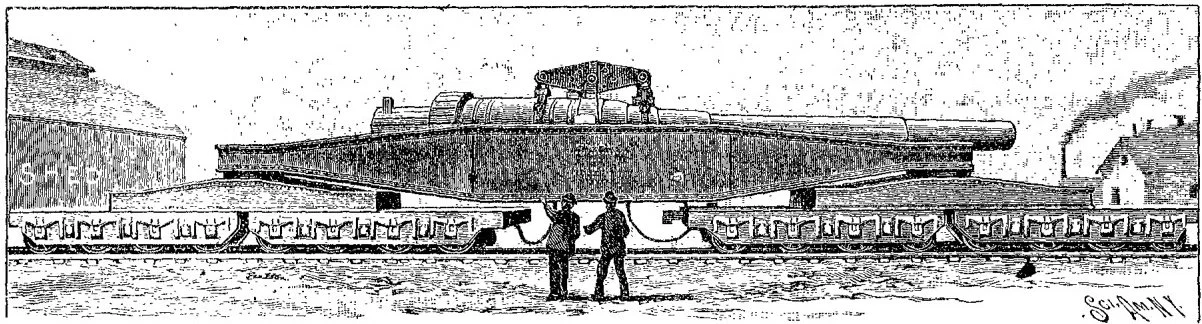
One of the big cannon being transported. It requires four flat cars, built of boiler steel, and so constructed that the weight of the gun rests alike on them all. Just think of one cannon making more than four ordinarily heavy car-loads!
These lines of prophecy, to him who will compare them with the testimony of history, present an array of evidence that is most impressively clear, showing that, beyond a possible doubt, the “end of all things is at hand.” But having reached the generation that is to witness the second coming of our Lord, we have the plainest and simplest statements of just what our literal eyes may actually see. How well our Lord knew that many in the last generation would be so driven for time that they would not have the opportunity of studying history, and comparing it with the prophetic symbols! Hence our Heavenly Father took pains most minutely to point out these prominent things in the literal world at this time.
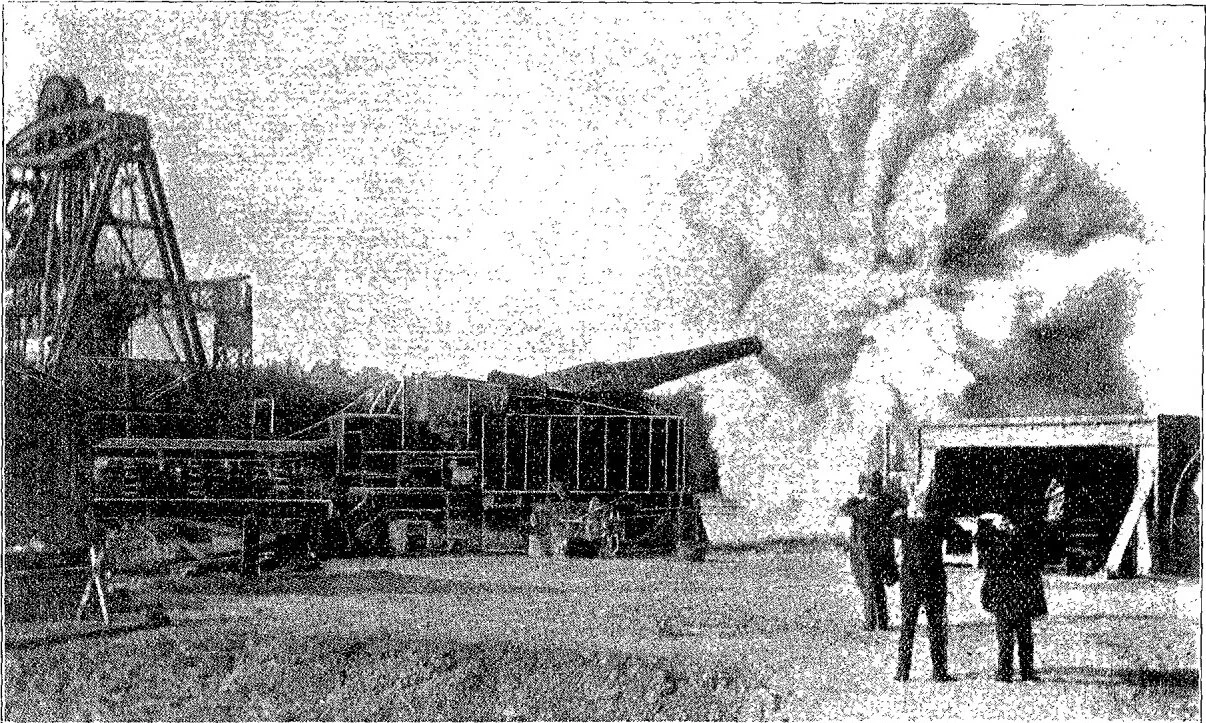
This cut shows the fearful appearance of the big gun in action. Is it any wonder that Jeremiah's “heart made a noise in him” as he viewed it in vision?
They are made so plain that a person, with simply the Bible as his guide, is able to see, with his own eyes, all about him, evidence that is most abundant and most overwhelmingly clear, showing that He “is near, even at the doors.” And as surely as God has given these “signs of the times” to show that his Son is soon to come, just so surely, when any of these signs are seen by us, will we be made to sense the fact that the “great day” is near.
We know that God has already convinced the world that the end of time is right at hand; for whenever a great storm is passing, or any unusual phenomenon presents itself, the confession is drawn from unwilling lips, “The end of the world is come! the end of the world is come!” Since the Lord has already given evidence that is most convincing, it is plain that he is only waiting for you and me so to present to the world his love and life that he can win for himself the jewels of his grace.
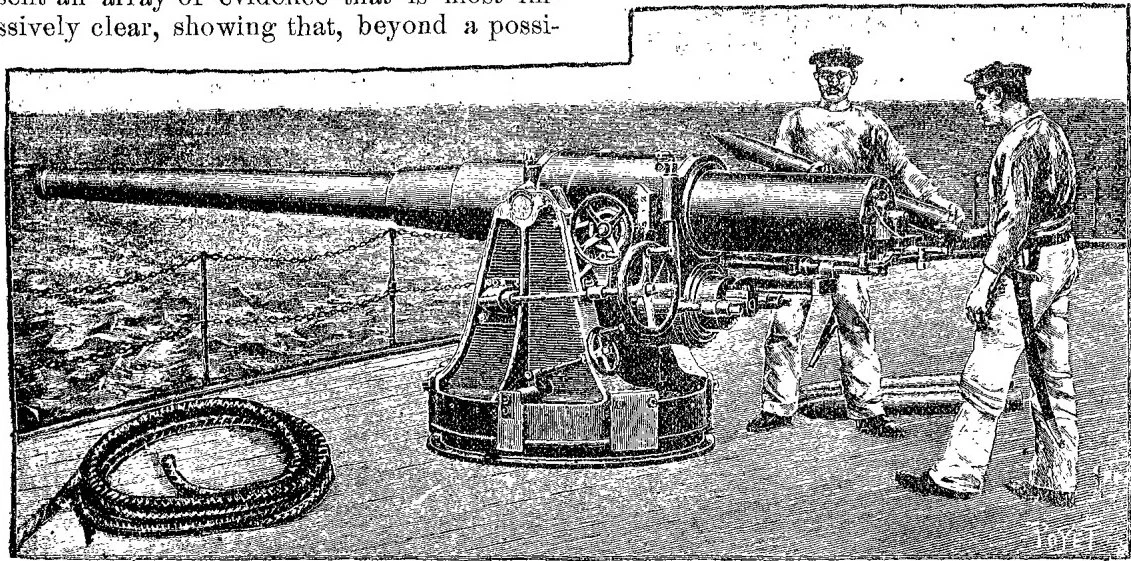
These guns may be fired from ten to fifteen times a minute, and throw a projectile weighing from 40 to 80 pounds, according to the caliber, a distance of over six miles. These projectiles will pierce wrought-iron plate 20 inches thick. Imagine the effect of a battery of such guns in action!
But turning to some of these “signs of our times,” note how clear the Word is: “And the nations were angry, and thy wrath is come, and the time of the dead, that they should be judged, and that thou shouldest give reward unto thy servants the prophets, and to the saints, and them that fear thy name, small and great; and shouldest destroy them which destroy the earth.” This scripture makes use of the plainest language, in telling us that when God’s “wrath is come, and the time of the dead, that they should be judged,” then the “nations were angry.”
Note that this text says, without qualification, “The nations were angry,” thus showing that the whole world will be involved in the struggle.
But this fearful, universal war is made to appear still more clearly from another scripture: “And I saw three unclean spirits like frogs come out of the mouth of the dragon, and out of the mouth of the beast, and out of the mouth of the false prophet. For they are the spirits of devils, working miracles, which go forth unto the kings of the earth and of the whole world , to gather them to the battle of that great day of God Almighty.” Rev. 16: 13, 14. Ponder this text; study each word. “Unclean spirits” “go forth unto the kings of the earth and of the whole world, to gather them to the battle of that great day of God Almighty.” How clearly it is stated that the “whole world,” led on by “unclean spirits,” will plunge into the awful combat of this final war of the “great day”?
Read another scripture, showing how fearfully intense this struggle will be: “My bowels, my bowels! I am pained at my very heart; my heart maketh a noise in me; I cannot hold my peace, because thou hast heard, O my soul, the sound of the trumpet, the alarm of war.” Jer. 4: 19. By reading the verses which follow in this chapter, it will be clearly seen that Jeremiah is here viewing the scenes of the last days. How could language be framed so as to have more intensity of expression? Says the prophet, “I am pained at my very heart; my heart maketh a noise in me.” What a wonderfully vivid view must Jeremiah have had of these warlike preparations for the “great day”! What fearful slaughter and furious warfare must he have been viewing in prophetic vision when he was led to exclaim, “I cannot hold my peace, because thou hast heard, O my soul, the sound of the trumpet, the alarm of war.” It was not some comparatively tame contest between barbarous tribes, armed with rude swords and spears, that he was here viewing; but the furious roaring of the ponderous guns, and the clashing of other destructive war implements prepared for the last great battle, were passing before him in impressive vision.
With these plain scriptures before us, telling what one of the things is that will conspicuously mark the “last days,” we are at once impressed with the very remarkable and literal fulfilment of the prophecy. In the face of all the sleep-inducing notes of the “peace-and-safety” cry to the contrary, it must be admitted that the spirit of war is the dominant spirit of this age. There is no subject that is discussed more or with greater interest; and there is no field in which more wonderful developments and inventions are being made.
At the breaking out of the Civil War in the United States in 1861, the largest projectile that could be successfully fired from a cannon weighed sixty-eight pounds, and the largest charge of powder was sixteen pounds. But how remarkable, yes, even awful, the developments since! The big one-hundred-and-twenty-ton guns of to-day fire a steel projectile weighing a ton, using a charge of half a ton of powder. Our artist has furnished us some cuts of these big guns and the results of their destructive shots. Next to seeing the guns themselves, the reader can get a better idea of what these “last-days” engines of death will do from the illustrations herewith presented, than from anything that could be written.
1. 20½ in. compound plate. 2. 8 in. wrought iron. 3. 20 ft. oak timbers. 4. 5 ft. granite. 5. 11 ft. concrete. 6. 6 ft. 4 in. brick wall. Total thickness of target, 44 feet.
This cut shows the actual penetration of a trial shot from a 16¼ in. 110-ton gun. Note the terrible effectiveness. Where are the fortifications that can resist these guns? And who can imagine what the awful slaughter will be when all the world, armed with such destructive weapons, begins the battle of the “great day”?.
1. 20½ in. compound plate. 2. 8 in. wrought iron. 3. 20 ft. oak timbers. 4. 5 ft. granite. 5. 11 ft. concrete. 6. 6 ft. 4 in. brick wall. Total thickness of target, 44 feet. This cut shows the actual penetration of a trial shot from a 16¼ in. 110-ton gun. Note the terrible effectiveness. Where are the fortifications that can resist these guns? And who can imagine what the awful slaughter will be when all the world, armed with such destructive weapons, begins the battle of the “great day”?.
It should also be noticed, in passing, that as recently as the time of the Civil War in this country, all firearms were practically “muzzle-loaders;” but in the few brief years since that time, the breech-loading gun has been developed, and in improving it, the “rapid-fire” and machine guns have been produced.
The facts and illustrations presented in this article are only the beginning. In one or two more illustrated articles on the spirit of war in our day, the subject will be more fully presented. But in the presence of these awful facts, who can doubt that we are in the time when the “nations are angry”? Are not these ponderous modern cannon, together with the “rapid-fire” and “machine” guns, among the things that Jeremiah saw when he gave that most wonderful prophecy: “My heart maketh a noise in me; I cannot hold my peace, because thou hast heard, O my soul, the sound of the trumpet, the alarm of war”?
What could be more fitting, in this connection, than the statement from one of the Special Testimonies? “Prophecies are being fulfilled, and stormy times are before us. . . . The angels are holding the four winds, that they shall not blow until the specified work of warning is given to the world; but the storm is gathering, the clouds are loading, ready to burst upon the world, and to many it will be as a thief in the night.”
The time is here; the “prophecies are being fulfilled;” the “stormy times” are ready to burst upon us; the “specified work of warning” is rapidly going on. Are you doing your specified work in this great day?
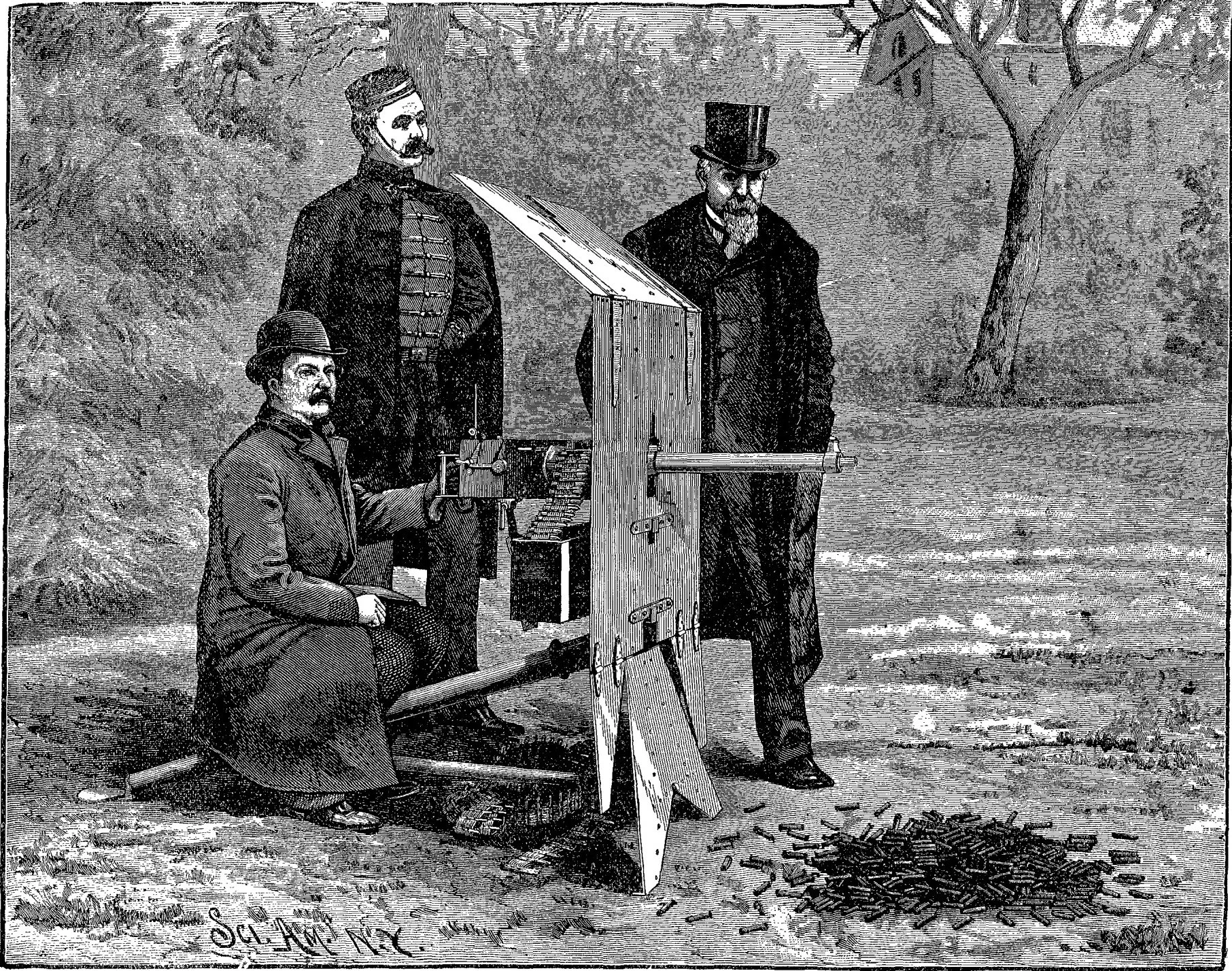
For any action within the range of one thousand yards, perhaps there could be no more murderous weapon than the “machine gun.” The “Maxim machine gun,” represented above, shoots from five hundred to seven hundred steel bullets a minute. One such gun is more to be dreaded than was a whole army five hundred years ago.

ONE TOUCH OF NATURE.

“I went to my husband’s office yesterday afternoon to get some money,” said the little woman in the gray gown, as she settled back in her chair to tell her “dearest friend” the latest family joke. “I was down-town shopping, and had spent every cent I had.”
“Of course,” said the dearest friend; “that’s the way I always do, too. Did he grumble about it?”
“No; he wasn’t at his office. That’s where the joke comes in.”
“Joke!” exclaimed the dearest friend. “I should have thought that you would have been mad enough to—to—almost swear.”
“I was at first,” admitted the little woman in gray. “But when they told me he had gone home early, I got over being mad, because I knew he’d gone home to have a quiet little chat with me before dinner, and that he’d be as mad as a hornet when he found I wasn’t there. It made me laugh to think of him standing around the house scolding because I wasn’t at home, after he’d left the office early to go home to me. I didn’t hurry, either. I took my time, because you know it does a man good to have these little disappointments once in a while. If he always found his wife at home, he wouldn’t half appreciate it.”
“Was he very mad?” asked the friend with interest
“No; that’s the funny part of it.”
“I don’t see what there is funny about that.”
“Why, the servant told him I’d gone downtown, intending to go to his office, and he said it made him laugh to think how mad I’d be when I found he had gone home. So he just sat there and chuckled all the time until I came home.”
“It was all right, then, I suppose?” said the “dearest friend.”
“No, indeed, it wasn’t.”
“But you were both in a good humor?”
“No, we weren’t; that’s the funniest part of the whole story. When we each found that the other thought it was a good joke, we were both so mad that we didn’t speak for the whole evening.”—Selected.
“An enterprising Philadelphia woman has a novel manner of converting her muscle into cash. She is an expert in floor-cleaning. Kitchen floors are her specialty. Kitchen floors nowadays are made of hard wood or tile, or they are covered with oilcloth or linoleum. An expert can clean them with great rapidity. This woman can clean the average floor in half an hour, and her charges are twenty-five cents. She carries her own tools, soaps, and cloths. For each customer she has a certain half-hour on a certain day. She earns from $3 to $4 a day. Many women are now making good incomes as professional menders. Their chief customers are men. They sew on buttons, darn stockings, brush clothes; and the experts are able to sponge and press clothes as well as any tailor, at a reduced price.”
HAVE you ever thought that God was away off from you, and you did not know how to get near to him?
His answer to all that is that “he is not far from every one of us.”
To be “not far” is to be near. Then as he is not far from every one of us, he is certainly near to every one of us.
Had it occurred to you that this word—“he is not far from every one of us”—was first spoken to a great crowd of heathen, Greek heathen, too, sunken to the very depths of idolatry and all other Greek heathen abominations; and that there was not a single even professed Christian there, except the man who spoke it?
That is the truth: it was spoken by Paul at Athens; and he was there “alone,” and he spoke it to a crowd of none but heathen. To them all he said, by inspiration of God, “He is not far from every one of us.”
That being true of heathen, and such heathen, too, how is it, then, with you who do believe in him and love him? Is he far from you?—No, no; he is not far from you; he is near to you.
Yes, he is more than near to you: he says, “Lo, I am with you.” More than that: he says, “I am with you alway.” Yea, even more than that: he says, “I will never leave thee, nor forsake thee.”
Then please, please, never think again that God is far from you. Nobody but the devil can ever suggest such a thing. Please believe the Lord rather than the devil.
Continue reading: MRS. S. M. I. HENRY