It has been said that ideas never die. A poet has beautifully sung:—
“Truth, crushed to earth, shall rise again,
The eternal years of God are hers,
But error, wounded, writhes in pain,
And dies amidst her worshipers.”
But this is poetry and poetical license. The error of assuming that our judicial system can deal and does deal with men’s actions from the standpoint of morality is not only still sustained by our courts, it is repeated by our text-writers, with results which are occasionally so remarkable that they would be amusing, if they were not painful.
To a rightly constituted mind, the spectacle of a great thinker striving to “make sense” out of a popular superstition is never edifying. It is all very well to say that the man has no business to defend what he does not, in the secret depths of his own thoughts, believe in. There may be no conscious truckling to the zeitgeist. The brightest intellects are seldom free from a notion, more or less vague, that it is necessary to keep things as they are, in a general way, if we would prevent them from going to pieces altogether. To regard certain principles as absolutely essential to order and progress; to assume that the state of affairs by which we find ourselves surrounded is the only practicable state of affairs; to doubt our own ability to seriously improve things by altering them—these are often attributes of men endowed with great mental strength.
I OPEN my “Sharswood’s Blackstone,” and read a long and elaborate “note,” suggested by Mr. Blackstone’s division of things into mala in se and mala prohibita, and the underlying assumption of this division to the effect that human law is in some way connected with human morality. The profound question here wrestled with is about as follows: Does a thing which is not malum in se become malum when it is made prohibitum? Is it immoral to violate a “game law,” in the same sense in which it is immoral to commit murder? Is a man morally bound to obey all the laws of his country just as he is morally bound to obey those laws which punish certain offenses mentioned in the Decalogue?
IT goes without saying that Judge Sharswood grapples this psychological problem most manfully, and handles it with skill and vigor. That the result is nil, is not his fault. One need only read a few lines to see how utterly out of place such a discussion is in a law-book, and to appreciate that the text (to which the note is really germane) must itself have roamed beyond the scope of its ostensible purpose, which is the elucidation of human law. And such is the fact. The attempt to blend matters of morality with matters of law is fundamentally illogical, and nothing but absurdity can come out of such an undertaking.
HUMAN law has nothing whatever to do with morals. An act is not moral because this law allows it; it is not immoral because this law forbids it. Morality is the law of conscience. If a man sincerely believes that he ought to obey all human laws, simply because they exist (as some good men have maintained), then a breach of any one of such laws is immoral in him, not by reason of its being a violation of human law, but by reason of its being a violation of the law of his conscience. On the other hand, if a man holds that the mere existence of a human law does not involve any moral obligation on the citizen to obey it, but that it is every one’s duty to determine for himself the morality of the conduct which the law prescribes or prohibits—then it is immoral in that man to obey any human law which seems to him to prohibit a moral course, or to prescribe an immoral course. All the Blackstones and all the Sharswoods that ever have been or ever shall be cannot determine such points for anybody except a Blackstone or a Sharswood. They are points that each and every man must settle for himself. If he settles them one way in his mind and acts in another way, he sins against the Holy Spirit within him.
AFTER a man has concluded that a certain law should not be obeyed, then, if he breaks it, he righteously lives up to the law of conscience; yet he sins against society; and the policeman, who is society’s high priest, arrests him, and brings him in to answer for his crime. When he is duly convicted, he pays the penalty to society, but he does so as a criminal, not as a sinner.
AND the good old “Common Law” explicitly recognizes its inability to penetrate the conscience, to adjudicate upon morality, to distinguish between malum and bonum, in one of its phrases which has been, from time immemorial, addressed to the prisoner condemned for murder: “The sentence of the court is that, on ——, between the hours of ——, you be taken —— and hanged by the neck until you are dead; and may the Lord have mercy upon your soul.” A great deal of wit and sarcasm has been leveled at this old formula. It is argued that there is a palpable inconsistency in expressing the hope that Deity will show mercy to a person in regard to whom we expressly avow our intention to dispense altogether with the exercise of that quality. But such criticism entirely misses the point.
To my mind, the coupling of that last sentence with what precedes is far from being objectionable; it is sublime.377What does the whole thing mean? It means that the State says to the culprit “You have done a deed which marks you out as a being whose presence is a menace to the lives and the peace of those amongst whom you live; the protection of its people from each other is the purpose of the State; it is necessary, in order to accomplish that purpose, that you should be removed; but, in carrying out that purpose, the State does not assume to decide the character of your deed as moral or immoral; it does not undertake to weigh your temptations against your capacity of resistance, and so to determine your responsibility; this it cannot do; but it leaves the matter to the Higher Power, to whom you must answer in this regard; and its last words to you constitute a prayer that when He comes to judge you, He will temper justice with mercy.”
So that culpability is one thing, and responsibility is another. And a man may be culpable and punishable under a human law for doing that for which he will not only receive no punishment hereafter, but for which, under the doctrine of future rewards and punishments, he may well obtain a high reward. And so, on the other hand, a man may escape the penalties of human law by suppressing the impulses of his conscience, and, while he may thus appear externally a good citizen, “law-abiding,” and all that sort of thing, he will, if he gets his deserts, according to the same doctrine, be none the less held to account as a transgressor. Nor can he plead, in defense, that his action or his inaction was required or enjoined by “the law of the land.” For it is not possible that this law should either know or make anything malum or bonum.
Religion in the Constitution of Australia.
THE Australian Federal Convention refused to insert a recognition of God in the preamble of the Constitution which it was the purpose of the session to draft, notwithstanding the importunities of the Presbyterian and some other churches in that country. The Convention decided to deal fairly in this matter with all parties and classes of the people to be governed by the new Constitution; and as this is God’s manner of dealing with people, God is in the Constitution in a very practical sense. But He certainly would not be in a Constitution which favored one class of people above others, for God is no respecter persons. He sendeth his rain on the just and on the unjust, and maketh his sun to rise on the evil and on the good alike. And only those who manifest the same disposition in their dealings with their fellows can consistently profess to be his children.
But the controversy over the question of a constitutional “recognition” of God is not yet ended; for the Church-and-State party hope to carry their point before the Constitution is finally ratified as the fundamental law of the land.
At the session of a commission of the Presbyterian Assembly, held in May, much attention was given to this matter, and it was moved that a committee of Presbyterians lobby at the colonial parliaments for the purpose of counteracting the vote of the Convention, and of securing more recognition of Sunday as a sacred day. Mention was made of the Seventh-day Adventists as having manifested a formidable opposition to the scheme for securing the proposed establishment of religion by the State.
The Australian “National Creed.”
By Editor
The “Bible Echo,” Melbourne, Aus.
THE Adelaide Church of England Church News, of March 26, commenting on the petitions which the churches are sending to the Federal Convention, says:—
“We, the members of the Church of England in Australia and Tasmania, desire that in the preamble of the bill which frames the Federal Constitution some words may be inserted setting forth our national creed.”
And it adds:—
“In this matter, we thank God, we are entirely at one with all the Protestant bodies of Christians in this city and colony.”
And it further says:—
“It is unlikely that our Roman Catholic brethren will fail to show their approval of the main principle.”
This is plain language, and shows just what we have maintained from the first, that the design of the petition of the Council of Churches is to establish a “national creed.”
And any principle implying such a thing Protestants may rest perfectly assured will be approved of by “our Roman Catholic brethren.” The Roman Catholic church indorsed that principle over a thousand years ago. Upon that the whole system of the papacy was built, and out of it grew all the evils and horrors and bitter persecutions of the Dark Ages. When the papacy approves of that principle she approves of her own; and when professed Protestants approve of it, and ask her to approve of it, they are both denying the fundamental principles of true Protestantism and clasping hands with that church, whose history for twelve long centuries is written in the blood of the saints. . . .
We are glad to say there is one church that is not “at one with all the Protestant bodies” in demanding a union of Church and State. It is the Seventh-day Adventist church. This church protests against the whole business, and declares for religious freedom.
Religious Constitutions.
By M. E. Kellogg
BY M. E. KELLOGG.
The National Reformers, so-called, who have for years been trying to secure a union of religion with the State in this country by means of an amendment to our national Constitution, are greatly rejoiced that in Australia, now about to form a confederation, there is a strong effort being made to form a constitution after this religious order. To this end the churches of Australia have circulated the following petition, which the members are largely signing:—
“1. That in the preamble of the Constitution of the Australian Commonwealth it be recognized that God is the Supreme Ruler of the world, and the ultimate source of all law and authority in nations. 2. That there also be embodied in the said constitution, or in the standing orders of the federal parliament, a provision that each daily session of the upper and lower houses of the federal parliament be opened with prayer by the president and speaker, or by a chaplain. 3. That the governor-general be empowered to appoint days of national thanksgiving and humiliation.”
As might be expected, the Catholics of Australia are very anxious that these principles should be embodied in the Australian federal constitution. They well know that the time may, and probably will, come when they can use this thin edge of a general establishment of religion to drive in the one religion of the Roman Catholic Church and make that the religion of the Australian State. Protestants in their blindness fail to see it. They also fail to see that the adoption of such ideas is a virtual surrender to the Church and State theories which caused so many persecutions in the Middle Ages.
Other points are worthy of notice. The Catholic Church here claims that she has all that she wants in this country; that the Constitution of the United States just suits her; but the Catholics of Australia wish to put into the constitution of that country the very things in regard to religion which were expressly and purposely thrown out and forbidden by the Constitution of the United States! This harmonizes with a late encyclical of the pope in which he said that while “it would be universally lawful or expedient for State and Church, as in America, to be dissevered or divorced, she (the church) would bring forth more abundant fruits if, in addition to liberty, she enjoyed the favor of the laws and the patronage of the public authority.” So the Catholics of Australia, and the Protestants too, want more than liberty; they want the “favor of the laws and the patronage of the public authority.” Should they get this in principle in the constitution, then the battle will open to see which will get the most in reality. It must be so.
Again: the very fact that they deem it necessary to insert a clause in their constitution acknowledging God to be the Ruler of nations before securing a provision for chaplains and days of thanksgiving and prayer, proves that under our Constitution such things, although practiced, are not constitutional. They at least desire to be consistent. It may be difficult to tell which is better, to have a good constitution and override it, as is done in this country, or to have a bad one and live up to it; but all will agree that a good one fully lived up to and respected in its letter and spirit is best of all.
We have a good Constitution here. Religion is left out that it may not be a subject of controversy, that it may be free. The framers of our Constitution, living so near the times of fierce persecution, knew how to avoid those furnace fires of religious intolerance which have consumed the glory of so many nations better than their degenerate descendants who have never felt persecutions and so do not know how they arise nor what they are like.
The example of our great nation in making a Constitution requiring no religious test of our citizens, a Constitution that every honest man of whatever religion or of no religion can support, and our remarkable national growth so largely derivative from it, ought to have more effect on the people of Australia as a pointer to them in framing their constitution than all the petitions of religious devotees whose misdirected religious zeal and enthusiasm have gotten the better of their judgment. The voice and lessons of history should be given the preference in attention rather than the wild clamors of religious zealots.
With many Australians so unwisely desiring what the fathers of this country knew would be fatal to our progress as a nation, and with a strong tendency here to change our Constitution in this respect or to override it, there is great need of a faithful expose of these mediæval theories which would drag our modern liberty and progress back into the quagmire of former generations and bury it beyond the hope of a resurrection.
The “New [Christian Citizenship] Fourth of July.”
By Editor
As was to be expected, the fourth of July is to share the fate of other national days is being appropriated to the uses of “Christian Citizenship.” A suggested programme, which has been sent out “To all ministers and Christian patriots” from the headquarters of the National Christian Citizenship League, in Chicago, provides for observing “The New Fourth of July” with “rousing celebrations on definite Christian citizenship lines.” The programme is as follows:—
“5:30 A. M.—Firing of salute of seven or thirteen guns, immediately followed by simultaneous peals from all the church bells, lasting five minutes.
“6:00 A. M.—Union sunrise prayer meetings. Everybody invited.
“9:00 A. M.—Band concert or other music at place of rendezvous.
“9:30 A. M.—Form procession and march to various churches.379Short service at each church, somewhat as follows:
“1. Sing ‘America’ (two verses); (2) short prayer; (3) run the flag to top of steeple or otherwise decorate church with flags; (4) reading of the call of the National Christian Citizenship League; (5) sing ‘Coronation’ (two verses). Continue line of march to next church. At each church have similar programme, varying the verses of ‘America’ and ‘Coronation,’ or using other hymns of like character. Leave the flags on each church until the following Monday at least. From last church decorated march procession to the park or grove where the chief exercises are to be held.
“12:00 M.—Basket dinner.
“1:30 P. M.—Music, band, chorus-singing of united choirs, school children, etc. Patriotic and Christian hymns.
“2:00 P. M.—Assembly called to order at speakers’ stand for a programme, to include singing, a prayer, two or three ringing speeches of not over twenty minutes each, reading of the call of the National Christian Citizenship League. Presentation of the Christian citizenship crusade for enlistments.
“Close, singing ‘Coronation.’”
In no way does it occur to us that the union of Church and State which “Christian Citizenship” embodies could be more fittingly symbolized than by the flying of the Government flag from the spires of the churches.
Religious Liberty in Argentine Republic.
By Jean Vuilleumier
BY JEAN VUILLEUMIER.
In his bull Indei Coetera, issued May 4, 1494, Pope Alexander VI. gave South America to the kings of Spain and Portugal, on condition of establishing thereon the Catholic faith and seeing to the conversion of the Indians. In 1810, an independent constitution was drafted, somewhat on the type of the North American constitution. With regard to religious liberty, this constitution was a compromise between the spirit of the nineteenth century and the Catholic usages and prejudices of the people. It grants “every man living on the territory of the republic the right of exercising his religion.” At the same time it declares that the president and vice-president “must belong to the Catholic, Apostolic and Roman confession,” and states that “the nation protects, upholds and propagates the Catholic, Apostolic and Roman religion.” Accordingly, the Catholic clergy are supported by the national funds, as are also convents, Catholic colleges and church edifices.
Until about ten years ago civil marriage did not exist, and one could be wedded only by submitting at the same time to the “sacrament” as administered by a priest or by Protestant ministers representing some European State church. It may surprise some readers to learn that the Methodist pastors in Buenos Ayres secured recognition by passing as ministers of the “United States State Church”!!
Civil marriage is now recognized in all parts of the republic. Still the law provides for divorce under no consideration. At the same time, many people enter as many illegal marriage relations as they please without being interfered with in the least.
The civil register has only been in existence for a few years, and that in just three provinces. In the other provinces citizenship is yet inseparably bound to the act of baptism performed by the Catholic priests, or by Protestant ministers recognized by the government. The baptismal certificate is the only document provided for by the law with which citizenship papers can be secured.
A lively fight is being kept up nevertheless against Jesuitism and intolerance by several secular papers. One Methodist lecturer in Buenos Ayres draws large congregations when speaking on anti-papal themes, and some leading men are avowedly in favor of the separation of Church and State.
Esperanza de Santa Fe, Jan. 26, 1897.
An Appeal.
From “Baptist Principles of Religious Liberty,” by Geo. B. Wheeler.
THE writer appeals to Baptists in the name of their historic struggle for freedom of conscience, in the name of the martyrs of that struggle, to be loyal to their own avowed principles of religious liberty, which principles are violated by the enactment and enforcement of religious legislation in the form of Sunday laws.
The persecutors of Baptists, the defenders of the Inquisition, and the bigots in all ages, have attempted to justify their persecutions on the ground that they were necessary for the “peace and good order of society.” In the name of justice and consistency I plead with Baptists, Do not adopt the “civil-sabbath” excuse as a cloak to cover the sin and crime of enforcing religious conformity by law, and thus tacitly admit the claim of the persecutors of your fathers, that these persecutors were civil patriots while your fathers were society pests.
This appeal is made in the name of Christianity which teaches liberty of conscience, but which its enemies, because of the continual persecutions carried on in its name declare to be necessarily cruel to dissenters. This is an appeal to Baptists to demonstrate to all the world that a weak, persecuted church can become strong and still refuse to use that strength to persecute its dissenting brethren. The world is waiting for such a church.
The writer appeals to Baptists to remain true to their historic position on Church and State, and oppose the theocratic movement which to-day is crowding the halls of legislation, as in the days of Constantine, in quest of human power to support religious institutions, instead of appealing to the throne of grace. In the language of the Russian boy, I again appeal to you, “Send your petitions to the throne of God, and not to the Congress of the United States.”380
The writer appeals to Baptists to purge their garments of this modern Sunday-law persecution by withdrawing their influence from its instruments and agents, and by raising their voices against it. This is not an appeal for sympathy on behalf of imprisoned seventh-day observers. If their faith is not worth suffering for, it is not worth possessing. Their persecutors, not they, are the ones most in need of sympathy. They can afford to suffer, but Baptists cannot afford to persecute them, nor remain silent while others oppress them. Persecutions will come, but woe unto him by whom they come.
Men, whose boast it is that ye
Come of fathers brave and free,
If there breathes on earth a slave,
Are ye truly free and brave?
If you do not feel the chain
When it works a brother’s pain,
Are ye not base slaves indeed—
Slaves unworthy to be freed?
* * * * *
Is true freedom but to break
Fetters for our own dear sake,
And with leathern hearts forget
That we owe mankind a debt?—
No; true freedom is to share
All the chains our brothers wear,
And, with heart and hand, to be
In earnest to make others free.
They are slaves who fear to speak
For the fallen and the weak;
They are slaves who will not choose
Hatred, scoffing, and abuse,
Rather than in silence shrink
From the truth they needs must think;
They are slaves who dare not be
In the right with two or three.
—James Russell Lowell.
Sunday on a U. S. Man-of-War.
A RECENT issue of the Union Signal gives the following description of the exercises by which Sunday is observed on a Government warship;—
“Sunday on board a United States man-of-war is in many respects similar to any other day in the week, save that the men are more quiet, the occasional games and recreations are suspended, there are no drills; and the morning ‘church’ is the feature of the day.
“On board the New York, the flagship of the North Atlantic Squadron, the Rev. A. L. Royce is chaplain. The services on this ship last about an hour, and a deep interest is taken in the responses from the book of prayer, as well as in the sermon and singing, music for which is furnished by the Admiral’s band.
“This quarter of the gun deck during religious services presents an interesting scene. At one end the chaplain stands at his pulpit—a solid oak piece of furniture draped with the Stars and Stripes—on which rests the open Bible. To the right the officers of the ship are seated, and facing the chaplain are the marines, in uniforms of white duck, with blue sailor collars. To the left the rear of a powerful gun is visible, the muzzle projecting through a porthole, while to the right, and back of the officers, a rack of rifles may be seen. Here, amid the deadly weapons of modern warfare, this body of men assemble to lift up their hearts and voices to their Maker.
“Sunday on board ship is resting-day for nearly all hands, and those who are inclined to attend divine worship do so of their own free will. It is to the credit of our seamen that very few of them neglect this privilege. The Government provides a chaplain, and designates the hour for service, but does not compel the men to attend, so that it is very encouraging to find a large proportion of the ship’s men at the Sunday-morning service.
“A beautiful custom in the navy in this connection is that when the ship’s bell tolls for church, the national colors are hauled down from the peak, and the church pennant, consisting of a blue cross on a white field, is displayed instead. The colors are then hauled back to a position immediately underneath the pennant. Thus the sacred symbol of Christianity alone is permitted to take precedence of the Stars and Stripes; and this, the only flag that is ever hoisted above the national colors, remains flying during the hour of Sunday worship, from half past ten until half past eleven. It is then hauled down and the Stars and Stripes are again hoisted. Every flagship in the navy carries a chaplain, and most of the first-raters, such as the Columbia and Minneapolis. Some of the second-raters, like the Texas and Maine, also have chaplains. Every prominent naval station and navy-yard are also provided with chaplains, so that in the navy the Government provides in all for twenty-four chaplains, who at the time of their appointment must not be over thirty-five nor less than twenty-one years of age.
“To those chaplains on the active list, the moral and religious work of our churches in the navy is intrusted, and each is required to do the work of his church without a shadow of sectarianism. Christian unity is aimed at and largely realized in the navy, and to the building up of character the chaplains are at work with might and main. They are appointed and commissioned, like any other naval officer, by the President, by and with the consent of the Senate. As in the case of other staff officers, they hold relative rank with the line, their rank terminating with that of captain, so that theirs is the privilege of the ship. The uniform is not military, neither is it unmilitary, since it consists of the ordinary clerical dress, which is especially becoming on board ship.”
Would the “church pennant”—the “sacred symbol of Christianity”—be kept at the masthead while the ship went into action and sunk opposing ships and killed the enemies of the Government? Probably not. But if the emblem of Christianity is ever appropriate at the masthead of a man-of-war, why should it not be so when the latter is in action? For what is a man-of-war designed to do but to fight? She does not change her principles when she goes into battle. But think of the “sacred emblem of Christianity”—the ensign of the Prince of Peace—flying in a sulphorous canopy over a ship from whose sides great guns are hurling missiles of death against other ships freighted with human beings, and whose decks present a pandemonium of men shouting and cursing in a mad endeavor to murder their fellowmen, or shrieking and groaning from the effects of the like efforts made by their opponents!
What has Christianity to do with a scene like this? Just as much, we answer, as it has to do with a man-of-war.381The purposes of the two are utterly and unalterably at variance.
Again, every feature of the service on a man-of-war rests upon the sanction of the Government, for a man-of-war is wholly a Government institution. Sunday observance, therefore, as a feature of this service, has the sanction of the Government,—a sanction which is wholly unauthorized by the fundamental law of the Government—the Constitution. This, and the governmental appointment of chaplains, are features consistent only with a union of Church and State.
True Protestantism.
By Count A. de Gasparin
TRUE Protestants are united in vindicating the rights of conscience and in protesting against intolerance.
True Protestants are united in fighting for the liberty of their antagonists as earnestly as for the liberty of their friends, ever preferring to be among the persecuted than among the persecutors.
True Protestants are united in rejecting the use of the civil power, ever preferring to see the gospel oppressed when deliverance from oppression must be obtained by the use of carnal weapons.—Count A. de Gasparin, 1852.
Scottish Sabbath Alliance and Sunday Milking
THE New York Press, of June 10, is authority for the following:—
“The Scottish Sabbath Alliance has come to the conclusion that milking cows on Sunday is sin. A series of experiments has demonstrated that if the cows be not fed on Saturday they will not need to be milked on Sunday. The next step will be to use gags which will prevent any mooing.”
Danger of Defending Inspiration Without Reading Scripture
DR. CHARLES A. BERRY, of London, recently remarked that “the most imminent danger to the Bible to-day is the man who would fight like a Trojan for the orthodox theory of inspiration, but does not sit down and read the Book for himself.” The Bible itself is in no danger, of course; for it stands by the power of God. But there are very many people who are in danger of incurring eternal disaster because they are more willing to show their Christian zeal by fighting than by humbly seeking for divine instruction.
Wanted.
By John Harvey Kellogg
FIFTY good hygienic cooks. The Sanitarium summer school will conduct a special course for the training of persons who desire to become practical hygienic cooks. There is an increasing demand for such persons to take positions in connection with our schools, sanitariums, city missions, and in private families. Those interested should address the undersigned at once.
J. H. KELLOGG.
Interesting Facts.
AT this time when so much is being said concerning the nations of Europe, we believe it will be interesting to everybody to see the picture of some of the people who stand at the head of the various governments. The above heading is the name of a little book, which contains besides 74 pages of very interesting facts brought out in various ways, AN ALBUM OF 21 FINE HALF-TONE CUTS DIRECT FROM THE PHOTOGRAPHS of European royalty, and includes Victoria, Queen of England; Christian IX., of Denmark, and his Queen; Frederick, Crown Prince of Denmark; Oscar, King of Sweden; Sophia, Queen of Sweden; the King and Queen of Greece; Alexander III., Czar of Russia; and Maria Dagmar, Czarina of Russia; Wilhelm II., Emperor of Germany, and his wife; Josef I., Emperor of Austria, his Queen and her son; and others of equal importance and renown.
This little book contains a total of 96 pages, nicely bound, in heavy paper, and was sold by the publisher at 25 cents. We will send it post-paid for 15 cents per copy two copies for 25 cents. Send now. Postage stamps will be received.
Address,
PACIFIC PRESS PUBLISHING CO.,
39 Bond St., New York City.
TO OUR PATRONS:
By Editor
Write names plainly.
Remit by P. O. Money Order, or Express Order, or by Bank Draft on New York. Personal checks are not desired.
Make all Orders and Drafts payable to Pacific Press Publishing Co., not to the editor or any other individual.
We will receive Postage Stamps in small quantities and any kind of good money. Defaced coins will not be taken. If paper money or coin is sent, register the letter.
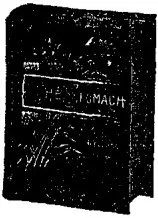
The Stomach: Its Disorders and How to Cure Them.
By John Harvey Kellogg
By J. H. KELLOGG, M. D.,
SUPERINTENDENT OF THE BATTLE CREEK (MICH.) SANITARIUM.
This book presents in a nutshell what every person ought to know about the stomach, its functions in health, the symptoms produced by disease, and the best methods of cure. The long experience of the already well-known author in the treatment of stomach disorders, in his supervision of the Battle Creek Sanitarium, makes this a work of inestimable value, not only for the sick but those who desire to keep well.
THE FOLLOWING ARE LEADING CHAPTER HEADINGS:
The Organs of Digestion. The Maladies of the Modern Stomach, The Systematic Treatment of Indigestion, Foods, The Digestive Fluids Important and New Discoveries Relating to Digestion, Treatment of Dyspepsia, Remedies for the Home Treatment of Dyspepsia, General View of the Digestive Process, The Symptoms of Dyspepsia, Quacks and Nostrums.
The work is illustrated with more than one hundred and thirty cuts, including eleven full-page plates, three colored plates, etc.
This work ought to be in the hands of every dyspeptic.
PRICE, Cloth, $1.50. - - Half Buffing, $2.00.
MODERN MEDICINE PUBLISHING COMPANY,
Battle Creek, Mich.
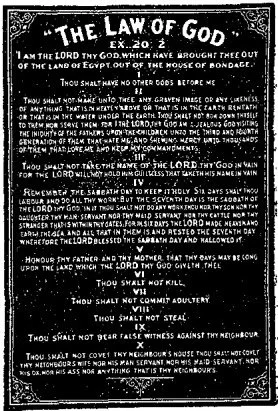
SOMETHING NEW, NEAT, NICE,
And necessary, if you would know, and have others know the COMPLETE DECALOGUE as God spake it from Sinai’s flaming summit.
A CHART 12 X 18 INCHES
On thick paper mounted at top and bottom with metal and ready to hang on the wall.
Postpaid 25 cents.
Postage stamps acceptable.
Address, PACIFIC PRESS PUB. CO., 39 Bond Street, New York.
Grand Trunk Railway System
IS THE MOST POPULAR ROUTE TO THE WEST,
Combining Every Comfort and Luxury.
Solid Vestibuled Pullman Dining and Sleeping Car Trains
Through from New York to Chicago without change
Choice of route from NEW YORK to NIAGARA FALLS, SUSPENSION BRIDGE, TORONTO, DETROIT, PORT HURON, CHICAGO, and the West, Northwest, and Southwest, via
The Celebrated ST. CLAIR TUNNEL,
Which connects Canada and the United States, and is the greatest submarine tunnel in the world.
The Grand Trunk Railway System is justly celebrated for its Fishing and Hunting Resorts, as on and contiguous to it are the greatest grounds of the civilized world, among them being the
MUSKOKA LAKES, ST. LAWRENCE RIVER, THOUSAND ISLANDS, LAKE ST. JOHN REGION, WHITE MOUNTAINS, ANDROSCOGGIN,
and many others too numerous to mention.
CHAS. M. HAYS,GEO. B. REEVE,W. E. DAVIS,Gen. Manager.Gen. Traffic Manager.Gen. Pass. & Tkt. Agt.
MONTREAL, P. Q.
FRANK P. DWYER,Eastern Passenger Agent,273 BROADWAY,NEW YORK CITY.