The Youth’s Instructor, Vol. 28, No. 21.

COLORADO

The Youth’s Instructor

May 19, 1880

S. D. A. Publishing Association · Battle Creek, Mich. · May 19, 1880

COLORADO

Who of the Instructor readers have not heard of Colorado? Probably none; yet there may be some who know little of its size, location, and scenery. For the benefit of such, we will mention some of the prominent features of this great State.
First, its size. Colorado has an area of 104,500 square miles, or more than any other State except Texas and California. It is rectangular in shape, having a width from north to south of nearly two hundred and eighty miles, and an average length of about three hundred and seventy miles from east to west. The eastern part of the State embraces a portion of the great plains sometimes called the “American Desert,” while the central and western divisions are made up of mountain ranges, with valleys and plateaus. Here the highest points and the deepest gorges of the Rocky Mountains are found. The “Continental Divide,” or higher portion of the mountains, is from 12,000 to 14,400 feet—between two and three miles—above sea level, and several thousand feet above the line where timber and nearly all vegetation ceases. This is sometimes termed the backbone of the American continent. From its eternal snows, streams are formed that unite and make large rivers, such as the Arkansas, Platte, and Colorado, that flow a thousand miles or more toward the Gulf of Mexico or the Pacific Ocean.
One interesting feature of the mountains is their parks, the most prominent being San Louis, South, North, and Middle Parks. These are generally level or rolling lands, covered with grass and occasional groves of timber. They are walled in on every side with high mountains, and abound in streams of the purest water. In the summer months, these become a resort for the invalid and the tourist, who pitch their tents amid the beautiful scenery, and find recreation in the sports of hunting and fishing, while they gain new life from the pure air of the mountains. These parks are supposed to have been lakes at an early period of the world’s history, but have been deprived of their waters by volcanic agency.
In our next, we will speak of some of the principal mountain valleys, or canyons.
J. O. Corliss.
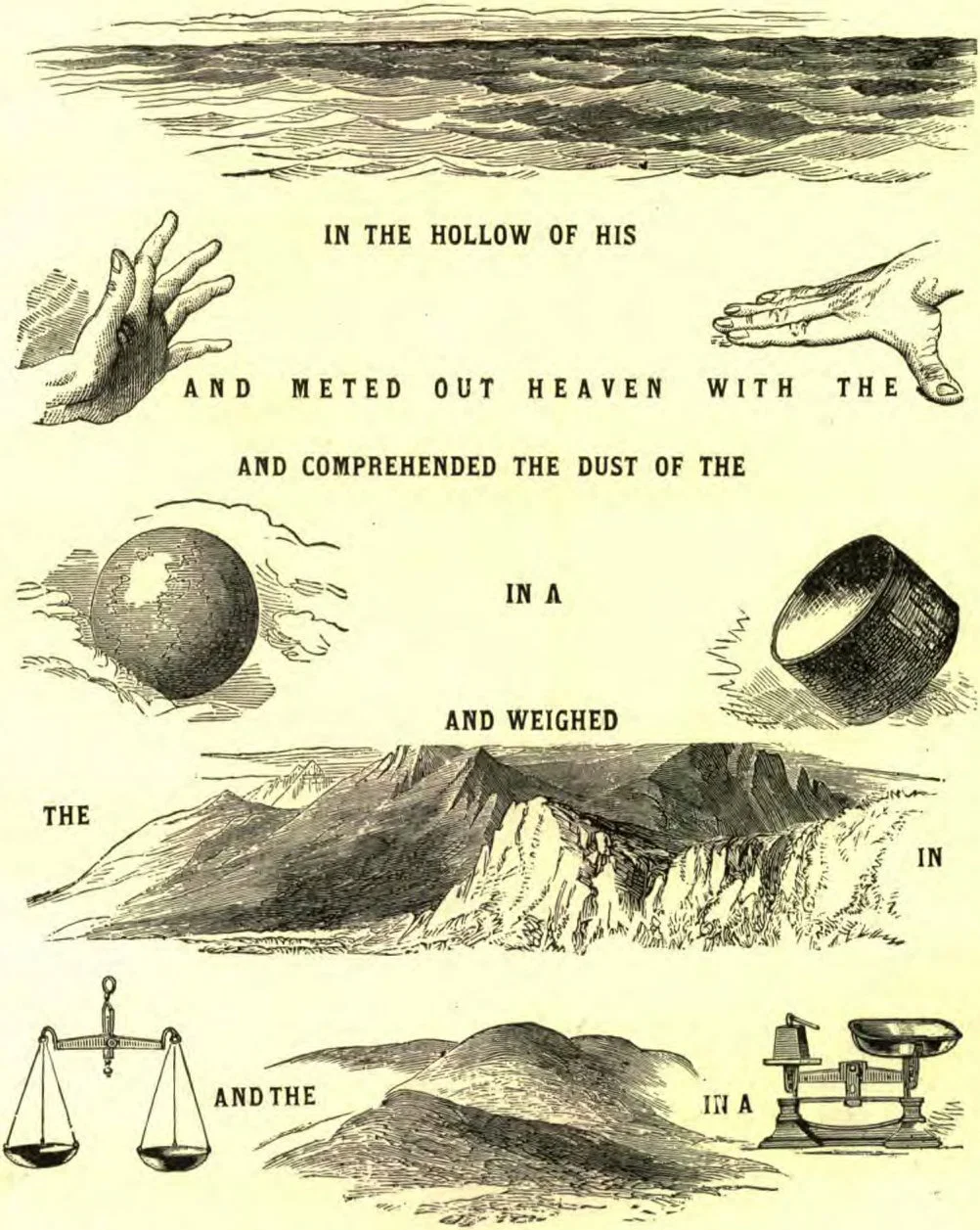
PICTORIAL TEXT. Isaiah 40:12.

WAITING FOR THE MAY.

From out his hive there came a bee; “Has spring-time come, or not?” said he. Alone within a garden bed A small, pale snow-drop raised its head. “’Tis March, this tells me,” said the bee, “The hive is still the place for me. The day is chill, although ’tis sunny, And icy cold this snow-drop’s honey.”
Again came humming forth the bee; “What month is with us now?” said he. Gay crocus-blossoms, blue and white, And yellow, opened to the light. “It must be April,” said the bee; “And April’s scarce the month for me. I’ll taste these flowers (the day is sunny), But wait before I gather honey.”
Once more came out the waiting bee; “’Tis come; I smell the spring!” said he. The violets were all in bloom; The lilacs tossed a purple plume; The daff’dil wore a yellow crown; The cherry-tree a snow-white gown; And by the brook-side, wet with dew, The early wild wake-robins grew. “It is the May-time!” said the bee, “The queen of all the months for me! The flowers are here, the sky is sunny; ’Tis now the time to gather honey!”

SPLICING THE LADDER.

One night the large and splendid Sailor’s Home in Liverpool was on fire, and a vast multitude of people gathered to witness the conflagration. The fury of the flames could not be checked. It was supposed that all the inmates had left the burning building. Presently, however, two poor fellows were seen stretching their arms from an upper window, and were shouting for help. What could be done to save them?
A stout marine from a man-of-war lying in the river said, “Give me a long ladder, and I will try it.”
It was done, and he mounted the ladder; but it was too short to reach the window. “Pass me up a small ladder!” he shouted.
It was passed up; but even that did not reach to the arms stretched frantically out of the window. The brave marine was not to be balked. He lifted the short ladder up on his own shoulders, and holding on by a casement, he brought the upper rounds within reach of the two men, who were already scorched by the flames.
Out of the window they clambered, and creeping down over the short ladder, and then over the sturdy marine, they reached the pavement amid the loud hurrahs of the multitude.
It was a noble deed, and teaches a noble lesson. It teaches us that when we want to do good service to others we must add our own length to the length of the ladder.
Harry Norton saw that his fellow-clerk, Warren Proctor, was becoming a hard smoker and a hard drinker, although he was only sixteen years old. When he urged him to stop smoking and drinking, Warren replied,
“Why, you sometimes take a cigar and a glass of wine yourself.”
“If you will sign a pledge never to smoke a cigar or touch a drop of liquor, I will do the same,” was the reply.
The bargain was made, and Harry saved his friend by adding the length of his own example to the length of the ladder.
A widow lady near me was suffering from sickness and poverty. Her daughter, a delicate, refined girl, said to herself, “My mother must be taken care of; I’ll advertise for a place as a servant girl.”
She did so. A rich man saw the advertisement, and determining that the brave girl should not undertake that, he procured her a situation as secretary in an institution where she gets six hundred dollars a year. An unselfish daughter thus brought relief to a suffering mother. She spliced the ladder with her own self-denying exertions.
It is a noble thing to be unselfish, and to give up gratifications for the sake of other people. I could tell of two Christian lads, well educated and refined, who go every Sabbath to a mission-school in a dirty, degraded street, that they may encourage some poor ragged boys to go there too. Those two boys have the spirit of Jesus Christ. They are not selfish; and they mean that the poor, ignorant lads shall climb up in the world over them.
That is the way to imitate the Divine Master, who gave himself that men might climb up out of the folly and degradation of sin into Heaven itself.—T. L. Cuyler.

EVERY-DAY HEROISM.

One of the Life-Saving Stations on the California coast has been officially named the “Maggy Geddes.” A little girl of that name in San Antonio, aged nine years, seeing a playmate fall into a mill-race, leaped in and with great skill and coolness, and after a desperate struggle, succeeded in swimming with her ashore.
Another little girl, a year younger, in one of our New England towns, sprang into the river a few weeks ago, and rescued her baby brother from drowning, carrying him in her arms through the swift current, which reached her chin.
Now it was a graceful act of recognition to real heroism for the Government to give the name of little Maggy Geddes to a Life-Saving Station, and it is right that these little heroines should be held up to other girls and boys as examples of unselfish devotion; always provided that the right lesson is drawn from their story.
Not many men, and very few children, ever have the chance to save another life at the risk of their own. Such supreme opportunities come but seldom. But every child should remember that just as much unselfishness, devotion, and cool presence of mind can be shown in the little incessant matters of every day as go to make up some one great heroic deed.
In God’s eye it is not the size nor the dramatic effect of the action which counts, but its motive.
Many a young girl patiently bearing for years the cares of a disorganized household, or the peevishness of an invalid parent, or brother or sister; many a boy, bringing indomitable cheerfulness and love to the help of his tired mother,—is entitled to more admiration and respect, and is just as heroic, as if in a spasmodic passion of courage they had momentarily faced death for those they loved.—Youth’s Companion.

LIZARDS

MOST lizards are innocent little animals, very bright and lively in their movements, but exceedingly timid when disturbed. They have a long body and a serpent-like tail, and glide about with the greatest ease. Some of them live in holes in rocks, or crevices in stone walls, while others dwell altogether in the sand, and when disturbed dive into it and cover themselves completely. The toes of the sand lizards are very flat, and fringed on the sides, and on this account they are enabled to run over the sand with the greatest rapidity instead of sinking into it; while the rough-toed lizards, by dint of their crooked claws, can cling to the sides of walls and rocks.
These animals thrive best in tropical countries. In a temperate climate, as soon as the cold weather commences, they drop lower and lower, and finally sink into a lethargic state, in which they remain all winter. Their food consists principally of insects, and in warm countries they may frequently be seen in the noonday sun, busily catching them by darting out their long tongues.
Among the natives of India, the lizard is hunted down by dogs for its flesh, which is considered a great delicacy, and for its skin, which is made into shoes. These little animals are sometimes accused of eating birds' eggs, and, what is still worse, when pressed with hunger, of devouring their own; but among the ancients, on account of the number of insects they managed to swallow, they received the title of the “friend of man.” They are generally so very gentle that European children use them as playthings; but they have sometimes been known to bite when laid hold of, and they have also been known to show fight to dogs and serpents, when thoroughly aroused, inflicting some very dangerous wounds.
The most curious thing about a lizard is its tail, which is so very brittle that the merest touch will break it in two; but the little animal walks off perfectly undisturbed, leaving a piece of it wriggling on the ground. From the broken end, in a short time sprouts out another tail, which is often covered with scales differing from the rest of the body. Even if the tail be only cracked, another will start out of the opening, so that some lizards may be seen with two tails, while others have none.
Some of these little creatures are quite long-lived. One was watched for twenty years as it came out daily to take its sun-bath.—Elmer Lynnde.

LESSONS FOR CHILDREN.

LESSON LXXIII.—NAAMAN THE SYRIAN.

“And Elisha came again to Gilgal; and there was a dearth in the land; and the sons of the prophets were sitting before him; and he said unto his servant, Set on the great pot, and seethe pottage for the sons of the prophets. And one went out into the field to gather herbs, and found a wild vine, and gathered thereof wild gourds his lap full, and came and shred them into the pot of pottage; for they knew them not. So they poured out for the men to eat. And it came to pass, as they were eating of the pottage, that they cried out, and said, O thou man of God, there is death in the pot. And they could not eat thereof. But he said, Then bring meal. And he cast it into the pot; and he said, Pour out for the people, that they may eat. And there was no harm in the pot.”
“Now Naaman, captain of the host of the king of Syria, was a great man with his master, and honorable, because by him the Lord had given deliverance unto Syria; he was also a mighty man in valor, but he was a leper. And the Syrians had gone out by companies, and had brought away captive out of the land of Israel a little maid; and she waited on Naaman’s wife. And she said unto her mistress, Would God my lord were with the prophet that is in Samaria! for he would recover him of his leprosy.”
So the king of Syria sent a letter to the king of Israel, and with the letter he sent ten talents of silver, and six thousand pieces of gold, and ten changes of raiment.
When the king of Israel read the letter, asking him to cure Naaman of his leprosy, he rent his clothes and said, “Am I God, to kill and to make alive, that this man doth send unto me to recover a man of his leprosy?”
When Elisha heard what had been done, he said, “Let him come now to me, and he shall know that there is a prophet in Israel.”
“So Naaman came with his horses and with his chariot, and stood at the door of the house of Elisha. And Elisha sent a messenger unto him, saying, Go and wash in Jordan seven times, and thy flesh shall come again to thee, and thou shalt be clean. But Naaman was wroth, and went away, and said, Behold, I thought, He will surely come out to me, and stand, and call on the name of the Lord his God, and strike his hand over the place, and recover the leper. Are not Abana and Pharpar, rivers of Damascus, better than all the waters of Israel? may I not wash in them, and be clean? So he turned and went away in a rage. And his servants came near, and spake unto him, and said, My father, if the prophet had bid thee do some great thing, wouldest thou not have done it? how much rather then, when he saith to thee, Wash, and be clean? Then went he down, and dipped himself seven times in Jordan, according to the saying of the man of God; and his flesh came again like unto the flesh of a little child, and he was clean.”
“And he returned to the man of God, he and all his company, and came, and stood before him; and he said, Behold, now I know that there is no God in all the earth, but in Israel.”

QUESTIONS.

1. When Elisha was with the sons of the prophets at Gilgal, what did he tell his servant to do? 2 Kings 4:38.
2. For what purpose did one of the men go out into the field?
3. What did he bring in?
4. Why did these men have to live on such poor food?
5. When the men began to eat the pottage what did they say?
6. Did the man who gathered the gourds know that they were poisonous?
7. How did Elisha save the men that had been poisoned?
8. Who was Naaman? 2 Kings 5:1.
9. How did he become great and honorable?
10. How was he afflicted?
11. What captive was in the house of Naaman?
12. What was she doing there?
13. How was she brought to that place?
14. What did she say to her mistress one day?
15. When the king of Syria heard that Naaman could be cured in Israel, what did he do?
16. What did the king of Israel say when he read the letter?
17. What word did Elisha send when he heard what had been done?
18. In what way did Naaman come to Elisha?
19. Did Elisha go out to meet him?
20. What did he do?
21. What did he tell the messenger to say to Naaman?
22. How did it make Naaman feel to have the prophet treat him in this way?
23. What did he say?
24. What did his servants say to him?
25. Did he consent to do as Elisha had said?
26. What effect did washing in the Jordan have upon his leprosy?
27. Where did Naaman go first after he was healed?
28. What did he say to Elisha?

BIBLE LESSONS FOR YOUTH.

LESSON XCIX.—REVIEW OF LESSONS XCVI-XCVIII.

1. Who ruled in Babylon when the Jews were taken captive?
2. How long did he reign?—Forty-three years alone, forty-five in all.
3. What remarkable events occurred during his reign?
4. By whom was he succeeded?
5. How much time elapsed between the death of Nebuchadnezzar and Belshazzar's reign?—About five or six years.
6. By whom was Babylon taken?
7. In what year?
8. How was the empire controlled until B. C. 536?
9. Who then took the throne?
10. What important decree did he make concerning the Jews?
11. What had been prophesied concerning Cyrus more than a hundred years before he was born?—Isa. 44: 28; 45: 1-4, 13.
12. How long did he have entire control of the empire?—About eight years.
13. By whom was he succeeded?
14. How long did he rule?—Eight years.
15. How long was the empire under the control of wicked Smerdis, the successor of Cambyses?
16. By whom was he succeeded?
17. How long did he reign?—Thirty-six years.
18. How long did Xerxes, the son of Darius Hystaspes, reign?
19. Who succeeded Xerxes?
20. How long did he reign?
21. What remarkable prayer is recorded in the eighth chapter of Daniel?
22. What caused him to make such a prayer at that particular time?
23. How was his prayer answered?
24. Describe the return of the Jews under Zerubbabel and Jeshua.
25. How were they hindered in the work of rebuilding the temple?
26. How were they encouraged?
27. What Persian sovereigns favored the work on the temple, and what ones were unfavorable?
28. What decrees were issued?
29. How were they finally enabled to complete the work?
30. When was it completed?
31. What important work was going on at Babylon at this time?
32. What other great historical events followed in the reign of Darius Hystaspes?
33. What during the reign of Xerxes?
34. Relate the circumstances that led Artaxerxes Longimanus to marry a Jewess.
35. Tell how a Jew became his prime minister.
36. Who was sent up to Jerusalem about this time?
37. How many of his countrymen went with him?
38. What reforms did he bring about?
39. What measures did he take to enlighten the people in regard to duty?
40. Who went up to Jerusalem thirteen years later?
41. What position did he hold at the court of the king of Persia?
42. Who was king at that time? Nehemiah 2.
43. What opposition did Nehemiah meet?
44. What errors and abuses did he correct?
45. Who aided him in bringing the people into harmony with the laws which their God had given them?

LIST OF EVENTS.

The following dates are supposed to be approximately correct:—
1. Shalmaneser removes the people of the B. C. kingdom of Israel, ... 721
2. Daniel and his companions taken captive, ... 606
3. Jehoiachin, or Jeconiah, with many others taken captive, ... 598-9
4. Jerusalem and the temple destroyed, ... 588
5. Capture of Babylon by the Medes and Persians under Cyrus, ... 538
6. Daniel's prayer for the restoration of Jerusalem, ... 538
7. Daniel cast into the lions' den, ... 537
8. Decree of Cyrus and return of the Jews, ... 536
9. Rebuilding of the temple begun, ... 535
10. The temple completed, ... 515
11. The walls and gates of Babylon broken down, ... 515
12. The Persians defeated by the Athenians at the plains of Marathon, ... 490
13. Battle of Thermopylae, ... 480
14. Greeks defeat the Persians under Xerxes, ... 479
15. Esther becomes queen of the Persian Empire, ... 458
16. Ezra under the decree of Artaxerxes goes to Jerusalem, ... 457
17. Haman's plot for the destruction of the Jews defeated, ... 452
18. Nehemiah goes to Jerusalem, ... 445

The Power of Love.

There was a boy in the city of Chicago who had attended Sabbath-school regularly for ten years, and who had a very good teacher. Finally, his teacher had to leave, and the next teacher was one of the indifferent kind. John thought there was a great contrast between the two teachers, and finally left. A few months later the superintendent met him and asked him why he did not come to school.
“Well,” said John, “I am going over to the north side now.”
“But that is farther,” said the superintendent.
“Yes, it is farther; but then they seem to love a fellow over there.”
That was what attracted him. What the Sabbath-school wants from superintendents and teachers is more love, and that love must be shown. “God so loved the world that he”—talked? No. That he worked? No. That he gave. And we are to love till we can give,—till we are ready to make sacrifices.—Sel.

Reviews in Class Teaching

REVIEWS.—The first step in class teaching should always be a brief review of the preceding lesson. Three to five minutes of careful and judicious review of the last week’s lesson will often do more toward fixing it in the memory than the half-hour’s teaching.
Detached, isolated knowledge, like single, separate links in a chain, is of little use, and is usually soon forgotten; welded to what is already known, and to that which is afterward acquired, it becomes a connected chain of ever-increasing strength and utility.
Continue reading: THE NEST-BUILDERS