The Youth’s Instructor, Vol. 28, No. 26.

ROCKY MOUNTAIN SCENERY

The Youth’s Instructor

Jun 23, 1880

S. D. A. Publishing Association · Battle Creek, Mich. · Jun 23, 1880

ROCKY MOUNTAIN SCENERY.
Nowhere in nature are the grand and beautiful more effectually illustrated than in the Rocky Mountains. Whoever beholds their towering, cloud-capped peaks, or explores the awful depths of their mysterious canyons, cannot fail to be impressed with the grandeur of the scene. And when in connection with this, the mind takes in the infinite variety afforded by the blending of rocks and refreshing foliage, the mountains present attractions that the eye never tires of beholding.
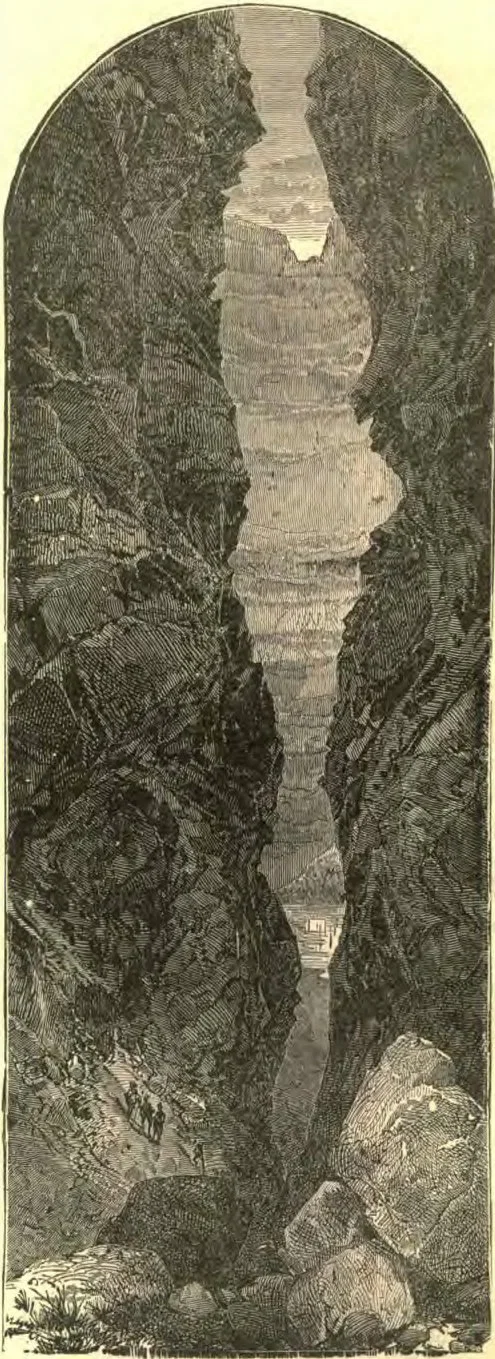
The accompanying cut represents a canyon in the Rocky Mountains. As can be readily seen, this is a deep ravine or gorge in the solid rock, the walls of which stand on either side several hundred feet high. In some localities the walls of these canyons rise to the height of two thousand feet. Among the most prominent canyons, we find the names of Boulder, Clear Creek, Cheyenne, and the Grand Canyon of the Arkansas.
To give a description of one will convey a general idea of them all. Through each of these mountain gorges dash streams of water white with foam, rushing impetuously on in their march toward the “great waters.” For beauty of scenery, Boulder Canyon compares favorably with any of those mentioned. Entering the canyon just above Boulder City, the road winds in and out among the rocks, at times on the verge of a precipice overhanging the stream, then crossing by bridges, and on and up the rocky opening. Here, the rocks tower aloft two thousand feet, shutting out the rays of the sun at midday; there, lies a stretch of road, one side decked with fragrant flowers, the other side washed by a crystal stream that foams and leaps from point to point in its hurry to reach the plain.
Ten miles up are the falls. Here the water drops some forty or fifty feet from the shelving rock into a deep, narrow pool, presenting a charming sight. To use the language of a famous writer: “We have read of Alpine scenery, and of the Yosemite Valley, and have seen Niagara Falls, Delaware Water Gap, and the passage of the Potomac through the Blue Ridge, and we pronounce them all as tame and commonplace when compared with the scenery of this wonderful canyon.”
On account of its railroad privileges, a journey through Clear Creek Canyon is more novel and interesting than one through Boulder. Think of taking a railroad ride through a mountain gorge,—a highway of innumerable short curves,—where you are steadily climbing at the rate of one hundred and thirty feet to the mile, and where one moment an apparently solid wall runs to the clouds across the track, and the next you twist sharply around or under it, while the cars surge and creak with the strain.
In some places where the chasm is very narrow, the road-bed has been carved out of the solid rock; and as you pass under the overhanging rocks, with the dashing, foaming torrent by your side, the scene becomes terribly sublime. As you ascend the canyon, the frowning rocks reach higher, and at times the chasm grows narrower till the eye can scarcely reach the summit from the car window.
A twenty-mile ride up the windings of this rocky defile brings one to the mines and stamp mills of Black Hawk. One mile farther on is Central. The first sight of these mountain cities is not soon forgotten. In spite of the barrenness of the country about, one is attracted by the novelty of the scene. Streets and houses are wedged into narrow ravines and gulches, and crowded up the steep incline. Far up the giddy mountain-sides are built cottages which hang over, and seem ready to topple on each other. These are the miners’ homes. Down in the depths, hundreds of feet from the light of day, these miners, by the dim light of a candle, delve for the gold buried beneath the mountains. Of the miners, and how they do their work, we will speak in a future article.
J. O. CORLISS.

VACATION DAYS.

Each year, early in the summer, While yet ’t is blue, blue June, Suddenly the wild birds waken, And with a longing tune Go song-singing of the children That are shut in from the sun; “They are coming,” the singers carol, “For the school-days are done!”
And they sing the song of cherries Along the garden wall; And they sing the song of berries That grow in thickets tall; And they sing the song of rambles, Long rambles in the sun: “They are coming,” the singers carol, “For the school-days are done!”
And they sing the song of hammocks Hung in the deep pine-trees, Where the children brown and brighten With swaying in the breeze,— Happy, happy little children Just let out in the sun! “They are coming,” the singers carol, “For the school-days are done!”
Give the world up to the children, Yes, near and far and wide! Let the willing welcomes waken Up all the country side! Meet them, bird, and bee, and blossom, And meet them, breeze and sun,— Carol! carol! Oh, carol! carol! That the school-days are done!
ELLA FARMAN, in Wide Awake.

A VISIT TO THE CAPITAL.

We had occasion, recently, to visit Lansing, the capital of the State of Michigan. Although business called us there, yet we found some time to visit the many places of interest.
Taking a private conveyance, in company with friends, we rode about four miles to the State Agricultural School. This school farm contains nearly three hundred acres. As we pass through the different buildings,—greenhouse, recitation-rooms, museum, and laboratory,—we are pleased to note the facilities for acquiring knowledge in the shortest time possible. As we walk or drive around the well-arranged and well-kept grounds, we notice the quiet and the sweet calm that pervade the whole place, and make a mental resolve that if ever a leisure time presents itself, we will seek some such quiet place for study.
The new Capitol next claims our attention. This magnificent edifice is said to be without an equal in the United States. Be this as it may, it seems to be the perfection of architecture. It is built in the Palladian style, and is 336 feet long and 180 feet deep, the height from basement to dome being 256 feet. As our time is limited, we will visit only the most important of its 216 rooms. Passing down the long hall, we enter the museum. Here we find so much of interest that it is impossible to see everything in so short a time. What most interest us are the mementos of our late war. As we look at the flags which were carried by the different Michigan regiments, and which still bear the marks of bullet and shell, we feel sad indeed, for they remind us of the blood that has been shed, and the thousands of lives laid upon the altar of freedom,—and this freedom we enjoy to-day.
We pass from floor to floor, through representative and senate chambers, through the governor's suite of rooms, and to the door of the supreme court room; but here we pause, only taking a “peep,” for that august body is in session.
Now we are at the door of the library. Here is something to feast the eye as well as the mind. Tier on tier of books, story above story, and as the ascent is by stairs at the side, while the center is open, we can look up, up, till we have counted four stories. One of the ladies in attendance tells us that there are 40,000 volumes in this library. Who of our little readers can tell us how long it would take a person to read this library, if he read one volume each week?
Up we go, climbing higher and higher, till, looking out, we see the city spread out before us like a map. We look till we are dizzy, and glad to descend. Ah! we have been so engaged that we have not noticed the black clouds rising in the west and overspreading the sky. Hurriedly we pass along the street, and gain the shelter of our temporary home.
The last day of our stay in the city found us on our way to the Reform School. We were much surprised to find the high board fence, which had always surrounded the yard, torn down. On inquiring of T. R. Waters, who kindly showed us over the building, we learned that the new superintendent had caused the fence to be taken away, also the iron doors to the boys' sleeping-rooms, where they had always been locked in. The boys, finding that they are trusted—put upon their honor—do not try to escape as they did under the old, rigid laws.
Leaving the reception-room, we first go to the chapel, and from there to the school-room. Here are about fifty boys studying, or were till we went in; now the bright eyes will not look on the books, but are turned shyly up at us as we pass along. We next go to the sewing-room. Here are some fifty or sixty boys sewing. Some sit tailor fashion on tables, sewing with a needle, others are sewing on machines, while others stand around a table, and, under the supervision of the person in charge, cut and prepare work. These boys seemed to take great pride in showing us how well they did their work. One little fellow only ten years old was making button-holes. We looked at his work, and as it merited praise, we gave it, which seemed to please him very much.
Up another flight of stairs, and we enter the chair factory. Here we find about a hundred boys at work; their nimble fingers weave the cane in and out, fashioning a seat or a back to a chair. As we are permitted to speak with them, we pass around among them, now talking to this one, now to that one. We find them very bright and intelligent, answering all our questions politely. All seem happy and contented.
Through room after room we pass,—shoe-shop, laundry, kitchen, and dining-room,—all scrupulously clean, the boys performing the work. We stop to examine the dormitories. Each boy makes his own bed, and keeps his room in order. It is interesting to see the taste the boys exhibit in making their rooms pleasant and attractive. Some rooms are hung with pictures, hanging-baskets of the boys' own manufacture, etc., etc.
Crossing the yard, two deer start up, but, stretching out our hands to them to make friends, they lose their shyness, and do not seem afraid.
Now we are in the picture-room. This, perhaps, is the most attractive room in the building, for pictures adorn the walls, while on every hand flowers nod to you a smiling welcome. Crossing the hall, we enter the reading-room. Here we find a good-sized library and the leading magazines and papers. We are told that the boys are very fond of reading, and spend much of their leisure time in this room.
There are 321 boys here at the present time. Each boy studies half a day, and works half a day. Saturday afternoon is a half-holiday. The most efficient punishment has been found to be a deprivation of this play-spell.
We have now come to the reception-room, the place from which we started. After registering our names and thanking our guide, we turn our faces homeward. The cars come shrieking and puffing into the depot. We take a seat in one of the coaches, and are rapidly whirled homeward. “Battle Creek!” ring out the clear tones of the brakeman. How pleasant the familiar name sounds, for we are at home. We alight from the cars, tired, but with a satisfied feeling, for have we not been to the Capital? V. A. M.

DUTY AND HAPPINESS.

We should never seek for happiness except in a lawful and noble way. It may be obtained by doing our duty. Duty comes first, then happiness; and this happiness is without any alloy; for when duty is well performed, the happiness that follows will be perfect. But if we seek for happiness first, and let duty come secondary, our happiness will all be mixed with sorrow, if indeed it comes at all.
Some people think that there is not much use in living unless they can have a good time. Some children are anxious to enjoy life, and they will leave their school, or the shop, or the farm, any time, to go on a hunt for pleasure; but such are never really happy. The happiest people in the world are those who are continually in some useful position. Even if they are on a pleasure excursion, they will plan how they may be useful in some way to others, and will contrive not to be burdensome to their parents or friends.
I think that those who will finally receive the crown of life will be such as have sought in their lives to do their duty, and in this were so occupied that they left happiness to come of itself.
Jos. CLARKE.

DENYING a fault doubles it.

LESSONS FOR CHILDREN.

LESSON LXXVIII.—ASA'S GOOD REIGN.

We have seen that all the kings of Israel, thus far, were bad men, who did not worship the Lord, and keep his commandments, but worshiped idols, and followed their own wicked desires. These kings kept on doing wickedly, and leading the people to follow their bad example, until the Lord sent the king of Assyria against them. This king not only conquered the Israelites, but carried them away captive into a country very far from their home, and made them dwell in the cities of the Medes. This was because they would not obey the voice of the Lord their God.
Most of the kings of Judah were also bad men, but some of them were very good. Asa was one of these good kings. He reigned in Jerusalem forty-one years. He trusted in the Lord, and kept his commandments, and taught the people to do so too. He destroyed the idols that were in the land, burnt the groves where these idols had been worshiped, and broke down the altars where the people had offered sacrifices to false gods.
At one time Zerah, the Ethiopian, came up with a thousand thousand men, and three hundred chariots, to fight against Judah and take Jerusalem. “Then Asa went out against him, and they set the battle in array in the valley of Zephathah at Mareshah. And Asa cried unto the Lord his God, and said, Lord, it is nothing with thee to help, whether with many, or with them that have no power: help us, O Lord our God; for we rest on thee, and in thy name we go against this multitude. O Lord, thou art our God; let not man prevail against thee. So the Lord smote the Ethiopians before Asa, and before Judah; and the Ethiopians fled.”
“And the Spirit of God came upon Azariah, the son of Oded; and he went out to meet Asa, and said unto him, Hear ye me, Asa, and all Judah and Benjamin; the Lord is with you while ye be with him; and if ye seek him, he will be found of you; but if ye forsake him, he will forsake you.”
But Asa did wrong in some things. He took gold and silver out of the temple, and gave it to the king of Syria to hire him to fight against the king of Israel. This displeased the Lord, and he sent the prophet Hanani to reprove the king, but Asa was angry at being reproved, and shut up the man of God in prison.

QUESTIONS.

1. What kind of men were all the kings of Israel?
2. What did they worship?
3. What did they follow?
4. What did they lead the people to do?
5. What finally became of this wicked nation?
6. Why was this done?
7. What kind of men were most of the kings of Judah?
8. Were any of them good?
9. Who was the first good king after David and Solomon? 2 Chron. 14:1, 2.
10. How did he honor the Lord?
11. What did he destroy?
12. What did he burn?
13. What did he break down?
14. Who at one time came up against Asa with a great army?
15. How great was Zerah’s army?
16. What did Asa do before they went into battle?
17. Repeat his prayer.
18. How did the Lord help him?
19. As he was returning from the battle, what message was sent him by the prophet Azariah? Chap. 15:1, 2.
20. Did Asa ever do wrong? Chap. 16.
21. Mention some wrong act. Verses 1–3.
22. How did the Lord show Asa that he was displeased with this? Verses 7–9.
23. How did Asa receive the reproof that the prophet gave him?
24. What did he do to the man of God?

LESSONS FOR YOUTH.

LESSON CIV.—PALESTINE UNDER THE PTOLEMYS.

After the death of Alexander, his generals contended with one another for the dominion of the world. The vast empire was finally divided among four of them,—Ptolemy, Lysimachus, Seleucus, and Cassander, thus fulfilling the prophecy of the four horns that were to come up in place of the great one that was broken. Palestine fell under the control of Ptolemy, who had his seat of government in Egypt, and was the first of eleven successive kings, called the Ptolemys. The Jews remained under these kings for nearly one hundred and twenty years, and until the fifth in order had ascended the throne.
“The Ptolemys, for the most part, were excellent rulers, and under them, Egypt enjoyed no small share of prosperity.” The first is commonly known in history as Ptolemy Soter, Soter meaning saviour. At first, he was somewhat severe with the Jews; but as soon as he learned their character, he treated them with marked kindness. He soon found that their intelligence and integrity fitted them for offices of trust, and finally came to value them so highly as citizens that he sent thirty thousand of them to different parts of his empire. By this wide dispersion of the Jews, many nations received a knowledge of the true God, and were thus prepared to believe in Christ, when he should come.
After a reign of thirty-eight years, Ptolemy Soter was succeeded by Ptolemy Philadelphus, who reigned thirty-nine years. Philadelphus means “lover of his brother;” and in many respects this sovereign seems to have deserved the title. He built, near the mouth of the Nile, the famous light-house of Pharos, one of the wonders of the world. He founded at Alexandria a library of seven hundred thousand volumes, a collection of the works of the writers of all nations. “It was under his patronage that the Hebrew Scriptures were translated into Greek, according to the famous version of the Septuagint. This was one of the most important missionary works ever performed by man. The Hebrew Scriptures, and especially the Hebrew predictions of the coming Redeemer, might now be read wherever the Greek language was known.” Throughout his entire reign he was friendly to the Jews.
The name of one of Alexander’s generals was Antiochus. Seleucus, the son of Antiochus, after various changes of fortune finally gained control of the greater part of Asia. Following the example of Alexander and others, he founded two new cities, Seleucia and Antioch, one to be the eastern and the other to be the western capital of his kingdom. “Seleucia was situated on the banks of the river Euphrates, forty miles distant from Babylon, which had now become a sort of inclosed park for wild beasts. Antioch was in Syria, on the banks of the Orontes, and was afterward famous as a center and stronghold of Christianity. Like Alexander and Ptolemy, Seleucus encouraged the Jews to take up their residence in his new cities; and many accepted his invitation.”
The kingdom founded by Seleucus was called Syria, or Syro-Macedonia. It continued two hundred and forty-seven years, from B. C. 312 to B. C. 65, and was ruled by twenty-two successive kings, called the Seleucidæ, several bearing the name of Seleucus, and thirteen that of Antiochus.
For many years there was fierce contention between Syria and Egypt. At last, about two hundred and seventeen years B. C., a decisive battle was fought near Gaza. Victory turned in favor of Ptolemy Philopater, king of Egypt, and Antiochus the Great was thoroughly conquered. Soon after the battle, Ptolemy visited Jerusalem, and insisted on entering the holy of holies in the temple, in spite of all opposition from the priests. It is said, however, that “when he had got so far as the holy place, he was seized with such confusion and terror that he retreated in dismay.” Ptolemy was so enraged at being opposed by the priests that he afterward treated the Jews with great cruelty. At one time he gathered all the Jews that he could find in Egypt, and shutting them up in the hippodrome, let elephants loose upon them; but instead of destroying the Jews, the elephants turned upon those who came to see the show, and killed great numbers of them.

QUESTIONS.

1. What contention arose on the death of Alexander?
2. How was the empire of the world finally divided?
3. What prophecy was thus fulfilled?
4. Where is this prophecy found?
5. Repeat it.
6. Under whose control did Palestine fall?
7. Where was his seat of empire?
8. How many kings succeeded him in the government of Egypt?
9. How long did the Jews remain under these kings?
10. What was the general character of the Ptolemys?
11. By what title was the first of them distinguished in history?
12. How did he at first treat the Jews?
13. What change took place in his conduct as soon as he became acquainted with their character?
14. What did he soon learn?
15. How did he show his high estimate of them as citizens?
16. How were the nations of the earth benefited by this wide dispersion of the Jews?
17. How long did Ptolemy Soter reign?
18. Who was his successor? and how long did he reign?
19. What did Ptolemy Philadelphus erect near the mouth of the river Nile?
20. Describe the library which he founded at Alexandria.
21. What great missionary work was accomplished under his patronage?
22. What is this translation called?
23. How did Ptolemy Philadelphus treat the Jews throughout his entire reign?
24. Who was Seleucus?
25. How wide a dominion did he finally acquire?
26. What cities did he build, and for what purpose?
27. Where was each situated?
28. For what was Antioch afterward famous?
29. What did Seleucus encourage the Jews to do?
30. What name was given to the kingdom that Seleucus founded?
31. When did this kingdom commence? and how long did it continue?
32. How many successive kings ruled over it?
33. What were they called?
34. What relation existed between Egypt and Syria for many years?
35. What decisive battle was at last fought?
36. With what result?
37. What did Ptolemy Philopater undertake to do at Jerusalem?
38. What made him angry with the Jews?
39. How did he afterward treat them?
40. Describe his attempt to destroy the Jews in Egypt.

Sabbath School Quarterly Report Blanks and Deadlines

It is hoped that the State Secretaries will be early in sending blanks to the Sabbath-schools in their respective States, that the blanks may be promptly filled out and returned as soon as the quarter closes. We are very anxious to get reports from all the States by the last of July. If all the schools will be prompt in reporting, this can easily be accomplished.
Let those State Secretaries who wish blanks, order at once through the Gen. S. S. Asso. You need not send pay for them, as, by order of the President, they will hereafter be furnished by the Gen. Asso. to all the States free of charge. All should have the new blanks. EVA BELL.

SOAP-BUBBLES

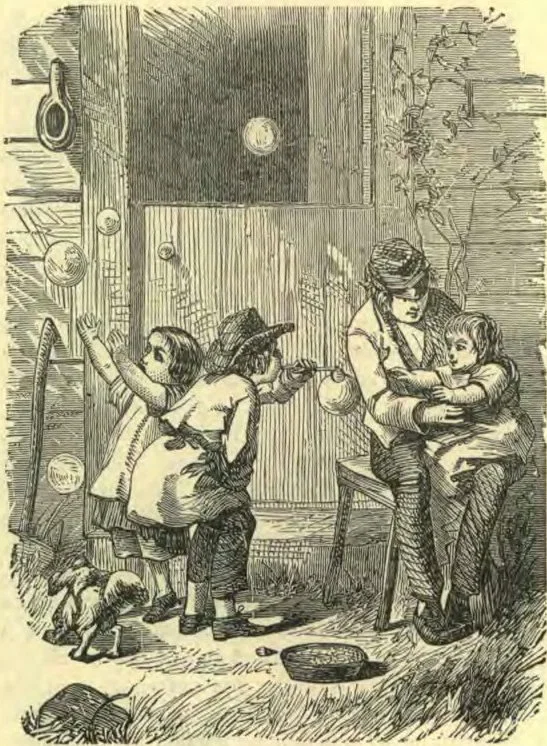
SOAP-BUBBLES are next to nothing in substance, yet how they glisten in the sunlight! How easily they are made! How desirable they seem to the children, but how quickly they vanish out of sight! The moment of seizure is always the end of the bubble.
I well remember one rainy afternoon, when, after two days in the house, my little ones were tired, restless, and uneasy, they came to me with the same old question, “Mamma, what can we do?” “What should they do?” I asked myself, really at a loss for anything to suggest.
The long storm had sorely taxed my ingenuity in trying to keep them busy and happy. Now it seemed that I could think of nothing more.
Suddenly, a sunbeam glanced through the window, and lay in my lap. It had stopped raining. A thought came to me. I remembered that there was a clay pipe in the back-part of the wash-stand drawer; so I said,
“How would you like to go out by the door and blow soap-bubbles?”
“That’s just the thing,” cried Willie in delight, while Lilly danced with joy.
Willie helped me prepare the water, trying it over and over in order to be sure there was just the right amount of soap.
At last it was ready, and a fine time they had. They would call out, “Look, look, mamma!” “Oh, just look, mamma!” until I had to spend most of my time looking in order to satisfy them.
Soon Ned came home from school. He took baby and went out to see the bubble-makers. What a good time they had! Baby clapped his hands and laughed gleefully . Frisk barked to let them know that he was enjoying it too, and every one was happy.
I was watching them with much pleasure, when something happened which made me feel very sorry. Willie had blown an unusually large bubble, and was just starting to blow it off, when Lilly accidentally hit it, and it burst.
This was too much for tired, excited little Will, and in a fit of passion, he struck Lilly, breaking the pipe in two.
The afternoon’s good time was over. I told Willie to come in and sit down till I could talk with him.
In a short time, I took him into my room, and, taking him on my lap, I said, “O Willie! how could you make your mamma feel so bad, when she tries so hard to make you happy?”
“I didn’t mean to, mamma; I did it before I thought,” he sobbed. “Won’t you forgive me, mamma?”
“Yes, my darling,” I answered, “but you must try to be more thoughtful another time. Don’t you know that it grieves the Father in Heaven, too, to see a little boy get angry and strike?”
“Yes, mamma; and I’m so sorry! Mayn’t I ask him right off to forgive me?”
“Yes,” I said, and folding his hands, he knelt down, and said,
“Please, great Father in Heaven, forgive me for being so naughty, and help me to be a good boy all the time. I’m very sorry, dear Father. For Christ’s sake. Amen.”
I am sure the little prayer was heard and answered; for I can see that my little Willie is growing more patient every day.—M. C.

A HUMMING-BIRD’S NEST.

RECENTLY a humming-bird’s nest was found by some persons who had sufficient natural curiosity to overcome their compassion, and who captured the nest, two young birds, and the old one, took them home and had them stuffed. They are to be sent to a museum of natural curiosities in London. The nest is built on a little twig, and is scarcely the size of half an English walnut. Both nest and twig are covered with little patches of lichen, until it is almost impossible to tell one from the other, and the nest looks like a kind of natural excrescence on the twig. The nest is pliable, like a tiny cup of velvet, and the inside is lined with a white substance, as rich and soft as white silk. The little birds are about the size of humble bees, very pretty, and they sit on a little perch just outside the nest, with open bills, while the old bird hovers over them to feed them.

USEFUL EMPLOYMENT.

WORKING as an ordinary hand in a Philadelphia ship-yard was a man whose peculiarity was, that, while others of his class were indulging in jollification, he was incessantly engaged in studying upon mechanical combinations. One of his companions secured a poodle-dog, and spent six months in teaching the quadruped to execute a jig upon his hind-legs. Knowlton spent the same period in discovering some method by which he could saw ship timber in a beveled form. The first man taught his dog to dance; Knowlton, in the same time, discovered a mechanical combination that enabled him to do, in two hours, the work that would occupy a dozen men, by slow and laborious process, an entire day. The result was, Knowlton rose to be a successful inventor, made a fortune, and illustrates the folly of useless employment. Let us improve our time. What we will be, depends much upon what we now do; better spend the leisure hours in gaining knowledge that will not alone benefit ourselves, but be of benefit to our fellow-man, than to spend it in teaching either poodle-dogs or ourselves to dance.—Philadelphia Bulletin.

Kindness to the Aged and Lonely

A LITTLE thoughtful attention, how happy it makes the old. They have outlived most of the friends of their early youth. How lonely their hours! Often their partners in life have long filled silent graves; often they have followed their children to the tomb. They stand solitary, bending on their staff, waiting till the same call shall reach them. How often must they think of the absent lamented faces; of the love which cherished them, and the tears of sympathy which fell with theirs; now all gone. Should not the young cling around them, cheering their gloom with songs and happy smiles?

Does English Contain a Word With All Vowels?

Is there a word in the English which contains all the vowels? Unquestionably.

LETTER BUDGET.

New Haven, Minn.
Dear Editors: I am a little girl six years old. I keep the Sabbath with my parents. I have two little sisters, Nellie and Myrtle. We have meetings and Sabbath-school at our house. We have a good school. I learn lessons in “Bible Lessons for Little Ones.” I get the INSTRUCTOR every Sabbath and like it very much. After I have read them I give some of them to my little friends. This is my first letter to the INSTRUCTOR. I cannot write, so I get my mamma to write this for me. I am trying to be a good girl and be saved when Jesus comes.
OLLIE A. SAMSON.

You have reached the end of this edition.

The Youth’s Instructor · Jun 23, 1880