The Youth’s Instructor, Vol. 28, No. 6.

JONAH'S PREACHING

The Youth’s Instructor

Feb 4, 1880

S. D. A. Publishing Association · Battle Creek, Mich. · Feb 4, 1880

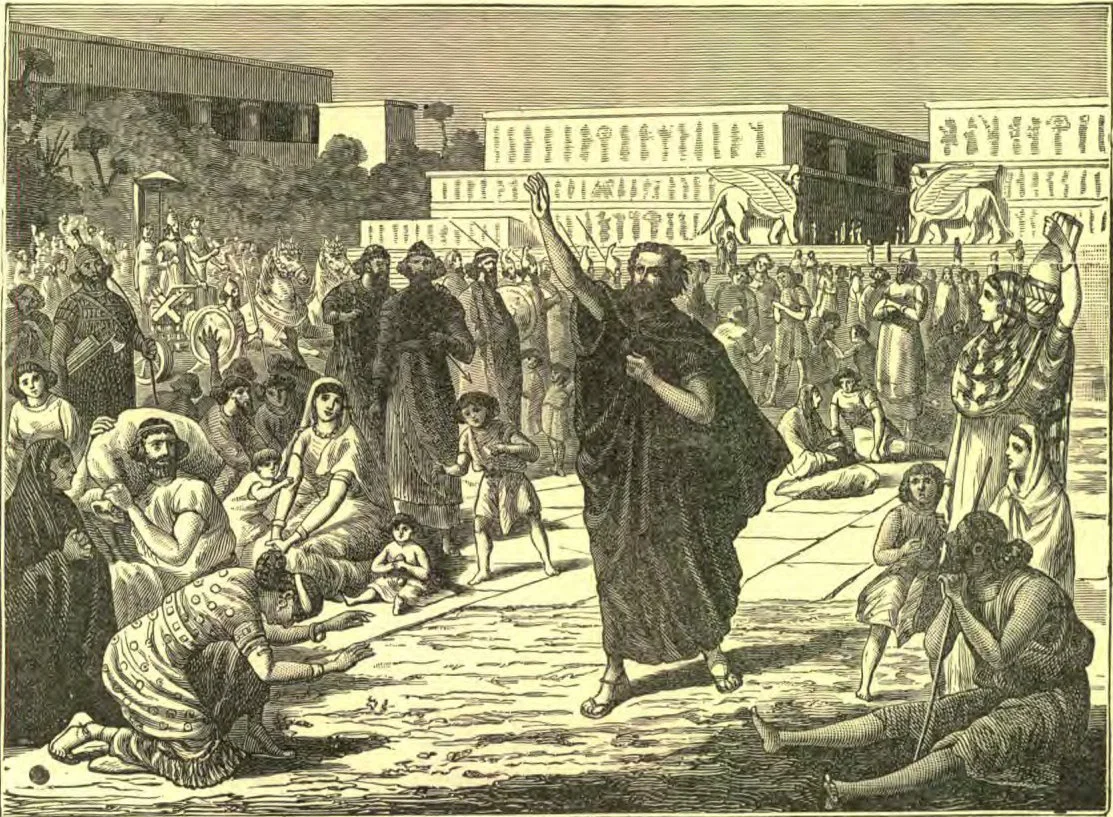
JONAH'S PREACHING.
HERE the waters of the Tigris, Through their sun-bright valleys flow, Sat proud Nineveh in glory, Near three thousand years ago. Power and strength had made her haughty, Wealth had filled her heart with pride; And from king to lowest people They had turned from truth aside. Rough, grim warriors, clothed in armor, Princes, people, old and young, E'en the groups of little children, Trooping forth with noisy tongue, Gave their hearts to filth and folly, Violence, and every wrong, Till the Lord declared, in anger, He their days would not prolong.
Suddenly within the city A bold stranger form appeared, With such words of woe and warning That the stoutest quaked and feared. On from street to street he hastened, Uttering with undaunted tone,—Within forty days, O people, Nineveh shall be o'erthrown. Multitudes around him gathered, “Who is this?” each whispered low. But his words went ringing forward—God will Nineveh o'erthrow—Till they spread through all the city, Reached the king upon his throne—Within forty days, O monarch, Nineveh shall be o'erthrown.
All dismayed the people heard him; And from off his throne of power E'en the king arose with trembling At the warning of that hour, Changed his robes for mournful sackcloth, And in haste sent forth command That a fast, by least and greatest, Should be kept through all the land; That their cries should rise to Heaven; From their evils each should turn; If perchance the Lord's fierce anger Might no longer 'gainst them burn. Then their joy was turned to mourning, Naught to man or beast was given, And the city sat in sack-cloth While their prayers arose to Heaven.
God, well-pleased, beheld their fasting, Their contrition deep and true, And he turned him from the evil He had purposed then to do; Spared the city and the people, Flocks and herds and children fair; For he is a God of mercy, And he hears and answers prayer.
Grand the lesson that is taught us By the history of that hour—If we sin, the Lord condemns us To the vengeance of his power; But if we receive his warnings Seeking to repent and live, He will meet us with his mercy, He will all our sins forgive. U. S.

SCRAPS FROM HISTORY.

THE DESTRUCTION OF OLD JERUSALEM BY THE ROMANS, AND THE DISPERSION OF THE JEWS.

After the death of Alexander the Great, Jerusalem was ruled by the Ptolemies of Egypt. The city was prosperous under their reign until Antiochus Epiphanes gained possession of it, and became so tyrannical that the people rose under the Macabees and regained their independence, remaining thus until the land of Judea became a Roman province.
During this time, the Greek language became common in Judea, and the first five books of the Bible, written by Moses and often called the Pentateuch, were translated into that language under the direction of Ptolemy Philadelphus.
The Jews were severely oppressed by the Romans, yet they exerted quite an influence in the empire, as brokers, exchangers, and merchants.
At the birth of Christ, Herod the Great was king of the land of Judea. In the early part of his reign, the city of Jerusalem was greatly improved, and the temple was richly embellished, much more so than at any time since the destruction of Solomon’s temple.
At the birth of the Saviour, it was announced that a king was born in Israel. When Herod heard this report, he feared that if it were true he would in due time lose his kingdom and throne; and, through jealousy of the infant king, he sent forth a decree that all male children, two years old and under in the land of Judea, the birthplace of the Saviour, should be put to death. When this cruel decree was executed, God preserved our Saviour by warning his parents to flee into Egypt. This cruel Herod died in the second year of the Christian era.
The Jews never became submissive subjects to those nations which ruled over them, and because of this were often severely punished. Although on account of their wealth they gained some influence in the empire, on the whole they were odious to the Romans, and were despised by them.
The last national punishment which the Jews received was at the hands of the Romans when Jerusalem was destroyed, A. D. 70. At this time Nero was emperor of Rome. He sent against Jerusalem the Roman army under Vespasian, who commanded during the first of the siege; but who finally retired to Rome, leaving his son Titus to terminate the war. No pen can describe the destruction, destitution, want, and suffering which the Jews endured during this war. According to Josephus, 1,100,000 persons perished during the siege, and about 100,000 were taken prisoners, while the city and the venerable temple sunk to ruins and ashes.
The remnant of the Jewish nation, as foretold by the sure word of prophecy, was dispersed into every civilized nation on the globe; but notwithstanding this, they have preserved their national characteristics to a very remarkable degree.
S. H. LANE.

MAKING PROMISES.

Children, if you make a promise, keep it. Nothing shows a person’s real character more than little things; and even if the breaking of your word would not lead to serious results to others, it will lead to a habit of neglect and carelessness to yourself.

BE TRUE.

The S. S. Advocate gives the following good advice on the subject of truthfulness, which we hope will be carefully heeded:—
There are persons whom you can always believe, because you know they have the habit of telling the truth. They do not “color” a story, or enlarge a bit of news in order to make it sound fine or remarkable.
There are others whom you hardly know whether to believe or not, because they “stretch” things so. A trifling incident grows in size, but not in quality, by passing through their mouths. They take a small fact or slender bit of news, and pad it with added words, and paint it with high-colored adjectives, until it is largely unreal and gives a false impression. One does not like to listen to people when so much must be “allowed for shrinkage.”
Cultivate the habit of telling the truth in little things as well as in great ones. Pick your words wisely, and use only such as mean just what you wish to say. Never “stretch” a story or a fact to make it seem bigger or funnier. Be truthful and people will learn to trust you and respect you. This will be better than having a name for telling wonderful stories or making foolishly or falsely “funny” remarks. There are enough true funny things happening in the world, and they are most entertaining when told just exactly as they came to pass. One has well said, “Never deceive for the sake of a foolish jest, or to excite the laughter of a few companions at the expense of a friend.”
Dear young friends, be true. Do the truth. Tell the truth. There are many false tongues. Let yours speak the things that are pure, lovely, and true.

A ROPEWALK.

ALL who read this may not know what a “ropewalk” is. It is the name of a long, narrow building in which rope is manufactured, and which is so-called because in spinning the small threads of the rope the spinner walks back and forth from end to end.
Until 1820 all the cordage made in the United States was the product of hand labor alone, but now it is made almost entirely by machinery in a few large establishments in our principal cities. While in Boston last summer, we had occasion to visit the ropewalk of the Charleston Navy Yard, and became much interested in the various processes which had to be gone through before rope could be produced.
The materials most commonly used in making rope are hemp and flax. These must first be hackled in order to draw out the fibers in straight lines and remove the short lengths and dust. The old-fashioned hackle is a sort of a comb made of long, sharp, steel points set upright upon a firm bench. A bundle of hemp or of flax held near one end is thrown over the points and drawn through, and the operation is repeated, reversing the ends. If you will ask your mother or grandmother about this, they will probably tell you more, for this is the way they used to prepare the flax from which they spun and wove all their linen. This work is now performed by a machine which can do more in five or ten minutes than a person by the old process could do in all day.
There are several processes by which rope may be made, but the one which particularly interested us was the hand process. In this the spinner wraps a bundle of hemp around his waist, having the middle portion of the fibers in front and the ends behind. He then draws from it in front a portion sufficient for making a small thread, and attaching the end to a whirl kept revolving in one end of the room, walks backward. As he proceeds, the fibers are continually drawn out from the bundle, the quantity being regulated by the action of his hands, one of them pulling the fibers forward or holding them back, and the other compressing the yarn as it passes through a thick woolen cloth held around it. Several of these threads put together form a strand, and three or four of these twisted together make a rope, while several ropes make a cable.
As we stood watching this process, we could but think what a good illustration of the way in which habits are formed. It is only one small thread at a time,—only one wrong act or one good deed. But, as many of these small threads twisted together form a cable strong enough to support hundreds of pounds, so by the repetition of wrong acts habits are formed which it will require the greatest effort to break.
Youth is the time when habits are most easily formed. How careful then ought all to be to form good and correct habits in early life. Now while it is comparatively easy, young friends, form habits of sobriety, prudence, and perseverance; learn to carefully respect the rights of others, and to sacredly regard the truth. Remember that you are continually spinning threads of habit which will one day bind you in hopeless misery, or lead to joy unspeakable.
M. K. W.

DISAGREEABLE HABITS.

NEARLY all the disagreeable habits that people take up, come at first from mere accident or want of thought. They might easily be dropped, but they are persisted in until they become second nature. Stop and think before you allow yourself to form them. There are disagreeable habits of body, like scowling, winking, twisting the mouth, biting the nails, continually picking at something, drumming with the fingers, screwing and twisting a chair, or whatever you can lay your hands on. Don’t do any of these things. Learn to sit quietly. There are much worse habits than these, to be sure; but we are speaking of very little things that are only annoying when they are persisted in. There are habits of speech, also, such as always beginning with “You see,” or “You know,” “Now-a,” “I don’t care,” “I tell you what,” “Tell you now.” Indistinct utterance, sharp nasal tones, a slow drawl, avoid them all. Stop and think what you wish to say, and then let every word drop from your lips just as smooth and perfect as a new silver coin. Have a care about your ways of sitting, and standing, and walking. Before you know it, you will find your habits hardened into a coat of mail, that you cannot get rid of without a terrible effort.—Little Corporal.

Why Bad Habits Must Be Thrown Off Entirely

“HABIT” is hard to overcome. If you take off the first letter, it does not change “a bit.” If you take off another, you still have a “bit” left. If you take off still another, the whole of “it” remains. If you take off another, it is not “t” totally used up. All of which goes to show that if you wish to be rid of a “habit” you must throw it off altogether.

LESSONS FOR CHILDREN.

LESSON LVIII.—JEROBOAM LEADS THE PEOPLE TO WORSHIP IDOLS.

Jeroboam feared that if the people should go to Jerusalem to worship, they would finally leave him, and take the king of Judah to rule over them. So he made two calves of gold, and said unto the people, “It is too much for you to go up to Jerusalem: behold thy gods, O Israel, which brought thee up out of the land of Egypt. And he set the one in Bethel, and the other put he in Dan.”
Jeroboam then made priests of the lowest of the people, which were not of the sons of Levi. He also built altars, and on them the priests offered sacrifices unto the images which he had made. In this way he caused the people to turn away from the Lord, and worship idols.
As Jeroboam was standing by one of these altars to burn incense, there came a man of God out of Judah, and said, “O altar, altar, thus saith the Lord: Behold, a child shall be born unto the house of David, Josiah by name; and upon thee shall he offer the priests of the high places that burn incense upon thee, and men’s bones shall be burnt upon thee.” And he gave a sign, saying, “Behold, the altar shall be rent, and the ashes that are upon it shall be poured out.”
When Jeroboam heard this, he put forth his hand, saying, “Lay hold on him.” And the hand which he put forth dried up, so that he could not pull it in again. The altar also was rent, and the ashes poured out, as the man of God had said. Then Jeroboam begged the man of God to pray for him that his hand might be restored. When his request had been granted, and his hand had become as it was before, he said unto the man of God, “Come home with me, and refresh thyself, and I will give thee a reward.”
“And the man of God said unto the king, If thou wilt give me half thine house, I will not go in with thee, neither will I eat bread nor drink water in this place: for so was it charged me by the word of the Lord, saying, Eat no bread, nor drink water, nor turn again by the same way that thou camest. So he went another way, and returned not by the way that he came to Bethel.” But an old prophet that dwelt in Bethel, when he heard what had been done, went after the man of God, and brought him back to eat with him, saying that an angel had told him to do so. This was not true, and when the man of God had eaten and gone on his way, a lion met him and slew him. This was because he disobeyed the Lord.

QUESTIONS.

  1. What did Jeroboam do to prevent the people from going to Jerusalem to worship? I Kings 12:28, 29.
  2. Why was he not willing to have them worship at Jerusalem?
  3. Where did he set up these idols?
  4. How did he obtain priests to offer sacrifices?
  5. On what did they offer the sacrifices?
  6. What effect did Jeroboam’s course have upon the people?
  7. Who came to Jeroboam as he was burning incense upon one of these altars? I Kings 13:1.
  8. What did this man of God say should sometime be offered upon this altar?
  9. What did he say should yet be burned where Jeroboam was now burning incense?
  10. By whom was this prophecy to be fulfilled?
  11. What sign did he say should be given to show that these things would certainly come to pass?
  1. When Jeroboam heard these words, what did he do?
  2. How was he punished?
  3. What did he then ask the man of God to do?
  4. When his hand had been restored, what kindness did he want to show the man of God?
  5. Why could not the man of God do as Jeroboam requested?
  6. Who followed him after he had gone on his way home?
  7. How did this prophet get the man of God to go back, and eat with him?
  8. How was the man of God punished for his disobedience?

BIBLE LESSONS FOR YOUTH.

LESSON LXXXIV—AMAZIAH; UZZIAH; AND JOTHAM.
  1. How were the murderers of Joash punished? 2 Chron. 25:1–3.
  2. What expedition did Amaziah plan?
  3. What preparations did he make for it?
  4. Describe the expedition.
  5. Why did the prophet think that the men of Judah should be sent back? Verse 7.
  6. How did Amaziah cause the Lord to forsake him?
  7. What calamity did Amaziah bring upon himself, and upon his people? Verses 17–24.
  8. Describe the death of Amaziah.
  9. By whom was he succeeded? Chap. 26:1.
  10. What was the general character of his reign?
  11. Mention some of the chief acts by which he maintained the strength of the kingdom.
  12. How did he encourage husbandry?
  13. What effect did his unusual prosperity have upon his character? Verse 16.
  14. To what rashness was he led by his pride?
  15. How was he warned against such presumption? Verses 17, 18.
  16. What punishment was inflicted upon him?
  17. By whom was the government of the kingdom then administered?
  18. Who reigned in Israel during the last part of Amaziah’s reign, and the first part of Uzziah’s?
  19. Into what condition did the kingdom of Israel fall after the death of Jeroboam II.?
  20. Tell how the government was administered during the latter part of Uzziah’s reign.
  21. When did Jotham begin to reign? 2 Kings 15:32.
  22. How long did he reign?
  23. How long did his father reign?
  24. Describe his character, and the character of his father.
  25. By what good acts did he improve the condition of his kingdom? 2 Chron. 27.
  26. What did he compel the Ammonites to do?

SYNOPSIS

Joash was succeeded by his son Amaziah, who reigned twenty-nine years. After executing the men who slew his father, he planned an expedition against the Edomites. He hired a hundred thousand men from the kingdom of Israel, giving them a hundred talents of silver for their services; but, taking the counsel of the prophet of the Lord, he sent them all back, and going out alone, gained a decisive victory over the Edomites, killing ten thousand in the valley of salt, and throwing ten thousand more from the rocky heights of their own Mount Seir.
Among other things taken from the Edomites were the idol gods which they worshiped; and Amaziah was afterward so foolish as to bow down to them, and offer incense to gods that had not been able to protect their worshipers against his own hand. The Lord then gave him up to follow his own weak judgment, which soon led him to destruction; for he provoked a quarrel with Joash, king of Israel, and met with a terrible defeat, which resulted in the breaking down of four hundred cubits of the wall of Jerusalem, and in the loss of all the gold and silver found in the house of God, and all the treasures of the king’s house.
Amaziah met a violent death by the hand of assassins, and was succeeded by Uzziah his son, who began to reign at the age of sixteen. Uzziah’s long reign of fifty-two years was in the main successful. He defeated his enemies on every hand, fortified Jerusalem, built towers in the desert, had engines made for throwing arrows and stones, and thoroughly equipped his large and well disciplined army with all kinds of weapons and implements of war. He was a lover of husbandry. He dug many wells in the desert, had many cattle on the mountains and plains, and many vine-dressers in the mountains.
“But when he was strong, his heart was lifted up to his destruction; for he transgressed against the Lord his God, and went into the temple of the Lord to burn incense upon the altar of incense.” For this rash act, he was smitten with the leprosy, and was obliged to spend the remainder of his life in seclusion, the government of his kingdom being administered by Jotham his son.
Jeroboam II. reigned in Israel from about the middle of Amaziah’s reign to about the middle of the reign of Uzziah, when for several years they had no king, everything being in a state of confusion and anarchy. Then reigned Zachariah, who, at the end of six months, was slain by Shallum. This usurper reigned but one month, when he was killed by Menahem, who, after a reign of ten years, was succeeded by his son Pekahiah. At the expiration of two years, Pekahiah was succeeded by Pekah, who reigned twenty years.
In the second year of Pekah, Jotham, the son of Uzziah, began to reign in Judah, and reigned sixteen years. Jotham was a good king, and the Lord prospered him. He repaired and improved Jerusalem, built cities in the mountains, and castles and towers in the deserts. He compelled the Ammonites to pay him a yearly tribute of a hundred talents of silver, and ten thousand measures of wheat, and ten thousand of barley.

HOW TO HELP THE LORD'S WORK.

EVERY child who wishes to be a Christian child, must do the works of Christian children. This is one: to give money for the Lord’s work. “How can I get money?” you ask. Save some that you spend for candy or toys. A little girl can ask her mamma to let her go without a new sash, or wear the old hat longer, and give the money they would cost to the church work. Children in cities can walk, and save street car fare to give. Those in the country can raise vegetables and sell them. Girls can make fancy or useful articles with their fingers and needles and sell them. Some children have missionary hens, and sell eggs and chickens. Then others have missionary apple-trees, pear-trees, berry-bushes, etc., from which they sell the fruit and raise money for the Lord’s work.
There are a great many ways in which children can raise money by labor or self-denial, that they can use for the Lord’s work, and so form good habits in that respect, and grow up to be liberal Christians, ready to help in every good work.—S. S. World.

STUDY

TEACHERS and scholars should study the lesson carefully and constantly. If the teachers will study, they will be so much more able to instruct the scholars, that very soon it will be found that the scholars are studying hard. But, boys and girls, we beg you to study for your own good. You have no idea, now, how much benefit these lessons will be to you, if you will only master them! It will be a joy and satisfaction and benefit to you, as long as you live. What a pity—might we not say shame—for boys and girls to go to Sabbath-school and not even look at the lesson during the week! That is certainly not right. Study, and study hard!

A LITTLE ERRAND FOR GOD.

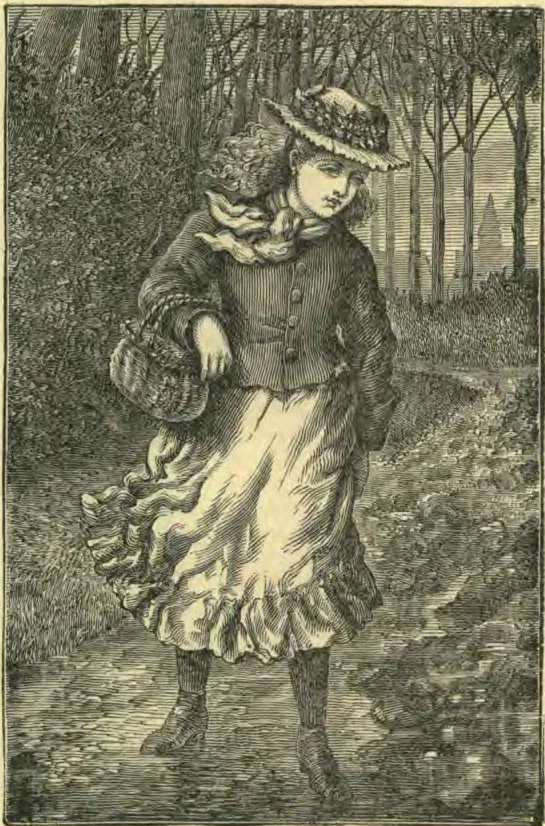
HELEN stood on the door-step with a small basket in her hand, when her father drove up and said: “I am glad you are all ready to go out, dear; I came to take you to Mrs. Lee’s park to see the new deer.”
“Oh, thank you, papa, but I can’t go just this time. The deer will keep, and we can go to-morrow. I have a particular errand to do now,” said the little girl.
“What is it, dear?” asked the father.
“Oh, it’s to carry this somewhere”; and she held up the basket.
Her father smiled and asked: “Who is the errand for, dear?”
“For my own self, papa; but—oh, no; I guess not—it’s a little errand for God, papa.”
“Well, I will not hinder you, my dear,” said the good father, tenderly. “Can I help you any?”
“No, sir. I was going to carry my orange that I saved from the dessert, to old Peter.”
“Is old Peter sick?”
“No, I hope not; but he never has anything nice; and he’s good and thankful! Big folks give him only cold meat and broken bread; and I thought an orange would look so beautiful and make him so happy! Don’t you think poor well folks ought to be comforted sometimes as well as the poor sick folks, papa?”
“Yes, my dear; and I think we often forget them until sickness or starvation comes. You are right; this is a little errand for God. As I want to speak with mamma a few minutes, I will wait till you have done the errand, and then take you to see the deer. Have you a pin, Helen?”
“Yes, papa; here is one.”
“Well, here is a five dollar bill for you to fix on the skin of the orange. This will pay old Peter’s rent for four weeks, and perhaps this will be a little errand for God, too,” said the gentleman.
Little Helen, who had taught a wise man a lesson, looked very happy as her fingers fixed the fresh bill on the orange.—Baptist Weekly.

LETTER BUDGET.

TEMPERANCE COLONY, CAL.
DEAR EDITORS: I am ten years of age. I take the monthly INSTRUCTOR, and get the weekly paper every Sabbath at Sabbath-school. I was baptized the first of September, by Eld. Haskell. I wrote a letter some time ago for the “Budget,” but did not see it published. I am trying to live so that I may be saved with the INSTRUCTOR family. Pray for me that I may be faithful. Yours truly, May A. Wauchape.
You are well supplied in having both the weekly and monthly INSTRUCTOR, May; but you can easily find some little friend who has no paper, who would be glad to read, and give her one of yours. We are pleased to learn that the INSTRUCTOR family are, one by one, following our Saviour down into the watery grave, and coming up, we hope, to walk in newness of life.
WASHINGTON, OREGON.
DEAR EDITORS: I thought that I would write a letter. I am ten years of age. I try to keep the Sabbath with my parents, three sisters, and two brothers. We have Sabbath-school at our house. I want to be a good boy, and be saved when Jesus comes. Yours truly, Thomas Fleck.
Thomas, do not simply “want” to be a good boy, but be one, and Jesus will save you when he comes.

LUCKY RIDAY.

There are many persons who think Friday is an unlucky day on which to begin any enterprise. Many sailors will not go to sea on that day, and many mechanics will not begin a new work on Friday. They think that because Christ was crucified on that day, ill fortune attends all works commenced on that day. Such a superstition is without any justification in fact, as the following statement will show: Christopher Columbus sailed on his great voyage of discovery on Friday. He discovered the continent of America on Friday. John Cabot received a commission from Henry III. which led to the discovery of North America, on Friday. The oldest town in the United States was founded on Friday. The May Flower made the harbor of Princetown on Friday. George Washington was born on Friday. Bunker Hill was seized and fortified on Friday. Saratoga was surrendered on Friday. The surrender of Cornwallis at Yorktown occurred on Friday. The motion that the United Colonies were, and of right ought to be, free and independent, was made on Friday.
Let us seek the blessing of God on our work, and one day will be as good as another on which to begin it.

FOOLSCAP PAPER.

I SUPPOSE all the children who read this have heard of foolscap paper, and perhaps they have wondered why it was so called. It happened in this way: Some two hundred years ago there was a civil war in England, in part growing out of disagreement among the people about the kind of religion they ought to have. The king, Charles the First, and his followers were on one side, and Oliver Cromwell at the head of the king’s opposers on the other side. Cromwell was successful, and the king was executed by his party. Then Cromwell became head of the government, and he had a Liberty cap made as a stamp for all the government paper. After his death, and when the royal family had regained the throne, it happened one day that King Charles the Second wanted to write a letter. They brought him some of the Cromwellian paper. He noticed the stamp and said, “What is that in the corner?” When he was told, he flew into a passion and said, “Take it away. None of your foolscap for me!” This little bit of history will make you understand why one class of paper which you use has so dull a name.

A Bible Definition.

A friend of ours, who was one day hearing his little eight-year-old Alice say her “definitions,” asked her the meaning of “Earthquake” and “Volcano.”
She hesitated a moment, but finally said, “I think that God tells us in the Bible what they are, father.”
“Does he? Why, where, Allie?”
“In the 104th Psalm, 32d verse.”
Now turn to that passage and see if this little student of the Bible didn’t make a good answer.

LITTLE DEEDS.

I shot an arrow in the air; It fell to earth, I know not where; For so swiftly it flew, the sight Could not follow it in its flight. I breathed a prayer into the air; It fell to earth, I know not where; For who has sight so keen and strong That it can follow the flight of song? Long, long afterward, in an oak, I found the arrow still unbroke; And the song, from beginning to end, I found again in the heart of a friend. —Longfellow.

You have reached the end of this edition.

The Youth’s Instructor · Feb 4, 1880