The Youth’s Instructor, Vol. 31, No. 23.

THE MAMMOTH CAVE

The Youth’s Instructor

Jun 6, 1883

S. D. A. Publishing Association · Battle Creek, Mich. · Jun 6, 1883

THE MAMMOTH CAVE.
The greatest cave known on the globe is the Mammoth Cave of Kentucky, situated in Edmonson County, near the Green River, ninety-four miles from Louisville, and nine miles from Cave City, which is the nearest railroad station to the celebrated cavern.
The cave has never been explored throughout its entire extent, and as yet but one entrance to it has been discovered. Visitors usually remain over night at the Mammoth Cave House, which is situated near the entrance, in order to get an early start, as it requires a whole day to “do” the cave, as they call it.
The cave was accidentally discovered some seventy years ago by a hunter, and ten years later was worked for the purpose of obtaining saltpetre; but the enterprise proving unprofitable, the cave was given over to curiosity-seekers. The present owners are fearful that a new entrance will be discovered outside the limits of their own real estate, and for this reason, all visitors are forbidden to carry compasses or make observations upon the directions of the great natural tunnel.
There are two routes, the long and the short; the former extends nine miles underground, and the latter three miles.
On entering, visitors are provided with a guide, who looks carefully after the lamps to see that they are properly trimmed and supplied with oil, as the chance of having one’s lamp go out in those desolate chambers, and being left in awful solitude and darkness, perhaps forever, is not a pleasant thought. At different parts of the cave, small tanks of oil are kept, from which the lamps may be replenished in case of accident, and these have proved in numerous instances to be of great service.
The path which forms the entrance is damp and slippery, and judging from the appearance of the opening, one hardly expects much from the interior. However, almost immediately on entering, his spirits begin to rise, on account of the abundance of oxygen in the air. Consumptives have gone there to live, in the hope that the invigorating air would restore them to health, but have been disappointed.
Hanging by their claws to the walls and ceiling of the cavern, are innumerable bats. During the winter they assemble there in such numbers that the curves of the cave are black with them.
Many avenues branch from the main tunnel, the most of which have been explored more or less. The “Methodist Church” is the first place of note. It consists of a semicircular chamber, in which a ledge of rocks represents the pulpit. Religious services have been held here; and the logs brought in for seats, though more than half a century ago, are still well preserved. Just beyond the church, apparently cut in the rocky ceiling, is a figure of gypsum called the “American Eagle,” though it bears little resemblance to the natural bird.
Near “Minerva’s Dome,” a place remarkable for the honeycombed appearance of its roof, is the “Fat Man’s Misery,” a passage between the walls of the cave so narrow that a person of ordinary size has to go sidewise in order to get through. Having forced a passage, however, our explorer enters the “Valley of Humility,” where, if he would make any progress, he is compelled to bend nearly double, the roof being so low; but he soon reaches the “Great Relief,” a broad passage a little further on, where he pauses to take breath and wipe the perspiration from his face.
There are numerous streams in the cave, the most noted of which, perhaps, is the Echo. This river is renowned for its echoes. It is much larger and more striking than the other streams, and when it is high, as it usually is in the spring, it is difficult to cross. A boat is provided for the purpose of crossing, and after rowing out into the stream a little way, the guide usually stops a short time so as to give visitors a chance to hear the echoes from their voices. Even the variation in the tone is accurately preserved in the echo, and one can scarcely believe that some one is not concealed, and repeating his words.
The “Styx” is another stream, which flows about a hundred feet below the floor of the cave. It is crossed by means of a rough wooden bridge. The murmur of the water can be heard below, but in order to see it, a lantern is let down over the side of the bridge by means of a long pole. The celebrated eyeless fish of the Mammoth Cave are found in the Echo River. These little creatures are about four inches long, and resemble ordinary minnows. Though entirely destitute of eyesight, it is very difficult to capture them.
Near the “Styx” is the Bottomless Pit, which is about one hundred and seventy-five feet deep. It receives its name on account of its gloom and dreariness. The Pit has frequently been descended, though the experiment is a dangerous one. Many other points of interest in connection with the long route might be mentioned did space permit.
On the short route the point most worthy of note is the “Star Chamber,” which is about seventy feet high, the roof being composed of gypsum crystals. On entering the chamber, the guide takes several of the lamps, and, descending into a hollow of the rocks, throws the light therefrom upon the ceiling. The effect is wonderful. The light striking upon the crystals of gypsum, makes them look precisely like stars, and creates so complete an illusion that one can hardly believe that he is not standing under the evening sky. The Mammoth Cave would be well worth visiting if its only wonder were the “Star Chamber.”
The dimensions of the cave vary greatly. At the “Fat Man’s Misery” it is about twelve inches wide, and in the Valley of Humility, just beyond, the roof is so low that one cannot get through without stooping; while in the “Grand Dome” it is over a hundred feet wide, and the ceiling is seventy feet high. The great cavern is noted for its wonderful variety, and one comes out of it feeling that he has seen one of the wonders of the world. EUGENE LELAND.

LEARNING TO FLY.

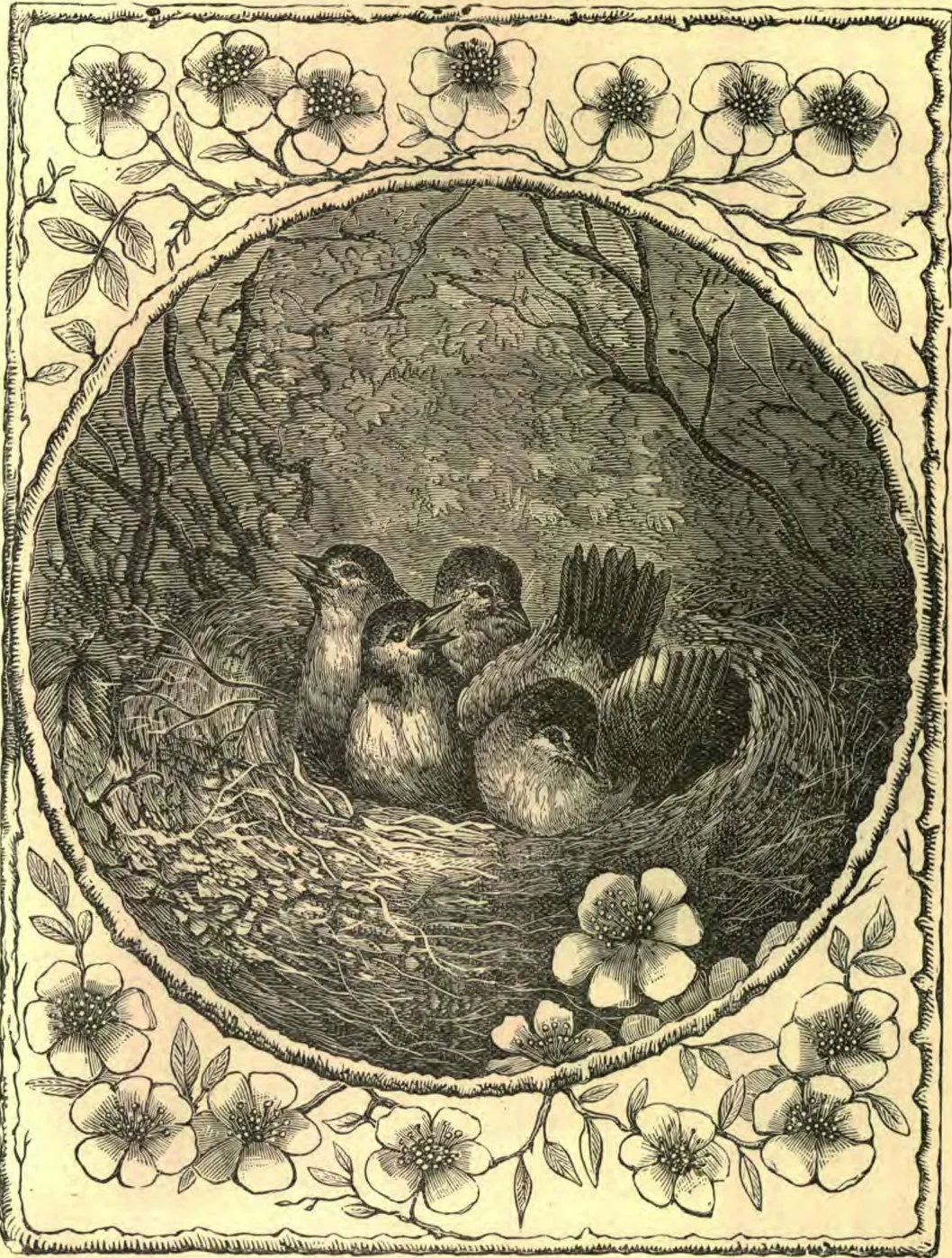
“Now, birdies, my darlings, I think it is best,” Said old mother bird, “that you all quit the nest; You've grown very plump, and the nest is so small That really there isn't quite room for you all.
“The day is so fair, and the sun is so bright, I think I can teach you to fly before night; And when you have learned, you can go where you please, As high as the gable,—yes! high as the trees.
“Come, Dickey, hop out, and stand up here by me; The rest of you stand on that branch of the tree; Don't be frightened, my dears; there's no danger at all, For mother will not let her dear birdies fall.
“Now all spread your wings. Ah! but that is too high; Just see how I do it. Now, all again try! Ah! that is much better. Now try it once more. Bravo! much better than ever before!
“Now flutter about, up and down, here and there; My dears, you'll be flying before you're aware. Now carefully drop from the tree to the ground; There's nothing to fear, for there's grass all around.
“All starting but Robbie. Afraid you shall fall? Ah! don't be a craven, be bravest of all. Now up and now down, now away to yon spire; Go on; don't be frightened; fly higher and higher.”
“I've waited one hour, right here on the tree; Not one of my robins has come back to me. How soon they forget all the trouble they bring! Never mind; I'll fly up on the tree-top and sing.”
—Church Register.

THE TWO MEN INSIDE.

An old Indian once asked a white man to give him some tobacco for his pipe. The man gave him a loose handful from his pocket.
The next day he came back and asked for the white man. “For,” said he, “I found a quarter of a dollar among the tobacco.” “Why don’t you keep it?” asked a bystander. “I’ve got a good man, and a bad man here,” said the Indian, pointing to his breast, “and the good man say, ‘It is not mine; give it back to the owner.’ The bad man say, ‘Never mind; you got it, and it is your own now.’ The good man say, ‘No, no; you must not keep it.’ So I don’t know what to do, and I think to go to sleep, but the good and bad men keep talking all night, and trouble me; and now I bring the money back I feel good.”
If we want blessing and peace in this world and the next, we must keep on good terms with the good man inside. If we refuse the counsel of conscience, and neglect the word of God, we shall walk in darkness, and go down to night at last. God has given us an inward monitor, and he gives us his word to instruct us, and his Spirit to lead us; and happy shall we be if we heed his voice, and are guided by his counsel.—Little Christian.

THE MARTYRDOM OF POLYCARP.

DURING the early days of the Christian religion, there was at times great persecution of those who loved the Lord Jesus and served him. It was during one of these persecutions that there occurred what is called the martyrdom of Polycarp.
Polycarp was the most distinguished Christian of the East. He had heard the apostle John, and had long presided as bishop over the See of Smyrna. Many Christians suffered at this city in the persecution under Marcus Aurelius, A. D. 167; and Polycarp, in obedience to the command, “When they persecute you in one city, flee ye to another,” went to a house a few miles from Smyrna, and there passed his time in praying for the church of the Lord Jesus. His place of concealment being betrayed by two slaves, whose confession had been extorted by torture, he calmly said, “The will of God be done!”
Three days before he was taken, he had a vision, in which it seemed to him that his bolster was on fire. Then he said to his friends, “I shall be burned alive.” The horsemen who came to take him arrived at his house late on Friday evening. He came down and spoke to them.
“What!” they cried, “where was the use of such haste and such a multitude to take one good old man?”
He ordered that supper should be made ready for them, and requested that he might have one hour for prayer. He spent two hours thus, and prayed by name for all whom he had known in his whole life. Then they set him on an ass—for he was too old to walk—and carried him to the city. He was met by Herod, the irenarch, and his father, Nicetus, who took the bishop into their own carriage, and tried to persuade him to submit to the two tests by which Christians were tried—the salutation of the emperor by the title of lord, and sacrifice. As he would not consent, their compassion gave way, and they hastily thrust him out of the chariot.
The next day he was brought before the proconsul. “Come,” said the magistrate, “have some pity on yourself and your great age. Only swear by the fortune of Cæsar; only say, ‘Away with the impious men’ [he meant the Christians], and you shall be safe.”
Polycarp looked sternly around the theater and cried, “Away with the impious men!” “Swear,” persisted the proconsul; “or at least speak evil of Christ.”
“Eighty and six years,” replied the bishop, “have I served him, and he hath ever been a good Master to me. How, then, can I blaspheme my King and my Saviour?”
The proconsul threatened to expose him to the wild beasts.
“It is well for me,” said the noble Christian, “to be speedily released from this life of misery.”
The proconsul threatened to burn him alive.
“I fear not the fire that burns for a moment,” was the calm reply; “thou knowest not that which burns forever and ever.”
His countenance was full of peace and joy, even when the herald advanced into the midst of the assemblage, and thrice proclaimed, “Polycarp hath professed himself a Christian.”
The Jews and heathens, who were full of rage against the Christians, demanded that a lion should be let loose upon Polycarp; and when it was said that this could not be because the games were over, a great cry arose that he should be burned alive. Then the multitude rushed—the Jews first—to the woodshops and the baths to find fagots; and they raised a pile in the midst of the theater.
When they were about to nail him to the stake, he said, “Leave me. He that gives me power to endure the flames will give me grace to abide them without your nails.”
They contented themselves with tying him.
Then he prayed a wonderful prayer, in which he said, “I render thanks to Thee that thou hast graciously thought me worthy of this day and of this hour, that I may receive a portion in the number of Thy martyrs, and drink of Christ’s cup, for the resurrection to eternal life both of body and soul!”
To those who looked on it seemed as if the fire was kindled in vain. It arose curving like an arch around the serene victim, or like a sail swelling with the wind, and left the body unharmed. To the eyes of the Christians his body shone in the midst like gold or silver in the furnace, and delicious odors, like myrrh or frankincense, breathed from his body.
The pagans, finding him unhurt, called for the executioner to come and dispatch the victim; and it is said that when he had struck Polycarp, the blood flowed out so freely that the flames were extinguished.
This noble bishop was at least a hundred years old at the time of his martyrdom; for he had been a bishop seventy years. He won hearts easily by his genuine spirit of Christian love and gentleness; and yet we have seen that he could be firm and unyielding when the test came.—Selected.

A Child’s Heart.

The other day a curious old woman, having a bundle in her hands, and walking with painful effort, sat down on a curb-stone to rest. A group of three little ones, the eldest about nine, stopped in front of the old woman, saying never a word, but watching her face. She smiled. Suddenly the smile faded, and the corner of the old calico apron went up to wipe away a tear. Then the eldest child asked, “Are you sorry because you haven’t any children?” “I—I had children once, but they are all dead,” whispered the woman, a sob in her throat. “I’m sorry,” said the little girl, as her chin quivered. “I’d give you one of my little brothers, but I haven’t got but two, and I don’t believe I’d like to spare one.” “God bless you, child—bless you forever,” sobbed the old woman, and for a minute her face was buried in her apron. “But I tell you what I’ll do,” seriously continued the child. “You may kiss us all once, and if little Ben isn’t afraid, you may kiss him four times, for he is just as sweet as candy.” Pedestrians who saw three well-dressed children put their arms around the strange old woman’s neck and kiss her, were greatly puzzled. They didn’t know the hearts of children, and they didn’t hear the woman’s words as she rose to go: “O children, I’m only a poor old woman, believing I had nothing to live for; but you’ve given me a lighter heart than I’ve had for ten long years.”
—Pansy.

NEW-TESTAMENT HISTORY.

LESSON 138.—THE CONVERSION OF SAUL.

After the death of Stephen, Saul continued his work of persecution with increasing bitterness. Having in some way learned that there were disciples in Damascus, he went to the high priest, and obtained letters authorizing him to seize and bring to Jerusalem any believers in Christ whom he might find dwelling in that distant city, whether men or women. Now it was not because Saul had such a cruel disposition, that he wished to imprison or put to death these peaceable disciples; but he was brought up a Pharisee of the strictest kind, and he held it to be a religious duty to put down what he believed to be a false faith, and one that was leading many into error and deception. He was, no doubt, proud and haughty, and in Acts 26:11 he says he had become “exceeding mad” at them; yet the violence of his persecution was probably due to the energy of his character rather than to a vindictive spirit.
Having obtained the necessary papers and a suitable escort, he took up his journey to Damascus; but on coming near that place, about noon, a great light, brighter even than the midday sun of that burning clime, shone about him, causing both him and his companions to fall to the ground. While thus prostrated, Saul saw the form of the Lord Jesus Christ, who said to him in piercing tones, “Saul, Saul, why persecutest thou me?” Then Saul said, “Who art thou, Lord?” and he said, “I am Jesus of Nazareth, whom thou persecutest.”
“But rise and stand upon thy feet; for I have appeared unto thee for this purpose, to make thee a minister and a witness both of these things which thou hast seen, and of those things in the which I will appear unto thee, delivering thee from the people, and from the Gentiles, unto whom now I send thee, to open their eyes, and to turn them from darkness to light, and from the power of Satan unto God, that they may receive forgiveness of sins, and inheritance among them that are sanctified by faith in me.”
The haughty spirit of Saul was now completely subdued, and he said in meekness, and with trembling, “Lord, what wilt thou have me to do?” Jesus answering, said, “Go into Damascus, and there it shall be told thee of all things which are appointed for thee to do.”
The men that were with Saul, saw the light, but did not see Jesus; and although they heard a voice, they could not understand what was said. When the vision and the light had passed away, Saul’s attendants could see, as before; but he was totally blind, and had to be led by the hand, as he went into the city. For three days he could see nothing. During this time he was left to meditate upon his past errors, to think of the mercy of God toward him, and to wonder what his future work would be. But he was not left alone in these hours of sorrow. The Lord gave him a vision, in which he was shown a man named Ananias, who was to come to him, and restore his sight.
At the same time, the Lord was preparing Ananias for the part which he was to act. Of this Ananias it is said, that he was “a devout man, according to the law, having a good report of all the Jews that dwelt there.” The Bible speaks of him merely as a disciple, and gives us no clue to his rank, or to his office, if he had any. To this man the Lord appeared in a vision, and told him to go into a street called Straight, where he was to inquire at the house of one Judas for a man called Saul, of Tarsus; “For,” said the Lord, “he hath seen in a vision a man named Ananias coming in, and putting his hand on him, that he might receive his sight.” Then said Ananias, “Lord, I have heard by many of this man, how much evil he hath done to the saints at Jerusalem; and here he hath authority from the chief priests to bind all that call on thy name.” Yet the Lord told Ananias to go; for, said he, speaking of Saul, “He is a chosen vessel unto me, to bear my name before the Gentiles, and kings, and the children of Israel; for I will show him how great things he must suffer for my name’s sake.”
Ananias, notwithstanding his fears, obeyed the vision; and when he had found Saul, and put his hands upon him, he said, “Brother Saul, the Lord, even Jesus, that appeared unto thee in the way as thou camest, hath sent me, that thou mightest receive thy sight, and be filled with the Holy Ghost.” As soon as these words were spoken, there fell from Saul’s eyes as it had been scales, and his sight was immediately restored.
Then said Ananias to Saul, “The God of our fathers hath chosen thee, that thou shouldst know his will, and see that Just One, and shouldst hear the voice of his mouth. For thou shalt be his witness unto all men of what thou hast seen and heard. And now why tarriest thou? arise, and be baptized, and wash away thy sins, calling on the name of the Lord.”
After this, Saul partook of food, and was strengthened. He remained some days with the disciples at Damascus, and began at once to preach to the Jews in their synagogues that Jesus of Nazareth was the Son of God.

QUESTIONS.

1. What course did Saul pursue after the death of Stephen? Acts 8:3; 9:1; Gal. 1:13; Acts 22:4; 26:10, 11.
2. To what distant city did he extend his persecutions? Acts 9:2.
3. How did he obtain authority for carrying out his purposes?
4. Was it a cruel disposition that led Saul to be so zealous in persecuting the people of God?
5. What was the probable cause?
6. What bad traits of character did he manifest?
7. What does he say about his own feelings?
8. To what must we attribute his wonderful activity in this bad cause?
9. How were Saul and his companions struck down, as they came near Damascus?
10. While thus prostrated, what did Saul see? Verses 17, 27.
11. How did the Lord address him?
12. What question did Saul ask?
13. What reply was given him? Acts 22:8.
14. What did Jesus command him to do? Acts 26:16.
15. For what purpose did he say he had appeared to Saul?
16. What protection did he promise him?
17. What work did he say he had for him to do?
18. What effect had this vision upon Saul?
19. What question did he immediately ask? Acts 9:6.
20. What instruction did Jesus give him? Acts 22:10.
21. Relate the experience of the men who were with Saul. Acts 9:7; 22:9.
22. What was Saul’s condition when the vision had passed away? Acts 9:8.
23. How long did he remain in this condition?
24. What probably occupied his thoughts during this time?
25. How was he comforted in these hours of sorrow? Verses 11, 12.
26. What does the Bible tell us about Ananias? Acts 22:12.
27. Of what does it leave us in ignorance with reference to him?
28. How did the Lord prepare him for the part he was to act in the conversion of Saul? Acts 9:10–16.
29. What was he in this vision told to do?
30. What objections did Ananias raise?
31. How did the Lord reply to these objections?
32. What did Ananias do?
33. When he had laid his hands on Saul, what did he say to him? Verse 17.
34. What change took place in Saul as soon as these words were spoken?
35. What did Ananias then say to him? Acts 22:14.
36. What did he say of Saul’s mission?
37. What question and admonition did he then utter?
38. What did Saul do after being baptized? Acts 9:19, 20.
39. What did he preach?

NOTES.

ACTS 9:2. Letters.—Travelers in the East generally carry with them letters or “passports” from some person or body in authority showing that they are honest persons, on honest business. They are thus protected from being arrested as suspicious characters. In addition to this, these letters sometimes give the bearer authority to perform certain duties. The letters carried by Paul probably served the double purpose of a passport on his journey, and authority for his arresting the Christians he might find at Damascus.
Damascus.—This city, one of the oldest in the world, is situated about one hundred and forty miles north-east of Jerusalem. According to the Eastern mode of travel, the journey from Jerusalem there would occupy about five days.
The first view of the city and surrounding country which is obtained on approaching it, is pronounced by travelers to be one of the finest in the world. The city is situated in the midst of an extensive plain. Through this plain flow two rivers, the Pharpar and the Abana. Here and there the white stone houses of quiet little villages glisten in the sun. On every hand is fresh green vegetation, everywhere interspersed with sparkling water, which is partly hidden from view by clusters of palm and cypress. Away to the north-west rises snow-crowned Hermon, and farther on, the long range of Anti-Lebanon. In the midst of all this scenery sits the city itself, surrounded by walls, and sending up scores of white stone minarets from its many mosques. One writer compares it to a “handful of pearls in a goblet of emerald.” It is also called the “Pearl of the East,” and the “Eye of the Desert.” The latter name is derived from the fact that the plain in which the city lies is surrounded by rocky, barren country, and also lies near the great desert east of Syria. The city now contains about 150,000 inhabitants, most of whom are Moslems. In Saul’s day there were about 50,000 Jews living in Damascus. It was on the main line of travel between Egypt and Babylon, Persia, and India. The religion of Jesus had probably been taught in Damascus by individual believers, driven away from Jerusalem at the time of the persecution, or Damascus Jews may have been among the converts on the day of Pentecost. This being so, by means of the large number of people from all nations who were continually passing through the city, the new religion would be rapidly spread from that place to all parts of the earth. Saul, no doubt, realized this, and hence set about putting a stop to it, by ridding the place of Christians.
A description of the city, accompanied by a picture of the “street which is called Straight,” appeared in the INSTRUCTOR for January 17, 1883. Those who have preserved the paper would do well to turn to it, as they will now read the piece with new interest in connection with the lesson.
Street called Straight.—This street was so named because it extended in a direct line through the city from the eastern to the western gate. In Saul’s day it was the main street of the city and was one hundred feet wide, and divided into three avenues by two rows of columns. But the houses have since been built so far out into the street that it is now nothing more than a narrow passage, resembling a by-lane.
Saul of Tarsus.—That is, who was born in Tarsus, though living now at Jerusalem. Tarsus was the capital of Cilicia, a province in the south-eastern corner of Asia Minor.
Was baptized.—This may have taken place in the house of Judas, where Saul was staying. Damascus is supplied with water from the Abana, which flows directly through the city, carrying water to the baths, fountains, and cisterns. All the better houses have a reservoir in their courts, or stand beside a natural or artificial stream.

Teaching Scholars How to Study the Bible

You will never live long enough, and if your life should be a thousand years, your scholars would not stay with you long enough, for you to teach them all they ought to know of the Bible. You will therefore do the most successful work if you will teach them how to study the Bible, and inspire them with a real love for its study. Any means you may employ to reach these ends will lie in the direction of the best service you can render them.—Bible Teacher.

He Went About Doing Good

No portrait of Christ by the artists gives so striking and true a picture of him as the words of Peter, “He went about doing good.”

HOW LUCIE HELPED.

Lucie was a little girl five years old. Her real name was Lucinda, but no one ever called her that. Her papa died when she was a baby, and ever since that time she had been living with her mamma on Grandpa Nichol's farm.
Grandpa's house stood on a hill, with tall trees growing all around it. Down in the hollow back of the house was a pond where grandma kept her ducks and lily-white geese. Lucie liked to watch them swimming gracefully around the pond, and she would often carry them bread crumbs in her apron. On one side of the house was a large orchard of old gnarled apple, peach, pear, and cherry trees. Here grandpa kept two little brindle calves. On the other side was an arbor, covered with a tangled mass of grape-vines. It was a pleasant home, and Lucie liked it well.
One morning she waked up very early; for she had been told that her cousins were coming from town that day, and she wanted to watch her grandma do the baking. On the kitchen table stood loaves of snowy white bread ready to be put in the huge brick oven, and grandma was busy cutting out wonderful little boys and girls and birds from cooky-dough. Lucie clapped her hands when she saw them, and said, “O grandma, are you making them for me?”
“Yes, dear,” grandma replied; “for you and your cousins Harry and Minnie.”
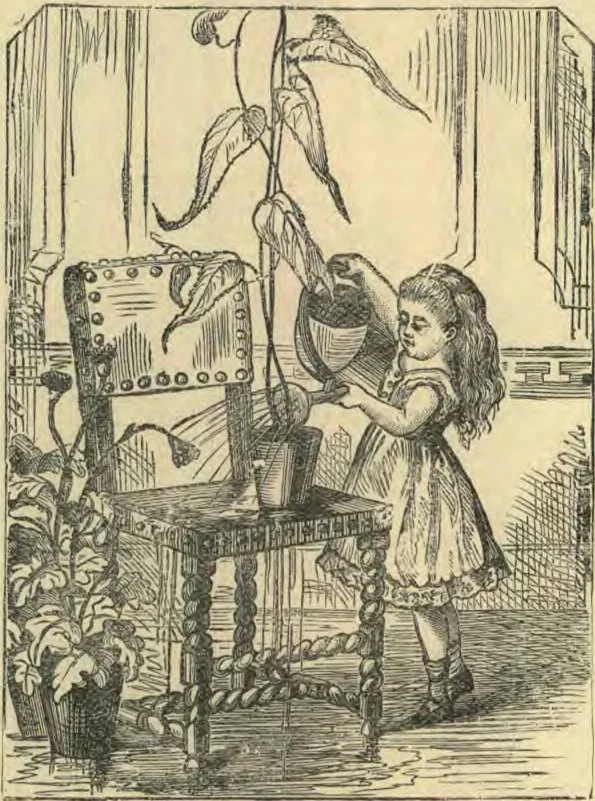
Lucy was eager to help in getting ready for the company, so her mamma told her she might take her little broom and sweep off the porches and steps. This took some time, for the porches were long and wide. Lucy was a kind, helpful little girl, and was willing to do everything she could, and some things that she couldn’t do. She thought she wouldn’t trouble her mamma to tell her any more things to do, so she looked around to find something. She swept the walk from the house to the gate as clean as a parlor floor. Then she saw the plants standing in the sitting-room window. “Mamma forgot to water ’em,” thought Lucie; “I guess I’ll do it for her.” So she ran to the woodshed, and filled the watering pot with water. It was almost more than she could do to get it to the sitting-room and lift it up off the floor to water the plants. She could not do it very well, and got more water and dirt on the floor than on the plants. There stood in the window a beautiful geranium with yellow and green leaves. Lucie thought because they were part yellow that they were dead, and picked them all off, as she had seen her mother do to the dead leaves on other plants.
Then she went to a plant that stood in a chair, and begun to water it, but it was up so high that the water all went on the chair and the pretty carpet.
Her mamma came in just then, and looked very sorry when she saw what Lucie had been doing. She did not scold her, for she knew that the willing little hands had tried to do the best they could. She kissed the flushed face, and told her next time to come and ask when she wanted to do anything; then she sent her out to give the chickens their breakfast.
Lucie ran gaily to the hen-park, happy in thinking that she had helped her mother. It seemed as if the sun shone a great deal brighter and the grass was greener then when she first got up. Perhaps some other little girls might feel happier and things might look prettier, if, instead of thinking of themselves and their play, they would try to help their mothers in every way they could; but they should remember always to ask when they want to do anything, lest, like Lucie, they hinder more than they help. W. E. L.

OUR BUG-CATCHERS.

We have a garden around our house, where we try to raise fruits and flowers and peas and beans and lettuce and cucumbers, and such like. But we have one trouble; there are lots of little bugs and worms that seem to like our provisions as well as we do, and that are always on hand to take their portion. And, in fact, they sometimes seem to want to take the whole.
Well, what is to be done in such a case? I will tell you what we do. We have several little bug-catchers, curious creatures,—in color and shape they look almost like a lump of earth, and one would hardly know them from the clods among which they travel about. The children see them about the fields or highways, and wherever they find one, they speedily pick him up, and invite him to make his home in our garden; and so they have their dwellings in holes and corners about the yard.
The little fellows have a queer way of catching bugs. They have a long, sticky tongue, though where they keep it is a mystery, as it seems to be longer than its owner. Perhaps they take a reef in it, as the sailors say, and so stow it away. But when one of them gets near a little bug, he sits and looks at him, and winks in a kind of solemn way, till all at once his mouth opens, and quick as a flash, the tongue goes out and in again, and the bug is among the missing! And then our little friend sits winking and blinking, and waiting for another bug to come that way.
He is said to have an ear for music, and to do some singing in the warm spring evenings, but we do not count much on this; nor do we brag much about his good looks. His skin is not smooth, nor his complexion fair; but, for real usefulness, he is about the best kind of live stock we have on our farm; and if people want to keep their gardens free from bugs, the best thing they can do is to get on good terms with the little bug-catchers, and make pleasant homes for the TOADS! As a certain poet said:—
“Don't kill the toads, the ugly toads, That hop around your door. Each meal, the little toad doth eat A hundred bugs or more, He sits around with aspect meek, Until the bug hath neared; Then shoots he forth his little tongue, Like lightning double-geared. And then he soberly doth wink, And shut his ugly mug. And patiently doth wait until There comes another bug!”
—Little Christian.

God's Mercy Toward Those Who Fear Him

‘The ocean is not more full of water than God is of mercy toward those who fear him and keep his commandments.

SABBATH-SCHOOL MAPS.

Twelve-sheet Map, illustrating the travels of St. Paul, 81x170 inches. $18.50
Eight-sheet Map of Palestine, 81x116 inches, 12.50
Eight-sheet Map, illustrating the Travels of St. Paul, 81x116 inches, 12.50
Peninsula of Mt. Sinai, 52x72 inches; 5.00
Old-Testament Map of Palestine, 41x58 inches, 3.00
Old-Testament Map of Palestine, 28x41 inches, 1.50
New-Testament Map of Palestine, 41x58 inches, 3.00
New-Testament Map of Palestine, 28x41 inches, 1.50
Map illustrating the Travels of St. Paul, 1.50
(The above are on cloth without rollers.)
Map illustrating the Travels of St. Paul, (boards) 13½x18½ inches. .50
Travels of St. Paul, (card) 5¼x3½ inches, .04
Same on paper, .03
A Bird's-eye view of the Holy Land, in colors, varnished and mounted. 50x78 inches. With an index to all the principal places, rivers, and mountains of Palestine. 8.00
“Bird's-Eye View of the Holy Land can be sent only by express. Twenty-five per cent discount to Sabbath-schools. The others will be sent by mail on receipt of price.
Continue reading: TELLING FORTUNES