Pacific Press Publishing Company · New York · Oct 1, 1896
THE CLERGY IN POLITICS.
By S.
“The Sunday-schools and pulpit are in politics. Time was when politicians sneered at them, but they might as well understand that they are now in politics to stay, to affirm great moral principles and keep on affirming them till election.” So said the Rev. R. S. MacArthur, before his audience in Calvary Baptist Church, Sunday evening, the 20th inst., and no one who has taken note of the church’s present activity in political affairs will feel inclined to dispute his assertion.
But why have the clergy suddenly become interested to such a degree in politics? Is it because politics present this year a great moral issue for the decision of the people? So we are told. One leading New York journal announces in bold headlines that “ministers agree that this is a contest for supremacy of the eighth commandment.” But is this the only contest in progress in which the supremacy of one of the ten commandments is involved? Have politics been conducted in such a manner hitherto as to avoid all disagreement with the dictates of honesty and justice? Is the question of the financial policy to be adopted by this Government the greatest moral issue before the people? Are not the clergy aware of any present, vital, and momentous controversy which centers upon some other commandment than the eighth?
It is not a little strange that the latter can so clearly discern a moral issue which is enveloped in the mists of political controversy, while seemingly quite oblivious to moral issues which are plainly exposed to view. It is a fact which no one can dispute, that the question whether “this is a contest for supremacy of the eighth commandment” or not, is one which involves the political question which the various parties are trying to settle. In other words, it involves the question of which one of the political creeds is entitled to the confidence of the people. No one of the parties proposes to be dishonest. No party platform announces an intention of violating the eighth commandment. Each one intends to do justice; and it is first necessary to settle the question of the fallacy or soundness of the political creed set forth before any moral issue comes into view. Whether there is any contest for the supremacy of the eighth commandment or not, depends upon whether the creed of one leading political party is as fallacious as it is pictured in the assertions of its opponents. It is a fact which also no one can dispute that vast numbers of intelligent, honest men see no intention of violating the eighth commandment where it is so loudly announced to exist by the pulpit politician.
We say it is not a little strange that those clergymen can see the moral issue so clearly through the mists of party creed, and are so stirred over the same, while they are oblivious to other great moral issues not involved in political obscurity, or at least unconcerned about them. For instance, the Rev. William Lloyd, of the Central Congregational Church, New York, said in his political discourse of Sunday evening, September 20: “The ten commandments are at the root of all national greatness. . . . They are the pillars of the State, the foundation of all good government; and the man who would break one of them and teach other men to do so, is a traitor, and places the whole social structure in imminent peril.” This was said with particular reference to the eighth commandment, which it is said the adherents of one political party purpose to violate. The Rev. Mr. Myers, speaking in “The Temple,” New York, the same evening, on the theme, “Sixteen to One,” said: “If any man says, ‘Thou shalt steal,’ I am commissioned by the Almighty God to declare, ‘Thou shalt not steal.’”
But it is certain that the eighth commandment is no more important than the fourth, which says: “Remember the Sabbath day, to keep it holy. Six days shalt thou labor, and do all thy work: but the seventh day is the Sabbath of the Lord thy God: in it thou shalt not do any work.” Mr. Myers, Mr. Lloyd, and the others of like calling, who are preaching political sermons on the eighth commandment, very well know that the vast majority of those who profess Christianity, themselves included, do not observe the seventh day, as the fourth commandment directs, but the first day. Now these clergymen can see very clearly that the proposed “free coinage of silver” will be a violation of the eighth commandment; but they are wholly unable to see that the observance of the first day of the week instead of the seventh is a violation of the fourth commandment; or if they do see it, they feel no burden to say anything about it. There is a mystery here which calls for explanation.
“What right have men to put the eighth commandment to a popular vote?” inquired Mr. Myers, further on in his discourse. “It is blasphemy. I can now hear the thunderings of Sinai.” But we would ask, What right have men to put the fourth commandment to a vote? That is what was done by the Congress of the United States, when in the summer of 1892, they decided by vote that “the first day of the week, commonly called Sunday” is the Sabbath, and that the World’s Fair should be closed on that day. But neither Mr. Myers nor the other clergymen who are now so much interested in politics, either “heard the thunders of Sinai,” on that occasion, or were in any way disturbed by the event. It is altogether probable that they rejoiced that such a vote had been taken.
Again, it will not be denied by these same clergymen that the sale of intoxicating liquors is a violation of the second of the two “great” commandments—“Thou shalt love thy neighbor as thyself.” Yet the liquor traffic continues its awful course in our midst, not only creating dishonesty and other criminal impulses on every hand, but blighting numberless homes and sending its victims annually by hundreds of thousands into dishonored graves, without a fourth part of the furore from the clergy that is being raised by them over the issue of “sound money.”
It is the proper business of the clergy to deal with moral issues, as these issues concern individuals. They are commissioned to be ambassadors for God, to beseech men to become reconciled to God. There is never a time when great moral issues are not claiming the attention of individuals everywhere. The controversy between sin and righteousness is raging to-day as fiercely as ever, the306issues of which are fraught with consequences as momentous to the soul as imagination can depict.
The minister of the gospel is commissioned to present to the people the law of God. He is commissioned to say in the name of God, “Thou shalt not steal.” He is commissioned also to say by the same authority, “The seventh day is the Sabbath of the Lord thy God: in it thou shalt not do any work;” and “Thou shalt love thy neighbor as thyself.” In presenting the gospel, he will present not merely the law by which mankind is bound, but the divine means provided of God to enable man to meet its requirements. And in all this he will address himself not to governments, or political parties, but to individuals; for it is to individuals alone that the provisions of the gospel can apply.
The pulpit politician, however, of which there are now so many representatives, has left the battle-ground where sin and righteousness struggle for the mastery of the soul, and stepped down into the arena of politics, not to beseech sinners to become reconciled to God, but to command them to become reconciled to a political party. Ignoring great moral issues which vitally concern the eternal welfare of souls, he devotes his energies to issues which concern the temporal interests of State and party. He would have moral questions decided and moral laws enforced by political methods, rather than by those divine agencies which alone are competent to instruct and guide the soul in moral conduct.
We are told that the church is now in politics to stay; and we see no reason to doubt the truth of the statement. But the church that is in politics to stay is also out of Christianity to stay. The political activity of the clergy, under cover of the “great moral issue” which is declared to be involved in the present campaign, affords a startling evidence of the advanced stage of development reached in the movement for a union of Church and State.
S.
THE INQUISITION.
By A. F. Ballenger
Arguments in Its Defense Critically Analyzed.
BY A. F. BALLENGER.
The Catholic Mirror, of August 29, published a defense of the Inquisition, written for that paper by James L. Conway, a prominent Roman Catholic layman. So able was the article considered in Roman Catholic circles, that it is reappearing in other Roman Catholic journals. Following are quotations from the article which are numbered for convenience in reviewing:—
1. “History divides the Inquisition into two distinct tribunals—the Roman Inquisition and the Inquisition of the Spanish Government.” “One is purely ecclesiastical, the other [the Spanish Inquisition] strictly secular,” “could not cloud the glories of Catholicity” even “were the charges as high as high Olympus.” It “must lean for its justification on national rights and privileges.”
3. To understand the Inquisition one must understand the “education” and “religion” of the time and “beget in his soul the reverence and love with which they cherished the time-honored traditions of their forefathers.”
4. “In the time of which we speak all the world embraced the teachings of the Catholic Church. King and subject, prince and peasant, rich and poor, priest and people, all believed her doctrines.” “Schools and churches, assemblies and meeting-houses echoed and reëchoed with her tenets and dogmas.”
5. “And so, quite naturally, it seemed to all who lived in such surroundings, and rightly, too [italics mine], that any one who sought to destroy the faith of a nation . . . was as great an enemy to the State, as one who contrived to undermine its civil institutions.”
6. “They [Roman Catholics] enacted laws and punishments in accordance with their religious convictions. To put it briefly, in those Middle Ages there was the greatest union of Church and State.” “It is evident that one who was a heretic then was by that very fact in opposition to the spirit of the laws and customs of his country—in other words—a disturber of the public peace, and an underminer of civil society.”
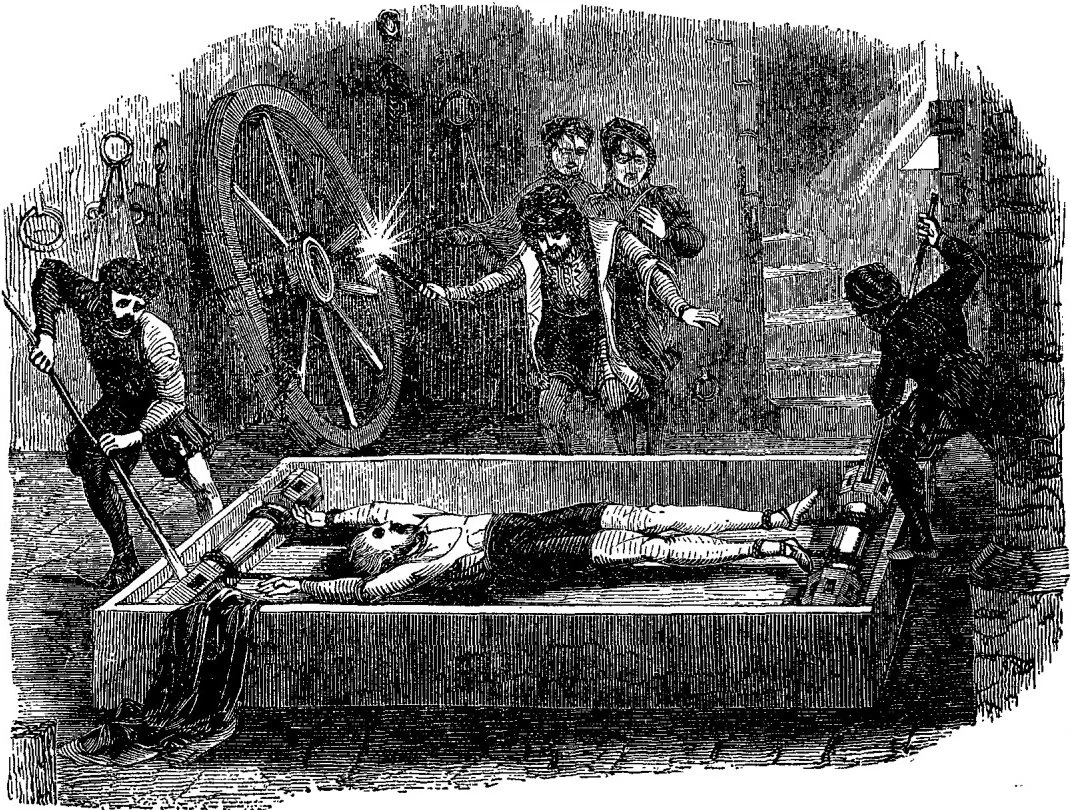
Racking a “Heretic.”
7. “This union was the natural outcome of the beautiful marriage of civil and religious institutions. The State then, as it should now [italics mine], protected and defended her [his] holy bride from danger and persecution” [from the teaching of any other than her doctrines].
8. “All the laws, then, had a tinge of Catholicity, and they were carried out in a manner savoring of the principles of that universal church.”
9. “The Inquisition was not formally established until 1248. Innocent IV. took the tribunal out of the hands of the seculars [Roman Catholic prelates not bound by monastic vows] and turned it over to the Dominicans.” “The Dominicans, according to their mission, introduced the Inquisition into all countries, and diligently sifted out and indicted heretics of every description.”
10. “Was the church justified in punishing307heretics for that reason alone? Most assuredly.” (Italics mine.) “Never could she countenance or encourage a formal heretic, a foe to civilization, a barrier in the way to salvation, to scatter his poisons unmolested.”
11. “To establish an inquisition, Ferdinand asked permission of Pope Sixtus I. That pontiff, however, was first unwilling to grant the request [the confiscated property of ‘heretics’ went to the Spanish king instead of to the Roman Pope], but was so urged by the Court of Spain, that he finally agreed, and in the year 1478 the Spanish Inquisition sprang into existence.”
12. “The permission of Rome was necessary for many reasons, but chiefly for two: First, because the men who were appointed as inquisitors by the Court of Spain were priests and prelates and theologians of the church, and were for that reason under the jurisdiction of the popes; and secondly, and most especially, because the Inquisition was instituted to try people on matters of faith!”
13. “Numbers of them [the Jews] . . . pretended to profess the Catholic faith, . . . and even were found among the priests and prelates of the church of God;” “but since there was no doubt but that very many of the Jews were honest in their conversion, what to do was a very perplexing question. Hence arose a great difficulty—a difficulty, which, as all will agree, could be overcome only by an inquisition.”
14. “Often was the tribunal at variance with the popes, and most frequently were the victims condemned by the Inquisition pardoned on appealing to the successor of Peter, . . . so serious were the frictions between them that several times the Holy See threatened the Spanish inquisitors with excommunication.”
15. “But the fact of the matter is there were no outrages committed by the Spanish Inquisition.” “Marian says that during the whole Inquisition about two thousand were killed.” Torquemada was a “pure, just, humane, incorrupted, and undaunted inquisitor.”
16. “Llorente tells us that on February 12, 1486, seven hundred victims were punished; but even granting these figures to be correct, he does not add that a single one of these victims was put to death.”
17. “When, then we say that those found guilty were compelled to make the ‘auto dafe,’ we mean that those who were publicly brought to trial and forthwith condemned and punished, were obliged to make some outward manifestation that they were really members of the church of Christ.”
18. “In fact, the Inquisition was a very merciful tribunal; I repeat it, almost a compassionate tribunal. Very few of those condemned were sentenced to death; and a man was only allowed to be racked once, which no one can deny was a most wonderful leniency in those times.”
Was the Inquisition “Strictly Secular”?
The church should not be held responsible, says this Roman Catholic champion, for the Spanish Inquisition, because it was “strictly secular” (1), although he confesses it was founded by Roman Catholics (11) with the permission of the Pope (11), was presided over by Roman Catholic priests, prelates and theologians (12), who were under the jurisdiction of the Pope (12); and “was instituted to try people on matters of faith” (12).
How can it be pleaded that the Spanish Inquisition was strictly secular (1) when “king and subject, rich and poor, priest and people” were Roman Catholics (4)? when all the laws were tinged with Roman Catholicism (8)? when Roman Catholics enacted laws and punishments in keeping with their religious convictions (6)? when, “to put it briefly, there was the greatest union of Church and State” (6)?
If the people of England, members of the English Church, were to establish an inquisition by permission of the Anglican archbishops, and would install as inquisitors clergymen of the English Church, and arrest, condemn, rack and burn Roman Catholics because they taught doctrines contrary to the teachings of the Church of England, would Roman Catholics permit the English Church to escape from the odium by the childish dodge that the civil authorities were wholly responsible, and that the Church of England was entirely blameless? Roman Catholics would ridicule such an attempt to escape responsibility. Then how can Roman Catholics expect intelligent men to accept such pitiable excuses for her bloody crimes?
A Dilemma.
Why try to relieve the church of the responsibility of the Spanish Inquisition by asserting that the Pope, while giving his sanction to the Spanish Inquisition (11), yet threatened to excommunicate the inquisitors for their cruelty (14), when in another paragraph it is asserted that the Spanish Inquisition was an absolute necessity (13); that it was not cruel (15) but a “merciful,” “compassionate tribunal” (17); that its inquisitor-general was a “just,” “humane” “inquisitor” (15)? Did the infallible Pope threaten to excommunicate a necessary, merciful, compassionate body of inquisitors because of their cruelty!!
Rome on Church and State.
According to this defense of the Inquisition, the only proper relation of Church and State is a “union of Church and State” (6), a “beautiful marriage of civil and religious institutions” (7). The laws of the State should be tinged with Catholicity and “carried out in keeping with the principles of the universal Church” (8).
Rome’s Definition of a Heretic.
Since the Roman Catholic Church ought to be united to the State, it follows that any one who teaches contrary to the doctrines of the Roman Church in countries where Rome is dominant is “an enemy to the State” (5), “a disturber of the public peace, and an underminer of civil society” (6), “a foe to civilization” (10).
But besides being a traitor to the State, every Protestant, according to Rome’s definition, is a “barrier in the way of salvation” (10), and for that reason alone the Roman Church is “most assuredly” justified in punishing him (10).
Rome’s Definition of Merciful Punishment.
“Very merciful,” “compassionate” treatment for Protestants or heretics is to rack them once (17). Webster defines a rack thus: “An engine of torture, consisting of a large frame, upon which the body was gradually stretched until sometimes the joints were dislocated.” If tearing muscles and sinews and dislocating bones is in the mind of a Romanist merciful, compassionate treatment of Protestants, what would in their minds be justice to such “heretics”?
The papal champion argues that the inquisitors punished heretics, but very few were sentenced to death (17). But this is no justification. Ordinary death would be welcomed with joy by the man or woman who was the victim of an inquisitorial dungeon or rack.
The Inquisition is defended on the ground that racking a man once was merciful, compassionate, “wonderful leniency in those times” (17). But if racking, sanctioned by the priests and prelates of the church, the highest types of Catholicism, was wonderful leniency, what must have been the spirit of the times! And who were responsible for the spirit of the “times”? For centuries the Roman Catholic Church was the dominant church. Those who taught differently were driven into exile. “In the times of which we speak all the world embraced the teachings of the Catholic Church” (4), “prince and peasant, priest and people, all believed her doctrines” (4); schools and churches, assemblies and meeting-houses echoed and reëchoed with her tenets and doctrines” (4). Who, if not the Roman Church, was therefore responsible for the barbarity of the “times”?
The Inquisition Probes for Heart Motives.
The article under consideration defends the Inquisition on the ground that it was necessary to discover the motives of the heart. Under the Spanish union of Church and State the Jews were handicapped in the race for wealth and political honor. Consequently, some professed conversion, and so complete was the deception that many of them were consecrated as “priests” and advanced to positions of “prelates” of the Roman Church (13). Some of the converted Jews were believed to be honest-hearted believers (13), but to ascertain what was in the hearts of all it was necessary to place the doubtful convert on the rack (17) and dislocate his bones and tear his tendons from their fastenings in order to reach his heart.
How “Heretics” are “Really and Truly” Made Roman Catholics.
The writer of the “defense” under consideration gives us a method of “really and truly” making “heretics” Roman Catholics that is deserving of attention. First establish an inquisition, then interdict “heretics of every description” (9), that is, every person who teaches contrary to the doctrines of the Romish Church. Next fasten their limbs to an adjustable wooden frame, then enlarge this frame so as to stretch the muscles of the victim and dislocate his joints. This will cause excruciating pain. Proceed with this process slowly, and occasionally ask the victim if he is not persuaded that he is or ought to be a member of the “only true church.” If he says “no,” stretch his limbs still more, increase the pain, and then repeat the question. In a majority of cases the victim under these conditions will express a desire to join the church. If, however, it is feared that when he escapes he will change his mind put him to death while he is really and truly a member of the church that he may not later apostatize and lose his soul.
A Contrast.
The method of the Lord Jesus was to say: “Come unto me, all ye that labor and are heavy laden, and I will give you rest. Take308my yoke upon you, and learn of me; for I am meek and lowly in heart: and ye shall find rest unto your souls.” “But the hour cometh, and now is, when the true worshipers shall worship the Father in spirit and in truth: for the Father seeketh such to worship him. God is a Spirit: and they that worship him must worship him in spirit and in truth.” “And when his disciples James and John saw this [that they rejected Christ], they said, Lord, wilt thou that we command fire to come down from heaven, and consume them, even as Elias did? But he turned, and rebuked them, and said, Ye know not what manner of spirit ye are of. For the Son of man is not come to destroy men’s lives, but to save them.” “Who art thou that judgest another man’s servant? to his own master he standeth or falleth: yea, he shall be holden up: for God is able to make him stand.”
The Papacy Is Unchanged.
This “defense” of the Spanish Inquisition clearly conveys the important truth that Rome is unchanged, and that if the same conditions should come to exist as obtained before the Reformation, the Roman Church would not hesitate to revive the Inquisition. And yet many professed Protestants have become so blinded as to regard the Church of Rome as “one branch of the Church of Christ.” May the God of the Reformation which ended the “merciful” work of dislocating bones to convert the soul, open the eyes of professed Protestants before it is too late.
MORALS AND RELIGION.
By Charles F. Deems
The fundamental idea of religion, beyond all doubt, is obligation. And the fundamental idea of morals is precisely the same obligation. So far as they can be distinguished, their distinction lies is this: that the obligation of morals is to a principle, while that of religion is to a person, even to God. But this does not and cannot discriminate either the subjects of moral obligation, that is, all moral beings, or the objects thereof, that is, all duties.
Religion takes up, under her imperial and benignant sway, all creatures to whom right and wrong are or can be known, and lays her heavenly sanctions on all they ought to do. She vastly enlarges the scope and dignifies the office of duty. She raises dead ethics to life. She substitutes allegiance to man's true King, for the cold and ineffective impositions of abstract truth. There need be no larger reference to Scripture, in confirmation of this statement, than to adduce our Saviour's two great commandments, on which “hang all the law and the prophets:” “Thou shalt love the Lord thy God with all thy heart, and with all thy soul, and with all thy mind, and with all thy strength, and thy neighbor as thyself.” “Shalt” is the very keynote of morals. “The Lord thy God” is the sublime Person from whom the law must come, and to whom, in infinite degree, moral service is due.—Charles F. Deems, D.D., LL.D., in Frank Leslie's Sunday Magazine, December, 1879, page 713.
RESPECT FOR LAW.
By S.
“ONE of the hopeful signs of the times,” says the Catholic Review, of September 13, “as it is also an eminent characteristic of the American people, is the profound respect for law which we everywhere behold. This respect for law lies at the root of public conscience; it trains and informs it. Were men to lose it, then the crimes of the great and powerful would go unwhipped of justice, and the popular conscience would soon become seared and perverted.”
It is possible that there is less cause for satisfaction upon this point than is believed to exist by those who view the situation in this light; there is a probability, in fact, and this probability constitutes one of the gravest dangers threatening this Republic. Certainly no question can more vitally concern the welfare of a nation than that of the respect of its people for the law. But “respect for law” is a phrase whose full meaning very many fail to comprehend. To them it is only a half statement of the truth, and as such becomes the inculcator of a most dangerous error.
The all-important truth which underlies this subject is that law is not something manufactured by the fiat of man, in legislative assembly or otherwise, but law is justice, and respect for law must mean respect for justice, if it would be of any benefit to the State. If the people lose sight of this distinction, then indeed will the public conscience become seared and perverted, and that in very brief time.
What is justice? is the question to be determined by the people themselves, and their right to determine it for themselves, in any case whatsoever, cannot be questioned. Legislatures and courts are not established to instruct the people, or to rule over them, but to transact the people’s business in civic affairs. As such they are the servants of the people, to execute the people’s will, and not to dictate to them. If the people are incompetent to determine what is right and just, then they are unfit for a republican form of government. But the right of self-government is the right of all intelligent people. They may not always determine correctly upon these points, but this fact does not affect their right in the matter. No man is invested with infallibility.
The danger is that the people will come to regard as law anything which legislators and judges may enact or affirm to be such, without considering it essential—or even proper—to pass judgment upon it themselves; in other words, that they will regard the fiat of legislator or judge as constituting the law, and forget that justice must constitute it. It might be well enough if legislators and judges were always sure to state the law of justice in each case, or to exercise their unbiased judgment in the endeavor to do so. But legislators and judges are but men, having human weaknesses and subject to the temptations common to all. Experience has proved that they are not entirely incorruptible. It has demonstrated that their action is not always above the suspicion of proceeding from selfish motives. The servants of the people, like all other servants, will bear watching.
When the people come to look with awe upon the fiat of man, as constituting the law which they are bound to obey, without reference to its justice or injustice, their sense of justice will inevitably become blunted; and without a lively sense of and regard for justice in the minds of the common people, the very foundations of popular government must crumble into dust. The people must remember that they themselves are the rulers in this Government, and that upon them rests the responsibility of the Government. The legislatures, Congress, the courts, even the national Supreme Court, are the creatures of the people; and the creatures must not dictate to the creator. The former is answerable to the latter; he must acknowledge the latter’s right of criticism. Such criticism is not anarchy. Bodies so powerful as legislatures and supreme courts should be scrutinized by the public eye with a care proportionate to the harm they are capable of doing by a wrong move. It is upon these fundamental principles of popular government that the people need to be educated, far more than upon the issues involved in a political campaign.
S.
POLITICAL PREACHERS HELPING ROME.
By Editor
If the clerical politicians, who are venting their political ideas from their pulpits upon long-suffering congregations, were injuring only the political prospects of the cause which they espouse, the evil done by them would be small. As we have elsewhere pointed out, however, they are directly working to break down the dividing wall between politics and religion, and thus to establish a union of Church and State. And this is not all; for they are putting a weapon into the hands of Rome which she will know how to use against the liberties of Americans. The evidence of this appears in an editorial paragraph in the Catholic Review (New York), of September 19, which alludes to the “pernicious activity” of Protestant preachers in politics as an example of “their devotion to the so-called American principle of the separation of Church and State.”
Rome does not believe—has never believed—in the separation of Church and State, and she can now point to the example of these American Protestant clergy and claim that there is no such American principle as that which demands the separation of the civil and religious powers, but only a “so-called” principle, which does not exist in reality. With this principle out of her way, the progress of Romanism in this country will be much more rapid.
THE EASTERN EMBROGLIO.
MASSACRE and outrage continue in Turkey, but the jealousy of the Powers prevents any effective action.
At a meeting held in London on the 21st ult., to protest against the massacre of Christians by Turks, “a most important announcement was made,” says a London dispatch published here on the 22nd ult., “which it is believed, puts an end to all conjecture regarding the action that will be taken by the British Government in the direction of putting an end to the massacres by force or deposing the Sultan.
“The statement was made by John Lowles, member of the House of Commons for the Haggerston division of Shoreditch. He said that if England had a free hand in the matter very few days would elapse before there would be a change in Turkey.
“He then added that he was authorized by the Foreign Office to say that Great Britain was confronted by an agreement between the three powers that if she attacked Turkey on any excuse or pretext she would have to face that combination. If she fired a single shot or took action alone it would mean that at that moment there would be a European war.”
The same day this appeared in the American papers the London Times published a309dispatch from Sebastopol saying that “the Russian Black Sea fleet has been put on a war footing, and that three battalions of infantry have been embarked.
“Part of the fleet is cruising off Otchakoff, at the mouth of the Dnieper River, forty miles from Odessa, under orders that if its commander receives a telegram from M. Nelidoff, the Russian Ambassador to Turkey, it must join the remainder of the fleet leaving Sebastopol and go direct to the Bosporus. All the troops in South Russia are ready for active service.”
These dispatches show that the situation is extremely critical. Even a very slight thing apparently might precipitate a conflict.
MOVING TOWARD ROME.
By Minard Wood
BY MINARD WOOD.
For several months past the Protestant churches of West Haven, Conn., have been holding union temperance meetings alternating with the several societies. Things ran well for awhile, and considerable enthusiasm was manifested by these local societies. But for causes unknown to the writer, there was a lack of attendance, and a failure on the part of our Protestant friends to keep pace with their Roman Catholic brethren. This fact rather grated on the nerves of the pastor of the Methodist Episcopal Church. He saw his frail bark was stranded upon a lee shore, and the only way left to save the survivors of the wreck, was to accept the overture of Rome, and grasp the treacherous cords by which millions have been led to death, or worse. So he publicly announced from his pulpit that hereafter the Methodist Episcopal branch of the temperance work in this section would unite with their Catholic brethren. This suggestion was highly favored, and carried into effect a few days later at a temperance demonstration, led by a Roman Catholic priest, of course. The wayward daughter was gladly received and affectionately embraced by the “Mother of Harlots.” The priest in charge held up both hands and said, “I hope the time is not far distant when there will be a general return to ‘the church,’ and all unite under one head;” that head the head of Leo, to be sure. Can’t you see it?
New Haven, Conn.
TOLERATION AND FREEDOM.
[Evening Herald, Syracuse, N. Y., Sept. 11.]
THE Illinois Appellate Court has just handed down a decision which will be welcomed by every person who understands at all the genius of our political institutions. This decision is that plowing of corn on Sunday, or other similar labor, quietly performed, does not in itself constitute a breach of the peace and call for the exercise of police power. The defendant in the case upon which appeal was taken to the Appellate Court is named Foll and is a Seventh-day Adventist. The members of the sect to which he belongs observe Saturday as the Sabbath, and on Sunday they feel free to engage in any work that does not in itself constitute a breach of the peace. The charge against Foll was that he plowed his land on Sunday. Any other decision than that rendered would be an outrage upon the rights of the individual.
A republican government can have no more license to force a citizen to observe any given day in a certain way than it can have to force every citizen to subscribe to a given religious creed, and persecution of the kind attempted by the petty bigots who caused the arrest of Seventh-day Adventist Foll for plowing his field on Sunday is utterly abhorrent to the genius of American institutions. A majority in the State has the right to say that the peace shall not be broken on a certain day, but it has not the right to say that the ordinary vocations of life are necessarily breaches of the peace in themselves if pursued on a certain day. Such intolerance would be a blunder as well as a crime against liberty.
Liberty for all to worship as they please and the separation of State and Church are only to be had where the State does not attempt to force conformity in such matters as creed and the observance of the Sabbath. When a Christian missionary goes to China or other country where Christianity is looked upon as a queer, absurd doctrine by the average native, he is fortunate indeed if his preaching and practices are not also regarded by the natives as breaches of the peace, dangers to society and corruptors of religion. When toleration has been secured, after tribulation and sacrifice, the missionaries regard the victory as a great one. It is an evidence that the country is becoming civilized.
Such a prosecution as that of Seventh-day Adventist Foll is a survival of the intolerance which has made history a bloody record. It shows that despite the theory of our institutions, and the bitter experience of many American denominations with their fellow-Christians, the old spirit of sectarian hatred, most merciless and revengeful, is yet alive here and there, even in a country whose very foundation was a protest against intolerance, and whose continuance as a republic and as a union depends upon toleration in the broadest possible sense of the word.