Review and Herald Publishing Company · Battle Creek, Michigan · August 27, 1903
Peculiarities of Common Garden and Field Plants
By BENJAMIN B. KEECH
The plants of our gardens and fields are interesting to study in more ways than one; and the person who observes them for the sake of witnessing their peculiarities only, will undoubtedly find much to entertain him.
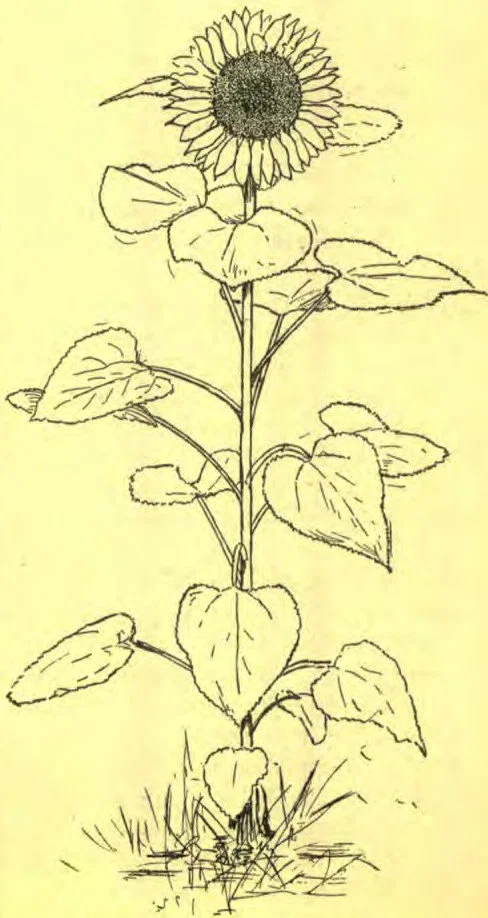
Almost everybody knows how the sunflower “follows the sun;” that is, in the morning the bright, good-natured-looking flowers will be facing the east; but as the sun mounts slowly in the heavens, and sinks down in the west, the blossoms gradually “follow” it, until at night they are turned completely around, and face the west.
One peculiarity of the sunflower is that sometimes it refuses to follow this rule, standing in the same position all day; but where there are many plants in a collection, one can usually find several blossoms that will do as they are expected. This is especially true of young, newly opened flowers.
Sunflowers planted around a yard are supposed to have the properties of a disinfectant, purifying the air and soil, and even preventing disease in live stock. Chickens are very fond of sunflower seeds, which contain much nutritive matter. The oil obtained by crushing the seed is regarded as valuable for many uses.
Ricinus sanguibarensis, or castor-oil bean, rich in its massive, tropical beauty, is an interesting plant to study. It has been supposed that the roots of this plant, growing in the soil, have the property of driving away the little moles that work just under the sod; but this idea has gradually been discredited.
Persons who have enjoyed the stately beauty of a Latania borbonica palm, and have fanned themselves comfortably with a palm-leaf fan, may be surprised to know that the latter is only one of the leaves of the former, dried, bleached, and “made over.” A close comparison of the live leaves and the dead will show many points of similarity.
Morning-glories have their own particular time of day for coming into bloom. Before their owners or any of the flowers in the garden are up, these bright blossoms are nodding and craning their necks in the early delight of a summer morning. The flowers are short-lived, however, and do not last until noon; though if they are grown where the sun can not strike them, they will remain open longer.
While the morning-glory is an early riser, the evening primrose and nicotina affinis can not be persuaded to wake from their slumbers until late in the day, though in cloudy weather the nicotina will blossom earlier, and often remain in flower for many hours, when conditions are favorable. Although a member of the tobacco family, the nicotina is beautiful, and a large plat of the white, fragrant blossoms will scent a whole yard on a summer night. Potato bugs are very fond of this plant, so do not be surprised to see them feeding on the leaves.
The evening primrose is both beautiful and interesting. Stand before a plant when twilight shadows begin to gather, and watch the buds. First there will be an exciting little “twirl” at the petals; then, almost before you know it, a great, yellow blossom will sway on the flowerless stalk of a moment before.
The oxalis, which also has its views on retiring and waking into bloom, is usually going to sleep at the time when some of our evening flowers are waking up. The oxalis rises with the sun, and the leaves and flowers gradually expand, until at noon they are fully opened. As the sun sinks lower, however, the foliage and flowers fold slowly together, and so remain until next morning. Tulip blossoms and poppies are of the same habit. The seed-pods of poppies exude a liquid from which opium is manufactured. Digitalis, or foxglove, also yields a drug often prescribed for those who suffer with heart trouble.
The water hyacinth is noted for its curious and beautiful growth, as well as its charming blossoms. The round, smooth leaves are attached to an inflated, bladder-like stem, that enables the plant to float. The roots are a peculiar shade of dark blue, and the blossoms are a handsome blending of lilac blue and azure. The plants may be placed in an aquarium, in tubs on the lawn, or in ornamental glass dishes. Place a small stone in the dish, and set the plant on this, leaving it there until the roots have become established. Change the water often.
While we at the North admire the water hyacinth, the dwellers in the Southern coast States detest it. A few years ago one of the principal rivers of Florida was blockaded because of the thick mass of plants that had grown across the bed of the stream, making it impossible for the steamers to cut through. A considerable sum of money was expended in clearing the plants away.
Parrot’s feather is another interesting plant to put in an aquarium or in well-moistened hanging-baskets. The long, feathery, drooping plumes are a bright, lively shade of green; the plant grows rapidly, and will prove a welcome addition to the garden museum.
An interesting plant is the sensitive plant, which has feathery, fernlike foliage that promptly folds together when touched by the human hand. The plant really appears to be suffering greatly, and its leaves curl up as if scorched by a hot blast, when approached too closely. While this plant has an aversion for most persons, it will occasionally allow children to touch it, so it is said, without shrinking away.
Equally amusing and entertaining is the resurrection plant, which, although apparently lifeless, will slowly unfold its brown stems when placed in a basin of water. When removed, it will gradually fold together, and remain “dead” until placed in water again.
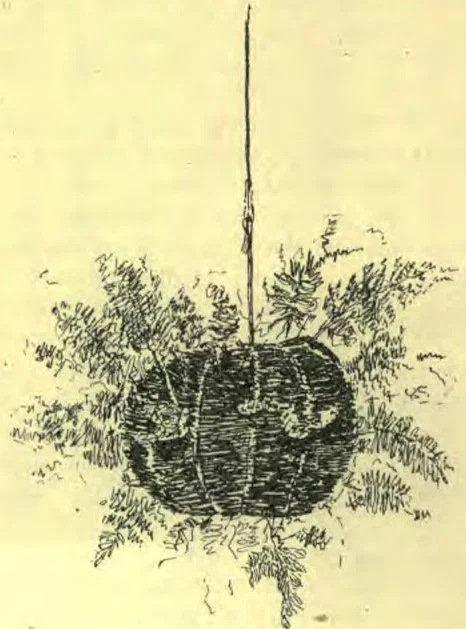
The Japanese fern-ball is another interesting plant to cultivate and study. The Japanese florists prepare it by wrapping the roots together in moss, in form of an oblate ball; and when received from the seedsmen, it is dry and seemingly lifeless. But suspend it by a string in the window or greenhouse, keep it well moistened, and in course of time the fresh, green growth will start, covering the ball with particularly graceful foliage, very pleasing to the eye. When you wish to go away on a journey, it is convenient to let the fern-ball dry up, with the assurance that it will start into growth again when more water is given.
It is surprising to note how determined most plants are to find for themselves a sufficient amount of light and warmth to carry on their business of growing. On cold, blizzardy nights it is often necessary to burn a large lamp near the window garden. When this is done, notice the plants in the morning. Most of the blossoms will be leaning eagerly forward toward the lamp, to get all the enjoyment possible from the light and warmth; but when the shade is rolled up, and the newspapers are taken down from behind the plants, the stems will gradually2straighten up; and before night they will be leaning toward the window.
THE CHEERFUL SUNFLOWER
The color of unopened hyacinths may some times be told after the lamp is lighted; whereas in the daylight, one can not tell whether they are white, pink, or something else.
Did you ever go down in the cellar, in late spring, and notice under a basket or box, a long, white, brittle potato sprout, doing all in its power to grow under difficulties? A pretty good example, is it not, for persons who find it almost impossible to expand into the larger, richer growth for which they hope?
But while they may become discouraged, the potato keeps right on looking for more light; and pretty soon some one comes down, gives it a trimming, puts it in more favorable surroundings, and before it knows it, the potato is really growing . So will the discouraged person be who persistently keeps his eyes on that little gleam of light, coming in through the darkness overhead.
JAPANESE FERN BALL
Even a potato may teach us, and the flowers in our homes and gardens may give us many a valuable lesson if we make ourselves susceptible. Flowers instruct, entertain, beautify, and heal. Even the weeds by the roadside are worthy of attention, for they may contribute to our amusement, happiness, and knowledge.
The queer ways of plants have only been lightly and incompletely touched upon here. The Chinese sacred lily, Chinese lantern plant, floral fire-cracker plant, pitcher plant, shoo-fly plant, cactuses, water-lilies, gourds, and other members of the Floral Kingdom, deserve one’s attention.
Make the acquaintance of all the flowers you can. They will be very cheerful companions.
BENJAMIN B. KEECH.
In and About San Francisco—III
By J. Edgar Ross
The Academy of Science Museum
Market Street is the main thoroughfare of San Francisco,—the street where the buildings are tallest, and the rent is highest; where the clang of the street-car gongs is most deafening, and the crowds of pedestrians on the sidewalks are most dense. In the busiest part of this busiest street of a busy city is a splendid museum that every one who has even a few hours to spare in San Francisco ought to visit.
I had passed the entrance to this museum hundreds of times before I knew of its existence, and I think it is safe to say that thousands of persons do the same thing every day. Admission to the museum is free, and its directors make no attempt to advertise it. I have seen museums that had not a tenth of the attractions of this one, and were situated in less frequented parts of the city, crowded with visitors from noon till midnight. These museums, though they charge a fee for admittance, are always well patronized because the crier at the door shouts their attractions to passers by. But I have visited the Academy of Science museum repeatedly, and have never seen a dozen people in it at one time.
The entrance to the museum serves also as the entrance to a large office building, and one must pass the elevators before he sees the small, inconspicuous sign “To the Museum,” and the index that points up a beautiful marble staircase to double swinging doors.
As the visitor pushes open one of these doors, he stands facing a lifelike restoration of a mastodon sixteen feet high and twenty-six feet in length, with long, curving tusks as large around as a man’s body. Behind the mastodon stands the skeleton of a megatherium,—a long-extinct sloth that in life could reach up and pick the leaves from a tree above the mastodon’s back. On the first floor there is a considerable number of restorations of animals now extinct, and the fossilized remains of many more. There is also a large collection of fishes preserved in alcohol. This contains fish from all parts of the world, but is principally devoted to those specimens found along the coast and in the inland waters of California.
Next comes a collection of mounted reptiles,—great black pythons from India, and still larger boa constrictors from South America; deadly hooded cobras and other venomous snakes from tropical jungles; and the less dangerous, though not-to-be-trifled-with rattler, with which we are more familiar. Besides these there are many others that I can not enumerate,—many that I did not even see; for snakes, even dead ones, make my flesh creep, and I always hurry past them.
The cases containing mounted specimens of birds are numerous and well filled. The largest of these specimens is a cassowary, or Indian ostrich, though the emu from South America crowds it quite closely. Both are about as tall as a man of ordinary height. The smallest is a humming-bird no larger than a man’s thumb. The bird of paradise and the lyre-bird are the most brilliantly plumed, while the apteryx from New Zealand is the ragamuffin of the collection. Then there come the eagles, hawks, owls, and other birds of prey, with condors, buzzards, gulls, and other winged scavengers of land and sea. There are also song-birds, game-birds, and waterfowl without number. In fact, the collection contains every bird that one could think of, and many that only a naturalist would dream of.
On the second floor there are many specimens of mounted animals. Side by side, standing on their hind feet, are two brown bears from Siberia that look enough alike to be twin brothers. You will get an idea of the dimensions of these great shaggy fellows when I tell you that I was barely able to touch the tips of their ears by standing on the tips of my toes. In one case there is a large walrus, and beside it is a strip of his tanned skin,—a fine piece of leather about an inch and a half thick. Another case contains a specimen of the largest and one of the smallest members of the deer family. The first is a moose from Nova Scotia that stands fully six feet high; the second, a full-grown musk deer from the East Indies,—a creature not much larger than a jack-rabbit. On this floor there is also a mounted whale. It is a California grayback, and measures about forty feet in length. To show that this is the baby of the whale family, there stand near by the jaw-bones of another whale, which are nearly half the length of the grayback’s whole body.
The third floor of the museum is given over principally to a collection of relics and curios from foreign lands. There are several sets of armor from different periods of old Japan. Bows and arrows, spears and shields, war-clubs and battle-axes, have been brought from all parts of the world. Then there are a few idols, two or three mummies, and quite a number of canoes from different countries. From our own land have been collected a large number of Indian baskets, with examples of pottery and other native work, as well as quite a few models of cliff-dwelling and other pre-historic ruins. And last, but not least, there is on this floor a large collection of seashells.
Every specimen in the museum has a placard attached giving its name and native country, and often a short history for the instruction of the visitor. There seems to have been no pains spared to make this an educational institution,—a real academy of science. J. EDGAR ROSS.
Snapshots at Failures
Wherein One Young Man Failed
“WHY is my son compelled to do the roughest stone work year after year, while others who have been with you a shorter period of time are given finer work?” asked a father, addressing the manager of a concern engaged in marble and granite work.
“Because he is too anxious to excel,” was the reply. “I have cautioned him scores of times not to strike with his hammer too heavily upon a block of marble or granite, but, though he has evidently endeavored to profit by my advice, in his anxiety to excel and get at the design within the rough stone, he has become impatient and delivered a blow that did much damage. To protect ourselves from serious loss, we have been obliged to restrict him to the roughest and simplest work.
“Heavy blows will do very well when we knock at the outside door, but would we summon the angel within the marble or the design within the granite, it is imperative that we gently tap at the inner door, frequently spending weeks and months in this manner before the angel will stand revealed or the design present all its lines of beauty.”
The father was silent, for his son’s employer had touched upon a point in the young man’s character which had caused him much uneasiness in the past.
Impatience to accomplish in a few days or weeks that which masters of their craft complete only after months and years of labor, is the key to the mystery surrounding the failure of many a young man. There are thousands who are kept pounding away at the outside doors which guard the citadel of success, thousands who never get beyond the outer court, while others, more patient, more willing to work, though they see no immediate results of their work, presently see the inner portals ajar and a welcoming hand reaching out, they step within to find themselves face to face with success.—Selected.
Heart-Keeping
By Theodore L. Cuyler
HEART-KEEPING is very much like housekeeping. There must be a continual sweeping out of dirt and clearing out of rubbish—a daily washing of dishes, and a perpetual battle with all sorts of vermin. If heart-cleaning could be done up once for all, then the Christian might discharge all his graces, and have an easy time of it.
And just because the assaults of subtle temptations are so constant, and the uprisings of sinful passion are so frequent, and the task of keeping the inward man what it ought to be is so difficult, many a one who begins a religious life gets discouraged and makes a wretched failure.
The question with every Christian is: Shall these Amalekites of temptation burn up all my spiritual possessions and overrun my soul? Shall outward assaults or inward weakness drive me to discouragement and disgrace me before my Master and before the world? Or shall they drive me to Jesus Christ, who will give me the victory?—Theodore L. Cuyler.
The Value of Time
“A MAN who dares to waste an hour of time has not learned the value of life.”
The Isle of Springs
By William Ambrose Spicer
COLUMBUS did his best to give the name of a Catholic saint to Jamaica, but happily the old Indian name clung to it and prevailed. In the old form it was spelled Xaymaca, which, it is said, means “isle of springs.”
It is still an island of springs. Providence intended that Jamaica should be a beautiful home for somebody; for it is the Lord who “layeth up the depths in storehouses,” and “sendeth the springs into the valleys, which run among the hills.” They break out from the mountains on every side, and run among the hills in beautifully clear streams to the sea. Jamaica is nearly all mountains and valleys. It is said that when Columbus told Queen Isabella of the tropical beauties of this island, she wanted to know the shape of it. He crumpled a piece of paper in his hand, and then partially spread it out, to show her how Jamaica looked. It was a very good way to describe it. And in most parts of the island one is greeted often by the gurgling of the mountain streams.
They are short, for the island is small. But when it rains, some of the streams become suddenly roaring torrents. Then the rivers are said to be down,—that is, down from the mountains. Our workers are sometimes turned back, in their journeys among our churches, or have to run considerable risks, in fording the streams when the water is “down.”
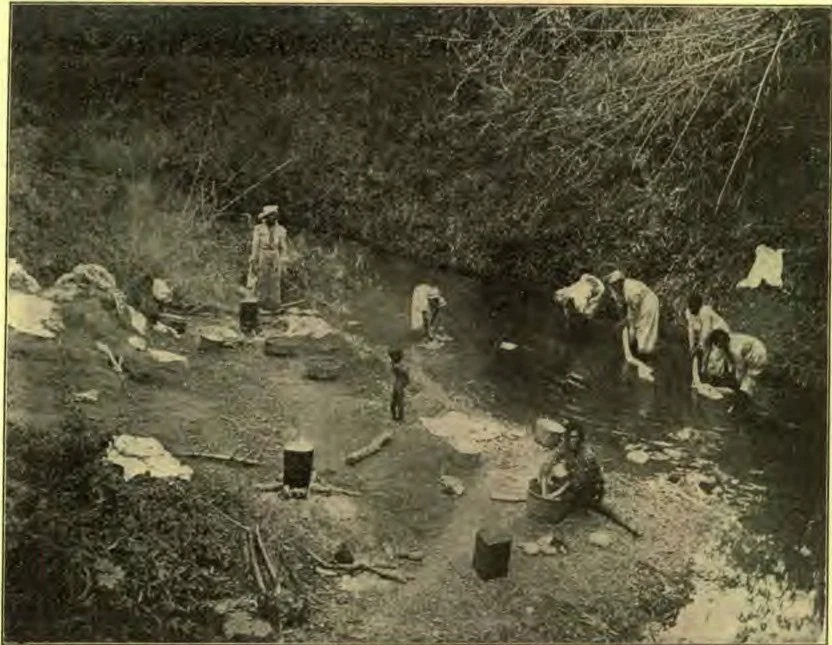
The village washday is commonly celebrated in the clear running brooks. The novelty of it very likely does not appeal to the washers, but to the visitor it gives washday the appearance of a holiday out-of-doors.
In ordinary seasons the foot-passenger along the mountain roads finds stepping-stones for crossing the streams. The fording of one little stream is associated in my mind with one characteristic of the Jamaican people which visitors must often remark. I waited half a day at Troja, a mountain railway station, to meet friends with whom I was to visit one or two churches. Strolling out, I came to a stream without the convenient stepping-stones. Near by a surveyor—a Jamaican—was running a line for a new wagon road. Before I had decided whether to turn back or wade the stream, he had quickly sent his workmen down to ferry me over dryshod. Seeing that I was a stranger, he spent an hour in showing me about the adjoining cultivations, explaining the culture of the cocoa and coffee, yams and bananas, and other products, and guided me to a hilltop commanding a view of the surrounding country. Then he saw me back to the village side of the brook again. It was all of a natural kindly courtesy that does one good to meet. The springs of human kindliness flow also in this beautiful isle of springs. Wherever you may meet an overflowing spirit of hospitality and courtesy, it is as refreshing as a mountain stream in the tropics.
W. A. SPICER.
Heart Tones
A STORY is told by a teacher of true culture which shows that that most charming possession of girlhood and womanhood, a sweet, musical voice, is not always a matter of breathing gymnastics. “The most exquisite voice I ever heard,” says this teacher, “is that of a woman who never in her life took a lesson in elocution or singing, or appeared in public. In fact, she is a dressmaker in rather humble circumstances. Hers is what we call a talking voice. It is low and sweet and musical. It is not an affected voice—one of the kind some folks put on with their best clothes and company manners. It is her everyday voice, and she never uses any other.”
A VILLAGE WASHDAY
“The first time I heard her speak, I was struck by the gentleness, sweetness, and true refinement of her voice. I determined to find out all about her, and I did. It was not much, just a homely, simple little history of unselfishness and self-sacrifice; of years spent in frugal living and in working hard for others. But it explained the possession of that voice.”
“One day a pupil of mine, a wealthy society woman who had taken up tone culture as a mere fad, heard this dressmaker speak.
“‘There!’ she exclaimed. ‘I want you to teach me to speak like that.’
“‘I only wish I could, madam,’ I replied.
“‘But why not?’ she insisted. ‘Isn’t it just a trick of managing the chest-tones?’
“‘No, madam,’ I said. ‘Those are not mere chest-tones; they come from the heart.’”
Felling a Giant Fir
The head feller lays his hand on the fir, looking up along its mighty bole, a hundred and fifty feet to the first limb. The head feller is without awe in this place. To him a forest is so much merchantable lumber, lath, shingles; a tree, three or four matter-of-fact logs, sound or shaky. They call him Chris.
“We’ll take this feller, Aytank,” he says. “Make ’im fall over dare.”
It seems irrational that two men alone should attempt such a task, two pygmies with toy axes, a toy saw, a sledge, a bottle of kerosene oil. For where the ridged and rugged butt of the great fir sets into the earth, it is thirty feet in circumference, a massive column rising two hundred and fifty feet in air. Its very bark is a foot thick; its flesh is solid and hard.
Chris and his partner clear away for a space the tangle of wild sweet clover and Oregon grape; then they cut stepping-notches in the bark of the giant. Ten feet above the earth they fasten two spring-boards, narrow planks on which they now stand perilously balanced, their spiked shoes clinging fast, their double-bladed axes in hand. Even at the height of this enormous prospective stump the tree is over seven feet through. Chris spits on his hands, and takes a nick from the brown bark. Jack follows; the tree stands as firm as the ages, towering to the sky. For hours they swing steadily, the knocking of their axes echoing through the silent forest. A fine drizzle of rain sets in, darkening all the wood.
Through nearly five feet of solid green timber have they thus cut their way, little jets of sawdust following each withdrawal of the saw; their trousers and shoes are yellow with it. But the fir has given no sign of yielding, still towering mighty among the smaller hemlocks and cedars. One’s interest grows acute. It is nothing less than a tragedy that this majestic tree should be laid low; it seems impossible, indeed, that it can be made to fall from its widespreading foundation, after five hundred years of the stout survival of storm and shock.
Unconcerned with the impending catastrophe, they withdraw the hot saw. Wedges they place in the saw kerf opposite the undercut, sledging them in. We hear the crack, crack of the sledge on wedge metal, then suddenly a sharp, penetrating, unearthly snapping, rending, tearing, which thrills through the dripping forest. Away plunge the fellers, shouting: “Watch out below! Watch out! Watch out!”
The great fir, for the first time, gives signs of distress, of yielding; a shiver passes through its mighty bulk; there are other sounds of rending wood, far-reaching, overpowering; then, slowly, with stately majesty, the noble tree sways aside, with matchless dignity even to the last. Its lofty head, gray, gnarled, stupendous, gives way, and opens a wide space of leaden sky, letting in a garish light to the wood. Faster it falls, striking the earth with a hollow roar, jarring the whole forest as with an earthquake, the sound of it reverberating through the valley, deep, hoarse, appalling—the death-cry of the fir!
Though the earth is moist with rain, the air fills with dust, followed for seconds afterward by a shower of falling branches, some as large as a man’s body. And such ruin as the fall has wrought in the wood! Here is a young hemlock, a magnificent tree in any forest but this, stripped clean on one side of every limb and all its bark. Lightning could do no worse. Here are a dozen young cedars crushed to splinters; smaller shrubs are driven into the soft earth, where the giant now lies as in a trough.—The Century Magazine.
“Jesus Loves Me”
By Elizabeth Matthews
In the crowded railway train,
Dimpled cheek against the pane,
Sang a baby, soft and low,
“Desus loves me, ’iss I know.”
Then, unconscious, clear and strong,
“’Ittle ones to him belong,”
Rose the dear voice at our side;
“Desus loves me, he who died.”
Hushed the hum of voices near,
Hoary heads bent low to hear,
“Desus loves me, ’iss I know,
For der Bible tells me so.”
So, mid silence, tearful, deep,
Baby sung herself to sleep.
But the darling never knew
How the message, sweet and true,
Raised one heart from dull despair
To the Love that lightens care;
But I think, beside the King,
I shall some day hear her sing,
“Jesus loves me, this I know,
For the Bible tells me so.”
— Elizabeth Matthews.
Young People's Work in Japan
By F. W. Field
SINCE our previous report of this work, our young men have had some experiences that we thought would be of interest to readers of these columns. We are glad to report that the little band are of good courage. On June 7 three more of the young men, besides two sisters, were baptized, and united in full membership. Of the eleven candidates baptized so far this year, seven are young men.
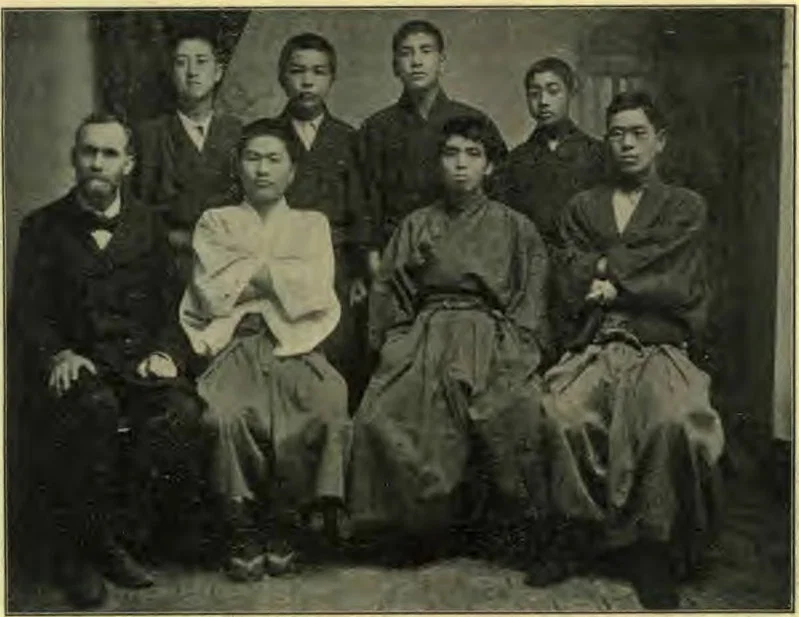
OUR YOUNG PEOPLE'S SOCIETY IN JAPAN —
PROFESSOR FIELD TO THE LEFT
Some knowledge of what these young followers of Christ have to sacrifice for his sake, and what trials they meet, may encourage our young readers to press forward in spite of the difficulties in the way. Two of the number have been hard pressed by relatives to enter worldly schools, where they would be preparing only for worldly business. All their expenses would be met if they would only yield. If not, one was threatened with arrest by officers of the law, as he is under age. He has returned to school for the present, but has kept Sabbath as before. On this account he is still much annoyed and threatened by his relatives, who seem determined to overthrow his faith. We feel very anxious for him, and are praying that his faith may not fail. The other young man was offered support in a law or a normal school, but was refused support in a medical school, where he hoped to prepare for some useful work in the Lord's cause. His father finally came to Tokyo, and appealed to the police to compel him to return home. He was obliged to go, and is meeting strong opposition because he will read his Bible and attend our meetings in his home town. But in a letter just received he expresses his determination to serve the Lord, and then quotes from 2 Cor. 11: 23-27.
It would take too long to tell of all the promises, threats, and schemes that are used to induce these young men to give up their plans for a Christian life. One of our boys who lives in Tokyo was sorely tempted to return to his home, from which he had been turned away for the truth's sake. He finally yielded, returned home, and entered school again. But he had no peace of mind, and after two weeks came back to us, thoroughly penitent. This was a good lesson for him; for since then he has been firmer than ever. He has written several times to his people; but the only notice they have taken was to send a messenger to take away some of his clothes and a pair of leather shoes. Afterward his mother (O, the power of a mother's love!) secretly sent him several garments for summer wear.
But trials and perplexities are not the only experiences that these young men are having. One experience that two of them had recently is worth telling. They started out to canvass in a village a few miles from Tokyo, intending to be gone over one night. They sold a few tracts the first day. Receiving no invitation to lodge for the night, they found refuge in a temple, and lay down upon the floor to sleep. But soon they were aroused by loud voices, and a troop of angry men seized them, and hurried them off to the police.
It seems that for three successive nights there had been incendiary fires in the village; and our boys, being strangers, were suspected as the guilty parties. At first the police were very harsh with them. But they told their simple story, and showed their New Testaments and tracts. They were fully vindicated; and one policeman was so much affected and interested, that he bought some of the reading-matter, and also gave them enough money to pay for lodging and breakfast. They sold more tracts and Testaments the next day, and returned that evening quite jubilant over their experience. They are improving in their canvassing work.
The accompanying view from a photograph will help INSTRUCTOR readers to feel better acquainted with their young Japanese brethren. All but one are members of the Tokyo church, and all these have been baptized during the present year. The little fellow at the right is a waif who came to our meeting place in Shiba one Sabbath, asking for food. Our young men befriended him, and he remained with them some weeks, resting on the Sabbath, and attending meetings and Bible classes. But he found it hard to support himself selling newspapers, and returned to his home in Nagoya. We hope his stay with us will prove a blessing to him.
We have bright hopes for the future of our young men; for we look upon them as our future workers in the Master's cause. But we greatly need some sort of industrial school where they can be trained for service. So many who accept the truth are opposed by their relatives, that most of those, even from well-to-do families, are left without support. Hence the necessity of furnishing them with remunerative work while they pursue their studies. But we have faith that God will help us in fitting these young men for usefulness in his cause.
The exaltation of Christ and the principles of his government. Phil. 2: 5-11.
Parallel Reading:—
“Great Controversy,” Chapter Three.
Lesson Topics
The spirit of self-exaltation and the fruit it bears.
The spirit of love and self-sacrifice and the fruit it bears.
The results of compromise with evil.
The papacy of Rome, and the papacy of every unrenewed heart.
A life of service compared with a life of selfishness.
Other practical lessons.
To the Leader
Select six persons, and give one of the “Lesson Topics” to each. Seek to make the study pointed and practical, giving prominent attention to individual experience.
The study should occupy about thirty minutes, and may be followed by a ten or fifteen minute experience meeting or prayer-meeting, as the occasion may require.