Your ShelfYour Projects

Review and Herald, Vol. 92, No. 6.

THE WORK AND THE WORKERS

Review and Herald

Feb 4, 1915

Review and Herald Publishing Association · Takoma Park Station, Washington, D. C. · Feb 4, 1915

THE WORK AND THE WORKERS

FIRST edition of the Free Press Extra of the February Protestant Magazine—50,000 copies—was ready February 1. Holding forms for the second edition.
PAPER-BOUND volumes of the Protestant Magazine or of Life and Health, for 1914. $1.25 each, postpaid. In cloth binding, $1.75 each, postpaid.
PUBLIC hearing on the two antifree-press bills before Congress was held in the Capitol building, Washington, D. C., Monday, February 1, at 10 A. M. Results will be announced later. Push the petition work now!
SAID John Milton: “Give me the liberty to know, to utter, and to argue freely according to conscience, above all liberties.”—“Areopagitica.” Read other noted authorities on free speech and free press in the Free Press Extra of the February Protestant Magazine now ready. Prices: single copy, 5 cents; 5 to 999 copies, 1 cent each; 1,000 copies, $8.00.
THE February number of Life and Health treats of the “Panama-Pacific Exposition,” “California,” “Lincoln,” “Home Cooking School,” “Food and Drug Frauds,” “What to Do First,” “Twilight Sleep,” and “Care of the Children.” Selling rapidly. Send $1.00 for 20 or $2.00 for 50 copies today. Practical throughout.
DON’T forget that the regular February issue of the Protestant Magazine is called the “Free Speech,” “Papacy and the War,” “Postal Legislation,” and “Thieves’ Bull” number. It goes well with the January or “England, Russia, and the Vatican,” “Pan-American Mass,” and “Keeping Faith With Heretics” number. Send $1.00 for 10 copies of each or $2.00 for 25 of each.
THE boycotting power of Rome is apparent in the cowardice of many prominent Protestants. Witness the following letter received recently from the commander of the U. S. S. — who had received two sample copies of the Protestant Magazine (October and December, 1914): “I do not care to have it known that I receive this publication, or inferred that I approve in any way the line of action which it advocates. . . . I will thank you to discontinue sending them. I am a loyal son of the church, and it is not the Roman Catholic Church.” For $1.00 we will mail 20 copies of this fearless yet dignified magazine to 20 government officials for you. Write your tract society today. If desired, we can furnish the names and addresses.
TEAR off the “Petition to Congress” blank on page 111 of the Free Press Extra of the February Protestant Magazine, get signers, and mail at once to the Post Office and Post Roads Committee members from YOUR STATE. See list under text of H. R. bill 20780.
BOUND volumes of Liberty for 1914 are now ready. Prices: paper, 60 cents; cloth, gilt title, 90 cents, postpaid.
THE sixteen pages of the Free Press Extra of the February Protestant Magazine (off the press February 1) are packed full of spicy free-press articles, quotations, etc. See the cartoon “Black Hand in the Editorial Room.” Prices: single copy, 5 cents; 5 to 999 copies 1 cent a copy; 1,000 copies, $8.00.

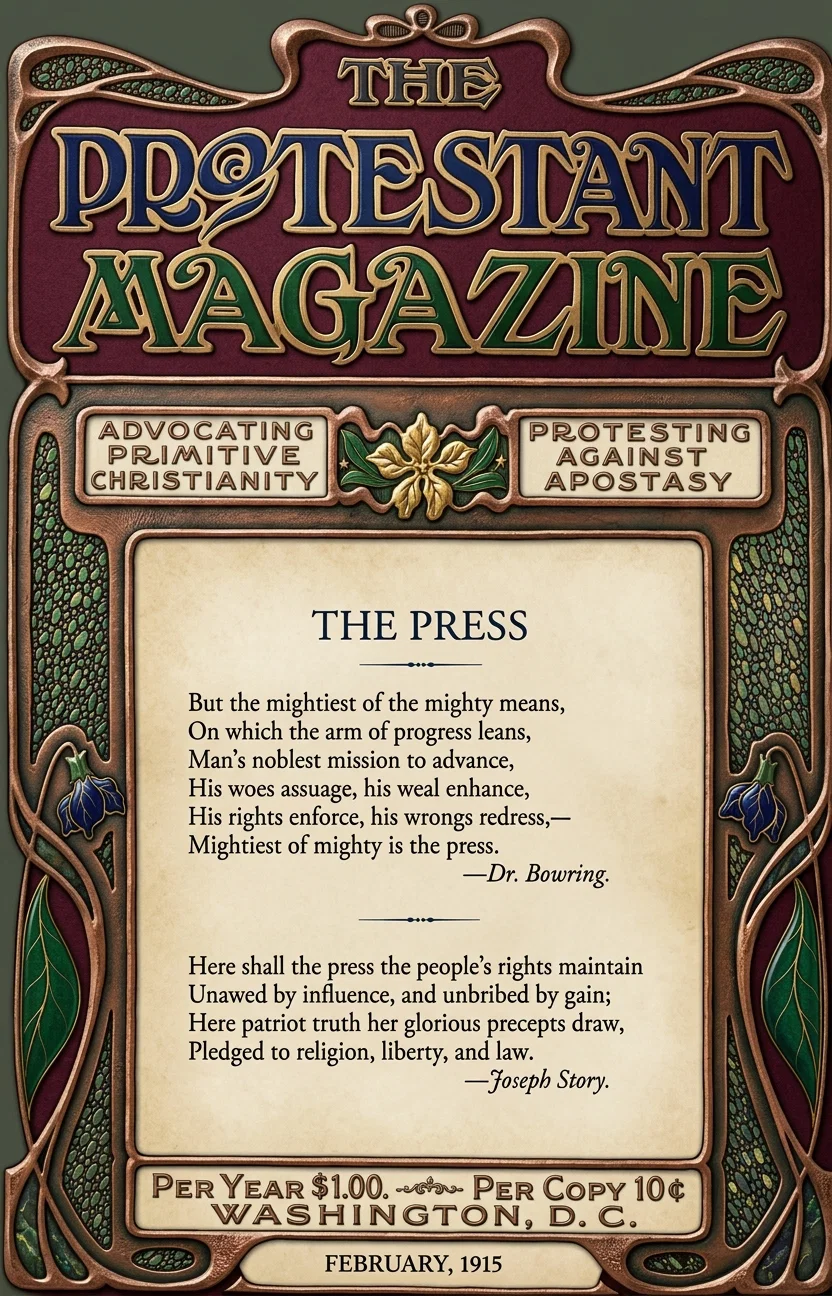
FREE PRESS EXTRA

An exact reproduction of the front cover page of our Free Press Extra of the February Protestant Magazine. Single copy, 5 cents; 5 to 999 copies, 1 cent each; 1,000 copies for $8.00. PUSH IT! LET NO TIME BE LOST!

The Sabbath the Seal of God

I. A. CRANE
The Sabbath is a sign by which we may know the only true God. See Eze. 20: 20. The gods that have not made heaven and earth are false gods. The only true God is the Creator of heaven and earth. Jer. 10: 10-12. The Sabbath is the seal of the law, the Sabbath command being the only command in the law which makes known the Author of the law, the true God, the Creator of “heaven and earth, the sea, and all that in them is.” Ex. 20: 8-11.
We learn from Isa. 43: 1, 3, 11, that he who “formed” and “created” is the only “Saviour.” Paul says that Christ, “through whom we have redemption,” is the one who created all things “that are in heaven, and that are in earth.” Col. 1: 14-17. The same One who created all, is also said to be the “head of the body, the church,” and the one upon whom it “pleased the Father” to bestow the fullness of power. Verses 18, 19; Matt. 28: 18.
When we know Jesus as the Mighty One who spoke the worlds into existence, then we can trust in his power to save. We keep this power in mind when we remember the Sabbath day. But it is not only a sign, or seal, of a finished work in creation; it is a sign of a finished work in redemption,—a sign “that I am the Lord that doth sanctify [or save] you.” Ex. 31: 13; Eze. 20: 12. In keeping the Sabbath, the memorial of his power to create, we know him as Creator; and can never give honor to false gods. In being able to enter into rest on the Sabbath we must know him as a Saviour; for how clearly he tells us that no one can rest on the Sabbath who has not been saved from the bondage of sin. “The wicked are like the troubled sea, when it cannot rest. There is no place, saith my God, to the wicked.” Isa. 57: 20, 21. A slave to sin will never be allowed to rest from sin so long as his master rules within him. One who is guilty of sin cannot rest at any time, much less is he able to enter into the rest of the holy Sabbath. The peaceful, quiet rest of the Sabbath belongs only to those who find rest and deliverance in Christ. We are told that God's seal will never be placed upon an impure man or woman, that “no one can share the refreshing who has not gained the victory over pride, selfishness, love of the world, and over every wrong word and action.” In harmony with this thought we know that no one can keep the Sabbath in its fullest sense while breaking any other commandment, or while in any way under condemnation. The transgression of any one of God's commands, at any time during the week, makes the transgressor wholly unfit to keep the Sabbath when its sacred hours arrive. To be able to keep the Sabbath is indeed a sign that we have been regenerated and are now keeping the commandments of God and the faith of Jesus.
The Sabbath rest is not abolished, however much Satan may declare it is and desire its abolition. It still “remains” for the people of God. Heb. 4: 9. It will be continued for a perpetual covenant from Sabbath to Sabbath in the new earth. Isa. 66: 22, 23. “Let us therefore fear, lest, a promise being left us of entering into his rest, any of you should seem to come short of it.” In these closing days of probation may we seek that preparation that will fit us to receive the seal of God. The time has come for us not only to receive but to preach the Sabbath more fully.
Waurika, Okla.

“I Must Go and Take His Place”

R. P. MONTGOMERY
DURING the present war in Europe the news flashed to a certain home that their eldest son had fallen in battle. The next younger son arose from the table, reached for his hat, and said, “I must go and take his place.” This was true loyalty to his country.
Brethren and sisters, if love, loyalty, and patriotism for one's king and country will lead to such sacrifices as are being made not only by this young man, but by thousands, yea, millions of others in Europe today, what should not the love of God and devotion to this message lead us to do for the hastening of the present truth to the world? We, too, have loyal soldiers of Christ who are falling at their post of duty or having to leave the field because of failure of health. Sons and daughters of Israel, when you hear of one of these cases are you willing to say, “I must go and take his place”? Mothers and fathers of Israel, are not you willing to see your sons and daughters enlist under the banner of Prince Immanuel and fight for King Jesus?
Our foe is working hard to prevent our onward march. We have some fierce encounters. But thanks to our great Commander, we are marching onward, and the victory will soon be ours.
And while the nations of this world are calling for recruits to fill up the broken ranks, we also are calling for recruits in order that the battle may be pressed to the front and a quick work be done in the earth.
Sandakan, British North Borneo.

FRANCIS M. BURG

“Is There Unrighteousness With God?”—No. 1

FRANCIS M. BURG

The assertion can be safely ventured that many readers of the Scriptures have failed to grasp the extent of what is involved in the question of the apostle which constitutes the title of this article. The question, as asked in Rom. 9: 14, grew out of a certain condition that was under discussion at the time; namely, the rejection of the Jews, who had for ages been the chosen and greatly favored people of God. After dwelling briefly on this situation relative to the justice of God, out of which this question naturally grew, I wish to lead the reader into a broader consideration of the Lord’s dealings with his creatures, as it involves the question of his justice.
In Rom. 9: 1-5 it is stated in a strong way that the Israelites were once a greatly favored people, to whom pertained “the adoption, and the glory, and the covenants, and the giving of the law, and the service of God, and the promises; whose are the fathers, and of whom as concerning the flesh Christ came, who is over all, God blessed forever.” In short, as stated in John 4: 22, “salvation is of the Jews.” No other people has ever been blessed in so wonderful a manner as were the Jews. Each of the blessings recited above might be dwelt on with much interest, but it all culminates with the one great thought that through that chosen people God provided salvation for the world. Jesus, through whose name alone sinners must be saved, came in the flesh as one of them. “He came unto his own, and his own received him not.”
What people could have been blessed and honored in a more wonderful manner? Alas, as the apostle is compelled to recite, the once favored people are no longer the chosen vessel in God’s hands to convey to the world his saving grace. They are, as a nation, rejected of him, and their beloved city is left desolate. This situation becomes the occasion for asking the question, “Is there unrighteousness [injustice] with God?” The apostle answers, “God forbid.” It cannot be admitted for a moment that the Lord is unjust in his dealings with his creatures.
An acquaintance with the Bible story of his dealings with Israel, his once favored people, is sufficient to convince us that in setting them aside and withdrawing the blessings and trust which had long been theirs, there was no room for a charge of injustice. Had he not been patient and long-suffering with them? Had they not time and again rejected his proffers of grace and mercy? He “sent to them by his messengers, rising up betimes, and sending; because he had compassion on his people, and on his dwelling place: but they mocked the messengers of God, and despised his words, and misused his prophets, until the wrath of the Lord arose against his people, till there was no remedy.” 2 Chron. 36: 15, 16. Jehovah had “all day long” “stretched forth” his hands “unto a disobedient and gainsaying people.” Rom. 10: 21. See their “Well Beloved,” as he weeps over his own. With quivering lips and tearful eyes, Jesus looks upon the beautiful city, splendid in the mellow rays of the setting sun, and with an emotion that only his loving heart could feel, exclaims, “O Jerusalem, Jerusalem, thou that killest the prophets, and stonest them which are sent unto thee, how often would I have gathered thy children together, even as a hen gathereth her chickens under her wings, and ye would not!” Matt. 23: 37.
Oftentimes in the history of that people did their wayward and rebellious course demand, as far as justice was concerned, that the severest retribution should be meted out to them; but as often the servants of God, the prophets, interceded with strong supplication in their behalf, and mercy was extended. See Eze. 20: 5-22; Neh. 9: 13-38. But the time finally came when justice demanded their punishment, and God told his prophets that any further praying for them would not turn him back from his purpose to send them into exile.
“Therefore thus saith the Lord, Behold, I will bring evil upon them, which they shall not be able to escape; and though they shall cry unto me, I will not hearken unto them. Then shall the cities of Judah and inhabitants of Jerusalem go, and cry unto the gods unto whom they offer incense: but they shall not save them at all in the time of their trouble. For according to the number of thy cities were thy gods, O Judah; and according to the number of the streets of Jerusalem have ye set up altars to that shameful thing, even altars to burn incense unto Baal. Therefore pray not thou for this people, neither lift up a cry or prayer for them: for I will not hear them in the time that they cry unto me for their trouble.” Jer. 11: 11-14. See also chapters 14: 10-12; 15: 16. So they were sent to Babylon to live in captivity for seventy years, to learn in their exile what they failed to learn under more favorable conditions.
Then when the Saviour of men came and tabernacled with them, and by his unselfish ministry revealed all the charms of his matchless character, even offering his life as a ransom for their sins, they “received him not,” but cried out for his blood, and condemned him to the death of the cross.
What answer will the reader give, in view of all this record, to the apostle’s question concerning the justice of God’s dealings in rejecting his once favored people? Paul’s answer is all that can be given, “God forbid.” As the prophet represented it in the parable of the vineyard, the Husbandman had done everything for his vineyard that could be done for it, and still it brought forth wild grapes. See Isa. 5: 1-4.
So God stands fully exonerated from any charge of unfairness or injustice in his dealings with the Jews; and in view of the story of their experience as told in the Scriptures, their rejection came as the inevitable demand of justice.
In following articles the question of the apostle relative to God’s justice will be further considered in its broader application.

Prayer and Faith

George Mueller

L. G. MOOKERJEE
In a study of the lives of missionary heroes of the last few centuries, comparing their peculiar characteristics which made them such illustrious examples, I find none to exceed George Mueller, of Bristol, in regard to prayer and faith. Prayer was “his native breath.”

Answers to His Prayers

A study of his life shows that the total amount received for his missionary work in answer to prayer was £1,611,559 8s. 10¾d. Every penny of this he received without asking any one but God. For his personal expenses he received during his life over £93,000; and as a servant of the Lord Jesus, who, constrained by the love of Christ, sought to lay up treasure in heaven, he gave away from that sum £81,490 18s. 8d. for the work of God.

His Missionary Activities

For seventy years George Mueller served in the cause of God. He founded and directed five large orphan houses in Bristol, England, took care of more than 10,000 orphans, circulated 500,000 copies of Bibles and portions, and distributed £47,188 worth of tracts.

His Foreign Mission Tours

He started his preaching tours in 1875, when he was seventy years of age, and undertook seventeen tours, lasting seventeen years, thus completing his tours in his eighty-seventh year. During these seventeen years he preached in England, Scotland, Ireland, Wales, Switzerland, Germany, Holland, Canada, United States, France, Spain, Italy, Egypt, Palestine, Syria, Asia Minor, Turkey, Greece, Austria, Hungary, Bohemia, Russia, Poland, India, Australia, China, Japan, The Straits Settlements, Tasmania, New Zealand, Ceylon, traveling about two hundred thousand miles by land and sea in the Lord’s service.

His Maxims

“Prayer and faith will do what no power on earth can accomplish.”
“Universal remedy in difficulties is prayer, faith, and patience.”
“Never despair; more faith, more prayer, and more patience will bring the blessing.”
“Pray hard, believe hard, wrestle hard, and never be discouraged.”

Summary

It has appealed to me that George Mueller shines brightly in the list of the heroes of faith of the last few centuries. As the reading of his life has strengthened my faith in God and his promises, I pass on this personal testimony for the benefit of the readers of the REVIEW. To quote Dr. A. T. Pierson: “The work he did for three quarters of a century, and the monument he built in Ashleydown, to witness to a living, present, prayer-hearing God, more enduring than marble, iron, or bronze, still testifies for the Lord, and, like the lighthouse of Pharos, sends out rays to pierce the gloom and darkness, to guide the perplexed mariners who have lost their bearings, and perhaps prevent shipwreck of faith.”
Simla, India.

Health Reform

M. M. MARTINSON, M. D.
When the gospel of Christ reaches the heart, it works a reform there; and by this new order of things, our ways of living, as well as of thinking, are changed. Health reform is not a new thing that has sprung up in this age of the world. We find it in the early church. Peter speaks of it like this: “For the time past of our life may suffice us to have wrought the will of the Gentiles, when we walked in lasciviousness, lusts, excess of wine, revelings, banquetings, and abominable idolatries.” 1 Peter 4: 3. Here we find almost a complete list of that which the flesh takes delight in doing before the gospel reaches the heart and makes a change. In the next verse we see that the gospel did work a reform in that early church, and to such an extent that its members were evil spoken of by their former associates, who were condemned by the gospel reform.
It is always the business of the adversary to make people believe that there is no need of overcoming the lusts of the natural heart; but let us remember that all uncleanness of the mind and of the body must be put away before we can enter the kingdom of heaven. Most of us realize that it takes more than human strength to overcome the lusts of the flesh; and when the Christian does gain that strength to overcome, he will not do anything that will lower the strength of his body, which is the temple of Christ. He will be a health reformer, not because he has to be, but because he sees that it is in harmony with Heaven’s principles.
From experience I have learned that people do not always receive the principles of health reform as a part of the gospel, as that, in most cases, would mean a change in eating and drinking and living. Worldly persons consider these matters as nobody’s business but their own, and many Seventh-day Adventists say the same thing by their indifference. It is not a popular doctrine to teach and preach; for a person cannot teach that which he does not live himself. For a long time I have felt that we have not given this subject so much thought and study as we ought.
I think we all agree that it is Satan’s delight to get us to act in such a way as to lower our strength, yes, even destroy our bodies. Our bodies should be in the best condition in order that we may speedily spread this gospel, and not for that reason only, but also so that we can endure the trials of the last days. However, instead of eating for strength, many are digging their own graves with their teeth.
“Our habits of eating and drinking show whether we are of the world or among the number whom the Lord by his mighty cleaver of truth has separated from the world. These are his peculiar people, zealous of good works. . . .
“Many are suffering, and many are going into the grave, because of the indulgence of appetite. They eat what suits their perverted taste, thus weakening the digestive organs and injuring their power to assimilate the food that is to sustain life. This brings on acute disease, and too often death follows. The delicate organism of the body is worn out by the suicidal practices of those who ought to know better.”—“Testimonies for the Church,” Vol. VI, pages 372, 373.
We may have the light of truth, know what it teaches, and still lose eternal life because we cannot control our appetites and lust. We have come to a time in this world’s history when every person who will go through to the kingdom must have full strength of body and mind to combat this evil age. To do this he must follow Paul’s instruction, “Whether therefore ye eat, or drink, or whatsoever ye do, do all to the glory of God.” 1 Cor. 10: 31. When we are willing to do this, we may ask for strength from above, and grace will be given. We can then overcome all temptations, and it need not be said of us, “Ye ask, and receive not, because ye ask amiss, that ye may consume it upon your lusts.” James 4: 3.
There never was a time when there were so many inventions to cause us to go astray, yes, even to destroy us, as there are now. That is the reason why we have been given special instruction through the spirit of prophecy. We need this instruction to help us win the prize of eternal life in this race.
We are living in the time of Matt. 24: 48, 49, when many professed Christians are eating and drinking with the drunken. That prophecy is being fulfilled before our eyes. Luke 21: 34, 35, warns us against surfeiting and drunkenness, lest that day come upon us unawares, as it will upon the whole world. We have been told of this danger; it has come; it is here now; and unless we heed the special instruction to watch and pray, we shall be ensnared. We need the Spirit of God so that we can see ourselves as Heaven sees us. Then there will be health reform in the home, and more medical missionaries in the church.

The Two Mysteries

J. B. WEST
“I marvel that ye are so soon removed from him that called you into the grace of Christ unto another gospel: which is not another; but there be some that trouble you, and would pervert the gospel of Christ. But though we, or an angel from heaven, preach any other gospel unto you than that which we have preached unto you, let him be accursed.” Gal. 1: 6-9.
There are two mysteries referred to by the apostle Paul, the “mystery of the gospel” and the “mystery of iniquity.” The character and work of these two mysteries are so clearly revealed in the Scriptures that we may discern the true from the false. According to Paul’s epistle, some of the Christians of Galatia had been influenced to turn from the true mystery “unto another gospel,” which was “not another” because it did not bear the divine credentials. It is very evident that the Papacy is teaching a counterfeit gospel in opposition to the true gospel. Dr. Wylie, in “History of the Papacy,” page 404, truly says:—
“This counterfeit church has its high priest,—the pope,—who blasphemes the royal priesthood of Christ by assuming his office when he pretends to be lord of the conscience, lord of the church, and lord of the world; and by assuming his names, when he calls himself ‘Light of the world,’ ‘the King of glory,’ ‘the Lion of the tribe of Judah,’ ‘Christ’s vicar and God’s vicegerent.’ This counterfeit church has, too, its sacrifice,—the mass,—which blasphemes the sacrifice of Christ by virtually teaching its inefficiency, and needing to be repeated as is done when Christ’s very body and blood are again offered in sacrifice by the hands of the priests of Rome, for the sins of the living and the dead. This church has, moreover, its Bible, which is tradition, which blasphemes the Word of God by virtually teaching its insufficiency. It has its mediators,—the saints and angels, and especially the Virgin,—and thus it blasphemes the one Mediator between God and man. In fine, it blasphemes the person and office of the Spirit as the sanctifier, because it teaches that its sacraments can make holy; and it blasphemes God by teaching that its priests can pardon sin, and can release from the obligations of divine law. Thus has popery counterfeited, and by counterfeiting set aside, all that is vital and valuable in Christianity. It robs Christ of his kingly office by exalting the Pope to his throne; it robs him of his priesthood in the sacrifice of the mass; it robs him of his power as mediator by substituting Mary; it robs him of his prophetic office by substituting the teachings of an infallible church; it robs God the Spirit of his peculiar work as a sanctifier, by attributing the power of conferring grace to its own ordinances; and it robs God the Father of his prerogatives by assuming the power of justifying and pardoning men.”
The fourth commandment is the only one of the ten in the decalogue that defines the true and living God. It is not a matter of surprise, then, to find that the man of sin has sought to release men from the obligations of the fourth commandment by instituting a counterfeit sabbath as a substitute for the Sabbath of Jehovah. By means of the Sunday sabbath the “man of sin” will cause all the world to worship him as God. According to the prophecy of Revelation 13, as far as the majority are concerned, he will succeed in his deception. But there will be a faithful remnant who will refuse to acknowledge his sign of authority. We should pray for a holy boldness to declare the true mystery, which is “the power of God unto salvation to every one that believeth.” Rom. 1: 16. Thank God there is power in the gospel of Christ to save from sin. This is being proved by the experience of many who are being delivered from “the mystery of iniquity” and are now rejoicing in the glorious liberty of the children of God.
Kirkintilloch, Scotland.

All Are Equal Before God

CLARENCE SANTEE
“And without controversy great is the mystery of godliness: God was manifest in the flesh, justified in the Spirit, seen of angels, preached unto the Gentiles, believed on in the world, received up into glory.” 1 Tim. 3:16.
God’s long-suffering, forbearance, and love are mysteries not understood by men. Angels desire to know more of them than they do. Lucifer, though chief of the angels, could not understand their meaning, and attributed their manifestation to weakness and indecision. Of this the servant of the Lord has said:—
“A compassionate Creator, in yearning pity for Lucifer and his followers, was seeking to draw them back from the abyss of ruin into which they were about to plunge. But his mercy was misinterpreted. Lucifer pointed to the long-suffering of God as an evidence of his own superiority, an indication that the King of the universe would yet accede to his terms. If the angels would stand firmly with him, he declared, they could yet gain all that they desired.”—“Patriarchs and Prophets,” page 39.
While the deep, unfathomed love of God continues to be questioned and doubted, its results continue to be seen and experienced. “God was manifest in the flesh.” There he was “seen of angels,” and not until then did they begin to see the love of God in its true light. There Gentiles saw him. Their draft at the fountain is as copious and full as that of the priest or the angel. The cup and the will are all that is required at the fountain as they are bidden to “dip down and drink.”
Shining cherubs; men of education, position, and mental power; and degraded heathen, with but one ray of light to penetrate their gloom,—all are equal when considering the manifestation of God.
Sammy Morris, a child in the jungles of darkest Africa, unlettered, yet hearing the voice of God’s love, wandered long days and weary nights among the wild beasts, until he reached the coast,—how, none but God can know,—and later, by a curious providence, he came to New York. There by his closer acquaintance with God he brought some of the city’s great divines humbly to their knees. Often the knowledge of God is seen shining in the face of the unlettered child of faith, while its softening influence has glanced powerless from the steeled armor of the Bible critic and the university theologian.
“For the Jews require a sign, and the Greeks seek after wisdom: but we preach Christ crucified, unto the Jews a stumblingblock, and unto the Greeks foolishness.” 1 Cor. 1:22, 23. “Where is the wise? . . . hath not God made foolish the wisdom of this world?” Verse 20.
There is something in the plan of salvation that tests the depths of trained mental power, showing its utter weakness to comprehend, while its precious fullness glows through the child of darkness who first turns his face to the light of God. Training, education, may be used in the hand of God in many ways to advance his cause, but it is entirely cast out of the balance when a man is drawn to know God. Faith alone can claim the coveted blessing. That comes directly as a gift from God (Eph. 2:8), and is shown in unquestioning obedience. “Hunger and thirst after righteousness” will claim the reward. See Matt. 5:6.
The disposition to lean upon self, to trust in self, and to become sensitive and resentful under supposed slights or inattention to self, is often strengthened by supposed mental superiority or by temporary power. To the extent that this is so, such advantages become an actual menace to a continued acquaintance with God. The disposition to justify self increases as we drift away from God.
In Israel there was a yearly offering that brought vividly to mind the eternal equality of all, the rich and the poor, the ruler with his thousands and the beggar by the wayside.
“Every one that passeth among them that are numbered, from twenty years old and above, shall give an offering unto the Lord. The rich shall not give more, and the poor shall not give less than half a shekel, when they give an offering unto the Lord, to make an atonement for your souls.” Ex. 30:14, 15.
This was a most solemn offering. Other offerings could be made at the discretion of the givers; but this offering, though small, was to be made by all—no less and no more. It represented the equality of value in the atonement. “The rich shall not give more, and the poor shall not give less than half a shekel.” The lesson must have been evident. When the atonement was made, when one by one they stepped into the balances of God, in the type, they were reminded by that offering that all were valued alike. The lesson was not written alone for them. We are now, one by one, stepping into the balances of the judgment. The value of the man of wealth and of him who is hungry for bread is still the same. All are equally precious, both valued by the worth of the offering made “once for all.”

The Balance or the Boundary Line

The unseen line bounding human probation is not arbitrarily drawn by God’s fiat, but each one hastens or delays this crossing, by individual choice of action. There is one thing that is not left to man’s choice: he must come to judgment. “Every one of us shall give account of himself to God.” Rom. 14:12. In that there is no choice. Beyond that, each person who gives account may choose what that account shall be. Yes, more, he must choose, whether he wills to do so or not. The responsibility in the freedom of choice is placed upon him, and he cannot evade it. A refusal to make choice, is making choice; for Christ has said, “He that is not with me is against me.” Matt. 12:30. There is no middle or neutral ground.
No man can know how near the line of final decision may be, but he is assured that the right and power to choose for God is his as long as he has any desire to use it. The “whosoever will” is put into the mouth of the servants of God, and by them is still sounded to the world.
The boundary is neared as God’s call grows faint and still more faint to the ear, and is crossed when that voice is heard no more. There is but a shade between the last time that that voice is faintly heard and the next call, which is unheard. It is a most serious matter to close the ear to the voice of God. If that voice has become faint, there is all the more cause for haste to heed and obey. To some the repeated calls of God become distasteful; but, dear friend, be assured that if those calls should cease tomorrow, never to trouble you more, your perplexity would be deepened tenfold. What a sickening, heart-sinking feeling will come to the one who awakens to the fact that it is too late! How that soul will long to hear, just once more, that voice that he so often stifled and stifled! Thank the Lord, we can hear it now. We can obey it now. You who have wished that voice, speaking through your conscience, stifled, how much would you accept today, if given the opportunity, to have it silenced forever? You would not set the price. You yet expect to be saved. Then begin now, and that voice which has seemed unwelcome, the voice of duty, will be sweeter than that of the loved ones of earth, and God’s peace will be yours.
Loma Linda, Cal.

Rich in Faith

MRS. JAMES LAUSTEN
O LUCIFER! in vain thou wouldst ensnare, With such great promise as this world so fair, The One who left such wealth as none hath known, And chose to die. Naught else could e’er atone Thou knewest well, and ever was prepared To thwart God’s purpose, thou who even dared To think within thine heart such vain design To stand on equal terms with the Divine.
And thus I would thy subtle mind expose To simple ones who dream in sweet repose, Unwary ones who seek earth’s brightest flowers, Not knowing serpents nestle ’neath its bowers. Yon path is most alluring, but beware! It leads to disappointment and despair; Earth’s pleasures are the weapons that control The foolish ones who choose to lose their soul.
And many will for gain be led astray, Unmindful of the poor along the way,— Life’s day is far too short to covet gold, For nothing will endure outside God’s fold,— And others are ambitious for a name, To sit on lofty pinnacles of fame; Thus holy messengers are held at bay, And grieve to see such pride and vain display.
O, rather choose a life that only knows Such humble happiness as grace bestows! A peaceful home, a body rich in health, And quiet pleasures,—these are more than wealth, For what will mortal man exchange his soul In the contending race to reach the goal. O, haste to find a place at Jesus’ feet, And learn of joys eternal and complete!
Knox, Ind.
Continue reading: Abide in the Ship