The Youth’s Instructor, Vol. 34, No. 38.

THE WELL-SIDE

The Youth’s Instructor

Sep 22, 1886

S. D. A. Publishing Association · Battle Creek, Mich. · Sep 22, 1886

THE WELL-SIDE.
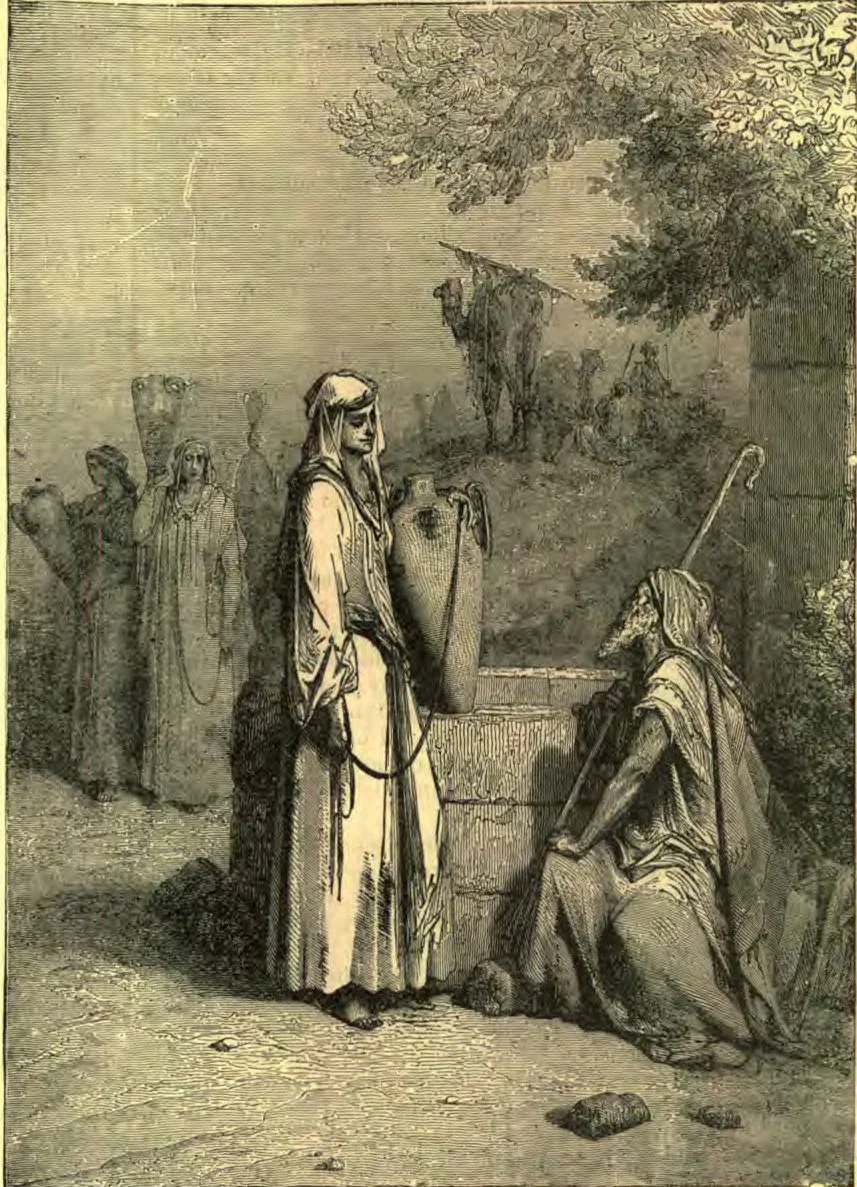
THESE old wells! How many memories throng the mind, as we rest here by this curbing in the cool of the evening, and watch the women coming out to draw water! Perhaps there is no other place in all Palestine where one can observe to such good advantage the peculiar characteristics of the inhabitants as right here at these public wells; for, as you will doubtless remember, water is comparatively scarce in the Holy Land, and it was seldom that a private individual could afford the luxury of a well. Accordingly the well, which frequently stood on the outskirts of the town, was a common place of resort for the women, who came hither at the cool of the day to exchange bits of friendly gossip with one another while they filled their water jars.
As we sit here and watch them, coming singly or in companies, with their large earthen jars, to draw water, we are reminded of a time, when, long and long ago, a traveler, worn and thirsty, paused outside a city gate by a well; and making his camels kneel down without the city, he cast his eye over the group at the well,—critically, we may suppose, for he had come a long journey to find a wife for his master's son. And even while he was communing in his heart with the Lord, asking for a sign whereby he might know the right one, there came to the well a damsel “very fair to look upon.” And when he asked her, as a test of kind-heartedness for a drink of water, she gave a drink not only to him, but drew water for his ten camels also. “And the man wondering at her held his peace; to wit whether the Lord had made his journey prosperous or not.” And we hardly know which to marvel at the most, the unusual benevolence and pure innocence of Rebekah, or the stupid indifference of Eliezar, who stood helplessly by while she, unaided, drew water from the deep well for all the thirsting animals.
By the gate of Bethlehem there stood a remarkably pure well of water; and we remember how one time when the city was held by enemies, and David was cut off from the water where in childhood and youth he had so often quenched his thirst, he longingly cried, “O that one would give me drink of the water of the well of Bethlehem which is by the gate!” And when the three mighty men secretly broke through the ranks of the enemy, and at the peril of their lives brought the water, David’s soul was touched by their devotion, and he poured the water out before the Lord, saying, “Be it far from me, O Lord, that I should do this; is not this the blood of men that went in jeopardy of their lives? And he would not drink it.”
And we remember another time, many, many years after this, when a company of travelers wound their weary way through the Judean hills, to the country of the Samaritans; and one, the Leader, paused to rest by a well, which was Jacob’s well, while his disciples went into the town to buy food. “There cometh a woman of Samaria to draw water: Jesus saith unto her, Give me to drink.”
The woman marveled at the request, for the Jews and the Samaritans were bitter enemies, and “had no dealings” with one another. “Jesus answered and said unto her, if thou knewest the gift of God, and who it is that saith unto thee, Give me to drink; thou wouldst have asked of him, and he would have given thee living water.” And the woman, still wondering at his strange words, made answer, “Sir, thou hast nothing to draw with, and the well is deep; from whence then hast thou that living water? Art thou greater than our father Jacob, which gave us the well, and drank thereof himself, and his children, and his cattle?”
And then Jesus replied, in those gracious words that have brought comfort to so many of his followers since that day, “Whosoever drinketh of this water shall thirst again; but whosoever drinketh of the water that I shall give him, shall never thirst; but the water that I shall give him shall be in him a well of water springing up into everlasting life.” That all may have this priceless gift we know; for we have in the Record, these words left us: “Let him that is athirst come. And whosoever will, let him take of the water of life freely.” W. E. L.

GRAPE CULTURE.

(Concluded.)
The methods of grape culture vary with the degree of heat, moisture, and soil of different localities. A sunny exposure, a good soil, but not over-rich, and constant attention are three essentials. In all the cooler countries and even in the large vineyards of California, the vines are pruned very closely by the practical grape raiser, and are protected where the winters are severe, usually by a light covering of earth. The vines of France are trained to short poles or saplings. The Italians give them still greater liberty, allowing them, it is said, the freedom of the lofty elms. The frequented wells of Turkey and Greece are trellised around and embowered in fruitful vines.
Dried grapes, known as raisins and currants, are prepared in great quantities for market. Great Britain in 1875 imported 27,575 tons of the former and 53,140 of the latter. For curing raisins several methods are employed. The muscatels, though the best article in the market, are prepared in the simplest way, which consists in “partially cutting through the stalk of the ripened bunches, and allowing them to shrink and dry upon the vine by the heat of the sun.”
Currants sold at the stores and used so much in cooking are not, as some think, the dried fruit of a bush like that cultivated in our gardens; but they are from real grapes growing on a graceful little vine. These are produced and prepared for market in great quantities about the ancient city of Corinth in Greece. The ripened fruit, when dried in the sun on the ground, is packed in barrels and thus made ready for shipment.
Fruit has been bestowed upon us so liberally by the Creator that it seems difficult to choose, but the grape is easily raised. It comes early into bearing. One planting suffices for a lifetime. In drought, it keeps green when all else has withered. It is withal so tractable and homelike, yielding itself to the hand of the cultivator, that we delight to have it about us. Since all, even the children, may learn to cultivate or at least to train it, we venture to tell how this may be done. Should you read this plan and ever try it, remember that your own experience will teach you more than books or papers. If you cultivate the soil for flowers or fruit or grain, prepare the mind at the same time for an occasional disappointment. The grape, of course, has its enemies, but these you will find out for yourselves better than we can tell you.
Should you decide to plant a little vineyard this fall, begin now. Select a rich piece of ground which is perfectly drained and does not slope to the north. Plow it or spade it real deep; twenty inches is not too much. Keep it mellow and free from weeds until the middle of autumn. Select vines two years old at some good nursery, and set in October. The best common varieties like the Delaware, Concord or Clinton will cost twenty-five or fifty cents each. If several are planted, put them eight feet apart. Work fine, moist earth carefully and evenly among the roots, and press lightly. Ever afterward keep the soil all around well stirred and free from weeds. Late in the fall lay the vines upon the ground, and cover lightly with well-rotted sods or something else that will keep them from freezing. After four or five years, the vines will have become large and strong and need not be laid down; but if some coarse material be allowed around the roots, they will be kept moist and warm.
The first spring after planting, set a solid stake five or six feet high near each vine. Allow only one shoot to grow the first summer, and keep it fastened to the stake with some tie that will not cut the tender shoot. Pinch the ends from the side branches that form on this young vine so as to leave each with but one leaf. A year from planting, your vine will be from two to six feet long. When the leaves have fallen, cut it back to the length of a foot and a half.
When danger from frost is past the next spring, remove the covering which you were directed to provide each fall, and allow two vines to grow from this stub, training each to a separate stake. These branches, if thrifty, will each bear two or three bunches of fruit, but all the side branches should be pinched again this year when they have formed one leaf, and the two old vines shortened to five or six feet when the leaves have fallen.
The third year and each year afterward these two standard vines will produce bearing arms which should be cut off beyond the fruit, one or two buds, as soon as it has set. Each fall these arms, after bearing, should be cut off again within two buds of the old wood. The side branches which bear no fruit should always be pinched out while young; and if you wish extra nice fruit, allow not more than half the clusters to grow on the bearing arms.
If a vine gets old and refuses to bear good fruit, cut it off in the fall about a foot and a half above the ground, allowing it in the spring to produce two new branches like the young vine of the second year. The chief benefits of pruning are lost by neglecting it until the fruit is nearly grown. On the other hand, pruning early in the spring exhausts the vine from the loss of ascending sap.
There is something about this plant, especially when under our own care and observation, that seems always to suggest new and good thoughts. You will notice that it has some traits in common with school-children. Both, if neglected, seem to choose the freedom of doing nothing; and the longer they are neglected, the less inclined are they to do. Under close training, the vine multiplies clusters far beyond what it can mature well, and the child takes half a dozen or more studies when two or three would be much better if well exposed to the sunlight of thought.
The sacred writers and even our Saviour found frequent occasion to honor this home-like plant. Parables the most beautiful and impressive to be found in the Sacred Word were founded upon it. Its presence in the future land of promise, the New Earth, is a matter of prophecy. As we prune away the fruitless branches from the plants under our care, and bestow even our best labor with uncertain results, let us consider the True Vine and learn to abide in him that we may bring forth much fruit; that even to us the promise may be fulfilled, “They shall build houses and inhabit them; and they shall plant vineyards and eat the fruit of them.” Isa. 65:21. We think that the rich, clustering fruit in those perennial vineyards will be such as no mortal hands ever pinched or bore away even from the valley of Eschol. GEO. R. AVERY.

BY THE WELL-SIDE.

By the well-side in the desert, ’Neath the mid-day’s burning heat, How I panted for the water Cool and crystal at my feet! And my spirit died within me Till a voice like music fell: “Draw near and quench thy fevered thirst, Behold the living well.”
By the well-side, by the well-side, How my soul delights to sing, With its chalice filled and sparkling From the never-failing spring! O ye travelers in the desert, Hear the loving Saviour’s call: “Draw near and quench your fevered thirst, There’s room, there’s room for all.”
By the well-side, O my Father, Let me drink and drink again Of the water Jesus gives me Till my earthly star shall wane; Then rejoicing, then exulting, When a few more days are o’er, The boundless ocean of his love I’ll drink forever more. —F. A. N.

TO THE BOYS.

My dear boys, I want to give you a little of what I have noticed all grown-up persons seem anxious to unburden themselves, that is—advice.
Lay a foundation of good habits while young, and you will always have something firm to stand upon. Do not abuse your mind with the idea that you must sometime “sow your wild oats,” and that it is better to do it while you are young, for then it will be through with forever. A farmer might as well say, “Sometime I must have a crop of Canada thistles, so I will sow them this spring, and then never be troubled with them again!” He would find, to his chagrin, that they were much easier planted than got rid of. So with the evil effects of the sins of your youth; they will crop out all your after life. Or, if trying earnestly to serve the Lord, you forsake them, the bitter memories are then to come into prominence when least welcome.
Bad habits are never contracted all at once. The first time, you do a wrong thing with twinges of conscience and falterings. That is the first little thread Satan winds about his victim. The second time it is easier to commit the sin, and the enemy’s bond is twice as strong; until at last you become habituated to wrong-doing, and his bonds become strong fetters that nothing but the Spirit of God can break.
Make it a rule of your life to have good company or none. Be good and obedient to your parents; you cannot have them long, at best. Don’t imagine that it adds to your manliness to smoke a cigarette, and to speak of your father as “the Gov’nur,” or “the old man.” All parents are willing to dispense with brilliancy in their children when it is to be obtained at the sacrifice of good manners and obedience. Unhappily American youth have a world-wide notoriety for pertness, and for disrespect to elders. I want to tell you a true story of what occurred in New York.
Paul P—— was the youngest of five children, an affectionate child, the pet and plaything of the household. When he was nine years old, he had the misfortune to lose his father; and his mother’s love now centered entirely in her children, especially in the youngest.
In mistaken kindness she thought, contrary to Solomon, that to “spare the rod” would not “spoil the child;” and accordingly Paul was left to his own way, which, as he grew older, evil companions soon made a bad and wicked way, and he went on the downward road until his family lost all control of him.
One cold night last winter, his mother came into the police station on First avenue, at midnight, and stood a minute before the desk, panting for breath. Then, with bitter shame and sobs, she asked that an officer might be sent home with her, to arrest her sixteen-year-old Paul, who had come home intoxicated, and was so unruly that she was afraid to sleep in the house with him.
One of the men, who was himself a father of boys, volunteered to go with her. As they were walking along, he ventured to suggest that probably she had been too indulgent with her boy in the past, when she might have controlled him. She answered: “That’s the trouble. I never lifted my finger to him. I always allowed him to have his own way. Now he does not mind me; and when I tell him not to associate with bad boys, he turns on me like a savage. He thinks I am his enemy, and his evil companions his firm friends!”
“O,” continued she, wringing her hands, “I would rather be dead than endure again what I have passed through in the last six months. I have done everything for that boy, and have been a good mother to him; and this is my pay!”
When they had reached the third block from the station, Mrs. P—— suddenly halted, placed her hand upon her heart, and crying, “My God! my heart is broken!” fell forward to the side walk, and immediately expired. The officer procured assistance, and she was tenderly conveyed back to the station, and a detective was sent to arrest Paul, whom he found asleep. When he told the two sons and daughters of their mother’s death, their anguish was painful to witness, and they bitterly reproached Paul. He did not need their accusations then; for his punishment seemed greater than he could bear, as he realized the awful consequence of his unfilial conduct. He ran all the way to the police station, and throwing himself down by his mother’s body, he wound his arms around her and touchingly pleaded for forgiveness.
“Mother, wake up and speak to me,” he moaned; “I want to confess how wicked I’ve been, and what a good boy I will be hereafter. I will never cause you pain again. You won’t have to cry, and sit up nights for me any more. O mother, look up and speak!”
Then the other children came in, and their exhibition of grief was an added weight to Paul’s heavy burden. Through the intercession of an elder brother, he was permitted to go home with them, the Justice rightly thinking that no human law could add to the boy’s punishment any thing comparable to what he was now undergoing. Though his conduct henceforth should be irreproachable, do you not think his “wild oats” have brought him a harvest of remorse that will last him during life? L. E. ORTON.

GOD IS WATCHING.

When Hans Christian Andersen, who wrote many pretty stories for children, was a little boy, he was attacked by a wicked man, who often beat the children who came near him. When the man was about to strike him, Hans turned and said, “O sir, how can you be so wicked as to strike me while God is looking on?”
These words so awed the cruel man that he lowered his club and did not strike. Would it not keep us from many a sinful act to remember that God is watching all we do?—Sel.

SEPTEMBER

SHORTER and shorter now the twilight clips The days, as through the sunset gates they crowd. And summer from her golden collar slips, And strays through stubble-fields, and moans aloud, Save when by fits the warmer air deceives, And, stealing hopeful to some sheltered bower, She lies on pillows of the yellow leaves, And tries the old tunes over for an hour. —Alice Cary.

THE GAUCHOS.

The gauchos are the inhabitants of the pampas of South America, and are one of the most curious and interesting people in the world. What the cow-boy is to North America, that the gaucho is to South America. He is said to have descended from the early Spanish aristocrats who first conquered the Indians. The gauchos are the most wonderful riders in the world, and their use of the lasso and bolas is proverbial. They learn to ride before they can walk; in fact, they never learn to walk properly, but have a curious, waddling gait peculiar to themselves. They spend nearly their whole lives on horseback, and are quite helpless on foot; and if a poor fellow loses his horse, he can literally be said to be too poor to work.
The gaucho is wonderfully polite; he can bow like a dancing master, and addresses even a beggar as “your mercy” or “my esteemed companion.” Every true gaucho also carries his guitar, on which he thrums his native tune, and extemporizes poetry, expatiating on the virtues of his audience. He is half savage and half courtier, and is just as cruel as he is polite, and would murder a fellow being with the same nonchalance as he plays his guitar or smokes his cigarette.
All the inhabitants of the pampas are hospitable, so much so, that if they see a traveler far off in the distance, they will send after him and beg him to sojourn the night with them. One reason for this is that they believe the angels go about disguised as men, and that if they can have the privilege of entertaining one, it will be a source of great blessing to them.
The gaucho lives solely on meat and yerba mate, a kind of tea made from the Paraguayan holly, which is very nutritious. Although surrounded by leagues of garden land, they never think of cultivating it, or raising vegetables on it, or in fact of doing anything on foot; and they may be said to be at once the most active and yet the most indolent of all people. Perhaps this characteristic is clearly illustrated in the way in which they make butter. After collecting the cream, it is put into one of those goat-skin or pig-skin bottles, just such as we read of in the Bible, and the gaucho, attaching his lasso to it, gallops away with the bottle of milk bouncing and bumping behind him; and by the time he gets to town, the butter is made.
A gaucho is a devout Catholic, and always says his prayers, no matter how much he may be laughed at. It is a curious fact that wherever men live surrounded by dangers and with their lives in their hands, they, as a rule, pray. It is sad to think that when God gives men safety, they so soon forsake him. A gaucho only recognizes two classes of religious people,—the Christians, which, of course, are themselves, and the Protestants and Indians, whom he classes together as having about the same amount of religion; and in nine case out of ten, the gaucho is right. Although the poor gaucho really believes he loves the Lord, yet he will ask God to help him steal his neighbor’s cattle, or murder some man that has offended him. And although he is as brave as a lion, yet he has a terrible fear of such a common thing as a will-o’-the-wisp, which he calls the mala luz, and thinks it is an evil spirit.
FRANK HOPE.

SHINING CHRISTIANS.

A friend told me that he was visiting a light-house lately, and said to the keeper, “Are you not afraid to live here? It is a dreadful place to be in constantly.” “No,” replied the man; “I am not afraid. We never think of ourselves here.” “Never think of yourselves! How is that?” The reply was a good one. “We know that we are perfectly safe, and only think of having our lamps burning brightly, and keeping the reflectors clear that those in danger may be saved.” Christians are safe in a house built on a Rock which cannot be moved by the wildest storm, and in a spirit of holy unselfishness they should let their light gleam across the dark waves of sin, that imperiled ones may be guided into the harbor of heaven.—The Fellowship.

EARLY COINS OF AMERICA.

No doubt you remember reading in the “Scrap-Book” of the INSTRUCTOR, not long ago, that in the 17th century the white colonists made wampum a legal tender. Well, after a time the people desired some other kind of currency. What it was that afterward came into use from time to time, and how it was brought about, we will copy from what a writer in the Treasure-Trove has said about it, which is as follows:—
“By 1652 colonial life had so advanced that a metallic currency was demanded. In that year the General Court of Massachusetts issued at Boston some silver pieces, having stamped on them on the one side the letters N. E. (New England), and on the other the values, XII., VI., and III., respectively. Of the threepenny pieces only two that are known to be genuine, can now be traced. These pieces have no date, and, despite their rude execution, possess considerable interest as being the earliest American coinage. The absence of any design gave such offense, however, that another series was issued in October, 1652. The design on these coins is an Oak tree with scraggy branches, inclosed in a circle of dots. A second series of this tree money bears a Pine tree, but in other respects resembles its companion.
“This tree money, once known as Boston or Bay shillings, was issued at different intervals for nearly thirty years, yet the original date, 1652, was retained on every piece. No genuine penny pieces of either type are now known; the genuine having been struck on a die, all that are cast must be counterfeits.
“In 1685, the Boston mint was closed by order of Charles II. No more issues of Massachusetts money were then made until 1766, when the Colonists, in expression of their gratitude to William Pitt for his exertions in obtaining the repeal of the Stamp Act, issued a medalet, or token, which soon became used as current money. On the obverse is a bust of Pitt, with wig and queue, with the legend, ‘The restorer of commerce, 1776;’ and below the bust, the words ‘No stamps.’ On the reverse is a ship sailing to the right, with the word ‘America’ on the field behind it, with the legend, ‘Thanks to the friends of liberty and trade.’”
“At different periods, various coins were issued by nearly all the different American States.
“Although the Declaration of Independence had been adopted in 1776, it was not until several years afterwards that a Federal coinage was issued. Up to that period the Colonies had either minted on their own account, or private individuals had struck or imported copper coins for currency. In 1787 the Government issued the ‘first United States cent’—now called the Franklin Penny, because one of his terse sayings was inscribed upon it. On the obverse is a sun-dial in the center, shone upon by the sun, with the word ‘Fugio’ on the right, and 1787 in the left, and in the exergue, ‘Mind your business.’ On the reverse is a circle formed of thirteen rings, representing the original number of the States; the small circles on one type, plain, and on another, each bears the name of one of the States. The large circle incloses a smaller one, on which are inscribed the words ‘United States;’ on one variety—there are seven—the order is reversed, and the words read, ‘States United,’ while in the center is the legend, ‘We are one.’ It is quite a jump from this to the splendid fifty-dollar gold piece issued in 1851 from the San Francisco mint, a large and handsome coin.
“With the issue of this solitary but interesting piece, the Federal mint contented itself from 1787 to 1791, when the present mint was established and at once proceeded to prepare dies for new issues.
“Besides the mints at Philadelphia, there are also Government mints at San Francisco and Carson; and a visit to one of them is among the most pleasant things to be remembered.”

PARABLES OF CHRIST.

LESSON 2.—THE WHEAT AND THE TARES, AND OTHER PARABLES.

1. To what did our Lord liken the kingdom of heaven in Matt. 13:24?
2. What took place while men slept? Verse 25.
3. What was observed when the blade had sprung up and brought forth fruit? Verse 26.
4. What did the servants of the householder say to him? Verse 27.
5. How did he answer them? Verse 28.
6. What inquiry did the servants then make? Same verse.
7. Why did the master object to having the tares plucked out from among the wheat? Verse 29.
8. How long were the wheat and the tares to be left to grow together? Verse 30.
9. What was to be done when the grain should be harvested? Same verse.
10. What did the disciples say to Jesus when the multitude had been sent away, and he had gone into a house? Verse 36.
11. According to the Saviour’s explanation, who sows the good seed? Verse 37.
12. What is the field? Verse 38.
13. What does the good seed represent?
14. What did the tares represent?
15. Who sows the bad seed? Verse 39.
16. When does the harvest come?
17. Who are the reapers?
18. What comparison does the Saviour make? Verse 40.
19. On what errand will the Son of man send his angels when the end of the world shall come? Verse 41.
20. What shall be done with these offenders? Verse 42.
21. What will be the condition of the righteous? Verse 43.
22. What is clearly taught in this parable?—That neither the righteous nor the wicked will receive their reward until the end of the world.
23. Repeat the parable concerning the hidden treasure. Verse 44.
24. What lesson does this parable seem to teach?—That the kingdom of heaven is more to be valued than all things else, and that whoever would obtain it must be willing to give all things for it.
25. What other parable teaches the same lesson? Verses 45, 46.
26. Relate the parable of the drag net. Verses 47, 48.
27. Give the Saviour’s explanation of this parable. Verses 49, 50.

THE CANARY NURSE.

The Humane Record published the following beautiful story of a canary bird’s tender care of strange, helpless birds; from which we may learn lessons in kindness and sympathy:—
“Many a soldier will remember the well-known Balfour Hospital at Portsmouth, Va. To cheer the sick and wounded men, those just able to creep about the house, a convalescents’ room was fitted up by a sweet, good woman, who, too feeble for active nursing, gave her whole time and thought to arranging books, pictures and flowers, to create an atmosphere of home, and to lighten the hours that would otherwise pass so wearily away.
“A little sweet-voiced canary bird placed on the window seat was the pet of the men. To clean his cage and feed him helped to while away many a dreary hour. One day, hearing a loud chirping, a wounded bird was found lying on the window ledge. Placing the strange bird in the canary’s cage, the result was watched; and to the amazement of all, instead of pecking at the stranger the canary seemed to know he must nurse and feed it. Carefully hulling the seed, he fed the sick bird every day until it was well enough to fly away. The little invalid must have told the story of his tender nursing to his companions, for soon came another disabled bird. He, too, was placed in the cage, when, strange to tell, the parent birds came every day outside the bars and helped to nurse and feed the sick one till he was cured.”

ICEBERGS AT SEA.

The sea-captain would hardly risk his vessel in seas made dangerous by exposure to floating icebergs if there were no means of discovering their approach; but the Daily Telegraph says:—
“Fortunately for the mariner, ice reveals itself in the densest fog or amidst the heaviest snow-storm by the change of the temperature in its vicinity. A thermometer will fall as much as four degrees to windward of an iceberg, and two degrees lower yet leeward. Indeed, experienced shipmasters assert that the thermometer will not only indicate the approach of a ship toward ice, but the amount of ice likely to be met with. An instance is given of a captain's passing two icebergs, the temperature of the water being forty-four and that of the air forty-two degrees. When ten degrees nearer the equator, the same man passed thirty-nine icebergs, the thermometer showing thirty-five in water and thirty-six in air. It will thus be seen that the temperature was eight or nine degrees lower, although the ship was between five and six hundred miles closer to the line, and at a point where the mean temperature would be ten degrees higher. Experienced seamen will often detect the adjacency of ice by the faculty of smell. A ship full of passengers once narrowly escaped destruction, thanks to the keen nostrils of her chief-officer. She was off the Horn, running before a gale of wind. It was snowing heavily, so that it was difficult, at moments, to catch a sight of the forward part of the vessel. Two of the best men in the ship's company were stationed on the lookout; the chief mate was at the break of the poop, and the captain stood near the wheel. On a sudden the mate began to sniff, and turning rapidly, he called to the captain that he could smell ice. There was a pause while the ship continued to storm along, but the mate, once more sniffing vehemently, turned eagerly to the captain, and cried again that he was sure that there was ice in the neighborhood. He had scarcely said this when a loud and fearful cry of “Ice right ahead!” resounded from the half-obscured forecastle, and the helm of the ship was shifted just in time to enable her to go clear of a gigantic iceberg, which leaped like a newly created island upon the sight, out of the whirling mist and snow. In this case it was calculated that the berg was between two and three miles distant when the officer of the watch detected its presence, to which must be added the circumstance of the mate's being to windward.”

INTELLECT OF FISHES.

We speak of the lower order of animals as dumb because they cannot communicate their thoughts to us by speech; but if it could suddenly be given us to understand their language, we might be even as much amazed as was Elisha’s servant when the Lord opened his eyes to see “the mountain was full of chariots and horses around about Elisha.” Not being capable ourselves of receiving communication from the inferior animals through the gift of speech, man has inclined to the belief that they did not possess much intelligence, being wholly governed by instinct in their movements. But close observation by naturalists is revealing in some animals a wonderful degree of intelligence, and that they possess decidedly strong reasoning faculties. Instances of this power in birds, dogs, and even some fishes, etc., have been given in the INSTRUCTOR; and now, a late exchange furnishes an article that would seem convincing proof that some fishes possess the power to reason. It reads as follows:—
“Dr. Charles C. Abbott, in a recent number of Science, tells the following story of some pike which avoided their cunning enemy. He said, ‘These pike had gone into a rivulet in search of minnows, but were cut off by a gilling net. The first pike was caught in the meshes of the net. Straightway the others stopped as suddenly as they had started, and recognizing their fellow in trouble, “took in the situation” at once. Each pike evidently realized the true condition of affairs, and reasoned thus: “That pike tried to go through this obstacle in the water, and is in trouble; it is necessary for me to avoid it by some other means.” There were five of these fish that paused close to the net; and each acted, I believe, as it thought best. One of them came to the surface, and, after a moment’s pause, turned upon one side, and leaped over the cork-line. Seeing the success of this effort on the part of one, a second did the same. A third came to the shore near where I stood, and discovering a narrow space between the brail and the net, passed very slowly through, as though feeling its way, although the water was so shallow that its body was fully one-third out of the water as it did so. The others were either more timid or less cunning. They turned to go up stream; but being met by my companion, who was making a great noise by whipping the water, they rushed again toward the net, but checked their course when their noses touched the fatal net. Prompt action was necessary. They had not confidence in their leaping-powers, and both, as though struck with the same thought at the same moment, sank suddenly to the bottom of the stream, and burrowed into the sand and beneath the lead line, which was in full view. In a moment they reappeared on the other side of the net, and were gone.’
“The author gives also a touching story of parental love in a catfish, ascribes ‘vocal powers’ to the eel, and asserts that fish have cunning, fear, grief, ingenuity, and anger, like other creatures.”

A Teacher Teaches by What He Is

Whatever other lesson a scholar may slight, he is sure to study closely the character and spirit of his own teacher. A teacher teaches less by what he says, than by what he is. As a preacher recently expressed this truth concerning the power of the life, rather than the letter: “The lives of good men, and not the libraries of theologians, are the convincing power in this world.”—S. S. Times.

THE TEACHER'S AMBITION.

Once upon a time a gentleman applied for the chair of geology in the University of Cambridge in England.
“Do you understand geology?”
“Not very much,” was his modest reply, “but I am a little ahead of the young men who come here to learn, and I shall promise to keep ahead.”
He had the right spirit, and he won the desired position. He was a close student, and he inspired others to study, and he kept ahead of his class. With hammer in hand, he wandered to and fro, and he pounded the rocks until they told him the story of their growth, and then he told it in well-chosen words to all the world; and so he gained a famous name.
The moral of this anecdote is plain. The teacher may think that he does not know much of the Bible compared with what he ought to know, and may shrink from the work before him. But if he knows only a little more than the members of his class, let him teach that little, and as they advance in knowledge, so let him advance, and always keep some steps ahead. He may not solve the deep problems of the word, but if he is a constant student, he will win and keep the respect of those who are glad to be taught by him.
Have, then, a noble ambition to keep ahead and to keep moving, and you will soon be far in advance of the starting-point. He who stands still in the pathway of learning will soon cease to be useful as a teacher, but he who marches on with steady step will find the pathway growing ever more and more attractive.—S. S. Journal.
Continue reading: THE CRAB