The Youth’s Instructor, Vol. 38, No. 35.

THE PILGRIM SONG

The Youth’s Instructor

Aug 27, 1890

S. D. A. Publishing Association · Battle Creek, Mich. · Aug 27, 1890

THE PILGRIM SONG.

I met a pilgrim on my way, And thus I heard him sing, and say: “No life without its joy and pain, No day without its sun and rain, No deed without its loss and gain; So let's be happy while we may— Sing hey!” This was the burden of his lay.
“But there's a difference, be sure,” I cried, “between the rich and poor!” The pilgrim smiled, and thus he spake: “What toils and cares do riches make, And then what sudden wings they take! Nay, gold is but a shining lure— Sing hey!” This was the burden of his lay.
“And yet,” quoth I: “of grief and care, Some folk a double portion bear,” “Then also double joy!” cried he, “For when their burdens drop, you see, They go so wondrous light, and free It seems like walking on the air— Sing hey!” This was the burden of his lay.
—Sunday School Times.

IF I WERE A BOY.

If I were a boy, I should like to be a hard-working boy. All success waits on that. Only fools and gamblers trust to “luck.” We never come to much unless the habit of hard work teaches us the right use of our faculties. As all boys are not specially bright boys, as the rank and file are average sort of boys, with ordinary brains and opportunities, it will be a good thing if we can realize how far hard work will go to make good lack of gifts and good chances. Sir Walter Scott was called the blockhead of the school at Edinburgh. Perhaps calling him that waked him up, and he put himself to hard work. Isaac Newton was the dull boy at school. The “smart” boy one day kicked the dull boy. That kick stung him to an iron purpose. He went to work, and never gave up till the stars were at his feet. Oliver Goldsmith was so stupid that the person who taught him the alphabet was thought to have worked a miracle. So he had. He waked up the boy who could by and by astonish the world by writing “The Traveler” and “The Deserted Village.”
Again, if I were a boy, I should want to be a thorough boy. If it were only to sharpen a pencil, I should want to bring it to the very best point—not for fine writing, but for self-discipline. We are all well enough endowed, if we only knew how to use the endowments. A spirit that is self-exacting, and will permit no slight in any sort of work, will soon get the habit of bringing large and difficult undertakings to own its mastery.
Again, I should want to be an obedient boy. Only those are fit to command who have learned how to obey. Grant, after the battle of Shiloh, was disgraced, and ordered to report each morning to an officer his inferior in rank. He touched his hat to that subaltern every morning as loyally, and waited for his commands as deferentially, as if he were standing before his commander-in-chief. That spirit helped to make him an irresistible commander. The boys who begin life by throwing out flags of independence before they are fairly out of the nursery, are not likely to come to anything. If we were looking for a captain, we would hunt for him among the boys who never disobeyed their mothers.
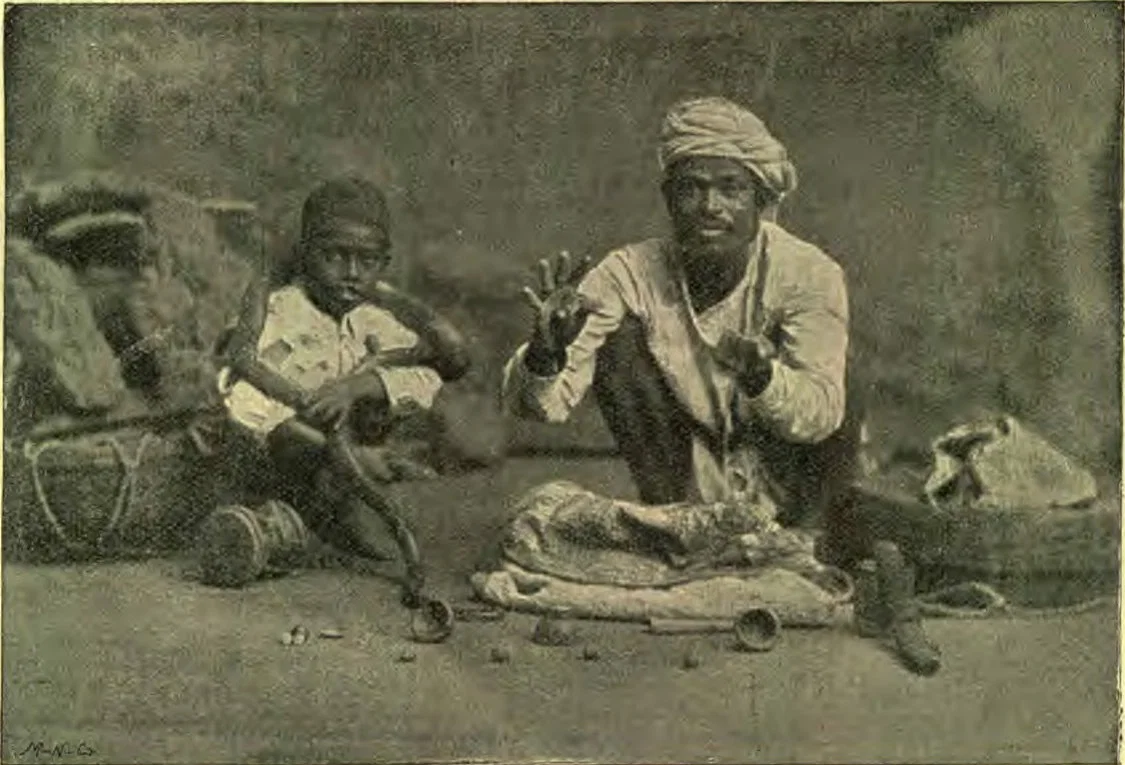
A HINDOO SNAKE CHARMER.
If I were a boy, I should want to be a boy with a purpose. I would not loaf or drift; I would set my rudder; I would select some aim worthy of my best of our energies; and then I would stick to it, and, as Carlyle would say, “Work at it like Hercules.” There are people who lecture you against ambition. But the boy without a good ambition will be likely to be the boy without a good record. And only high things are worth aiming at. As Emerson said, “Hitch your wagon to a star.”
I should also like to be a truthful boy. Truth is a cardinal virtue. In Hebrew it means firmness; in Greek it means that which cannot be hid. A boy at once open and firm commands universal respect. And when business men are looking for a boy whom they may advance in their service, their most important question concerns truthfulness. It makes a good foundation. He can build high who has that for a corner-stone.
And then, as including everything else, if I were a boy, I would be a Christian boy. I am quite sure it would help me in the battle of life. As I look around among the successful men of my acquaintance, I do not know of one whose success has not been helped by his Christian principles. But I know of very many who have made failures because they have no Christian principles.
Great things are to be done in the life-time of the boys; and if I were a boy, I should want to get the best tools for helping to do them. Among them are things we have named; and, however small my gifts or privileges, I should feel pretty sure that my small gifts wrought out by hard work and discipline, directed to a great aim, and uplifted by a true Christian spirit, would give me a good and successful standing in the list of the battle.—Band of Hope Review.

ROUND THE WORLD.—25.

FROM CALCUTTA TO BENARES.

The winters in Southern and Central India are such that even those who are only half clad are in no danger of perishing from cold, or of getting frost-bitten hands or feet; the season is short and warm, and by far the most pleasant time of the year. There are three seasons in India:—
First, the winter monsoon season. The word “monsoon” signifies “periodical wind.” During this time there is a gentle, dry breeze; it blows from the northeast, commencing in October, and lasting till February.
Second, the summer monsoon, which is a southwest wind, blowing up an abundance of rain. It commences in June, and lasts till October. India runs out like a wedge into the ocean, which is called after it the Indian Ocean. The vapor is collected from thousands of square miles, not only from that part of the ocean lying within the tropics, but also from the two great seas by which India is bounded on the right and on the left. The greater the heat on land, the greater the amount of vapor collected on sea. At last, when the heat on land has become intense, the cooler current of air makes a strong movement toward the heated land-area, which it refreshes with torrents of rain. This influx of vapor-laden air comes with a rush when it first touches the land, so that it is just the opposite from the winter monsoon. It drives the vapor northward as previously described, and gives to India an abundance of rain.
Third, a hot season of a few months, which comes between the end of the winter monsoon and the beginning of the summer monsoon. This is what we are enjoying (?) while I write, in the month of March. I am almost inclined to believe a well-known adage in this country, that if there is an orthodox, ever-burning hell, the partition between it and India is only tissue paper!
On February 25, on the train that bore the British mails to the steamer at Bombay, we left for Benares, bidding farewell to Calcutta. Every country seems to have cars to suit itself, and India is no exception. There are three grades of cars; in the lowest, or third grade, the natives travel, packed like sardines in a box, for the modest sum of about half a cent a mile! Guessing at their length, I should say that the cars appropriated to the use of first and second class passengers were twenty-four feet long, formed into two compartments, with a partition across the middle, and to each is added a lavatory containing a shower bath; for cold water is something that cannot be done without. The door is on one side, and at the end, of each compartment. There are three seats arranged parallel with the length of the car, one on each side and one in the middle, and two upper berths, which can be let down at will. Every one travels with a large stock of bedding, and generally takes most of his baggage in the compartment with him.
We secured our seats, and waited anxiously for the train to pull out, fearing that a Babu, or native gentleman, might make his appearance and take a seat with us. They are not very pleasant fellow-travelers, and have a habit of ruminating, not American chewing gum, but what is known as betel nut; and there is an aroma hovering about them worse than that of any Western cattle corral on a wet morning.
All night we journeyed, and in the morning were running along at the rate of thirty-five miles an hour, through a flat country. The people were reaping their wheat, and letting the cattle tread it out in primitive style. Coronetted palms, toddy-trees, and wide-spreading banyans were dotted here and there. The native agriculturist knows not the use of machinery; everything is done by hand, and it would be a sin in their eyes to introduce more easy methods, as they think it would throw many out of employment.
It appeared at first as if the plains were destitute of houses, and our curiosity was aroused to know where the people lived. Their homes are not scattered about over the farms, but huddled up in villages, each hamlet being hidden by its own grove of plantains and other wealth-giving trees. Although the Hindoos constantly lave in sacred streams, they look anything but clean. Ten or twelve dwell in one little, dirty room, in a kind of squalid luxury, and no doubt they enjoy the local society. The little children are literally caked with filth of various descriptions. Yet they pride themselves as much on their pedigree as if they belonged to the Royal House of Hanover. How they ever came to live in these miserable tenements, is a problem unsolved with them.
We passed through some fairly large cities, but there is scarcely a white man in them; the native sits supreme. In all India there are only about 100,000 Europeans.
At a place with a name that sounded something like Moghal Serai, we changed trains, and on the platform I was accosted by a young man whom I had noticed watching me very closely the night before in Calcutta. I could not recollect having done anything that was criminal, and could not imagine what there was about me to attract so much attention. He said he believed he had the pleasure of my acquaintance. If he had, he possessed an advantage; for I could not recall him to mind, although I tried to remember every visage I had ever seen before. But he rapidly explained how we had been school-mates together years ago in “Merry England,” and soon woke up a train of thought that had long been slumbering undisturbed. The world is wide, but it is not very large, and wherever you go, there is sure to be some one who knows all about you.
At one town we were entertained by a snake charmer, who fondled the slimy serpents as a mother would her infant. He wound them around his neck, played with them, and after the performance was over, informed us that he had broken all their teeth, so that they could not hurt him. Their teeth are broken by enticing them into a sack, and then they will try to bite their way out again. But here lies the trap; for their fangs are caught in the strands of the material, and easily broken.
By the middle of the afternoon we reached the sacred city.
P. T. M.

WHAT ARE THE STARS?

PART I.—THE SOLAR SYSTEM.

Looking up into the heavens on a clear night, the twinkling stars seem very small as compared with the sun or moon; but they appear small simply because they are so far away from the earth. The nearest one is supposed to be twenty-two million of million of miles away. The very smallest one the eye can discover is many, many times larger than our sun, which, if it were removed so far away, could not be seen at all. And there are other stars so far away that a telescope has to be used to find them; and others more distant still, whose light is so faint the eye cannot detect them through a telescope, and so a sensitive plate, coated with nitrate of silver, which is exquisitely sensitive to even very faint rays of light, is placed at the telescope in place of the human eye, and a “negative” is taken, from which a photograph is obtained.
Now, if these little twinkling stars which appear are bodies immensely large, looking small only because so far away, what must be the size of those whose rays of light can be caught only by the sensitive silver? Our own sun, glorious to us, would, if removed to the region of visible stars, pale to the vision, and disappear, not only from sight, but beyond even the power of nitrate of silver to detect.
The diameter of these distant bodies must be simply inconceivable, and so all astronomers are satisfied that these twinkling lights are all huge bodies, and are suns themselves. It is not possible to prove that all are as large as our sun, but many must be millions of times larger. Astronomers know that our sun is the center of a system of worlds, of which our earth is one. Now try to conceive of each one of the millions of stars revealed by the telescope as a sun, and the center of a system of worlds, and then say with David, “When I consider thy heavens, the work of thy fingers, the moon and the stars, which thou hast ordained, what is man that thou art mindful of him? and the son of man that thou visitest him?”
W. S. C.

STRAW BONNETS IN AMERICA.

How many fair American maidens, while “trying on” their dainty straw head-coverings, ever think of the New England girl whose fingers braided the first straw bonnet made in this country? Most of them, it is to be feared, have never so much as heard of Miss Betsey Metcalf, of Providence, R. I., who thus became, without any such intention on her own part, the founder of an important American industry. That first home-made straw bonnet, if still in existence, must be now about ninety-two years old; for it was made in 1798, when Miss Betsey was a girl of fourteen.
Up to that time all straw bonnets had been imported from Europe, and were consequently high-priced. Even wealthy ladies could not afford a new one every season, while their poorer sisters must often have been at their wits’ end to make a five-year-old hat look “as good as new.”
Straw hats—“Leghorn hats,” as they were called—were originally made in Italy, where a particular kind of bearded wheat was cultivated on purpose for their manufacture. Thence they soon found their way into France, and from that country were introduced into England.
At first they were straw hats pure and simple—a skull-cap surrounded by an immense brim. Little by little this primitive structure was modified,—in this world all great things seem to be the result of an evolutionary process,—till at last the hat became a bonnet; something very different, we may be sure, from its fashionable descendant of the present day, but unmistakably a bonnet.
In the spring or summer of 1798 an exceptionally pretty Dunstable straw was displayed in the window of a milliner’s shop in Providence. Miss Metcalf looked at it longingly from the sidewalk. Then she went in and priced it, sighing to herself as the figures were named. She poised it on her hand, held it at arm’s length, and criticised it from all points of view. Then, with another sigh, she relinquished it to the milliner, who placed it once more in the window.
All these details, it is fair to say, have not come down to us in the official record. That veracious chronicle simply informs us, in the most commonplace terms, that Miss Betsey admired the bonnet, but could not afford to buy it. It was well she could not, as matters turned out. Her poverty was to become a kind of national blessing.
With true New England spirit, she resolved to make a bonnet with her own hands. She waited till harvest-time. Then she gathered some of the oat-straw, split it with her thumb nail, and set to work to plait it. If her first attempts were unsuccessful, as no doubt they were, she was not discouraged, and before no very long time, she had achieved a pretty close imitation of the foreign braid.
Shortly afterward Miss Betsey “blossomed out” in a new bonnet. Her admiring friends urged her to get her process patented, but she declined, thinking it hardly modest to let her name come before Congress.
Her example was speedily followed. The braiding of straw became the fashionable fancy-work of the day, and was carried on and discussed at afternoon teas and wherever else women were accustomed to gather.
It is amusing, though not surprising, to read that the new industry, so harmless and even so useful, was promptly assailed by the press and the pulpit. Some great divine pronounced it a downright sin; it fostered feminine vanity, he declared, and would encourage envy and all uncharitableness.
Early in the present century a learned doctor wrote an “Essay on the Manufacture of Straw Bonnets,” in which nearly all the evils of the day were laid at the door of this dangerous innovation. Certain political economists prophesied a famine as a result of cutting the straw before the grain was fully ripe. Then, as now, however, the ladies had a mind of their own, and perhaps found their new pursuit only the more interesting because of the opposition it provoked.
For a short time Miss Metcalf monopolized the trade, receiving orders from customers for miles around; but as the accomplishment became general, it grew to be the custom for the “manufacturers” to put their goods on sale at the village store.
The entire process was of a strictly domestic nature. The straw was raised and braided, and the bonnets were sewed and shaped by the same family. Common starch was used for stiffening, and a common flat-iron for pressing.
A fac-simile of the first American straw bonnet is still to be seen in the rooms of the Rhode Island Society for the Encouragement of Domestic Industry.
—Selected.

THE ISTHMIAN CANALS.

More than three centuries ago, the idea of constructing a water-way across the Isthmus of Darien, to connect the Atlantic with the Pacific Ocean, was proposed by one of the early explorers. Balboa, the first European to gaze upon the waters of the Pacific from the American shore, saw what great results might follow from such a water-way.
Many projects to accomplish this have been formed in the long interval since Balboa's time, and the idea may yet be carried out in our own day. Two routes have been proposed, and are now being attempted, for a great canal across the Isthmus. One is that proposed by the famous French engineer, M. de Lesseps, who performed the feat of cutting a canal across the Isthmus of Suez, thus connecting the Mediterranean with the Red Sea. The other project is that of an American company, which seems now the more likely of the two to be carried to a successful end.
For nine years M. de Lesseps and the French company, of which he is the head, have been struggling to build a canal from Aspinwall or Colon, on the coast of the Gulf of Mexico, across the isthmus to Panama, which stands on the western, or Pacific shore. The whole length of the proposed canal is fifty-four miles, but the natural difficulties of building it are very formidable. To do so, it is necessary to cut through one of the Cordillera Mountains, and several times to cross the bed of the River Chagres. But the natural obstacles in the way of success have been less serious to M. de Lesseps than the difficulty he has had, and which he still has, of raising the money necessary to pay the cost of the great canal. The company has failed to procure the loans it has asked for; it has been obliged to suspend payment of its interest; it has practically become bankrupt, and its affairs have passed into the hands of a liquidator. It has appealed in vain to the French Government to help it out of its financial straits, and up to this time no settlement of its difficulties has been made. At present all work has been stopped on the Panama Canal. Business in its vicinity has become prostrated, the bad climate and the stagnation of the work have driven a large number of settlers from the neighborhood, and it seems as if the whole project were about to fall through altogether.
But work has already been begun on another great canal, with the same purpose of connecting the two oceans across the isthmus. In February of last year Congress incorporated an American company empowered to cut a canal northward of that of M. de Lesseps, through the territory of the Republic of Nicaragua, and in the May following fifty men began work on the designated spot. The length of this proposed Nicaragua Canal is to be one hundred and seventy miles, much longer than the Panama Canal, but through a much less difficult route; for the Nicaragua Canal route will cross about fifty-six miles of lake, sixty-four miles of river, and twenty miles of basin navigation. The actual canal to be dug, therefore, will be only twenty-nine miles. Thus it will be but little over one-half the distance of the Panama Canal.
It is believed that this canal will cost something like eighty million dollars. Its depth will be nowhere less than thirty feet, and in most places will be greater. The governments of Nicaragua and Costa Rica, through whose territory the canal will pass, have agreed to allow it to be built. There is every reason to believe that this canal will be completed, and will be opened for ship traffic within the next four years. This must be the wish of all Americans; for it is far better for this country that the isthmian canal should be built by American enterprise, and remain under American control, than that it should be owned by a foreign company.—Youth's Companion.

LIGHTNING IN JOHNNY'S HAIR.

“Combs can’t blow, can they?”
Could you guess what Johnny meant by such a queer, backhanded question? I couldn’t, nor his sister Mary either. I was quite sure, however, that he meant something sensible, if one could only get at it; but Mary was doubtful.
“Blow what?” she asked, not so pleasantly as she might.
“Why, blow air, to make wind.”
“Of course not, you silly child; what makes you ask such a question as that?”
Mary thinks Johnny a pretty bright little fellow in general, but on particular points she is always ready to call him a dunce, without stopping first to find out what he really means to say. The trouble is, she knows so little herself that she thinks she knows everything, at least everything worth knowing; and Johnny is all the time puzzling her with questions that she has no answer ready for.
“What have you seen to make you ask that question?” I inquired.
“I didn’t see anything,” said Johnny; “I just felt it—like some one breathing softly on my face and hand when I held my comb near.”
“Nonsense,” said Mary; “you just imagined it.”
“No, I didn’t,” Johnny insisted; “I felt it really, this morning when I was combing my hair.”
“Oh,” said I, suspecting the cause of his difficulty; “what kind of comb was it?”
“A black comb,” said Johnny.
“Horn or rubber?” I asked.
“It’s a rubber comb,” said Mary.
“How did your hair behave when you were combing it?”
“Mean as anything,” Johnny replied. “It stuck up like Mary’s when it’s frizzed, and wouldn’t stay anywhere.”
Part of that was for Mary’s benefit. Johnny likes to tease her.
“Did you think the comb made it do that by blowing it?”
“Not at first,” said Johnny; “the comb seemed to crackle, and I put it to my ear to listen; then I felt the wind on my cheek.”
“Suppose you bring the comb here, and show us what it did.”
Johnny ran off for the comb, but came back quite crestfallen.
“It won’t do it now,” he said.
“As much as ever!” cried Mary, triumphantly.
“But it did this morning, truly,” he said, rather humbly.
“Pshaw!” said Mary, “you imagined it.”
Like many another discoverer, Johnny had to learn what it is to be discredited and ridiculed for knowing too much. Because Mary had never noticed what he described, she was as ready as older people to cry “nonsense,” “impossible,” and all that sort of thing, without stopping to consider whether he might not be in the right, after all.
“You would better try it again some other day,” I said to Johnny. “Try different combs. Try in the dark, too.”
“What for?” Johnny asked.
“You might see something.”
“In the dark?”
“Yes, in the dark.”
Johnny wondered how that could be; and he wondered still more when I suggested that it might be a good plan to try the comb also on Humpty Dumpty—that’s his shaggy dog.
Two or three mornings after, Johnny came pounding at my door before breakfast; when I let him in, he cried,—
“It blows now, sure!”
“What blows?”
“Why, the comb.”
I took the comb from his hand, and putting it to my cheek, said,—
“I don’t feel any wind from it.”
“That isn’t the way,” he said, reaching out for the comb. “You must do this first,” and he ran the comb rapidly through his hair a few times, then held it to his cheek, saying, “I can feel it plainly.”
“See if it will blow these,” I said, stripping some bits of down from a feather, and laying them upon the table.
Johnny repeated the combing, then held the comb near the table, expecting to see the light stuff blown from the table. To his great surprise, it was not blown away at all, but on the contrary it sprang suddenly toward the comb, then dropped off as suddenly.
“That’s queer,” said Johnny.
I excited the comb again, and held it near the back of my hand, calling Johnny’s attention to the fact that all the fine hairs stood up when the comb came near them.
“When you hold the comb near your cheek, the downy hairs stand up like that, and the feeling is just like that of a breath of air.”
“Then it isn’t wind that comes from the comb?”
“No, it is not wind.”
“May be the comb is a magnet,” suggested Johnny, seeing its attraction for light hairs, dust, and the like, as I held it over them. I took a small magnet from my table-drawer, and held it near the feathers and hair. It did not stir them, no matter how much I rubbed it. It picked up a needle, though, very quickly. Then I rubbed the comb, and though it attracted the feathers, it had no effect on the needle.
“Is that like a magnet?” I asked.
“No,” said Johnny.
“When the needle springs to the magnet, it sticks there; but when the hair or down springs to the comb, it flies away again instantly.”
“It is very queer,” said Johnny.
“Try this horn comb,” said I.
Johnny tried it, but comb his hair as much as he might, the horn would not draw anything. Then he tried a shell comb, and an ivory comb, neither of them acting as the rubber comb did.
“I don’t understand it at all,” said Johnny.
“No one does fully, but if you keep on trying, you may learn a good deal about it in time.”
Then we went to breakfast. It was several days before the subject was brought up again. “I’ve been watching a long time,” said Johnny that evening. “I began to think it would never happen again, but it’s a first rate day to-day.”
“Have you found out anything new?”
“Not much,” said Johnny. “I tried Humpty, and the comb crackled like everything. What makes it do that?”
“I think we’ll have to study that to-night,” I replied. “Where’s Humpty?”
“In the kitchen. Shall I call him?”
“If you please; bring pussy too.”
Johnny was soon back with Humpty and Nebuchadnezzar—that’s pussy. We call him Neb, for short. Then we went into the library, and put out the lights.
“How can we see what the comb does?” Johnny asked.
“Some things can be seen in the dark,” I replied. Then I drew the comb briskly through Johnny’s hair, making it snap and sparkle beautifully. “See,” I said, bringing the teeth of the comb opposite my knuckle, “this is what makes the snapping.”
“How pretty!” Johnny cried, as the tiny sparks flew from the comb to my knuckle. “What is it?”
“Lightning.”
“Lightning! In my hair?”
“Certainly. Let me comb out some more.”
Johnny was almost afraid of himself when I brought another lot of sparks from his head.
“Folks had better look out when I’m round,” and the little fellow strutted about pompously. “Mary says I make more noise than a thunder-storm sometimes; I guess it’s the lightning in me. Somebody’ll get hit yet.”
“Not very severely, let us hope,” said I, laughing. “Suppose we try Humpty. May be he’s a lightning-bug, too.”
Sure enough, when we passed the comb through his shaggy coat, the sparks flew finely. So they did when we rubbed him with the hand.
“Let’s try Neb,” said Johnny. “You hold him, Fanny.”
But Neb had no notion of being rubbed the wrong way. As soon as the sparks began to show, his patience gave out, and he bristled and went off with a rush.
“I guess Neb’s lightning goes to his eyes and to his claws,” said Fanny, rubbing her scratched arm.
After that we tried the sheep-skin rag, Mary’s muff, and several other things of the sort, getting sparks from all of them.
“Everything seems to have lightning in it,” said Johnny.
“Apparently; but you can’t make it show in everything alike; any way, not by rubbing. Try the chair back, the table, the sofa, and such things. Generally when two things are rubbed together, the lightning—or electricity, as it is commonly called, escapes quickly. When it can’t do that, it accumulates, as it does in a rubber comb, and goes off with a snap when it gets a chance. When a cloud contains more electricity than it can hold, some of it jumps to another cloud or to the earth, making a flash of lightning. The thunder is its prodigious snap and the echoes of it. Are your slippers quite dry?”
“I think so,” said Johnny, wondering what that had to do with lightning.
“I think the furnace has been on long enough to make the carpet quite dry, too,” I said, turning just a glimmer of light on. “If it is, you can make a little thunder-storm of yourself easily.”
“How?” Johnny asked eagerly.
“Just skip around the room a few times without taking your feet from the carpet.”
Johnny spun round like a water-beetle for a minute or two; then I stopped him, and told him to reach out his forefinger. When he did so, I reached my forefinger to his, and as the points came together, snap! went a spark between them, whereat Johnny cried “Oh!” and put his finger to his mouth.
“Did it burn you?”
“No, but it scared me.”
He was not so badly scared, however, but he wanted to try it again and again, while I turned up the light, and went on with my reading. By and by Humpty came out from under the sofa to see what was going on, and Johnny sent a spark into his nose. It didn’t hurt him any, though it surprised him not a little.
“Wouldn’t it be fun,” said Johnny, “to give Mary a shock?”
“Charge yourself again,” I said, “then come to me with your hands down.”
Johnny did as I bade him, whereupon I stooped and kissed him on the mouth. It was his turn to be surprised that time. He didn’t expect a shock from me!
When Mary came to tell the young lightning-catcher that it was time to go to bed, she found him ready.
“All right,” said the little rogue cheerily, while skipping about the room. “Kiss me good-night, but don’t touch me with your hands,” he said, demurely holding up his mischievous mouth.
Mary gave the kiss, and got in return what she didn’t expect.
“You little rascal!” she cried, “you’ve got a pin in your mouth.”
“No, I haven’t,” he said.
“It’s a piece of rubber, then.”
“No, it isn’t rubber.”
“What is it?”
“Lightning,” said Johnny. “See!” and he skipped a few times across the floor, stopped suddenly before her, and touching her cheek, gave her a spark from his finger. Then he ran off to bed, laughing at Mary’s bewilderment.—Selected.
Continue reading: THE HONEY-BEE'S SONG