The Youth’s Instructor, Vol. 30, No. 26.

THE LOST FLOWERS

The Youth’s Instructor

Jun 28, 1882

S. D. A. Publishing Association · Battle Creek, Mich. · Jun 28, 1882

THE LOST FLOWERS.

On the bank of a rippling, silvery stream, Sat a happy child one day, With her apron filled with fragrant flowers, While she warbled a merry lay.
And now and then on the streamlet’s breast, Her treasures sweet were cast, While she laughed in glee as they danced along, And then went floating past.
Again, again is her reckless sport, Till all are on the stream; Then with a cry of wild distress, She wakes from her thoughtless dream.
“My flowers, my flowers, bring back my flowers, Oh, cruel waters, stay! My flowers, my flowers, you have them all, Oh, bear them not away.”
But the stream danced on with its precious freight, And tauntingly echoed back, “My flowers! my flowers! bring back my flowers!” As it sped on its onward track.
The hours of youth, more precious far Than the maiden’s flowerets gay, How oft to snatch some fancied joy, Are as recklessly thrown away.
Then when all gone, the soul awakes, And bitter is the cry, “My flowers! my flowers! bring back my flowers! My flowers that prostrate lie.”
—Selected.

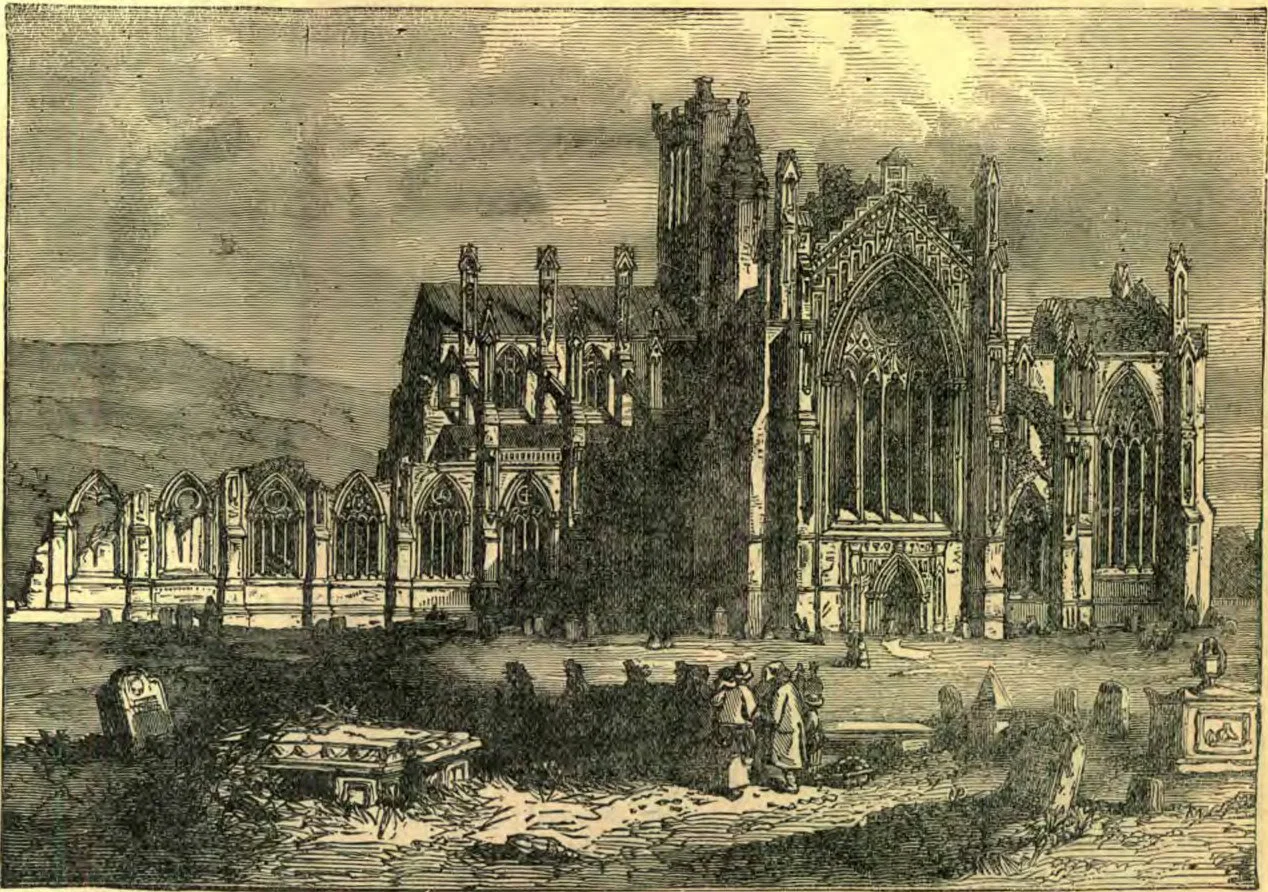
MELROSE ABBEY.

MELROSE ABBEY, one of the most celebrated ruins of the world, is situated in the town of Melrose, on the River Tweed, about forty miles from Edinburgh, Scotland. Three miles from Melrose is Abbotsford, the home of the great poet, Sir Walter Scott, who by his charming description in the “Lay of the Last Minstrel” has thrown over the old ruin a halo of romance. It was first built by David I., of Scotland, and dedicated to the Virgin Mary, from which it was sometimes called St. Mary’s Abbey and sometimes St. David’s. It was afterward almost entirely destroyed by English invaders; but when the famous Robert Bruce came to the Scottish throne, he had the Abbey rebuilt, and restored to more than its former glory.
The Abbey originally consisted of a monastery and a church, but little except the ruins of the church now remains. These crumbling walls, though they have withstood the ravages and storms of five centuries, give to the traveler something of an idea of the departed glories of the ancient pile. All along the centuries the place has been despoiled by invading armies, and even in these latter days many of its stones and ornaments have been removed to help in beautifying other buildings. Notwithstanding all this, the old ruin has been wonderfully well preserved, which shows that only the finest material was used in its building. The stone of which the Abbey was built is so hard that much of the ornamental work looks as if it had but just been cut. A traveler says that while looking at some of the windows, he could not but recall the description Scott gives of the place:—
“Thou would’st have thought some fairy’s hand ’Twixt poplars straight the ozier wand, In many a freakish knot had twined; Then framed a spell, when the work was done, And changed the willow-wreaths to stone.”
For a century and a half the building and grounds have been owned by the Dukes of Buccleugh, and of late years they have done all they could to preserve the ruin from decay. Iron bars are placed here and there to hold the walls together. The old clock in the tower still goes, though its face is so worn that one can hardly tell the time; and it still strikes the hour as it did of old, when William of Deloraine went to the old abbey on his ghostly errand in the solemn midnight. The carving with which the whole inside is covered, is exquisitely beautiful,—no dragon-heads and other hideous looking things, but sweet little cherub faces and beautiful flowers and plants of every description.
“Now slow and faint he led the way, Where, cloistered round, the garden lay; The pillared arches were over their head, And beneath their feet were the bones of the dead! Spreading herbs and flow’rets bright, Glisten’d with the dew of night; Nor herb, nor flow’ret glisten’d there But was carved in the cloister-arches as fair.”
Within the walls of the Abbey lie many of Scotland’s noblest dead, and here, tradition says was buried the heart of Robert Bruce, King of Scotland. Perhaps the words of one who has actually visited the place will give to it a greater reality than any other description could:—
“As we came into the midst of this glorious old structure, we actually stood silent for some moments, so filled were we with admiration at its wondrous beauty. To be sure, the blue arch of the heavens is now its only roof, and from its shattered walls rooks or jackdaws fly noisily overhead; but, then, the majestic sweep of the great Gothic arches; that vista of beauty, a great Gothic aisle still standing, fifty feet long, and sixty feet from door to keystone; the superb columns; and the innumerable elegant carvings on every side; the graves of monarch, knight, and wizard, marked with their quaint inscriptions at your feet; and—
‘The cloister galleries small, Which at mid-height thread the chancel wall,’ all join to form a scene of most charming and beautiful effects.
“And we stood there, with the blue sky looking in through the shattered arches, the noisy rooks flying hither and thither on their morning calls; the turf, soft, and green, and springy, sprinkled here and there with wild flowers, in the center of the ruin; while festoons of ivy waved in the breeze, like tapestry hung about the shattered windows and crumbling columns. Quaint Latin inscriptions on the walls and the time-worn slabs record the resting places of once proud but now extinct families and forgotten heroes—all now one common dust. . . . But what must it have been when nave and transept and aisle were perfect, when the great windows were radiant glories of colored glass, the carvings fresh from the sculptor’s chisel, and the chant of a hundred monks floated through the lofty arches!”
The following lines written by Scott show how well he loved to wander and muse within the walls of the old ruin:—
“If thou would’st view fair Melrose aright, Go visit it by the pale moonlight; For the gay beams of lightsome day Gild but to flout the ruins gray, When the broken arches are black in night, And each shafted oriel glimmers white; When the cold light’s uncertain shower Streams on the ruin’d central tower; When buttress and buttress, alternately, Seem framed of ebon and ivory; When silver edges the imagery, And the scrolls that teach thee to live and die; When distant Tweed is heard to rave, And the owlet to hoot o’er the dead man’s grave, Then go—but go alone the while— Then view St. David’s ruined pile; And home returning, soothly swear, Was never scene so sad and fair.” E. B.

Lena’s Sacrifice and Reward.

“What ’oo finking, sister Lena? Your eyes are looking ’way off into the fire!”
The only sounds to be heard in the kitchen, besides Nellie’s voice, were the hum of the boiling tea-kettle and the kitten’s contented purr.
Lena sat before the bright fire, toasting bread for tea, one slice at a time. She was watching it carefully that it might be done just a delicate brown, even if her eyes were, as Nellie had said, “ever so far away.”
She was deciding a very important question, turning it over and over again, and trying to find out exactly what God wished her to do about it. Her aunt, who lived in Boston, had invited her to spend the winter with her, promising to send her to school, and give her music lessons, if she would come.
She was passionately fond of music, and to have a piano was the greatest wish she had in the world. Then, to have plenty of books to read, to see beautiful pictures, to go to concerts and lectures,—oh! how like a fairy dream it all would be to the little country girl of fourteen, who had but once in her life been far beyond the boundaries of the small village in which she had been born. Had not God heard her childish petitions offered in faith? Was not this his answer?
On the other hand, there were five children younger than she, and no servant to help her mother. It was Lena who washed the five little hands and faces so many times every day. It was Lena who set the tables and washed the dishes, and made the beds, and tidied up the rooms, before and after school. It was Lena to whom the children came for a thousand things. It was Lena who soothed the crying baby, and righted the children’s quarrels, and taught her little brothers and sisters to be helpful and kind and loving. What could God mean? What did he want her to do? If she only knew!
Somehow, as she toasted the bread, it all grew plain before her. She had asked God to tell her so that she might feel very sure; and, louder than the hum of the tea-kettle, she heard the still, small voice in her heart, saying,—
“If any man will come after me, let him deny himself, and take up his cross and follow me.”
“Yes,” she thought, “Now I know just what you want me to do, dear Lord. Good-by, dreams. Good-by, music and books and lectures, and the long happy winter in Boston. I will be brave and happy about it, for thy sake, dear Lord, for thy dear sake.”
The bread was all toasted at last; enough big slices to satisfy the five little mouths, her father’s and mother’s, and her own. What a big plateful they made! The children’s eyes shone as she set it on the table, and her mother smiled fondly at her oldest girl, whose place was always beside her.
It seemed to Lena as if her eyes said, “How can I spare you, little daughter?” And in her heart she answered,—
“You’ll not have to, little mother mine.”
Late that night, after Lena was sleeping sweetly, her father and mother sat before the kitchen fire, busily talking.
“We must contrive some way to let the dear child go,” said her father. “The advantages are too great to be missed.”
“Yes,” said her mother, “and she has been so good and patient and self-sacrificing. I wonder if Martha would not come and stay with me? I could do nicely if I had her.”
“I’ll drive over in the morning and see.”
When dinner-time came the next day, Lena found a folded paper upon her plate. She tore it open hastily, and read these words in her father’s handwriting,—
“Our dear little daughter may go and welcome, for Aunt Martha is coming to stay with mother. FATHER.”
“Oh, mamma, dear mamma! I’d given it all up. Oh, is it really, really true?”
“Yes, daughter,” answered her mother, kissing her fondly.
“I believe ‘God always ends by granting our requests.’”—M. E. B. in Well-Spring.

WHY KINGS WEAR CROWNS.

“Father,” said Charlie, “why do kings wear crowns?”
“To distinguish them from the rest of the world, I suppose,” answered his father. “You see, my boy, in old times, when very few people knew how to read, they had to be taught everything in pictures. So the king took care to dress himself in a purple robe, and to put a crown of gold upon his head, that every one might know he was king. Thus, the crown came to be the sign of royal power; and the first thing a new king did was to secure the crown, and have himself crowned king as soon as possible. Thus, the king and his crown have become so united in people’s minds that we often talk of the crown as if it were a person. The crown, we say, did this or that, meaning the king or queen did this or that. But there were smaller crowns worn in ancient times, were there not, Tom?”
“Yes, father. In the Greek games, the victors wore crowns of laurel and pine, and even of parsley.”
“Those crowns made of green leaves were the crowns to which the Apostle Paul alluded, when he said, ‘They do it for a corruptible crown’ (that is, a crown that will fade away in a few days), ‘but ye for an incorruptible.’ Thus, you see, my boy, a crown may be a sign of power or a sign of victory. And such will be the heavenly crown. Those who are crowned with it will be kings and priests and victors. Let us earnestly strive to gain this heavenly crown.”

SCENES IN THE LIFE OF CHRIST.

LESSON 75.—THE PRODIGAL SON.

Jesus taught that his disciples must not love any thing, nor any person, even the dearest friend, more than they loved him, for, said he, “He that taketh not his cross and followeth after me, is not worthy of me.” He also taught that all will lose eternal life, who think more of this life than they do of the life to come; saying, “He that findeth his life shall lose it, and he that loseth his life for my sake shall find it.”
When the scribes and Pharisees saw that Jesus taught sinners, and even ate with them, they said bitter words against him, and thought that no good man would do such things. Then Jesus spoke to them saying, “What man of you, having a hundred sheep, if he lose one of them, doth not leave the ninety and, nine in the wilderness, and go after that which is lost, until he find it? And when he hath found it, he layeth it on his shoulders, rejoicing. And when he cometh home, he calleth together his friends and neighbors, saying unto them, Rejoice with me; for I have found my sheep which was lost. I say unto you that likewise joy shall be in heaven over one sinner that repenteth, more than over ninety and nine just persons, which need no repentance. Either what woman having ten pieces of silver, if she lose one piece, doth not light a candle, and sweep the house, and seek diligently till she find it? And when she hath found it, she calleth her friends and her neighbors together, saying, Rejoice with me; for I have found the piece which I had lost. Likewise, I say unto you, there is joy in the presence of the angels of God over one sinner that repenteth.”
“And he said, A certain man had two sons: and the younger of them said to his father, Father, give me the portion of goods that falleth to me. And he divided unto them his living. And not many days after, the younger son gathered all together, and took his journey into a far country, and there wasted his substance with riotous living. And when he had spent all, there arose a mighty famine in that land; and he began to be in want. And he went and joined himself to a citizen of that country; and he sent him into his fields to feed swine. And he would fain have filled his belly with the husks that the swine did eat: and no man gave unto him. And when he came to himself he said, How many hired servants of my father’s have bread enough and to spare, and I perish with hunger! I will arise and go to my father, and will say unto him, Father, I have sinned against heaven, and before thee, and am no more worthy to be called thy son: make me as one of thy hired servants. And he arose, and came to his father. But when he was yet a great way off, his father saw him, and had compassion, and ran, and fell on his neck, and kissed him. And the son said unto him, Father, I have sinned against heaven, and in thy sight, and am no more worthy to be called thy son. But the father said to his servants, Bring forth the best robe, and put it on him; and put a ring on his hand, and shoes on his feet: and bring hither the fatted calf, and kill it; and let us eat, and be merry: for this my son was dead, and is alive again; he was lost, and is found. And they began to be merry.”
“Now his elder son was in the field: and as he came and drew nigh to the house, he heard music and dancing. And he called one of the servants, and asked what these things meant. And he said unto him, Thy brother is come; and thy father hath killed the fatted calf, because he hath received him safe and sound. And he was angry and would not go in: therefore came his father out and intreated him. And he answering said to his father, Lo, these many years do I serve thee, neither transgressed I at any time thy commandment: and yet thou never gavest me a kid, that I might make merry with my friends: but as soon as this thy son was come, which hath devoured thy living with harlots, thou hast killed for him the fatted calf. And he said unto him, Son, thou art ever with me, and all that I have is thine. It was meet that we should make merry, and be glad: for this thy brother was dead, and is alive again: and was lost, and is found.”

QUESTIONS.

  1. How did Jesus guard his disciples against setting their affections upon other things, more than upon their Lord? Matt. 10 : 37.
  2. Who has given us our friends, and every good thing we have to enjoy?
  3. Which should we love most, the things we have, or the one who gave them to us?
  4. Which of the ten commandments do we break when we love other things more than we love God?
  5. What did Jesus say about those who were not willing to suffer for his sake? Matt. 10 : 38.
  6. What will those lose who think more of this life than they do of the life to come?
  7. What did Jesus say about this? Matt. 10 : 39.
  8. What did the scribes and Pharisees do and think when they saw that Jesus taught sinners, and even ate with them? Luke 15 : 1, 2.
  9. What question did Jesus ask them? Verse 4.
  10. What did he say the man would do with the lost sheep when he had found it?
  11. What would he do when he reached home?
  12. What was this parable meant to illustrate? Verse 7.
  13. What other parable did he give that was meant to teach the same thing?
  14. What did our Lord mean to teach in the parable of the Prodigal Son?—He meant to show how willing the Lord is to forgive those who truly repent of their sins.
  15. In this parable, what did the younger of the two sons ask his father to do?
  16. How did the father regard his request?
  17. How did this younger son spend his fortune?
  18. How did he come to want?
  19. What did he then do?
  20. What employment was given him by the man who hired him?
  21. As he was occupied in this way, what thoughts came to his mind? Verse 17.
  22. What did he resolve to do?
  23. What place was he willing to take if his father would allow him to come home?
  24. What did the father do when he saw his lost son returning?
  25. When they met, what did the son say to his father?
  26. What orders did the father give his servants?
  27. What reasons did he give for making a feast?
  28. What did the elder son observe as he came near the house?
  29. What inquiry did he make of one of the servants?
  30. What reply did the servant make? Verse 27.
  31. How did the elder son receive this news?
  32. What did he say when his father came out and urged him to go in to the feast? Verses 29, 30.
  33. How did the father reply to him?

NEW-TESTAMENT HISTORY.

LESSON 33.—A VOICE HEARD FROM HEAVEN.

Among the people assembled in the temple were some Greeks, who had come up to worship at the feast. Having a great desire to see Jesus, they spoke to Philip, a disciple from Bethsaida, and said, “Sir, we would see Jesus.” Philip communicated this request to Andrew, and these two disciples went together and told Jesus. Jesus seems to have been contemplating his death, which he knew to be near at hand, and said to them, “Verily, verily, I say unto you, except a corn of wheat fall into the ground and die, it abideth alone; but if it die, it bringeth forth much fruit.” Jesus knew that the faith of the disciples was to be severely tested, and he seems to have been preparing their minds for the bitter disappointment which they were so soon to meet. He had just made his triumphal entry into Jerusalem; he had been proclaimed as the “King who cometh in the name of the Lord;” the priests and Pharisees were confounded; and now the Greeks were anxious to see him. It would be natural that their hopes should be raised high; but before this feast should be over, their precious Lord was to be scourged, and nailed to the cross. Their faithfulness was to be tested at the peril of their lives, and perhaps to inspire them with courage he said, “He that loveth his life shall lose it; and he that hateth his life in this world shall keep it unto life eternal. If any man serve me, let him follow me; and where I am, there shall also my servant be: if any man serve me, him will my Father honor.”
It appears that our Lord, still further contemplating the anguish and agony that awaited him, began to soliloquize; for he said, “Now is my soul troubled; and what shall I say? Father, save me from this hour: but for this cause came I unto this hour. Father, glorify thy name. Then there came a voice from heaven, saying, I have both glorified it, and will glorify it again. Some of the people who stood by and heard it, said that it thundered; but others said that an angel spoke to him. Jesus then said, This voice came not because of me, but for your sakes.” They were to have the most complete evidence that Jesus was the long-looked-for Messiah, the Son of God. He then continued his discourse, saying, “Now is the judgment of this world: now shall the prince of this world be cast out. And I, if I be lifted up from the earth, will draw all men unto me.”
From this evident allusion to the raising of the brazen serpent on the pole in the wilderness, the Jews seemed to understand that he meant to predict his own death upon the cross; for they said, “We have heard out of the law that Christ abideth forever: and how sayest thou, the Son of man must be lifted up? who is this Son of man?” Knowing that it could do no good to answer their quibbles, Jesus went on warning and instructing such as would heed his words. He said, “Yet a little while is the light with you. Walk while ye have the light, lest darkness come upon you: for he that walketh in darkness knoweth not whither he goeth. While ye have light, believe in the light, that ye may be the children of light.” After Jesus had spoken these words, he went from them and hid himself.
Notwithstanding the many wonderful miracles that Jesus performed, there were but few who would believe on him. Thus was fulfilled the prophecy of Isaiah, who said, “Lord, who hath believed our report, and to whom hath the arm of the Lord been revealed?” These people could not believe in Jesus and receive the truth, because they had been blinded by the very light that would have enlightened them if they had been willing to receive it; and their hearts had been made unfeeling by the very experiences that, if properly improved, would have led them to conversion. This was also according to the prediction of Isaiah, when he said, “He hath blinded their eyes, and hardened their heart; that they should not see with their eyes, nor understand with their heart, and be converted, and I should heal them.” Nevertheless, among the chief rulers also many believed on him; but because of the Pharisees they did not confess him, lest they should be put out of the synagogue: for they loved the praise of men more than the praise of God.
“Jesus cried and said, He that believeth on me, believeth not on me, but on him that sent me. And he that seeth me seeth him that sent me. I am come a light into the world, that whosoever believeth on me should not abide in darkness. And if any man hear my words, and believe not, I judge him not: for I came not to judge the world, but to save the world. He that rejecteth me, and receiveth not my words, hath one that judgeth him: the word that I have spoken, the same shall judge him in the last day. For I have not spoken of myself, but the Father which sent me, he gave me a commandment, what I should say, and what I should speak. And I know that his commandment is life everlasting: whatsoever I speak therefore, even as the Father said unto me, so I speak.”

QUESTIONS.

  1. Who, among those who came up to the feast, had a great desire to see Jesus? John 12 : 20.
  2. To whom did they speak about the matter?
  3. What course did this disciple pursue?
  4. From the answer he gave them, what subject seems to have been occupying the Saviour’s mind when the disciples told him what the Greeks desired?
  5. What did he say to them? Verse 24.
  6. What was the probable cause of his speaking thus to them?
  7. Why does it seem that the hopes of the disciples must have been high at this time?
  8. What terrible disappointment were the disciples to meet before the week should close?
  9. How severely were they to be tested?
  10. What did Jesus say that was probably meant to inspire them with courage? Verses 25, 26.
  11. As Jesus still further contemplated the anguish and agony that awaited him, what did he say, apparently to himself?
  12. What was then heard?
  13. What words did the voice utter?
  14. What different opinions were held by those who stood by, in regard to the voice?
  15. What remark did Jesus make with respect to the purpose for which the voice was sent?
  16. Why was this miracle necessary for the people?
  17. What end did it accomplish for those who still rejected the Saviour?
  18. In continuation of his discourse what did Jesus then say? Verses 31, 32.
  19. To what did this remark evidently allude?
  20. Did the Jews seem to understand this?
  21. What did they think he meant to predict?
  22. What remark seemed to show that they so understood him?
  23. Why did not Jesus answer their questions?
  24. In what words did he then continue to instruct them? Verses 35, 36.
  25. After having spoken these words what did he do?
  26. What effect did the miracles of Jesus have at this time in causing the people to believe on him? Verse 37.
  27. What prophecy was thus fulfilled?
  28. Why could not this people believe in Jesus and receive the truth?
  29. How had their condition been predicted?
  30. Why was it that many of the chief rulers refused to confess Jesus, although they were really convinced that he was sent of God?
  31. What truth did Jesus then proclaim? Verses 44, 45.
  32. For what purpose did he say he had come into the world? Verse 46.
  33. What did he say about judging those that would not receive him?
  34. By what did he say they should be judged? Verse 48.
  35. How did he establish the authority of his words?
  36. What did he say of his Father’s commandments?

NOTE.

Except a corn of wheat fall into the ground.—The request of the Greeks to see Jesus brought the future before him. The Jews had rejected the only one who could save them. They were soon to imbrue their hands in his blood; and place him with thieves and robbers. The Saviour, rejected by the house of Israel, was to be received by the Gentiles. He looked forward with joy to the period when the partition wall between Jew and Gentile would be thrown down, and the broad harvest field would be the world.
Jesus regarded these Greeks as representatives of the Gentiles at large. In them he discerned the first-fruits of an abundant harvest, when all nations, tongues, and people upon the face of the earth should hear the glad tidings of salvation through Christ. He saw that the gathering of the Gentiles was to follow his approaching death. He therefore presented to his disciples and to the listening crowd the figure of the wheat, to represent how his death would be productive of a great harvest. If he should draw back from the sacrifice of his life, he would abide alone, like the kernel of wheat that did not die; but if he should give up his life, he would, like the kernel of wheat that fell into the ground, rise again as the first-fruits of the great harvest; and he, the Life-giver, would call the dead, that were united with him by faith from the graves, and there would be a glorious harvest of ripe grain for the heavenly garner. In the gospel of the death and the resurrection of Christ, and the resurrection of the dead, life and immortality are brought to light, and the kingdom of heaven is thrown open to all believers.—Spirit of Prophecy.

Caution Against Hasty Talkers and Careless Speech
It will be found that no man is more to be feared than the man who is willing to tell you all that he knows, because the chances are that he will tell you a great deal more than he knows.

HOUSES IN BIBLE LANDS.

The people of the far-off East, and especially those living in Palestine, spend much of their time in the open air, and during a good share of the year they even sleep whole nights with the starry sky for their only roof. But now, children, don't picture in your minds a nice wooden cottage with a green yard around it, and the folks sleeping out under the trees, where everybody going by on the street can see them and wake them up with their noisy travel, for they do nothing of the kind. Although they live out of doors so much, yet they are just as safe and quiet and as much alone as they would be in the house. In fact, they are in the house even while they are in the open air, for you see the people of those countries build their houses around the outside of their yards and have to go through their houses to get to their “courts” as they call the ground on the inside.
Their houses, too, are almost always built of stone, and generally one story high. They often make a covered walk all around the edge of the court, and when the house is two stories high, the roof of this covered walk is made the floor of a second walk above, which is also covered. In this way they have their piazzas and verandas also on the inside of the house. On seeing a house from the outside, one might think from its blank, dismal walls that it must be a very dreary place to live in; but if the people of the house would let him in through the porch, and out into the court, he might change his mind when he saw what a charming little world they had there all to themselves.
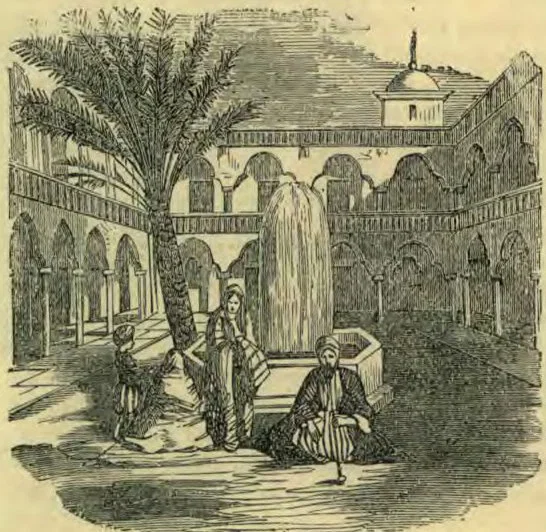
The picture above shows one of these courts. It has a fountain and a palm tree in it. How pleasant it would be on a warm day to sit under the shade of the palm tree, and hear the water falling in thousands of tiny drops in the basin below, and to feel the soft, cooling spray on our faces! And then at night to be lulled to sleep by the same musical sounds! The natives generally sleep on the roofs where they can catch the cooling breezes that are wafted in from the Mediterranean Sea. This is a very easy matter, for they always make their roofs flat, and have stairs leading up to them from the court.
Many of the courts are much more beautiful than the one seen in the picture, and very rich families have several courts in their houses. In them they have beautiful gardens laid out, and these with the fountains, and trees often growing far above the house, make a park on a small scale, which is enjoyed only by the family and those whom they may invite to see them.
So now when you read about anything in the Bible where a house is mentioned, you can form a right picture of it in your mind, and, perhaps, understand better what was done in it. C. H. G.

THE DEVIL’S FOUR SERVANTS.

THE devil has a great many servants, and they are all busy and active ones. They ride in the railway trains, they sail on the steamboats, they swarm along the highways of the country and the thoroughfares of the cities, they do business in the busy marts, they are everywhere and in all places. Some are so vile-looking that one instinctively turns from them in disgust; but some are so sociable, insinuating, and plausible that they almost deceive at times the very elect. Among this latter class are to be found the devil’s four chief servants. Here are their names:—
“THERE’S NO DANGER.”
“ONLY THIS ONCE.”
“EVERYBODY DOES SO.”
“BY AND BY.”
When tempted from the path of strict rectitude, and “There’s no danger” urges you on, say, “Get thee behind me, Satan.”
When tempted to give the Sabbath up to pleasure, and “Only this once” or “Everybody does so” whispers at your elbow, do not listen for a moment to the dangerous counsel.
If the Holy Spirit has fastened upon your conscience the solemn warnings of a faithful teacher or friend, and brought to mind a tender mother’s prayers for your conversion, do not let “By and by” steal away your confidence, and, by persuading you to put away serious things, rob you of your life.
All four are cheats and liars. They mean to deceive you, and cheat you out of heaven. “Behold!” says God, “now is the accepted time, now is the day of salvation.” He has no promise for “By and by.”—Christian at Work.

MOSSES

THEY are harmless little dwarfs that live among the big plants—sometimes the size of a needle’s eye; again, as long as your finger. Maiden hair moss spreads over the turf in a soft cushion, with golden head and feathers, wearing a golden crown. The star-moss bears fruit-like golden bells; and another, of yellowish-green, droops over great forest trees. A hundred kinds grow on the house tops, by the mountain side, and in the woods and moors. The roots are the frailest. A single one could not exist by itself. It dries up in the wind, withers in the sun, and is crushed, even by a light bird step. But Providence kindly places the mosses in families; so—being of a spongy nature—they flourish, and even in a drought grow rich by absorbing dew together. Mosses have been called the “good spirits of the forest.” They nurse the shelterless in cold winter, taking into their warm beds acorns and all the nuts. The butterfly, beetle, and spider find shelter, and the bear sometimes sleeps away his winter there. Mosses watch over all the seeds, while they drink and germinate; and protect every living thing near them. How grateful to the weary traveler on the mountain is a sight of mosses, that show him a soft bed to rest upon. How delightful to children, in a summer’s ramble, to play among the green tufts, and take them home—woven into beautiful garlands! And so the mosses tell us a pretty story—how the feeblest of little beings, without strength of its own, by sweetly uniting with kindred spirits, may live and thrive, and finally become a great power upon the earth. —Christian Intelligencer...

Telling the Truth Versus Untruth

TELLING an untruth is like leaving the highway and going into a tangled forest. You know not how long it will take you to get back, or how much you will suffer from the thorns and briers in the wild woods. How much better it is to tell the truth at all times.

THE SIGNS OF THE SEASONS.

What does it mean when the bluebird flies Over the hills, singing sweet and clear? When violets peep through the blades of grass?— These are the signs that the spring is here.
What does it mean when the berries are ripe? When butterflies flit and honey-bees hum? When cattle stand under the shady trees?— These are the signs that summer has come.
What does it mean when the crickets chirp, And away to the south-land the wild-geese steer? When apples are falling and nuts are brown?— These are the signs that autumn is here.
What does it mean when the days are short? When the leaves are gone and the brooks are dumb? When the fields are white with the drifting snows?— These are the signs that winter has come.
The old stars set, and the new ones rise, And skies that were stormy grow bright and clear; And so the beautiful, wonderful signs Go round and round with the changing year.
—Our Little Ones.
Continue reading: LETTER BUDGET