The Youth’s Instructor, Vol. XLIX, No. 34

THE RED-WINGED BLACKBIRD

The Youth’s Instructor

August 29, 1901

Review and Herald Publishing Company · Battle Creek, Mich. · August 29, 1901

THE RED-WINGED BLACKBIRD
In the marshes, among the reeds and rushes, along the fringes of the rivers, you will find the Red-winged Blackbird. When he sings his clear kong-ker-a-kee, it is a signal that all is well,—home life happy, and business prosperous. When a suspicious character draws near, he utters an inquiring chut, chuck! and if all is not as he likes, with a long, shrill alarm of chee-e-e-e! he circles out on fluttering wings, showing vividly his gorgeous crimson shoulder-strap.
The Redwing’s nest is built of coarse grasses, weed-stalks, etc., lined with finer grasses and rootlets, and is attached to low bushes or reeds. The eggs usually number from three to five, and are pale-blue, peculiarly streaked, spotted, or scrawled with dark-purple or black, chiefly at the larger end.
The female bird has neither the black coat nor the red wings of her mate. The first time I saw a female Redwing, I supposed her to be some sort of thrush, or a new bird I had not yet identified. She is very plain, much streaked, and utters the same chut, chuck! of her husband, when one draws near. This note of itself ought to be enough to identify her. She is not so bold as Mr. Redwing, but perches low, in the bushes or reeds, always not far from her nest.
“In Minnesota there is a bounty on the Redwing; but its grain-eating habit is purely local, and, as Professor Beal has found, nearly seven eighths of its food is of injurious weeds and insects, whose destruction is a decided benefit to agriculture. This shows unmistakably that the bird should be protected, except perhaps in a few places where it may have become too abundant.”
The Redwing eats some corn, but it has been said, on good authority, that even then he more than pays for the corn he eats, by destroying the worms that lurk under the husks of many ears. The rest of the year he subsists on grubworms, cutworms, grasshoppers, armyworms, caterpillars, etc.
Many of our readers know that beets are nowadays raised in large quantities for the manufacture of sugar. A number of years ago the beet fields in one section of the country were threatened with great injury from a certain caterpillar that had nearly ruined all the beet tops. About this time large flocks of Redwings appeared, and after a week’s visit, the caterpillars had all vanished.
A DRINK FROM A WAYSIDE SPRING
The earth is cursed with many destructive pests; but when nature is not interfered with, there is always some plan by which man’s work may be saved. In this we have a parable of the work of Christ. Man does much to injure and destroy himself and others, but Christ is forever at work to bless and to save.
L. A. REED.
Jacksonville, Ill.

STORIES OF SOME OF MY PETS

Joe, the Blue Jay

ONE of the most interesting ways of studying animals is by watching particular specimens that have become tame. Of all my pets, I have never kept one caged or imprisoned in any way. God placed the animals under man; and if we treat them rightly, they will love us, and enjoy being near us. I have always felt that if my pets should wish to leave me, it would be because they were not happy with me; and so I can not think of restraining them. If any of my readers should ever try to make pets of any animals, remember that you must win by love, not by the cage. God wins us by his love; and if we reject this, he never compels us to serve him. Let us deal in the same way with the animals, to whom we stand as gods.
The first pet I will tell you about is Joe, the blue jay. I took him as an orphan, before he had learned to fly, and kept him in a nest of straw in the house by day, and under my pet hen at night. I fed him mostly on Dutch cheese, fresh from the milk. Sometimes I gave him hard boiled egg or a few grasshoppers, but not often. Dutch cheese, by the way, is the best food I have ever found for most young birds, owls and hawks included.
Joe soon learned to fly, and then he had full liberty; but by that time he had learned to love the whole family so much that he would not leave us. His home was on the top of the bell post, under a large dinner bell. The bell protected him from rain and wind, and he was so pleased with it that I think he slept there every night till the day of his death.
He was an inquisitive fellow, and dearly loved company. He would follow mother into the kitchen, the cellar, in fact, everywhere she went; and if she closed a door so he could not follow, he would chatter and scold and frisk about till he saw that she would not let him in. Then he would fly to the top of a tall tree, and sulk for hours. Sometimes, however, he would come to me in the field, perch on my hat, and jabber and talk, as if trying to tell me all his troubles. In fact, he jabbered most of the time when he was with me,—though he was never too busy to see and to seize every worm my plow would turn up.
Sometimes Joe and I would go hunting. Then he was in high glee. He would flutter about while I moved boxes and barrels, and would get so interested that I could hardly keep from piling them on him. There was a lively scramble when two or three cockroaches ran out at the same time, but he seldom failed to catch them all. He would catch every bug or worm he saw, killing those he did not care to eat. Sometimes, after coaxing me in vain to go with him, he would go alone to the meadow to hunt grasshoppers. If he caught an unusually large grasshopper or a brilliant butterfly, he would come, screaming at the top of his voice, to show it to me. Then he would flutter and hop about, bragging and boasting of it at a great rate, but always keeping just out of reach.
Jays have a habit of hiding food for future use, and Joe would cache acorns in every fence-post, behind the clock, under the carpet, in the pump,—wherever he could find a lodging place for a bit of food. His favorite place for hiding a titbit for a future meal was in my mother’s hair. He would coax and caress her till he thought she wasn’t looking, and then he would put a piece of something in her hair. When hungry, he always came for it. If it was there, he was highly pleased; but if it was gone, he would scold at a great rate. He took special delight in dropping a pebble or an acorn into an empty shoe, and then watching its owner put it on.
There was a barrel of rainwater always standing behind the house, and here he bathed at least once every day. If he were given a bit of bread that was too hard to suit him, he would fly straight to this barrel, and put the crust to soak, coming for it when it had had time to soften. He had a mania for gathering up trinkets, such as spools of thread, buttons, needles, and mother’s scissors or thimble, etc., all of which he would drop into this barrel of water. If mother missed her scissors or thimble, she always looked first in the rain-barrel.
Joe was a great trader, and though he always intended to be strictly honest, his ideas of business often got him into trouble, and finally cost him his life. Our nearest neighbor had a canary, which he would sometimes hang out in a tree. Joe would visit this bird, and after chattering awhile, would banter Mr. Canary for a trade, which usually resulted in Joe’s eating all the egg, seeds, and bread that were in the cage, and then working for hours filling it with cherry stones and pebbles.
The owner did not like this; and one day when Joe came to show him a large grasshopper (for the bird thought all men were to be trusted), he knocked him down with a fork, and killed him. I think I mourned for Joe more than for any other pet. His cunning tricks, a few of which I have told, won him a warm place in my heart; and to-day, I think the blue jay the sauciest, smartest, and most talented, all-round, jolly good-fellow of our native birds.
FLOYD BRALLIAR.

BIRDS AND WORDS

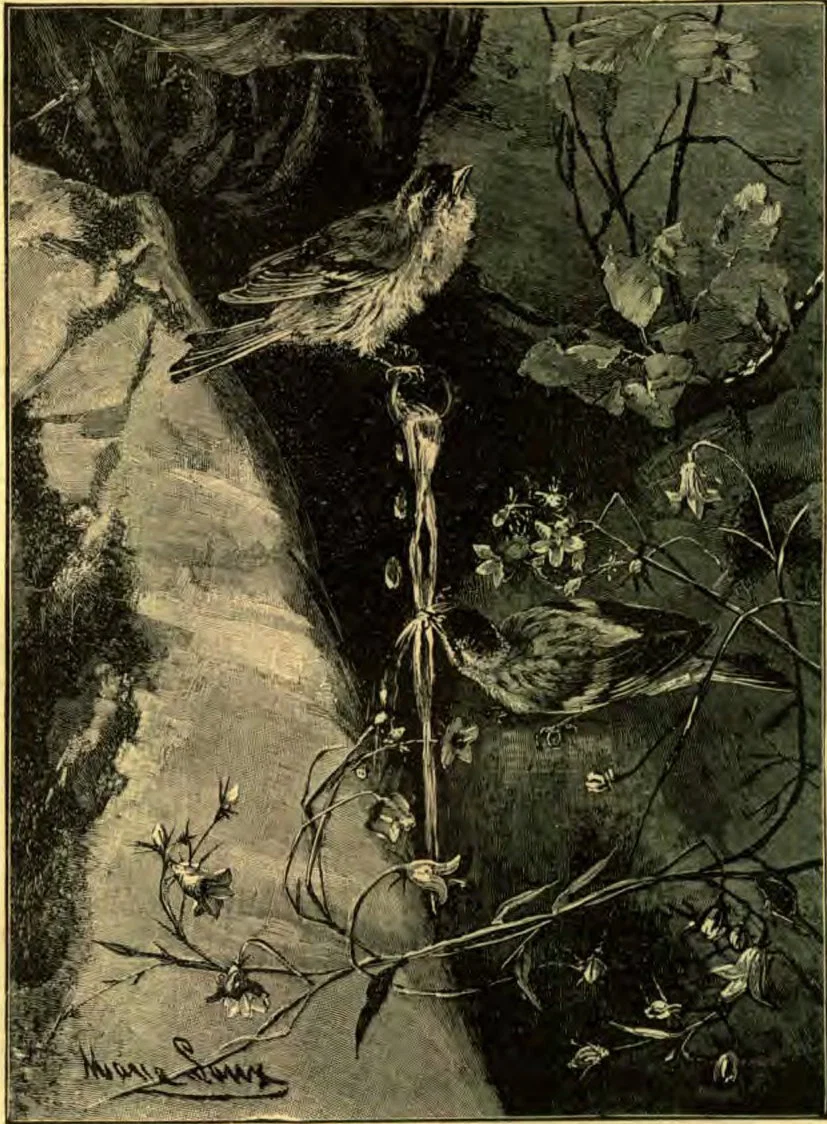
THEY all go forth in the morning, On light and active wing; Their food from the fields they gather, And drink from the wayside spring. Thrush or robin or sparrow, Vulture or kite or crow, They sing in joy and gladness, Or croak in tones of woe. With notes of doleful warning, Or trills of pure delight, The birds go forth in the morning; But they all come home at night.
So we send them forth in the morning,— The words from our hearts that spring,— Some of them croak and grumble; Some of them lift and sing. Loving, cheery, and helpful, Bitter, scornful, or sad, They fly to the hearts about us, And make them sorry or glad. But at night we'll have to meet them,— Those words so sad or bright,— With joy or grief we'll greet them; For they'll all come home at night.
ELIZABETH ROSSER.

DIVISION I—CONCLUSION OF CHAPTER I

Geology

§9. God might have destroyed Satan then and there; but if he had done so, the many queries already raised in the minds of the heavenly beings would have remained unanswered. Satan’s theories and plans, so contrary to the established government and law of God, must have time to develop their baneful results.
The inhabitants of heaven loved the beautiful angel who had for years stood by the throne as one of its “covering cherubs” (Eze. 28:13–15), and his words of accusation against the government of God bore weight with those who had so long looked to him as a leader. God desires only loving, intelligent obedience on the part of his subjects. Now that his wisdom and goodness had been called into question, he saw fit to allow Lucifer, “and the angels which kept not their first estate, but left their own habitation” (Jude 6), to establish themselves on this earth, and work out, before the whole universe, the plans of their own devising. God has never caused any one to join the rebel’s cause; but on the other hand he has never permitted a soul to be taken in the devices of Satan without first being sufficiently warned, so that all have acted upon their own free will and choice in the matter.
For six thousand years other worlds have witnessed the workings of the principles of sin. For one thousand two hundred and sixty years (Dan. 7:25) Satan was given almost absolute control over the bodies of men; and the horrors of the Inquisition have left their bloody traces upon the sad pages of human history.
§10. Concerning the trial of Abraham’s faith, we read in “Patriarchs and Prophets,” pages 154, 155, that “the sacrifice required of Abraham was not alone for his own good, nor solely for the benefit of succeeding generations; but it was also for the instruction of the sinless intelligences of heaven and of other worlds. The field of the controversy between Christ and Satan,—the field on which the plan of redemption is wrought out,—is the lesson-book of the universe. . . . All heaven beheld with wonder and admiration Abraham’s unfaltering obedience. All heaven applauded his fidelity. Satan’s accusations were shown to be false. . . . God’s covenant, confirmed to Abraham by an oath—
§11. “Before the intelligences of other worlds, testified that obedience will be rewarded.
“It had been difficult even for the angels to grasp the mystery of redemption,—to comprehend that the Commander of heaven, the Son of God, must die for guilty man. When the command was given to Abraham to offer up his son, the interest of all heavenly beings was enlisted. With intense earnestness they watched each step in the fulfillment of this command. When to Isaac’s question, ‘Where is the lamb for a burnt offering?’ Abraham made answer, ‘God will provide himself a lamb;’ and when the father’s hand was stayed as he was about to slay his son, heart; and the ram which God had provided was offered in the place of Isaac,—then light was shed upon the mystery of redemption,—
§12. “And even the angels understood more clearly the wonderful provision that God had made for man’s salvation.”
From this we learn that the inhabitants of other worlds actually see and hear us as we move about and converse with one another. Under its proper heading, we shall learn how this is a scientific possibility. While our vision grasps many interesting things—
§13. Concerning the other worlds, yet we do not see their inhabitants, nor hear their conversations, as they do ours. We see only as through a glass darkly; but if faithful, we shall yet, like them, see face to face, and know as we are known.
As we go into the deep strata of this earth’s composition, we find many facts that tell of the dealings of God with this physical world of ours.
§14. The strata of rock, the fossil remains, the extinct Mammalia, the carbonaceous deposits, the remains of prehistoric races,—all speak, bearing positive witness to the truth of the Biblical account of the formation of the earth, and the terrible experiences through which it has passed.
Again: in “Patriarchs and Prophets,” pages 113–116, we read: “God has permitted a flood of light to be poured upon the world, in both science and art; but when professedly scientific men treat upon these subjects from a merely human point of view, they will surely come to wrong conclusions. It may be innocent to speculate beyond what God’s word has revealed, if our theories do not contradict facts found in the Scriptures; but those who leave the word of God, and seek to account for his creation upon scientific principles, are drifting, without chart or compass, upon an unknown ocean. The greatest minds, if not guided by the word of God in their research, become bewildered in their attempts to trace the relation of science and revelation. . . .
§15. “Moses wrote under the guidance of the Spirit of God; and a correct theory of geology will never claim discoveries that can not be reconciled with his statements. All truth, whether in nature or in revelation, is consistent with itself in all its manifestations. . . . Those who take the written word as their counselor—
§16. “Will find in science an aid to understand God.” For “the invisible things of him from the creation of the world are clearly seen, being understood by the things that are made, even his eternal power and Godhead.” Rom. 1:20.

QUESTIONS

Why did not God destroy Satan in the beginning of his rebellion? After watching this rebellion for six thousand years, how must the inhabitants of other worlds now feel concerning the matter? Point out the parallel between the offering of Jesus and that of Isaac. For whose instruction was the trial of Abraham required? How did the spirit of Abraham compare with that of Lucifer? How did this offering throw light upon the plan of salvation? Who besides the angels eagerly watched this test? Do the strata of rock, and fossil remains, necessarily prove the Mosaic record of creation untrue? Unless guided by the word of God in our study of science, what is likely to be our condition? Will the truths of science ever conflict with the truths of the Bible? What text shows that the study of science is an aid to our understanding of God?
Dr. O. C. GODSMARK. Louisville, Ky.
NOTE.—These lessons, comprising a brief study of Geology, Philosophy, Meteorology, and Astronomy have been prepared in response to the many calls that have come for a simple treatise on these subjects, that shall be free from the many infidel theories and deductions that are unscriptural and untrue. They have been written with special reference to the fireside, and the home- and church-school. The author would be pleased to receive, by correspondence, any criticisms or suggestions that will help to make them better adapted to this field of usefulness.

Entering the Joyful Life of God's Children

LEAVING the past behind, asking no praise, pay, or reward, submitting ourselves to the grand law of the world, turning the way of faith and hope, giving ourselves to the nearest present duty, asking ourselves only what does right or truth or love bid, we thus enter into the joyful life of the children of God.—Charles F. Dole.

TONS OF HONEY IN A GIGANTIC BEEHIVE

ONE of the most wonderful spots in the world, in its way, is the famous “Devil’s Punch Bowl,” as the natives have named it, in Valverde County, Texas, which borders on the Rio Grande. Its discoverers noticed, as they came within two miles of it, what appeared to be a cloud of smoke constantly rising from a spot in the valley below them, and when they came nearer, they heard a rushing sound, as of a great waterfall. It proved to be nothing more nor less than a gigantic beehive,—a hole in the ground forty feet in diameter, from which were rising, and into which were descending, innumerable swarms of bees. This, then, was the cause of the distant appearance of rising smoke, accompanied by the loud hum of countless insect wings.
Those who have ventured to visit this curious cave since its discovery, protecting themselves from the stings of the bees by mosquito netting or otherwise, as they look down into the yawning cavity, observe, clinging to its sides, great festoons of honeycomb. Opening into the large cavity can be seen many smaller ones, which, it is reasonable to suppose, contain additional stores of honey in their dark recesses; for bees love darkness. If a method could be devised to secure the contents of this great treasure-house of honey, several tons of the sweet product would be the probable outcome. But this cave, large and well-filled as it is, contains but a small part of the honeyed treasures with which those valleys abound.
In that far southern latitude the winters are so mild that the bees can gather honey through the whole year. In the summer they obtain it from the endless variety of flowers which bloom in these fertile valleys, and in the winter from sweet cactus-pears, and berries of many sorts. The bees store the honey thus gathered in hollow trees and small clefts of rock, but chiefly in caves, some of which are easily accessible, while others can be reached only by means of ropes let down from heights above. The country is so rough that the hunter must leave his pack-pony or burro at a long distance, and must find his toilsome way on foot to the cave whence he hopes to obtain his honey. For this and other reasons, our bee-farmers will have little cause to fear competition from the wild honey of that wonderful region, at least for many years to come.
It might be supposed that these bees of the Rio Grande could cease from their toil, and feast themselves and their grubs on the stores collected in former years. But instinct prompts them to continue their labor as steadily as if they were entirely destitute.
How much in this respect they resemble men, who go on piling up wealth long after they have laid by enough to support themselves and their families in comfort! So, though no fable, our story ends with a moral.—Selected.

Cuttle-Bone and Sepia

Cuttle-bone was once made use of as a medicine, but is now used by goldsmiths as a polish, and by bird fanciers as food for caged birds. This cuttle-bone, so called, is not bone at all, but a very wonderful structure consisting almost entirely of pure chalk, and having been, at one time, very loosely embedded in the substance of some departed cuttlefish. It is an oval bone, white and hard on the outside, but soft and friable within, and is inclosed by a membranous sac within the body of the cuttle.
When the cuttle is living, this structure runs through the entire length of the abdomen, and occupies about one third of its breadth. In weight cuttle-bone is extremely light; and if it be cut across, and examined through a lens, the cause of the lightness will at once be apparent. It is not solid, but is formed of a succession of exceedingly thin floors of chalk, each connected with each by hundreds of the smallest imaginable chalky pillars.
The cuttlefish has an internal sac under the throat, near the liver, that contains a very dark natural ink. When pursued by enemies, the cuttle ejects this inky substance, and thereby forms a cloud of darkened water all about it, in which it hides until out of danger.
How wonderfully God has provided for even the smallest, most insignificant of his creatures! — Selected.

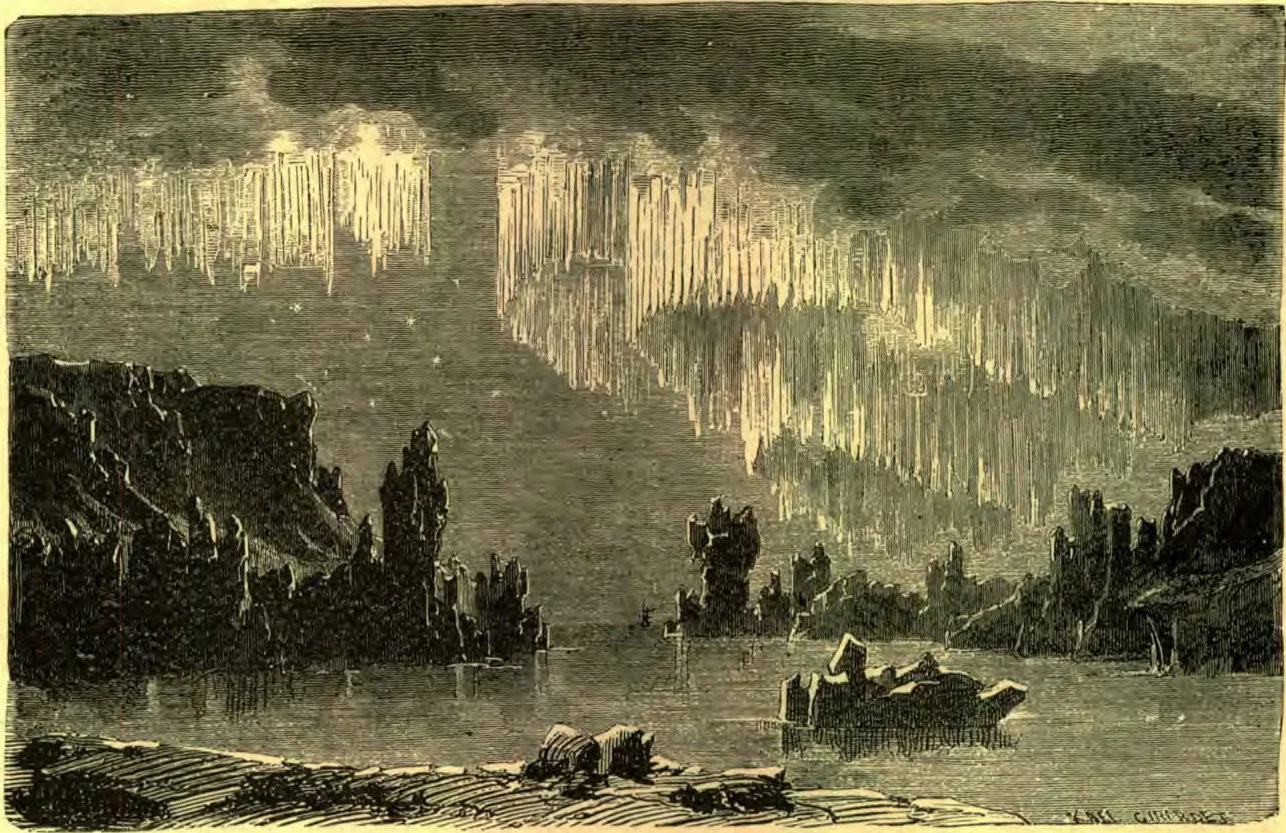
THE AURORA

The aurora borealis, also called “polar lights” and “northern lights,” is still a mystery to astronomers and scientists. No effort to write a connected history of the phenomena has ever been attempted. The ancients called them chasmata bolides, or trabes, according to their form and colors. In Shetland and Scotland, where they have been frequent, they have been called “the merry dancers.”
The first record of an aurora was made in 688 A. D. This was followed by occasional mention of the phenomenon, until in September, 1621, it was observed all over France. Between 1621 and 1707, eighty-six years, astronomers make no mention of the occurrence of an aurora.
AN AURORA *
AN AURORA *
As it has sometimes been visible by daylight, the conclusion has been reached that a light so faint as is the aurora (a light so faint that it does not obscure the stars) could not be visible in sunlight unless it was developed in cloud or mist of some sort. D. Low asserts that all clouds are subject to magnetic influence; that when the lines converge toward the magnetic pole, fine weather follows; when they are at right angles to this position, wet and stormy; and that he has observed as fine auroral motions in the cirrus cloud as he ever beheld in a midnight sky. As clouds have sometimes been observed during the day to assume the forms of aurora, he, with others, is inclined to believe that the aurora is dependent upon the existence of certain clouds for its development.
Lilbermann asserts that aurora are preceded by the same general phenomena as thunder-storms, in which the clouds, instead of bursting in thunder, are drawn into the upper part of the atmosphere, and their vapor crystallized in tiny prisms by the intense cold, the electricity becoming luminous as it flows over these tiny particles.
Early observers believed that the aurora was an electric discharge in the rarefied upper atmosphere, but recent spectroscopic observations do not support this view. Any glowing gas, when analyzed by the prism, is found to consist of a series of colored lines and bands, called its spectrum. The light of the aurora gives a spectrum, “usually consisting of a single line, in greenish-yellow, which does not coincide with a principal line of any known substance,—a spectrum totally different from those of the gases of the atmosphere.”
W. S. CHAPMAN.

AWAKE!

The rosy morn awoke at dawn To kiss each gem of dew, And, ere each vanished at its work, To deck with rainbow hue.
The zephyr gently stirred the leaves, Caressing, ere the day Should tax the patience of the trees With scorching noontide ray.
The birds were warbling, thus to greet The radiance of the morn, And hopped from limb to limb to meet The zephyr newly born.
But man alone had not yet stirred. At length in haste he woke; The breeze, the morning, and the bird He scarce had time to note.
To us each day some cheer will come From face of morn or friend, If not intent to simply run For prizes at the end.
And other songs than birds’ may cheer, More beauty than the morn appear; Ope wide thine eyes, lend listening ear: Life’s music is half-heard.
WORTHE HARRIS HOLDEN.

THE GREATER BIBLE

In the Bible, God’s great thoughts are crystallized into words. In nature his thoughts are manifested in matchless beauty and marvelous diversity and splendor. But as our ears have not always been accustomed to catching the notes of divine melody, which are being continually swept to us from God’s great keyboard,—the nature-world about us,—therefore God has given the Bible to help us interpret correctly the beautiful lessons that are stamped on everything which he has made.
In spite of the law of gravitation, the trees, by the law of growth, are enabled to carry barrels of water scores of feet above the surface of the earth; so the Christian, inspired by the divine power within him, is enabled, in spite of depressing influences, daily to elevate the thoughts and ambitions heavenward.
A shower, instead of merely suggesting the necessity of hunting up an umbrella, should convey to us the blessed assurance that every promise in God’s word shall accomplish that which he wills, and prosper in the thing whereto he has sent it. The thick cloud may suggest that God has “blotted out as a thick cloud our transgressions.” The gentle but unseen breeze that refreshes us should cause us to reflect upon the sweet influence of the Spirit of God.
Examples could be multiplied almost indefinitely. It is difficult to conceive of any Bible study which is more interesting, profitable, and helpful than can be secured by simply noting some particular thing in nature, and then looking up in a concordance the beautiful lesson that God has connected with it in his written word. None but those who have tried it have any appreciation of the spiritual strength which can be gained in this way. To such a student, the face of nature soon becomes an open mirror, reflecting at every point the glory, majesty, and love of an all-wise and all-beneficent Creator.
DAVID PAULSON, M. D.

Prayer for Guidance in Daily Mistakes

“GRANT my request, dear Lord, I pray, That every mistake I make to-day May serve, like an angel’s touch, to show How on the morrow I ought to go.”

WHAT CAN YOUNG PEOPLE DO?

There is many a life that would be brightened and uplifted by a friendly visit. The world is full of loneliness. Heart-hunger and longing for sympathy are not the heritage of the poor alone, but of the rich and great, as well as of the common people. Comfort, good cheer, and helpful ministry are the needs of the world to-day. And the youth who sets about the work of supplying that need, intelligently, perseveringly, and faithfully, is following in the footsteps of the Master.
Have you never had the experience of coming in contact with persons who seemed by their very presence to extend to you sympathy and encouragement? This influence was not due to carefully chosen words, or a beautiful face, or a perfect manner; for doubtless none of these were displayed. An indefinable, inexplainable something caused your doubt, and gloom, and ill temper to give place to faith, courage, and peace. This was the genuine fruit of the Spirit of God abiding in the heart of one of his children.
Cultivate a sympathetic interest in others. Begin right in your own church. Seek out the aged, the lonely, the sick, any who are in trouble, and call upon them. You need say but little, but your visit is evidence of your kindly interest. If you are watchful, you may see opportunities for active service. Modestly, quietly, prayerfully follow up the opening providences. This work may be extended among your neighbors. We have this instruction: “This is the way light is to be communicated,—by private, personal effort. In the home circle, at your neighbor's fireside, at the bedside of the sick, in a quiet way you may read the Scriptures, and speak a word for Jesus and the truth. Precious seed may thus be sown, that will spring up and bring forth fruit after many days.”
Quite likely there are those among our young people who feel that so far in these articles very small things are pointed out in answer to the question, “What can our young people do?” It will certainly seem so to all who are looking for a work that will bring to themselves the honor and praise of men. But are there not many who will gladly engage in this work in the manner dictated by the Spirit of God? “Do that which is the nearest you, right at your own doors, however humble and uncommended it may seem. Work only for the glory of God and the good of men. Let self sink out of sight, while with earnest purpose and solemn prayers of faith you work for Him who has died that you might live.”
This simple work done in his name, is worthier the ambition of our Sabbath-keeping army of youth than all the deeds of worldly valor that have called forth a world's homage, or a world's remembrance. MRS. L. FLORA PLUMMER.

A KNOWLEDGE OF GOD

Read “Steps to Christ,” Pages 106-115
(September 1-7)
God reveals himself to men —
1. In his works. Ps. 19: 1-3; Rom. 1: 20.
2. In his word. Ex. 34: 6, 7; Jer. 31: 3.
3. By his providences. Ps. 107: 43.
4. By his Spirit. John 14: 26.
Jesus our Teacher. Matt. 11: 29.
Our lesson book. Job 12: 7, 8; Matt. 6: 28.
The knowledge of God is obtained by —
1. Prayer. Eph. 1: 17.
2. Study of the Scriptures. 2 Tim. 3: 15; John 5: 39.
3. Filling the heart with the words of God. John 6: 53, 63.
What it costs. Phil. 3: 7, 8.
Its great value. Job 28: 12-28.
It increases. Col. 1: 10; 2 Peter 3: 18.
Makes its possessor rich. Rom. 11: 33.
Brings peace. 2 Peter 1: 2.
Is manifested in the life. 2 Cor. 2: 14.
Inheritance of those who know God. 1 Cor. 2: 9.
Final condition of the earth. Isa. 11: 9.

SUGGESTIONS

1. This chapter in “Steps to Christ” contains some of the most beautiful and precious thoughts in the book, as its theme is one of the most exalted. It should be reread many times; indeed, if it is read once, it will be read again and again. Notice especially what is said about —
The constancy of God's care for us.
Four ways in which he speaks to the heart.
The simplicity of the saving gospel.
Four desirable characteristics that result from a study of God's word.
The conditions on which the knowledge of God is bestowed.
2. Find, in the study and the chapter, answers to the following excuses, often offered for neglecting a study of God's word and works:—
“I am too busy.”
“I have no time nor place to study.”
“There is no one to teach me.”
“Other things seem of more importance.”
“My brain gets tired, and I can not remember what I study.”
“I can not understand the Bible.”

CALLS FOR MISSIONARIES

The reader is probably interested in mission work, and would like to know in what fields there are urgent calls for missionaries, and when and how these calls should be filled. First, let us see how God calls missionaries. You are a Christian—possibly you are being called without knowing or heeding the call. A brief study of the call of some of the missionaries whose experience is recorded in the Bible may help make the matter plain.
In Gal. 1: 15, 16, Paul tells us how he was called to his great work of carrying the gospel to the Gentiles: “When it was the good pleasure of God, who separated me, even from my mother’s womb, and called me through his grace, to reveal his Son in me, that I might preach him among the Gentiles, immediately I conferred not with flesh and blood, . . . but I went into Arabia.” (The Revised Version, American Edition.)
Note the things that Paul tells us about himself:—
  1. God wanted to reveal, or show, Christ in him.
  2. He wanted to show Christ in Paul, so that Paul could show him to the heathen.
  3. He called Paul to this work through his grace.
  4. He separated, or appointed, Paul to this work at his birthday.
  5. When Paul understood that he was called to this work, he at once went away into Arabia to prepare for it.
Paul evidently refers to his conversion as the time when Christ was revealed in him, yet he says plainly that he was separated and called from the time of his birth. After Paul had worked and studied for several years, God, through his prophets and teachers, asked the church to recognize Paul’s separation and call to a definite work. Read Acts 13: 1, 2.
This example teaches:—
  1. That Paul was called, as all men are, to salvation by the grace of God. Read Titus 2: 11.
  2. That from his birth he was appointed by God to a definite work; but that the doing of this work depended upon his accepting his call to salvation; that is, believing in Christ.
  3. When Paul did believe, and asked, “What wilt thou have me to do?” God showed him his appointment (Acts 9: 6, 15), and he at once began to get ready for it.
From a study of the life and work of Moses, of Jeremiah, and more than all, of Christ, we learn that God calls others to his work as he called Paul.
Christ was called to his work from his birth. Isa. 49: 1, 5, 6. When he was twelve years old, God began to reveal to him his calling. “For the first time the child Jesus looked upon the temple. . . . He witnessed the impressive rites of the paschal service. Day by day he saw their meaning more clearly. . . . Silent and absorbed, he seemed to be studying out a great problem. The mystery of his mission was opening to the Saviour.”—“Desire of Ages,” page 78. Then he said to his parents, “Wist ye not that I must be about my Father’s business?” Observing his course through youth, and during his short ministry, we ever find him “filled with intense purpose,” carrying out “the design of his life, that he himself should be the light of men.”—Id., 92.
His way of learning how to carry out the design of his life was no different from the way that you and I must learn to carry out the design of our lives. He learned, by being “so utterly emptied of self that he made no plans for himself. He accepted God’s plans for him, and day by day the Father unfolded his plans.”
JOEL C. ROGERS.
(Concluded next week.)
Continue reading: A GUESS STORY