The Youth’s Instructor, Vol. 28, No. 12.

TEN-MINUTES SERMON TO CHILDREN

The Youth’s Instructor

Mar 17, 1880

S. D. A. Publishing Association · Battle Creek, Mich. · Mar 17, 1880

TEN-MINUTES SERMON TO CHILDREN.

TEXT: OUR WORDS.

I wish to talk to you, my little men and women, about our words. We shall see the importance of our subject if we read the words of Christ in Matt. 12:37: “For by thy words thou shalt be justified, and by thy words thou shalt be condemned.”
We shall be judged by our words. It is right that we should be, because our words reveal the state of our hearts. You look at the hands of a clock, and you know that behind them there must be some works or machinery that keeps them in motion. If the clock keeps correct time, that is, if the hands move just right, we know that the works are good. If it keeps incorrect time we say that the works are bad. Now, our words are the outward sign of an inward state. If they are good, it is a proof that the heart is right; but if they are bad, it is a proof that the heart is wicked. I wish to show, by some familiar objects, what words we should not and what words we should use.
I hold in my hand a piece of India-rubber. It is very elastic. I can stretch it until it is many times as long as when lying on the table. We must be on our guard against speaking India-rubber words. Boys and girls who will not tell a lie will sometimes try to stretch the truth. I have known boys who, when they did not want to do as they were bidden, were always “so tired” or “so sick.” They stretched a little ache into a severe sickness. The other day two girls were running together. When they stopped, one said, “Oh, dear, I thought I should die,” while the other declared she was “most dead.” They rested about one minute, and ran again as fast as they could go. This careless way of talking is very wrong. We lose our love of truth when we begin to exaggerate. When I was a boy at school I sometimes had a sharp knife and would sharpen my slate-pencil with it, and would thus dull its edge. So our love of truth is blunted by sharpening the point of an excuse or a story. There are no such things as “white lies.” India-rubber words are falsehoods, and every falsehood is as black as a stove.
Here is a cruse of vinegar. Taste it. If I give you some of it to drink, you will draw up your faces; for vinegar contains a sharp, bitter acid. The followers of the gentle Saviour should never speak vinegar words. Boys and girls use them when they are saucy and quarrelsome. I have seen fathers and mothers and teachers pained by the vinegar words of their children and pupils. When there is unkindness in the heart it shows itself in the words we speak. Unkind words are sometimes more cruel than a kick or a blow, for it is easier to heal the wounds of the body than those of the soul. In the twenty-fifth chapter of First Samuel we read of a very churlish man, called Nabal, “he is such a son of Belial that a man cannot speak to him.” What a dreadful thing it is to have such a thing written about a man for people to read for hundreds of years after he is dead. I have seen some such men as Nabal, and they make one shiver like a north-east wind. Don’t be Nabals, boys.
Children sometimes use very bad words. I have been thinking by what object I could represent them. I have thought of a bird that is fond of nasty things, and is called a turkey-buzzard, and have concluded to call them buzzard words. While the humming-bird, looking like a piece of rainbow with wings, goes flitting about breathing the perfume of the flowers and feeding upon their sweets, this vulture bird goes flying along and is not happy until it finds some offensive thing that any decent bird would shun. Once, when I was a boy, the dogs came by night and killed a great many sheep, and soon a whole army of buzzards came to devour their decaying flesh. They have an appetite only for disgusting things. I hope my young friends have all too much self-respect to use buzzard words. When I hear a child using vulgar words I feel as if I would like to take his head under my arm and wash out his mouth with soap and water.
We have seen that we should shun India-rubber words, vinegar words, and buzzard words. Can we find any objects that will represent good words? What does the Bible say about good words? Ah! here is the verse in Prov. 16:24: “Pleasant words are as a honeycomb, sweet to the soul, and health to the bones.” What is sweeter than honey; what is better than pleasant words? Honey words cost nothing, and yet do much good. Pleasant words have brightened many a dark life and sweetened many a bitter cup of sorrow.
I have one more object with which to illustrate good words. Here is a twenty-dollar gold piece. Solomon says, “A word fitly spoken is like apples of gold in pictures of silver.” What beautiful illustrations the Wise Man uses! Look at this piece of gold. How bright and pretty it is! Gold is the material from which many of our most beautiful things are made. There is nothing more beautiful than this coin, unless it is a golden word. Gold is genuine money; money that has intrinsic worth. Look at this five-dollar counterfeit note. It looks like the truth, but it is an out-and-out lie. Here is a silver coin that is marked “one dollar,” but it is worth less than ninety cents. It carries a falsehood on its face. Our words should not be like the counterfeit five-dollar note, but should be the truth itself. Listen to the ring of this coin as I let it fall upon the table. Gold words are those that have the ring of truth in them. These are the words that will be pleasing to God.
Let us remember, young friends, that all the words we speak are heard in Heaven. You should speak only such words as you are willing that God should hear; for, “by thy words thou shalt be justified, and by thy words thou shalt be condemned.” Perhaps you feel sometimes that it is hard to speak only such words as your Saviour would approve, but if you will go to him with words of prayer he will help you.—L. R. Voorhees.

THE AMEN OF THE ROCKS.

TRANSLATED FROM A GERMAN LEGEND.
Though blind with age, forth Beda went with zeal The tidings of salvation to proclaim. Through town and hamlet, guided by a boy, The pious father wandered, full of love, And preached to dying men the word of life. The boy once guided him into a vale O'erstrewn with rocks and mighty heaps of stone, And there in wantonness, not malice, said, “Most rev'rend father, many men are here, And wait to hear the word of gospel truth.” The blind old man arose with joyful haste, Chose him a text, explained it and applied, Exhorted, warned, rebuked and comforted So loving, that the tears rolled down his cheeks And gently hid themselves in his gray beard. When in conclusion, then, as it is fit, He prayed the prayer the Saviour taught, and said, “Thine is the kingdom, thine the pow'r, and thine The glory unto all eternity,” There burst from out the vale a mighty shout: “Amen, most rev'rend father,” and “Amen!” The boy was frightened; kneeling down with shame He to the holy saint confessed the sin. “Son,” said the father, “hast thou never read, When men are silent, rocks and stones will cry? Mock nevermore, O son, the word of God; A two-edged sword it is, and quick, and sharp, And powerful. And if the heart of man Should turn to stone, defying truth and love, The rock with human heart would throb aloud.”

THE BOOK OF NATURE.

THERE is an open book spread out before all eyes. This book was made by God, and its pages cover the universe. Every one can study this volume, even if he is unable to read other books. Strange facts are written on hills, vales, and mountains. Curious things may be learned from insects, birds, and beasts; and the most familiar objects teach important and instructive truths. Everything in nature is arranged with the greatest order and symmetry. The snowflakes are perfect geometrical forms. The stars move in beautiful harmony above. The trees are gracefully proportioned, and all things below show forth the wisdom of the great Author of creation. The tiniest objects of earth, when placed beneath a microscope, reveal curious facts. The dust that covers the wings of the butterfly is feathers. Mold is a forest of beautiful trees. Hairs are hollow tubes, and stagnant water is full of strange-shaped beings.
There are many objects and scenes in nature that are grandly impressive and sublime. The deep gloom of stately old forests, the bursting fury of the storm, the mighty rush of some vast cataract, the awful beauty of the hoary-headed mountain, the sparkling waters of some solitary lake far from human habitation, the dim, uncertain outlines of distant hills,—all tend to awaken feelings of sublimity and awe. In the deep silence of the midnight hour, when the starry firmament seems the very floor of Heaven, the mind is impressed with the sense of an unseen Power, and in the awful stillness the heart cries out after God.
The hand of art cannot reproduce the beauties of nature. No artist can make the canvas glow with the colors that exist in the plumage of birds, the tints of seashells, the gems from mines, and the hues of sky and flowers. No sculptor can produce the graceful lines that are found in the great art-gallery of nature.
Beauty in its simplest, purest, and most lovely form exists in the outer world. The waving fields, the smiling valleys, the snow-topped mountains, the caves of earth, and the waters of the sea, are full of the riches, of the majesty of God’s glory.
The study of these natural objects gives strength of mind and a love for the beautiful, which, if cherished, will lighten the burdens of life and lead the heart nearer to God.
ELIZA H. MORTON.

OUR DAILY RECKONING.

If we sit down at set of sun, And count the things that we have done, And counting, find One self-denying act, one word That eased the heart of him who heard; One glance most kind, That fell like sunshine where it went, Then we may count the day well spent.
But if, through all the live-long day, We've eased no heart by yea or nay; If through it all We've nothing done that we can trace, That brought the sunshine to one face; No act most small, That helped some soul, and nothing cost, Then count that day as worse than lost.

WORK

“LET his hands be sufficient for him.” This was a part of the blessing pronounced by Moses, the man of God, upon the tribe of Judah. See Deut. 33:7. It implied a noble, self-reliant principle, an independence of character, which would educate the hands to labor and toil, and the mind to guide, in works of usefulness and profit. It would not depend upon the unwilling favors of friends, nor upon the legacies left by ancestors, nor upon the spoils of war; but honest industry and skill would be the right arm of his power. This has been realized in the history of that people; and to this day they are seldom given to idleness or suffer want; for all young men among the Jews are taught some trade; and they are taught to do the best quality of work.
Our Saviour worked at the carpenter’s trade, until he entered upon his public ministry. The apostle Paul was a manufacturer of tents, and no doubt made the best and most durable article. He says, “I have coveted no man’s silver, or gold, or apparel. Yea, ye yourselves know that these hands have ministered unto my necessities, and to them that were with me.” If he had been dependent upon the church for a support, it is not likely his ministry would have been as successful as it was.
In early life, the hand should be taught to execute works of usefulness and skill. A good trade, well learned, is a fortune in itself. The educated hand, guided by an intelligent mind, may prove a very profitable servant, asking no wages, making no complaint, always obedient, always teachable, always ready. To crown the whole, the mind, the hand, and the fortune should be consecrated to God.
JOSEPH CLARKE.

Pardon Shows Superiority Over an Enemy

By revenging yourself on your enemy, you make him your equal; by pardoning him, you show yourself his superior.

AMUSEMENTS

That amusement is good in its time and place is conceded by every one. All need relaxation from work; but time and strength spent in amusement that does not bring the desired end, rest, are worse than lost. It should be remembered that every waste, whether of vital energy, time, or money, will be felt; if not now, yet most certainly a little farther on in life. It is best, therefore, to choose only such kinds of recreation as will afford rest and change without overtaxing physical strength or impairing the mind.
To many the seasons of rest do not come often, and are like oases in a desert—green, fresh spots around which cluster pleasant memories. But a large share of our readers are children and youth, and the burdens of life rest lightly; therefore amusement is not so much needed; yet young people and old, students of all ages and classes, and even children require relaxation from an accustomed routine.
But the question which agitates so many minds is, What sort of amusement is allowable for a Christian? To worldlings, everything is open; no bars of duty, no scruples of conscience, hinder the enjoyment. The gay dance, the frivolous companion, dress, fiction, cards, and the fashionable party are all attractive to them; but to use the hours of the night, which are given us for sleep that our bodies may be refreshed, in hilarity, in company with vicious and wicked associates, is not right for a Christian, for it demoralizes the character, and unfits for the stern realities of life.
There are many pleasant and profitable ways of spending leisure time. Of all amusements that can be imagined, there is nothing like an entertaining book—it cheers, enlivens, rests. To those whose work confines them indoors, there is nothing equal to coasting, breathing the invigorating air of heaven, till every drop of blood feels its intoxicating effect, and dances along through the veins as though mad. With the opening of spring, our botanical friends will need no other amusement than their excursions into the fields and woods for the treasures of mother earth. The lessons that nature teaches are fresh and pure, brightening, exalting, and vivifying the character.
Nature, home, and friendship will furnish abundant resources for amusement to the Christian; but whether our time is spent in one way or another, let us make the most of ourselves. Let us have a high standard at which to aim, and not engage in anything that will tend to lower it in the least, or to separate us from Christ.
V. A. M.

BIBLE LESSONS FOR YOUTH.

LESSON XC.—DESTRUCTION OF JERUSALEM.

1. WHEN Nebuchadnezzar put Zedekiah upon the throne of Judah, what oath did he compel him to take?
2. How did Zedekiah disregard this oath?
3. What does the Sacred Record say with reference to his rebellion against the King of Heaven? 2 Chron. 36:13.
4. What course did the Lord pursue toward this hard-hearted and rebellious people?
5. Why did he send them so many messengers?
6. How did the people respond to such compassion and forbearance? Verse 16.
7. What was the final consequence of this course of action? Verse 17.
8. How did the Chaldeans treat the people of Jerusalem?
9. What treasures did the king of Babylon take from Jerusalem?
10. How did he bring desolation upon the temple and the city? Verse 19.
11. What was the fate of those that had escaped the sword?
12. How long were the Jewish people held captives in Babylon?
13. What prophecy was fulfilled by this captivity? Jer. 25.
14. What sabbaths had the Lord ordained that the land should enjoy? Ex. 23:10, 11; Lev. 25:1–7.
15. Had the people kept the sabbatical years according to the commandment?
16. At the siege of Jerusalem, what did Zedekiah finally attempt to do?
17. How was he disappointed in his attempt?
18. To what place was he taken?
19. What was his fate?
20. Who was made governor of the few people who still remained in Judea? 2 Kings 25:22.
21. Why were they permitted to remain?
22. What kindness did the king of Babylon show to Jeremiah?
23. What did the prophet prefer to do?
24. Describe the character of Gedaliah.
25. By whose hand did he perish? Verse 25.
26. Who was this Ishmael?
27. Whom did he destroy, besides Gedaliah?
28. How did the remnant disregard the counsel of Jeremiah? Jer. 42:43.
29. How did the prophet manifest faithfulness to God and love toward his people?
30. What was the fate of those that went to Egypt?

SYNOPSIS.

When Nebuchadnezzar put Zedekiah upon the throne of Judah, he made him take an oath to be loyal to him; but in the ninth year of his reign, Zedekiah, regardless of his oath, revolted against the king of Babylon, as he had long before revolted against the King of Heaven. The Sacred Record says, “He stiffened his neck, and hardened his heart from turning unto the Lord God of Israel.”
“And the Lord God of their fathers sent to them by his messengers, rising up betimes, and sending; because he had compassion on his people, and on his dwelling-place. But they mocked the messengers of God, and despised his words, and misused his prophets, until the wrath of the Lord arose against his people, till there was no remedy. Therefore he brought upon them the king of the Chaldees, who slew their young men with the sword in the house of their sanctuary, and had no compassion upon young man or maiden, old man, or him that stooped for age; he gave them all into his hand. And all the vessels of the house of God, great and small, and the treasures of the house of the Lord, and the treasures of the king, and of his princes; all these he brought to Babylon. And they burnt the house of God, and brake down the wall of Jerusalem, and burnt all the palaces thereof with fire, and destroyed all the goodly vessels thereof. And them that had escaped from the sword carried he away to Babylon: where they were servants to him and his sons until the reign of the kingdom of Persia, to fulfill the word of the Lord by the mouth of Jeremiah, until the land had enjoyed her sabbaths; for as long as she lay desolate she kept sabbath, to fulfill threescore and ten years.”
“Zedekiah, attempting to fly in the same direction as David had fled from Absalom, was caught in the valley of the Jordan, and carried to Riblah, where his brother Jehoahaz had been thrown in chains by the king of Egypt. There he was doomed to witness the execution of his sons, his own eyes were put out, and he was carried to Babylon.”—Bible History.
The few people who were left in the land to cultivate the soil and prevent a state of utter desolation, were placed under the rule of Gedaliah, who had a remarkably kind disposition. The prophet Jeremiah preferred to remain with this poor remnant of his people rather than to accept Nebuchadnezzar’s invitation to go to Babylon, where he, no doubt, would have had an honorable place among the counselors of the king.
Soon after the Babylonians withdrew from Judea, one Ishmael, who was related to the royal family, and who had taken refuge in the country of Ammon, conspired against Gedaliah, and treacherously murdered him, together with many more of the wisest and best of his countrymen. The remnant, contrary to the counsel of Jeremiah, fled to Egypt, because they feared the vengeance of Nebuchadnezzar. Jeremiah, unwilling to forsake the people whom God had commissioned him to instruct, accompanied them to this land of their former bondage, where they were afterward destroyed by the army of Nebuchadnezzar, when he invaded Egypt.
NOTE.—The following from the pen of the Rev. William G. Blaikie, D. D., gives some idea of the sufferings of the Jews during the siege and at the capture of Jerusalem by Nebuchadnezzar’s army:—
“The cruelties suffered by the inhabitants, especially during this last siege, were frightful. The ‘Lamentations’ of Jeremiah present us with vivid pictures of these. Enraged by their rebellion and vigorous opposition, Nebuchadnezzar, when he took the city, ‘had no compassion on young man or maiden, old man, or him that stooped for age.’ Famine had done its work before the conqueror entered; and children swooning in the streets for hunger, princes raking dung-hills for a morsel, and other hideous and affecting sights, showed the extremities to which the people were driven. When the Chaldeans rushed through the breach, the usual brutalities were perpetrated by the licentious soldiers. The famished fugitives were pursued with relentless fury. The Chaldeans were hounded on by the Edomites and other neighbors of the Jews, who knew the country well, and like bloodhounds tracked to the holes and caves such as had escaped from the city. Dead bodies lay piled in heaps upon the streets. Multitudes of these were mere boys and girls. Princes were hanged by their hand, enduring the slow horrors of crucifixion. Some seem to have been consigned to subterranean dungeons, perhaps on the shores of the Dead Sea, where ‘waters flowed over their head.’”

GEDALIAH

The following extracts from the works of Josephus, the noted Jewish historian, are full of interest to those who would know the history of the Jews still remaining in Judea after the destruction of Jerusalem by Nebuchadnezzar:—
“Now the general of the army, Nebuzaraddan, when he had carried the people of the Jews into captivity, left the poor, and those that had deserted, in the country; and made one whose name was Gedaliah, the son of Ahikam, a person of a noble family, their governor; which Gedaliah was of a gentle and righteous disposition. He also commanded them that they should cultivate the ground, and pay an appointed tribute to the king.”
“When Nebuzaraddan had done thus, he made haste to Babylon; but as to those that had fled away during the siege of Jerusalem, and had been scattered over the country, when they heard that the Babylonians were gone away, and had left a remnant in the land of Jerusalem, and those such as were to cultivate the same, they came together from all parts to Gedaliah to Mispah. . . . And Gedaliah persuaded them, now they were there, to stay with him, and to have no fear of the Babylonians, for if they would cultivate the country, they should suffer no harm. This he assured them of by oath; and said that they should have him for their patron, and that if any disturbance should arise, they should find him ready to defend them.”
He said that they might dwell in any part of the land that pleased them, and that he would send men along with them to help rebuild houses on the old foundations. “When he had thus discoursed to them, he dismissed them.”
Now when the people heard of the kindness of Gedaliah, “they were exceedingly in love with him, and told him that Baalis, the king of the Ammonites, had sent Ishmael to kill him by treachery and secretly, that he might have the dominion over the Israelites, as being of the royal family; and they said that he might deliver himself from this treacherous design, if he would give them leave to slay Ishmael, and nobody should know it. . . . But he professed that he did not believe what they said, when they told him of such a treacherous design in a man that had been well treated by him.” He also thought it would be better to be slain than to take the risk of causing the death of an innocent man.
So Johanan and the other men who had come to warn Gedaliah, departed; and about thirty days after, Ishmael came, and ten men with him. Gedaliah feasted these men “in a splendid manner at his table,” and also gave them presents. But in trying to be merry with them, he drank too much wine, so that he fell asleep; “and when Ishmael saw him in that case . . . he rose up on a sudden, with his ten friends, and slew Gedaliah and those that were with him at the feast; and when he had slain them, he went out by night, and slew all the Jews that were in the city, and those soldiers also which were left therein by the Babylonians; but the next day fourscore men came out of the country with presents to Gedaliah, none of them knowing what had befallen him. When Ishmael saw them, he invited them in to Gedaliah, and when they were come in, he shut up the court, and slew them, and cast their dead bodies into a certain deep pit, that they might not be seen.”
Ishmael was afterward overcome, and driven out of the country; but the Jews, fearing further trouble, especially from the Babylonians, proposed to go to Egypt. Before going, however, they wished Jeremiah to consult the Lord in relation to the matter. After ten days, God appeared to the prophet, and told him to say to the people, that “he would be with them while they remained in that country, and take care of them, and keep them from being hurt by the Babylonians, of whom they were afraid; but that he would desert them if they went into Egypt; and out of his wrath against them, would inflict the same punishment upon them which they knew their brethren had already suffered.”
When the people heard this they would not believe that it was from the Lord; so, taking their own way, they went to Egypt, and there suffered the fulfillment of the prophecy.
G. H. B.

LESSONS FOR CHILDREN.

LESSON LXIV.—REVIEW ON LESSONS LXI-LXIII.

1. DESCRIBE Elijah's first acquaintance with the widow of Zarephath.
2. By what miracle did the Lord sustain both Elijah and the widow's family?
3. Tell how the widow's son was brought to life.
4. Describe the meeting of Ahab and Elijah.
5. At Elijah's request, whom did Ahab gather at Mount Carmel?
6. Give the substance of Elijah's address to the people.
7. What did Elijah ask the prophets of Baal to do?
8. Describe their attempts to bring fire from heaven.
9. How did Elijah mock them?
10. At what time of day did Elijah make ready to offer his sacrifice?
11. Describe the preparations which he made.
12. When he asked the Lord to answer by fire, what reasons did he give for making such a request?
13. How was his prayer answered?
14. How did this miracle affect the people?
15. What was done with the prophets of Baal?
16. Where did Elijah go to pray for rain?
17. Tell what occurred there.
18. How did Elijah's message to Ahab show his faith in God?
19. How did this message prove to be true?
20. Why did Elijah have to flee for his life?
21. Tell how he was fed in the wilderness.
22. Tell how wonderfully this food sustained him.
23. Where did he lodge when he came to Mount Horeb?
24. Describe the interview he had there with God.
25. How did the Lord manifest himself after he had called Elijah to the mouth of the cave?
26. On what errands was Elijah sent?
27. What did the Lord say to comfort him?

AUNT LIZZIE'S STORY; OR HEEDLESS HARRY.

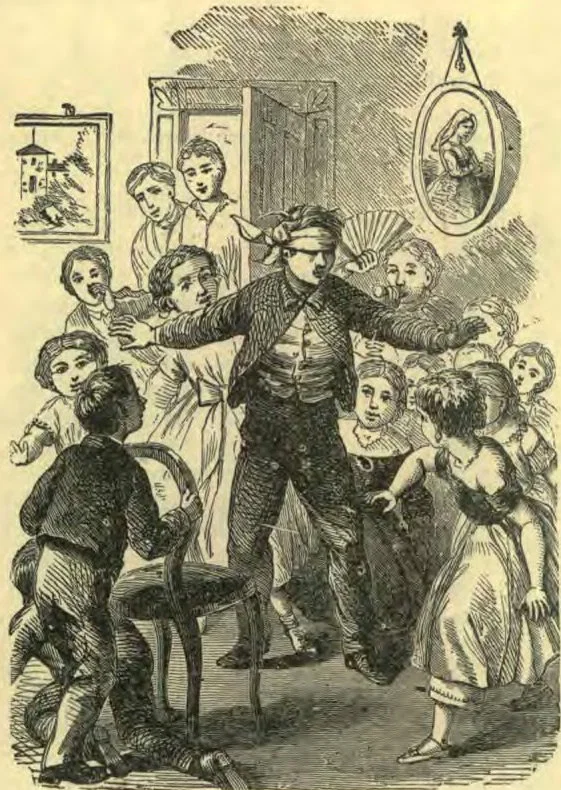
We, nephews and nieces, were spending the day at Aunt Lizzie's. We had played, “Hunt the slipper” and “Blind man's buff,” till we were tired. Just then Aunt Lizzie came into the room.
“Now,” exclaimed Charlie, “let's get Aunt Lizzie to tell us a story. Her stories are better than play, any time.”
“Yes; a story, a story, Aunt Lizzie,” cried a dozen voices.
“Very well, children, I think that I can tell you a story you have never heard, of a little boy who went to school in Niles, when I was teaching there. He was one of the most heedless boys I ever saw. His schoolmates called him ‘Harry Heedless.’ He was one of those persons who never look where they are going, and who are therefore all the time going into trouble and getting others into trouble with them. He never meant to do this, but he did it, and the results were just the same as if he had meant it. A blow struck by accident will blacken an eye just as soon as would an intentional blow.
“Harry was always sorry when he made trouble for others; this ought to be said to his credit. But then his sorrow did not put matters where they were before his heedlessness caused the trouble.
“Harry never went into the house or out of it with any regard for the ears or feelings of other people. His usual plan was to push the door open with a bang, and rush through the hall, or up and down stairs as if the house were on fire. If he wanted his mother—and he generally did want her —he hallooed at the top of his voice ‘M—o—o—ther! where are you?’ Of course this was sure to wake the baby and start it crying, and in the midst of the din Harry usually started out of the house again, first throwing his strap of school books down on the floor, and then slamming the front door after him.
“Harry got into all sorts of scrapes by his heedlessness. Once while rushing through the hall he ran against the hired girl, who was carrying a waiter with several glasses of water on it, to some visitors in the parlor. The glasses fell to the floor with a crash and broke into pieces, while the water and broken glass went over the carpet.
“Another time, while running through the street in his usual headlong way, he ran against a ladder on which was a man painting a house. Just at that moment the man was lifting the pot of paint to fasten it on a higher round of the ladder. The shock nearly threw him from the ladder and caused him to drop the pot of paint, which emptied its contents on Harry, completely covering him from head to foot with the disagreeable mess.
“Poor Harry was a sight to see; and he did not hear the last of this adventure for a long time. The boys made all manner of fun of him.
“Do you know anybody like Harry, children? Does such a boy or girl live in your town? Would you see his likeness if you looked into a glass?”

Letter Budget

Summer Shade, Ky.
Dear Editors: I have written to you once; but as my letter was not printed, I thought I would write again. A friend subscribed for the Instructor for me this year. I like it very much, and take an interest in the lessons. I keep the Sabbath with pa and ma, and my only sister. Her name is Retter. One auntie is keeping the Sabbath with us. She is blind; but if she is faithful, when Jesus, the great Physician, shall come, she will be restored. Pray for me, that I may share the overcomer’s reward.
Mattie Marshall.
Dear Mattie, it is your privilege to be an overcomer. Strive for it, pray for it, work for it. When God’s people dwell in the new earth, there will be no sickness, sorrow, nor pain.

Sermon for Young Readers and Its Hard Words

The “sermon” on the first page of this issue will, we think, be found interesting and profitable, and we hope all our readers will try to put in practice the lesson it teaches. Although there are a few “hard” words in it, it is quite simple and easy to understand. Get father or mother to pronounce the hardest words and explain their meaning, and then try to remember what they tell you. Thus you will learn much more than if you skipped the hardest words. The INSTRUCTOR would not be an “instructor,” unless it told you something besides what you already know. If it contained only such words as you can pronounce, it would not help you as much as to give you something upon which you must study. So, see how much information you can get out of the “sermon.” V. A. M.

How the Angels Carry Out God's Will

A Teacher was explaining to her class the words concerning God’s angels, “ministers of his who do his pleasure,” and asked,
“How do the angels carry out God’s will?”
Many answers followed.
One said, “They do it directly.”
Another, “They do it with all the heart.”
A third, “They do it well.”
And after a pause a quiet little girl added, “They do it without asking any questions.”

You have reached the end of this edition.

The Youth’s Instructor · Mar 17, 1880