The Youth’s Instructor, Vol. 35, No. 26.

THE BLACK-CAPPED TITMOUSE

The Youth’s Instructor

Jun 29, 1887

S. D. A. Publishing Association · Battle Creek, Mich. · Jun 29, 1887

THE BLACK-CAPPED TITMOUSE.
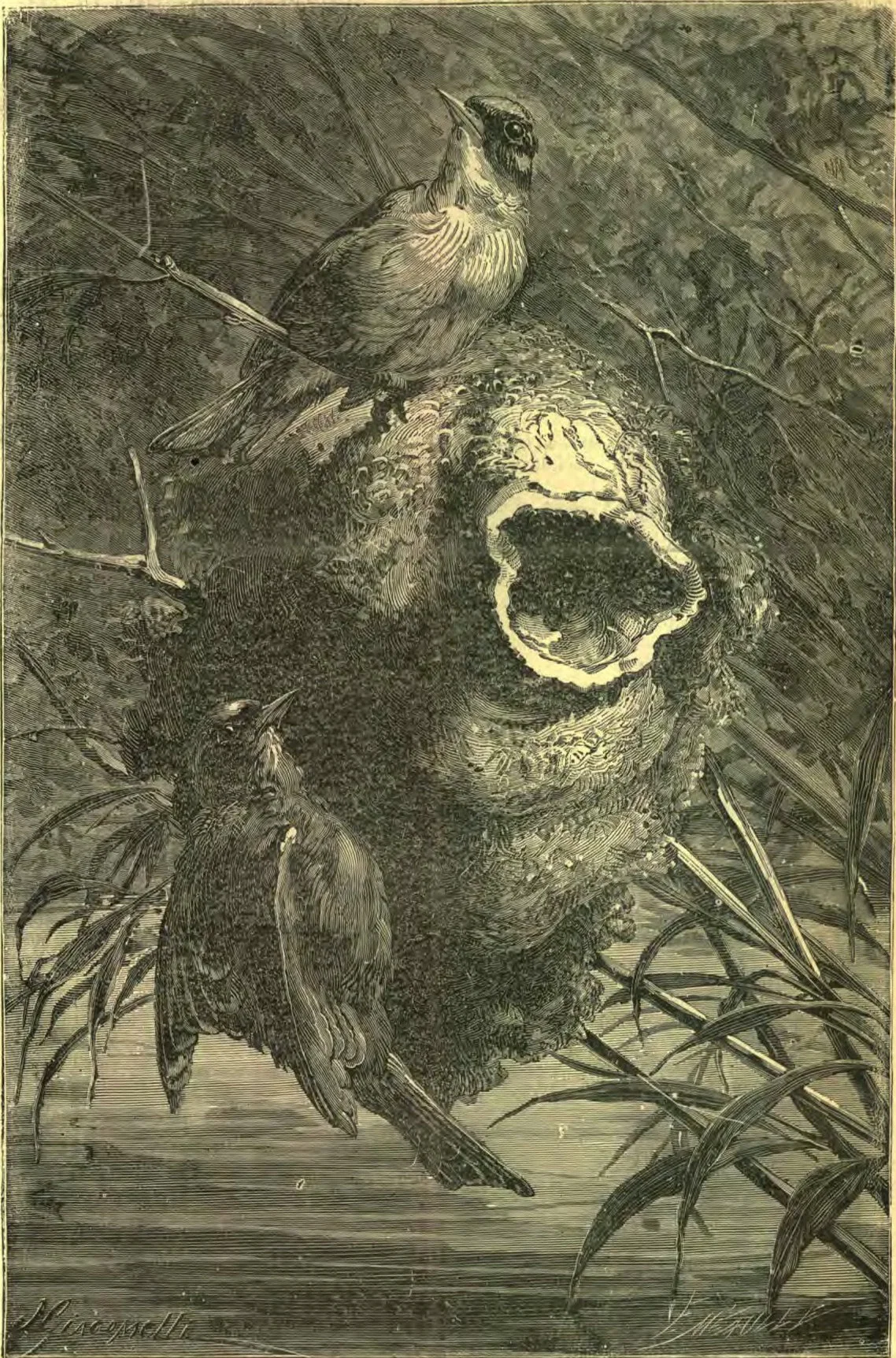
THIS familiar mite of bird life, more commonly known as the chickadee, is found throughout nearly the whole forest region of North America. Its relatives, the titmice, in general numbering over fifty species, are found in all parts of the world, South America and the islands of the South Pacific excepted. Those within the tropics are found mostly in cool mountainous districts. Our cut represents the penduline titmouse of Southern Europe, with its very ingenious nest, “which in form resembles a flask, and is generally at the end of a flexible twig, in a situation near to or overhanging water.”
All the birds of the order are small, yet bold and sprightly, flitting from branch to branch, running to their very extremities, chattering and tumbling in industrious search for insects and their larvæ. We do not know another bird so easily approached, within reach of one’s very breath even, as the black-capped titmouse during nine months of the year; yet throughout the nesting season it is more shy, retiring usually into the most secluded depths of the woodland. They are the constant companions of the lumbermen in the great pine woods, and make themselves familiar with all who work in the wintry woodland, as every country boy knows who has split wood or “rossed” stave bolts in winter.
They seem to prefer animal food; and after watching a trio of them for a few minutes, one would conclude that if any skulking thing was to be found anywhere, they would find it. Through and through the bristling brush heaps they flit, in and out of the loose piles of wood and staves, under every careless bark, and into every cavity that will admit their tiny, active bodies. No spot seems to escape the scrutiny of their searching dark eyes; and if they were a hundred times as large, it often seems that they could still live on the fruits of such persistent and long-continued plunder. A stark, corpse-like worm or larvæ about an inch in length seems to be the chief object of their search at such times, and they pull them forth from their lurking places with but little time for argument, and swallow them with a very evident relish. They do not scruple to search the lunch basket and try the sandwiches, and in one instance at least came so near at lunch time as to be struck dead with a table knife.
We recently had occasion, one early May morning, to walk past a thicket of prickly-ash and other shrubs bordered by an old lichen-covered fence; and though it was raining drearily, and most other birds were in safe retirement, we noticed a pair of these little black-capped fellows coursing along between the rails of the fence, eying every crevice, and peering under every splinter and loosened bark, yet in order to do so, they they often had to cling with heads downward to the rail above them. Though at times several yards distant from each other, they kept up a constant whispered conversation, varying it in loudness to suit the distance. They seemed, however, to find but little among the dry old rails to encourage them in their search, and would in spite of the rain fly out occasionally upon the neighboring bushes, shaking down a shower of raindrops in so doing; but they would as often return, for their search in the rain seemed almost fruitless. Finally, when separated at least a rod, one of them succeeded in pulling out one of those white larvæ so tempting to the chickadee’s palate; but instead of eating it himself, he carried it to his mate, who devoured it forthwith with a show of thankful pleasure such as only a bird can manifest.
Though the well known “chick-a-dee-dee” is its usual note, this bird produces a variety of sounds. It has a cry peculiar to the warmest, sunniest days of winter or early spring-time, which, transcribed into English, sounds like a long drawn Pee-dee or Tee-tee, with a circumflex. This from some high perch it repeats again and again with great resonance, and a musical, cheery call it is, always betokening the approach of May time.
While in the woods during their nesting season, we have heard this cry repeated responsively and with a most charming effect, the male, we suppose, uttering the call first, and the female, at a distance of a hundred yards or so, responding with such regularity as exactly to simulate an echo.
The untiring energy of the bird finds full exercise in the construction of a home and the care of eggs and young. Its nest, unlike that of the European species in the cut, is usually built in some hollowed stump or decayed tree previously used for a similar purpose by some other bird or a squirrel. It is said, however, that with great labor it sometimes excavates such a nesting place for itself. The eggs are usually six in number, of the purest white, but flecked with minute specks of red. Two broods of young are produced each summer, the first about the beginning of June, the second toward the end of July.
Among those conversant with bird life, it is well known that the cow-pen bird, or cow bunting, never builds a nest of its own; but after stealthily depositing its eggs singly in the nests of smaller birds, it leaves them then wholly to their care. These buntings, we ought perhaps to add, are the brown or dingy black birds that associate with the red wings, but are not infrequently seen in company with herds of cattle or flocks of sheep, often perched upon the backs of the latter, and leisurely riding about. Once, by accident, we broke the top from a decayed stump, frightening therefrom a chickadee whose nest we had thus unintentionally broken up. Looking it over carefully, we found two unfledged chickadees and one unhatched egg; but in pulling the nest apart, we found the lower portion to be an exact counterpart of the upper, and containing the solitary, unhatched egg of a bunting, full twice the size, and differently marked, from that of the chickadee. Evidently the titmouse had built both nests; but on completing the first, and before depositing any eggs therein, the bunting had without invitation or assent of the chickadee, left the offending egg for the plucky little bird to care for. Right here she found her mistake, if indeed like most careless people she ever concerned herself about mistakes; for Mrs. Chickadee, uniting tact with her pluck, built nest number two right in the first and upon the offending egg, and thus saved all possible trouble with a young bunting,—trouble in which other birds with less brains but more feathers often find themselves involved.
“The Black-capped Titmouse,” says Wilson, “is five inches and a half in length, and six and a half in extent; throat and whole upper part of the head and ridge of the neck, black; between these lines a triangular patch of white, ending at the nostril; bill, black and short; tongue truncate; rest of the upper parts, lead colored or cinereous, slightly tinged with brown; wings edged with white; breast, yellowish white; legs light blue; eyes dark hazel. The male and female are nearly alike.” GEORGE R. AVERY.

"WHY DON'T HE DO IT, THEN?"

Two sisters were together in the sunshine nursery of a country home. One was busy painting, the other quite as busy playing with her doll Clara. Netty was struggling to make Miss Clara look fine in a new dress, but she found the ribbons too hard to fasten. So she threw the doll into Gertrude's lap, and said, with a little sigh: "Please tie dolly's sash."
Gertrude knew how to make the prettiest of bows; but now she was more interested in putting dainty rosebuds on a piece of light blue satin, and did not like this interruption. She answered crossly: "Baby, I do wish you'd go away. You always bother, and want something."
The little one's lip quivered, and the tears filled her big brown eyes. Without a word, she took precious Clara and sat down in a corner, whispering her trouble into the China ears. The moment the hasty words were spoken, Gertrude was sorry. She was conscientious, and knew she was wrong, and that she had hurt the little heart. It did not comfort her much to hear Netty's low voice tell her sawdust child, "Jesus would not speak to us so."
After a little struggle with pride, Gertrude crossed the room, took dear little "Fish-net"—as the older brothers called her—on her lap, tied Clara's sash and other ribbons, and then said: "O my dear little sister! Jesus will keep me from being so cross if I only ask and trust him."
The child was still for awhile; she was puzzled. Then, patting her sister's cheek, she said, with that searching directness and simple power of a child's tongue: "Gerty, why don't he do it, then?" The question fairly startled Gertrude, as well it might.
Day after day had she earnestly asked—and, as she thought, trusted—Jesus for deliverance from quick temper, irritability, and all sin. But the fact that she had not improved, showed either that Jesus would not do as he said, or that she had not trusted him as she ought. And the child's interpretation showed that Gerty's promise threw the burden of failure upon Jesus; for little Netty had not thought that her sister could be faithless in her praying.
The tears came into Gerty's eyes as she thought how her unbelief had wounded the heart of Jesus; she had promised for him, and the responsibility was upon her to see the promise made good. So she kissed Netty, put her down, and went to her own room. It seemed to her that she had no right to the name Christian at all, she was so un-Christlike, and she had so dishonored Christ. She might have borne it, had the childish voice asked, "Why don't you do it, then?" for the responsibility would have been all hers, and the dishonor all hers, if she failed in her duty again. But as it was, she could not stand the idea of promising that Jesus would do what her faithlessness made him seem to fail of doing.
Poor Gertrude poured out her sin and grief at his feet; and, as he never sends any empty away, he forgave, and comforted her. Little Netty never had to repeat her question; for, from that day, the elder sister changed, growing patient, gentle, and very loving. She had lacked faith, and, as soon as she saw it, she took her need to Jesus, waiting patiently upon him. And as he always gives in greater abundance than we ask, so he gave her, not only faith, but peace and joy in him.—S. S. Times.

HONOR

Losses on losses, fast they came; Men said: "There's left him but his name; But that is free from blot or blame." Despairing, bowed with care and dread, As if he heard, he raised his head, "Thank God, I have my name!" he said.

SMALL FEET OF CHINESE WOMEN

TCHOUNG-KOUO,—NO. 5.

SMALL FEET OF CHINESE WOMEN.

Travelers often assert that the feet of Chinese women are deformed in order to confine them to the house. If one should make this statement in China, his words would be greeted with peals of laughter. Ever so far away in the past,—so far away that the exact date has been lost,—there once lived a most beautiful Chinese princess. She was so beautiful that she was the theme of song and story throughout the Empire. This lovely woman had such small feet that they were the marvel and envy of all the ladies of China, who adopted her as the type or standard of beauty, this fact being recorded by Chinese writers. The fashion thus inaugurated grew into favor slowly and steadily, until it became general.
What attempts were made anciently to reduce the size of the foot is not positively known. Of course many and various experiments must have been tried ere the present effective mode was adopted. The failures of the women to reduce the size of their feet, and only the partial success of the young people, is a matter of record. The operation was at last confined to children.
All Chinese women are lame. Their feet are simply shapeless stumps, from which life has been literally squeezed out. They are constantly enveloped in bandages; yet when encased in their exquisitely embroidered boots, they would make the heart of a Parisian belle quiver with envy. The poor things, however, have as much difficulty in balancing themselves as would a chicken whose feet were cut off above the joint. Yet many move along with ease and rapidity, and some run quite readily for short distances. The tottering steps which they assume, however, and which tend to convince a stranger that they are on the point of falling, is simply affectation, being as much the fashion as a mincing gait sometimes is in other nations. They suffer no pain or fatigue; and frequently the girls, in playing the favorite game of battle-door and shuttlecock, use their slippers instead of battle-doors, moving about on the unprotected stumps.
The mother begins to operate upon the child's foot at the age of five or six years. Long bandages are wound around the toes and foot in a peculiar manner. These are tightened daily, and are never dispensed with during life. The result is that the four toes (the great toe remaining unbandaged and allowed to grow naturally) are finally brought under the foot, and made to project at the side or instep. Generally the operation is successful, and in a few years the foot loses its sensibility and ceases to be painful. The shrieks and moans of the little girls, as the mother rearranges and tightens the bandages, can be heard on every side of a morning; and it is a pitiful sight to witness the agony of the poor little things, as they sit upon tables while the mother operates upon the feet. They have to be closely watched during the entire period; for they make desperate attempts to loosen the wrappings.
A very small foot is certain proof of the possession of aristocratic blood, very small feet, from three to four inches in length, being found only among the better classes. The laboring classes are of a coarser build generally, and their feet are naturally larger; and besides, the requisite attention is not always given, the feet frequently never being bandaged. Among the peasants, especially where the women are yoked to plows, bandaging the feet is seldom resorted to.
W. S. C.

A PEEP AT AFRICA.—NO 2

Written for the Instructor.

A PEEP AT AFRICA.—NO 2.

EGYPT.

In the northeastern part of Africa lies one of the most ancient and wonderful countries on the globe,—the land of Egypt. The Bible mentions it by this name more than six hundred times. It seems to have been peopled by the descendants of Ham, who was the second son of Noah. Sometimes the Bible calls it the “land of Ham.” It is also called Mizraim. At the first glance, the country seems to divide itself into two strongly contrasted regions; and this was the original impression which it made upon its inhabitants. The natives from a very early time designated their land as “the two lands,” and represented it by a hieroglyph in which the form used to express “land” was doubled. The kings were called “chiefs of the Two Lands,” and wore two crowns to signify that they were chiefs of two countries. The Hebrews caught the idea; and though they sometimes call Egypt “Mazor,” they preferred commonly to designate it by the dual from “Mizraim,” which means “the two Mazors.” These two Mazors, “two Egypts,” or “two lands,” were the broad tract upon the Mediterranean known as “Lower Egypt,” or “the Delta,” and the long, narrow valley that lies to the south, which bears the name of “Upper Egypt,” or “the Said.”
The contrast between these two regions is very striking. If we should enter Egypt from the Mediterranean Sea on the north or from Asia by the caravan route, we would see stretching before us an apparently boundless plain, wholly unbroken by natural elevations, generally green with crops or with marshy plants, and over these a cloudless sky, which rests everywhere on a distant, flat horizon. No hills or mountains break the tiresome monotony. No alternation of plain and highland, meadow and forest, no slopes of hills, or hanging woods, no gorges or cascades, no rushing streams or babbling brooks, meet our gaze on any side. Whichever way we look, all is sameness, one vast, smooth expanse of rich alluvial soil, part of which is cultivated and part lying waste. If we should journey southward about a hundred miles from the coast, an entirely new scene would meet our gaze. Instead of the boundless plain, we would find ourselves in a narrow vale, up and down which the eye would command an extensive view, but where the prospect on either side is blocked at the distance of a few miles by rocky ranges of hills, white or yellow or tawny, sometimes drawing so near as to threaten an obstruction of the river course, sometimes receding so far as to leave some miles of cultivable soil on either side of the stream. The rocky ranges, as we approach them, have a stern and forbidding aspect. They rise, for the most part, abruptly in bare grandeur; on their craggy sides grows neither moss nor heather; no trees clothe their steep heights. They seem intended to keep the inhabitants of the vale within their narrow limits, and to bar them out from any commerce or acquaintance with the regions beyond.
Egypt is the richest and most productive land in the world. In its most flourishing age we are told that it contained twenty thousand cities. Undoubtedly it deserved the title of “one great town” more than did Belgium. Though the territory of Egypt was small, yet she was happy in her soil and in her situation. Each year the Nile overflowed its banks, leaving upon the surface of the ground a rich deposit which greatly enriched the soil, and rendered it very productive. Three crops were gathered each year. The date-palm, springing naturally from the soil in clumps, or planted in avenues, everywhere offered its golden clusters to the wayfarer, dropping its fruit into his lap. Wheat, however, was the chief product of the country. Egypt for long ages was regarded as the granary of the world, and to it all the neighboring nations looked for relief in times of famine. You will remember that Abraham fled to this country when Palestine was visited by a famine. In after years his grandson Jacob sent his sons down to Egypt to buy corn. There they found their brother Joseph, whom they had wickedly sold more than twenty years before. They did not know that it was Joseph, however, until their second visit, when he made himself known to them. Joseph had been sold into Egypt as a slave, but now his brethren found him occupying a position next to the king upon his throne. While Joseph was a prisoner, his kind words, his good behaviour, and his pleasant and agreeable manners won for him warm friends among the keepers of the prison. Amid all his ill-treatment he neither murmured nor complained, and finally he occupied the high position which he held when his brethren came to Egypt to buy corn. D. A. ROBINSON.

The Joy of Generosity Shared

The generous never enjoy their possessions so much as when others are made partakers of them.

SACRIFICE

LESSON 3.—ACCEPTABLE SACRIFICE.

1. What is the first command of all? Mark 12: 29, 30.
2. How does the keeping of it compare with the offering of burnt-offerings and sacrifices? Verse 33.
3. What kind of sacrifice will God regard? Ps. 51:16, 17.
4. What makes mere outward offerings contemptible in the sight of God?—The heart is not in them.
5. What calamity came upon the Jews on account of David’s sin in numbering the people? 2 Sam. 24: 15.
6. How did this affect David? Verse 17.
7. What did the prophet tell David to do to show his repentance? Verse 18.
8. Could David have made this offering without expense to himself? Verses 22, 23.
9. How did David feel about making such an offering? Verse 24.
10. What does this indicate concerning David?—That with a broken and contrite heart he sincerely repented of his sin, and was anxious to express it by a costly offering.
11. What is therefore shown by the offerings which men make?
12. What does the Lord say concerning those who honor him? 1 Sam. 2:30.
13. How did the ancient priests dishonor God and despise his name? Mal. 1:6-7.
14. What kind of offerings did they bring? Vr. 8.
15. How did they feel about performing the service of the temple? Verse 10.
16. How did they look upon the work of the Lord? Verse 13.
17. How does God look upon those who make inferior sacrifices to him? Verse 14.
18. Whose offerings are more acceptable than such offerings? Verse 11.

NOTES.

“It is a maxim from heaven, ‘Honor the Lord with thy substance.’ He who has a religion that costs him nothing, has a religion that is worth nothing; nor will any man esteem the ordinances of God if those ordinances cost him nothing. Had Araunah’s noble offer been accepted, it would have been Araunah’s sacrifice, not David’s; nor would it have answered the end of turning away the displeasure of the Most High. It was David that sinned, not Araunah; therefore David must offer sacrifice.”—Clarke.
Malachi was the last prophet whom God sent to Israel. It seems that it was their crowning sin in losing the spirit of contrition and humbleness of heart, which was necessary in order to make their sacrifices acceptable to God. They saw no difference between the idolatrous worship of the nations around them, and the worship of the true God. To them it was simply a form. That which was of no value to themselves they brought and gave to the Lord; therefore they did not know what the true spirit of sacrifice, as manifested by David, meant. It argues a great contempt of the Almighty when men are less careful in maintaining the decency of his worship than they are in giving their respect to their superiors. It is evident that these priests had so far lost the true spirit of sacrifice that they had nothing of the true meaning of the sacrifices as shadowing forth the unblemished Lamb of God. The eleventh verse is a prophecy showing that the gospel would go to the Gentiles.

WHAT GOVERNMENT COSTS.

Probably but few of the young readers of the INSTRUCTOR know what a great sum of money it costs every year to support the United States Government. For any who wish to become enlightened upon the subject, the following paragraphs from the Youth’s Companion are reliable. Of its cost, and the purposes for which the sum is expended, it says:—
“A statement has been made up showing the amounts appropriated by Congress at its late session for the support of government for the year which will end June 30, 1888. The total sum is about two hundred and forty-eight and a half million dollars. There were two appropriation bills that failed to become law; the river and harbor bill, which the President neither approved nor vetoed, and the deficiency bill, which was passed by both branches of Congress, but could not be prepared for the President’s signature before the time of adjournment. If we add the $14,000,000 appropriated by these two bills, and the $48,000,000 required to pay the interest on the public debt to the sum above mentioned, we have $310,000,000 as the amount deemed by Congress necessary to meet the current annual expenses of government. The corresponding expenditures during Washington’s administration averaged less than six million dollars a year. The population is fifteen times as great as it was then; the expenditure is fifty times as great. Yet this is not an evidence of extravagance, because the government does for the people vastly more than it did in the time of Washington.”
“The largest single item of appropriation is that for pensions. No less a sum than eighty-three million dollars is granted for this purpose for the fiscal year soon to begin. This sum alone would have paid all the ordinary expenses of the government, except interest, for the first eighteen years under the constitution, or until 1808. Next comes the post-office, taking fifty-five and a half millions, but of this amount more than fifty millions will be derived from postage and other revenues of the department. The charge for the army is a little less than twenty-four millions. The appropriation for the navy is larger than usual, almost twenty-five millions, because some new ships are to be built. Most of the salaries paid to officers of the United States, and to Congress, are provided for in the legislative, executive, and judicial appropriation act. This act covers a sum of twenty and a half millions, which is only about three millions more than it was twelve years ago, when the population was much smaller than it is now. A great variety of matters are provided for under the bill known as the ‘sundry civil’ appropriation act,—the mint; constructing, repairing and warming and lighting public buildings; the life-saving service; collecting the revenue; paying back duties wrongly assessed; and a great many others. This act appropriated twenty-two millions, this year, about the usual amount. We have thus accounted for all but about seventeen millions of dollars of the appropriations, which are disposed of thus: Indians, five millions; District of Columbia, four millions; ministers and consuls abroad, one million and a half; agricultural department, one million; military academy, half a million; and the rest for miscellaneous small purposes.”
“Although there are some abuses in the government, the public service is, on the whole, conducted in a manner that will compare creditably, for economy and efficiency, with that of any other country in the world. For example, the British civil service, which is so much praised, costs nearly thirteen million dollars, or twice as much as the corresponding service in this country, although the population of the United States outnumbers that of the United Kingdom by twenty-five millions.”
“It is quite beyond the bounds of human possibility to expend the three hundred millions and more which the government pays out every year without some of it going to waste, by being paid to people who are not entitled to it; but we succeed as well as any other country in limiting these abuses. This success, however, should not have the effect of leading the people to cease their efforts still to improve the service. We must also remember that an increasing population means an increase of expenditures; and that the march of civilization itself is constantly adding to the requirements which the people make of their government, while every new function of government adds to the cost of maintaining it.”

BETTER TO STRIVE.

BETTER to strive than to waste in desire Time we might give toward gaining our end. Naught like endeavor the spirit to fire— Labor is always ambition's best friend. Action will give us no time to despond, Keeping each impulse and purpose alive, Showing the goal of success far beyond; Idle is wishing—'tis better to strive!
Better to strive than to rashly depend On the kind aid that another may give; Better to strive than to wait for a friend, Strive for ourselves to be worthy to live. Ever be doing! Each little success Causes the spirit that drooped to revive; Hearty endeavor kind Heaven will bless. This be our motto: "'Tis better to strive!"
—Golden Days.

THE BAMBINO.

The celebrated Dr. J. H. Vincent is editor of the Sunday-school Advocate, and while spending some time in Rome recently, he sent an engraving of the Bambino, to be used in the Advocate. It is a representation of the infant Saviour wrapped in swaddling clothes—an image which is displayed in many Catholic churches on Christmas occasions. Although we cannot furnish the picture for your examination, this is what the Doctor says about it:—
“If you were to show that picture to the Roman Catholic priest in your town, and if he were to speak out at once and tell you just what he knows, he would say, ‘O, that is the Bambino. That is one of the gods which the Roman Catholics worship in Rome.’ Now I am sure he would not say that outright, because it would not be good policy to confess it in America. But he knows that the Bambino is a god of the Roman Catholics. That is not what they call it, but that is what it is. He might tell you its wonderful story; what miracles it has ‘experienced’—miracles wrought for it; what miracles it has performed, and that within a few years in Rome: how it healed the sick again and again by being taken to the room of the afflicted; how it is venerated and visited and kissed, and its blessings and healing power are devoutly invoked.
“The Bambino is a great treasure to the church and the monks who happen to own it. It yields money. Foolish people have faith in it. They know of cures it has wrought. Now, it effects no real cures at all except through imagination. I pity the people who are victims of the delusion, but what shall I say of the pope, bishops, priests, monks, and nuns who allow these insanities and idolatries to go on unreproved? They do it for gold. They do it to keep people in ignorance and in superstition in order to keep a hold upon them for the sake of financial gain and political power.
“Whenever you see an American Roman Catholic priest, think of his Bambino in Italy, and how he and his kind encourage idolatry. And always remember that he and they suppress the second commandment, which forbids the making of graven images and bowing down before them to worship them. They make graven images, and they encourage the people to worship them. Don’t forget these idolatrous practices of the Romish Church. Look at the Bambino, and learn to loathe every thing Romish.”

FLOATING ISLANDS.

On many of the lakes of China may be seen a curious and beautiful sight,—artificial floating islands. Bamboo rafts of enormous size are constructed, and on these is laid a thick layer of rich earth. On this earth, rice is planted, and large crops are harvested. The raft forms the home of the proprietors, and whole colonies may be seen on a single raft, their pretty homes surrounded by flower gardens, and hedged in by fields of rice, forming a charming and surprising picture. When not engaged in farming, the colonists are fishing, which is not only an amusement but a source of profit. Birds of all kinds build their nests in and around the houses, while all kinds of land and water fowl roam about the island. Like the Arabs, these floating proprietors wander at will, constantly seeking new localities. Large sails are attached to each corner and to every house, yet the islands are so huge that they move very slowly. W. S. C.

BOOKS OF CLAY

FAR AWAY beyond the plains of Mesopotamia, on the banks of the River Tigris, lie the ruins of the ancient city of Nineveh. The spade, first of the Frenchman, then of the Englishman, has cleared the earth away, and laid bare all that remained of the old palaces where the princes of Assyria walked and lived. The gods they worshiped and the books they read have all been revealed to the sight of a wondering world.
The most curious things preserved in this wonderful manner are the clay books of Nineveh. The chief library of Nineveh was contained in the palace, the ruins of which have been dug up. The clay books which it contained are composed of sets of tablets covered with very small writing. The tablets are oblong in shape, and when several of them are used for one book, the first line of the tablet following was written at the end of the one preceding it. The writing on the tablets, was, of course, done when the clay was soft, and then it was baked to harden it. Then each tablet, or book, was numbered, and assigned to a place in the library, with a corresponding number, so that the librarian could easily find it.
Some of these clay books were made as many as four thousand years ago, and claim to be translations from records that likely existed when Noah was yet living. And what is very remarkable, some of the oldest of these Syrian and Chaldean tablets contain an account of the Creation, which is in substance almost the same as that given in the first chapter of Genesis.—The Busy Bee.

DISPUTES OF CHRISTIANS.

In whale fishing, when a whale is struck with the harpoon, and feels the smart, it sometimes makes for the boat, and would probably dash it to pieces. To prevent this, the seamen throw a cask over-board; and when it is staved to pieces, they throw over another. The whale spends his strength on these, and soon becomes harmless to the men. So when Satan fears that Christians united would become too powerful for him, he throws over-board a tub—some non-essential point of doctrine or polity, and lets them spend in angry disputation over this, the strength that ought to be used in defeating him.

Knowledge Increases Responsibility

KNOWLEDGE increases responsibility. The scribes could quote Scripture, and yet condemned themselves by rejecting it.

Letter Budget.

We have letters from MATTIE and MAUD CROWELL, of Winnebago Co., Wis. Mattie is twelve, and Maud is eight years old. Mattie writes: “I go to day school, and have been to Sabbath-school several times this fall. We have Sabbath-school at home when we do not attend one away from home. I study in Book No. 2. I have learned the commandments, and the names of the twelve disciples. I read in fifth reader at day school. I am trying to be a good girl, and want to meet all the INSTRUCTOR family in the new earth. I like to read the letters in the Budget.”
Maud writes: “I have a sister twelve years old, and a brother six years old. We have taken the INSTRUCTOR nearly a year, and we all love to read it. My sister studies lessons in No. 2, little brother and I in No. 1, and mamma learns lessons in the INSTRUCTOR. We have Sabbath-school at home. I have learned all the commandments, and I am trying to keep them too. We learn a verse in the Bible by heart every Sabbath. We all keep the Sabbath but papa, and we hope he will by and by. I go to day school and study second reader, arithmetic, spelling, and writing. Mamma went East on a visit last summer; and when she came back, she brought us some little Guinea pigs, which are real funny. We have named one Fanny, and the other Bunny. I have two chickens, and when they are sold, I am going to have the money to put into the missionary box. I hope to be called worthy when the Saviour comes.”
He is worthy who does worthily, Maud. The Saviour says, “Blessed are they that do God’s commandments.” Do you keep them?
GRACIE M. SNOW wrote a letter some time ago from Allegan Co., Mich., in which she says: “As I have never written for the Budget, I thought I would write. I am eleven years old. I have been keeping the Sabbath two years with my papa and mamma who adopted me. I was baptized at Grand Rapids. I have missed Sabbath-school but twice in this time. I study in Book No. 2. Before I came here, I did not know anything about the truth. I am glad I found it. I am reading the Bible through this year. Mamma says if I will read it through, she will give me a Bible. I would not read it through just for the sake of having one, but to search the Scriptures so I may know what God’s word teaches. I have a little brother, seventeen months old, and he is as sweet as he can be. I go to school. I have a sister fourteen years old. She has a home with a Sabbath-keeping family, so she has a chance to know this truth too. She has been there as long as I have been here, and we are both trying to obey God. We believe the Saviour is soon coming, and we want to be ready to meet him.”
We are glad you love the truth so well, Gracie, and that you appreciate your good home. The Lord has been very good to you.
ETHEL E. TABIER, of Vernon Co., Mo., says: “As I have never written to the Budget, I thought I would do so. I am a little girl eight years old. I have two brothers and two sisters. Our baby sister is one year old. We all love her very much. My oldest brother was baptized last October at the Harrisonville camp-meeting. He is secretary of our Sabbath-school now. I study in Book No. 1. I attend day school, and love my teacher very much. I read in second reader, and am trying to learn fast. I have a dear auntie, who teaches in the Academy at So. Lancaster. I have not seen her for over two years. Her name is Mrs. S. J. Hall. I want to be a good girl, and be saved with the INSTRUCTOR family.”
Ethel’s auntie once taught in the college in Battle Creek; indeed, she is one of the B. C. graduates.
Here is a letter from Miami Co., Ind., written by PEARL WOORHEAD, a little girl twelve years old. She says: “I like the INSTRUCTOR ever so much, especially the children’s department. I go to Sabbath-school every week. I have come to live with my grandmother. I came from Wamego, Kan. I got on to the train at two o’clock, and went to Kansas City; there I changed cars and traveled all night and the next day, when I got here all safe. I traveled all alone. My brother was baptized about two months ago, and is very happy.”
“All alone!” and yet not alone, if children of the heavenly King; for the Lord has said, “He that keepeth thee shall not sleep,” and “he shall give his angels charge over thee, to keep thee in all thy ways.” Did you think of these promises while upon your journey, Pearl?

LITTLE KIT.

PRETTY Kit, little Kit, Oh, you're a lovely pet! With your sleek coat and your white throat, And toes as black as jet; It's true your eye is rather green, But then it shines so bright, That you could catch the naughty mouse Who stole my cake last night.
Pretty Kit, little Kit, I've often fondled you Before your little legs could walk, And eyes were opened too; And when I laid you on the rug To roll you o'er in play, Your kind mamma in her great mouth Would carry you away.
Pretty Kit, little Kit, Annie's bird can sing, Arthur's dog can carry sticks, And Mary's parrot swing; But though you do not carry sticks, Or sing, or swing, you are, With your low purr and your soft fur, The dearest pet by far.
Oh, you Kit! naughty Kit! What is this I find? Annie's little bird is gone, And Poll's scratched nearly blind; Carlo's coat is sadly torn; Oh dear! what shall I do? You've feathers hanging round your mouth— It's all been done by you.
Fie, Kitty! fly, Kitty! You're no pet for me! I'll neither rock you in my lap Nor nurse you on my knee.
—Selected.
Continue reading: ANTS THAT BUILD MOUNDS