time, holding herself free from all alliance with this world, content to fulfill her calling in witnessing for Christ, in suffering with Christ, and so to accomplish her appointed work of the gathering out of the elect body for the Lord “until he come.” A strange and almost grotesque conception to many modern Christians no doubt. But it was while maintaining this attitude that the Church moved on most rapidly and irresistibly in her missionary conquests.
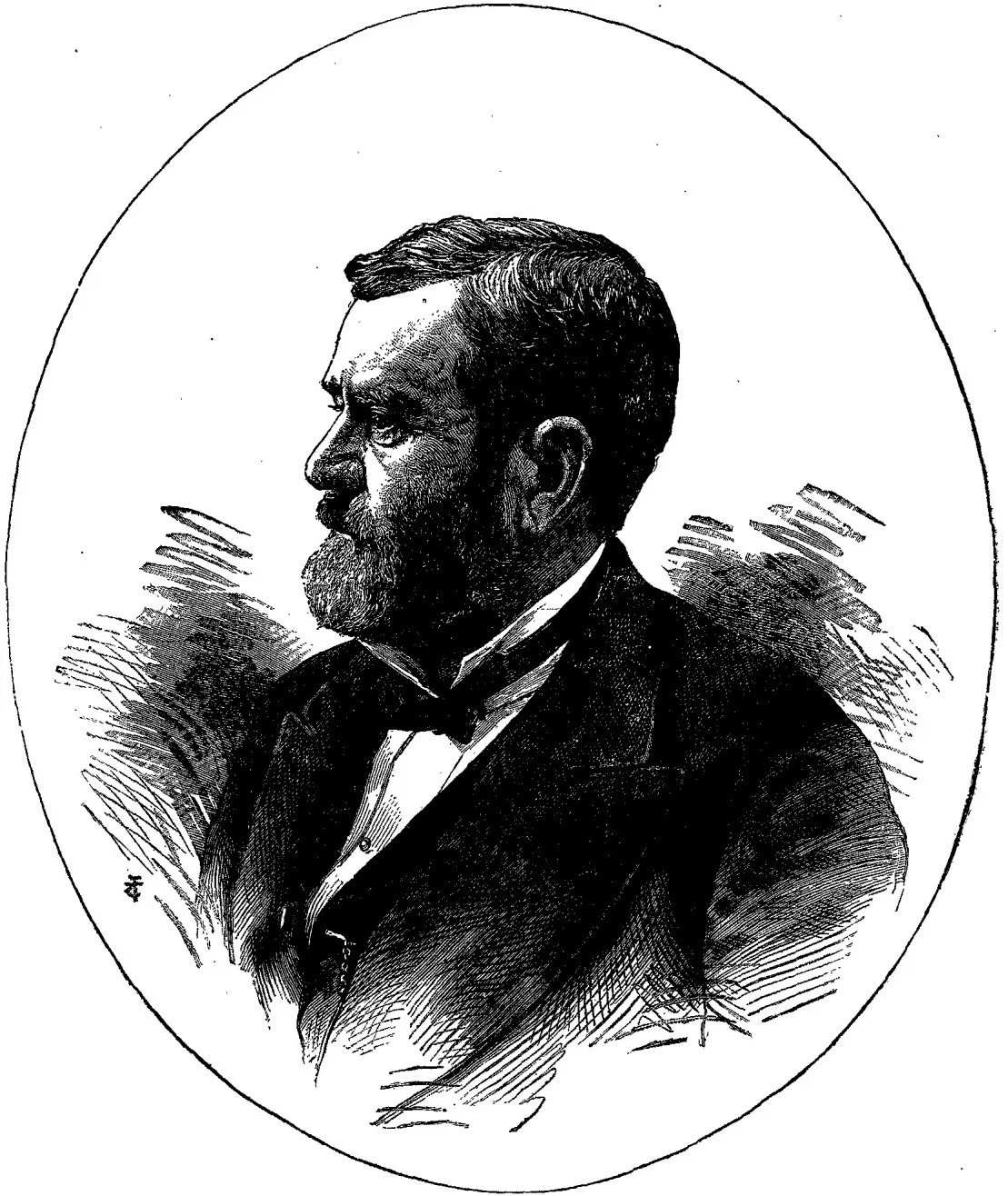
ULYSSES S. GRANT.
Then came the foreshadowings of the great apostasy. The world which had been a foe to the Church became her friend and patron; Constantine, the emperor of Rome became her head, and thus the eyes of Christians began to be withdrawn from Him who is “Head over all things to his church.” The great and good Augustine yielded to the seduction and was among the first to teach that in the temporal triumph of Christianity the kingdom had already come, though the King with whose return the primitive Church had been wont to identify the appearing of the kingdom was still absent. Little by little, as the apostasy deepened, this early hope of Christians became eclipsed till, in the words of Auberlin, “when the Church became a harlot she ceased to be a bride who goes forth to meet her bridegroom,” and thus chiliasm disappeared. What moreover would have been deemed an apostasy in the primitive Church grew into a tradition and a creed in the post-Nicene Church, which creed until this day largely rules the faith of Christians.
The Primitive Church as the Heavenly Bride
The most eminent living master of ecclesiastical history, Harnack, photographing in a single sentence the Church of the earliest centuries, says: “Originally the Church was the heavenly Bride of Christ, the abiding place of the Holy Spirit.” Does the reader not see that here is the same two-fold conception—Christ in-resident in the Church by the Spirit; and Christ expected to return in person as the Bridegroom for his bride? This was the Church which moved with such rapid and triumphant progress against ancient heathenism. With no power except “the irresistible might of weakness;” with no wealth except the riches of glory inherited through her heavenly citizenship; refusing all compromise with the world, declining all patronage of kings and emperors, she nevertheless went forth conquering and to conquer, till in a few years she had undermined the whole colossal fabric of paganism. And might not the Church of Christ do the same to-day if she were to return to this primitive265ideal? and if renouncing her dependence on human resources—wealth and power and social prestige, she were to inscribe upon her banner that ancient motto: “Not by might nor by power, but by my Spirit, saith the Lord.”—From “How Christ Came to Church,” Baptist Publication Society, Philadelphia, Pa.
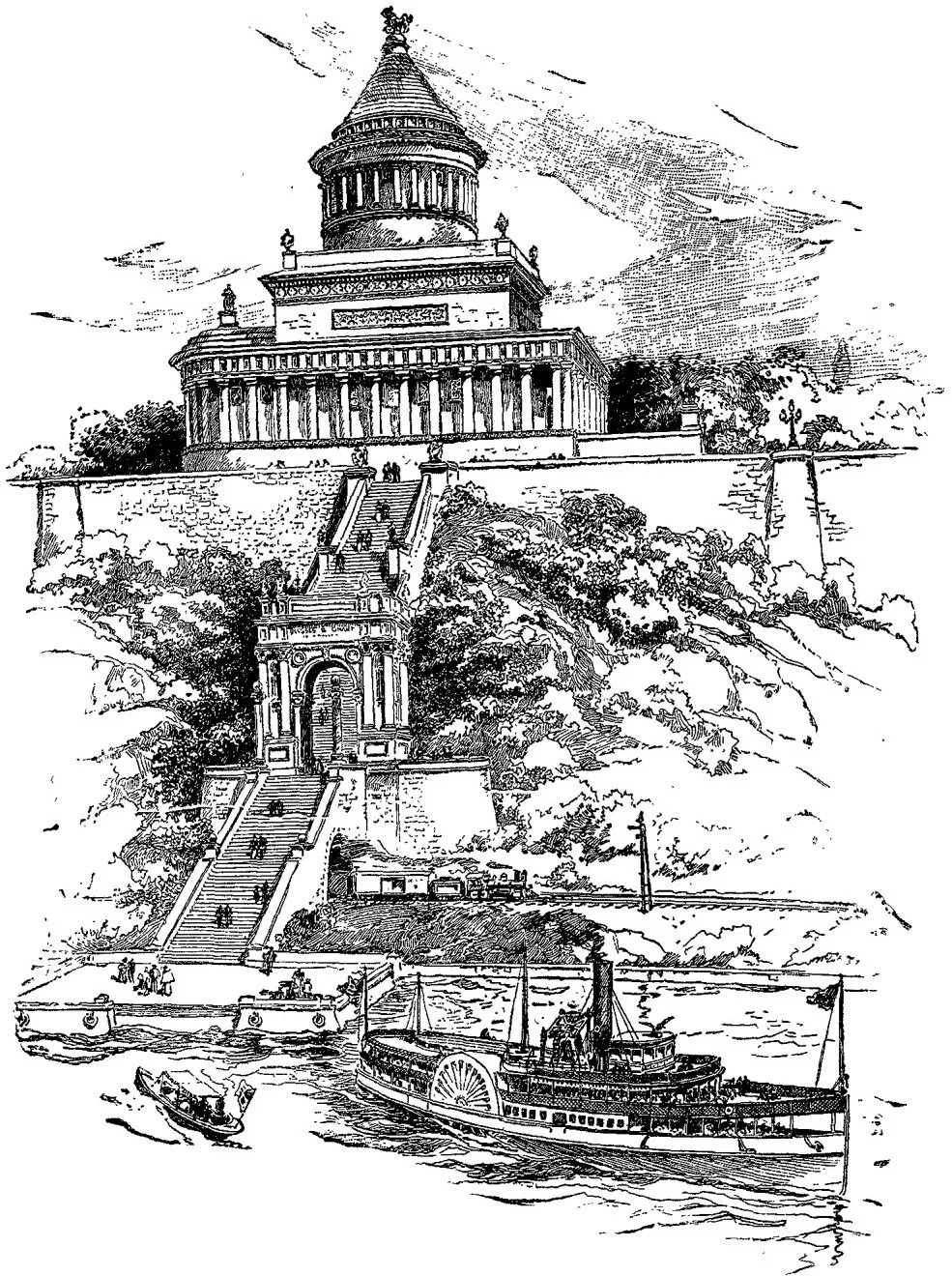
GENERAL GRANT'S NEW TOMB IN RIVERSIDE PARK, NEW YORK CITY.
General Grant on Separation of Church and State.
APRIL 27, the birthday of General Ulysses S. Grant, while the representatives of the military world unite in demonstrations of honor to his memory, the remains of the great leader will be transferred from the temporary tomb in which they have reposed since the general’s death, to their permanent resting-place in the new and imposing mausoleum in Riverside Park, New York, overlooking the Hudson River, as shown in the accompanying illustration. While all eyes are thus for the moment turned once more toward the commanding figure which must ever hold so prominent a place in American history, it is a fitting time to recall some of those utterances of the dead leader which, more than his feats of arms, revealed the stalwart integrity and true Americanism of his character.
For this purpose there is perhaps nothing more suitable than his Address to the Army of the Tennessee, delivered at Des Moines, Iowa, in September, 1875. It is especially fitting that the American people should recall this address at this time, because of the emphasis it puts upon the fundamental American principle of separation of Church and State, which is just now, through the machinations of religious combinations seeking political power, in the most imminent danger of entire subversion.
Following is the address.
ADDRESS TO THE ARMY OF THE TENNESSEE.
COMRADES: It always affords me much gratification to meet my old comrades in arms ten to fourteen years ago, and to live over again in memory the trials and hardships of those days,—hardships imposed for the preservation and perpetuation of our free institutions. We believed then and believe now that we had a Government worth fighting for, and, if need be, dying for. How many of our comrades of those days paid the latter price for our preserved Union! Let their heroism and sacrifices be ever green in our memory. Let not the results of their sacrifices be destroyed. The Union and the free institutions for which they fell should be held more dear for their sacrifices. We will not deny to any who fought against us any privileges under the Government which we claim for ourselves. On the contrary, we welcome all such who come forward in good faith to help build up the waste places and to perpetuate our institutions against all enemies, as brothers in full interest with us in a common heritage. But we are not prepared to apologize266for the part we took in the war. It is to be hoped that like trials will never again befall our country. In this sentiment no class of people can more heartily join than the soldier who submitted to the dangers, trials, and hardships of the camp and the battle-field, on whichever side he fought. No class of people are more interested in guarding against a recurrence of those days. Let us, then, begin by guarding against every enemy threatening the perpetuity of free republican institutions.
I do not bring into this assemblage politics,—certainly not partisan politics,—but it is a fair subject for soldiers in their deliberations to consider what may be necessary to secure the prize for which they battle. In a republic like ours, where the citizen is the sovereign and the official the servant, where no power is exercised except by the will of the people, it is important that the sovereign—the people—should possess intelligence. The free school is the promoter of that intelligence which is to preserve us a free nation. If we are to have another contest in the near future of our national existence, I predict that the dividing line will not be Mason and Dixon’s, but between patriotism and intelligence, on the one side, and superstition, ambition, and ignorance on the other. Now, in this centennial year of our national existence, I believe it is a good time to begin the work of strengthening the foundation of the house commenced by our patriotic forefathers one hundred years ago at Concord and Lexington. Let us all labor to add all needful guarantees for the more perfect security of free thought, free speech, and free press; pure morals, unfettered religious sentiments, and of equal rights and privileges to all men, irrespective of nationality, color, or religion. Encourage free schools, and resolve that not one dollar of money appropriated to their support, no matter how raised, shall be appropriated to the support of any sectarian school. Resolve that neither the State or nation, nor both combined, shall support institutions of learning other than those sufficient to afford to every child growing up in the land the opportunity of a good common school education, unmixed with sectarian, pagan, or atheistical tenets. Leave the matter of religion to the family altar, the church, and the private school, supported entirely by private contribution. Keep the Church and State forever separate. With these safeguards I believe the battles which created the Army of the Tennessee will not have been fought in vain.
Murder and the Millennium.
By A. F. B.
THERE were 10,652 men, women and children murdered in the United States in 1896.
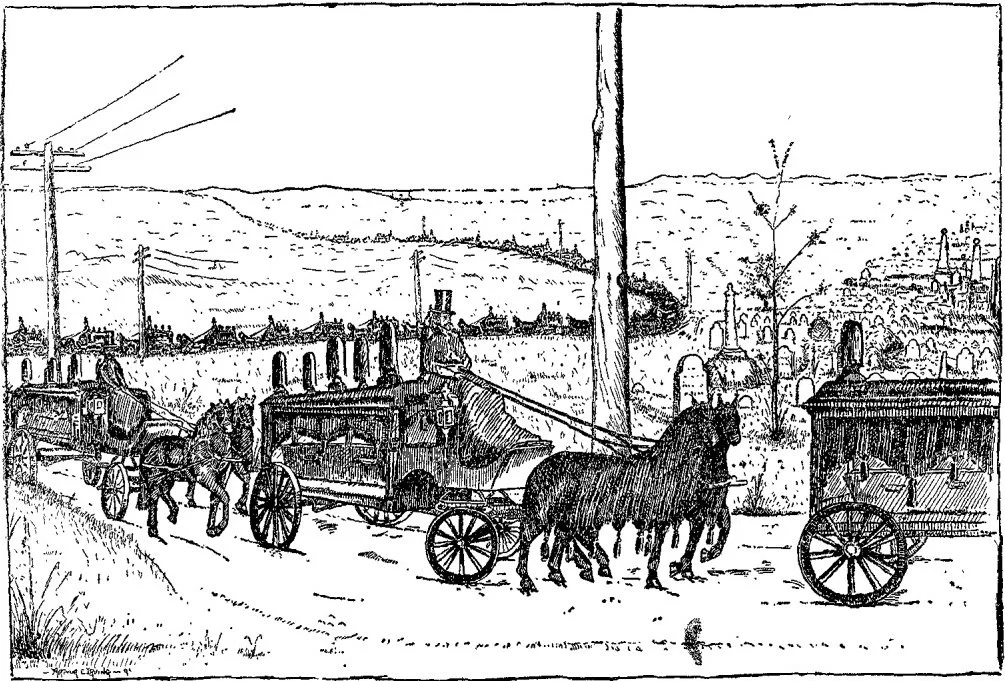
Allowing forty feet to each vehicle and ten vehicles to each funeral, the number of persons murdered in the United States last year would make a funeral procession eight hundred miles long.
Traveling at the rate of five miles an hour it would take six days and sixteen hours for this procession to pass a given point. Starting at noon on Sunday and traveling day and night, the last of this train of tears and blood and blighted hopes, this product of greed and rage and lust would pass by at the early hour of two on the next Sunday morning.
For years this record of blood has steadily increased. The number murdered in 1892 was 6,794; the number in 1896 was 10,652. This is an increase in five years of nearly 57 percent., while the population in the same time increased less than 12 per cent. And yet in the face of these startling figures the large majority of religious leaders teach that the world is getting better, that we are entering the long-expected millennium.
The authority for these figures is the Chicago Tribune, which publishes on January 1st of each year, among other statistics, the number of homicides during the previous year. This responsible journal could have no object in exaggerating this record of crime.
Those who prophesy smooth things, who have predicted a millennial reign of righteousness now dawning upon the earth, have denied the correctness of these figures in order to break the force of their import. With this in mind the writer corresponded with the Tribune, and received the following clear statement under date of March 31, 1897, of the methods used in collecting these statistics:—
“The only defense needed for the statistics is an explanation showing how they are collected. Every morning the telegraphic reports to the Chicago papers are examined for these and other statistics. In addition to this the leading papers of every important city in every State and Territory are closely scrutinized, and each case is entered. The statistics as a whole, therefore, include every case of murder received by the Tribune by telegraph, and by mail in the exchange list. These cases are carefully kept day by day to the end of the year. My impression is that the totals are under rather than over the exact figures.”
“Very truly yours,
“GEO. P. UPTON,
“Asso. Ed. Tribune.”
Judge Isaac C. Parker, of the United States District Court, in a signed article in the New York World, of Feb. 9, 1896, writes thus:—
“The record of the last five years (’91-’95) shows that there have been 43,902 homicides in the United States, an average of 7,317 per year. In the same time there have been 723 legal executions and 1,118 lynchings.267
“This bloody record shows a fearful increase of crime which destroys human life.”
“How can we correct this condition of blood? It must be corrected. If we cannot, the man of crime will soon be in the ascendancy.”
In the World, of Feb. 14, 1896, the Judge is reported as saying that—
“The number of persons who have been murdered in the United States in the last five years is six times larger than the continental army at the close of the Revolution, and the number murdered last year is greater than our standing army at the outbreak of the civil war.
“The issue before the country is not money or tariff, but whether or not we are able to guarantee proper protection to human life.”
While these fearful facts do not agree with the programme mapped out by a large proportion of religious teachers, yet they do agree with the Word of the Lord, which speaks thus:—
“The number murdered last year in the U. S. would make a funeral procession 800 miles long.”
“In the last days perilous times shall come.” “Evil men and seducers shall wax worse and worse, deceiving and being deceived.” 2 Tim. 3:1-13.
The theory that all men are to be converted before the Lord’s second coming is an error. The Lord’s explanation of his parable of the wheat and tares (Matt. 13:37-39) reads thus:—
“He that soweth the good seed is the Son of man; the field is the world; the good seed are the children of the kingdom; but the tares are the children of the wicked one. The enemy that sowed them is the devil; the harvest is the end of the world; the reapers are the angels.”
Putting the Lord’s explanation into the parable it reads thus:—
Gather not the wicked from among the just lest in destroying the wicked ye destroy the righteous. Let both the righteous and the wicked dwell together in the earth until the end of the world; and then gather the wicked to be destroyed in the furnace of fire, and the righteous for the kingdom of their Father. Compare Matt. 13:28-30 and 13:38-43.
Despite these plain scriptures the religious world is expecting a reign of righteousness and peace on the earth before the second coming of the Lord. Like the Jews at Christ’s first coming, the religious teachers of to-day have fixed up a programme for the Lord contrary to the scriptures. Having done this they overlook the startling signs of the times, while watching for signs which shall confirm their unscriptural predictions. In the very presence of the most startling signs of the second advent they come, saying, Show us a sign; just as the Pharisees of old in the presence of the greatest Sign, the Lord himself, demanded “Show us a sign.”
Error begets error, and growing weary of waiting for the predicted reign of righteousness they have come to the conclusion that they must bring it by their own efforts. Consequently, we have the modern “Christian Citizenship” movement, with the avowed purpose of bringing about a reign of righteousness by human law; but instead of a reign of peace we have almost a “reign of terror.”
The preaching of the cross is the only way to reach the seat of the disease, the carnal heart; but this is fast being abandoned by the Church of to-day for the treatment of crime, the surface symptoms of the disease. Meanwhile, murder multiplies, the funeral train, the pageant of the prince of darkness, swells its ranks and moves on to the city of the dead.
Oh, where are the men of God, whose lips have been touched with a live coal from off the altar, who are men endowed with power from on high, who will at this crisis cry aloud and spare not, who will lift up their voice like a trumpet and proclaim that “all flesh is as grass,” that “not by might, nor by power, but by my Spirit, saith the Lord of Hosts,” are men to be saved from their sins? A. F. B.
Art Thou He That Troubleth Israel?
“ART thou he that troubleth Israel?” was the query put anciently by Ahab to Elijah; and the same query has been put in the same spirit to those bearing the message of God, by opposers of the truth, from Elijah’s day down to the present. Ahab was the real troubler of Israel, the real enemy of the peace and prosperity of his country.
The Divine and Indestructible Nature of the Sabbath
No conception of the nature of the Sabbath can be at all near the true one which is accompanied by any fear that it will become “lost” because people seem to be paying less and less deference to it. Such a conception puts the Sabbath on the basis of a mere human institution. But the Sabbath is divine, and indestructible.
Ballot and Bullet.—No. 4.
By H. E. Giddings
BY H. E. GIDDINGS.
When the citizen takes the ballot where can he stop and be loyal to his pledge?
Where can the Christian begin and be true to God in keeping his loving commands?
Let us take one example. In 1844, many peaceful looking ballots were folded and placed in the boxes. These elected James K. Polk to the presidency. When he was inaugurated these ballots began to unfold, compelling him to take an oath faithfully to serve the people as they had prescribed in the Constitution. Let us carefully watch the ballot unfold and see what is in it.
Texas complying with the conditions was admitted into the Union as a State. The ballot sovereignty had promised to protect each State against invasion. The Mexican army invaded Texas, killing her citizens and destroying property. The President, in pursuit of his oath fastened upon him by the ballot, issued a call for some of the power which the people had promised him that he might carry out his obligations. The power came in the form of men with guns,—in those guns, bullets. The people know the result. Mexicans and loyal U. S. soldiers were killed by the hundreds. If this was not all in the ballot when it was first cast, where did it come from?
The ballot is of no force unless the men who cast it will stand by it,—the men can do nothing without guns and the guns are useless without bullets, and all falls as unmeaning as autumn leaves unless the bullets kill.
But, says the non-combatant, the Christian has no right to use the bullet. By what show of reason then can he fasten it upon others?
This peaceable ballot was bought with consecrated blood placed upon the altar by noble men who pledged their lives, their fortunes, and sacred honor at the shrine of liberty. He who will do less to-day has no right to employ the ballot. Those who use it to-day intelligently and sincerely stand on the same platform with those noble men pledging themselves as fully. He who, when casting the peaceful ballot in the decision of any political question, does not see in it the obligations he is placing others under as well as himself, is not qualified to vote.
A man in order to act properly the part of sovereign in the use of the ballot must see in it not only privileges but also the grave responsibility he is enjoining upon others. He must see that in placing men in responsible positions he is as truly holden for the discharge of their duties as they are, and if there is anything in it which he could not do personally he has no shadow of right to empower another to do it for him.
Our peaceful ballot, as well as the peace we enjoy in using it, was born in blood with the sword and bullet. It has been maintained ever since in the same way. It can be secured no other way.
He who does not see in the quiet ballot the nation’s sovereignty in the voter, the solemn responsibility which rests upon officials, the oath of office, the call for troops, the trumpet and the drum, the belching cannon, the groans of the dying and the bloody field; the tears of widows and orphans, desolated homes and blasted hopes, has an imperfect idea of what it means to be a citizen of the grandest of all governments—the United States of America.
Let the Christian be true to his calling, the work of Christ, who came not to destroy men’s lives, but to save them.
Let the sovereign citizen be true to the ballot, not only in its peaceful folding, but in its logical unfolding, knowing that the bullet is but the supplement to the ballot. They are by nature united; neither is of any force without the other.
The ballot is the premise of a practical syllogism: “A government of the people, by the people, and for the people,” and the bullet is the conclusion.
Let every man stand loyal and true to his calling.
The Loss of Spiritual Power Explains the Appeal to Civil Power.
By Geo. B. Wheeler
From “Baptist Principles of Religious Liberty,” by Geo. B. Wheeler.
IN the “Hallowed Day” before referred to, it is said:—
“We see the sad spectacle of the great moral and religious activities of the Church dropped down into the rut of the ordinary routine of mere business affairs, while her beautiful and glorious life is shorn of its spiritual power.”—Page 20.
A paper read before the New York Baptist Pastors’ Conference, Feb. 4, 1895, says:—
“The writer feels that this is a pleasure-loving age, when too many of our churches have degenerated into religious clubs, to gratify the esthetic tastes of the wealthy; when refined Christians excuse themselves from disagreeable civic and other duties; when pig sty tenements are rented to the poor at twenty per cent. on value, buildings rented for saloons and brothels, and even license petitions signed by nominal Christians; when the faces of the poor are ground by sweat house proprietors and by iniquitous combinations and trusts in which those who claim to be Christians are interested.”
One of the last articles written by the late Dr. A. J. Gordon, entitled “Drifts Among Baptists,” in the Watchman, Feb. 14, 1895. says:—
“It is no secret that the liturgical tendency has appeared in some of our Baptist congregations. It has manifested itself indeed in a very mild form—in the chanting of responses, in the use of occasional collects, and in the recitation of the Lord’s Prayer and of the Apostle’s Creed. This we have met in a few churches, while in many we have encountered a musical service so elaborate and long-drawn-out as to drive the sermon into very narrow quarters. Then quite generally our churches have fallen into line in observing sacred days—Christmas, Good Friday, and Easter. Far be it from us269to restrict the liberty in such matters. Yet the practical observation must be made, that ritualism, like eczema in the human body, is generally the symptom of a low state of the blood. As a rule, when the Church becomes secularized, it becomes ritualized, while it is equally true that great revivals pouring through the Church, have almost always burst the liturgical bands and restored it to the freedom of the Spirit.”
Rev. Walter Evans, in an article in the Arena, October, 1895, says:—
“The church of the apostles and martyrs, few in numbers, unorganized, poor, despised and persecuted because it was pure, was invincible. But the church of victorious Constantine—the church of royal patronage, intoxicated with worldly success, lulled in the lap of luxury, first slept in security, and then (all but) died in iniquity. So it is ever. Shall history repeat itself? We hope not. We pray not. But no careful observer of men, and events as reflected in the secular and religious press, can fail to see that the relative power of the church over the masses for public and personal righteousness in this nation, has most signally and sadly failed to keep pace with the increase in the number of communicants in the churches. There has been indeed an increase of numbers in the church, but relatively a decline in moral influence and spiritual power. The church has waxed; religion has waned; Christians have multiplied: but the significance of the term has become indefinitely vague; quantity has been attained, but quality lost.”
“Send your petitions to the throne of God, and not to the Congress of the United States.”
In a remonstrance and petition against allowing the State to judge in matters of conscience, sent to the Connecticut legislature in 1791, it is said:—
“And we long to see religion left entirely in the hands of Christ, to be governed alone by his laws, that the grand controversy may be decided, whether religion is such an adjective that it cannot stand of itself, or so important that it will support itself upon its own merits, and all who trust in it.”
O that Baptists would heed the pleadings of a Russian boy, addressed in 1892 to a prayer-meeting in the First Baptist Church of Chicago, following a call of the leader of the meeting for signatures to a petition to Congress for a Sunday law closing the World’s Fair on Sunday! Following is the boy’s appeal:—
“I am from Russia, the land of intolerance; the land of a union of Church and State. I have seen the scars on the wrists of the missionaries whom you sent to my country—scars made by chains placed on them by Russia’s union of Church and State. I joined the Baptist Church in Russia because it trusted in God, not in the State. And now I come to America and enter my beloved Baptist Church, and hear you petitioning Congress for a law to bind chains on the wrists of your fellowmen. I appeal to you in the name of God, Send your petitions to the throne of God, and not to the Congress of the United States.”
The statement so often made that Christianity in this country cannot be maintained unless its chief bulwark—the Sabbath—be supported by the civil law, is a terrible reflection on the power of Him who declared that he would be with his disciples till the end of the world, and who said, “All power is given unto me in heaven and in earth.” It is equivalent to saying that in this country where Christians are protected in every way in the promulgation and practice of their religion (with the single exception of seventh-day observers), their religion is so devoid of vital, inherent power, that without the direct support of the human arm of civil power, regard for its precepts will perish from the hearts of men.
What the Church needs to-day is not civil power, but divine power; a revival of primitive, apostolic, Holy-Spirit religion. The writer appeals to Baptists in the language of the Russian boy, “Send your petitions to the throne of God, and not to the Congress of the United States.”
Arizona Sunday Legislation and the Christian Citizenship Circular
ARIZONA too is afflicted with the Christian Citizenship Sunday Legislation Reform. A friend has sent to us a copy of one of their circulars.
In this they declare that, “If you love your home, you will not approve of foot ball on Sunday;” that, “If you love your country, you will not approve of baseball on Sunday;” that, “If you love your own best good, you will not approve of any public amusements on Sunday;” and that, “If you love God, you will keep the Sabbath holy as He has commanded.”
The last of these statements is true enough, as He has commanded that you shall “Remember the Sabbath day to keep it holy; six days shalt thou labor and do all thy work, but the seventh day is the Sabbath of the Lord thy God, in it thou shalt not do any work.” But all this has nothing whatever to do with Sunday or with what a man shall do on Sunday except that he shall work.
As for the rest of these things, a man can love his home and approve of foot ball on Sunday just as well as270to approve of foot ball on any other day. A man can love his country and approve of base ball on Sunday just as well as to approve of base ball on any other day. And a man can love his own best good, and approve of public amusements on Sunday just as really as he can approve of public amusements any other day.
One of the most surprising things in connection with this whole Sabbath and Sunday subject is that men will confound things that are absolutely distinct, assuming the one thing which above all other things it is essential to prove, and presume that the ignorance or indifference of the people will allow it to pass unchallenged. And all this in the face of the Word of God which makes perfectly plain the eternal fact that the seventh day of the week, and that day only, is or ever can be the Sabbath.
A “Significant Gathering” in 1900.
“At the recent meeting of the Board of Control of the Epworth League in New York,” says a New York religious journal, “the following resolution was adopted: ‘Resolved, That we desire, as heretofore, to express our wish for close fellowship with all Christian young people, and our readiness to coöperate in practical Christian work with the young people of all evangelical denominations, and hereby authorize the general Cabinet to receive or make such advances for a federation of young people’s societies, or for a Young People’s Congress in the year 1900, as they may deem advisable.’”
“This desire for closer fraternal relations with other similar organizations has been ratified by the trustees of the United Societies of Christian Endeavor, who at their last meeting a few weeks ago decided to take steps toward the holding of a great Young People’s Congress in 1900 in some central city to be determined upon later. It is proposed to omit all annual gatherings of such societies for that year, in order that they may be merged into the congress, which will probably be a great and significant gathering.”
Talmage's Sermons: Syndicate Enterprise and Misrepresentation
THE manner in which some kinds of spiritual enterprise unite in this day with carnal enterprise, is illustrated by the following from the N. Y. Christian Advocate, of April 1:—
“‘Dr. Talmage’s sermons’ are sent out to the papers in a syndicate. They are generally represented as having been obtained at great expense by telegraph.
“On the 20th of February last he was advertized to preach at the Florida Chautauqua, at De Funiak Springs, but he failed to keep his promise, and some of the papers stated that a suit was to be begun against him for violation of contract. He appears to have stayed in Savannah, but the sermon that he preached in Savannah was not published in the syndicate papers, and all over the land they published one which he did not deliver, and which purported to have been given at De Funiak Springs.”
Legislative Sabbath Enforcement Is Not Enough
THAT individual is only half awake who “wakes up” to the need of legislative measures to repress the “increasing desecration of the sabbath.” If he were fully awake he would realize that the situation everywhere is far more serious than can be dealt with by any measures short of those which embody the power of God himself, manifested for the saving of the people from their sins.
Orders for the Special “Sentinel.”
By Editor
FEELING confident that our readers will appreciate the value of this special SENTINEL when they see it, much more than would be possible from the mere announcement of it previously made, we have printed a large number beyond that required by our regular circulation, and are ready to fill all orders promptly. Who cannot make good use of at least a few copies of an issue like this? We look for the friends of the SENTINEL everywhere to improve this grand opportunity to do effective work in the cause of liberty.
Toronto Citizens to Vote on Sunday Street Cars
Saturday, May 15, has been fixed upon as the date for taking another vote of the citizens of Toronto on the question of running street cars on Sunday.
Excellent Books Offered at Half Price
SEND FOR LIST OF EXCELLENT BOOKS, slightly damaged, offered at half price. Address PACIFIC PRESS PUBLISHING CO., 39 Bond St., New York.
TO OUR PATRONS:
By Editor
1. Write names plainly.
2. Remit by P. O. Money Order, or Express Order, or by Bank Draft on New York. Personal checks are not desired.
3. Make all Orders and Drafts payable to Pacific Press Publishing Co., not to the editor or any other individual.
4. We will receive Postage Stamp in small quantities and any kind of good money. Defaced coins will not be taken. If paper money or coin is sent, register the letter.
Baptist Principles of Religious Liberty Applied to Sunday Laws
is An Appeal to Baptists to be true to their historic principles and practices touching religious freedom.
—PLAIN BUT KIND.—
Of it a leading Baptist minister and editor writes:—
“I have read your pamphlet on ‘Baptist Principles of Religious Liberty’ with great interest and entire sympathy. . . . I hope you will continue your efforts for the promotion of religious liberty.”