An esteemed correspondent writes us from a foreign field:
Will you give some of the Bible proofs on the personality and corporeal being of God? It is a live question in this country.
First of all let us not associate “corporeal being” with the gross, material corporeity of fallen humanity. God doubtless has many substances in the universe that we know not, and many unknown forms of substances that we partly know.
Neither let us regard the contempt with which modern, disguised pantheism speaks of “anthropomorphism” when Bible believers speak of the personality of the Deity, personality in the sense of having a local place, habitation, throne. The same class would take from us our Bible and Saviour.
On the person of the great, omnipotent, omniscient, infinite Creator and Ruler of the heavens and the earth, poor, finite, erring man should think and speak with bared feet and head and hushed voice. But there are some things that God has revealed in His Word; and what is revealed belongs to us and to our children forever. Deut. 29: 29.
1. The Bible clearly teaches that there is one God in three-fold manifestation, as Father, Son, and Holy Spirit. Matt. 28: 19.
2. That God the Father is manifested to us by the Son. “No man knoweth the Son, but the Father; neither knoweth any man the Father, save the Son, and he to whomsoever the Son will reveal Him.” Matt. 11: 27.
3. That the Holy Spirit is the divine power, energy, life, by which God’s works are accomplished, from the creation of worlds to the re-creation of sinful men or the conviction of the sinner, and that this Spirit makes everywhere present to the child of faith both the Father and the Son. Gen. 1: 2; Job 26: 13; John 3: 5; 16: 7, 8; 14: 23.
4. The Word clearly teaches that God the Father has “His throne in the heavens,” and that “His kingdom ruleth over all.” Ps. 103: 19. He, “the God and Father of our Lord Jesus Christ,” is in some place as He is in no other place. There is a center to His empire which we can conceive. We can faintly imagine its infinite outspreadings, but we can clearly conceive of the great center. In fact we know of no manifestation of power or energy within our grasp of comprehension that does not have a center from which it pushes forth, disperses, diffuses, spreads abroad. This is taught repeatedly in the Word. Nowhere is the great God represented as being in all places in general and in no place in particular. The whole plan of His universe argues mightily that His throne is as central to His illimitable universe, which by Him has the potency of infinity, as is our sun to the solar system. The words of Jesus, the second person in the Godhead made flesh, indicate this: “came forth from the Father, and am come into the world: again, I leave the world, and go to the Father.” John 16: 28. “I go unto the Father.” John 14: 12, 28; 16: 16. In His prayer He said: “And now, O Father, glorify Thou Me with Thine own self with the glory which I had with Thee before the world was.” John 17: 5. “These are in the world, and I come to Thee.” Verses 11, 13. After His resurrection He said to Mary: “Touch Me not; for I am not yet ascended to My Father: but go to My brethren, and say unto them, I ascend unto My Father, and your Father; and to My God, and your God.” John 20: 17. If the Father had no local habitation, the words were wholly misleading. But they were not. The Incarnate Truth did not deceive. See Luke 24: 50, 51.
And this is the teaching of Paul, who in speaking of Christ said: “Who being originally in the form of God, counted it not a prize to be on an equality with God, but emptied Himself. . . . Wherefore also God highly exalted Him.” Phil. 2: 6-9, R.V., margin. Jesus Christ was with the Father before the world was, existing in “the form of God.” He left that exalted position, became the chief of angels among angels, became the chief of men among men—wholly because of character and service; died for man; rose again; ascended to the right hand of God, the seat of power, the center of God’s kingdom. When we know that every middle step in this series of steps was concrete—the humiliation, the becoming flesh, the death, and the resurrection—should we make shadowy, vague, figurative the “being originally in the form of God” and the ascension to the right hand of God upon His throne? See Heb. 8: 1; Rev. 3: 21.
To this very point are the words of another New Testament writer: “By whom also [the Son] He [God] made the worlds; who [the Son] being the brightness of His [God’s] glory, and the express image of His [God’s] person.” Heb. 1: 2, 3. “The very image of His substance,” reads the A.R.V. “An exact representation of His very being,” reads Rotherham’s rendering. “The image of Himself,” is Murdock’s Syriac. “The express image of His substance,” reads Boothroyd, also Alford. So was Christ, the Son of God, before the world was.
5. That Creator “created man in His own image, in the image of God created He him.” Gen. 1: 27. On this word “image” in verses 26 and 27 “The Companion Bible,” a late work, now in process of issue by the Oxford University Press, says: “One Image . . . likeness. One thing, not two — ‘In the likeness of one image.’ . . . Refers only to outward form, not to attributes. . . . In any case the ‘image and likeness’ is physical, not moral. Man fell and is still a moral ruin, but some physical likeness to Elohim still remains. Compare Gen. 9: 6; 1 Cor. 11: 7; Jas. 3: 9. No indication that that similitude was ever lost. Gen. 5: 3.” On Gen. 3: 7: “Adam becomes ‘naked’ by losing something of Elohim’s glorious likeness.”
6. We do not feel like pressing the various visions given to the prophets. These are more or less symbolical, for the purpose of impressing us with some attribute of God or His interest in the affairs of men. For instance, we could not use Rev. 5: 1 as to the form of the Father any more than we could use verse 6 in the same vision as to the form of the Son. But that scripture and a multitude of others are clear evidence as to the great central King and throne of God’s government, the Father as truly a personality as the Son.
7. But is He not everywhere present? He is. From the Center of Infinite Power flow the great currents of power. Ps. 104: 30. From the great heart of God, in direct, sympathetic life-touch with His whole living universe throb the heart-beats of His love. Heb. 4: 15. From the perennially welling Fountain disperse the great streams of life to every soul. Ps. 36: 9. God is in touch with every creature in His vast empire by His Spirit. Acts 17: 27, 28. Living faith can reach up its antennae of prayer and connect by divine wireless with the throne of God; and the mighty current of life brings to the needy soul the divine Presence, the Father and Son. For it is by the Spirit that God is everywhere present. “Whither shall I go from Thy Spirit? or whither shall I flee from Thy presence? If I ascend up into heaven, Thou art there; if I make my bed in hell, behold, Thou art there.” Read Ps. 139: 1-12.
The personality of the Holy Spirit is not a revelation of that Spirit, but it makes personally present to the child of faith the personality and power of Father and Son. John 14: 17, 23; 16: 13-15. Would we come in touch with its unperverted power to save?—Then submit to God’s law of righteousness, the channel through which life flows; for “in the way of righteousness is life;” “the Spirit is life because of righteousness;” “that the life also of Jesus might be made manifest in our body.” Prov. 12: 28; Rom. 8: 10; 2 Cor. 4: 10.
This article could be greatly extended. For our correspondent and others who may be troubled we have noted these facts and scriptures as they have come to us. With them all is harmony and hope.
One God and One Lord
But to us there is but one God, the Father, of whom are all things, and we in Him; and one Lord Jesus Christ, by whom are all things, and we by Him. 1 Cor. 8: 6.
SIGNS OF THE TIMES
By Editor
MOUNTAIN VIEW, CAL., MAY 16, 1911
Manuscripts should be addressed to the Editor
Revolution in China
Revolution in China.— Plague, famine, Russian encroachment, and other evils seem not enough to fill China's seething caldron of trouble; revolution has been added. Inflammatory publications are circulated by tongs and secret societies in various parts of the empire, and it is impossible at present to learn the extent of the uprising. The revolt seems to be against the Manchu dynasty, but not in the interest of anarchy. The government is endeavoring to meet the difficulty without warfare. But in parts of some provinces, Kwangtung, for instance, there is murdering, pillaging, burning, by desperadoes who are following the revolutionists.11In many cases the soldiers are affected. Terror prevails in Canton. Bodies of the dead lie in the streets. The stench of decomposing human flesh fills the air. The city walls are closed, and the authorities are still dominant. The whole revolution, which broke out simultaneously April 27, is said to be engineered by a Doctor Sen Yet Sen of New York City.
THE OUTLOOK
"Watchman, what of the night?"
"Iniquity Shall Abound"
Notwithstanding the nineteen centuries of the Christian church, the three centuries of the English Bible, the multiplied institutions of learning, the thousand and one efforts put forth to raise the moral tone of society, the fact remains that iniquity abounds. Take three cities, for instance:
Harrisburg, Pennsylvania, is undergoing investigation by the Voters' League. "The city government is corrupt" and has "been opened wide to the prostitute, the gambler, the speak-easy, and criminal classes generally." (We quote from "Current Literature.") Mr. Leo Weil, the president of the Voters' League of Pittsburg, declares that he is "prepared to unveil the whole loathsome, disgusting picture of a city defiled." The majority of the central board of education, one from each ward, "are gamblers, bartenders, saloon-keepers, political employees placed on the board to control voters," and others with education entirely inadequate. There are on this board of education fourteen bartenders and saloon-keepers. A majority of the whole are "dishonest and incompetent." Grafting and wholesale bribery are common. In one instance four directors were to receive $1,500 each for a building contract. In a darkened office four envelopes were deposited in a hat by the contractor. Each of the four entered, one after the other. Two took one each, one took two, and the fourth man was left without anything. "He made a row with the contractor, the contractor accused one of the men with stealing, and after knocking him down recovered the fourth envelope. Children have been robbed of picnic tickets by directors, and the tickets sold or given to friends. Demoralization is fearful.
Chicago is before us again. Some fancied that she was reformed, but the flood of crime is again at high-water mark, and there is no sign of its receding. The "wave of crime exceeds that of New York." "In the month of March thirteen men were killed outright, and nineteen desperately wounded in criminal assaults. Between January 15 and April 6 eighteen murders were committed, and the murderers escaped." Merchants have doubled night guards in the retail districts. "Men are shot down 'almost daily,'" says "Current Literature." The annual loss in lives in Chicago from prostitution alone is 5,000. The annual profit of those engaged in that traffic of body and soul is $15,000,000.
The hoped-for reform in New York under Mayor Gaynor has not by a long way met the expectations of his admirers. Magistrate Joseph E. Corrigan of that city declares that the city is "wide open." He tells us that 312 out-of-town criminals have come to New York within the last year, and are operating. In one district there were 800 unlicensed liquor sellers. Arrests for crime have fallen off, but crime has not.
These are local conditions, but "Current Literature," in the light of what Mr. S. S. McClure, the publisher, has revealed, says that "the lawlessness of the American people and the local revelations assume a national significance." He is quoted as saying: "There are ten times as many murders in the United States per million inhabitants as in any other country. The number of murders in this country in thirteen years makes as great a death list as that of those who died on the Southern battle-fields in the Civil War. Last year saw twenty-nine murders in Detroit and two in Toronto.
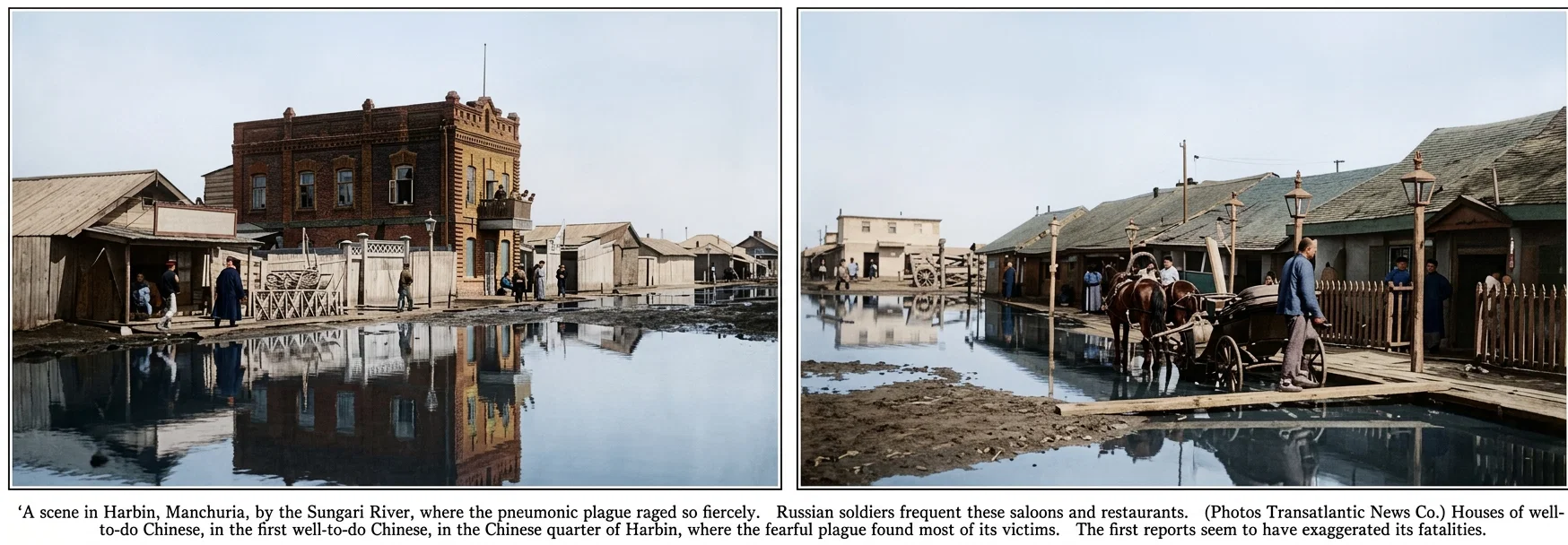
A scene in Harbin, Manchuria, by the Sungari River, where the pneumonic plague raged so fiercely. Russian soldiers frequent these saloons and restaurants. (Photos Transatlantic News Co.) Houses of well-to-do Chinese, in the Chinese quarter of Harbin, where the fearful plague found most of its victims. The first reports seem to have exaggerated its fatalities.
Our civilization has not broken down all at once under this advancing lawlessness. It has taken time. In 1881 there were twenty-four murders to every million of population. In the next fifteen years the murder rate grew six times faster than the population, till today we read with indifference newspaper headlines in any paper such as, if they appeared in any European newspaper, would cause a downfall of the power of government."
Jesus Christ our Lord declared that abounding lawlessness would characterize the end of this age. Matt. 24: 12-14. It begins in disregard, in unbelief, of the eternal verities. When men forget God and despise His Word they are bound to go down. The best of all our civilization has been an outgrowth of Bible influence. The men who made the stable structure of our government believed the Book. But now the professed ministers of Christ are, in the minds of the masses, destroying the Bible. Forgetting God, slighting, ignoring, or trampling upon His law, why should the law of man be regarded? The lawlessness of America to-day is the fruitage of apostasy. If the professed ambassadors of Christ had kept before the world the eternal verities, the holiness of God's law, the certainty of judgment, we would have had a different picture than is presented to-day.
Peace Prospects
There is much talk of the desirability of peace, and the strongest sort of assurances are given of peace by high officials in all the great governments of earth; but the very assurances betray their anxiety, and the constant and feverish preparation for war clearly indicates that the assurances are at the least not wholly sincere, or that the assurances refer to the present, the preparations for war are for the future near and far.
The great journals of Europe, which doubtless reflect public opinion, readily acknowledge that all differences between civilized nations ought to be settled by arbitration as suggested by President Taft; but very few of them have any faith in the outcome of such a scheme. Sir Edward Grey's speech in response to Mr. Taft's suggestion is called by a great German journal, the "Taegliche Rundschau," "words, nothing but words." The French "Temps," in close touch with the Foreign Office, says: "What an aberration it is to believe in the efficacy of remedies that can not be applied."
While all praise the idea, they still hold it to be impracticable and visionary.
Yet the nations go on, groaning under their ever increasing war burdens. War is not declared, but it has its victims now, with bowed backs and knitted brows and paling cheeks, staggering under intolerable loads of taxation imposed by the enormous expenses of war material gathered for future murder, when it would seem that a little practically applied common sense between man and man might end it all. But in their mad pursuit they are fulfilling predictions, not of what God wants, but of what He declared centuries ago will come.
Tom L. Johnson’s Moral Convictions
A Politician with Moral Convictions.— The San Francisco Star of April 15 has a strong sympathetic article by Hon. James G. Maguire on Tom L. Johnson, single-taxer, "lover of the people," late mayor of Cleveland, who won for them after a tremendous conflict three-cent fare on street railways. He won his wealth through or by a monopoly, and spent it in fighting the dominating trusts. When he read Henry George’s "Progress and Poverty," he gave his attorney, Mr. L. A. Russell, a prominent corporation lawyer, a $500 fee to examine the book, refute its arguments, and present that refutation in a written opinion. The lawyer said that he could refute the book in two hours, and the fee was too large; but after reading the volume he told Mr. Johnson: "I would not give such an opinion as you want [in refutation of the book] for one thousand dollars. The book is right, and such an opinion would make me ridiculous." Mr. George based some of his arguments on the Bible, and the moral convictions of Mr. Johnson, strangely wanting in some politicians, were appealed to. But he was more than a politician; he held all the ideals of a great statesman. The world has not too many of his ilk.
The Washington Place Fire
By Editor
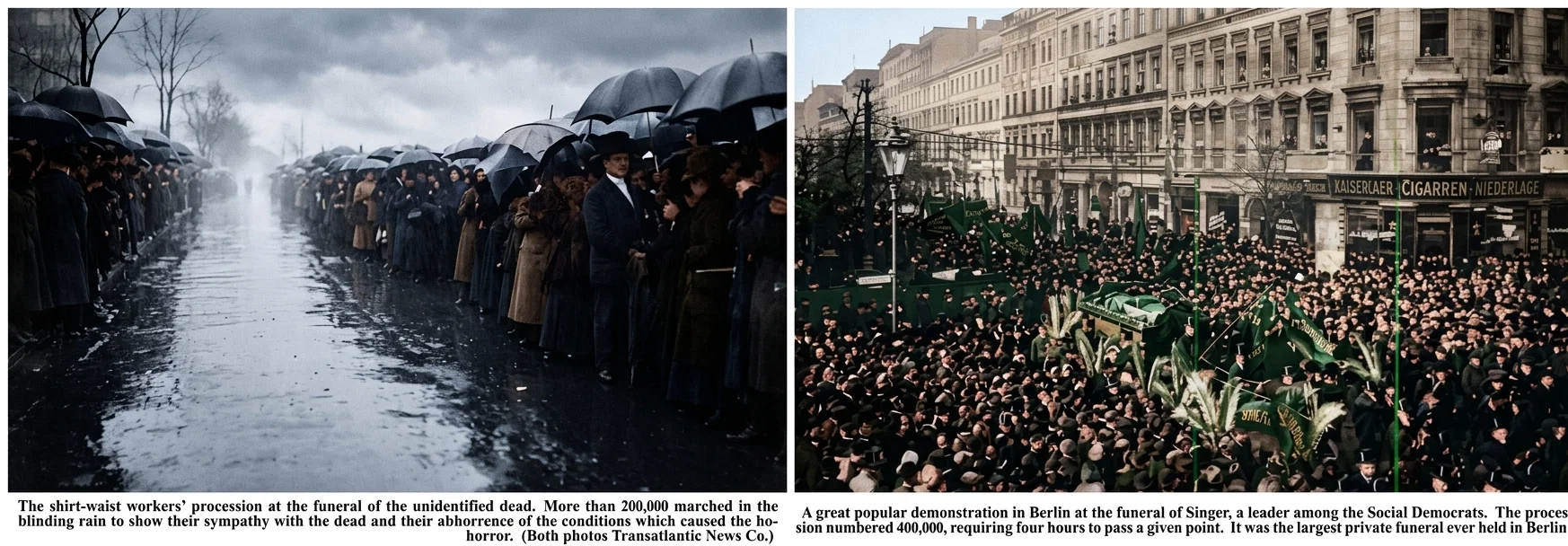
The shirt-waist workers' procession at the funeral of the unidentified dead. More than 200,000 marched in the blinding rain to show their sympathy with the dead and their abhorrence of the conditions which caused the horror. (Both photos Transatlantic News Co.) A great popular demonstration in Berlin at the funeral of Singer, a leader among the Social Democrats. The procession numbered 400,000, requiring four hours to pass a given point. It was the largest private funeral ever held in Berlin.
Our readers are more or less familiar with the awful horror in Washington Place, New York, on March 25, when nearly 150 lives were snuffed out in fifteen minutes. The cause at the bottom of the thing is dominating covetousness, which rises above all regard for human rights and human lives; which creates the sweat-shops and the slums; which seemingly would rather expend five hundred dollars for police protection from infracted law than one hundred dollars for the safety and health of human beings. When property rights are placed above human rights the humans must suffer. The death of those girls was a crime, not an accident. As a crime it is denounced by newspapers generally; but when asked to fix the guilt it is placed upon "society" and "politics," wholly impersonal things. Sometime, wherever man may place the crime, God will bring it home to individuals.
One hundred and forty, mostly young women and girls, were burned to death or leaped to destruction on the pavement 100 feet below. The laws of New York do not demand fire-escapes on fire-proof buildings; yet the laws do demand that doors shall open outward in case of fire; but on one floor the doors were locked that no employees might escape till they were searched before passing out at the close of the day’s work. Our photos above show that the sad catastrophe has brought together into stronger fellowship the workers, and it is hoped that this awful price paid for criminal neglect may result in greater safety and better conditions for the workers.
A Millionaire on Higher Education
AFTER many years of investigations and correspondence, Richard T. Crane, a millionaire iron dealer in Chicago, says:
“I know of only two or three business men in the United States who have even pretended to favor college men in their business. And not one of them is honest in the matter.
“This fact is so overwhelmingly conclusive of the folly of higher schooling as a preparation for business that there is nothing left for the colleges to stand on.”
To the contention of the colleges that they are making “character” Mr. Crane says:
“To ascertain something definite regarding the surroundings at Harvard College I engaged a detective to investigate. He followed these boys in their visits to Boston. His report was too disgusting to print. The conditions at New Haven are about the same.”
And there is good common sense in this:
“No education is to be compared for a moment with the education you get by learning some honest trade or business and in preparing to support yourself.”
Treated Fairly.
The St. Louis Western Watchman (Roman Catholic) says:
Certainly the United States has treated the Catholic Church fairly since she came into possession of the Philippines. She has a great and noble work to do in Cuba. There the church needs the protection of her laws and her courts, and she will get them. The American hierarchy must take over the people of our island possessions, and we think we can rule them with as much success spiritually as we have done already politically. Our bishops are as wise as our politicians [the “we’s” and “our’s” seem somewhat confused]. But it will be necessary for Rome to incorporate the churches of the Philippines and the Antilles in that of the United States. At present this is only partially done. We should not give to those Catholic peoples spiritual autonomy as long as political autonomy is denied them. We have not as fully realized the American church’s responsibility in this matter as the Government has recognized its political obligations. Let us by all means have another Plenary Council, and let all the bishops of our island possessions be called to take part in its deliberations.
Increasing Crime in France.
The Paris Economiste Français, which the Literary Digest calls an "undoubtedly reliable and accurate" journal, having made a scientific study of criminal conditions in France, says:
The increase of crime is one of the most urgent questions now occupying public attention. Juvenile crime has reached a pitch which rouses the greatest apprehension. The evil has become so crying that the official reports on criminal procedure have never been less optimistic. In the district of Paris the number of murders is steadily on the increase.
In ten years crimes of this character have increased in the ratio of 20 to 94. We are told that each year nearly 100,000 crimes remain unpunished. There are in France 400,000 highway robbers, and vagabonds, deserters, and tramps equal in number an army of 70,000 men.
Catholic papers say the cause of it is non-religious teaching in the public schools. Others declare that it is due to decadence of the police. Rather its root lies in the depraved human heart, encouraged by the almost entire absence of a high moral standard, and in France this is found in neither Church nor State.
Christian School for Deaf-Mutes in Korea
A Christian school for deaf-mutes in Korea has been opened. There are 14,000 deaf-mutes in Korea. The Bible societies are printing a million copies of Mark’s Gospel, with the purpose of putting one in every home of Korea.
Spain and Morocco Tensions
A Madrid despatch reports that Spain is preparing to send 20,000 troops to Morocco to defend her sphere of influence, and is also mobilizing her navy. The alleged interference of France with Spain's Moroccan policy is said to be the cause of Spain's action.
Bombay Festival Fire
A small thatched building in Bombay, India, in which 500 persons were holding a religious festival, caught fire, and it is said 200 perished in the flames.
Bill to Expel Mormon Missionaries
A bill to drive Mormon missionaries out of England is being prepared by the government, and will, it is thought, be passed without any opposition. Home Secretary Winston Churchill has been shown that 500 young girls have recently left England for the Mormon colony in Utah, without the consent of their parents.
Man Descended from Seaweed
And now Darwin is outdone by Prof. Maynard Shipley, who declares that man descended (or is it ascended?) from seaweed, but to find his ancestor he must go back 10,000,000 years.
Missouri Railroad Land Claim
The largest land claim ever made upon the United States Government, is that of the Missouri, Kansas and Texas Railroad Company for territory to the value of $61,287,000 now included in the State of Oklahoma. The plaintiffs declare that by act of Congress, approved July 25, 1866, the land was granted to the railway company, but has since been deeded to the Indians individually by the Government. The case will be watched with interest.
Russia and China Crisis
Newspapers report that Russia is on the point of addressing to China an ultimatum fixing a date for entire satisfaction of her demands. China's reply to successive notes from Russia is described as conciliatory, but the text in each case has been unsatisfactory. Private despatches received by London business houses from representatives in the Far East are disquieting. Later: China has met the demands of Russia. Peace is assured.
Fundamentals—Responsibility—Definite Aim—Power of a Purpose—Habit—System
By L. P.
Letters to a Young Man—No. 1
Fundamentals—Responsibility—Definite Aim—Power of a Purpose—Habit—System
MY DEAR ROBERT,—
Your letter of last week finds me more than busy, but it deserves and shall have such an answer as I am able to give it without careful preparation. I am deeply interested in all that concerns you; and your frank request for a little advice touching the life upon which you are now entering as an employee in ——'s large commercial house, makes a strong appeal to me.
To be sure, I might with some show of reason refer you to older men, reminding you of the saying, "Days should speak, and multitude of years should teach wisdom." I am but a young man myself, and in my saner moments, at least, feel that I am more fit for receiving than for giving wise counsel. Nevertheless, like other young men, I am prone to advise my friends; and if my convictions lack the sanction of gray hairs, they may possess the slight advantage of not being worn-out. Not that I mean to lay claim to originality. It takes a young man to excel in commonplaces, to tell with an air of impressive solemnity what everybody knew long ago; but if he has found out those things for himself, they are not stale commonplaces to him, but fresh, living realities, and as such to be urged upon his friends with what power and enthusiasm he is able to command.
You say, my dear Robert, that being in a strange city, aloof from friends and relatives, and surrounded with new companions, and having new duties to perform, you are in a very real sense making a fresh start in life, and you are anxious that it shall be a right start. The sentiment is a natural one. Hope tells every aspiring man, and rightfully, I believe, that "the best is yet to be." There is exquisite pleasure in the sense of leaving our failures behind, and pressing on to what we hope, at least, will be successes. For my part I like to think of every new day as coming to me direct from the kind hand of a bountiful Creator, pure as the morning air, fresh as a wild rose on which the dew still lingers, and fragrant with unknown possibilities of good. But it is not to be denied that there are critical epochs in our lives, points of time at which actions take on peculiar meaning and importance because they are instinct with such far-reaching results. At these epochal moments we do well to look ourselves squarely in the face, and ask some plain questions.
Such an epoch has come in your life. You are considering many things as it were de novo, and you must begin with your relation to what is eternal, everlasting. The words will come to you with new force: "In the beginning, God." Human life takes on its true meaning and sacredness only as it is seen to be part of the divine plan of the ages. The fundamental fact for you and me, as for all right-thinking young men, is that we wholly belong to God. Conversion is meaningless unless it include consecration. The religion of the Bible is not what its enemies have called it, a kind of insurance against the fires of hell; but a present joyous surrendering of one's whole energies to the service of Christ. A man's faith in God lies back of everything else in his nature, and gives value to his life-work. He must be right before he can do right.
Next to this full recognition of the divine claim upon him it seems to me that the young man should have a pretty definite aim in life. In other words, he should begin early to specialize. It is possible that your tastes are not so completely formed that you can decide definitely upon your life-work; but you can be studying your bent and capabilities with a view to a wise choice when the proper time comes. Moreover, tho you may not now decide upon the profession you are to follow for life, you can set for yourself some noble object of a more or less temporary character, and give your energies to its accomplishment. There is nothing like the cherishing of a noble purpose to brace a man against the trivialities and allurements of the world, and give him high seriousness, force of character, and a keen sense of the value of time. The chief reason why so many young men have gone astray is because they were not, to begin with, going anywhere in particular. Their
life vessel was freighted with a precious cargo, but it lacked the well-set sails and the strong hand at the helm steering for a definite harbor. It lay in the trough of the sea, and was soon broken up by the elements. The winds that might have wafted it safely to its desired haven, became its destruction.
Let me further illustrate what I mean by a definite purpose. You are in business at present; but unless I am much mistaken, you do not expect always to stand behind a counter. You have some literary ambition. Now if you definitely decide to devote your leisure time during the next two years to getting a literary training, you will not only make appreciable progress toward your goal, but you will escape a thousand temptations that are continually assailing young men who have no clearly defined purpose. Your evenings will be fully occupied, and that profitably and enjoyably. You will not be free to devote yourself to the round of social gaiety; you may not make a very wide circle of acquaintances; but you will make fast friends of some men and women who like yourself have a purpose in life. Your purpose, then, will be a veritable life-preserver, and a source as well of abiding peace and satisfaction. Moreover, it will win you influence and promotion. It is surprising how quickly obstacles melt away before a resolute purpose. Everybody makes way for the man who knows whither he is going. The stars in their courses fight for the man with a purpose.
The next important thing after a life purpose, is the formation of good habits. Without these a purpose is of little use, not because it is inoperative, but because it necessarily operates very wastefully. The purpose furnishes the heat, the initiative force; the habits, the machinery by which it is utilized. We are all to a certain extent creatures of habit. Whenever a thing is done in the same way time after time until it is done without thinking, that thing has become a habit; and good or bad, it will be hard to break off. It is a great saving of time to have even a few fixed habits; but if we were to cultivate systematically our habit-making powers, we should be able to relegate to the mechanical realm many of the things that now occupy a lot of the time which should be devoted to matters really requiring an exercise of the reasoning powers.
In general young men need to cultivate the habit of doing things systematically,—of having a place in the day's program for each duty, and doing it the same way each time till it becomes habitual. To be able thus to apportion out one's work, and take it up in the right order, piece by piece, is advantageous in many ways. First, it does away with hurry, which is always wasteful.13Secondly, it makes it possible for one to do things promptly. Thirdly, it is a great time-saver, for it largely eliminates that not inconsiderable time which slips away between the completion of one piece of work and the definite determination to take up another. Fourthly, it puts one in a position to get the most help from others, for even the busiest people are able to render service to the man who plans ahead. Fifthly, it brings into the life even of the hardest-worked man a certain calm serenity, which is greatly conducive to health of mind and body. The cause of this serenity is not hard to find. When the work is systematized, duties come not three or four abreast, but in single file. A man has just one thing to do at a time, and he can be a whole man to that thing. Not only can he do it far better than he could if he were distracted by a half dozen other things, but he can do it with greater ease.
And now before closing let me anticipate a little as to the view you are likely to take of this matter of being systematic. Like most young men, you are not naturally methodical, and may feel at the outset that regular habits of study, something to occupy each waking hour, will involve a kind of bondage. It may seem to you that when you keep regular, hours at business, your leisure time should be free. That is the view taken by a good many young men; but if you will look into their standing and prospects, you will find that these are the ones who wonder why their services are not better appreciated, and why others are always preferred before them when promotions occur. Then again, system provides also for some hours for innocent recreation, and the time thus spent becomes far more enjoyable when definitely planned as part of a rational system than when taken indiscriminately. Thus system adds to the pleasures of life as well as vastly increasing its power for good. This is all for to-night. You know I am always glad to hear from you. Affectionately yours,
L. P.
On Which Side?
By Lowell
ONCE to every man and nation comes the moment to decide,
In the strife of Truth with Falsehood, for the good or evil side;
Some great cause, God's new Messiah, offering each the bloom or blight,
Parts the goats upon the left hand, and the sheep upon the right,
And the choice goes by forever 'twixt that darkness and that light.
Hast thou chosen, O my people, on whose party thou shalt stand,
Ere the Doom from its worn sandals shakes the dust against our land?
Tho the cause of Evil prosper, yet 'tis Truth alone is strong,
And, albeit she wander outcast now, I see around her throng,
Troops of beautiful, tall angels, to enshield her from all wrong.
— Lowell.