The Youth’s Instructor, Vol. 31, No. 49.

THE LAST WALK IN AUTUMN

The Youth’s Instructor

Dec 5, 1883

S. D. A. Publishing Association · Battle Creek, Mich. · Dec 5, 1883

THE LAST WALK IN AUTUMN.
O’er the bare woods, whose outstretched hands Plead with the leaden heavens in vain, I see beyond the valley lands, The sea’s long level dim with rain. Around me all things, stark and dumb, Seem praying for the snows to come, And, for the summer bloom and greenness gone, With winter’s sunset lights and dazzling morn atone.
Along the river’s summer walk, The withered tufts of asters nod; And trembles on its arid stalk The hoar plume of the golden rod. And on a ground of somber fir, And azure-studded juniper, The silver birch its buds of purple shows, And scarlet berries tell where bloomed the sweet wild [rose!
With mingled sound of horns and bells, A far-heard clang, the wild geese fly, Storm-bent, from Arctic moors and fells, Like a great arrow through the sky,— Two dusky lines converged in one, Chasing the southward flying sun; While the brave snow-birds and the hardy jay Call to them from the pines as if to bid them stay.
I passed this way a year ago: The wind blew south; the noon of day Was warm as June’s; and save that snow Flecked the low mountains far away, And that the vernal-seeming breeze Mocked faded grass and leafless trees, I might have dreamed of summer as I lay Watching the fallen leaves with the soft wind at play.
Rich gift of God! A year of time! What pomp of rise and shut of day, What hues wherewith our Northern clime Makes autumn’s dropping woodlands gay, What airs out-blown from ferny dells, And clover-bloom and sweetbrier smells, What songs of brooks and birds, what fruits and flowers, Green woods and moonlit snows, have in its round been ours!
What greetings smile, what farewells wave, What loved ones enter and depart! The good, the beautiful, the brave, The Heaven-lent treasures of the heart! How conscious seems the frozen sod And beechen slope whereon they trod! The oak leaves rustle, and the dry grass bends Beneath the shadowy feet of lost or absent friends. —J. G. Whittier.

CESAREA PHILIPPI.

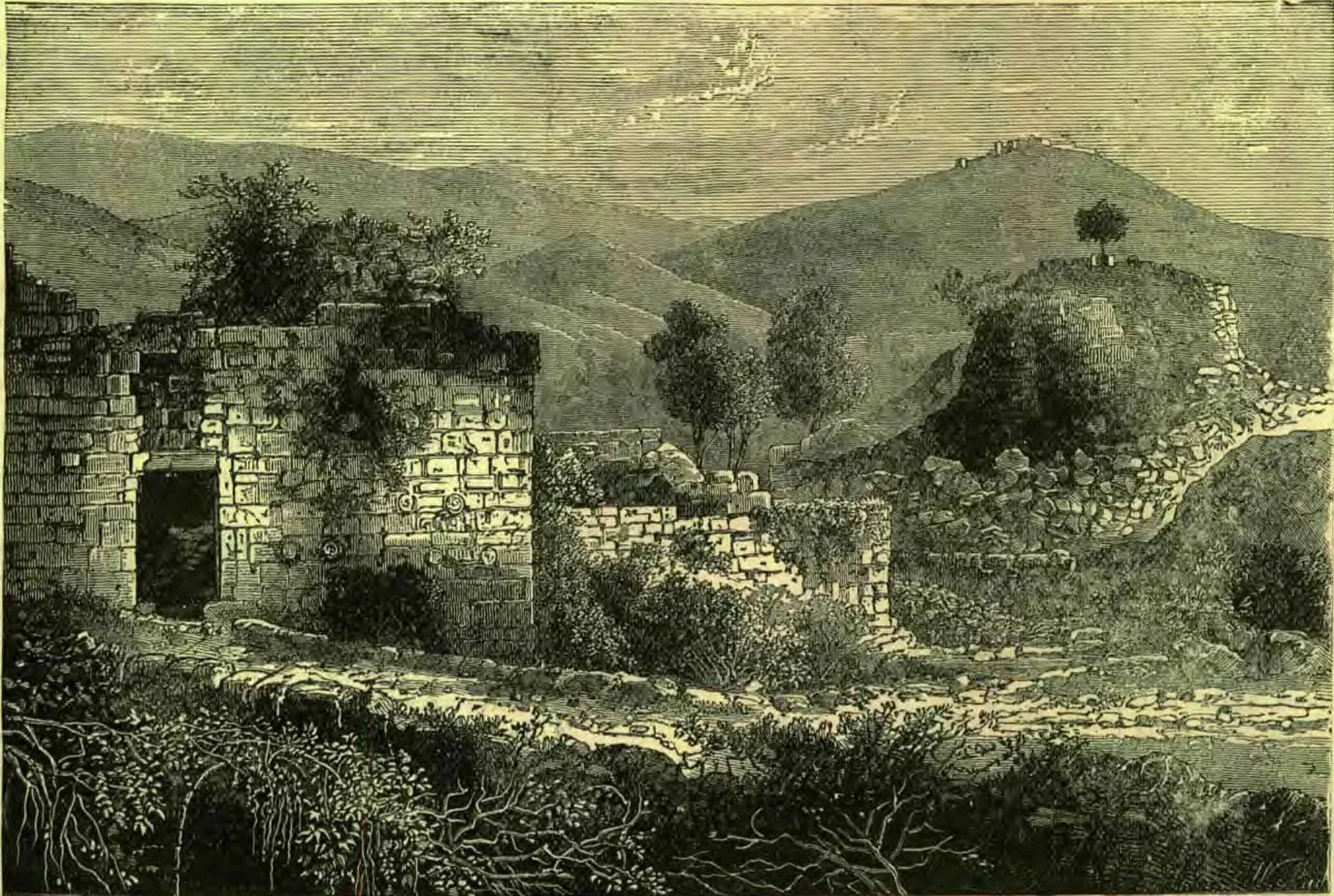
IN the northern part of Palestine, at the end of the Jordan Valley, lies a short mountain range, called Mount Hermon. At the foot of this range stands a triangular terrace, covered over with moss-grown, vine-clad ruins. In the limestone cliff that forms the terrace is a deep cavern, for the most part filled with rubbish. From this cave, and from every crack and cranny in the rocks around, pure, crystal streams bubble up to light, and rippling over the stones, soon unite into a torrent, that rushes down the valley, and plunging in a sheet of foam over a precipice, hastens to mingle its waters with the other two sources of the Jordan.
Centuries ago the Greeks worshiped their god Pan in a shrine beside the cave, and for this reason called the city Panium. When Philip, son of Herod the Great, was tetrarch of Galilee, he enlarged and beautified the city, built a temple to Cesar beside the fountain, and called the city Cesarea in honor of Cesar. As there was another city by the same name on the sea-coast, Philippi was added to this name to distinguish it from the other.
Eighteen hundred years ago this was a flourishing city, the center of wealth and fashion. Hither Titus, after his siege of Jerusalem, brought the Jewish captives, and made them fight in the gladiatorial shows of the theater arena.
In the lower left-hand corner of the picture may be seen the bridge of antique pillars leading over the Jordan. All around are scattered ruins, while on the hill back of the town, and a thousand feet above it, can be seen the remains of the Banias castle. It has a fine outlook over the plain. It was a mammoth building, one thousand feet in length and three hundred in breadth, surrounded by a deep moat cut in the solid rock, and having deep cisterns beneath the floor, some of which even now hold water. It is made of stone finely wrought; yet when or by whom it was built no one can tell.
Though the city now lies in ruins, the place is still beautiful. Perhaps the following words of a recent traveler in the Holy Land may give a good idea of the place: “I had known,” says he, “that here was a noble spring gushing from the rocks and forming one of the sources of the Jordan; but I was not prepared for the many beauties of the spot. Its charms were a surprise to me. At the base of Hermon is a triangular terrace, with luxuriant olive-orchards and fields of grain. . . . The stream flows out from the rocks crystal pure and sparkling, and rushes down to the vale amid oleanders, ferns, and hanging vines. Its dashing waters, concealed by clustering shrubbery or glancing in the light, make a music delicious in this land, where water is precious as gold. The view from the terrace, southward over the plain and northward to Hermon’s snow-crowned ridge, with the broken walls, arched gateways, and shattered towers of old Cesarea Philippi, is one of romantic and picturesque beauty.”
We read that Christ and his disciples came into the coasts of Cesarea Philippi; and it is thought that to this very mountain, rising in such stately grandeur behind the city, he led up his disciples, and was transfigured before them, receiving the commendation of his Father, “This is my beloved Son, in whom I am well pleased.”
W. E. L.

The Secret of Girls' Influence in the Home

If girls could only realize the secret of their power! Seldom to any public life can they look for their greatest influence, but always to the home, where all good manners, all kind thought for others, is sure to carry sunshine.

LADY JANE GREY.

The health of Edward VI. of England had been failing many months, and his thoughts were turned toward his successor. Mary, his half-sister, was the rightful heir to the crown; but she was a fierce, cruel Catholic, and the young king feared, if she were to hold the scepter, persecution and misery would overspread the land. He resolved to transfer the crown to a more worthy head.
His cousin, Lady Jane Grey, was wise and good. She played upon several instruments, sang sweetly, and could write and speak in French, Latin, Italian, and Greek. She was a Protestant, and would make a much better queen than Mary; and he decided to exclude his half-sister from the throne, and made his will, giving his crown to his cousin Jane.
In a few days Edward died; and, after the funeral ceremonies were over, several court ladies and gentlemen went to Lady Jane to acquaint her with Edward’s will, and to pay her homage as queen. She was much surprised, and could hardly speak. Then she grew pale and faint. The crown did not belong to her. She said it was Mary’s by inheritance, and she did not wish to be made a queen instead of her.
“Shall I,” she asked with spirit, “who would not steal a shilling, usurp a crown? Oh, if you love me, do not force me to that high station, so sure to be followed by a fearful fall.”
The Duke of Northumberland, her husband’s father, told her it was Edward’s dying wish. Her parents commanded; and her loved husband, Lord Guilford Dudley, begged her to accept it. At last she consented with reluctance, and was proclaimed queen.
Her reign was short.
The people admired and respected her; but Mary was the lawful heir to the crown, and they did not wish to see her cast aside. They felt it was a wrong to their loyalty, and soon began to look upon Lady Jane Grey as a usurper. Mary’s cruel character was but little understood; and when she pressed her claims, the people rose to do her homage, and she was crowned in triumph.
When these tidings reached Lady Jane, who had been queen only in name for nine days, she expressed no surprise or sorrow. “These words,” she said mildly, “are more pleasant than those in which you bade me be a queen.”
Soon, the dark, cruel side of Mary’s character was seen. Almost her first act was to cause the arrest of the Northumberland family, and order the execution of the Duke.
Her eyes were then turned with revenge on Lord Guilford Dudley and his wife. Their property was seized; and they were sent to prison, followed by weeping people.
Days and weeks passed.
Mary’s course did not please her subjects. The strict confinement of Lord Guilford Dudley and Lady Jane excited anger and pity everywhere. The murmurings faintly reached Queen Mary, and she feared the people might rise against her. She sent a message to Lord Guilford and his wife, bidding them be ready for an immediate death.
On the morning of their execution, February 15, 1554, Lord Guilford sent a request to his wife, asking to see her. She feared such a meeting would shake the courage of both and make death harder, and she refused.
“Such a meeting,” she returned, “would only add to our affliction. It would disturb the peace with which we should arm our souls for dying. Defer it for a short time, and we shall meet where unions are no more severed.”
When she saw her husband pass on his way to the scaffold, she showed great emotion, and waved her hand to him, a silent farewell. Her own doom came soon after. Before she reached the place of execution, she met men carrying the lifeless body of Lord Guilford. She stopped and looked a moment upon him, sighed deeply, and walked on with a firm step, with her eyes fixed on her prayer-book. She ascended the scaffold still wet with her husband’s blood, and spoke to the people a few words.
Then, she knelt down, and prayed calmly, “Have mercy on me, O God, according to thy loving-kindness; according to the multitude of thy tender mercies, blot out my transgressions.”
The heart of the grim executioner was touched, and on his knees he asked her pardon.
Lady Jane laid her head upon the block, closed her eyes, clasped her hands, and prayed, “O Lord, into thy hands I commend my spirit.” The next moment, by one blow, her life was over.
Lady Jane was seventeen years of age. History cannot find another more accomplished, pure, and beautiful; and her early death filled the nation with horror and mourning.—The Well-Spring.

KIND WORDS

Written for the Instructor.

KIND WORDS.

Our words may seem to us like little things, but if we could realize the good a few kind words may do, we would never miss an opportunity of speaking them. It may be nothing more than a pleasant “Good morning,” and yet touch the heart; it may be a word of sympathy, whispered low, that will cheer and comfort through all the hurry and bustle of the day. No doubt we can all look back over our lives, and see many times when a few kind words have helped us over the rough places.
No one is free from cares and perplexities, and no one is so independent that he will not be thankful for our sympathy. Then why should we be afraid to express it? Why should we never tell our friends that we see and appreciate their difficulties? It certainly can do no harm, and it may lighten the load far more than we think. But, too often, we keep our sympathy to ourselves until our friend sinks beneath his load, and then, when too late, we try to cheer and help.
We need not make a great display of sympathy in order to have it felt. It can be shown much more effectually in the tender clasp of the hand, in the subdued voice, and in the tearful eye. Many have been saved from a life of sin and folly by a single kind word. Then let us speak kindly, gently to one another, remembering that “kind words can never die.” C. B. S.

CHRISTIAN GROWTH.

I FEEL a deep anxiety that the youthful disciples of Christ may grow in grace and in the knowledge of the truth. Progression is as much a law of spiritual as of physical life. The Scriptures speak of our growing up into Christ. Young converts are represented as babes, who need the tender care of those older in experience than themselves. They cannot by one great effort attain to the perfection of Christian growth. They are children, who must advance, little by little, until they reach the stature of men and women in Christ.
None should be satisfied with a mere profession of Christianity. We should be ever seeking to know more of the plan of salvation, and striving diligently to copy the Pattern set before us. Those whose eyes are just opened to see the love of Jesus, cannot at once fully comprehend his life, his character, or his requirements. All have daily lessons to learn in the school of Christ, and a daily experience to gain, that they may understand their duty as his children.
Many an honest, well-meaning person makes no advancement in the Christian life because he does not see the necessity of constantly learning more of Jesus. When first converted, he rejoices that he has taken his position on the Lord's side. A year later, he bears the same testimony. There is no evidence of spiritual growth; he is still weak as a child.
Much is lost to the Lord's cause because souls that have just entered the school of Christ are left to pick up their education as best they may. Young Christians are not properly instructed, and this is why there are in the church so few strong, active workers for God. The first experience of the new convert is happy and joyous; but trials come; the perplexities of life are to be met; sinful traits of character that have not been controlled, strive for the mastery, and too frequently obtain it. Then come a loss of confidence and peace, neglect of prayer and the reading of the Scriptures. For want of the knowledge and experience which they should have, many are overcome by Satan. They do not know how to discern his temptations, or to resist them.
The young should ask counsel from those who are older in experience in the Christian life, and should be humble enough to receive instruction. And older Christians should have a watchful care for these young disciples, and be ready to encourage and instruct them. Here is an opening for missionary labor of the most important character. How necessary that there be in the church faithful members, who have a love for souls, and who will lead them into correct paths of religious experience. This is a work in which all Sabbath-school teachers should engage. They should know Christ and his saving power for themselves,—no others should be teachers in the Sabbath-school,—and then they should seek earnestly to lead their pupils to the Saviour. By reading the Scriptures and praying with them, they can direct them to Him who is the way, the truth, and the life.
Dear young friends, be careful to begin right in the Christian life. Have faith in Jesus as your helper. Remember that you are not to choose your own work, or follow your own ways, but to look to Jesus as your guide and pattern. Keep his example before you, and constantly ask what will be pleasing in his sight. Learn from him lessons of self-denial and self-sacrifice. Study how you can be like him, in thoughtfulness for others, in meekness and humility. Thus may you “grow up into him in all things, which is the head, even Christ;” you may reflect his image, and be accepted of him as his own, at his coming.
MRS. E. G. WHITE.

WINGED WORDS.

If words were birds, And swiftly flew, From lips to lips Owned, dear, by you; Would they, to-day, Be hawks and crows? Or blue, and true, And sweet? Who knows?
Let's play to-day We choose the best; Birds blue and true, With dove-like breast! 'Tis queer, my dear, We never knew That words, like birds, Had wings and flew! —Jessie M'Gregor, in St. Nicholas.

NEW-TESTAMENT HISTORY.

Lesson 164.—The Hope of Immortality

Although suffering from such fierce persecutions, and liable at any time to be put to death, the apostles still continued to preach with unwavering faith, knowing that, should their lives pay the forfeit of their boldness, they would be raised from the dead by the same power that raised up the Lord Jesus; and that when he should appear in glory, they, with all the saints, would be caught up to meet him in the air.
Since all these troubles served but to spread the truth, and save the more, the apostles did not feel discouraged by them, but their hope and faith grew stronger continually. Paul says: “For which cause we faint not; but though our outward man perish (or is decaying), yet the inward man is renewed day by day. For our light affliction, which is but for a moment, worketh for us a far more exceeding and eternal weight of glory; while we look not at the things which are seen, but at the things which are not seen; for the things which are seen are temporal, but the things which are not seen are eternal. For we know that if the earthly house of our tabernacle be dissolved, we have a building from God, a house not made with hands, eternal, in the heavens.”
Here the apostle refers to the same thing as in the latter part of his first letter,—the glories of the resurrection, and of the immortal body which shall at that time be given to the saints. They need not fear to have this corruptible body destroyed, when they know that an incorruptible one awaits them. Continuing the subject, he says: “For verily in this we groan, longing to be clothed upon with our habitation which is from heaven; if so be that being clothed we shall not be found naked. For indeed we that are in this tabernacle do groan, being burdened; not for that we would be unclothed, but that we would be clothed upon, that what is mortal may be swallowed up of life.”
Thus Paul teaches that, while suffering from the infirmities of this corruptible body, they longed, not for disembodiment, but for that glorious body which shall never know pain nor decay. He says that it is God himself who has wrought us for this very thing, and has given us the earnest of his Spirit as a pledge of the certain fulfillment of his promise.
In view of all these things, Paul would prefer to drop this mortal body, and having been changed to an immortal being, fit for the society of heaven, to enjoy the actual presence of that divine Lord whom he can now enjoy only by faith. But knowing that all men must pass the test of the judgment, he says, “Wherefore we labor, that whether present or absent, we may be accepted of him. For we must all appear before the judgment seat of Christ; that every one may receive the things done in his body, according to that he hath done, whether it be good or bad.”
Knowing the terrors of this judgment, and the fearful destruction that will come upon the wicked, Paul and his fellow-workers were willing to peril their lives in trying to persuade men to flee from the wrath to come.
After thus showing the basis of their faith and courage, of their untiring patience, of their ardent hope under the most discouraging circumstances, he says: “Whether we be beside ourselves, it is to God; or whether we be sober, it is for your cause; for the love of Christ constraineth us; because we thus judge, that if one died for all, then were all dead; and that he died for all, that they which live should not henceforth live unto themselves, but unto him who died for them, and rose again. . . . Therefore, if any man be in Christ, he is a new creature: old things are passed away; behold, all things are become new.”
In Christ, God would reconcile all men to himself; for the sins of those who believe in Christ are borne by him, and will not be imputed to them, in case they prove faithful. So Paul says: “We are ambassadors for Christ, as though God did beseech you by us; we pray you in Christ’s stead, be ye reconciled to God. For he hath made him to be sin for us, who knew no sin; that we might be made the righteousness of God in him.”

QUESTIONS.

1. How were the apostles enabled to preach with such unwavering faith, though suffering from the fiercest persecutions, and liable at any time to be put to death? 2 Cor. 4: 11-14.
2. What did all these exciting troubles serve to do?
3. What does Paul say about the encouragement thus afforded? Verse 16.
4. How does he speak of their afflictions?
5. What good did they work out for those who suffered them?
6. On what did the apostles fix their attention? Verse 18.
7. What things have the greatest abiding reality?
8. On what does Paul fix his hope when the earthly house in which we now abide shall perish? Chapter 5: 1.
9. Where has Paul previously dwelt at length upon the certainty of the resurrection, and upon the immortal body which shall then be given?
10. Why has the Christian no cause to fear the destruction of this mortal body?
11. How does Paul describe the Christian’s condition and desires in this infirm and temporary frame? Verses 2–4.
12. Was it disembodiment that the apostles longed for?
13. What did they desire?
14. What pledge has God given the Christian as an assurance of eternal life, and of the immortal body of which Paul has been speaking? Verse 5.
15. In view of all these things, what would Paul prefer to do?
16. For what will all those be fitted who are made immortal?
17. In what way only could Paul enjoy the presence of his Lord in this life?
18. Who alone will receive immortality?
19. In view of this, to what end did Paul labor? Verse 9.
20. How does he speak of the judgment? Verse 10.
21. Why did Paul and his fellow-workers feel willing to peril their lives in persuading men to believe in Christ?
22. What does he say about their zeal and caution in laboring to save souls? Verses 13, 14.
23. By what were they constrained to labor?
24. What conclusion does Paul draw from the fact that none have any hope of life except in Christ, who died for all? Verse 15.
25. What does he say of every one who has given his heart to the Lord? Verse 17.
26. What would God, through Christ, do for all men?
27. How is this done for all who believe and are faithful?
28. What strong appeal does Paul make?
29. How does he say that God has prepared the way? Verse 21.

FROM ANTIOCH TO EPHESUS.

Just how long Paul tarried with the church at Antioch we do not know; but there seem to be good reasons for thinking it was longer than at Jerusalem. Jerusalem was the metropolis of the Jewish nation, and therefore the center of interest to the Jewish Christians; but Paul was pre-eminently the apostle of the Gentiles, and it is reasonable to believe that he would feel greater responsibility in regard to affairs at Antioch, the metropolis of the Gentile church, than at Jerusalem. We can well imagine with what joy he was welcomed there, and that he spent a very busy time in settling difficulties and questions which had arisen in the Antioch church, and that he left them with many exhortations to continue steadfast in the faith.
It is distinctly stated in Acts that he “passed through the upper coasts” before returning to Ephesus, in accordance with the promise he had made the brethren there on his former hasty visit. By this we understand that he did not make the journey by water, but probably passed over very much the same route as on his former journey from Antioch,—through the regions of Cilicia and Lycaonia, Phrygia and Galatia. This would give him a chance again to visit Tarsus, the home of his youth, and the churches which he had raised up through those parts,—Derbe, Lystra, Iconium, Antioch in Pisidia, etc.
Ephesus was so long the scene of the apostle’s labors that we cannot but feel interested in some description of it. It was beautifully situated on some rocky hills in the broad and level valley of the Cayster River, and yet was near to the sea, of which it commanded a fine view. The city was in the days of the apostle the greatest city of Asia Minor and the metropolis of the province of Asia. Being visited by ships from all parts of the Mediterranean, and united by roads with all the large towns of the interior, it was the meeting place of various characters and classes of men. This made it, like Corinth, a fitting place for the apostle to direct his labors from.
Those who now walk over the desolate site of the once proud city, see piles of ruined edifices on the sides of the rocky hills whereon it was builded. They look from Mount Prion, the highest of these hills, out over the morass, which was once the fine harbor of Ephesus, where Aquila and Priscilla landed. In the bowels of the same hill they visit the rich marble quarries, now unentered save by travelers and wild beasts, and see where was obtained the beautiful marble which made the great buildings of Ephesus. They trace the inclosure of the stadium, which doubtless suggested to Paul many of the figures used in his epistles. And not of least interest are the ruins of the vast theater, where the multitude, aroused by Demetrius, the silver-smith, cried out for two hours in honor of their heathen goddess. These are only a few of the splendid ruins which go to show what Ephesus was.
But one building in Ephesus surpassed all the rest in magnificence and fame. This was the temple of Diana, which glittered in brilliant beauty at the head of the harbor, and was reckoned by the ancients as one of the wonders of the world. It was said that the sun in all his course looked on nothing more magnificent than this great heathen temple. It was a very ancient building, and was many years in erection. The laying of its foundations and the beginning of its structure are lost in the mists of time. At last it was completed. But the building which rose through the space of so many years did not long remain in the beauty of its perfection. On the very night in which Alexander the Great was born, it was burned to the ground. Yet in the process of time the temple was rebuilt with more magnificence than before. The ladies of Ephesus even contributed their jewels to help on the work. The national pride in this heathen sanctuary was so great that when Alexander offered great sums of money toward its erection, if he might but inscribe his name on the building, he was refused. The building was four hundred and twenty-five feet in length and two hundred and twenty in breadth, and the columns were sixty feet high. The number of columns was one hundred and twenty-seven, each the gift of a king. Some of them were of marble and others of rare stones. The folding doors were of cypress wood, the part which was not left open to the sky was roofed over with cedar wood, and the staircase was formed of the wood of one single vine from the island of Cyprus.
Probably no religious building in the world was ever the center of a greater amount of admiration, enthusiasm, and superstition. But the glory of the Ephesians lies low; its remains may be found in the columns of green jasper which support the dome of the cathedral of St. Sophia, at Constantinople, and in the naves of other European cathedrals. E. B. G.

SNOW BIRDS.

The frost is thick upon the pane— Such pretty frost, all starry-bright! The ground is white, without a stain, For it was snowing hard all night. It is too deep for me to play, Yet there are birds enjoying it; I see them hop and dive and flit. Dear little birds, why did you stay?
Were you less wise than all the rest Who southward flew so long ago? Or did you love, each one, his nest, So much you could not leave them so? Did no one tell the easy way Which leads to summer bloom and sun, Open to all, forbidden to none? Dear little birds, why did you stay?
Your homes are full of drifted sleet, The ice-hung boughs are cold and bare; The woods hold nothing good to eat, There is not one red berry there; Yet there you twitter, loud and gay, As though you knew not care nor fear, Hopping and flying there and here. Dear little birds, why did you stay?
My mother says God is so good He loves each bird, however small, And thinks of him and gives him food. How strange he can remember all! Was it for this that, unafraid, You lingered, trusting in his care, When all the world was cold and bare? Dear little bird, I’m glad you stayed.
—Susan Coolidge, in The Independent.

ARCHIE'S CHRISTMAS LESSON.

“MAMMA, do get up and look out of the window,” called Archie Horton, as he pattered into his mother's bedroom one frosty November morning, in his white nightgown and bare feet.
“What is the matter? Who is coming?” said Mrs. Horton sleepily.
“Why, mamma, the snow has come, and the ground is all covered with it, and it was piled so high against the hall door that when Ann opened it to go out to the milk-man's wagon, it just fell in on the floor. I've been out in the kitchen, and Ann told me it was most a foot deep, she guessed. Say, mamma, can't I have my sled and go out to slide?”
“Not until you are dressed, I guess,” said his mother, with an amused smile.
“But can I go then?” pleaded Archie.
“Well, you scamper away now and get dressed; and after breakfast we'll see what papa thinks about it.”
The little boy had his clothes on so quickly that Ann said it was a “pity it wouldn't snow or something every night, if it would make that child so spry about getting dressed.”
Archie felt like crying, though, when his papa came in to breakfast, and said the snow was not yet packed enough to make good sliding, and, besides, it was too cold and windy for him to go out anyway. So that settled it. But Archie spent most of the day looking out of the sitting-room window, watching the people passing to and fro through the snow, and the big boys throwing snowballs at one another.
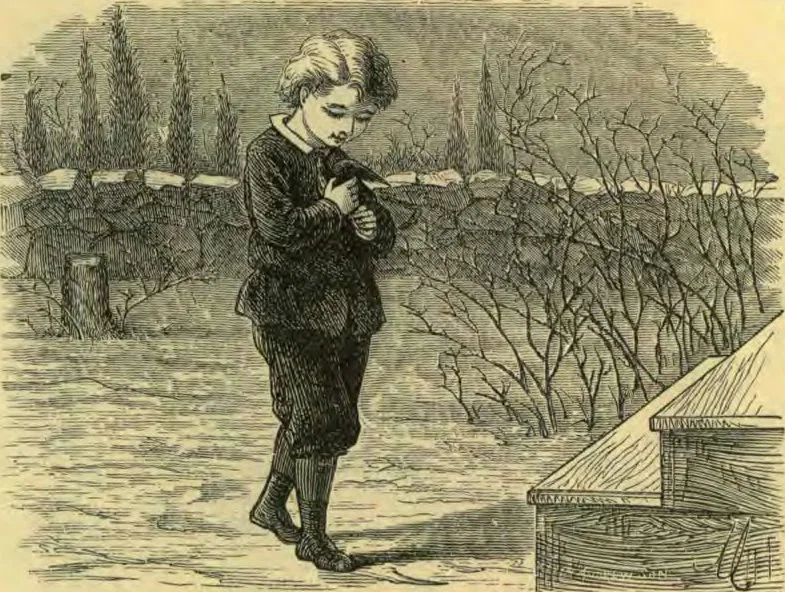
Finally he spied a little bird hopping around under the window, so he got some crumbs and went out the door to feed it. Toward night the sky grew gray, and it began to snow again; but still the little bird did not fly away. Archie's mother said maybe it was hurt in some way, and that he might go out and catch it if he could. As he came near to it, the birdie did not try to fly away, and Archie picked it up and carried it in to his mother. She looked at it, and said she thought its wing was hurt so that it could not fly. So she found a bird-cage in the garret, and told Archie that he might keep it till it was well. The bird was of a greenish brown color, and Mrs. Horton said she thought it might be a tame linnet which some one had lost.
The weeks went on very fast, and it was most Christmas, and still birdie stayed. His wing was well long ago, but when they let him go, he did not offer to fly away, but clung to the window sill outside, and picked at the glass with his bill, as if teasing to come in. So Archie's mother brought him in, and they kept him. He seemed very happy in his new home, and sang sweet songs. Archie had no brothers or sisters, and he took a great deal of comfort with his birdie.
One cold afternoon a few days before Christmas Mrs. Horton came in from a walk, and though warmly bundled in cloak and furs, she sat down shivering by the fire. “It is bitterly cold,” she said to her sister, who sat by the window sewing. “I have been to look up my washer-woman,” she went on. “She did not come this week, and I never knew her to fail of coming on Monday before, so I thought something must be the matter, and went to see.”
“What was the matter, mamma?” said Archie.
“Well, she has been sick; and it's no wonder. Such a poor, cold little house, and not half enough wood to keep warm. And she has had no one to do anything for her but Eddie, her little cripple boy, who has to drag himself around by a chair. If he had some crutches, he could do better. His little pale face haunts me; he don't look as if he had enough to eat, and his clothes are very thin for this cold weather. I think I must speak to your father about them, and we'll see if we cannot fix them up a few comforts in the way of a Christmas surprise. Mrs. Wilson has seen better days, I am sure. How stupid it has been of me never to find out how she lived before!”
And with this, Mrs. Horton got up and went to her room to put off her wraps. When she came back half an hour later, Archie was sitting on a hassock by the fire, with a very sober look on the little face which he held in his hands.
“What could I give, mamma?” said he to his mother when she had sat down.
“Give to whom, my son?” asked the mother.
“Why, to the little lame boy.”
Now Archie, like many an only child, was growing up selfish. His mother felt sad about it, and tried in every way she could to cure him of it. So she said,—
“I think you would better give something of your own, for if papa or I got something for you to give, it would not be really your gift.”
“Well, what would you give, mamma?”
“Oh, whatever you like; but I know what I think would please him better than anything else. I do not think, though, that you would like to part with it.”
“Tell me what it is, and see,” said Archie.
“Well, then, I mean your bird; but you must do just as you like about it.”
Archie's face grew very sober, and he had to wink hard to keep back the tears.
It would be too long a story to tell all that Archie and his mother said about it, and all that Archie thought. But when Christmas came, the linnet, for that it was, found its way along with wood, flour, and a bundle of warm clothes, to brighten the home of the little lame boy.
And that Christmas night, as Archie sat in the twilight with his head in his mother's lap, she told him again that blessed Christmas story which every child knows so well,—about the angels and the shepherds, and the great Christmas gift which came to us all, that night, on the starry plains of Bethlehem.
“Mamma,” said Archie, after a while, “I feel gladder all the time that I gave my birdie. I like to think he is singing and making poor little Eddie happy. Don't you s'pose God sent him to me on purpose for a Christmas present?”
“Perhaps he sent him to teach my boy a Christmas lesson,” said the mother, more to herself than to the child. Archie did not quite understand what she meant, but he went to sleep that night with his little heart full of the true Christmas joy of giving. E. B. G.

Letter Budget.

MAUD F. ALLEN, of Westport, Mass., says: “I live with my grandfather and grandmother. I will be thirteen years old in December. There are no Sabbath-keepers here but grandma. We take your paper, and think a great deal of it. I go to school about a mile away, but I hope to go to the So. Lancaster school soon. I want to do right, so that I may be counted among the INSTRUCTOR family in heaven.”
FANNY S. CLARK, of Albion, Nebraska, writes: “I wrote a letter for the Budget a long time ago, but as we do not see many letters from Nebraska, I thought I would write again. We have Sabbath-school in our house. Two years ago there were thirty scholars; now there are only twelve. This is a small number, yet the Sabbath would be a long day without the Sabbath-school and prayer-meeting. We went to camp-meeting this fall. It was the largest Adventist camp-meeting ever held in the State.”

You have reached the end of this edition.

The Youth’s Instructor · Dec 5, 1883