The Youth’s Instructor, Vol. 35, No. 38.

The Fallen Leaves

The Youth’s Instructor

Sep 21, 1887

S. D. A. Publishing Association · Battle Creek, Mich. · Sep 21, 1887

The Fallen Leaves.

My gorgeous leaves are gone; I saw them fall, And murmured sadly, “Wherefore take at all Such visions bright!” But now the trees stand bare. The sunlight fills my room, and I can see A wider life in hills and valleys far, Which leafy branches with their beauty bar. The bright-hued hopes of youth fall one by one; We grieve at first, but soon we feel the sun Of God’s great love gets better space to warm Our inmost life; and while we lose the charm Of dreams that shut us in to selfish mood, We gain far wider views of greater good.
— Youth’s Companion.

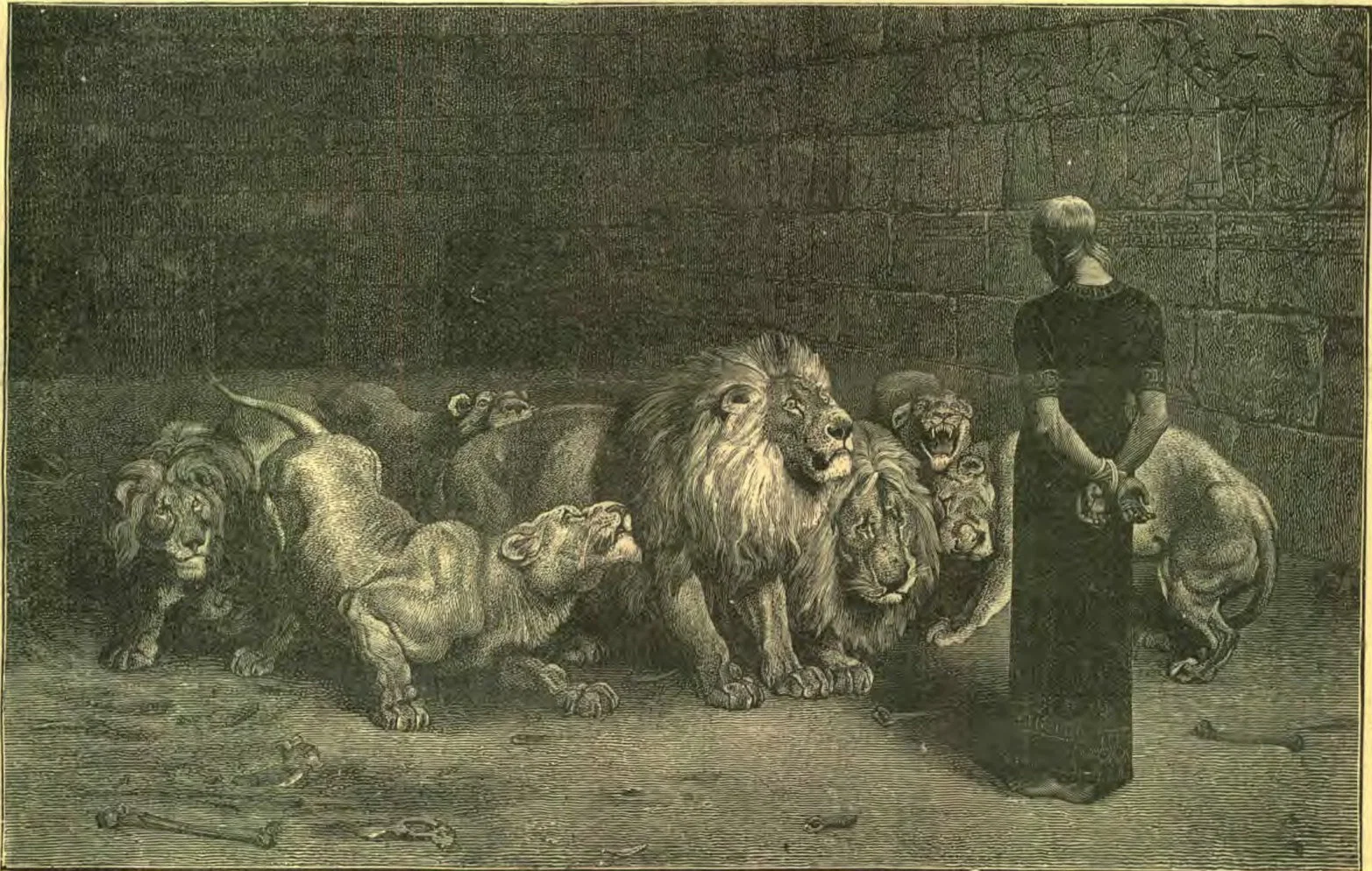
“WHO STOPPED THE MOUTH OF LIONS.”

WORTH makes its way. Even in a heathen land, integrity of purpose and uprightness of heart are recognized and respected. And so we find that when Darius the Median conquered the most glorious kingdom of the earth, he chose the prime minister of the subjugated monarchy to rule over his realm, because “an excellent spirit was found in him.” But, like most men of strong characters, this “president of the princes” found many enemies among the nobles and those in high estate. They could ill brook to see a foreigner, and a Jewish captive at that, promoted to be the head man in the realm; and we may fancy Daniel’s life was often embittered by the intrigues of these foes. They “sought to find occasions,” says the Ancient Record, “against Daniel concerning the kingdom; but they could find none occasion nor fault; forasmuch as he was faithful, neither was there any error or fault found in him.” What a record to show! That even among the multiplied cares of a large and newly conquering kingdom, not the slightest pretext could be found against the man who bore the burden of it all!
“Ah!” cried one, “we shall find no occasion against this man, except it be concerning the law of his God.” But that, we may fancy, was a difficult thing to accomplish, since the king would protect his favorite.
Taking advantage of the vulnerable point in the character of Darius,—his love for absolute authority and his desire to have it recognized, they assembled before him, and said: “King Darius, live forever. All the presidents of the kingdom, the governors, and the princes, the counsellors, and the captains, have consulted together to establish a royal statute, and to make a firm decree that whosoever shall ask a petition of any God or man for thirty days, save of thee, O king, he shall be cast into a den of lions. Now, O king, establish the decree, and sign the writing that it be not changed, according to the law of the Medes and Persians, which altereth not.” And so the flattered king signed the writing and the decree.
“Now when Daniel knew the writing was signed; he went into his house; and his window being open in his chamber, . . . gave thanks before his God, as he did aforetime.” Then the watchful enemy reported the matter to Darius, who, sorely displeased that his own vanity had brought so good a man into trouble, “set his heart on Daniel to deliver him: and he labored until the going down of the sun to deliver him.”
But finding no flaw in the decree, the king, according to his own unchangeable law, thrust his favorite into the lion’s den, and sealed the stone at its mouth with his own signet. With a heavy heart he returned to the palace, and passed the night in fasting; neither could sleep visit him as he thought of his faithful servant in the den of cruel lions.
Very early in the morning he arose, and going in haste to the den, cried with a lamentable voice, “O, Daniel, is thy God, whom thou servest continually, able to deliver thee from the lions?”
And from the dark depths, came the respectful salutation, “O king, live forever.”
“My God,” said Daniel, in confident trust, “hath sent his angel, and hath shut the lions’ mouths, that they have not hurt me; forasmuch as before him innocency was found in me.” “Then was the king exceeding glad for him, and commanded that they should take Daniel up out of the den.”
“And the king commanded, and they brought those men which had accused Daniel, and they cast them into the den of lions, them, their children, and their wives; and the lions had the mastery of them, and brake their bones in pieces or ever they came at the bottom of the den.” So “the wicked is snared in the work of his own hands.”
Well would it be for us all, if like Daniel, there could be no accusation found against us, save for the law of our God.
W.

HOW BANANAS ARE GROWN.

Bananas are wholly a tropical production, and are most abundant in those latitudes where the temperature throughout the year has an average of about 75 degrees. They are common to both hemispheres and intervening islands, where they form in many districts the principal food of the natives. Our principal supplies come from the West India Islands and Central America. Large numbers also come from Port Limon, in South America. Mexico produces them in considerable abundance. They are cultivated also in South Florida. Cuba and Jamaica furnish them in the largest quantity. All the red bananas come from Cuba. They are larger than the yellow varieties, and are said to be better flavored and more nutritious.
Bananas are cultivated from shoots or cuttings, much after the manner of our southern sugar cane. As the shoot grows upward, it puts out leaves, which, wrapping closely one around the other, form a stem or trunk eight to ten inches in diameter and five or more feet in height. The top is an expansion of the leaves that formed the trunk, which now spread out on all sides six to ten feet in length and twelve to fourteen inches across. A variety found in Brazil is said to reach a height of fifteen to twenty feet, with leaves correspondingly large.
After a few months’ growth, a deep purple bud appears in the crown of the stalk, whose constantly lengthening stem soon pushes it beyond the leaves, and it hangs down beside the main trunk. In due time, it becomes a mass of beautiful flowers, which in turn are replaced by the fruit, growing closely together in compact clusters around the stem, forming a massive bunch two and three feet in length, containing from one to two hundred or more bananas. When matured, these bunches weigh from 50 to 100 pounds, and the bananas are from six to ten inches long and one or two inches in diameter.
When grown for transportation, the fruit is cut from the stem while yet green and firm. The stalk, if left to itself, soon wilts and dies, and new shoots spring up around the roots, which may be transplanted for new stalks. But in cultivated fields, the stalk is cut down as soon as the fruit is removed, and a new shoot springs up which matures much sooner than do the transplantings.
A deep, loose, rich, moist soil is required for its best cultivation. Like tobacco, it very speedily exhausts the strength of the land where it grows. By timing the planting, a plantation may be made to yield all the year round. Humboldt states that the same land which produces 1,000 lbs. of potatoes will yield 44,000 lbs. of bananas. The ground required to raise wheat enough to feed one man, would feed 25 men if planted to bananas. The Mexicans raise three crops a year, and ship largely to the United States via New Orleans. It is said that on the great wholesale plantations of interior Mexico, one can buy a great “ramo” or bunch of 200 ripe bananas for one real (11 cents).
The banana requires tender handling, as very slight bruising will render a bunch unsalable. The large wholesale dealers of New York have from ten to fifteen steamers of their own, that are specially constructed for carrying bananas and other tropical fruits, being provided with refrigerators, fans, ventilated chambers, and other devices for preserving an equable atmosphere and protecting their cargoes from overheating or being otherwise damaged in their sometimes boisterous journeys across the Gulf. Recently, through mismanagement and stress of weather, an entire shipload of bananas was lost by over-heating.
In unloading the cargoes, two bunches are laid in a low, flat basket, and placed on the head or shoulders of men accustomed to that work, and carried off the vessel. They are then conveyed to the large banana rooms of the dealers and carefully hung up, each bunch to a single hook, and the temperature of the room kept even at 70 or 75 degrees, till the fruit has undergone a “sweating,” when the temperature is lowered to 65 degrees, at which the banana soon colors and ripens for the market.
In warm weather they are shipped to distant markets throughout the country, in ventilated cars, or else packed in boxes with openings in the sides, for the purpose of ventilation. In colder weather, each bunch is put separately in a heavy paper sack, then two or more of these are enveloped in salt marsh hay, and packed in cases lined with heavy sheathing paper, then forwarded to their destination in the warm refrigerator cars. Wholesale dealers receiving them have also to provide refrigerators, or warm apartments with an equable temperature, for keeping them in cold weather, as the least touch of frost injures them. But the winter trade is light.
In their native country, the banana is one of the most useful of all productions. Besides being a principal article of food to many of the inhabitants, the great leaves of the plant are used in thatching the roofs of their huts; a fine, strong fiber from the leaves of some varieties is woven into garments (our manilla hemp and cloth come from one of the families of the banana); its leaves as a decoction make a pleasant and wholesome drink, the same fermented makes a popular but intoxicating beverage, and the young and tender shoots properly cooked are much used as food.
The old Spaniards, from some fanciful reason of theirs, conceived the singular notion that this was the forbidden fruit of the garden by which Mother Eve was tempted to disobey the Lord, and one variety has now the technical name “Musa Paradisica.” —The Echo.

HIS UNKNOWN FRIEND.

If we could know beforehand the good effect a few kind words might have upon a discouraged heart, it is doubtful if we should be so chary of them. Some of the most brilliant lights in the literary and religious world are the outgrowth of a few words “fitly spoken” by some sympathizing friend; hence it seems a duty that we owe to God that we should try to help burdened ones over hard places. The INSTRUCTOR boys and girls can find much of this kind of work if they will watch for opportunities; and the example of one who in this life tasted the sweets of helping the friendless affords a good lesson for them. We give it below, as published in a late Youth’s Companion.
Mrs. Willis was a kind-hearted woman, who lived in a college town. It was the habit of the friends of members of the graduating class to present to them, on Commencement Day, flowers, books, or other little gifts expressive of their affection and good wishes. Mrs. Willis had observed that while some of the more popular lads were loaded with tokens of friendship, there were others who seemed to have no friends, and were unnoticed.
On the next Commencement Day, therefore, she made up a bunch of flowers and attached it to a card conveying a kindly message. This she sent to the usher, with a request that he should give it to any one of the students who happened to be neglected. A shy, awkward lad received it, and took it with evident surprise and pleasure.
The incident soon passed from her mind. Ten years later, however, she visited an inland city, and there became acquainted with a young physician who had already attained a high standing among his brother practitioners.
One day, just before returning home, she noticed in his office a faded bunch of flowers under glass.
“That has a story, which I should like to tell you before you go,” he said. “I began life as a poor farm-boy. I had no family. I saved money enough to go to school, and afterward to college.
“But I lived during three years in dire poverty. I wore the coarsest clothes, I rented a room, and cooked my own food, which was so scanty that I used to stagger as I walked up to recitation. My poverty made me dread to meet even my fellow-students.
“Young people need approbation and affection. An occasional word of sympathy would have strengthened me like wine. No such word came. There were days when all my struggles seemed useless to me, for—who cared?”
“When at last I stood on the platform, and received the diploma earned by four years of work and privation, I looked over the mass of faces and thought, ‘Not one of them is turned to me with a kind look.’ All the other men had their families and friends. There was nobody to give me a good wish at my entrance into the world. I was tired, and my heart was sick and bitter.
“But just before we left the platform, that bunch of flowers was handed to me. A card was tied to it, on which was written, ‘From a friend who hopes that your life may always bring you, as to-day, the reward for honest endeavor.’
“The doctor’s voice grew husky.
“Why, madam, those words saved me! I had a friend! Somebody had approved me, cared for me! Never were roses as sweet as those! I vowed I would not disappoint my friend; that I would work as I never had done before. I have tried to do it; I have many dear friends now, but not one of them has given me such help as came to me through those faded roses.”
Mrs. Willis thanked him for his story, with the tears in her eyes, and bade him farewell.
The little seed which she had carelessly planted had given back to her this rich flower and fruit. Every seed that we plant brings forth its fruit and flower, either in this life or in the life to come.

MY KINGDOM.

A LITTLE kingdom I possess, Where thoughts and feelings dwell, And very hard the task I find Of governing it well; For passion tempts and troubles me, A wayward will misleads, And selfishness its shadow casts On all my words and deeds.
How can I learn to rule myself, To be the child I should,— Honest and brave, and never tire Of trying to be good? How can I keep a sunny soul, To shine along life's way? How can I tune my little heart To sweetly sing all day?
Dear Father, help me with the love That casteth out my fear; Teach me to lean on Thee, and feel That thou art very near: That no temptation is unseen, No childish grief too small, Since Thou, with patience infinite, Doth soothe and comfort all.
I do not ask for any crown, But that which all may win; Nor try to conquer any world Except the one within. Be Thou my guide until I find, Led by a tender hand, Thy happy kingdom in myself, And dare to take command. —Louisa M. Alcott.

THE WORTH OF OBEDIENCE.

THERE is an old story told of a poor German family in Strasburg, which discloses the secret of a happy home. The father was a teacher, and found it hard work to support his family of nine children, who were, however, the chief joy of his life. Had he not trusted in his heavenly Father, full often his heart would have sunk as he thought of the numberless jackets, stockings, and dresses they would need in the course of a year, to say nothing of the quantity of eatables that would be consumed in that time. His house also furnished small quarters for the merry nine, and the fun and noise they made. But the father and mother managed very well, and the house was a pattern of neatness and order.
One day there came a guest to the house. As they sat down to dinner, the stranger, looking at the hungry children gathered around the table, exclaimed compassionately, “Poor man! what a cross you have to bear!”
“A cross to bear?” asked the father, “pray, what do you mean?”
“Nine children, and seven are boys, at that!” replied the stranger, adding bitterly, “I have but two, and each of them is a nail in my coffin.”
“Mine are not,” said the teacher, with prompt decision.
“How does that happen?” asked the guest.
“Because I have taught them the noble art of obedience. Is not that so children?”
“Yes,” cried the children.
“And you obey me willingly?”
The two girls laughed roguishly, but the seven boys shouted, “Yes, dear father, truly.”
“Sir,” said the father, turning to the guest, “if death were to come in at the door, waiting to take one of my children, I would say, Who cheated you into thinking that I had one too many?”
The stranger sighed; for he saw that it was only disobedient children who made a father unhappy, a mother miserable, and the home which should be the light of them all, gloomy. R. S.

LACK OF PUNCTUALITY.

Lack of punctuality in keeping all one's engagements is immoral because it is selfish. We are too lazy and intent on pleasing ourselves to care for the convenience of others. It is immoral, because to be tardy in keeping a social or business appointment is an insult to the person whose rights are thus ignored. It is more than immoral, it is ill-bred. It shows a contempt for those courtesies that make social life possible. This is especially the case when lack of punctuality is shown in public gatherings.—Examiner.

The Complete Man: Training Body, Mind, and Morals

CULTIVATE the physical exclusively, and you have an athlete or a savage; the moral only, and you have an enthusiast or a maniac; the intellectual only, and you have a diseased oddity—it may be a monster. It is only by wisely training all of them together that the complete man can be found. —Smiles.

PRAYER

LESSON 7.—PRAYER FOR THE RECOVERY OF THE SICK.

1. How does David present his own case? Ps. 88: 2, 3.
2. What does he seem to expect if the Lord does not deliver him? Ps. 13: 3.
3. What does he pray the Lord to do? Ps. 39:13.
4. What should any Christian do in affliction? James 5:13.
5. What is it the Christian’s privilege to do in sickness? Verse 14.
6. How are the elders to proceed in such a case? Same verse.
7. What precious promises are given in verse 15?
8. What is necessary in order to make this prayer effectual? Verse 16.
9. What assurance is given in the same verse?
10. How may it be shown that this mode of healing the sick was practiced by the apostles? Mark 6:13.
11. Show that this gift of healing was to be bestowed upon true believers. Mark 16:17, 18.
12. From what scriptures does it appear that sin is one of the causes of sickness? Isa. 33:24; Matt. 9:2.
13. What did Jesus say to the man whom he had healed at the pool of Bethesda? John 5:14.
14. Tell how Miriam was smitten for the sin of murmuring. Num. 12:1–10.
15. How did Aaron plead for her? Verses 11, 12.
16. Repeat the prayer of Moses. Verse 13.
17. How was the prayer answered?
18. Show that God in his wisdom and goodness sometimes refuses to heal the sick. 2 Sam. 12:15–18.
19. What king prayed for recovery after God had decreed his death? 2 Kings 20:1, 2.
20. How did he plead with God to spare him? Verse 3.
21. How was his prayer answered? Verses 4–6.
22. Did the king prove himself grateful for his recovery? 2 Chron. 32:24, 25.
23. What evil did he thus bring about? Last part of the same verse.
24. What may we learn from this?—That God sometimes yields to the importunities of men, in order to convince them that his ways are best for them.
25. With all the instruction we can receive, is it possible for us to know what to pray for as we ought? Rom. 8:26.
26. How may our infirmities be helped in this respect? Same verse.
27. What assurance have we that honest petitions will be presented according to the will of God? V. 27.

SUPPLEMENTARY QUESTIONS.

(1) What promises are an especial encouragement to prayer? Matt. 7:7, 8; Luke 11:9; John 14:13, 14. (2) What conditions are implied in this promise? Matt. 21:22; Mark 11:24; 1 John 3:22. (3) What encouragement is given to the poor and to those who are in trouble? Ps. 34:6; 10:17; 102:17; 50:15. (4) How are we encouraged to pray for wisdom? James 1:5; Jer. 33:3. (5) What conditional promise have those who join in social prayer? Matt. 18:19; 1 John 5:14, 15. (6) What is said for the encouragement of those who have to pass through severe trials? Zech. 13:9. (7) What assurance is given to penitent believers? Lam. 3:25; Isa. 30:19.

NOTES.

COMPENDIUM.

At one time David says, “My life draweth nigh unto the grave.” He also thinks himself in danger of sleeping the sleep of death, and speaks of going hence, to be no more, unless the Lord shall deliver him. Under these circumstances he cries to God in prayer that his life may be spared, and that he may recover strength. Ps. 88:2, 3; 13:3; 39:13. This seems to be in keeping with the instructions of the apostle James when he counsels prayer in the case of sickness, and makes the promise that the prayer of faith shall save the sick, that the Lord shall raise him up, and that if he has committed sins, they shall be forgiven him. Jas. 5:13–16. There is a promise that this gift of healing should be bestowed upon true believers, and there is direct proof that the gift was exercised by the apostles. Mark 16:17, 18; 6:13; Acts 5:16; 19:11, 12. It seems that in some instances, at least, sin is closely connected with the causes of sickness. Isa. 33:24; Matt. 9:2; John 5:14. It is sometimes sent as a judgment. Num. 12:1–10. Even then it has been removed in answer to prayer. Verse 13, etc. God does not always see fit to raise the sick in answer to prayer, as may be seen in the case of David’s child. 2 Sam. 12:15–18. The history of King Hezekiah seems to show that it is not best to be too importunate in pleading for the recovery of the sick. 2 Kings 20:1–6, etc.; 2 Chron. 32:24, 25. We have the blessed assurance that although we may sometimes not know what to pray for as we ought, the Spirit of God will help our infirmities; and that our petitions will be properly presented and considered at the throne of God. Rom. 8:26, 27.

CONDENSED ANALYSIS.

1. David’s example. 2. Instruction given by James. 3. Practice of the apostles, and continuation of the gift of healing. 4. Sin sometimes connected with sickness. 5. Recovery not always to be expected or desired. 6. Aid of the Spirit in prayer.

THE CAMPO SANTO OF GENOA.

A CEMETERY, as you know, is a place set apart for the burial of the dead. There is a noted one at Pisa, Italy, which was named Campo Santo, after which all Italian cemeteries are called. This one “is a beautiful oblong court 490 feet long and 170 feet wide, surrounded by arcades of white marble 60 feet high, and adorned with ancient Etruscan, Greek, and Roman bas-reliefs and other sculptures, and with paintings by the early Italian masters. In its center is an enormous mound of earth said to have been brought from Palestine during the crusades, and formerly used as a burial ground. Among its most famous monuments is the tomb of Algarotti, erected by Frederic the Great in 1764.”
There are several interesting campo santos in Italy, but we will give the description of but one other, at Genoa. An exchange says of it:—
“It is about a mile and a half from the city, and is built in the form of a vast square court, with the tombs of the rich in raised galleries on the four sides, and the graves of the poor in the flat ground in the middle. All the galleries are built with white marble, with roofs and long lines of pillars; and the tombs are generally placed along the inner side of the galleries, and the greater part of them are surmounted by groups of life-size statuary. It is these statues, all of them the work of famous modern Italian sculptors, which give to the place its queer and peculiar character. Many of the groups consist not only of statues of the person buried in the tombs, but life-like figures of the surviving relatives, dressed in modern clothes. In one place you will see a father on his death-bed, his wife, dressed in the fashion of the present day, sitting by his side, while his son, a young man in double-breasted sack-coat and striped trousers, and a daughter, with a polonaise and pleated skirt, stand at the foot of the couch. These figures are so well done that they almost seem to be alive; and as the members of the family come year after year to the cemetery, they must be content to see the clothes they were sculptured in getting more and more old-fashioned. Some of the designs are fine and artistic, although to our ideas very strange.
“In one part of the grounds we perceive a young lady richly attired in a dress with a long train trimmed with a double row of ruffles and lace, and wearing a cap edged with scalloped lace, kneeling at the foot of her father’s tomb, while a grand and beautiful figure of Christ rises out of some clouds just in front of her, and with one hand over the recumbent statue of her dead father, and one over her head, offers her consolation. In another place there is a group of two sisters, who are knocking at the door of the tomb of a third sister; the door of the tomb is partly open, and the buried sister, in company with an angel who holds her by the hand, has just come out of it, and is rising toward the sky; as these figures are life-size, the effect is very striking. Close to this tomb is one which is planned upon an entirely different idea; a large old angel, with a long beard and a very grim and severe countenance, is sitting solemnly upon a closed tomb. His expression gives one the idea that he has looked around upon the young lady who has been liberated by the angel, and that he has said to himself, ‘The person in the tomb on which I am sitting need not expect to get out until the proper time comes.’ There is no doubt that these groups are considered very appropriate monuments to deceased friends and relatives by those who have placed them there, but some of them cannot fail to strike Americans as strange and odd.”

THE BRIGHT SIDE.

DON'T worry and whine Over your trouble, Be it little or big, 'Twill make it grow double; But carefully turn the cloud Round about— A silver lining You may find out.
And if after all your patience and pains, And all your looking over, Only the gloominess still remains, If you can no brightness discover, Lift the dark side up to the light, And polish it well, 'till you make it bright! —Daughters of America.

Clouds of Birds.

The writer of “Under the Rays of the Aurora Borealis” gives a vivid picture of a scene in the Arctic regions. The steamer was passing the northern shore of the Scandinavian peninsula, the great frozen North on the one side, and on the other what seems a continuous mountain wall, falling straight into the sea.
At length we round the cape of the peninsula, the famous bird-mountain Sværholtklub, jet black in color, one of the most remarkable sights in the world.
“Along every one of the innumerable terraces, caused by the stratiform formation of the mountain, and all of which run nearly horizontal, white birds sit in rows, like the porcelain jars in a druggist’s shop, one above the other, so close that the mountain in many places has the appearance of being covered with snow.
“A jet of smoke issues from the port side, and the next moment the report of a gun reverberates through the air. In a second we gaze on one of the grandest and most marvelous spectacles it is given human eyes to behold.
“From every terrace and cavity in the mountain snow-white birds issue in millions—looking at first like a gigantic foaming torrent—which rise and descend in enormous flocks, with deafening cries, and so great is their number that at times mountain, sky, and sun are obscured.”—Exchange.

A NOVEL CURE.

THE health of the mind can always be promoted by rousing it to methodical action. The Scientific American describes an interesting case of fighting insanity by insanity, recently noticed among the patients of Blackwell's Island:—
“Two lunatics who were disposed to commit suicide had been received at the hospital. Each possessed a special delusion, one that he was a cow, and the other that his head was an iron ball, which must be rolled along the floor. They carried these beliefs into action, one striking his head against the padded wall of his cell, and the other rolling his, and of course his body with it, over the floor.”
“The two patients were placed together, and each was privately told of the other's weakness, and warned to watch his companion, to prevent his committing suicide. Thus each had charge over the other.”
“Their vigilance was unceasing. Each supposed himself to be perfectly sane, and the belief was accompanied by considerable scorn of the other's weakness of intellect. Gradually both were improved.
“To center their attention on a definite duty, and on objects external to themselves, proved strengthening to their diseased minds, and they soon were discharged from the asylum completely cured.—Companion.

BURNING OF THE CONFUCIAN MUSEUM.

The Gaceta del Constructor of Madrid, says: There recently occurred a fire, in a remote city of China, which reduced to ashes one of the most remarkable, artistic, and literary museums of the world. The edifice was the ancient mansion of the family of Confucius, constructed about the time of “Loo” in the province of Shan-Tung. In this house had lived, generation after generation, the male heirs of the great Chinese philosopher, bearing in an uninterrupted line for 2500 years the ducal title. In every Chinese family, a noble rank must be always inferior to that of the ancestor, but no true Confucian presumes to be more than his grandfather, father, or elder brother. In the illustrious “House of Confucius,” the exalted title of duke is transmitted undivided, to the heir, and sometimes the Emperors add, by royal decree, a new praise of honor to the name and descent of the famous philosopher. The tomb of Confucius, on the bank of the Sze, is on a great eminence covered with trees, and has carved on its base figures of animals and rows of cypress. The relics of the epoch of the philosopher and the rich religious offerings which generation after generation has contributed since the year 600 B. C., all contained in this “House of Confucius,” were consumed. In it were accumulated precious texts on stone and marble, commentaries on his books, admirable sculptures of alabaster, urns and vases of porcelain, and an immense quantity of jewels sent from all parts of the celestial empire. All or almost all these treasures are lost forever by this deplorable event which has fallen upon China like a national calamity. Neither the munificence of the Emperors nor the liberality of the people can replace the lost souvenirs of that notable master.—Pacific States Illustrated Weekly.

The Wasp's Carnivorous Appetite

The wasp, closely as it resembles the honey-bee, is hungrily carnivorous. It will cut from a joint of beef a portion as large as its own head in an incredibly short time, and fly away with and devour it.

Letter Budget.

From Monroe Co., Wis., we have a letter written by MAMIE L. FIELD, who says: “We have taken the INSTRUCTOR and kept the Sabbath about seven years. I am thirteen years old. One of my brothers is attending school at Battle Creek College this winter. Our Sabbath-school is five miles away, so that we cannot go every Sabbath. I study Book No. 3, and have had perfect lessons every time this quarter. I love to read the INSTRUCTOR very much. I am reading the Bible through. I am reading in Jeremiah now. I am doing missionary work right along. I write missionary letters and send away tracts and papers. I am trying to be a good girl and work for Jesus.”
ADA A. STISLING, of Webster Co., Iowa, sends a letter, in which she says: “I am a little girl eight years old. I have kept the Sabbath with my mamma one year. Last year we lived in Sioux City, where we had a nice Sabbath-school. The Sabbath-keepers have all moved away from here, and as pa does not keep the Sabbath, ma and I keep it alone now. I hope pa will keep it some time. I do not go to day school, but I learn my lessons at home. I have no brothers or sisters to play with. I have a lovely French dolly. Her name is Tessie.”
ADON S. KING writes from Rockwall Co., Texas. He says: “I am twelve years old. I study in Book No. 1 at Sabbath-school. I can say the ten commandments. I have one sister. She is ten years old. I have a nice dog, which I call Tony. He likes to have us play with him. I help pa work on the farm. I like the INSTRUCTOR and the letters in it. This is my first letter.”
We have a letter from Marion Co., Iowa, written by JOHN C. STEVENS, who says: “I like to read the INSTRUCTOR, and have seen so many nice letters in the Budget, I want to write. I am eleven years old. I have two brothers. I study in Book No. 4 at Sabbath-school. My aunt is my teacher. Last quarter I did not miss a lesson. I can say all the commandments. We have four horses, one colt, and a cow. One horse is at Pleasantville. Pray that I may meet you in heaven.”
EDITH SAPP, of Morrow Co., Oregon, writes: “There is but one family besides ours that keeps the Sabbath near us. We have kept it some more than two years. We have Sabbath-school at our house, and after Sabbath-school, Bible-readings. I have two sisters and two brothers, all younger than myself. I am thirteen years old, and am trying to keep the commandments.”
Continue reading: THE LITTLE BACK-DOOR MISSIONARY