Pacific Press Publishing Company · New York · Jul 30, 1896
GROWTH OF THE MILITARY SPIRIT.
The military spirit is the fighting spirit. It is for the purpose of fighting that the military forces exist. They do not exist to parade and give pleasing and impressive shows before the public. While their time is very largely spent in this way, the fact remains that were it not for the real fighting which they are supposed to be capable of doing, they would never have been called into existence.
The fighting spirit is essentially the same under all circumstances. The application of “science” to the “art” of disabling an opponent by physical force, does not change its nature. The professional pugilist displays much “science” in conducting a prize-fight, but he acquires this merely in order that his efforts may be more effective in overcoming his adversary; and so of military drill. An army is more effective than a mob, and that is the reason the mob is organized and drilled into an army.
The organization and drill are for the purpose of enabling the army to kill more men and do more injury to the enemy in a given space of time than it could do otherwise, and not for the purpose of elevating the “art” of killing and mangling human beings.
The sudden and widespread development of the military spirit in this country within the last three years, is a conspicuous and significant sign of the times. Within this brief space of time there has been evolved from the ranks of the youth in our public schools, a military organization, taking the name of the “American Guard,” and more commonly referred to as the “Boys’ Brigade,” which has extended itself into every part of the country, and is rapidly looming into prominence in the public eye. Measures have been passed in its favor by State legislatures, and Boards of Education now find it among the prominent things which claim their attention. “It is likely,” says one authority on the subject, “that before long military drill will be established everywhere as a part of the American common school system.”
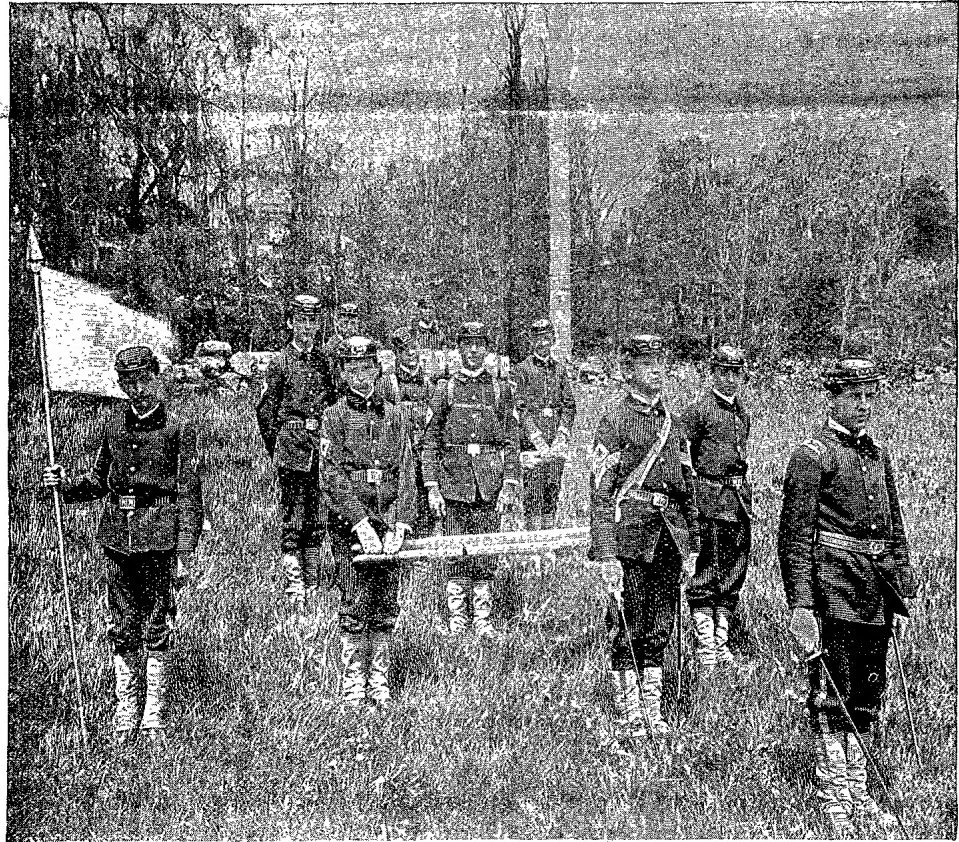
Ambulance Corps, First Battalion of the American Guard (Grammer School 87, New York.)
The friends of the organization are said to be many, and its opponents comparatively few. It is said in defense of the system that it confers much physical benefit upon the boys of the schools, giving them “neatness in person and clothing, a firm step, and a straight and graceful figure.” The correctness of this assertion no one will be likely to dispute. The physical advantages to be derived from thorough military training are too well known to need argument. It would be idle to maintain, however, that such benefits can be derived in no other way.
But it is said that there are other and greater benefits pertaining to the system. “Still more important,” we are told, “are the mental and moral lessons directly or indirectly given in the course of military instruction. The boys are taught to be brave, honorable, and manly; that they must be obedient, courteous, and respectful; that they must protect the weak, be helpful to their comrades, and above all else, be truthful and patriotic.” Evidently, if all this were true of the military system, the careful parent, solicitous that his sons should be well brought up, would need do little more than to see them safely initiated into this organization.
It is worthy of note that one of the earliest and most influential promoters of the organization, was the Grand Army of the Republic. It was not an educational sentiment, but a military, or “patriotic” one, in which the idea originated. The education which the system provides is almost wholly in the line of that necessary to military operations. Our illustration shows the “Ambulance Corps” belonging to one New York City “battalion” of the Guard, as they would appear equipped for operations on the field of battle. It contains few suggestions in the line of physical or mental education, but some very strong ones of a different nature. Indeed, it indicates plainly that the training given in the organization is of a kind which looks toward actual military operations.
That the system teaches “patriotism” of a certain kind, is doubtless true. But the patriotism which is represented by belligerency certainly does not need to be cultivated in the mind of the average school-boy.
The important question which presents itself234in the consideration of these facts, is, Granting that the youth in our public schools will derive certain physical and mental benefits from such training, does this system provide the only method, or the best one, or even a proper one, by which it may be imparted? Do the benefits of the system more than outweigh the possible evils which it may contain?
We think they do not; but that, on the other hand, the evils far outweigh the benefits. Militarism is not a thing which should be developed in any form on this continent. We do not want a “patriotism” which appeals to arms rather than to the principles of right and justice,—a “patriotism” which is but another name for selfishness, which puts national prosperity above right and regard for humanity. We want rather the patriotism which first called this nation into being, by standing in support of those universal principles of justice asserted in the Declaration of Independence. The youth in our public schools need nothing more than they need instruction in those very principles. They need to be taught what are the unalienable rights of all men, and respect for those rights, in order that they may become the best citizens. The fighting instinct is sufficiently strong in all. It needs to be repressed, rather than cultivated.
The nation’s youth, and its older citizens as well, need to be taught that Justice, not Force, is the proper arbiter of all disputes. If this nation is again to become involved in war, far better will it be if its citizens go to the conflict in the strength of an enlightened conviction that they are contending for the principles of right and justice, than if they are impelled by a mere blind enthusiasm which trusts only in the strength of arms, and pays heed to nothing but the signal for combat.
The country may have reason to be thankful that the military idea and spirit were not more fully developed than they were when a few months ago it became involved in the Venezuelan dispute with Great Britain. As it was, the air was full of war clamor, which was recognized by sober-minded citizens as one of the greatest dangers of the situation.
Militarism and free government do not go together. Militarism belongs with despotism. The natural affinity between the two is illustrated sufficiently upon the shores of the Old World.
The evil effect of this militarism upon the public school system and through that upon the nation, is pointed out in the following from the New York World, of July 6, in reference to a resolution then before the Board of Education authorizing the introduction of military training as a feature of grammar-school education for boys:—
The adoption of such a resolution would seriously cripple the schools. It is wholly at odds with the fundamental idea on which they are based. They are founded and supported by the State that the instruction given in them may in turn support civil government.
For the support of military government free schools are unnecessary. Where the military idea predominates intelligence must be subordinated. It is inevitable that it will be. The history of the world offers no case of a people which has been able to found civil government responsive to the intelligence of the people on militarism and the military idea. If the boys of New York are to be made into soldiers in the public schools, it cannot be expected that they will be developed into the best possible citizens. They have only a few years for acquiring the rudiments of education, and if these are to be wasted the gravest injustice will be done them and the community whose destinies they are hereafter to decide.
But it is now not a question of accepting or rejecting the innovation upon its merits. The evil has fastened itself upon the common school system, and while we may and should combat it to the extent of our power, it must be with no reasonable hope of effecting its removal. The thoughtful, liberty-loving citizens who see danger in this development, are but few in proportion to the number who look upon it with favor or unconcern. It seems to be generally accepted as a proper if not a necessary and desirable feature of our “Christian” civilization.
Indeed, we find this same militarism in the “Christian” Church itself. An authority tells us that “In addition to the drill in public and private schools, there have in recent years sprung up, all over the country, cadet companies in connection with churches of various denominations, some of them numbering hundreds of boy soldiers.” There are also, we are told, many companies of youthful cadets connected with temperance organizations and similar bodies.
Militarism is one of the great curses of the world to-day. Its sudden appearance and development in this favored land is an ominous sign of the times. It bodes no good to liberty or to peace. It harmonizes not with the pleasing dream of “peace and safety,” but with the internal dissension and strife now so manifest in our own national affairs, and the world-wide unrest of the nations, and the jealousy and distrust with which they are watching each other. In view of all this the prospect is that the youthful organization will soon have opportunity to turn its military knowledge and skill to another use than that of pleasing the public eye. The authority from which we have quoted, significantly says: “Recent events have brought the question of national defense prominently before the public. If this country has rights which it desires to assert against the pretensions of foreign powers, it must be prepared to fight for them. Military authorities have recently agreed in urging the drilling of the millions of American schoolboys as a useful training for a volunteer force, which could go to the front without losing time in learning the rudiments of war.”
Reader, is it not evident to you that the spirit of the times, at home as well as abroad, is making for war and not for peace,—for despotism and not for liberty? And the spirit of war is not the spirit of righteousness. Be not deceived. War is fighting—the outlet for the same instinct which animates the principals in the prize ring. It is murder and ruin on a vast scale; as General Sherman pithily remarked, “War is hell;” and not all the dignity and glory with which “civilization” can invest it can make it anything else. The universal spirit of the world to-day is the war spirit; the drift of events the world over is for war. It is for you, reader, to ponder the situation with all seriousness and earnestness, in the light of these facts, and—what is more important—the light of the prophecies of the inspired Word.
A NEW FEATURE FOR “MISSIONARY” CONVENTIONS.
By S.
THE “Illinois Missionary Association of the Christian Church,” announces a new feature in the program of its coming annual session, to be held in Eureka, Ill., July 28 to August 6. Press reports speak of it as follows:—
A new feature has been introduced in the program this year, which tends to greatly increase the interest in the occasion; that is a series of political speeches, each party to be represented by one of the leading men of the State. Wednesday, July 29, Hale Johnson, of Newton, Prohibition candidate for Vice-President, will be present and speak. Thursday, Governor John P. Altgeld will speak as the representative of Democracy. Friday, Hon. A. J. Hopkins, Congressman from the Eighth Illinois District, will discuss the great questions of the day from the standpoint of a Republican. This speech will close the series.
The remainder of the meeting will be divided between the various conventions of organizations pertaining to the Christian Church.
Verily, the signs are abundant on every hand that religion and politics are rapidly coming together. But one thing is certain,—the mixture will not constitute Christianity. Quite probably this “new feature” on the convention program will “increase the interest in the occasion,” but the nature of that increase of interest will be political, not Christian. Christianity and politics are not in the same sphere. To engage in politics the Church must go outside the sphere of her God-appointed work. S.
THEY SUFFER FOR THEIR FAITH.
Down in Lake County, Tennessee, surrounded by the heavy timber for which the lowlands of the Mississippi are noted, is a small community of Seventh-day Adventists.
A year ago, one of their number who owned a small portable saw-mill, secured, in company with another man, a tract of 1,500 acres of wild timber land for the purpose of converting the trees into lumber.
Calling to his assistance several of his brethren of like faith from other neighborhoods, Mr. Callicott, for such is the name of the owner of the mill, proceeded to establish a lumber camp in the hitherto almost trackless forest which he and his partner had purchased.
Soon a number of rough but comfortable homes sprang up where previously there had roamed only wild beasts, or herds of semi-wild cattle and hogs, which have free range of the Mississippi bottoms in Lake County.
The mill hands brought with them their families, and very soon after the mill was in operation steps were taken to build a school-house, which task completed, a teacher was employed and a school successfully conducted for several months.
The school-house served also for a church, and every Sabbath as also on Wednesday evenings, the whole community assembled for divine worship, which, unless a minister was present, which seldom happened, was conducted by one of their own number. The children were organized into classes for a regular Sabbath-school in which both old and young took part, while for the older ones there were Bible readings or “lay” sermons prepared and delivered by some of the men. A few of the employés of the mill were not Adventists, and it was never operated on Sunday, and so was run only five days each week. Naturally Sunday was “chore day” with the Sabbatarians, and numerous little odd jobs were done on that day.
When it was determined to build the school-house and church the men volunteered to do the work. The owner of the mill gave the timber and the use of his mill, besides himself assisting in the work. On a Sunday morning the volunteers sallied forth to cut the logs at a point about a mile distant from the mill and still deeper in the dense forest. But evil eyes were spying out the liberty of the Adventists. Sunday loafers from farms adjacent to the forest followed to the scene of operations the fathers intent upon erecting a temple sacred at once to the worship of God and to the education of their children, and235this work was the basis of some of the indictments referred to.
Formerly the forest had echoed on Sunday with the baying of hounds and the crack of the rifle in the hands of godless hunters, but nobody was disturbed. Now however when the “sabbath” stillness is broken(?) by the “swish” of a cross-cut saw drawn by sturdy but God-fearing lumbermen, who had on the previous twenty-four hours “rested the Sabbath-day according to the commandment,” the neighborhood was “disturbed.” Methodists and Presbyterians, and even Baptists, who saw a rival sect gaining a foothold in their neighborhood, were greatly annoyed, not indeed when they heard the saw cutting the logs to be subsequently made into lumber for the Adventist church, for that could not have been heard ten rods, but when they heard that the saw had been running.
The facts of this work together with the odd jobs done about their homes on Sunday, were promptly reported to the grand jury. A ne’er-do-well in the neighborhood, who has more than once crossed his legs under the hospitable boards of his Adventist neighbors and partaken of their salt, appeared in the role of prosecutor, and five of the Adventists were indicted for nuisance, according to the following formula varied only as to names:—
State of Tennessee, } Lake County. } Circuit Court, November Term, A. D., 1895.
The grand jurors of the State of Tennessee, elected, impaneled, sworn, and charged to inquire in and for the body of the county of Lake, in the State aforesaid, upon their oath present that W. S. Lowry, late of said county, laborer, heretofore to wit, on the 17th day of November, A. D. 1895, that day being Sunday, and divers other Sundays next before that date, in the county of Lake aforesaid, then and there unlawfully, openly, publicly, notoriously and unnecessarily did, in the presence of divers persons, engage in his secular business, and did perform and follow his common avocations of life on Sunday by working at the sawmill, moving and hauling saw logs, building houses and fences, chopping and sawing lumber, and doing divers other kinds of work on Sundays, said work not being necessary or a matter of charity; and it was and is to the great annoyance and disturbance of the good people of the community, to the evil example of society, prejudicial to public morals, and a public nuisance to the citizens of the county, and against the peace and dignity of the State.
J. W. LEWIS,
Attorney General.
As before stated, the mill was never operated on Sunday. The work done, as shown by the evidence, was such as is usually done on Saturday afternoon or on Sunday by men employed on other days in mills or factories, and especially in lumber camps. But for this, one honest man has just completed a term of imprisonment dating from the 14th day of last March, and three more God-fearing men have just been convicted, and must spend several months in prison and in the chain-gang, for they refuse to pay either the small fine or the large costs assessed against them for exercising a God-given and inalienable right.
The indictments referred to were found last November. Last March one of the defendants was tried on two indictments, and in default of payment of fines and costs was committed to jail for nearly eight months.
The other four cases were continued because of a flaw in one of the indictments. On the 16th inst., these cases were tried and three convictions were obtained.
The judge, W. H. Swiggart, of Union City, Tenn., seems to be a fair-minded man, who has lost his relish, if he ever had any, for such cases. Regarding himself as bound by the statute and the decision of the Supreme Court, he discharges what he conceives to be his duty. It is stated on good authority that Judge Swiggart does not want these Sunday cases in his court, and certainly he does not regard Sunday work as done by the Adventists as a very serious offense, since he imposes only the nominal fine of one dollar even on defendants before him for the second or third time on the same charge.
Attorney-General Lewis does not seem so liberal or even fair-minded, and is said to have made some threats by no means creditable to him. It is reported that he induced the prosecutor to assume that role by promising to “nolle” a case against him, and that he has boasted that he drove the Adventists out of Henry County into Obion County, and from Obion County to Lake County, and that now he will drive them into the river. It is to be hoped that this is a mistake. The Adventists were never driven out of either Henry or Obion Counties, and are not likely to be driven out of Lake County; but even should they be driven out of the State or even from the United States it would not prove them wrong nor their persecutors right. Might does not make right, and Attorney-General Lewis may be wrong even though he has at his back all the power of the State of Tennessee.
PULPIT POLITICS.
By S.
We seem to be rapidly approaching the time when the political “stump” will have become identified with the “Christian” pulpit, and one can learn all he desires to know concerning questions of politics, national finance, law, civil government, etc., by simply going to church and paying attention to the regular Sunday discourse. The clergy will become the political campaigners, and the party managers will simply have to call the conventions, nominate the candidates, and frame the platforms; then the clergy will attend to the rest.
The congregation of the Calvary Baptist Church, New York City, are already thus favored(?) in respect to the political issues of the present campaign. In his discourse of Sunday evening, the 19th inst., the pastor “paid his respects” to the “Chicago platform,” condemning especially its reference to the United States Supreme Court. He said:—
This court is the authoritative interpreter of the Constitution. To degrade it would be a national calamity. Do the supporters of this platform want anarchy? Do they not know that Christian patriotism insists that “lex is rex”—that law is king and must rule? That platform propounds and promulgates dangerous doctrines. Its teaching comes perilously near being revolutionary. Americanism is not anarchism.
Whether the standard of truthfulness of the average political campaign speech will be raised or lowered in the hands of the clergy, is a question which remains to be determined. It is evident, however, that in this instance it was not greatly elevated. The statements that the Supreme Court “is the authoritative interpreter of the Constitution,” and that “law is right, and must rule,” are about as misleading as any that could be uttered. It is true that the Supreme Court of the nation can speak with authority superior to that of any other court upon the questions which come before it; but that court is not superior to the people who created it, and cannot settle for them any question of absolute right or wrong. If it could, it would have settled the question of negro slavery in favor of the slave-holder, when it rendered the historical Dred Scott decision. Not even a decision of this august tribunal can give a bad doctrine a right to rule in the practice of the nation or of individuals. The people have not delegated to any court their reason or moral accountability. Right must rule; and the people must determine for themselves, in the light of their own reason and of revelation, what is right.
The Supreme Court cannot make law. Law, in its true sense, is always synonymous with right. But that is often set forth as “law,” which is simply what the court decides to be right; and the court’s decision, in many if not most instances, is determined by its constitution at the time. Recently, the Supreme Court considered the question of the constitutionality of the “income tax” statute passed by Congress, and decided it to be law; but almost immediately afterwards reconsidered its decision, and by a change of mind on the part of one member, decided the statute to be unconstitutional and not law. It is evident that the question of “law” in this case might have been settled either way by a slight change in the personnel of the court.
This voice from the pulpit would have us believe that “Christian patriotism” requires an acceptance of the doctrine that “law is king, and must rule,” and that what the “law” is which must rule, is a question to be settled by the courts. We are not told what “Christian patriotism” is, but it is a term used evidently to allege that the individual is neither a Christian nor a patriot who will not be ruled in all matters by the “law,” as the courts may determine it. There is a strong tendency in this country toward political as well as religious popery, and this tendency will doubtless be strengthened by the utterances of pulpit politicians. Such utterances are invested with a weight and dignity, as coming from the pulpit, which they would not possess, put forth as mere “stump speech” rhetoric. By the pulpit-reverencing class, they are apt to be received as gospel truth.
There is “law” in almost every part of this country in favor of a church dogma—the Sunday-sabbath—and this “law” has the sanction of the nation’s Supreme Court. The mere behests of the church, backed by a sufficient show of power, are apt to receive the stamp of “law” from the legislating power, as was seen in the national edict closing the World’s Fair on Sunday. The church is looking to the “law” and the courts as her allies in religious work; and it will therefore not be strange if the pulpit politician shall endeavor to impress the public mind with the idea that the “law is king, and must rule,” and raise the cry of “anarchy” whenever the rightfulness of the “law,” or of a Supreme Court decision, is called in question. S.
THE REFORMING POWER OF GOD'S WORD.
By S.
THE religious world seems at this day to have little or no confidence in God's simple word as a means of moral reform. There is no lack of effort at reform, nor was the need of reform in both Church and State ever greater, probably, than it is now; but the means employed by the various reform parties indicate a general belief that men must be either coerced into reform, or lured into the way of righteousness by some attraction which will appeal to their carnal natures.
The SENTINEL invites the attention of reform workers to the word of God as a reform-producing power.
There is a power in the divine word which236men cannot comprehend. The comparative powerlessness of man's word has given rise to the familiar saying that “talk is cheap stuff.” Not so of the word of the Lord. And there would be much less need of reform to-day if the distinction had been preserved in the public mind between that word and the “cheap stuff” put forth from the pulpit by those standing in the position of God's spokesmen.
Consider the great reform accomplished in the time of John the Baptist. John was simply a preacher in the wilderness. He himself denied that he was the Messiah, or that he was Elias, or a prophet risen from the dead. There was nothing wonderful about his appearance. He had no circus to exhibit before the people. He performed no miracle. And yet we read that there “went out to him Jerusalem, and all Judea, and all the region round about Jordan, and were baptized of him in Jordan, confessing their sins.” Matt. 3:5, 6. If there could be such a reformation as this at the present day, it would surpass all the hopes of those now preaching reform to the unheeding, world-loving masses.
What then is the trouble to-day? Has the word of God lost its power? That cannot be, unless God has lost his power. Does not the trouble lie in the fact that the word of God is not studied to-day, not believed, not preached? Does not imagination, or dogma, or politics, or city government, furnish the theme of discourse in the vast majority of instances, instead of revelation? And in how many instances does a text of Scripture, when used, furnish more than a foundation from which the speaker can take a rhetorical flight into the realms of fancy?
Martin Luther and his associates presented the simple word of God to the people of their time, and the Reformation of the 16th century was the result. The people found in the word as it was presented to them, that which satisfied the longing of their souls; they found the bread and water of life. Will it not be found the same to-day? And will it not be welcomed as of old? Yes; it is as true to-day as it ever was that the mysterious longing of the soul for the happiness and peace which it vainly seeks from the resources of earth, must be satisfied, if at all, by that which is “spirit and life” indeed; and that is the word of God. John 6:63.
God is in his word; and this is the secret of the infinite difference between his word and man's word. This is why his word will come to the heart with a power which man's word knows nothing of. The power of God's word is shown in creation. “By the word of the Lord were the heavens made, and all the host of them by the breath of his mouth.” Ps. 33:6. No greater work was ever done than that of creation. No greater power than that which produced creation could possibly be needed for any work at the present time.
God—the Omnipotent—is in his simple word; but not in the great shows and demonstrations which are considered so necessary in religious work at this day. When Elijah the prophet stood on Mount Horeb, after he had fled from the wrath of Jezebel, he was a witness to some very impressive demonstrations. First, we read, “a great and strong wind rent the mountains, and brake in pieces the rocks before the Lord; but the Lord was not in the wind.” Next there was an earthquake; “but the Lord was not in the earthquake.” Then came a fire; “but the Lord was not in the fire. And after the fire, a still small voice;” and that voice revealed the presence of the infinite One. It is so to-day; God is yet in the “still small voice,” and any work of reform which does not have that voice in it, whatever else it may have, is disconnected from God.
We point to the divine word as the one essential and all-powerful means of moral reform to-day. Of course, if the reform sought is not sanctioned by the word of God—as, for example, the reform to promote Sunday observance—there is no divine power in it and never can be. There is absolutely no hope for “reform” work of this kind. But there is a Sabbath-reform work going on in our land and in all lands, which is based directly on God's word, proclaiming to the people “the seventh day is the Sabbath of the Lord thy God;” and such is the power that is in it that multitudes of every race and class are reforming in Sabbath observance and keeping the seventh day, in the face of popular scorn, popular custom, financial loss, and legal pains and penalties.
Let every honest-hearted reform worker ascertain if his work has the sanction of the word of God; and if so, promulgate it by that word. If it has not, it is worse than useless to resort to another means for its propagation. S.