The Youth’s Instructor, Vol. 27, No. 12.

THE SPEECH OF A POLAR BEAR

The Youth’s Instructor

Mar 19, 1879

S. D. A. Publishing Association · Battle Creek, Mich. · Mar 19, 1879

THE SPEECH OF A POLAR BEAR.
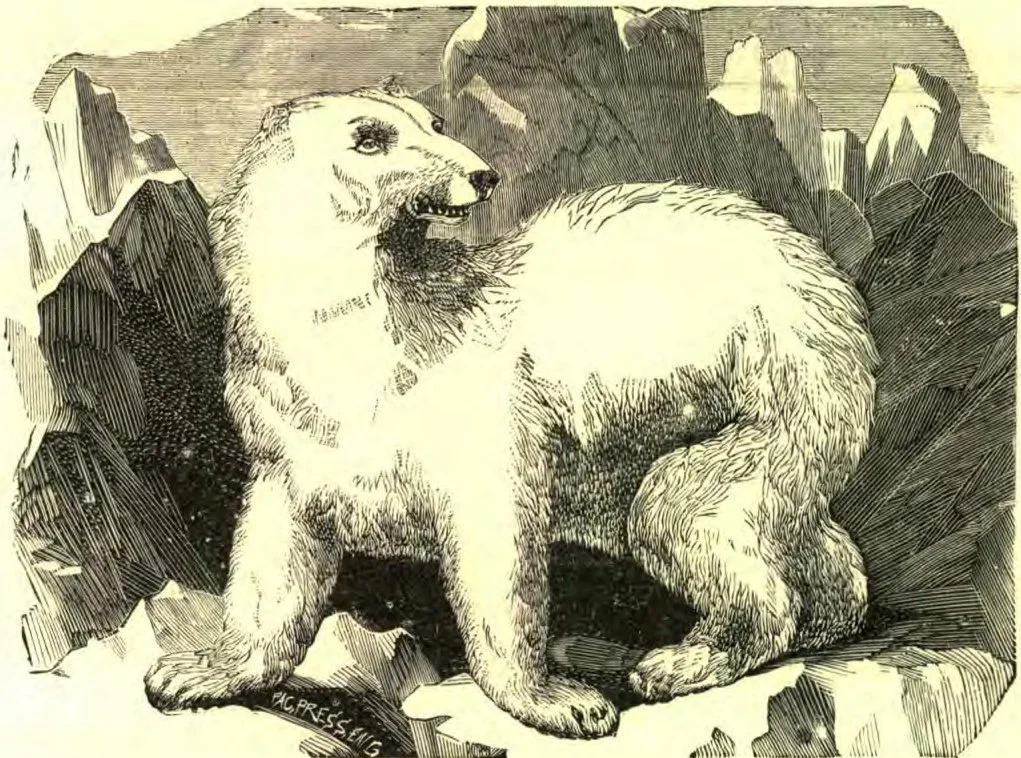
DEAR CHILDREN: Do not be frightened, and run away; but listen to my speech. If you leave your quiet homes and come up here in search of an open polar sea, as Dr. Kane and others have done, you may meet with a Polar Bear; and if away from your vessel unarmed and defenseless, you will probably be made a prisoner and punished for intruding on my domain, for I am king of the North; but if you stay where you are, you will be perfectly safe. Perhaps you would like to know something about me, where I live, and what I do for a living; listen, then, and I will tell you. My home is among the icebergs of the frozen north—in the region of perpetual snow and ice; but I do not suffer from the cold as much as one might suppose. He who created you, made me with long neck and head; short round ears; long feet with hair on the soles, so that I can walk on slippery places; and a white fur coat, warm and comfortable, which grows with my body till it is sometimes thirteen feet long! I am not afraid of the cold, and when the black bear of Canada is in his den “sucking his paws,” or doing little else, I am wandering over the fields among the mountains of ice, swimming from one island of ice to another, in search of food, or having a good time with my companions.
There is as much daylight and darkness where I live as where you live, though we have but one day and one night in the year. In the period of darkness called night, we have starlight, moonlight, and the aurora borealis, or northern lights, as you call them; and we are so much pleased with our climate that we would not exchange it for “the sunny south.”
I get my living by hunting, but I use neither gun, nor spear, nor bow. I am in the habit of sitting near the openings in the ice, and watching for seals and other animals; and when they rise above water to get air, I pounce upon them, and tear them to pieces with my strong teeth and sharp claws. If I am so fortunate as to find a dead whale, I have a feast, I assure you; but when I can get neither fish nor flesh, I live on vegetable food—though that is rather a scarce article in these parts. In short, I am not over-nice about my diet, and do not pout and cry if I cannot get just what I like best.
You may think me cruel, because I live by preying on other animals; but I kill them to eat, and not for sport as some men do.
I am not much given to boasting, but I really think I am worth more when dead than some people are when living; for then my fur is used for clothing, my flesh for food, my fat for oil, and my shoulder-blades can be made into sickles that will cut down more stalks of grain than Samson slew of men with the jaw-bone of an ass!
Perhaps you have heard of a prophet who dreamed of seeing a bear come up out of a stormy sea with three ribs in his mouth; of a shepherd who killed a bear that came to destroy his father’s sheep; and of two she-bears that “tare forty and two children” who mocked a bald-headed man. They were not Polar Bears, however; they were the ferocious, yellowish white bears of Syria.
But I must bring my speech to a close, lest I weary you with my bare-faced statements. I suppose I answer the design for which I was created; do you? Much more is required of you than of me. Go and learn your duty and do it, that your home may at last be in that new world
“Where bears and wolves, no longer wild, Obey the leading of a child; Where lions with the oxen eat, And dust shall be the serpent’s meat.”
As I have never learned to write,—though I can make my “mark” on ice if not on paper,—you have this speech by means of an interpreter, and while you are reading it in your comfortable homes, by the fireside, I will be seated on my icy throne, or standing, as in the picture, in the open air, a
POLE R. BEAR.
—Youth’s Visitor.

YOUR HOUSE.

BE true to yourself at the start, young man, Be true to yourself and God; Ere you build your house, mark well the spot, Test well the ground, and build you not On the sand or the shaking sod.
Dig, dig the foundation deep, young man, Plant firmly the outer wall; Let the props be strong and the roof be high, Like an open turret toward the sky, Through which heavenly dews may fall.
Build slow and sure: ’tis for life, young man— A life that outlives the breath; For who shall gainsay the holy word? “Their works do follow them,” saith the Lord, “Therein there is no death.”
Build deep, and high, and broad, young man, As the needful case demands; Let your title-deeds be clear and bright, Till you enter your claim to the Lord of light For the “House not made with hands.” —Packard’s Monthly.

CORRECT SPEECH.

ONE fault very common with children, and which will strengthen with their years unless particular pains is taken to correct it, is the making use of incorrect and inelegant expressions in speaking. This habit frequently results from their being tutored in a sort of “baby language” when they first begin to talk.
But it matters not so much how these habits have been acquired, as how we shall rid ourselves of them; for surely the INSTRUCTOR family want a “clean speech,” a “pure language,” and will try to attain to them when their deficiencies are pointed out.
We have seen nothing better upon this subject than a few paragraphs which we will quote from the Christian Weekly for March 15, 1879. Try the method of criticism here recommended, not for strife or argument, but for mutual improvement; and we think you will be surprised at the great change which will appear in your choice of words. M. J. C.]
Nothing bespeaks a true lady and gentleman or well-bred child more than the use of correct language, pure, clean speech. Cultivate, my young friends, good English in every-day conversation. Unclean speech is in keeping with a smutty face, begrimed hands, and soiled clothes. Strange how easily and almost unconsciously one slides into a careless, slipshod way of talking, even when the rules of grammar are quite familiar. It is not uncommon to find people learned in all the rules of syntax who apply them to the art of writing, yet habitually talk incorrectly.
Early culture, and association with refined persons are quite essential to give purity to speech; but if one has unfortunately been deprived of these, he should continually watch his words till he gets in the habit of using decent English, for nothing so unmistakably marks one with vulgarity, no matter how elegant is the outside covering, as shabby, low-born speech.
Not long since the young folks belonging to several families in a certain neighborhood entered into an agreement to pay a small forfeit every time either of them made use of certain vulgarisms in speech that had become a habit with them. Old and young, large and small, soon became interested and entered into the compact. All had fallen into the habit, for false syntax is contagious, and spreads through whole communities when it once breaks out, and one of its worst phases is that people become affected by it without knowing it.
The treasury, the contents of which, by the way, was given to charitable purposes, for a time was pretty full. Each one was a self-appointed monitor. The plan caused considerable amusement, but what is better, completely cured the bad habit. I doubt if in that circle the horrid words “ain’t,” or “wont,” or “have got,” or “done” for “did,” are ever heard. And their conversation is seldom embellished with “you know,” “now a,” “I tell you what,” “of course,” and the like, or with high-sounding superlatives where only the moderate positives have any meaning.
As much as I dislike slang, even what is termed the better sort of it, which, by the way, should be used very sparingly if at all, apt as it sometimes seems, I dislike these specimens of false syntax, these vulgarisms, more, and they should be carefully watched lest they creep in and spoil fair speech.
I would recommend to all my young friends who are daily associating together the formation of such a club as I have been describing for mutual benefit. My word for it, it is a marvelous corrector of false syntax, and the rules might extend to other bad habits, and so be constituted a reform club.

THE AIR A MEDIUM OF LIGHT.

Air is the medium by which light is diffused. Men who have been up in balloons say that the higher they went up the blacker the sky became; and no doubt above the air it is perfect darkness. Although the sun’s rays pour through the vast space above, yet they give no light, except upon the objects on which they directly fall; for there is no air for them to illuminate.
Light travels very fast. It takes it only eight minutes to come from the sun to us, although the distance is about ninety-one million miles. The color of the air is light blue, and what we call “blue sky” is simply blue air. The grayish or white appearance of the sky is caused by clouds, or vapor. Clouds are masses of mist floating in the air; and are of different sizes, forms, and colors. Sometimes they assume many strange and wonderful shapes. And persons with vivid imaginations often fancy they see curious forms and figures in the sky. Clouds generally appear the most beautiful when the last rays of the setting sun light up the west, and paint the sky with burning colors of crimson and gold.
Clouds are drawn from the water and moist soil of the earth by the heat of the sun. On an average, they are about two and a half miles from the earth; and they descend to the earth in the form of rain. Hail is frozen rain, and snow is frozen mist. There are portions of the earth where rain never falls, and other parts where it rains nearly all the time. Some parts of the earth are always covered with snow, and other parts have none at all. Snowflakes, when viewed through a microscope, exhibit forms of exquisite beauty. In the polar regions, they assume the most beautiful and varied forms.
In these regions, strange lights are often seen in the sky, such as shining balls and crosses of fire, and a crown of red light called the aurora borealis, or polar light. This is a beautiful light, and exhibits various colors, from a white to a blood red. It often assumes fantastic shapes, but is usually in streams. It is frequently seen in our own country, but it never appears as beautiful as in the North.
The first appearance of the Northern Lights in this country after its settlement, was on the evening of Dec. 11, 1719, and as the people had never heard about them, they caused much alarm. One writer describes them thus: “About 8 o’clock there arose a bright red light, like that which arises from a house on fire. It spread itself through the heavens from east to west, and streamed with white flashes of light down to the horizon. It was the brightest in the middle, and its appearance was dreadful; sometimes it looked like fire, and sometimes like blood. It lasted about an hour, and many thought the day of Judgment was at hand.”
It is not certainly known what causes these lights in the heavens, and no wonder they create terror, when they stream—
“Like living things with flaming wings, Across the sunless sky.”
ELIZA H. MORTON.

TRUE GENTLEMEN.

“I BEG your pardon,” and with a smile and a touch of his hat, Harry Edmond handed to an old man, against whom he had accidentally stumbled, the cane which he had knocked from his hand. “I hope I did not hurt you. We were playing too roughly.”
“Not a bit! not a bit!” said the old man cheerily. “Boys will be boys, and it’s best they should be. You didn’t harm me.”
“I am glad to hear it;” and lifting his hat again, Harry turned to join the playmate with whom he had been frolicking at the time of the accident.
“What do you raise your hat to that old fellow for?” asked his companion, Charley Gray. “He’s only Giles, the huckster.”
“That makes no difference,” said Harry. “The question is not whether he is a gentleman, but whether I am one; and no true gentleman will be less polite to a man because he wears a shabby coat, or hawks vegetables through the streets, instead of sitting in a counting-house.” Which was right?

BIBLE LESSONS FOR YOUTH.

LESSON XXXVIII.—REVIEW.
1. What covenant did the children of Israel make with God at Mount Sinai?
2. Had they then heard the voice of God which they promised to obey?
3. When did they hear it?
4. What words did God speak?
5. Where were they spoken?
6. How was the mount affected by the presence of God upon it?
7. How were the people affected by what they saw and heard?
8. Were they willing to renew their covenant after they had heard the voice of God?
9. What did they say when Moses repeated to them all that the Lord had said to him?
10. By what ceremony was this covenant ratified?
11. After this, what did the Lord tell Moses to do?
12. Who went up into the mount with him?
13. How long did they remain there?
14. After the Lord had made an end of communing with Moses, what did he give him?
15. What did the people say when Moses tarried so long in the mount?
16. What were they doing when Moses returned to the camp?
17. What did Moses do with the tables of stone that God had given him?
18. What did he do with the calf which the people worshiped?
19. What punishment was inflicted upon those who had led the people into this idolatry?
20. What did the Lord propose to do with all the host of Israel?
21. How would he then raise him up another people?
22. What did Moses say when the Lord told him this?
23. What promise did God finally make him?
24. How were the tables of the law renewed?
G. H. BELL.

SABBATH-SCHOOL CONTRIBUTIONS.

It is a well-known fact that any Sabbath-school, to be interesting and of the greatest benefit to its members, must have a few suitable appliances. It must have lesson papers and books, record books, and song books, and ought to have a few maps of Bible lands, with a few text-books for Bible study. Some of these have to be bought only once, while the lesson papers and record books, must be renewed from year to year. Though the expense of these is very light if distributed among the members of the school, the entire lack of them makes a school almost useless.
Let us figure for a school of fifteen members where there are ten children and five adults. What is the school worth to each member? One dollar a year? If not, it is not worth attending. But suppose the grown people give one dollar a year, and the children, half of that. We then have ten dollars. Half of this will obtain ten weekly INSTRUCTORS for a year, and these will furnish lessons for the whole school, as the supplements can be taken out and used by the Bible Class. One dollar will procure record books to last two years; one dollar can be given to the State Association to help in carrying on its work; and there will be three dollars left, for song books, or for Bible maps.
“But,” says some one, “one dollar apiece is too much to give, and, besides, the children have no money.” We think that this will not be regarded as a high price for its benefits when the school is properly appreciated; and as to the children, they should have something, and be taught to sacrifice and give of their little treasure. They may be encouraged in habits of usefulness and obedience by small rewards which they will treasure up, and from which they can donate to the Sabbath-school treasury.

HOW SHALL THIS MONEY BE GIVEN

or collected? We would say, In the way that best suits the majority of the school, always being sure that some plan is adopted and thoroughly carried out. In a few cases, the Superintendent will prefer to take a subscription paper, and visit each member of the school, securing at once the amount needed. In other cases, the members will prefer to pay their donation to the S. S. Secretary monthly or quarterly. In this case, they should pledge what they will do, and should feel responsible for placing it in the Secretary’s hands at the appointed time.
A third, and we think a much better way, is to place a little box in the church or place of meeting, and let each member drop in an offering when he enters the school. This has been called the Penny Contribution, but we do not see why it may not include nickels, dimes, and quarters. The children will delight to bring their little offerings; and parents will not despise the plan when they come to realize that the Sabbath-school is one of God’s best gifts, and that it is part of his great work.
Some have objected to making this offering on the Sabbath, thinking that it was a violation of that holy day. When the plan was first proposed, we regarded it in the same light; but a few arguments from those well acquainted with the Scriptures, and a little careful study, have fully convinced us that the bringing of an offering to the Lord is a very appropriate part of our worship on his day.
There are many acts connected with our Sabbath worship, which, if done with a careless, worldly spirit, become Sabbath violations; and yet, when done with a spirit of devotion, are an essential part of our worship. Some have said, “It’s not bad of itself, but will lead to things worse. If we give for the Sabbath-school, why not pay S. B. on the Sabbath?” One is purely a donation, an offering at the option of the giver; the other is a business transaction. The S. B. is the payment of a debt. It requires an examination of the cash account, and brings to mind the principal business transactions of the week. One does not lead to the other any more than harnessing one’s team to drive to meeting leads to putting on a load of wheat to be sold for money to donate to Foreign Missions.
The children of Israel brought more offerings to the Tabernacle on the Sabbath than on any other day, and we are informed that the Jews from ages past to the present time have observed the solemn custom of bringing an offering and placing it in a box at the door before engaging in their Sabbath worship. Eld. Andrews tells us that this custom is almost universal with the Christian churches of Europe, and the feeling prevails that no one should appear before the Lord empty-handed.
We recommend this kind of a Sabbath contribution, and we confidently believe that if its adoption is accompanied with the proper instruction, it will impress upon the youthful mind a solemn sense of our dependence upon God for all his blessings, and our duty to manifest our gratitude by frequent offerings to him.
We like the plan of fastening a box on the wall near the door. Then all those whose consciences say, “Put in a coin,” can do so without display; while those whose consciences say, “It is wrong,” can pass right by. These latter consciences, if good ones, will say at the end of the quarter, “Attend the business meeting and put in thirteen or twenty.”
Whatever plan is adopted, let the officers see that it is promptly and cheerfully carried out.
W. C. W.

LESSONS FOR CHILDREN.

LESSON XII.—REVIEW QUESTIONS.—CONTINUED.

1. DESCRIBE mounts Ebal and Gerizim.
2. What city lies between them?
3. Describe the altar that was built on Mount Ebal.
4. Describe the solemn ceremony that was performed here.
5. What command was fulfilled by this?
6. Who came to see Joshua, after he had returned to Gilgal?
7. How did they deceive Joshua?
8. What did they persuade him to do?
9. What did Joshua afterward learn?
10. Did Joshua stop to inquire of the Lord before making a league with these men?
11. What trouble did the Gibeonites have soon after this?
12. Who went to help them?
13. What was the result of the battle?
14. In what way were the greater part of the men killed that day?
15. What other astonishing miracle was performed?
16. What was done with the five kings that hid in the cave?
17. What was the name of the one who was king of Jerusalem?
18. How were the Gibeonites punished for deceiving Joshua?
19. Where did the king of Hazor and the kings that joined with him gather their armies?
20. Where is this lake?
21. Describe the army that gathered there.
22. How did the Lord encourage Joshua?
23. Give an account of the battle.
24. What did Joshua do after the land was conquered?
25. What portion was given to Caleb?
26. What portion was given to the tribe of Levi?
27. What did Joshua do just before his death?
28. How did he remind them of the goodness of God?
29. Repeat some of his good words of counsel.
30. How old was he when he died?
31. How long did the children of Israel continue to serve the Lord after the death of Joshua?

PUNCTUALITY

It is a sad failing with many that they are always behind time on Sabbath morning. They are very particular about their own time, they cannot afford to lose an hour of that; but the Lord’s time, the only day out of the seven that the Lord claims as his, and requires us to devote to him, quite a portion of this is squandered away by sleeping late in the morning. In this they are robbing God. It causes them to be behind in everything; it makes confusion in the family; and finally results in the tardiness of the entire family at Sabbath-school, and perhaps at meeting. Now why can we not rise early with the birds, and offer praise and thanksgiving to God? Try it, brethren and sisters. Have your preparations all made the day before, and come promptly to the Sabbath-school and meeting, and you will thereby not only benefit others, but you will reap rich blessings for yourselves.
E. G. W.

AN INDICATION.

An expression sometimes heard in a district school after the class has taken the recitation seats, is, “Books closed.” This means that there is no more time for studying the lesson. The pupils must be prepared to recite, or make a failure.
If, in an ordinary recitation, you should see a class with books open, reading the answers, what would you think? You would say, “The scholars lack interest in the study, and the teacher does not understand his business.” Very well, if you see the same thing in a Sabbath-school, would you draw a different conclusion? E. T. BEDEE.

LETTER BUDGET.

DAVID CITY, NEB.
DEAR EDITORS: I am a little girl twelve years old, and am a reader of the INSTRUCTOR, which I like very much. I never read the paper but it brings to mind my kind uncle, E. E. Hayes, who gave me the money to subscribe for it. He was a Sabbath-keeper, and I presume he is still remembered by some of his fellow-students at Battle Creek. I am trying to keep the Sabbath with my mother and grandmother.
Truly yours, BERTIE M. WEBB.
PLEASANT GROVE, MINN.
DEAR EDITORS: I have taken the INSTRUCTOR four years. I now take the weekly. I like to read the paper. I am trying to keep the Sabbath. I go to Sabbath-school. My father and mother do not keep the Sabbath. I keep it all alone. The Lord will help me, for he has promised to be with those who try to keep his commandments. I am fourteen years old. I hope to meet all the INSTRUCTOR family in the kingdom of God.
Yours in love, C. E. KENDALL.

A SLEIGH-RIDE IN TEXAS.

Most of the Instructor readers live where cold weather and snow come regularly with the winter, but in “sunny Texas” these are quite unusual, and of course a sleigh-ride is a rare treat. During the first two weeks of January, the present season, however, the cold was really severe, and three or four inches of snow fell, and remained on the ground for several days.
This was an opportunity not to be slighted, and the streets of the cities were alive with sleighs, most of them prepared expressly for the occasion,—dry goods boxes on runners, rude board sleds, etc., filled with well-dressed people, all intent on having a grand sleigh-ride. Not to be behind the rest, a party of four, including the writer, started one afternoon for a ride to a neighboring city, a distance of ten miles. The box of a large double buggy had been placed on runners for our use, and we were well provided with robes and all fixtures except sleigh-bells.
It was a lovely day; not a cloud marred the beauty of the bright blue sky, and the newly-fallen snow sparkled in the sunlight. We set off in high spirits, anticipating a delightful ride, but soon found what threatened to be a serious drawback to our happiness. The axles of the buggy projected far over the runners, and as our road lay mostly through the woods, these axles were constantly catching in the roots and stumps of trees, or burying themselves in the sand-banks. Several times the driver was obliged to pry our vehicle off with a rail from the fence; and finally these disasters became so frequent that he put a stout pole into the buggy, and took it along with us.
We passed two or three emigrant wagons drawn up in the woods by the roadside. The occupants had built a fire on the snow, and were warming themselves as best they could. We also passed several tents, occupied by families. Having ourselves found it difficult to keep comfortable in a plastered house, we wondered how they could endure the cold, with the mercury (as it had been) down to zero.
The people do not expect such cold weather, and they make no preparation for it. Many wondering glances were cast upon the large fur coat worn by one of our party. An old negro stared at it some time, in silent amazement, and then turned away, exclaiming, “I d-e-c-l-a-r-e, that’s ’dic’lous!” Probably he had never seen one before.
We started for home about dark, and just before we reached the woods the full moon showed her bright face in the east. But if it was difficult to make our way in the daytime, we found it much more so at night, even with the light of the moon. One of the gentlemen walked before the horses nearly all the way, to pilot us, yet every now and then we would hear the cry, “We’re aground!” and sometimes the united effort of two men not being sufficient to start our craft, we were all obliged to get out in the snow. But we had light hearts, and enjoyed even our mishaps, and at last reached home in safety, feeling that we should not soon forget our first sleigh-ride in Texas. M. A. D.

M. J. C

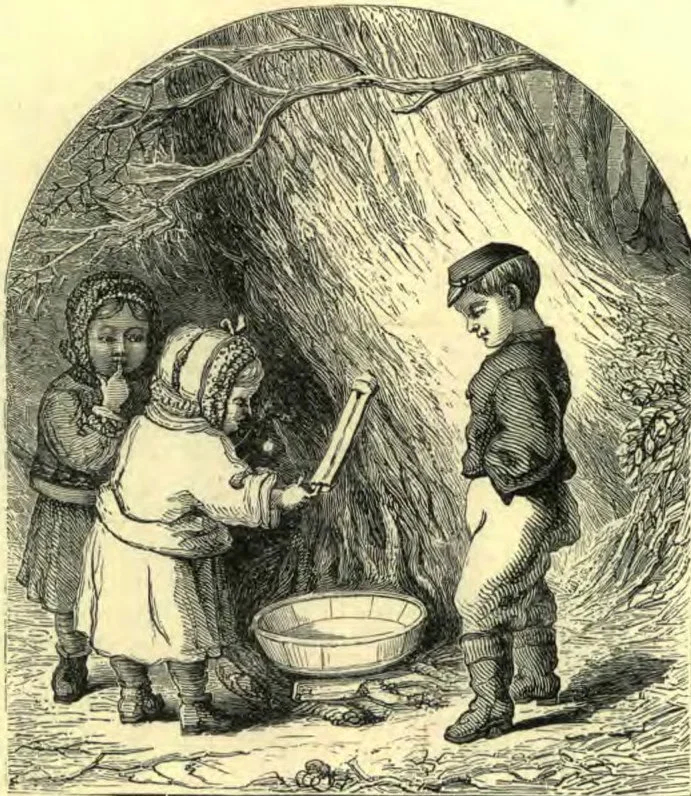
The children delight in helping their parents gather the sap, which is put into large pans or kettles and boiled down to syrup. It is afterward further boiled until it makes sugar.
The little company in the picture are having a pleasant time in a “sugar-bush.” They are tasting the sap as it flows from the trees. Did you ever taste it? It is not very sweet, and requires much boiling to convert it into sugar; but it often brings a higher price than any other kind of sugar.
In how many ways our heavenly Father provides for the wants of his children! There is no spot upon earth that does not receive his blessing and his loving care.

M. J. C

Little Children Have a Mission
LITTLE children have a mission, And there's work for each to do; Little hands can help the mother, Little hearts be brave and true. Idle hands are oft in mischief, Selfish hearts are not at rest; Do your work to bless another, And your work shall make you blest.

MAPLE SUGAR.

We do not need to tell our little friends what sugar is; for have they not all tasted it? Yes! and sometimes too much for their own good; for the free use of sugar is quite injurious to health. But perhaps they do not all know how it is made, and that it is manufactured from different materials.
In some States large quantities of sugar are made from the sap of the maple tree. During the winter the sap, or juice, of shrubs and trees is in their roots; but in the spring the sap rises and flows out to all their branches to nourish the new growth. It is then that the trees are tapped, and vessels are set to catch the rising sap.
Continue reading: THE FIRST ROBIN