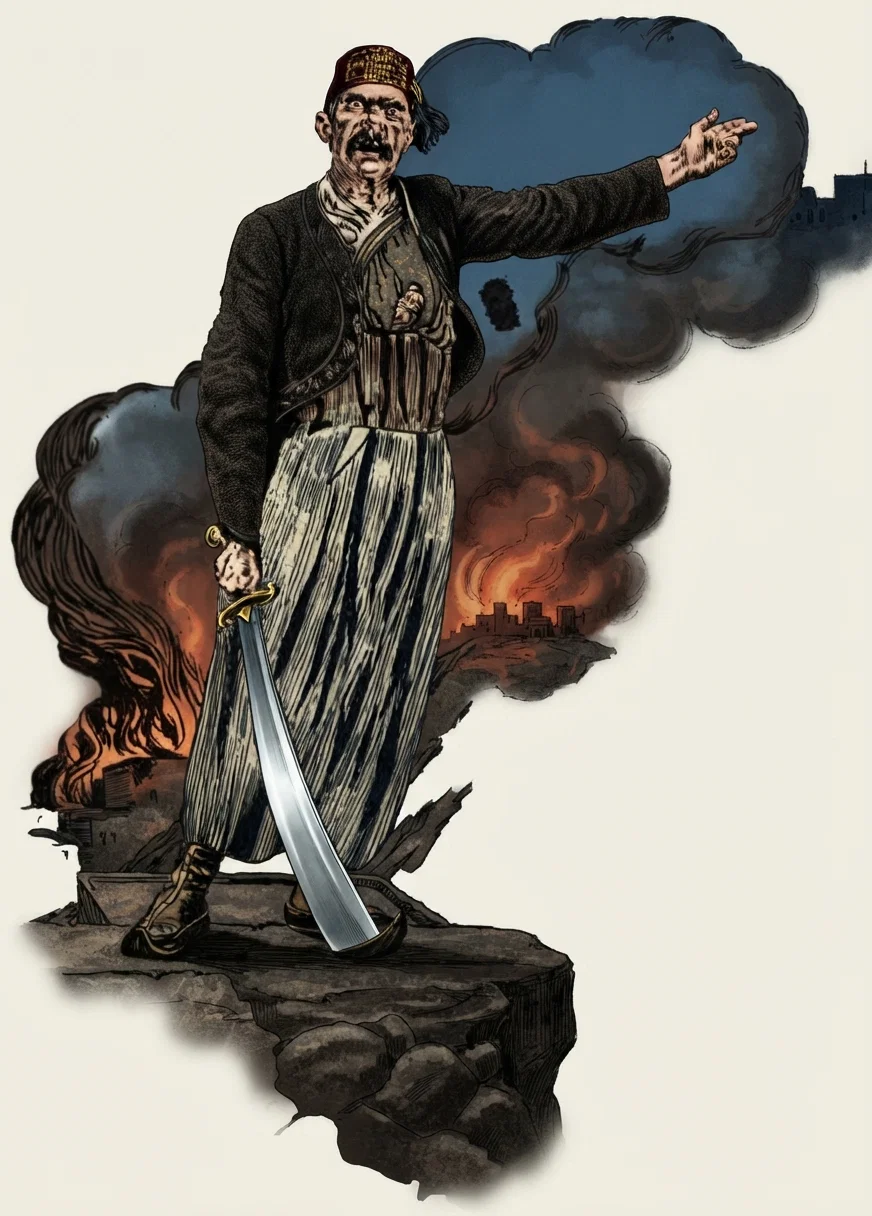
MOVEMENTS OF THE TURKISH POWER, AND THE SIGNIFICANCE — SIGNED BY THE "STANDING" ARMY— THE KING OF EGYPT
MOVEMENTS OF THE TURKISH POWER, AND THEIR SIGNIFICANCE — SIGNAL FOR THE “STANDING UP” OF THE KING OF KINGS
By LUCAS ALBERT REED
Query No. 1.—Against whom will the world powers move in the great final war?
Answer.—Against the Turk in Palestine. The thirty-sixth and thirty-eighth chapters of Ezekiel, the third chapter of Joel, and the twelfth chapter of Zechariah indicate that it will be Jerusalem and the country immediately contiguous to it that will bear the brunt of the final attack of the nations, and that this will take place just before Christ comes. The same truth is conveyed in Rev. 16: 12-16,—that it is near Jerusalem the nations gather for the final war—“the war of the great day of God, the Almighty.” Verse 14.
Query No. 2.—When the great nations shall enter upon their campaign against Turkey, what assistance will Turkey have in opposing them? Will Turkey be in a confederacy with other nations, and be aided by them?
Answer.—No. Turkey will be entirely alone when the great campaign against the Ottoman Empire engages the great powers of Europe; for the prophecy declares, “He shall plant the tents of his palace between the seas at the glorious holy mountain; yet he shall come to his end, and none shall help him.” Dan. 11: 45, A. R. V., margin. He will have no aid. He will be overpowered in the struggle, and come to his end. This shows an important change in the attitude of the nations toward the sick man of the East. In the past, Turkey has been aided; and but for the help England has offered the Ottoman Empire in past years, apparently she would long ago have come to an end.
When Napoleon fought desperately to break through the territory of Turkey, and to establish a branch of the French empire at Constantinople, it was the fleet and armies of England that defeated his ambitious plans. And when Russia, in her military victories of 1878, would have secured great advantages over Turkey, she was balked by the powers led by England, and failed to gain any decisive advantage. Over and over again Turkey has been aided, but her days of receiving help will cease. How significant were the words, coming recently from highest authority in England, that if Turkey entered the present war against England and Russia, it would be the signing of her own death-warrant! October 1 the newspapers chronicled the following incident:
“Turkey, the London Daily Telegraph says it understands, is about to make a demand concerning the station of certain British war-ships with which it will be impossible for Great Britain to comply, and it is likely, therefore, to bring Turkey into the European war.
“The Telegraph instances many indications of the Turkish policy, such as the Ottoman government’s ambiguous conduct in relation to the German cruisers Goeben and Breslau, the invitation to German officers to go to Constantinople, the mobilization of Turkish troops in Syria, and the closing of the Dardanelles, and adds:
“If Turkey chooses war, let her clearly understand that it will mean the end not merely of Turkey in Europe, but of Turkey in Asia, and that the allied powers will exact the fullest retribution.”
Query No. 3.—Is there any significance to the removal of Turkey from Europe?
Answer.—In one way only. While the prophecy does not say anything about Turkey’s removal from Europe — that is, the changing of its capital from Constantinople — it does say something about the final establishment of that capital at Jerusalem; and it declares that “he shall plant the tents of his palace between the seas at the glorious holy mountain.” Dan. 11: 45, A. R. V., margin. In other words, he will establish his capital some day at Jerusalem. This making of Jerusalem the capital city of the Mohammedan empire is a sign that the end of Turkey and Mohammedanism is imminent, and it is a sign that Christ at that time takes His kingdom. As the Scriptures declare, “At that time shall Michael stand up,
the great Prince who standeth for the children of thy people.”
The words “stand up” are a Hebrew expression used in other places in the eleventh chapter of Daniel to express the beginning of a king’s reign. For example, in the prophecy regarding the rise of Alexander we read, “A mighty king shall stand up.” Verse 3. Again farther on we read, “One shall stand up in his place.” Verse 7. Of the rise of one of the emperors of Rome the prophet says, “Then shall stand up in his place one that shall cause an exactor to pass through the glory of the kingdom.” Verse 20. And again, “In his place shall stand up a contemptible person.” Verse 21.
In all of these instances, the expression means an aggressive action on the part of a ruler, in which he manifests his sovereignty. Understanding the significance of the expression as used in the first verse of the twelfth chapter of Daniel, we see that the moving of the Turkish capital to Jerusalem is a signal that Christ will immediately thereafter assume His power as King of kings, and Lord of lords, and will exert His sovereignty against all who oppose Him.
Studying this matter from the book of Revelation, we find that the first marks of Christ’s sovereignty exerted in the world will be the beginning of His judgment in the pouring out of the seven last plagues, as described in the fifteenth and sixteenth chapters of that book. This is a work of judgment, a work in which God begins to manifest His opposition or wrath against hardened rebellion. But during the seven last plagues, we find that Christ has ceased His sacrificial work in the heavenly sanctuary. Rev. 15: 8. This of itself explains the work of Christ thereafter to be that of King.
According to the prophecies of the Old Testament, Christ was to be Prophet, Priest, and King. In giving the Old and the New Testament, part of which was a record of His own life upon earth, He acted as Prophet, and met the full significance of His name in this particular. For nearly two thousand years in the heavenly sanctuary He has acted as Priest. The book of Hebrews plainly tells us that “we have such an High Priest.” But the prophecies as clearly tell us that Christ is to be King,—King of kings, and Lord of lords. This office of Christ is yet to be filled. And when Turkey moves its capital to Jerusalem, we have the sign in earthly events that Christ ceases His service as Priest, and takes up the office of King.
Of marvelous significance, then, to all humanity is the history of the Ottoman Empire. As we will show next week, the sign is not an arbitrary one. It reveals a great triumph among the nations on the part of antichrist, and shows that a crisis has been reached, in the history of the world, which necessitates aggressive and decided action on the part of God through His Son.
Query No. 4.—After the moving of the Turkish capital to Jerusalem, what is the next event pointed out in prophecy, to which God’s people should give heed?
Answer.—The driving of the Turk out of Mesopotamia, or the destruction of his power in that territory, is represented in the symbols of the prophecy as the drying up of the waters of the river Euphrates. Rev. 16: 12. Outside of Europe, the Euphrates645Valley is one of the most important portions of Mohammedan territory. But there are three areas of note within the Turkish dominions, and two of these are mentioned in the prophecies. For example, to the north is the territory contiguous to Constantinople. A little way south are the head waters of the Euphrates and Tigris rivers. These flow south into the Persian Gulf, forming long and fertile valleys. Also to the south and west is Palestine, with Mecca and Medina still farther south.
According to the prophecies, the Mohammedan power is first driven out of Europe, because the prophecy declares that he removes his capital to Jerusalem. Under the sixth plague (Rev. 16: 12), the Mohammedan power loses the Euphrates Valley; and under the seventh plague, the last event of earthly history, Jerusalem is taken by siege and assault. But as the nations are about to drink the cup of victory, it becomes to them a cup of trembling, or a "cup of reeling." Zech. 12: 2, 3. The very moment when the nations capture the city of Jerusalem, God chooses as the time for intervention, because this very moment proves to be the time chosen by a world-wide apostasy for the destruction of God's people throughout the earth. And God speaks with a mighty voice from His throne, shaking the heavens and the earth, and bringing ruin to the apparent triumph of rebellion. See Eze. 38: 18-23; Rev. 16: 17-21; and Heb. 12: 26-28.
Religious Legislation in Disguise
By William Mayhew Healey
Initiated Sunday Law Capable of Much Mischief and Inconvenience — An Eight Hour Measure That Would Enslave Men — Vote "No" on Both Propositions
By WILLIAM MAYHEW HEALEY
THERE is an old saying that "it is better to be safe than to be sorry." There are two proposed laws on California's initiative ballot to be voted on November 3, 1914, upon which it is safe to vote "NO." They are entitled "Hours of labor" and "An act to provide for one day in seven as a day of rest," and bear the numbers on the ballot of 3 and 45.
COMBINING LABOR AND RELIGION
No. 45 is a double measure combining labor and religion. Section 1, subsections 1 and 2, declares it unlawful "to hire, employ, or require any employee, apprentice, servant, or other person or persons, to work at or engage in any trade, business, profession, or occupation for more than six days in any calendar week of seven days."
"To work at or to engage in any said trade, business, profession, or occupation for wages for more than six days in any calendar week of seven days."
In subsection 4 is the following exception: "And, provided, that the above subsections 1 and 2 do not apply to any person whose total hours of labor during seven consecutive days do not exceed forty-eight hours."
A SLAVE UNDER THE LAW
If one man or a number of men have the right to say that another shall not work for wages more than forty-eight hours in seven days, it follows, without argument, that they have a right to say that he shall not work less than a certain number of hours, and all individual liberty would be taken away, and the man would be a slave under the law. Do you enjoy your freedom? Do you wish to preserve it? If you do, vote "NO" to this slavery act.
AMUSEMENTS AS A NECESSITY
Subsections 3 and 4 make it unlawful to keep open places of business, or to transact business or perform labor, on Sunday, except "works of necessity." Many of the "works of necessity" are named, among them, "sports, theaters, and amusements." There seems to be nothing in the proposed law to prevent such "works of necessity" running full twenty-four hours a day, and seven days in the week, provided no one person is employed in them to exceed forty-eight hours in the week.
Why allow these places of "sport," etc., to sell tickets and take in money in other ways on Sunday, and send a poor woman to jail for opening her store and taking in a nickel for a spool of thread? That is just what the law can do if it is enacted. It is safe to vote "NO."
Why any law for rest on Sunday? There is nothing in physical nature that demands rest on that day more than on any other day. Physical nature demands rest when weary, and needs no policeman or jail to enforce it. Physical nature enforces her own law, and collects her own penalties.
Sunday is an institution of the church. In nature it does not differ from any other day, but it has been religiously set apart for religious purposes. The ancient sun worshippers dedicated it to their god, the sun, and on it they held their holiday festival and worship. They called it sun's day. It has come down through the ages, and is clinging to the Christian church, with more or less of a religious halo around it.
THE PHYSICAL NECESSITY ARGUMENT
This is its only claim for special recognition. Resting upon it is in no way essential to the good of labor. The Japanese and many others have labored for ages without it or any other weekly day of rest; and yet those who have observed a Sunday rest all their lives, as did their parents before them, are forced to admit their inability to compete successfully with the Japanese in physical labor.
The bill admits that Sunday rest is not needed for those laborers whose hours of labor for wages do not exceed forty-eight in one week.
NEEDED FOR RELIGION AND SPIRITUALITY
A weekly Sabbath rest day as a religious institution is for the best good of mankind, for the benefit of his religious and spiritual nature. These blessings are beyond the reach of civil law. To compel rest on Sunday is therefore, to say the least, unprofitable and useless.
Obedience to civil law makes good citizens; but he is not a good citizen who only obeys the law because he is in the penitentiary and can not break it. Neither is any one made better by resting on Sunday or any other day merely because the law of the land compels such rest. The character is shown, and the blessing comes, in choosing, and not in being compelled.
EXEMPTS THE ONE DOING THE DEED
No. 3, called "Hours of labor," makes it unlawful to hire any person to labor for more than eight hours in one day, or forty-eight hours in one week, "except in case of extraordinary emergency caused by fire, flood, or danger to life or property." The maximum penalty is $500 fine and ninety days in jail. This proposed law would be a curious, unique, and iniquitous piece of legislation, in that it severely punishes an employer who merely "permits" a thing to be done, but fixes no penalty on the employee who commits the act.
If doing a thing is not wrong, then no guilt can by any means attach to one who "permits" it. If the doing of a thing is wrong, then that wrong is in the act, and must attach to the one who performs it. This unjust discrimination puts into the hands of the employee a powerful weapon by which to coerce the employer.
CONSTANT MENACE TO EMPLOYERS
A domestic servant or farm hand could easily prolong the labor of a day or week beyond the legal limit, and produce evidence that the employer did "permit" it. A constant menace in a threat of prosecution, could be held over the employer, who would be helpless, having no redress or protection; because the employee would not be amenable to the law, and could not be held for its violation, while the employer could.646
If this religious labor combine, in seeking recognition, asks for such laws as these, what may be expected from it if it should get complete control of civil power? The history of the past shows what always follows when any party or power attempts to enforce, by civil law, any religious creed, dogma, or institution—that it has lent itself to oppression and cruel wrong.
The desire to enforce one's religion on others by civil law and penalties is the twin of injustice and the father of persecution. Make no mistake. It is safe to vote "NO" to such propositions.
Special to Californians
By Editor
VOTE "NO"
On the two measures discussed in this article.
ALSO
On the constitutional amendment making it impossible to hold prohibition elections oftener than once in eight years — Proposition No. 47.
VOTE "YES"
To secure Prohibition Amendment — Proposition No. 2.
To retain the "Redlight Abatement Law" — Proposition No. 4.
For the law against prize-fights — Proposition No. 20.
For suspension of prohibition amendment — Proposition No. 39.
The Sabbath in the Apostolic Age
By William Covert
The First Sabbath After the Crucifixion—How It Was Observed—Gentile Converts—How They Kept the Sabbath
By WILLIAM COVERT
The disciples of Christ after His crucifixion early showed their attitude toward the Sabbath question. It was on this wise: Joseph, a councilor of the Jews, when Christ expired on the cross, "went unto Pilate, and begged the body of Jesus. And he took it down, and wrapped it in linen, and laid it in a sepulcher that was hewn in stone, wherein never man before was laid. And that day was the preparation, and the Sabbath drew on. And the women also, which came with Him from Galilee, followed after, and beheld the sepulcher, and how His body was laid. And they returned, and prepared spices and ointments; and rested the Sabbath day according to the commandment. Now upon the first day of the week, very early in the morning, they came unto the sepulcher, bringing the spices which they had prepared." Luke 23:52-56; 24:1.
DEFERRED EMBALMING THE LORD'S BODY
This is a most remarkable account of Sabbatic observance. None other in all the Bible is so explicit. And, too, it occurred this side of the cross. The resting was done according to the commandment, showing that the knowledge of the true Sabbath was preserved by them, and that they were purposely keeping it in harmony with the law of God.
The disciples were preparing to embalm their Lord. Yet, when the Sabbath came, they suspended this work, and kept the Sabbath according to the commandment. The foregoing account settles the question as to how the followers of Christ viewed the Sabbath day, and their relation to it. It was the seventh day, and they knew it. They kept it from choice, in harmony with Biblical Sabbath law. We shall find the apostles observing it, too.
Those who kept the Sabbath so decidedly while the Lord of the Sabbath rested in Joseph's tomb were the very kernel of the church of Christ. And this is the first recorded act of their loyalty to God this side of the cross.
After His resurrection, they received their commission for gospel work. Matt. 28:16-20. When it was ratified (Luke 24:46-49; Acts 2:32, 33), they proceeded to give the glad news. The endorsement was manifested from heaven by the outpouring of the Holy Spirit. On the day of their first meeting, three thousand accepted the faith and united in Christian fellowship. Acts 2:38-41. "The number of the disciples multiplied in Jerusalem greatly; and a great company of the priests were obedient to the faith." Acts 6:7.
THE LAME MAN HEALED
These were all Hebrews. The apostles were of the same stock, and of course all were keeping the Bible Sabbath. Christ had come in fulfilment of the promise made to Abraham; and when a lame man who was daily laid at the temple gate was made whole, Peter told the amazed multitude the story of the cross and its significance; for thousands came to behold the man, who was leaping, and shouting praises to God. Peter said, in substance, to the eager, listening throng: "You must not attribute this good deed to us. Give God the glory through Jesus of Nazareth, for He whom you crucified has raised him from the dead. The Crucified One, who is now in heaven, is God's own Son, who came here to save us from our sins. Our hope is in Him, and He is ready to save us from sin, as He was willing to heal our afflicted neighbor." He said to them: "Ye are the children of the prophets, and of the covenant which God made with our fathers, saying unto Abraham, And in thy seed shall all the kindreds of the earth be blessed. Unto you first God, having raised up His Son Jesus, sent Him to bless you, in turning away every one of you from his iniquities." Acts 3:25, 26.
FIVE THOUSAND BELIEVED
It was God's plan to instruct all Israel in regard to the mission of Christ to our world, and to lead them out of sin into the fulness of salvation through Him. But the jealousy of the priests stood in the way of this good work, so only a remnant accepted it. It was on this occasion that the five thousand believed; and those who did believe, did so understanding that the whole typical system of the ceremonial law pointed to the cross and was blended in it. They believed that Christ's sacrifice was the culmination of what had been promised to the fathers, and that now they must follow Him. They were the promised seed and the church of Christ.
Peter said they were the "elect according to the foreknowledge of God the Father, through sanctification of the Spirit, unto obedience." Paul said to the Jews, "They are not all Israel, which are of Israel: neither, because they are the seed of Abraham, are they all children: . . . that is, they which are the children of the flesh, these are not the children of God: but the children of the promise are counted for the seed." Rom. 9:6-8.
Peter was favored in his preaching on the day of Pentecost; because at that time "there were dwelling at Jerusalem Jews, devout men, out of every nation under heaven." Acts 2:5. These devout ones were ripe for the gospel sickle; and it is most likely that the three thousand converted on that day were largely from these devout Jews, who came when they heard the sound of that "rushing mighty wind."
EVERYWHERE SPOKEN AGAINST
The opposing Jews called those who accepted Christ "the sect of the Nazarenes." Acts 24:5. And they said of this sect, "We know that everywhere it is spoken against." Acts 28:22. But this sect was the humble, obedient followers of Christ, and we have seen that those who were chosen and taught by Christ "kept the Sabbath day according to the commandment." Luke 23:56.
Jesus told His people, before He was crucified, that Jerusalem would soon be overthrown by the Romans; and for their own safety, they should flee before it was destroyed. But said He, "Pray that your flight be not in the winter, neither on the Sabbath day." Matt. 24:20. The city was destroyed by the Romans A.D. 70. Before this time, when a certain sign was given (Luke 21:20, 21), the Christians fled from Jerusalem, and not one of them was there when it was destroyed.
FORTY YEARS PRAYING ABOUT IT
Here was a period of forty years, during the first part of the apostolic age, when the Christians were daily praying to God that in His providence He would favor them about their Sabbath keeping. Surely they were obedient to the Sabbath commandment during this time.
In the Scriptural history of the apostolic church, there are many references to the Sabbath. First we notice Acts 13:14: "But when they departed from Perga, they came to Antioch in Pisidia, and went into the synagogue on the Sabbath day, and sat down." Paul, being invited to speak, showed from the Old Testament promises that Jesus was the Christ, and many of the Jews and religious proselytes accepted the testimony produced. Acts 13:43.
The Gentiles who were present requested that the same words which had been preached to the Jews might be preached to the Gentiles the next Sabbath. "The next Sabbath day came almost the whole city together to hear the word of God." Verse 44. This move on the part of the Gentiles displeased many of the Jews. Nevertheless a large number of both Jews and Gentiles in that city believed, and a church was established. These meetings occurred about fourteen years after the resurrection of Christ, and their history was written much later. All through the book of Acts, the Sabbath is mentioned as an existing institution which was understood by all, so no explanation was needed. It is the seventh day, which God made for man at the beginning.
IN A GENTILE COUNTRY
Pisidia, where this church was established, was a Gentile country, and Antioch was a Gentile city. Gentiles and Jews together comprised its membership.
We know that the Jews called the Christians heretics, and their doctrine a heresy; but Paul, in answering their charges, said, "After the way which they call heresy, so worship I the God of my fathers, believing all things which are written in the law and in the prophets." Acts 24:14. It was647Christianity that the Jews called heresy. Then, according to Paul, the Christians believed and obeyed the law, and accepted the teachings of the prophets.
READ THE PROPHETS EVERY SABBATH
In the church, the prophets were read every Sabbath day. Acts 15:21. This reading of the Old Testament prophecies every Sabbath day was an important part of Sabbath worship. And of course it would be so, because in this manner the apostles were confirming the faith of the Christians in Christ as the Son of God. The converts to Christianity from among the Jews were Sabbath keepers. The devout Greeks were those who had been led to God by the teaching of Hebrew missionaries, so they were Sabbath keepers also.
We pass into Europe, and of Philippi, in Macedonia, the account says: 'We were in that city abiding certain days [waited for the Sabbath to come]. And on the Sabbath we went out of the city by a riverside, where prayer was wont to be made [a customary day for prayer]; and we sat down, and spake unto the women which resorted thither.' Acts 16:12, 13.
A certain woman among them, with her household, obeyed Paul in his teaching, and these constituted the charter members of the church at Philippi. The good work could be done speedily with such women, because they were a praying band, seeking for more light.
But Paul and his helpers found them devout Sabbath keepers when they first met them. So the church at Philippi was founded in a Gentile country, by Paul, the apostle to the Gentiles, and it was composed of Sabbath-keeping converts drawn from the Gentiles.
CHRISTIAN SABBATH KEEPERS
We next read of when the apostles came to Thessalonica. There 'was a synagogue of the Jews: and Paul, as his manner was, went in unto them, and three Sabbath days reasoned with them out of the Scriptures. . . . And some of them believed, and consorted with Paul and Silas; and of the devout Greeks a great multitude, and of the chief women not a few.' Acts 17:1-4. These gospel preachers were driven away by the ill-tempered Jews; but a strong church of Christians was established, who were Sabbath keepers, as may be seen from what Paul afterward wrote to them.
In a letter to them, he said they 'became followers of the churches of God which in Judea are in Christ Jesus.' 1 Thess. 2:14; 1:6. We know that the Lord kept the Sabbath, the apostle Paul kept the Sabbath, and the churches in Judea were Sabbath-keeping bodies. In planting the church at Corinth, Paul and his helpers did self-supporting work, making tents. He reasoned in the synagogue every Sabbath, and persuaded the Jews, and the fruit of their work ripened into the church at Corinth.
What has been written is sufficient to show that the Sabbath day had neither been changed nor abrogated when the New Testament Scriptures were written.
God’s Word, the Source of Knowledge
"No other knowledge is so firm, so consistent, so far-reaching, as that obtained from the study of God's word. Here is the fountain of all true knowledge."
Are You in the Road to Canaan?
By Clarence Santee
Will You Stop at Haran? — Examples of Those Who Stop at the Half-Way Places
By CLARENCE SANTEE
CANAAN has been the land of desire and effort through all the ages. Either the earthly Canaan or the heavenly has been the goal of all who worship the true God.
God had said to Abram, "Get thee out of thy country, and from thy kindred, and from thy father's house, unto a land that I will show thee." Gen. 12: 1.
Abram decided to obey. Instead of being separated entirely, Terah, his father, decided to start with him. On reaching Haran — not so far but that it would be easy to return — Terah decided to stop for a time. Abram was persuaded to stop also, and, as far as the record gives light, he might never have reached Canaan if Terah had not died. Gen. 11: 31, 32.
HE BECAME AN OBSTACLE
Had Terah never started, Abram would no doubt have taken his all, and, at the command of God, gone direct to the land of Canaan. But Terah, starting in the way, became an obstacle to Abraham by stopping, that he would not have been if he had not started.
There are many to-day who have started on the way to Canaan, but who, delaying, or stopping and camping in the way, not only lose their own spiritual life, but are in a place to do more to cause weak professors to stumble to their ruin than if they were yet worldlings.
THE INFLUENCE OF YOUR INDIFFERENCE
Dear brother or sister, how is it? Have you rested on the way, turning your thoughts on the things of the present? If so, you can do more where you are, by example, to cause others to rest in false security, than if you were entirely out of the way. They will measure their Christian experience by yours, and while far from being satisfied, they will calm their rising fears by seeing your indifference.
Terah, half way to Canaan, could do more to keep Abraham out of Canaan than when he was in Ur of the Chaldees. How many might be far on the way if we had not settled down in the half-way place, the opening of the books of heaven alone will reveal.
THE CORDS WERE NOT ALL BROKEN
Evidently the cords that bound Terah to Ur were not all broken, and had it not been for the decision of Abraham to obey God, he would not have started.
Many are now resting their hopes of reaching Canaan more upon the associations and counsels of men than upon the call of God as revealed in His word. The cords of earth have not been broken.
ENTHUSIASM CARRIED A MULTITUDE
When Israel left Egypt, their enthusiasm was great, and a large company, fearing to remain behind, greatly swelled their numbers. There was a strong move that it was more difficult to resist than to go forward. True, some even of the stock of Israel, refusing every appeal, remained behind, but their places were more than filled with the "mixed multitude" that went along.
All things now seemed possible. They started from Rameses, the capital of Goshen, the general gathering place, which to them was a reminder of slavery, bitter servitude, and death. At Succoth they breathed the air of freedom, and temporarily rested in security. Their faces were toward Canaan.
Even those who had said to Moses, "Let us alone, that we may serve the Egyptians" (Ex. 14: 12), were silenced. Was not that wonderful "pillar of cloud" by day, and the "pillar of fire" by night, lighting the vast host as one continual day, leading them unmistakably in the way, a pledge of every want supplied? As the disciples, following their Lord in the way, dreaming of temporal grandeur and greatness (Mark 9: 33, 34), were not prepared for disappointment and cross bearing, so these, picturing temporal advantage and preferment, with no tests or trials (Num. 16: 14), were binding themselves with other and stronger cords than even the literal cords of Egypt.
Again they journeyed. Etham was their next encampment, and here began their wilderness experience. Ex. 13: 20. Well had it been if, while their feet trod the outward wilderness paths that must be crossed, their hearts had been in Canaan. Instead, at this place, after the novelty had worn away, their hearts began their desert experience, and God began to reckon with their weakness as it was manifest. Verse 17.
COULD NOT TAKE THE DIRECT ROUTE
God could not lead them the short way. It must be through trials of pursuit and danger, of apparent annihilation by armies (Ex. 15: 9), a Red Sea of difficulty (Ex. 14: 22), a wilderness of drought, and waters of Marah (Ex. 15: 23), a land of no food, of desolation and death — all an outward index of the unbelieving heart.
There were some in that large company who were faithful to God. They were the human, visible pillars with whom God could renew His covenant of mercy and watchful care. Strange as it may seem, these faithful ones were misunderstood, mistreated, and often their lives were in danger because of their faithfulness to duty. Num. 14: 6-10 is an illustration.
The unregenerate heart is ever the same. It is filled with hatred and jealousy against those who are blessed of the Lord because of a sincere heart. Abel had his Cain, Joseph his brethren, Daniel the presidents and the princes, Jesus the apostate Judas, and Paul the unrelenting Jews.
AT A STANDSTILL IN THE WAY
As dangerous as all these is the man who, with "an evil heart of unbelief," will follow the child of God half way to the kingdom with his questioning, his doubts as to the nearness of the coming of Christ — whose coming has been delayed by the lives of such — his criticisms of the large amounts sent to far-away missions, his example of selfish activity, and indifference to the things of God, never getting beyond Haran, yet in the way to Canaan.
Have you become acquainted with them? Have you started from Ur with them? Have you reached Haran with them? Are you there till this day with them? You must not wait, as Abraham did, until they die. It may be too late.
The inhabitants of Canaan are about made up. The day of applications is in its last hour. With repentance for past delay, you must hasten on, for truly "it is toward evening, and the day is far spent."
The High and Holy Place
"I DWELL in the high and holy place, with him also that is of a contrite and humble spirit, to revive the spirit of the humble, and to revive the heart of the contrite ones."