The Youth’s Instructor, Vol. 27, No. 16.

MOURNING

The Youth’s Instructor

Apr 16, 1879

S. D. A. Publishing Association · Battle Creek, Mich. · Apr 16, 1879

MOURNING

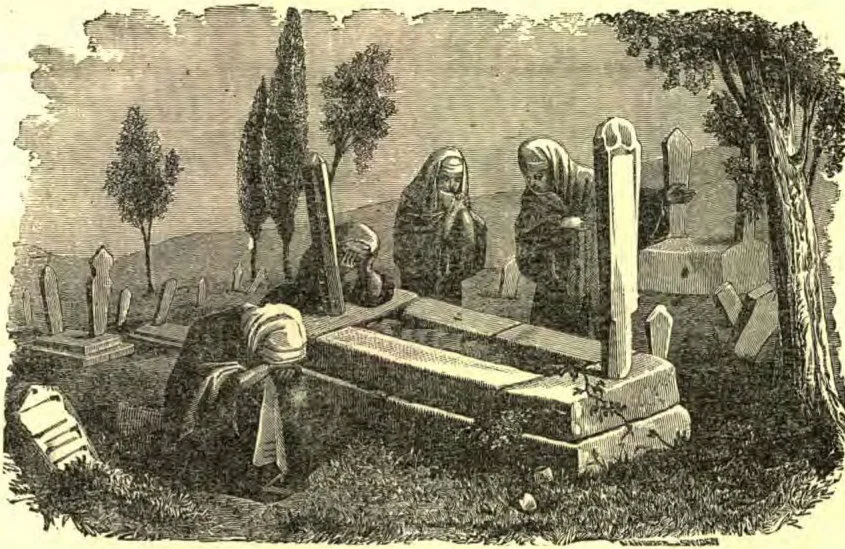
Here we have a scene in a Turkish burial-ground. To all appearances, a body has recently been deposited in one of the graves, around which the friends of the deceased have come to weep and mourn. As you behold their expressions of grief, your sympathy is aroused, for it would seem that such agonizing expressions must be caused by the deepest sorrow. But in this we may be mistaken; for we learn that it is the custom in that country for the women of a bereaved house to visit the grave every morning for many weeks after the funeral, and weep over it, whether their sorrow be real or not; and that, when they are not disposed to go and weep for them. Thus showing that it is not always genuine sorrow that causes them to weep, but that often it is for fear they will not be respected by their friends unless they keep up the appearance of great sorrow.
Although the custom of hiring mourners may seem strange, yet it is very ancient. Jeremiah says: “Call for the mourning women, that they may come, . . . . and take up a wailing for us;” showing that they were common in his day. Such mourners were often hired to attend the funeral to assist the relatives of the deceased in expressing their sorrow, and by their doleful tones and wailing to extort grief from those present.
Even the children in the streets through which the procession passed, often suspended their sports, and joined with equal sincerity in the lamentations. Hence our Saviour’s illustration: “Whereunto shall I liken this generation? It is like unto children sitting in the markets, and calling unto their fellows, and saying, We have piped unto you, and ye have not danced; we have mourned unto you, and ye have not lamented.”
A recent writer, speaking of these mourning women, said: “It is not necessary that they should know the family at all; money is all that is needed to start their tears, and tune their voices to the most doleful lamentations.”
Another common way in which the ancients expressed their grief was by rending their clothes. “In performing this ceremony,” says a Jewish writer, they take a knife, and holding the blade downward, give the upper garment a cut in the right side, and then rend it a hand’s breadth.” For a father or mother the rent is made on the left side, and in all the garments.
It was also customary in Scripture times to put earth upon the head as a sign of sorrow. The Benjamite who brought Eli the news of the death of his sons, came with “earth upon his head.” When the Israelites were defeated at Ai, Joshua and the elders “put dust upon their heads.” And when Job’s three friends mourned with him, they “sprinkled dust upon their heads toward heaven.”
In the British Museum there is a tombstone on which is a representation of a funeral procession, the mourners in which show their grief by throwing dust upon their heads. The Egyptians had an ancient tradition that their god Noum taught their fathers that they were but clay or dust. And the practice of putting dust on their heads is supposed to have been symbolical of their origin from dust, and to show their humility in view of that fact.
Many other signs of sorrow were employed by the ancients, such as fasting, shaving the head, plucking the hair, putting on sackcloth, smiting the breast, and cutting and lacerating the flesh, the latter being still practiced by the Arabs, Persians, and Abyssinians, also by the New Zealanders.
So it is; in all countries and in all ages, people have been called to mourn. It matters not how this is done, whether the grief is borne in silence and seclusion, or with loud acclamations and in public places; the loved ones are gone from us to return no more till the resurrection morn.
Dear readers, none of us know how soon we may be called to mourn for dear friends, or they to mourn for us. We are in the land of the dying. Change is written upon everything. Even the budding trees and the springing grass remind us of the time when they must wither and die as did those of the previous year. To-day only, is ours. Who of us will so improve it that we may be among the redeemed of the Lord, when they shall come unto Zion with songs and everlasting joy, and when “sorrow and mourning shall flee away.”
M. K. W.

WHO WILL BE THERE?

WHEN our earthly life is done, When our onward race is run, When all worldly hopes and pleasures Perish with its hoarded treasures, Shall we meet beyond the portal Of the heavenly kingdom fair? Shall we greet our friends immortal, Glorified and happy there? Shall we meet?
Will life's frail and rocking boat, That will hardly keep afloat On time's ever-shifting water, Reach the home of Him that bought her? Shall we, shall we ever enter The fair haven of that shore, Where ne'er comes the chill of winter, And the dwellers sin no more? Shall we gain Heaven?
Of our dearest friends below, Who've been called from earth to go, Who, oh! who will be in Heaven When the crown of life is given? When the fair immortals, meeting Round the vernal tree of life, Each exchange a heavenly greeting, Free from woe, and pain, and strife, Oh! who will be there?
—Selected.

NATURE'S LESSONS.

The “time of the singing of birds has come,” and beautiful spring again invites us forth to view the wonders she has wrought. Now the children will eagerly turn away from the bright fireside and the books that were such pleasant companions during the long winter evenings, to ramble in the woods and over the breezy hills.
Yet even now you may be learning. The lessons of wisdom are not contained alone in printed books, or taught only within the walls of human dwellings. There is hardly an object in nature that has not been used by the Divine Teacher to illustrate some sacred truth. The glorious sun, whose warm rays have so gladdened and beautified the face of nature, reminds us of Him who is the Sun of Righteousness. As we look up on a clear night and behold the heavens glittering with unnumbered hosts of stars, we remember the promise, “They that be wise shall shine as the brightness of the firmament, and they that turn many to righteousness, as the stars forever and ever.”
The budding trees, which tell us that summer is near, remind us also that the promised signs have been fulfilled, and our Saviour’s coming is at hand. The wild flowers, and the little birds in their glad songs, so happy, so free from care, teach us a lesson of our Heavenly Father’s love,—that He who clothes with beauty the flowers of the field, and feeds the birds of the air, will care much more for us.
The rose and the lily, the graceful vine, the sheltering rock, the apple-tree, with its springtime wealth of fragrant bloom, and its autumn treasures of ruddy fruit, the shepherd watching over his flock with tender care, the spotless lamb, perishing under the slayer’s knife,—all these and many other objects are used as symbols of our Redeemer.
As you see the farmer tilling the soil with care, and scattering the seed, remember that One is sowing good seed in the garden of your heart. The seed sown may be the holy impression made by a prayer, by a Sabbath-school lesson, by the word of God itself, by that “still, small voice” which speaks to our hearts, or by some other means. Let it be cherished; remove the weeds, the wrong habits and feelings that would choke it, let it not be caught away by sinful or thoughtless companions, and in the time of harvest you will reap a rich reward.
Sunlight and shadow, snow and rain, cold and heat, thorns and thistles, precious gems and worthless stubble, wheat and chaff, mountain and valley, the dust of the earth, the flying cloud, the falling leaf, the fleeting vapor,—all teach us lessons of heavenly truth. Learn from the word of God what these lessons are, young friends, and then, as you enjoy the beauties of nature so freely spread out before you, let your thoughts go up to nature’s God, and your hearts be warmed and gladdened by his love. M. A. D.

A THOUGHTLESS BOY PUNISHED.

I SHALL never forget, writes a correspondent of the Agriculturist, an incident of my childhood by which I was taught to be careful not to wound the feelings of the unfortunate. A number of school-boys were playing by the roadside one Saturday afternoon, when the stage-coach drove up to a neighboring tavern, and the passengers alighted. As usual, we gathered around to observe them. Among the number was an elderly man with a cane, who got out with much difficulty, and when on the ground he walked with the most curious contortions. His feet turned one way, his knees another, and his whole body looked as though the different members were independent of it and each other, and every one was making motions to suit itself. I unthinkingly shouted, “Look at that old rattle bones!” and the other boys took up the cry, with mocking laughter, while the poor man turned his head with an expression of pain which I can never forget. Just then, to my surprise and horror, my father came round the corner, and immediately stepped up to the stranger, shook his hand warmly, and assisted him to walk to our house, which was but a little distance.
I could enjoy no more play that afternoon, and when tea time came I would gladly have hid myself, but I knew that would be vain, so I went tremblingly into the sitting-room. To my great relief, the stranger did not recognize me, but remarked pleasantly to my father, as he introduced me, “Such a fine boy was surely worth saving.” How the words cut me to the heart! My father had often told me the story of a friend who had plunged into the river to save me as I was drowning, while an infant, and who, in consequence of a cold then taken, had been made a cripple by inflammatory rheumatism; and this was the man whom I had made the butt of ridicule.
I tell you, boys and girls, I would give many dollars to have the memory of that event taken away. If you are ever tempted as I was, remember that while no good can come of sport whereby the feelings of others are wounded, you may be laying up for yourselves painful recollections that will not leave you for a lifetime.—Sel.

ILLUSIONS OF THE AIR.

THE air sometimes presents strange optical illusions, such as mirage, etc.; but as these have been explained in the INSTRUCTOR, I will not dwell upon them. There is a remarkable appearance called the mariner’s light, or St. Elmo’s fire, that is frequently seen during storms at sea. Flames of fire play about the masts, and glide along the rigging of vessels; which superstitious sailors say is the spirit of St. Elmo holding a lighted candle. This light is no doubt caused by electricity in the air. Lightning, or electricity, assumes many different forms. In Iceland it often plays over the whole sky, making it seem on fire. It presents an alarming spectacle, but does no damage.
The currents of air display endless variety in velocity and force. In some countries the wind blows fiercely and almost constantly. Terrible hurricanes and storms occur in the ocean. Sometimes they are accompanied with so much electricity that the eyes of the sailors become dim; and their finger nails turn black, and remain so for weeks. The rush of fire balls through the air is often observable. They give intense light, and are accompanied with a hissing noise. Stones of great weight often fall to the earth. They are probably formed above the atmosphere. Some people think they come from volcanoes in the moon.
The rainbow is the most glorious vision of the air. The Hebrews called it the “Bow of God;” the Greeks, the “Daughter of Wonder.” The people of the North think it is a passage connecting heaven and earth, and they call it the “Bridge of the Gods.” We sometimes see a lunar rainbow, at night; but it is inferior in beauty to the solar rainbow. The rainbow is the sign of God’s covenant with man, and we know by that sign that water will never again cover the face of the earth. The contemplation of that radiant arch should lead us to adore its great Designer.
ELIZA H. MORTON.

A WARNING.

A MAN once took a piece of white cloth to a dyer, to have it dyed black. He was so pleased with the result that, after a time, he went back to him with a piece of black cloth, and asked to have it dyed white. But the dyer answered: “A piece of cloth is like a man’s reputation; it can be dyed black, but it cannot be made white again.”

Forgiveness and the Disposition to Forget

“I can forgive,” say some, “but I cannot forget.” Woe to us if God should make the same distinction. But forgiving, and a disposition to forget are the same. If the memory of an injury is cherished, it is not forgiven.

BIBLE LESSONS FOR YOUTH.

LESSON XLII.—REVIEW.

  1. WHAT were the children of Israel invited to build for the Lord?
  2. How was Moses charged to build this sanctuary?
  3. When had the Lord shown Moses this pattern?
  4. What were the dimensions of this tabernacle?
  5. Of what were the walls composed?
  6. How many coverings had it?
  7. Describe the inner covering.
  8. How many apartments had the sanctuary?
  9. How were they separated?
  10. What formed the east end of the tabernacle?
  11. How large was the court?
  12. How was it inclosed?
  13. What was the first apartment of the sanctuary called?
  14. What did it contain?
  15. Describe each of these vessels.
  16. For what was each used?
  17. What did the second apartment contain?
  18. Describe the ark.
  19. What did it contain?
  20. What vessels were placed in the court?
  21. Describe them.
  22. For what were they used?
  23. How was the sanctuary consecrated before the services commenced in it?
  24. Who were appointed to serve as priests?
  25. Who assisted the priests in the services and care of the sanctuary?
  26. What was offered each morning and evening?
  1. What was he who brought a sin-offering required to do?
  2. What did the priest do with some of the blood of the victim?
  3. What was thus done in figure?
  4. How and when were these sins removed?
  5. What was this ceremony called?
  6. What rested continually upon the tabernacle?
  7. What was done when this cloud or pillar was lifted from the tabernacle?
G. H. BELL.

MY EXPERIENCE IN READING SABBATH-SCHOOL STORY-BOOKS.

I remember very well when the little church at T— received its Sabbath-school library. How glad we were to have some books to read! I was then thirteen years of age, and enjoyed reading stories very much. The village school which I had long attended had become so corrupt that my mother, thinking it a place that should be shunned by the children of Seventh-day Adventists, wisely kept me at home. For the next two years I did not attend school at all. During this time I read many Sabbath-school books, as I had little else to occupy my time.
I not only read Sabbaths, but most of the time on other days if I could find anything to read. One book a week was not enough, so I borrowed from those who attended other schools. I felt perfectly at ease while reading these books because they were Sabbath-school books. I came to enjoy them so much that they were more to me than the company of young friends,—more than food, or sleep, or anything else. If anything troubled me, I soon forgot it in an interesting story-book. When I began a book I did not want to leave it until I had read it through. I thought of nothing around me, but entered right into the story, very often crying and laughing in company with some of the characters. By the time I had finished a book, I was really intoxicated; everything around me seemed to be a dream. These stories raised in me no high ambition of greatness or goodness, perhaps it would have been better if they had, but I simply read them because they satisfied my desire for story reading. I could no more see a good Sabbath-school story-book lying around, and not read it, than the drunkard could have a glass of liquor by him, and not taste it.
This fearful habit grew upon me until all sound reading became distasteful. My Instructor lost much of its interest unless there was some story in it. Sometimes I would begin on the first page, and read it through line by line just to say that I had read my paper, but this was not done when a Sabbath-school book could be had.
I soon began to enjoy the stories in the newspapers. I thought this all right, for they were just like the Sabbath-school stories, a little better if anything. I was not allowed to read such papers as the New York Weekly, the New York Ledger, etc.; but I wanted to, and the next step would have been dime novels, which have caused the ruin of so many.
Such light reading had its effect upon both mind and health. My course was stopped, however, by coming to Battle Creek, where the library was locked, and, being a stranger, I borrowed no books, consequently had none to read. After I began to attend school, I knew I could not have perfect lessons, and read so many books too; so I firmly resolved to let such reading rest, and up to this time, four years, I have not read more than three or four Sabbath-school books. I would not dare to read them for fear that love for light literature would overpower everything else.
During the last four years my health has been improving all the time, much to the surprise of some who thought I would not attend school long. The bad effect upon my mind has passed away in part, but not wholly. What has helped me most has been the study of the writings of the best English and American authors. They write for children as well as for older people, and what a pity it is that such light reading as is found in most of the Sabbath-school books should take the place of their writings!
There is very little choice between the condition of a person intoxicated with liquor, and of one intoxicated with light literature; the effects upon the mind are strikingly similar. I really believe that to-day I would have a healthier body, a stronger mind, and a greater love for God's holy teachings if I had never read a Sabbath-school story-book. EVA PERKINS.

THE SABBATH-SCHOOL.

FOURTH Sabbath in April.

LESSONS FOR CHILDREN.

LESSON XVI.—REVIEW.

  1. AFTER Joshua and all that generation died, what did the people do?
  2. How did the Lord deal with them?
  3. How did they show their gratitude for his kindness?
  4. Who was the first to judge Israel?
  5. Who was the next?
  6. From whom did this man deliver the Israelites?
  7. How did he take the life of the king of Moab?
  8. How did he make his escape?
  9. How did he afterward subdue the Moabites?
  10. What remarkable thing did Shamgar do?
  11. For how long a time did the land of Israel have rest after this?
  12. Who was their next oppressor?
  13. How long did he rule over them?
  14. Why did the Lord give his people into the hands of this wicked man?
  15. What did the cruelty of this king cause the people to do?
  16. Whom did the Lord then raise up to be a judge in Israel?
  17. How did she have wisdom to decide the difficult cases that were brought to her?
  18. What message did she send to Barak?
  19. What answer did he make?
  20. What reply did she send to him?
  21. Describe the battle at Mount Tabor.
  22. What was the fate of Jabin’s army?
  23. What was the fate of Sisera?
  24. Who afflicted the Israelites when they next did evil in the sight of the Lord?
  25. How long were they suffered to prevail against the people of God?
  26. What did the Midianites do every year about harvest time?
  27. How numerous were they?
  28. How did the Israelites keep out of the reach of these cruel enemies?
  29. By whom did God send the people a message, when they cried to him for deliverance?
  30. What did he tell them?
  31. Whom did the Lord choose to deliver his people at this time?
  32. Who was sent to talk with Gideon?
  33. Describe the interview between Gideon and the angel.

SPURGEON ON SABBATH-SCHOOLS.

MR. SPURGEON, in a speech at a Sabbath-school meeting held in Edinburgh, uttered some thoughts worth the consideration of parents and teachers:—
“If we do not teach the children, Satan will teach them. I have heard of a father who objected to teaching his child to pray. The child broke his leg, and while the leg was being taken off, he continued to curse and swear all the time. ‘See,’ said the physician, ‘you have a point of conscience about not teaching the child to pray; but Satan has no conscience about teaching him to swear.’
“I think that to make good Sabbath-school teachers, there must be thorough knowledge and appreciation in your souls of the things you have to teach. I was in Italy last year, and in crossing the Alps with my wife, the sun was so hot that it scorched her face. She asked me to get her some elder-flower water. I started off to a chemist’s, and as I did not know a word of the Italian language, I looked through the bottles and jars in his shop, but could not find anything of the kind. I tried to jabber something in French; but he did not understand me, because it was no language at all. I went down to a little brook that ran through the town, and walking along the edge, I came to an elder flower tree. I got a handful of flowers, walked off to the shop, and held it up to the man; and he knew in an instant what I meant. I think it is not easy to convey the gospel to the heart by merely talking of it; but if you can say by your own life, ‘This is the life of Christ, this is the joy of the Christian,’ you will be much more likely to make converts.
“The teacher who goes to his class thinking that he himself is always competent without preparation, is making, what I think, a gross mistake. It is well to preach without notes, no doubt; but a man who should preach purely extemporaneously, without thinking beforehand, would be an exceedingly dull and dry preacher.
“‘Would you believe it, Sandy,’ said a divine, ‘that I never thought of the sermon before I went to the pulpit?’
“‘Oh! that is exactly what Mr. Mackintosh and I have been saying while you were preaching.’
“Now, if Sabbath-school teachers pride themselves in their extemporaneous teaching, their pride is peculiar to themselves, and the children will not take much pride in them.”—Selected.

Four Classes of Readers, After Coleridge

Coleridge says there are four classes of readers. The first class is like the hour-glass—their reading begins on the sand; it runs in, and it runs out, leaving no vestige behind. A second is like the sponge, which imbibes everything, and returns it in the same state, only a little dirtier. A third is like a jelly bag, allowing all that is pure to pass away. The fourth is like the slave in the diamond mines of Golconda, who, casting aside all that is worthless, retains only pure gems

LETTER BUDGET.

Napa City, Cal.
Dear Instructor: I am a little boy six years old. I like to hear my parents read your pages. I keep the Sabbath with them, and attend Sabbath-school and meeting. We had a flood in Napa, and the water came into our house about a foot deep; but we put our trust in the Lord, and he cared for us. Yours truly, Jerome W. Myers.
Byers, Col.
Dear Editors: I am a little girl ten years old. I have three brothers and one sister. I do not attend school, but mamma teaches me at home. The first time I ever saw the Instructor, Mrs. Loughborough sent a copy to my mamma, and my papa sent right away for it for one year, with the book of poems, for my birthday present. I must close; so good-bye. Yours truly, Beulah B. Barnes.
Laingsburg, Mich.
Dear Editors: I am a reader of the Youth's Instructor. I took the monthly, but now take the weekly. I am not situated where I can go to Sabbath-school, but I read the paper and like it very much. I mean to be good, and do right, as the paper teaches. From a little friend eleven years of age. Ella A. Clarke.

A PLEASANT SIGHT.

FEW weeks since I saw a beautiful sight. Do you wonder what it was? You shall know. I entered a large sitting-room one fine Sabbath morning; the coal fire was blazing brightly in the grate, and the room seemed very cheerful and much like home; all this was pleasant, but a more beautiful sight met my gaze.
In the center of the room sat the father with a weekly INSTRUCTOR in his hand, teaching his three little children the lesson concerning the taking of the city of Ai by Joshua and the children of Israel. Do you remember of learning that lesson?
These children looked their father in the face, and paid the best of attention while he explained the lesson until they understood it, and then asked the questions until they could answer them and repeat the texts of Scripture referred to in the lesson. Then all seemed satisfied, and their little faces shone with the knowledge of the truth they had learned.
At family worship we all sang “Sweet Hour of Prayer,” and then, as we bowed in prayer, these little children all knelt down and were very still while prayer was offered.
This was right. I hope all the children who read the INSTRUCTOR sing and pray, and learn the Sabbath-school lessons. Do you love these things? If so, the Lord will bless you. S. H. LANE.

The Children's Corner.

SUNSHINE.

THE sunny hours of childhood, How pleasant, fresh, and bright! But, like the morning sunbeams, They quickly take their flight. O'er hearts that now are lightest, A cloud may soon arise, And faces that are brightest Be dimmed by tearful eyes.
If we would glow with gladness, And paths of pleasure trace, Then we, to banish sadness, Must gaze on Jesus' face. 'Tis sunshine to be dwelling Where all is light and love; And bliss, all thought excelling, To rest in Christ above.
He is the Sun and center Of Heaven's delightsome land; And blest are they who enter, And in his presence stand, The Lamb adoring, praising, Who once on earth was slain; To God the Father raising The ever-joyous strain.

FOR THE LITTLE FOLKS.

Many thanks, little friends, for your dear letters. Although but few appear in this week's paper, yet we are receiving quite a good many just now. Next week we shall be able to give you more room in the letter department. We are glad that so many feel an interest to write, and to try to make their letters interesting.
There is so much sameness, however, in some of the letters, that it prevents our using all of them. We would be glad to have every name appear in the “Letter Budget.” Therefore if your letters are not used in due course of time, make another effort. You will certainly succeed after awhile.
We feel encouraged that some, at least, are trying to heed the teachings of the INSTRUCTOR, and to become good and useful. We believe many of our readers will have homes in the new earth. What a blessed thought! We pray for all, and that all may choose that good part, which shall not be taken away from them. M. J. C.

A WALKING LEAF.

Not a quivering, or flying leaf, but a real, live, walking leaf, with feet and legs and everything that goes to make up a genuine insect. These leaf-insects are found in the Indian jungles, of every color, from the pale yellow of the opening bud, to the rich green of the full-grown leaf, and even the faded hues of the falling leaf. The imitation is not confined to shape and color, but the wings are veined and ribbed like a leaf, and the joints of the legs spread out into plaits, like half-opened leaflets. They lie flat on the ground, or on any smooth surface, their legs serving to drag them slowly along, and this flatness gives still more the appearance of a leaf. Even the eggs of these insects might easily be mistaken for the seeds of certain plants, so far is the resemblance to the plant world carried. Did mother Nature have a tender regard for the life and safety of this little creature when she adopted this cunning plan to preserve it from danger? Perhaps so: who knows?—Selected.

CURIOUS EXPERIMENT.

THERE is a small part of the eye that is shut out by blindness from seeing the beautiful things that the other parts enjoy. The following directions will enable any one to find it.
Shut your left eye, and with your right one look steadily at the cross below, holding the paper ten or twelve inches from the eye.
X                 O
Now move the paper slowly toward the eye, which must be kept fixed on the cross. At a certain distance the other figure—the letter O—will suddenly disappear; but if you bring the paper nearer, it will come again into view. You may not succeed in the experiment on the first trial, but with a little patience you can hardly fail; and the suddenness with which the black spot vanishes and re-appears is very striking.—Young Folk’s World.

WAITING TO GROW.

LITTLE white snowdrop, just waking up, Violet, daisy, and sweet buttercup! Think of the flowers that are under the snow, Waiting to grow!
And think what hosts of queer little seeds— Of flowers and mosses, of ferns and of weeds— Are under the leaves and under the snow, Waiting to grow!
Think of the roots getting ready to sprout, Reaching their slender, brown fingers about Under the ice and the leaves and the snow, Waiting to grow!
Only a month or a few weeks more Will they have to wait behind that door; Listen and watch and wait below— Waiting to grow!
Nothing so small, and hidden so well, That God will not find it, and presently tell His sun where to shine and his rain where to go, Helping them grow!

You have reached the end of this edition.

The Youth’s Instructor · Apr 16, 1879