The Youth’s Instructor, Vol. 36, No. 17.

FEATHERS AND MOSS AND A WISP OF HAY

The Youth’s Instructor

Apr 25, 1888

S. D. A. Publishing Association · Battle Creek, Mich. · Apr 25, 1888

“FEATHERS AND MOSS AND A WISP OF HAY.”

A BLUE-BIRD sang to his listening mate: “Feathers and moss and a wisp of hay: We’ll gather them early and gather them late; We’ll weave them in with the slender grasses; We’ll build our nest, and we will not wait ’Till the spring is o’er and the summer passes; That would be tempting fate.”
They worked and builded through golden May,— “Feathers and moss and a wisp of hay;” They gathered and threaded them in and out With tenderest care, and many a twitter Told of their joy as they flew about; “We’ll earn the sweet and leave the bitter And work through the glad spring day.”
The eggs were laid, and the blue-bird sang: “Feathers and moss and a wisp of hay: We’ve gathered them all, and the nest is swung High in the tree with the green leaves over.”
The song was sweet, and the whole woods rang With the happy lay, and the wind, the rover, Carried the song o’er the fields away.
A young maid heard it with glistening eyes: “Faithful to God I will be this day; I’ll serve the dear Master ’neath golden skies, Nor loiter and wait till the shades are falling; Bright bird, with your song you have made me wise!” And still through the meadows the birds are calling: “Feathers and moss and a wisp of hay.”
—Christian Weekly.

GAUTAMA, "THE ENLIGHTENED ONE."

ABOUT six centuries before Christ there lived in India a prince named Gautama.
He dwelt in a beautiful home, surrounded by well-watered rice fields, the pride of an Indian's heart; and always before his eyes loomed up the grand Himalayas, clear cut against the bright blue sky. He had kind friends, and wealth, and everything that is supposed to bring happiness; but they did not bring peace of mind to Gautama.
The old legends say that one day the prince was riding along with his charioteer, when he met a very old, broken-down man; at another time, he saw a person suffering from an incurable disease; and at another ride, he passed a decomposing corpse. Strangely moved at these sights, he asked his charioteer what it all meant; and the wise man told him that this was the fate of all human beings. Shortly after this, he met in his ride a hermit, whose calm and dignified manner was in such contrast to the misery he had formerly met, that he marveled at it, and inquired of the charioteer in regard to the cause.
Gautama thought much about these things; and when he saw that wealth and pleasure often brought sorrow and misery, he thought his present mode of life an unworthy one, and that he would do well if he should give up home and wealth, and live like the hermits. So he turned a poor monk, and spent many years in the forests and in solitary places in study and meditation. He offered many sacrifices, according to the religion of the times, and fasted long and often, till his brother monks thought him more holy than one of the gods. But nature revolted against these penances, and one day Gautama's bodily strength, his resolution, and his faith gave out together. When his disciples saw such signs of weakness on the part of so great a saint, they fell away, one by one, and sought other teachers.
Poor Gautama did not know what to do. He had found that wealth did not bring happiness; he had tried study and meditation, and was counted very wise, but that had not brought him the peace he desired; neither did his ascetic life, with the fastings, severe penances, and the sacrifices he offered to the gods. How attractive the loving home, and the wealth and power he had left, now looked to him! He would have found the sympathy of his friends very pleasant in this time of need, but they had all left him.
However, Gautama did not yield to the temptation to abandon his calling. He thought a great deal, and at last concluded that to reach happiness, one must conquer his mind, and subdue all evil passions. Then he thought he ought to go out into the world, and teach other people how to find peace. Gautama did not know about the true God or the Christ who was to die for the sins of the world; so of course he taught much that was wrong. He thought that life on the whole was a curse rather than a blessing, and that those who did evil would be born again into a new body, perhaps of some animal or a bird; but that those who did well would at last reach the paradise of rest, which simply meant that when they died, they would be as though they had never been. Gautama taught that if this paradise was to be reached, we must first become free from all impure thoughts; then from all revengeful feelings; then from all evil desires, from ignorance, from doubt, from heresy; and last of all, from all unkindness and vexation. “As even at the risk of her own life, a mother watches over her child, her only child, so let him (the saint) exert good-will without measure towards all beings.”
First a pure mind, and then right actions; for right actions spring from a mind freed from revenge and passion. It seems wonderful that in the midst of so much error and idolatry, Gautama should have discovered so great a truth.
Gautama had many disciples whom he taught in the winter time, or rainy season, and sent abroad in the summer to teach the people. Gautama was known by his title Buddha, meaning, the Enlightened One, and his followers are called Buddhists; they number to this day nearly one-third of the human race.
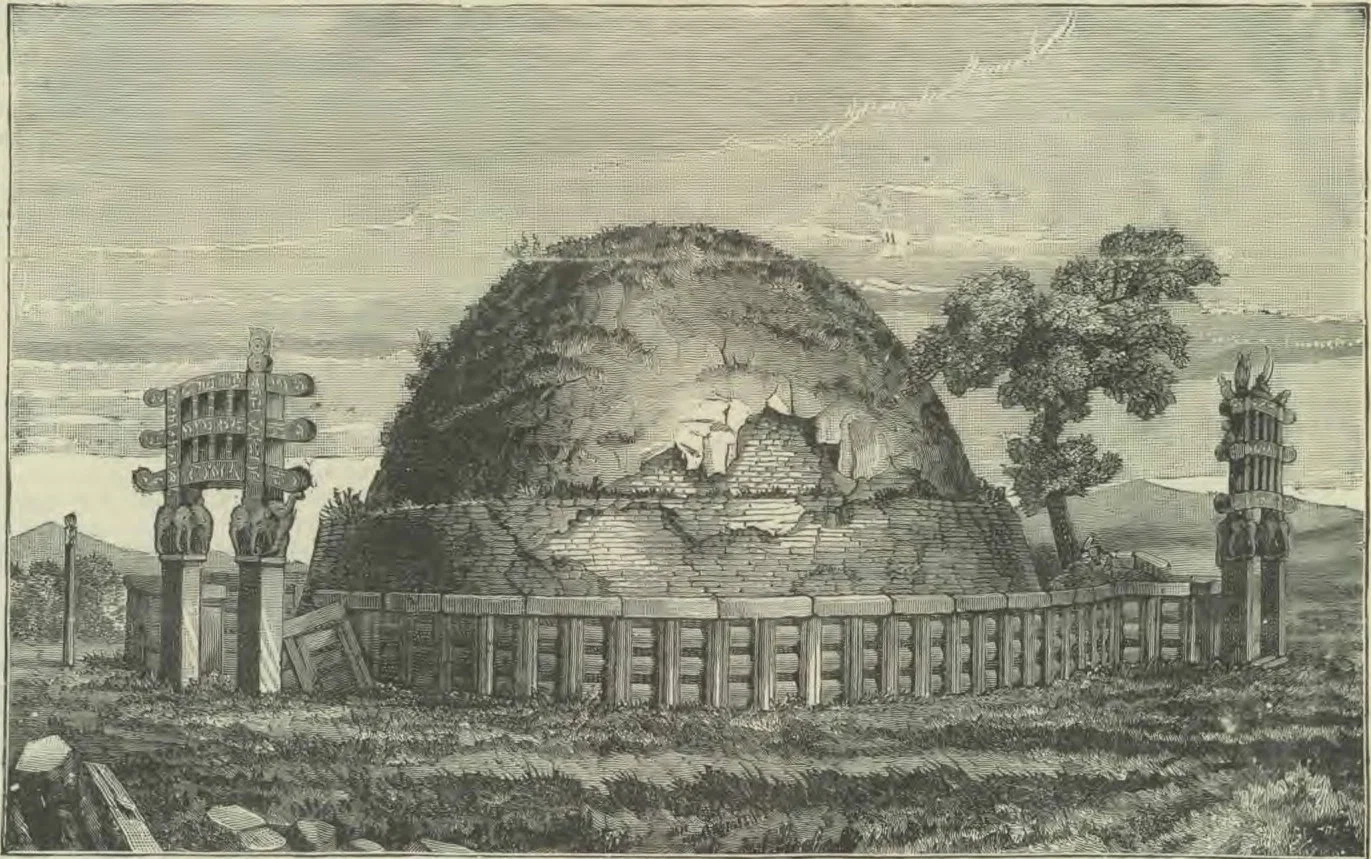
But Gautama's followers did not live out his doctrines so well after his death as they did during his life. They found it was much easier to worship Buddha as a god than to fight against the evil inclinations of their own hearts. Gautama's body was burned at his death, and his bones were distributed as relics among the people, who built topes for their preservation. The picture shows the famous tope of Sanchi, which is one hundred and six feet in diameter and fifty-six feet high. At its base is a terrace, upon which the worshipers could march. The tope is said to contain one of Buddha's bones and a lock of his hair, which were placed in a gold casket, and put in a cell in the centre of the tope. And these relics are worshiped by millions of pilgrims who visit the shrines.
W. E. L.

Too Busy for God's Work

“AND as thy servant was busy here and there, he was gone.” Such is the old and ever-repeated excuse for neglected duty. We were too busy to do the very thing which God’s business required. Each year finds us busy and planning to do great things. With all earnestness let us do the work which God sets for us, even if we neglect some things that the world requires, and inclination urges us to do.—Sel.

Contentment With Little

He who is not content with little is content with nothing.

WHAT MAKES IT RAIN?

How often on showery days little folks have asked themselves or their elders, “What makes it rain?” and how very seldom they have been able to get a satisfactory reply! Sometimes those who know have no time to tell, and oftener, those who have plenty of time do not find it quite convenient to explain. Let us sit down and talk it over, and see if we can discover, first, why it rains at all; and then, when it does rain, why it does not rain in the same way over the whole earth.
Did you ever stop to think, when you looked out of the window and saw dull, gray clouds from which the rain was so steadily pouring, and which seemed to shut in the world all around, that, in reality, they extended over a very small part of the country: that somewhere else, perhaps only twenty or thirty or a hundred miles away, the sun was shining, and all was bright and beautiful? This is really the case. For storms, however long and dreary, do not extend over many miles; and though it is always raining at some place in the world, yet always and at the same time it is pleasant somewhere else. Now, let us see why this is.
Suppose that on a warm summer afternoon we were to bring a pitcher of clear, cool water, fresh from the well, and to place it on the table in the dining-room. No matter how carefully we may have dried the pitcher before bringing it in, we shall discover, if we watch closely, that the outside soon becomes wet or misty; and that the mist grows heavier, and then gathers into drops, and perhaps even runs down the pitcher to the table. Now, where does all this water come from? Not through the sides of the pitcher, that is impossible; but from the air. We can not see it, perhaps, but still it is there, in the state of vapor. How came it there? Did you ever notice, after a rain, how in a short time the puddles became dry, and how the moisture disappeared from the grass and leaves, as soon as the sun shone out and the wind blew? Or did you ever notice that if you left a pan of water out-of-doors, the water each day grew less and less, until all was gone, and the pan was dry?
All the water that was in the puddles, on the grass and leaves (except that which was soaked into the ground), and in the pan, was taken up as vapor into the air—has “evaporated,” as we say. The same thing happens when water boils, only it then evaporates more rapidly, and we can see the vapor rising as steam. If you live near a river, or in a country where there are brooks, perhaps you can see this evaporation actually taking place. Get up early some morning, before the sun rises, and look out toward the river. You may see a long line of mist, or fog, like a big white cloud, hanging over the water. Now this mist is only the water evaporating from the river, and is just now visible as fog because the air is cool. After the sun has shone, the air becomes warmed, and the fog disappears, but the evaporation goes on, nevertheless. Indeed, it is going on continually, and all over the earth; so that if the water were not returned to us as rain, snow, and dew, all the oceans, lakes, and rivers would in time dry up and disappear. All the trees, grass, and plants would then wither, and our beautiful land would become as dry and parched as the great Desert of Sahara.
Having now learned how the water is drawn into the air, let us see how and why it comes down again as rain or snow or dew.
There is a singular thing about this moisture, which is this: the air will hold only a certain quantity of it, and that quantity depends upon the temperature of the air. But warm air always holds more than cold; so, however warm the air may be, or however much moisture it may contain as invisible vapor, we have only to cool it enough, and the vapor condenses, as we say; that is, it becomes visible, first as fog or mist, and then as drops of water, such as we see on the pitcher. And the reason we see a white fog rising at night, after the sun goes down, is only because the water, which has been evaporating all day, and going up into the air as invisible vapor, becomes condensed to fog by the cooling of the air when the sun’s heat is withdrawn. When the sun rises, the fog disappears; but the vapor still ascends, and when it reaches the altitudes where the air is always cool, it becomes condensed again as fog, only it is then called “clouds.” And if it becomes condensed enough to form in drops of water, they fall, and it “rains,” or, perhaps, it snows, for snow is but frozen rain.
Thus we have learned that rain is caused by the cooling and condensation of the moisture in the air. Bearing this in mind, let us study the surface of our country, and see why the rain does not fall equally on all parts of it, instead of falling very abundantly in some places, as in New England and some of the Gulf States, and very sparingly in many parts of the West, as in New Mexico and Arizona.
The winds which blow to this country from the south and the east, being warm, tropical winds, can hold much moisture, and are full of this invisible vapor of water, which they have taken up from the Gulf of Mexico and the ocean. Coming to the cooler land, they gradually become cooled. Their moisture, therefore, falls as rain while they pass over the land, till, by the time they reach western Kansas and Colorado, the moisture being gone, no more rain can fall. But the winds which come to this country from the north and the west are colder than the land, and, as they sweep over it, toward the south and east, they gradually become warmer; so that instead of giving up their moisture in the form of rain, they are constantly taking up moisture from the earth. It is for this reason that our north and west winds are dry winds, and mean fair weather; while the south and east winds bring rain. For this reason, also, the Eastern and Southern States have an abundance of rain, while the Central and Western States are often very dry.
And there is still another point to be considered. We already have noted the fact that at great heights the air is cooler. Hence, when a warm wind full of moisture comes blowing across the country and strikes a mountain range, it heads upward and rises high in the air to pass over. In so doing, it becomes cooled, giving up its moisture, and passes over to the other side a dry wind. It is for this reason that some islands, like the Hawaiian Islands in the Pacific Ocean, where the winds blow almost always from the same direction, are subject to almost continuous rain on one side, while on the other rain is exceedingly rare. This also shows why California, west of the Sierra Nevada mountains, receives sufficient rain to make the soil fit for cultivation; while Nevada, on the east, is nearly rainless and barren. The moisture coming from the south and east is all condensed by the Alleghany, the Rocky, and the Wahsatch ranges; while that from the west is cut off by the Sierras. Hence the great extent of country known to geologists as the Great Basin—which reaches from Oregon on the north to Mexico on the south, and from Colorado on the east to the Sierras on the west, comprising an area of not less than 200,500 square miles, which is nearly equal to the whole of France—receives over a great part of its surface an annual rainfall of not over four inches, and is therefore a desert.—Geo. P. Merrill, in April St. Nicholas.

A RHYME FOR A RAINY DAY.

WITH pitter-patter, pitter-patter, on my window-pane, Tapped chipper little visitors, the tiny drops of rain; They did not ask to enter, but in liquid tones I heard This story, which, as told to me, I tell you word for word:
“Within a cool, deep well we lived, quite happy, side by side, Until an empty bucket came, and asked us out to ride; Then springing in, away we went, drawn up into the air, And a pretty china pitcher stood waiting for us there.”
“Beneath that pitcher’s brim we thought much happiness to see, But soon a lump of ice popped in, with whom we can’t agree; For though Ice claimed relationship before it married Frost, With such a hard, cold-hearted thing all sympathy is lost.
“Ice tried to steal our heat away, but Air was on our side, And when it felt how cold we were, it just sat down and cried; You might have seen the tears upon the pitcher where they pressed, Till Ice itself was forced to melt, and mingle with the rest.
“But next I have to tell you of a most amazing thing,— Above a blazing fire we were made to sit and sing, Till Bubbles brought the message up, that Heat would set us free; When, boiling hard, we just steamed off, and gained our liberty!
“We bounded off with motion swift, but met a colder wind, Which blew so fast that everything grew cloudy to our mind. We cared not to go higher then, we felt a heavy chill, And down we came quite suddenly upon your window-sill.”
Now, little people everywhere, there is a saying old That “Truth lies at the bottom of the well;” and we make bold To say: Within this bucketful of water you may find Some grains of truth drawn up to store within each busy mind.
—Julia M. Colton, in St. Nicholas.

John Wesley as an Example of Total Abstinence

JOHN WESLEY was an eminent instance illustrating that total abstinence from strong drink promotes health and comfort, and better enables people to go through labor and toil without than with it. There never was a man that, throughout a long life, worked harder with body and mind than he did. No beer nor wine-drinking preacher in England ever preached so many sermons or traveled so many miles as this water-drinking man of God did.—Morning Dew-Drops.

KING SOLOMON.

Solomon's early life is remarkable on account of its beautiful associations. His father, David, calls him Solomon, that is, “the Peaceful One.” The 72d psalm, which David composed, is a figure of Christ's kingdom under the type of Solomon's reign. The prophet Nathan calls him Jedidiah, or “the Beloved of the Lord.” And when the God of heaven condescends to give Solomon anything he asks for, he modestly entreats for wisdom to govern his people. We catch another beautiful glimpse of him at the dedication of the temple, where, in the sight of all Israel, the noble young monarch, kneeling down, asks God to accept his handiwork. But how soon these beautiful visions pass! In a few years he departs from his God; and in the very shadow of that same temple, he offers sacrifices to the goddesses Ashtoreth and Chemosh, and participates in the cruel and murderous rites of the horrid Molech.
The book of Ecclesiastes is the wail of a misspent life. In it Solomon tells his own experience. He starts by asking the question, “What profit hath a man of all his labor?” He wants to find out how to do something that will satisfy his longing for happiness, and he goes on to enumerate the different ways by which he tried to secure such a desirable end. He does this, no doubt, to warn others from going the same road; for against all he places the sign, “Vanity of vanities.” If the wisest man that ever lived came to grief on these dangerous roads, what chance of escape will the ordinary mortal have, who follows in his footsteps?
First of all, he tried wisdom; said he, “Lo! I am come to great estate, and have gotten more wisdom than all they that have been before me in Jerusalem.” This was not egotism, but plain truth; for the Lord says the same thing. And surely no man ever approached Solomon in learning and knowledge. Whereas most men can master only one or two branches of learning, Solomon seems to have driven them all abreast. He was a great botanist, and was acquainted with all classes of vegetation, from the cedar of Lebanon to the hyssop that springeth out of the wall. He classified with precision all the flora and fauna of Palestine. He spake of natural history, treating on subjects varying from the behemoth to those feeble folk, the conies. He was a great poet, and wrote one thousand songs, of which only one remains; he also wrote three thousand proverbs, which cannot be improved upon, and are to this day considered the quintessence of common sense. But he grew tired of writing books, and even here failed to find that which his heart craved.
He then went a step lower, and tried to find happiness in pleasure. “Whatsoever his hands desired he kept not from them.” He builded houses, planted vineyards, and orchards, and beautiful gardens, and made artificial pools of water. He gathered to himself a harem of seven hundred princesses for his wives, and three hundred women as concubines. He collected a cellar of the choicest wines, and all his drinking vessels were of pure gold. He killed each day for his table, thirty oxen, and one hundred sheep, besides deer and fowl and other game. He had apes and peacocks brought from Tarshish to amuse his courtiers. But from this he at last turns away with loathing, and stamps it all as vanity.
He tried to find consolation in his wealth. He made gold to be in Jerusalem as the stones. His own private income was six hundred and thirty-six talents of gold, or nearly $50,000 a day. He had four thousand stalls of horses, attended by twelve thousand grooms. It took 100,000 men nearly thirteen years to build him a dwelling-house, whereas the same corps built the vast temple in but seven years. He built another magnificent palace for Pharaoh's daughter, and another for himself in the forest of Lebanon, in which he hung four hundred golden shields of three talents apiece, and built his celebrated ivory throne. So he goes on, but finally comes to the conclusion that the path of duty is the only road to happiness, and concludes, “Fear God and keep his commandments; for this is the whole duty of man.” And therein lies happiness.
The life of Solomon is one vast picture lesson; as in Christ we see how a man overcomes every temptation, so in Solomon we seem to be shown how a man fails at every point, and that, too, the wisest man that ever lived. And yet there are poor, foolish, feeble people who try to follow his footsteps, as if they could in any wise do better. His life is a testimony to the wisdom of Paul's admonition, “Be not unequally yoked together with unbelievers.” He formed a business partnership with Hiram, king of Tyre, and contracted a marriage alliance with Pharaoh's daughter; had he not done so, his heart might never have been stolen from God.
FRANK HOPE.

OLD TESTAMENT HISTORY.

LESSON 19.—THE CONSEQUENCE OF PLEASING GOD.

INTRODUCTION.—The last lesson detailed the circumstances of the sale of Joseph by his brethren to the Midianite merchants. The present lesson follows him into Egypt, and acquaints us with his manner of life, general conduct, trials, and particularly the severe temptation he was subjected to while a servant under Pharaoh, and his noble resistance, and what came of it. The distance from the place where Joseph was sold by his brethren, to the home of the Egyptian king whose servant he became, was 250 or 300 miles. The incident of Joseph’s temptation occurred when he was about 27 years old, and his resistance is a striking testimonial of his unswerving integrity and virtue, and his firm reliance upon God, although surrounded for so many years by idolatrous influences and wicked companions.

ANALYSIS.

I. Joseph Sold—
  1. To whom?
  2. At what age?
  3. Where taken?
II. Joseph’s life in the house of Pharaoh.
  1. His conduct and service.
  2. Results of the same to himself and Pharaoh.
  3. Joseph’s temptation—
a. How endured? b. Revenge taken by Potiphar’s wife. c. Results to Joseph of his resistance. 4. Joseph’s source of strength and help.
III. Practical Applications—
  1. Manner of enduring persecution and injustice.
  2. Value of faithfulness in duty and trust in God.
  3. Necessity and manner of resisting temptation.
  4. Treatment the righteous may expect from the wicked.

QUESTIONS.

  1. To whom did Joseph’s brethren sell him? Gen. 37: 28.
  2. What did the Midianites do with him? Verse 36.
  3. Who was with Joseph in this strange land? Gen. 39: 2; Acts 7: 9.
  4. What was the consequence to Joseph of the Lord’s being with him? Gen. 39: 3, 4; Acts 7: 9, 10.
  5. What was the result to Potiphar from having a godly man in his house? Gen. 39: 5.
  6. How much responsibility was placed upon Joseph? Verse 6.
  7. How old was Joseph when he was sold into Egypt?—Seventeen years. Gen. 37: 2.
  8. When he was strongly tempted in Potiphar’s house, what noble stand did he take? Gen. 39: 8, 9.
  9. Did he stand firm to this resolution? Verse 10.
  10. What was the immediate result of his upright conduct? Verses 19, 20; read also verses 11–18.
  11. Who was with Joseph still? Verse 21.
  12. What can always be said by one who has the Lord for a companion? Ps. 23.
  13. How was this verified in Joseph’s case? Gen. 39: 21.
  14. What trust was committed to Joseph in the prison? Verse 22.
  15. Why was this? Verse 23.
  16. What scripture was fulfilled in Joseph’s case? Prov. 16: 7.

PRACTICAL NOTES.

Gen. 39: 2: “The Lord was with Joseph.” “Joseph was not only favored with the comforting presence of the Lord, and with seasons of peculiarly sweet communion with him, but he was so remarkably furnished with wisdom from above, and prospered in all his undertakings, that it was evident, even to Potiphar himself, that the Lord was with him, assisting and succeeding them. Thus, though a slave, he was had in reputation; and being diligent in his business, he became a favorite with his master, who greatly countenanced and confided in him.”—Scott.
Verse 3: “And his master saw that the Lord was with him.” “The prosperity of Joseph was manifest. The blessing of God upon his labors was so conspicuous, that his master himself observed and acknowledged it. It is not probably to be understood that Potiphar knew God by the name of Jehovah, or called him so. But he saw that Joseph was the object of supernatural care and favor; and this Moses, not Potiphar, ascribes to its true source. He prospered because Jehovah, and not any imaginary deity, blessed him. This is a circumstance not a little to Joseph’s credit, inasmuch as it implies that he made no secret of his religion. Had he dissembled on this score, had he disguised his real faith, and apparently countenanced the Egyptian idolatries, he certainly could not have looked for those tokens of the divine favor which he received. We must suppose, therefore, that he firmly, though probably without ostentation, avowed himself a worshiper of Jehovah, and as his conduct in every other respect was perfectly exemplary and satisfactory to Potiphar, he made no objection to it. . . . The circumstances are, moreover, an admonition to all Christians to be faithful to their heavenly Master, even when there are no religious friends about them to watch over them.”—Bush.
It is especially incumbent upon God’s true people, who are surrounded by those whose religious faith and practice are materially different, to lead such a consistent and exemplary life as will recommend their religion to their neighbors. They should avoid being unnecessarily conspicuous in consequence of peculiarities of faith or practice, and at the same time they should not sacrifice principle, or stultify themselves by seeming to countenance false worship, or by approving of wickedness. Their consistent and exemplary lives should be a continual rebuke to wrong doers, and a recommendation of the right way.
Verse 5: “The Lord blessed the Egyptian’s house for Joseph’s sake.” “God favored his master, though an Egyptian, a stranger to the true God, for Joseph’s sake; and he himself, like Laban, soon learned it by experience. Chap. 30: 27. Good men are the blessings of the places where they live; even good servants may be so.”—Comprehensive Commentary.
Of Joseph’s temptation, and the manner in which he resisted it, Dr. Thomas Scott well says: “Let us not, however, rest satisfied with admiring Joseph in the honorable victory he acquired, but consider him as a bright example proposed to our imitation, and an illustrious proof of the energy of divine grace. Trusting to that grace, we may hope to be more than conquerors, not only if exposed to the fiery trial of persecution, but even if assaulted in this far more dangerous manner. But, would we stand steadfast in the day of trial, we must have our minds armed with gratitude, justice, the fear of God, faith, love, the abhorrence of evil, contempt of worldly pleasure or gain, and readiness for the cross; we must learn also to judge of every sin, and of licentious indulgences especially, not in the slight manner of the world, but as enormous crimes, ‘for the sake of which the wrath of God cometh on the children of disobedience.’ And, that importunity may not prevail over us, nor secrecy encourage us, we should endeavor to have our minds habitually possessed with a sense of our obligations unto God, his all-seeing eye upon us, and the approaching discoveries of the day of judgment.”—Scott.
On the co-incidence of Joseph’s losing his garment, Bishop Hall remarks: “This second time is Joseph stripped of his garment; before in the violence of envy, now of lust; before of necessity, now of choice; before to deceive his father, now his master, for, behold the pledge of his fidelity, which he left in those wicked hands, is made an evidence against him of that which he refused to do. Therefore did he leave his cloak, because he would not do that of which he is accused and condemned, because he left it. What safety is there against great adversaries, when even arguments of innocence are used to convince of evil?”
Hereby may we learn what wretched injustice and unfairness the righteous must expect to suffer at the hands of their persecutors. Happy will it be for them if they can bear all with the same fortitude shown by the brave and noble Joseph.
“It is far better, if the will of God be so, that we suffer for well-doing, than for evil-doing. A clear conscience and the presence of a merciful God, will support us, not only under our trials, but under the most injurious calamities; and we need not use much labor to vindicate ourselves, for in due time the Lord will vindicate us, and clear off every aspersion. The more meekly and patiently we suffer, the less bitterness shall we experience in our trials, and the more consistent will our conduct be with the Christian character. By all these things, the Lord is training up his people for glory—perhaps for better scenes and important services in this present world. And if we are not in a wrong spirit, or out of the path of duty, we can never be out of the way of either comfort or usefulness. But let us not forget, through Joseph, to look unto Jesus, who suffered being tempted, yet without sin; who was calumniated and persecuted, but without cause.”—Scott.

MARS, THE RED PLANET.

The planet Mars now takes on his most interesting aspect. He is in opposition with the sun on April 11th, when he is opposite the sun, as the word signifies, rising at sunset and setting at sunrise. He is at that time at his nearest point to the earth, for our planet is directly between him and the sun. Mars at opposition, and for two weeks before and after, is most favorably situated for observation either with the telescope or with the unaided eye. If discoveries are made concerning him, they will occur when he is at or near this epoch in his course.
Mars is probably the only planet whose real surface is visible from the earth. An ordinary observer, looking at our celestial neighbor through a good telescope, will behold a fiery red sphere of dazzling brightness, with light and dark markings. But practiced astronomers will see much more. They see zones of brilliant white around each pole, that in their view are due to collections of snow or ice. The light and dark markings are continents and oceans. The surface is more diversified than that of the earth, while the oceans are long, narrow seas that look like canals, seeming in many cases to have a division in the center. Martian observers are directing attention to these double canals, hoping at every opposition to find a solution of the mystery. No explanation of the red color of the planet has yet been found, unless it be that vegetation there is red, as with us it is green. Unfortunately, we cannot visit our outer neighbor, to find out if the earth shines in his sky as a green star! The oppositions of Mars are therefore of much importance to terrestrial observers. They occur at comparatively long intervals; for two years and fifty days must pass, when Mars is in opposition, before he comes round to opposition again.
Mars moves in an orbit of great ellipticity, and is at some times much nearer us than at others. If this epoch occur when he is at his least, and the earth is at her greatest distance from the sun, the planets are as near as possible, only thirty-four million miles apart. The last time this occurred was in 1877; when the two moons were discovered. The next time it will occur is in 1892.
Mars may be seen in the southeastern sky, early in the evening, being easily recognized by his ruddy glow. He is not alone, but is preceded on the south-west by a companion star of silvery whiteness, known as Spica, one of the suns of the first class or highest order, whose pristine brilliancy has as yet known no diminution. Mars is near Spica on April 11th, and meets and passes the star on the 14th.—Exchange.

THE WORLD'S SEVEN BIBLES.

THE seven Bibles of the world are the Koran of the Mohammedans, the Eddas of the Scandinavians, the Try Pitikes of the Buddhists, the Five Kings of the Chinese, the three Vedas of the Hindoos, the Zendavesta, and the Scriptures of the Christians. The Koran is the most recent of the seven Bibles, and not older than the seventh century of our era. It is a compound of quotations from the Old and New Testaments, the Talmud, and the Gospel of St. Barnabas. The Eddas of the Scandinavians were first published in the fourteenth century. The Pitikes of the Buddhists contain sublime morals and pure aspirations, but their author lived and died in the sixth century before Christ. There is nothing of excellence in these sacred books not found in the Bible. The sacred writings of the Chinese are called the Five Kings, king meaning web of cloth, or the warp that keeps the threads in their place. They contain the best sayings of the best sages on the ethico-political duties of life. These sayings cannot be traced to a period higher than the eleventh century B. C. The three Vedas are the most ancient books of the Hindoos, and it is the opinion of Max Muller, Wilson Johnson, and Whitney, that they are not older than eleven centuries B. C. The Zendavesta of the Persians is the grandest of all the sacred books next to our Bible. Zoroaster, whose sayings it contains, was born in the twelfth century B. C. Moses lived and wrote his Pentateuch fifteen centuries B. C., and therefore has a clear margin of 300 years older than the most ancient of the other sacred writings.—Selected.

ELECTRIC SUNSTROKE.

It has been recently stated, in a paper read before the French Society of Surgeons, that workmen operating electric forges at Creusot are subject to an affection resembling sunstroke, which is evidently due to the powerful light proceeding from the focus of the forge. Ordinary electric lights are incapable of producing such an effect, not being sufficiently intense; but these forges emit a glare of almost inconceivable brilliancy. The first effect upon the men is frequently to be noted after two or three hours' work. They complain of pains in the head, neck, and forehead, and the skin changes from its original color to a reddish brown. In spite of their care in shielding the eyes with dark glasses, the sight is affected to such an extent that, for some minutes after ceasing work, and beginning to view objects by common daylight, the operatives are wholly blind; perfect vision is seldom restored under an hour's time. The eyes are inflamed, and affected by that painful irritation which accompanies the presence of a foreign substance under the lids. A constant flow of tears is kept up for twenty-four hours, during which time the patient is also afflicted with insomnia. During the following days, the skin peels from the face and neck, leaving the surface of a deep red color, which possibly fades away about the fifth day. None of these symptoms spring from the effect of heat upon the brain, but are due entirely to that of light.—Companion.
Continue reading: HOW MATTIE PUNISHED HERSELF