The Youth’s Instructor, Vol. 38, No. 24.

BE HIS THE PRAISE

The Youth’s Instructor

Jun 11, 1890

S. D. A. Publishing Association · Battle Creek, Mich. · Jun 11, 1890

BE HIS THE PRAISE.

ONCE more the sunny colt's-foot shoots Rare blossoms from its knotted roots, And the small wrens, with cheerful lay, Make music to the dawning day. Tamed by the frost, the rough, brown land Thrills to the Master's shaping hand. And earth and air one chorus raise— Be His the praise! Be His the praise!
The Word, in old time charged with awe, Quickens in Nature's tireless law; New forces wake, new pulses beat With odor, color, movement, heat: In endless forms, through endless voices, She laughs, exults, expands, rejoices, Till hearts their answering homage raise— Be His the praise! Be His the praise!
—The Congregationalist.

LACE WINGS.

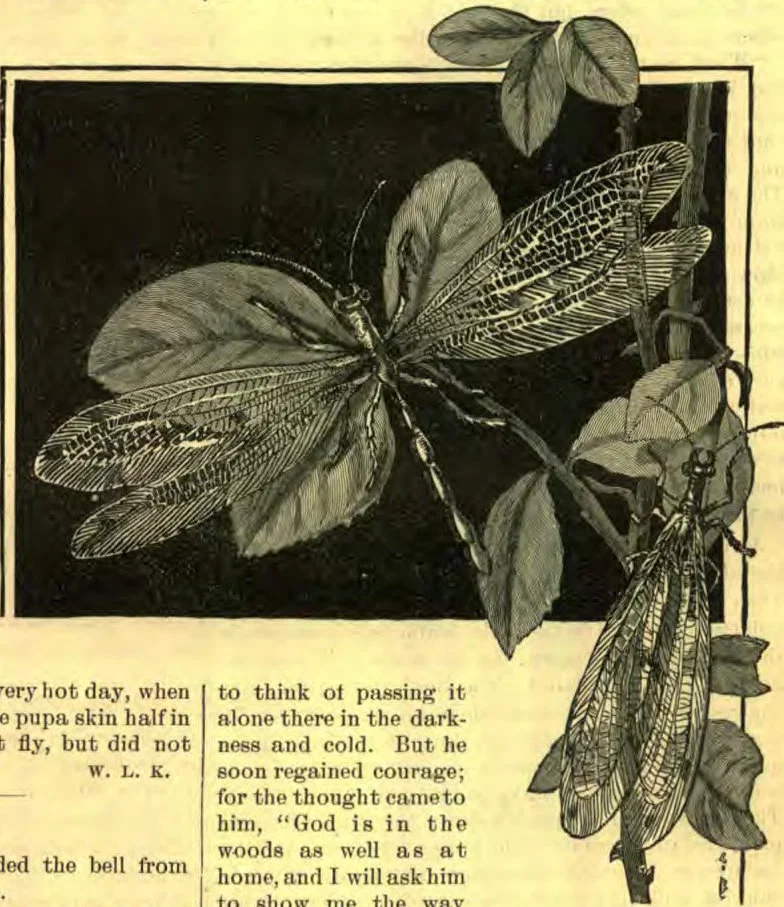
LACE WINGS is the name of the little insect shown in the picture on this page. He is often called the ant-lion, or, if a more scientific name is wished, Myrmeleon. The ant-lion, in its perfect state, much resembles a small dragon-fly, and has good power of flight. It goes through all the changes incident to insect life, from the egg, the pupa, and the larva, to the perfect insect.
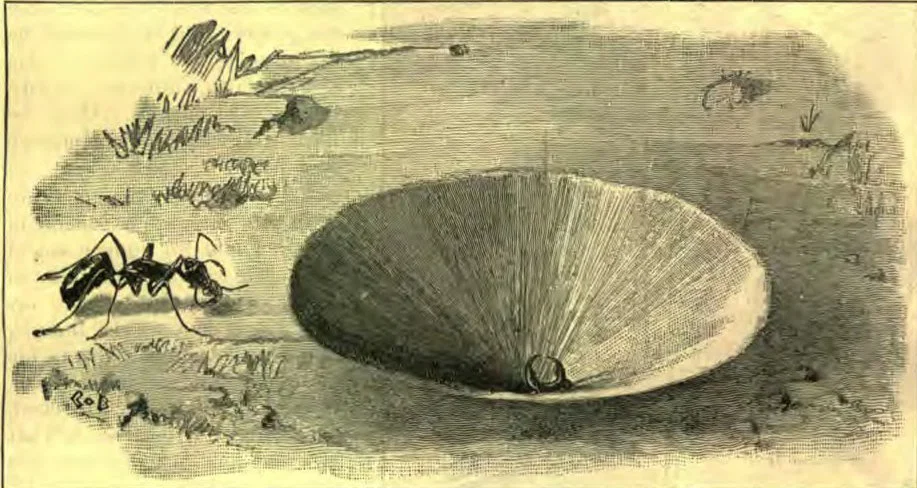
It is while in the larva stage that the habits of the ant-lion attract the most attention, for it has a singular way of gaining a livelihood. As it has feeble powers of locomotion, it resorts to artifice to capture its prey. The ant-lion deftly digs a pit, two inches in diameter and one inch deep, first striking a circle and then throwing the sand from the center, always far enough out to avoid making a ridge around the edge of the pit. This he is enabled to do by means of his flat head and jaws, which he pushes under several grains of sand, and jerking backward, throws them into the air.
When the pit is finished, the ant-lion stations himself at the bottom, entirely concealing himself, except his jaws, as is shown in the picture, and there he awaits some unwary insect. The sides of the pit have been made as steep as sand can be piled up, and the slightest movement at the top sends a small avalanche of sand down to notify the ant-lion of an intruder.
The ant-lion at once begins to throw out sand and deepen the pit, thus blinding the insect, and causing it to slide down the steep walls to meet grim fate. The captor seizes it, and holding it above his head, sucks out its blood; then, throwing the dead body out of its hole, it seeks to repair damages.
A naturalist gives the following account of the habits of an ant-lion which he had in captivity:—
“After eating, he became more timid, and sometimes would not take a second insect. If, however, several were put into the pit at once, he would bite one after another until all were killed, before deciding on which to begin. I fed him two or three times a week, usually with house-flies, cutting their wings off, and letting him take them in his own way. In October, having occasion to travel some distance, I put him in an ounce bottle half filled with sand, corked him up, and carried him with me in my bag. In about a week I gave him a large house-fly, which he did not catch, not having room enough to make a pit-fall. I gave him no more food till the next March. . . .”
About the first of March, when flies began to be plenty, I commenced to feed him again. He found it rather awkward to catch insects in the bottle, as there was not room enough to make a pitfall, and his inability to move forward made it hard for him to seize an insect, unless he met it directly between his jaws. He soon, however, made pitfalls half an inch in diameter, which answered the purpose.
“Sometimes he lay on the surface of the sand, with a few grains scattered over his back to conceal him from notice, and his jaws extended on the surface. If a fly was put into the bottle, it would circle around it, close to the glass, and usually run over the ant-lion’s back. He would jerk up his head and attempt to seize it, which he seldom succeeded in doing the first time. If he caught a leg or a wing, he was unable to move nearer, and shorten his hold, and the fly escaped. He would often throw up the sand, and try to undermine the fly. He would sometimes work an hour in these ways before the fly would get into a favorable position. I fed him every day or two until May 15th, when he spun a spherical cocoon around him, and remained inclosed until June 26th, a very hot day, when he came partly out, and leaving the pupa skin half in the cocoon, appeared as a perfect fly, but did not spread his wings completely.” W. L. K.

HARRY'S TRUST.

“Ding-dong! ding-dong!” sounded the bell from the door of our village school-house.
The boys rushed in, glowing with exercise, and resumed their places at their studies.
“Where is Harry?” asked the teacher, as his eye fell upon the vacant seat. None of them could answer; but little Johnnie Lee, who came in panting at this moment, exclaimed, “Harry is in the woods, sir. We were playing ‘deer,’ and I was the ‘hound,’ and I’ve chased Harry so far into the woods I’m ’fraid he’s lost.”
The boys all laughed at Johnnie’s excited manner, and the teacher dispatched two of the larger boys to capture the stray “deer.” Harry had indeed become bewildered, and lost his way in the woods; and when, a full hour later, the boys returned, giving an account of a fruitless search, the teacher was himself alarmed; for the body of woods that joined the play-ground was miles in extent, and a little boy might easily go astray in them.
The teacher immediately dismissed the school, and the children, scattering in every direction, commenced their shouts of “Harry! Harry!” while Mr. Long took the heavy bell that he used for calling the school together, and going into the thickest of the woods, sent its peals echoing far and wide. The search party was soon joined by the neighbors, but no little Harry could they find.
Where was Harry all this time? For awhile he had gone springing through the woods with great agility, fancying the “hound” was close upon his track; but he suddenly became conscious that the voices of his schoolfellows had died away in the distance, and that he was alone in the great forest.
Bewildered and frightened, he turned in every direction, but he knew not which was the right way to seek for home. All the anxious hours his friends were seeking for him, he was wandering farther and farther from them. No path in all the dense woods appeared to help him out. After much weary wandering, he found himself in a deep hollow, where, disheartened and hopeless, he sank down upon the dry leaves, and began to cry; for the long night was coming on, and it was dreadful to think of passing it alone there in the darkness and cold. But he soon regained courage; for the thought came to him, “God is in the woods as well as at home, and I will ask him to show me the way out.” So he knelt upon the dry leaves, and prayed to the heavenly Father, asking him to guide him through the woods, and permit him to see his home again.
He arose from his knees and looked around on all sides of the hollow. It was one mass of tanglewood; but “God will show me,” he kept saying, “God will show me,” and pushing up one side through the thick underbrush, he suddenly struck a path. How happy he was now! and still more so, when, on following it a short distance, it led him into a well-defined wood road. He traveled on cheerily for three miles through the thick woods. His prayer, he felt sure, had gained a hearing, and his trust was strong. Suddenly the road merged into the wide country road, and the welcome sight of a friendly village greeted him. He had often been there before, and knew that another mile would bring him to the railroad station. He hastened on, and reached the station just as a train was ready to start. When he told his story to the conductor, he kindly allowed him a seat in the car, and Harry was soon on his way back to his home and his anxious friends.
Do you ever think, dear children, that in passing through this world there is much danger of getting into blind paths that lead us into the deep tanglewood of sin? Oh, how sad it is to get one side from the path of life; but unto every one who does so, the kind Father saith, “Call upon me in the day of trouble;” and again, “I will show you the path of life.” And when we have called upon him, we may trust to his friendly hand to lead us into “ways of pleasantness” and “paths of peace.”—L. F. Bourne.

ROUND THE WORLD.—16.

FROM SOUTH AFRICA TO CEYLON.
At Port Durban, Natal, on the 11th of January, the steam is hissing through the valves from the engine-room of the steamship Umtata. Her cables are hauled in and coiled on the windlasses, and all is ready for sea. She is bound for Calcutta, the great metropolis of India. Her hull stands high out of the water, as she goes in ballast, having no cargo, only a little sand to hold her steady in the water. The owner expects her to come back in three months, freighted with coolies, to supply the demand for labor in the growing colony. The captain mounts the bridge, and the pilot comes aboard. A few minutes later, and the tale-teller rings out, “Stand by,” and almost immediately after, “Half speed ahead.” The steam hisses louder than before, but the cylinders do not move, and the propeller refuses to turn. “What is the matter?” is the question on every lip; but nobody seems to know, when the chief engineer comes on deck, and informs the managers that there is something in the high pressure cylinder, and that they will have to “lie by” till morning. The order is given to make fast, and all not on duty soon “turn in” to their bunks, wondering if the “old kettles,” as a sailor derisively terms the boilers, will blow up; for mariners of the old school, accustomed to set the white wings of their craft, and go as the breeze will blow them, look down with a sort of conservative pride and lordly disdain upon the science of modern days, which sends ships through the water, whether Neptune wills it or not. But there is nothing to break the stillness of the dark watches save the sound of the engineers’ and firemen’s hammers, as they labor patiently to take the cylinder to pieces and rectify the defect.
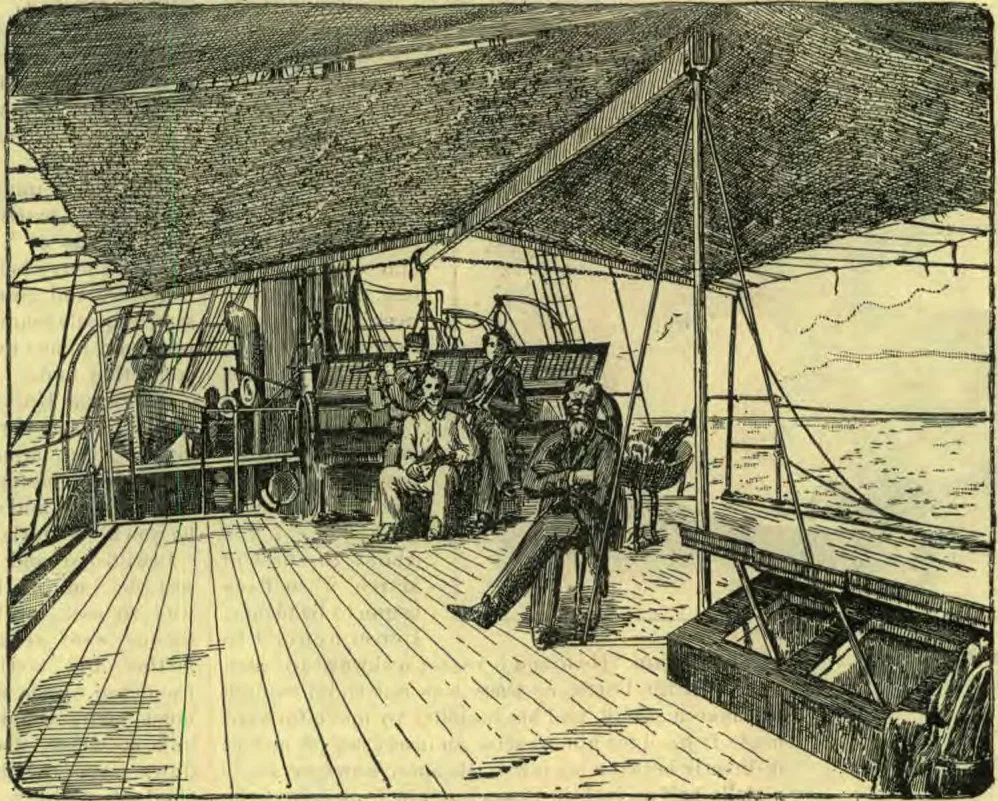
“UMTATA” QUARTER DECK IN THE TROPICS.
At early dawn we are awakened by the grating of the cables, as they are drawn through the hawse pipes. Then there is a trembling vibration, and the ship quivers from deck to keel; the water is stirred into a thick foam at the stern, for the screw is in motion, and the good ship is off. The sun is just rising, and the vessels at anchor as yet show no signs of life. It would be hard to realize anything more sleepy-looking than a number of vessels in port at early dawn, before the stevedores have commenced their labors. The Umtata glides quickly down the Bluff Channel, past the great white light-house, and out to the anchorage. The tale-teller rings once again, steam is shut off, and the pilot descends a rope ladder into his boat, and with a “Good-by,” and “Wish you a pleasant voyage,” his men bend to their oars, and the Umtata puts to sea. When well away from the land, which soon fades in the distance, her head is turned, and a straight course is steered to the northward, up the Mozambique Channel.
Life at sea varies almost as much as on land, according to the place and the people. It is almost like being in two different spheres, to take a trip on a large ocean “liner,” and then another in a tramp boat, built for freight and not passengers. In the one the cold, stiff rules of society prevail almost as much as ashore, excepting that as people grow seasick, they generally become confidential. In this class of boats there are many passengers who have never been to sea before, or away from their native land,—young men just starting out in life to seek a home and fortune in foreign climes. But those who travel in vessels of the latter description are mostly men who have seen the world, and are as much at home afloat as ashore, and know how to make themselves comfortable and to pass away time on board.
There were only two passengers on the Umtata besides the doctor and his assistant, who were going out to take charge of the coolies on the home trip. Head winds and heavy seas made slow running for a few days, but as the ship neared the head of the channel, the weather moderated. On January 19, we passed between two small islands known on the marine charts as Joanna and Mayotta. There are no inhabitants on them, save some black fishermen. Once past them, we are in the Indian Ocean. There are many of these islands in the Indian and Pacific Oceans, some of them having no inhabitants at all. On many of them the British government has placed goats, and in a cave with a conspicuous landmark, left provisions, so that if a vessel is wrecked or cast ashore, her seamen will not perish.
For the greater part of the voyage, the sea was as smooth as a mill-pond. It looked like one great sheet of glass, more smooth than many of the little lakes that dot the surface of North America. After leaving the land, we passed but one ship; that was on January 22, and she was at quite a distance from us. A sail in the offing causes great excitement at sea, when one has not been sighted for a long time. Every one is on the bridge, and telescopes and opera glasses are in demand. Four flags were run up her main mast halyard, which were made out to be M S N J. This was the official number of her name, which we found to be the Malba. We ran up our’s, and then watched to see if they would speak us again. Up went three more flags, B W F, which means, “Any news?” But as we did not happen to have the morning papers, we put D on our halyards, which means “no.”
One day we lay to for awhile, to clean the salt out of the boilers, and while thus delayed, amused ourselves fishing for sharks. One came alongside, and a piece of fat pork on a grappling hook was let down for his dinner. But he was too wary, and would not bite, although he kept swimming around it. The weather is delightful. Under the awnings one can lie at ease, and enjoy the cool, crisping breezes which hover around the bosom of the ocean, and as they dance along, seem to keep music with their invisible feet. Glowing and varied are the hues which the waves take from the rosy clouds, while the sunsets are of that perfect nature read of in books, but seldom witnessed except in these seas. On a moonlight night it is pleasant to sit on deck, and often the question goes round, “Who wouldn’t sell a farm and go to sea?”
When it rains in the tropics, the water comes down in sheets; a black line is seen on the horizon, and before there is time to do anything but run from the deck to the cabin, the squall is down. This is the unpleasant part of traveling in these seas, as all the ports and skylights must be kept closed, and the heat is almost suffocating. In hot weather, when it is dry, no one thinks of sleeping below; a hammock or a cushion on the deck is all that is necessary to make life comfortable.
As the ship passed directly under the sun, we can say that there has been a time in our lives when we have been without a shadow. On the last day of January the skipper said he could smell the spices blowing off from the coast of Ceylon, but the rest of us failed to detect anything unusual. In the night, however, we awakened, rubbed our eyes, and beheld in the distance the light-house, which was the beacon of the small port of Point de Galle. P. T. M.

TO TAME A BIRD.

No creature is more jealous or sensitive than a bird, says Olive Thorne Miller. It is easy, however, to win the heart of almost any bird, and without starving him or making him think he has mastered you. Simply talk to him a good deal. Place his cage near you on your desk or work-table, and retain his choicest dainty to give to him with your own fingers. Let him know that he can never have that particular thing unless he takes it from you, and he will soon learn, if you are patient, and do not disconcert him by fixing your eyes upon him. After this he will more readily take it from your lips; and then when you let him out of his cage, after the first excitement is over, he will come to you, especially if you have a call you have accustomed him to, and accept the dainty from you while free. As soon as he becomes really convinced that you will not hurt him, or try to catch him, or interfere in any way with his liberty, he will give way to his boundless curiosity about you; he will pull your hair, pick at your eyes, and give you as much of his company as you desire.

BERNARD PALISSY'S CHOICE.

The fame of Palissy the potter cannot outshine the honor of Palissy the Huguenot. After the long years of labor in which he won the secret of his art, the products of his genius were held in such regard that in the massacre of St. Bartholomew his life was protected; slay the potter, and there could be no more of his pottery. His sturdy faith, however, made him many enemies. Once he narrowly escaped imprisonment and death.
At last there came a time when the artificer's friends in power could no longer shield him. He was an old man of seventy-six when he was arrested and sent to the Bastile, and the last four years of his life were spent within its walls. King Henry III., “starched, frilled, and curled,” used to visit him there. Two fair young girls shared the latter period of his imprisonment.
“My good man,” said the king, “you have been forty-five years in the service of the queen, my mother, or in mine, and we have suffered you to live in your own religion, amidst all the executions and massacres. Now, however, I am so pressed by the Guise party and my people, that I have been compelled, in spite of myself, to imprison these two poor women and you; and they are to be burnt to-morrow, and you also, if you will not be converted.”
“Sire,” answered the old man, “you have said several times that you feel pity for me; but it is I who pity you who have said, ‘I am compelled.’ That is not speaking like a king. These girls and I, who have part in the kingdom of heaven, we will teach you to talk royally. The Guisarts, all your people, and yourself, cannot compel a potter to bow down to images of clay.”
The girls were executed a few months later, and Palissy died in the Bastile.

THE RUNAWAY GOOSIE.

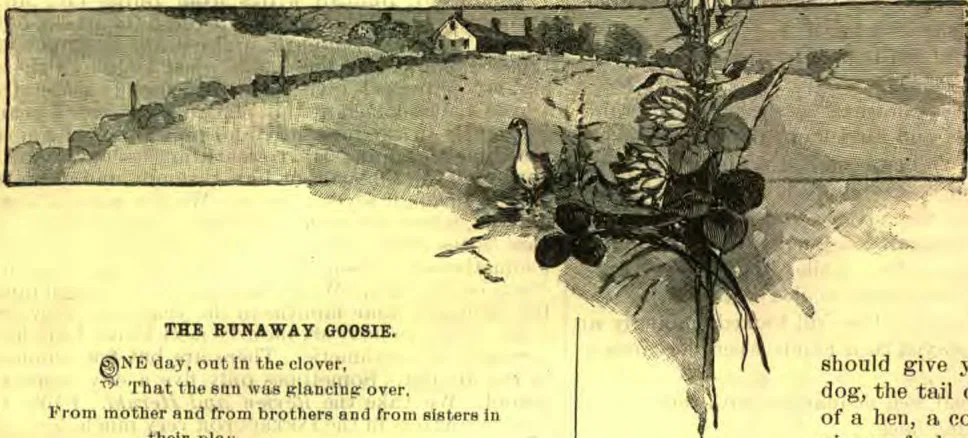
ONE day, out in the clover, That the sun was glancing over, From mother and from brothers and from sisters in their play, Through a hole or broken paling, Where the pretty vines were trailing, A little baby goosie in the summer-time did stray.
It was big with thought and feeling, And the freedom it was stealing Sent a tingle to its wing-tips and its little yellow toes; It marched as brave and steady As an army when it's ready, And it seemed to say, “Oh, come and see where little goosie goes!”
Where the tallest grass is bending, Its onward course was tending, Leaving funny little foot-prints in the yellow, dusty road. It caught both bugs and beetles, From weeds that looked like steeples; But its heart grew very heavy, as if it bore a load.
When the night-wind sighed and quivered, The little goosie shivered, And it said, “I want my mamma, and I want to see them all.” But it could not bring them over All the dewy grass and clover, So it hunted till it found the hole within the garden-wall.
It knew its mamma missed it, For she smoothed it, and she kissed it In a way that only Mamma Geese know how to do, I know. But if Master Fox had found him When the night-time closed around him, His pretty toes and wing-tips had been scattered high and low.
—Our Little Ones.
THE RUNAWAY GOOSIE.
THE RUNAWAY GOOSIE.

JOHNNY BEGINS TO STUDY BOTANY.

Johnny is an imitative little fellow. Whenever he sees any one doing anything, he is very apt to want to do it, too. He came the other day to my summer study-room—in the hay barn on the hill, where the air is always fresh and cool, and found me busy with a lot of plants that I had gathered in the woods that morning. He looked on curiously for a little while, then asked what I was doing that for.
“Doing what?”
“Why, picking all those weeds to pieces, and putting them away in those big books.”
“I’m afraid you haven’t been looking sharp,” I replied. “I don’t put away those I pick to pieces.”
Johnny was still again for two or three minutes, then he broke out with, “What do you pick them to pieces for?”
I told him they were plants that were new to me, and I was studying them to learn what they were like and what their relations were.
“Relations! Do plants have relations?”
“Certainly,” I replied.
“That’s queer! And is that the way you learn so much about them?”
“Chiefly.”
“I wish I could do that,” he said, after another period of silent watching.
“So you can.”
“When?”
“Any time; now if you want to.”
“Will you show me how?”
“With pleasure.”
“Right away?”
“Right away.”
“Well,” said Johnny, after waiting awhile, “I’m ready.”
“So am I.”
“But I don’t know what to do,” said Johnny.
“You must get your plants first,” said I.
“Where?”
“Anywhere—out in the garden, if you like.”
Johnny ran to the garden, and was soon back again, with his hands full of leaves and stems.
“Will these do?” he asked.
“Suppose you wanted to study animals, and I should give you the ear of a dog, the tail of a cat, the foot of a hen, a cow’s horn, and a piece of sheep-skin, to begin with. Do you think they would help you much?”
Johnny laughed at the idea of such a funny mess, and said he thought a whole dog would be better.
“A good deal better, and one whole plant would be better than all these pieces.”
“Can’t you tell me what the names are from the pieces?”
“I could, but names are not what you are to study. You are to study plants.”
“Of course,” said Johnny, not knowing what else to say.
“I will go with you,” I said, “and show you how to get something to study.”
When we reached the garden, I stooped to dig up a weed that few boys in the country do not know something about—purslane, or, as it is commonly called, pusley.
“What is the use of taking that?” inquired Johnny. “Everybody knows what that is.”
“We’ll take it, for all that. Perhaps we may learn something about it that you never noticed before.”
“That’s catnip,” said Johnny, as I began to dig up another plant that stood near the first. “You aren’t a-going to take that, are you?”
“Why not?”
“Cause I’ve known catnip ever since I can remember.”
“Shut your eyes,” said I. “Now tell me what kind of stalk catnip has.”
“Why,” said Johnny, hesitating, “it’s just like—any other stalk.”
“Like pusley?”
“No; pusley hasn’t any stalk; it just sprawls on the ground.”
“Like mullein stalk?”
“No, not like that.”
“Like corn stalk or thistle?”
“Not like them, either,” said Johnny. “It’s like—I guess I don’t remember exactly what it is like.”
“So you don’t know catnip so well as you thought?”
“These two will be enough to begin with,” I continued. “Study them carefully, and when I have finished with my plants, I will come to see how you get on.”
Johnny soon tired of studying by himself, or maybe he did not find very much to learn; at any rate it was but a little while before he stood at my table, plants in hand.
“Well,” I said, as I put away my work, “what have you discovered?”
“Catnip stalk is square,” said the young botanist.
“Good; anything more?”
“It smells,” said Johnny.
“What like?”
“Like—like catnip tea,” said Johnny.
“Very like, indeed. What else have you learned?” Johnny hesitated.
“Is the pusley stem anything like catnip?” I asked.
“Do you call those stems, when they don’t stand up?” was Johnny’s questioning reply.
“Yes, those are stems.”
“They’re round,” said Johnny, “and smooth. Catnip is fuzzy a little, and the stems are straight.”
“Anything more?”
“The leaves are bigger than pusley leaves, and thinner, and softer,” said Johnny, comparing them.
“We haven’t finished with the stalk yet. Can you tell me anything more about it?”
“That’s all I know,” said Johnny.
“How about the color?”
“It’s green.”
“Is the pusley stem green?”
“Some of it, and some of it’s almost white; and some is almost red; queer, isn’t it?” he went on, spreading the plant out, as it grew in the garden. “The under side of the stem is pale, and the upper side is red—tanned, I guess, in the sun.”
“It looks like it,” I said. “What is the color inside?”
“Shall I break it?”
“Certainly.”
Johnny bent the pusley stem with both hands, and to his surprise, it snapped short off.
“Oh,” he cried, “how brittle it is! I didn’t think it would break so sudden.”
“Try the catnip stem.”
“It won’t break.”
“Cut it with my knife.”
“It’s tough,” said Johnny, “and woody, and hollow. The stalk is square, but the hole is round.”
I took the knife, cut the stem across at a joint, and said, “I don’t see any hole here.”
Johnny was puzzled.
“See,” I said, splitting the stalk lengthwise, “the hollow is closed up at the joints, where the branches begin.”
“I shouldn’t have thought of that,” said Johnny. “What a lot of things there is to learn about one stem.”
“We’ve scarcely made a beginning yet. But before we go further, let us recall what we have already found out:—”
“The catnip stalk is square; stands up straight; has a strong odor; is slightly fuzzy; is green; is rough and woody; will not break easily; is hollow, except at the joints; and—”
“That’s all I can think of,” said Johnny.
“And the pusley stem is round; lies flat on the ground; is smooth; brittle; pale green below, and red on top; solid—are you sure of that?”
Johnny split a pusley stem its whole length, and said there was no sign of a hole in it, adding, meditatively, a moment after, “It takes a great deal of study to find out all about a plant, don’t it? if it is a weed.”
“A very great deal.”
“I think I know all about these now,” said he.
“Oh, no!” said I, “not nearly. You haven’t learned anything about the roots yet, nor the branches, nor how they grow, nor about the flowers, nor the seeds, nor when they come up in the spring, nor when they die in the fall, nor what things eat them, nor what they are good for, nor what their relations are, nor—”
“I’ll never be able to learn all that!” cried Johnny, fairly frightened by the greatness of the task he had undertaken. “And there are such a lot of plants.”
“It would be a terrible task, indeed, if you had to learn it all at once. But you haven’t. Just keep your eyes open, and take notice of the different plants you see, and you will get better and better acquainted with them every year. The older you grow, the faster you will learn, and the more you will enjoy it. In a few years it will be pleasanter than play to you.”
“I hope so,” said Johnny, resolutely; “for I’ve got to learn them all. I’ll try, anyhow.”—Selected.

THE CACTUS OF MEXICO.

A LONG time before Columbus discovered America, the Aztecs, or ancient Mexicans, were looking about for a place in which to build their houses, and settle down.
These Aztecs came from a country far to the north of what is now Mexico.
In their wanderings they came first to the Great Salt Lake, in Utah. Here they stopped a while to rest. Then they moved on to a place near the river Gila.
They wandered in this way from place to place for about one hundred and thirty years, when they came to the shores of Lake Teycueo.
A wise man had told the Aztecs that when they came to a spot where an eagle was perched upon a rock, in that place they must build their city.
As they drew near Lake Teycueo, they saw an eagle perched upon a branch of the nopal cactus, which grew out of a crevice in a rock. The eagle held a serpent in its beak.
Then they knew that this was the place where they were to build their city. They built it on the little islands of the lake, and called it a name which meant “nopal on a stone.”
This old story is the origin of the Mexican coat of arms, which is an eagle perched upon a cactus stem, and holding a serpent in his beak. This coat of arms is stamped upon the coin of Mexico, and painted upon her flags.
The Mexican flag has three bars of equal width across it—green, white, and red. The central one is white, and upon it is the old coat of arms.
And the Mexicans have taken the nopal cactus for their national flower. The nopal cactus is also called the prickly-pear. It often grows several feet in height. It has leaf-like joints, which spread out in such a way they look like large rabbit’s ears.
It is covered with sharp thorns, of an orange color. Its blossom is bright yellow, and its fruit is smooth and red, and good to eat.
The name of the city the Aztecs built was afterward changed to Mexico, and such it is called to this day. It grew in time into a very beautiful city, and looked, it is said, more like the work of fairies than of human beings. But in the sixteenth century, the Spanish conqueror, Cortez, seized it and destroyed a good deal of it, and it has never been so beautiful since.—Our Little Men and Women.
Continue reading: By the Wayside at a Chicago Depot