Some Characteristics of the Boers in Peace and War
Page 1
The Youth’s Instructor
May 15, 1902
Review and Herald Publishing Company · Battle Creek, Mich. · May 15, 1902
Some Characteristics of the Boers in Peace and War
By Joel Cyrus Rogers
On a journey from East London to Kimberly in 1896, the writer found himself with five others, three Englishmen and two Boers, in one of the small compartments of the ordinary English railway carriage. These compartments have two seats reaching from side to side and facing each other. The Storm Berg had been passed, and we should have arrived at the Dutch village of Steynsburg at dark, and at De Aar before daybreak next morning. A long drought had denuded the veld of every vestige of life. Besides, it was autumn, when these up-country plains are brown and dry; so traveling was dull indeed. April is not the season for rain, which generally falls in these districts during the summer, from November to March. But nature sometimes seems out of her course here, as in other lands, and a cold, steady rain came on that night. Our engine had gone wrong, darkness fell, and we were still below Steynsburg. While passengers slept, the disabled engine rested; and when approaching daylight enticed us out of the cold, leather-lined berths, we expected to see the familiar iron-roofed houses of De Aar. But only rain and flooded sandy plains extended, ocean like, before us. The roof of our compartment had sprung a leak, and with overcoats and blankets, the six of us tried to keep warm.
This was but four months after Dr. Jameson, once a resident physician of Kimberly, had attempted to conquer the Transvaal with three hundred men,—an episode not tending toward warm feelings between Dutch and English. Our Dutch companions had entered the train in the night; and though we knew they were there, the dim light of an African railway carriage gave but slight idea of their physique. I knew they smoked, as nine hundred and ninety-nine out of every thousand men in this land do. Providentially being the one, I may innocently have given offense to my Boer friends by persistently keeping the window next to me open. Now, in the slowly increasing light of that rainy day, Boer eyed Briton, and Briton eyed Boer. All were cold and somewhat wet, and the situation was altogether cool. My American manner and speech, being recognized by the Boers, soon relieved me of embarrassment, and gave me the place of an interested spectator. These two Boers were farmers, and fairly good types of their race. Both sturdy fellows of full six feet two, broad shouldered, with keen blue eyes and sunbrowned complexion, they looked equal to the endurance of a Spartan.
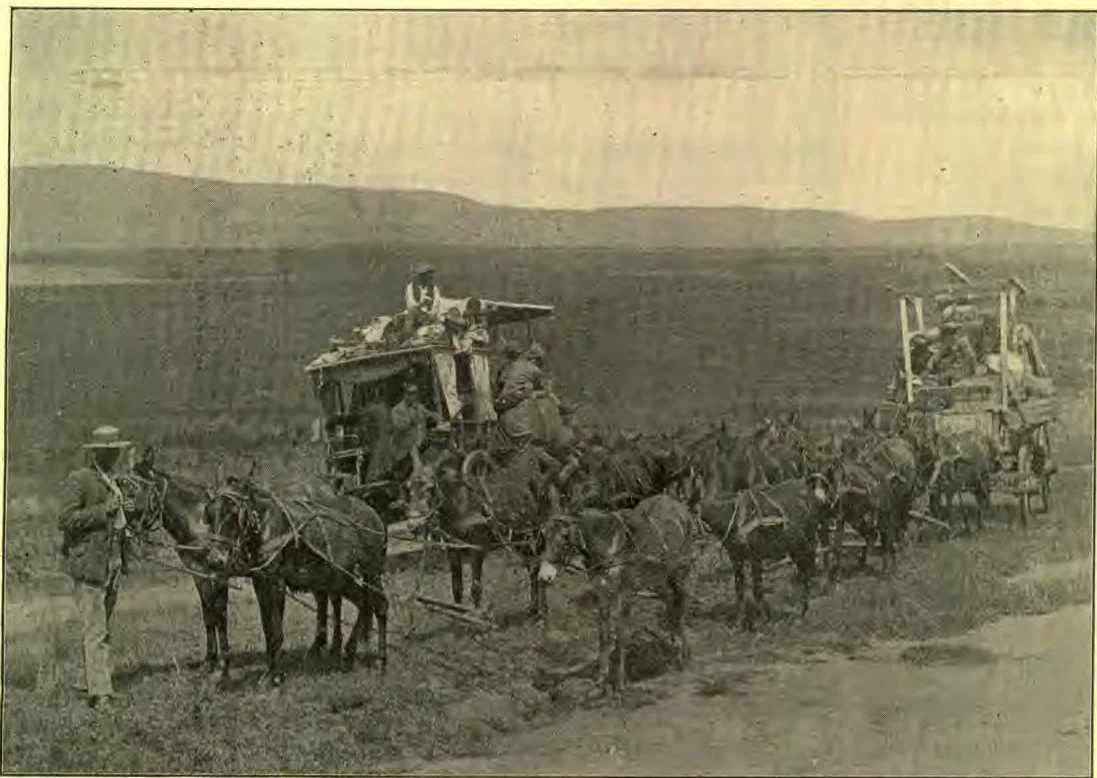
TRAVELING BY STAGE IN SOUTH AFRICA
Farming in South Africa is altogether unlike what is usually understood by that term. The Boer farm has from three to five thousand acres, generally of treeless, rocky ground. If there be any attraction or value about it, it is because somewhere within its borders is found a spring or fountain, marked by the presence of two or three willow-trees. Near this fountain the farmer builds a one-story, flat-roofed house, made of sun-dried brick, and plastered over with a white mixture of cement and coarse gravel. All well-to-do farms are characterized by these white houses, which serve as landmarks for many miles around.
The farmer’s occupation is the raising of sheep and cattle. He must have no fewer than thirty or forty good oxen, as it requires at least sixteen of these animals to haul one of his great transport wagons over the hills and sandy roads. From six to a dozen horses are needed for riding and driving. It is a disgrace, here, for a man to be seen walking any considerable distance; therefore horses are much in demand. All ordinary errands to the village, or “burg,” which may be several miles distant (though the Boer never reckons by miles, but always by “hours,” six miles on horseback being an hour); visits from farmhouse to farmhouse, of which the Boer is extremely fond; overseeing his flocks and herds, under the care of Kaffir servants,—all this and more is done from the back of an agile horse. Thus the Boer farmer is trained from early boyhood to skillful horsemanship.
While our train dragged wearily along that rainy morning, one of the party managed slightly to relieve the coolness of the situation by remarking that the train had lost its route, which appeared not altogether impossible under the circumstances. Not until nine o’clock, and long after the “down train” had passed, did we pull up at the well-known junction. If in the Roman empire all roads led to Rome, surely in South Africa all roads lead to De Aar; for through this place of possibly two dozen houses, amid an apparently limitless, barren, sandy plain, every traveler from the south must pass into Africa. Here some of our party were transferred into a mixed freight, proceeding to Kimberly; others took another direction, and we lost sight of our Boer companions.
The hundred miles from De Aar to the Modder River is an almost unbroken plain, as level as a floor, relieved only by occasional small, flat-topped hills called “kopjes” by the Dutch. Between these little cone-shaped hills the railroad winds its way. The Orange River is crossed half-way between De Aar and the Modder. The British troops, landing at Cape Town for the relief of Kimberly, were carried by rail to Orange River. Except in the rainy season, the Orange at this place appears a great stream of sand, having only a rivulet of water somewhere within its wide bed. The Modder is a much narrower stream, yet just above the point where it is crossed by the railway, stretches a long island. This island and the river-banks are well covered with bushes and small trees. Here forty thousand British troops on November 18, 1900, met seven or eight thousand Boers in the first important battle between the two armies. On the day following a thousand English dead were counted by the keeper of the hotel which stood on the north side of the river.
After inflicting this loss upon the British, with but small loss to themselves, the Boers quietly withdrew, and made a more strongly defended position ten miles nearer Kimberly, at Magersfontein. Waiting nearly a month, the English moved forward only after receiving large re-enforcements. Then came Magersfontein, where the famed “Black Watch” (a detachment of Scotch Highlanders) was all but annihilated. Here the picked men from the world army of the154British, in number at least four to one, were time after time from morning to night hurled against the entrenched lines of Boer farmers, only to retire broken and defeated. Then for eight long weeks, there lay an army of vastly superior numbers, and being constantly re-enforced, but not choosing again to face these men of the veld. It is believed that the battle of Magersfontein cost the British double the number of men in killed and wounded that were lost at Modder River. One of the Black Watch, who, with his regiment, charged the Boer entrenchments at Magersfontein, says that the barbed wire stretched in front of the advancing line at the sides of the trenches effectually stopped their progress. They rushed upon this wire, became entangled, and even tried to pull it down with their hands. Some of their number, shot by the Boers, were left standing against the wire fences upon which they fell. Such are some of the horrors of modern warfare.
While the British army, after falling back, lay along the Modder for two months, Kimberly lay in state,—a state of siege. When endurance of all their ills seemed no longer possible,—at the very moment when the wretched inhabitants were being hurried down the shafts of the diamond mines, the only remaining place of safety from the increasing rain of shells,—the banners of the “Relief Column” under General French were seen fluttering far across the brown veld, and from the starving populace went up a wild shout of joy as their rescuers entered the city.
JOEL CYRUS ROGERS.
Ruth the Moabitess
By G. C. Tenney
THE sorrowful story of Naomi and her bereavement in a land of strangers has a beautiful sequel in the experience of Ruth, the Moabitish woman. Elimelech and Naomi were driven by famine to remove from Bethlehem, in Judah, to the land of Moab. Here their two sons were married to young women of the land. Here, Elimelech died, and later his sons died also. Nothing remained for the desolate mother but to return to her kindred in Bethlehem. The daughters-in-law accompanied her, out of respect, probably, to the border of their town. Here a pause was made, and Naomi affectionately and thoughtfully dismissed her daughters, giving them her benediction. She would take no advantage of their devotion to lead them away to a land of strangers and strange customs, where, separated from their kindred, they would be likely to suffer from loneliness and want.
Orphah saw the difficulties, and felt a strong attachment to home. She therefore yielded to the suggestion to return. We hear no more of her. It is probable that when the influence of her godly mother-in-law was no longer felt, she soon lapsed into the ways of her heathen surroundings, and thus lost forever the opportunity she had had of becoming identified with the people of God.
But Ruth was of another spirit. She had partaken of the grace that sustained Naomi; she had become acquainted with her God; she had learned to love, trust, and obey him; and she could not bear to be separated from the one who had brought her such great light and happiness. Her reply to the words of Naomi bidding her to return are deserving of the high place they hold among the gems of thought and language that have been handed down to us from the past: “Entreat me not to leave thee, or to return from following after thee: for whither thou goest, I will go; and where thou lodgest, I will lodge: thy people shall be my people, and thy God my God: where thou diest, will I die, and there will I be buried: the Lord do so to me, and more also, if aught but death part thee and me.”
There was no rejecting such a plea. The heart of Naomi was opened to receive a true daughter. Ruth became inseparably associated with God’s people, through which association she became the great-grandmother of King David, and, according to the flesh, a direct progenitor of Jesus.
Orphah chose her future from the natural feelings of her heart, and from a worldly point of view. Ruth’s choice was governed by the dictates of duty, and was made by faith. It is very likely that she realized what we all ought to know,—that the choice of the right course can eventually have no other than a good result. Often, when the one involved calmly trusts in God, the greatest good comes from what seems to be a hopeless situation.
The choice of Ruth stands in bright contrast with that of Lot, who chose for himself a good worldly prospect at the sacrifice of his association with the plan, the promises, and the people of God. How many young people there are to-day who stand at the parting of the way! Which way shall I take? The world, the heart, and friends often say, “Return from following Jesus.” But duty and gratitude whisper to the heart to persevere. Eternal life, and the blessedness of the saved, urge you to go on. The way may look lonely and strange and difficult, but angels will attend you in it, Jesus is there, and it leads to immortal glory. G. C. TENNEY.
Homely Duties
A WELL-KNOWN American writer, and a woman old and wise enough to understand the use and meaning of the past events of her life, recently told a friend of an incident of her youth which may interest and help others.
She resolved, on leaving school, to go on with the studies which she had begun. The day she divided systematically; so much time for Latin, so much for science, so much for the higher mathematics, music, painting, general literature. Besides these occupations she proposed to take exercise at stated and regular times.
But when she sat down to her Latin, dictionaries and note-books open, Will, her brother, was sure to rush in with a coat to mend, or a splinter to be taken out, or perhaps only wanted to tell her a long story of the football match, or the game at recess. She always pushed the Latin aside while she listened or sewed.
When she was busy with logarithms and problems, she would catch sight of her mother stooping over a basket of unmended stockings, or nursing the heavy baby. Books and slate were put aside while she took the task on herself, and sent her tired mother to rest.
When she wished to go to the gymnasium, the parlor was to dust; when she was ready for an hour's pleasant reading, there was old Peggy in the kitchen spelling out a verse in the Bible with her dim eyes.
Often when night came, the day, as she looked back, appeared to be filled with nothing; a little sewing, a little housekeeping, a thousand little trifles done for her mother, for the boys, for the old servant.
She was irritable and rebellious. Her plans had been for a higher work and a higher life than this!
At the age of sixty, she said, looking back: “I have never found occasion for the use of the higher mathematics or Latin in my life. But the old negro in the kitchen died trusting in her Saviour, whom she had learned to know as I read to her every day.
“When my brother Will, at twenty, fell into bad habits and ran away from home, I was sent to bring him back. He had grown fond of me because I humored him, and he came. It was the turning-point of his life.
“I know now, too, that if I had not taken some of my mother's hourly burden of little duties upon myself, she would have sunk beneath them. As it was, she lived to a happy, helpful old age. God knew better than I what work was best for me in life.”—Our Church Record.
Nature's Unlimited Forces
By David Paulson
As the race deteriorates in physical strength and endurance, God is instructing men more and more how to utilize some of nature’s enormous reserves of energy, which are daily going to waste. In certain departments of human industry one man now guides and controls with ease a machine doing the same amount of work that would have required hundreds of men a few years ago,—and doing it better than would have been possible then.
Niagara Falls could furnish sufficient power to run all the machinery in the world. A small part of the vast amount of water pouring over the falls has been diverted into huge tunnels, and the power so generated is utilized in lighting the streets and homes of a city of nearly half a million inhabitants, more than twenty miles away.
Recently a dam has been constructed, and the necessary machinery installed, at the head of the Missouri River, near Helena, Montana, for conserving energy for similar purposes. By means of some of this power, the city of Helena is lighted, and its electric cars are run. The same wonderful energy is conveyed over mountains and valleys to Butte, sixty miles away, and is there doing the same work.
When we see such tangible evidences of God’s power lent so freely to the service of man, even while he is cherishing wickedness in his heart, why should we doubt that God will impart to us moral power, even while we are in an imperfect state?
In a few favored localities, nature actually furnishes water in a heated condition, thus saving men the trouble of warming it. Several miles from Helena, Montana, water gushes out of the earth at a temperature of one hundred and sixty degrees. A mile below is situated one of the largest nurseries in the Northwest. The water from these springs is drawn down the valley in wooden pipes, and then passes under the155flower-beds in metal pipes, thereby supplying all the artificial heat needed. This water is afterward conveyed to an immense swimming-pool, where it still retains so much of its natural heat that it is necessary to mix it with ordinary water in order to cool it to the proper temperature for bathing purposes. DAVID PAULSON, M. D.
“He Knoweth Our Frame”
By B. F. M. Sours
“He knoweth our frame,” with its burden of
frailty;
“He knoweth our frame,” the soul’s cottage
of dust;
And how o’er the spirit the tempests that
hover
Seem spears of our foemen, in deadliest
thrust;
For we are frail, and wild winds wail,
And strength fails that we trust.
“He knoweth our frame!” O mourner in
shadows!
He knoweth thy weakness, thy sorrow and
care.
Look upward! His birds in their gladness are
bathing
Their wings in his sunlight; their songs fill
the air.
His love is true ’neath skies of blue,
And flowing everywhere.
“He knoweth our frame!” Then O why be
downhearted,
As if he, thy Saviour, thy grief had forgot?
Let faith with clear vision gaze evermore
heavenward,
And behold how with mercy his judgments
are fraught.
“He knoweth our frame!” O praise his name
Who has salvation wrought!
B. F. M. SOURS.
The Bush - Sparrow
By John Burroughs
In the busy pastures, Ere April days are done, Or along the forest border, Ere the chewink has begun, Is Spizella trifling In notes that circling run Like wavelets in the water That go rippling in the sun.
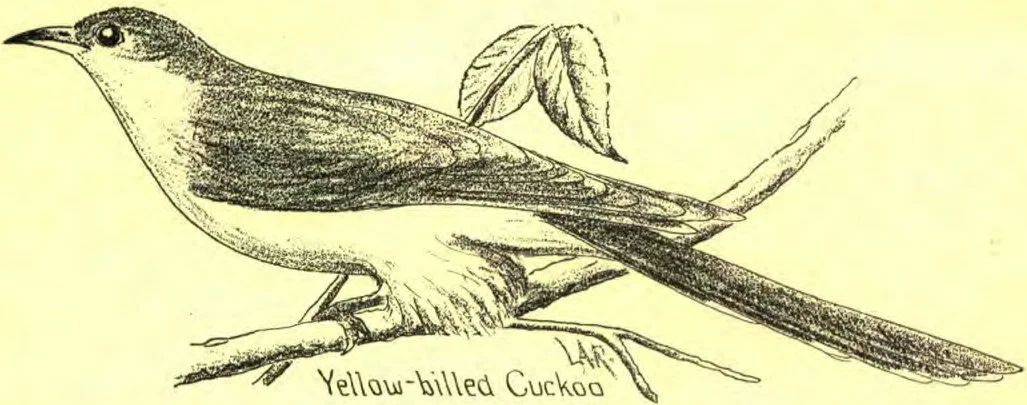
Yellow-billed Cuckoo
A gentle, timid rustic, Who makes the dingle ring, Or round about the orchard Where bush and brier cling, Most tuneful of the sparrows, With little russet wing,— A joy in early summer, A thrill in early spring.
His coat has russet trimmings, And russet is his crown; Less bright and trim of feather Than chippy near the town,— A plainer country cousin, With plainer country gown, Who loves the warmth of summer, But dreads the autumn’s frown.
He hides in weedy vineyards When August days are here, And taps the purple clusters For a little social cheer; (The boys have caught him at it, The proof is fairly clear!) Still I bid him welcome, The pilfering little dear! He pays me off in music, And pays me every year.
— John Burroughs, in Harper’s.
The Cuckoos
The Yellow-billed Cuckoo is familiarly known by the name of Rain-crow, from the supposition that its call betokens rain. There are many who have never seen the bird, and know it only from its peculiar notes. The Rain-crow keeps closely hidden; and whenever it does leave shelter, it flies so silently and swiftly as almost to escape detection. It will be worth your while to get acquainted with this bird, even at the expense of patient study and endeavor.
You will need to be careful in watching the nest of the Cuckoo; for the birds are wary, and are apt to desert the nest when discovered. The nest is built with a platform of small sticks, with a few grasses or catkins, and it is a wonder that the little birds are able to stay in their flimsy cradles. In fact, they do sometimes tumble out, and fall to the ground; but, fortunately, the nest is usually not very high up, and they seldom get hurt.
Olive Thorne Miller once found a young Cuckoo tumbling about on the ground. He was trying to fly, but made sorry work of it, not getting more than a foot or so at a time. It was rather dark; so she caught the bird to get a good look at it, to see what it was, and then let it go again. The bird gave a shriek, and out from the thick bushes popped a Cuckoo, which alighted on a low branch near by, and gave such a cry of distress as showed that the little bird was her baby. The mother bird evidently thought that the little one was about to be carried off. Olive Thorne Miller loves the birds, and she could not think of distressing one; so she opened her hands and let the little thing go. Then, half scrambling, half flying, it went away.
The little Cuckoos do not look like other young birds. The feathers are wrapped in a sheath for a long time after they come out, and the young birds look as if white pins were stuck all over their little black bodies.
The call of the Yellow-billed Cuckoo is given as tut-tut, tut-tut, cl-uck-cl-uck-cl-uck-cl-uck-cl-uck-cl-uck, cow, cow, cow, cow, cow, cow, cow! The notes of the Black-billed Cuckoo are quite similar, but somewhat softer.
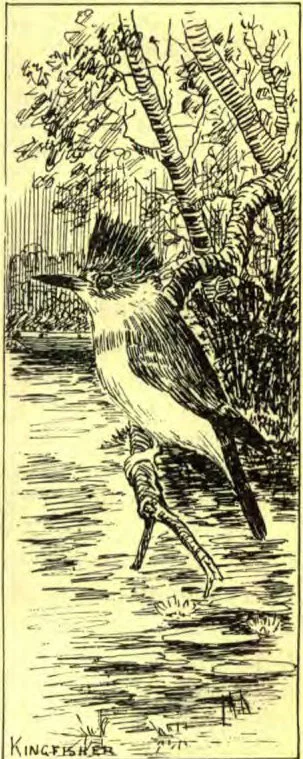
The Cuckoos and the Belted Kingfisher belong to the same family. The Kingfisher lives on fish when he can get them, or on grasshoppers. He wears a crest; his back is bluish, under parts white, with blue belt; he is found near the water.
The Cuckoos have no crest; the upper parts are brownish, and the under parts plain white; and they are found in undergrowth and low bushes. You can distinguish the Yellow-bill from the Black-bill by remembering that the tail of the Yellow-bill is black, with clear-white thumb-marks on the under side, and the upper part of the bill is yellow; while the tail of the Black-bill is brown, with no thumb-marks, and the bill is black.
The Cuckoos are useful birds on account of the large number of caterpillars which they eat. They devour so many of these creatures that it is said their stomachs are lined with the hairs. Three hundred and twenty-eight caterpillars, besides fifteen grasshoppers and a number of spiders, were found in the stomachs of sixteen Black-bills. Two hundred and seventeen fall webworms were found in the stomach of one Yellow-bill.
The Mourning-Dove
By L. A. Reed
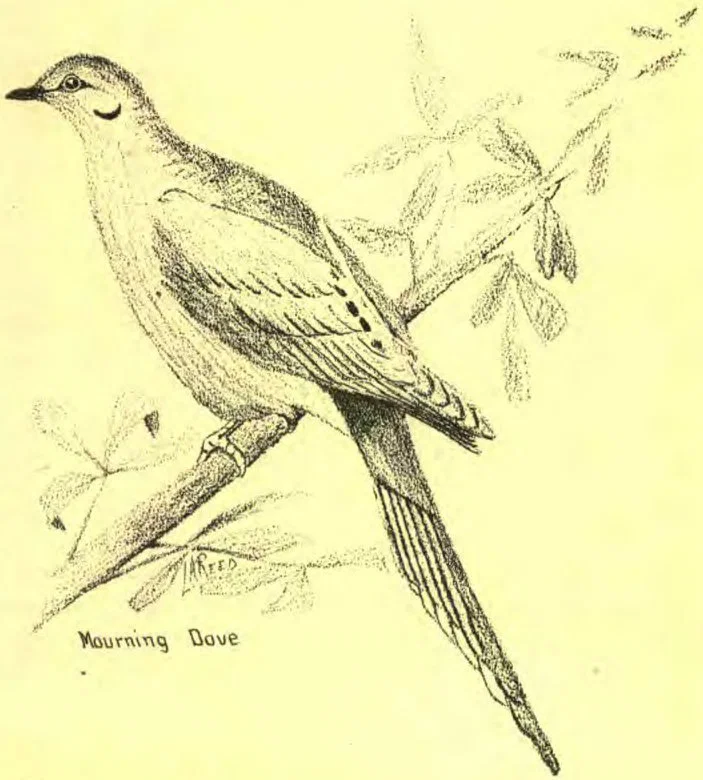
Doves look something like wild pigeons, but are much smaller, and their rapid flight is accompanied with a whistling sound. Wild pigeons have a bluish, slate-colored rump, while the dove’s is olive grayish-brown. The dove also has a black mark below the ear.
“Sometimes,” writes Florence Merriam, “we see the soft, fawn-colored creature looking out at us from the foliage of a tree, turning its head from side to side to inspect us, while its mate calls solicitously, ‘Coo-o-o, ah-coo-o-o — coo-o-o — coo-o-o!’ Again we see it walking along the ground, moving its head back and forth with the peculiar motion of the doves; then we hear a musical whir as it passes swiftly through the air beside us, and on looking up catch sight of the white circlet of its long vanishing tail; or perhaps watch it soar low over the bushes, with wings stiffly spread till it gets near the nest, when it alights with a wabbling motion of wings and tail.”
In the dry parts of Arizona, the Mourning-dove has been known to nest so far from water that it could go to drink only twice each day. But the mountaineers, trained in the lore of the woods, know its habit, and follow it when in search of water. If the dove is once made sure of your protection, it will build its nest in your garden. In central Illinois I have found the bird very tame.
During the nesting season the doves will be found in pairs. After the nesting season, they gather in flocks, and frequent grain and corn fields. Major Bendire thinks the pairs remain mated throughout the year, as they are seen together summer and winter. Their conduct toward one another shows that the name Turtle-dove, which has become synonymous with tenderness and affection, is more appropriate than the name Mourning-dove. L. A. Reed.
Mourning Dove
A Summer Afternoon
THE hills are wound in silver-green and gray.
Before the noonday hour, his plea for rain
Imploringly the rain-crow piped aloud
Through olive shadows, and the sun was fain
To bathe his hot, red face in cooling cloud.
No bodeful wind molests the earing grain;
There are no scowling tempest signs to-day,
Only, along the hill peaks, far away,
A mystery of soft and silent rain.
— Selected.
An Open Door of Usefulness for Our Young People's Societies
By B. G. Wilkinson
It is with a sense of profound gratitude that I receive the news from the YOUTH'S INSTRUCTOR that the Young People's Societies of Iowa have determined to raise a thousand dollars for the work in France. And why not? I believe in these determinations which look heavenward. I believe in the success of this movement, and why should not the Young People's Societies of other States and of our colleges take up a similar work, and press forward along missionary lines? Here is enough of opportunity. Here are Belgium and Italy, Portugal and Spain, Algeria, Tunis, and France with its teeming cities, almost unentered.
But these fields would not receive all the benefit. We can fervently hope that such a movement would result in our soon seeing in these countries some of the very young people who have labored in this line,—here to use the means they have won by prayer and loving labor.
There is cause for the deepest encouragement in this step taken by the young people of Iowa. It shows the hand of God in the organization of our young people. It shows what mighty results will be obtained when these young people are directed toward a definite object. By it a wave will be produced whose motion will affect, I was about to say, Europe and Asia, but I must say, will affect lives for eternity.
Dear young people, you have been called to service; and into service place yourself. March forward in faith, remembering that what you do is not half; the other half, and more than the other half, is being done by him who has called you to his service. That you may be encouraged in the step you have taken, let me give you some facts.
I have just returned from a week's labor in France, in the departments of the Gard, Drôme, and Puy-de-Dome. While the work in the first two departments advances encouragingly among both Protestants and Catholics, the Puy-de-Dome is almost all Catholic; so of that I speak expressly.
I arrived at 7:30 P. M., at Thiers, a city of twenty-seven thousand inhabitants, and was met at the train by M. Blanzat, a brother who is a bookkeeper in a gas factory. Up the steep hills he conducted me to the home of a Catholic family. They had supper prepared, but not caring to eat, we proceeded to break the bread of life. At the table were two Catholic ladies, who had begun to keep the Sabbath only a month or two before. Two other families and a young man were present, all interested in the truth, and under conviction. We studied God's word till 10:30. Then across the city we went, to the home of a wealthy Catholic widow, who had offered me lodging for the night.
When I descended with Brother Blanzat to close the street door after him, our hostess stepped out of the room to ask if anything further was needed. Then we were invited into her room. Here we found at the table another lady, who had just arrived on a visit from Clermont, the city of the first Crusade, a neighboring city of some seventy thousand population. We began to talk on the word immediately, and conversed till after midnight. When we arose to go, our hostess said, “Sir, you must be a prophet; we never hear these things in our church.”
Next morning I was about to leave for another place to eat breakfast, when she called me in, saying she had prepared something for us. We declined breakfast, having already engaged it elsewhere. Then she said, “Sir, won’t you pray with us, as you did the night before?” I prepared to do so, standing up according to the French custom, when she knelt. After I had finished, the visitor said, “We never hear prayers like that in our church.” From after breakfast till in the afternoon, when I took the train to leave, I was busy visiting and praying with different families.
Time would fail me to relate more. I can only say that the doors are open for consecrated, qualified laborers, and there is much hope for France, Italy, and Algeria. B. G. WILKINSON.
Young People's Society Meetings in Austin, Minnesota
By Calvin D. Kinsman
From Austin, Minnesota
OUR Young People's Society was organized Dec. 27, 1898, and we have been holding meetings each Sabbath afternoon, with an average attendance of thirteen. Now we have a membership of sixteen. We have a president, vice-president, secretary, and an assistant secretary. The president conducts the opening exercises, and then turns the meeting over to some one who has been appointed, usually two weeks before, and who has the study or reading for the day. We elect our officers every three months, as this course affords more opportunity for the different members to gain experience in conducting meetings. This has been a real help to us. When we began our meetings, there were some who had not the courage to speak in public. Now they can conduct a meeting or give a Bible study very readily.
Most of the time we have held a Bible study or reading each week, but for about three months at one time we followed the plan of having two or three members write an essay upon the life and work of some Bible character to be read in the meeting, after which all were free to talk about the life of the person studied. Another three months we studied the book of Genesis in connection with “Patriarchs and Prophets,” reading a chapter or two each week. When the YOUTH'S INSTRUCTOR took up the Young People's work with “Steps to Christ,” and the missionary studies, we used it as a basis for study. A short time ago we began studying the Testimonies, but continue the missionary studies each month.
We held fourteen cottage meetings during the last quarter, and distributed a number of tracts and papers. CALVIN D. KINSMAN.
A Prayer of Gifts
Give us no other art
Than knowing to be kind;
Give us the thankful heart,
Light where we walk so blind.
Give us to think no ill—
Forgive as we're forgiven,
With earth and thy dear will
Sweet as a dream of heaven.
—Selected.
Battles between Truth and Falsehood
Lesson VII—Making the Sabbath
(May 18–24)
How to Study These Lessons.—(1) Read the lesson story; (2) try to recall or find scriptures in proof of each statement; (3) study the texts; (4) see how many missing links you can supply; (5) give the lesson to some one else. You will keep only what you give away.
Jesus was the active partner in the creation of the earth. To him the Father said: “You make all things.” The great Creator chose to take six days in making the earth and all things in it. After working six days, he rested the seventh day. That made it the rest day of the Lord. Then he blessed the seventh day. Now it was God’s blessed rest day. Last, he sanctified the seventh day, or made it holy. Therefore since then the seventh day is God’s holy, blessed rest day. But, though it is God’s rest day, he made it, not for himself, but for man. The rest, blessing, and sanctification are all for man. For six days the Lord had been preparing a perfect home for man. In the seventh day he placed his crowning gift.
THE Young People’s meeting of Sabbath, April 12, was the best attended, and by many present pronounced the most edifying, ever held in Pueblo; and it is with the hope that many other societies may enjoy similar, and even greater benefit by trying this or some other plan, that this is written:—
Sabbath, April 5, a slip of paper on which one of the following queries was written, was handed to each young person among us, with the request that a brief Bible answer be prepared for reading at the next meeting. In distributing these slips the ability of each was considered, and it was thought that every one could, with study, give a correct Bible answer. Each question was given to two or more persons, in order to have a variety of answers. Just before preaching service on the morning of the date of the meeting, the questions were read as an announcement of the afternoon meeting. After the reading of each question and its answers, opportunity was given for a brief discussion.
So much interest was manifested in the exercise that we had been together two hours (one and one-half hours on this exercise) before any attempt was made to close, and even then we could not do so before a number had testified concerning the blessing received on this occasion.
Here are the questions used:—
I. To whom was God talking when he said, “Let us make man”?
2. Why do Seventh-day Adventists wash one another’s feet?
3. After a person accepts the Sabbath, is it all right to keep Sunday, too?
4. Why do Seventh-day Adventists hold that the days begin at sunset?
5. Is it possible for one to know he is a Christian? How?
6. Does the Bible tell how we may know when Jesus comes? How?
7. Why did God say, “But the seventh day is the Sabbath”? Where is the passage?
8. Where is it written that man’s whole duty consists in fearing God and keeping the commandments? What commandments are meant?
9. If fearing God and keeping the commandments is man’s whole duty, why was the whole Bible written?
10. Where does God’s word say, “The grace of God that bringeth salvation hath appeared to all men”? If this is so, why send missionaries all over the world?
11. Write one Bible verse or more showing that Jesus will come soon.
12. What does baptism signify?
J. L. HUMBERT.
The Spiritual Life Is Doing
THE spiritual life is not knowing, not hearing, but doing. We only know so far as we can do. We learn to do by doing. What we do truly, rightly, in the way of duty, that, and only that, we are.—Frederick W. Robertson.
We’ll Save Them All for Mother
By Paulina M. A. Anderson
WE wandered through the woodland dells
One beautiful spring morning;
The birds were singing in the trees,
The busy bees were humming.
Our happy hearts o’erflowed with joy;
Then spoke my thoughtful brother:
“We’ll gather up the fragrant flowers,
And save them all for mother.”
As on we rambled through the wood,
There flashed upon our view
A sight which to our childish eyes
Too good seemed to be true,—
Strawberries ripe, so red and sweet!
Then quickly spoke my brother:
“These, too, we’ll gather up with care,
And save them all for mother.
“To carry them our hats will do,
Lined with fresh leaves of green,”—
A tempting dish, as you’ll confess,
And fit for home’s dear queen.
And as we saw her look of joy,
Each said unto the other:
“O, aren’t you glad now that we saved
Both flowers and fruit for mother.”