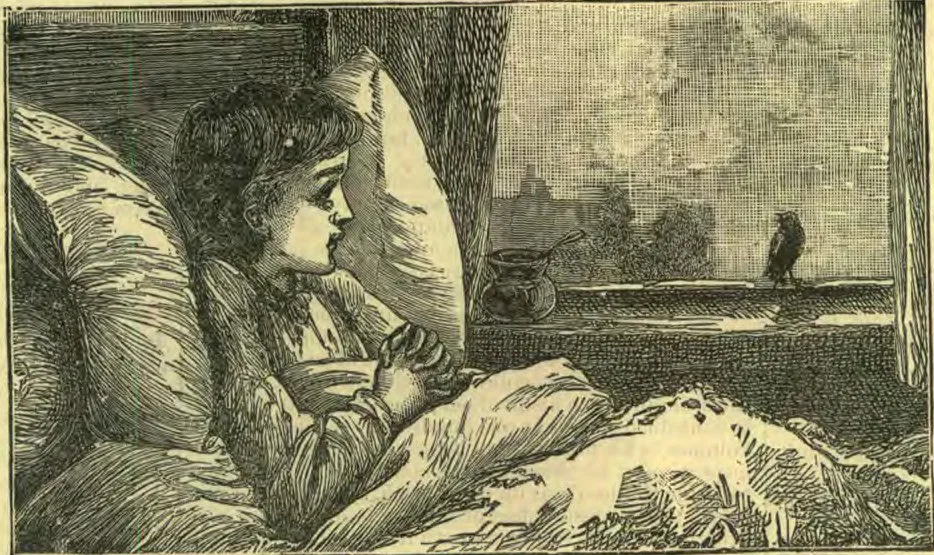
It was so hard to be shut in through all the beautiful spring weather! That was what Annie thought, as she looked out of her open window, and saw all the world growing green in the bright May-time.
“O dear!” she said to herself, “I want to go out so much!” and the great tears rolled down her cheeks as she thought of the happy times she had had on other spring days. While she was crying and making herself a very miserable little girl, a gay little robin red breast hopped in at the window and sang, “Cheer up, deary; cheer up, cheer up.” At least, that was what Annie thought he must have said. She dried her tears to look at him.
Robin turned his little head this way and that, and looked at Annie with his bonny black eyes. Then he flew down on the coverlet and began picking at the fringe. But as soon as Annie stirred, he was up and off. She saw him fly into the pear tree near her window.
Annie asked the hired girl to bring her some shreds and ravelings and some crumbs. She put these on the window sill, and then waited for robin to come again.
Next morning Annie was awakened by a loud, “Dearest, dearest; sweet, sweet,” and she saw robin and his mate breakfasting on the crumbs outside, and twittering earnestly over the bunch of ravelings. At last they took it to the tree. They were busy all day in bringing straw, dead grass, little sticks, and mud, with which to build their home.
“O mamma,” said Annie excitedly, “do come and see what the robins have done! They’ve put in a lot of white rags, and left the ends dangling in the wind.”
“I suppose the robins think it makes their home look more inviting,” said mamma, taking her sewing and coming across the room to sit by Annie.
“Why don’t they take more pains to weave in all the stuff?” asked Annie, after a pause.
“I don’t know, I’m sure,” her mamma replied. “It makes me think of a story I read when I was a little girl.”
“Do tell it!” said Annie, without taking her eyes from the nest.
“As the story goes, the birds at first did not know how to build nests; but at length a few birds that were quicker witted than the others contrived to make some. All the other birds admired them, and were anxious to find out how it was done. So the nest builders set a day for them all to come and be taught how to build a home. When the day arrived, there were robins and swallows, sand pipers, storks, eagles, crows, and every other bird you can think of.
“The magpie began by telling them how to choose a safe place in the top of a tall tree. But one little sand martin, who was a conceited fellow, wanted the other birds to think he knew without being told. So at every pause the magpie made, the sand martin piped in, ‘Certainly; of course—of course; anybody can see that!’ The jackdaw was troubled in a good deal the same way, and would echo what the martin said, adding, ‘I knew that before!’
“Some birds paid attention to the magpie, but the most of them grew so tired of the chatter of the sand martin and jackdaw, that the meeting broke up, and the birds all flew away. The sand martin had paid so little heed to the teaching that when he tried, he could not build a nest, and has always had to live in a hole in the sand. The foolish jackdaw can only throw a few loose sticks together; and most of the other birds have to live in houses without roofs, because they wouldn’t wait to find out how to put one on.
“Now,” continued mamma, “I must go and see to baby. In the story there is a nut to crack, but I shall leave you to find it for yourself.”
Annie knew mamma’s “nut to crack” always meant some moral or lesson for her to learn; and setting her wits to work, she soon found it. Can you tell what it was? W. E. L.
ONLY TONGUE-LOVE.
Mary Marston was always telling how much she loved her mother. Words were very cheap; and little Mary seemed to have a great number of them—so many that her mother got tired of hearing her talk. Of course, you will expect me to tell you that Mary was a great comfort to her mother, and was always glad to help her in every way possible.
That was just what Uncle Ralph thought when he first heard his little niece’s fine, loving words; but before his visit was half over, he found the little girl loved her mother with a love that was good for nothing at all.
One day the girl who did the work was taken sick, and baby Willie was very fretful; so the mother’s hands were more than full. Mary kissed her mother when she saw how tired she was, and called her “Darling mamma,” but did not offer to amuse the sick baby, or take Ann’s breakfast to her room. Oh, no! she could not stop, for she was making her dollie a new hood for the winter. Uncle Ralph said to his sister,—
“What can I do to help? I see that your little daughter does not love you any, but I do.”
Mary stopped knitting and rocking in her comfortable chair, and looked at her uncle in surprise.
“I do love mother,” she said angrily.
“Oh, no, you don’t!” her uncle said, shaking his head sorrowfully.
“I do.” And here, I am sorry to say, one little foot went down on the floor very hard.
“You have plenty of tongue-love, I know; but that is like ‘sounding brass,’—noisy only; it don’t amount to anything.”
Mary began to cry at this, and wonder what she could do.
“Ask mother, ‘What shall I do?’” said her uncle.
Little Mary stopped crying, but looked very unhappy; for it seemed to her that she must sit in that very comfortable chair and knit dollie Jane’s hood. But she might take care of baby, she very well knew.
“I will take baby out,” said her uncle; “that will help.”
Then Mary was easy again, for some one else was doing her duty for her.
“I wish your Mary loved you,” said her uncle to his sister, as he put baby into his little carriage: “but she does not, I fear,—only tongue-love, no heart-love.”
After knitting for quite awhile, Mary went softly into the dining-room, and set the table neatly for dinner, picked up baby’s playthings in the sitting-room, and made his little crib-bed for his nap, besides taking care of her own room.
What kind of love did this show? Which kind have you for your mother?—Sel.
Letter Budget.
CECIL C. RULAFORD sends a letter from Spokane Co., Wash. Ter. The letter reads: “I like so well to have mamma read the little letters to me that I want her to write one for me. I am a little boy five years old. I live near a beautiful medical lake, where many sick people come during the summer month to bathe in its healing waters. I have taken the INSTRUCTOR over a year, and pay for it with my own money instead of buying candy. We have a Sabbath-school of twenty members, at our house. I recite in Book No. 1, and repeat a verse every Sabbath, besides the lesson. I have two brothers younger than myself. I take care of the baby while mamma does her work. She says she doesn’t see how she could keep house without me. I want to be a good boy, so I may live in the new earth.”
JOE HOSKING, writing from El Dorado Co., Cal., says: “I will be eleven years of age the 15th of next March. I attend Sabbath and day school, and am the only one that studies in Book No. 3. There are eleven members in the school. I like to read the INSTRUCTOR. I have one large sister and two little brothers. I have three guinea pigs. They live on grass and apples mostly, but they never drink any water. I let them run out in the winter, but in the summer I have to keep them in a pen, or else they will eat off the vegetables and my sister’s flowers. It is lots of fun to catch them. Their legs are very short.”
CLARIBEL TAYLOR, of Jackson Co., Mich., says: “I am eight years old. I have four brothers and two sisters. My oldest sister is married, and has a little girl four years old. I love her dearly. Two of my brothers are married, and one of them has a little boy three years old. I have kept the Sabbath with my parents and two brothers seven months. We went to Sabbath-school every Sabbath until I took the whooping cough. I am sorry to be absent, for I love the Sabbath-school. I have a perfect lesson nearly every Sabbath. I like to read the letters from the little boys and girls that write for the Budget, and I send my love to them.”},{
The next is a letter from Kent Co., Del., written by GEORGE B. HARRINGTON, who says: “I have been reading the letters in the Budget, and was so much pleased that I thought I would write one. I am fourteen years old. I have three sisters and two brothers. My parents live on a small farm one mile and a half from town. My oldest sister and I are keeping the Sabbath. I am living with Mr. D. C. Babcock. I am canvassing for the ‘Marvel of Nations,’ and have taken over fifty orders. We have a flourishing little Sabbath-school here, and I study in Book No. 1.”
AMY ETHEL and HERBERT I. SNIVELY send a letter from Larimer Co., Col. They attend Sabbath-school in a private house a mile and three-quarters from home. Ethel says: “I am nine years old. I learn my lessons in Book No. 1. I read in the second reader at day school. There are thirty-four members in our Sabbath-school. Pa wrote this for me. I am trying to be his good little girl, so I can meet all good little children in the new earth.”
Herbert says: “I get my lessons in Book No. 3. One of my brothers is deaf and dumb. He is at the Institute, and I would like to see him. I read in the fourth reader at day school.”
Two letters came in one envelope from Clark Co., O., written by DAISY GRANT and STELLA A. COCKRAN. Daisy is ten years old, and Stella six. Daisy says: “I keep the Sabbath with my mother. I have a little brother four years old. I go to Sabbath-school, and study my lesson in Book No. 4. I like my teacher, and I am trying to keep all the commandments, that I may be saved in the new earth.”
Stella attends Sabbath and day school, and learns lessons in Book No. 1. She says: “I love to go to school, and love my teacher too. This is my first letter, and I would like to see it in print.”
WHAT CAN WE DO?
By Well-Spring
Oh, what can little children do to make the great world glad; For pain and sin are everywhere, and many a life is sad?— Our hearts must bloom with charity whenever sorrow lowers; For how could summer days be sweet without the little flowers?
Oh, what can little children do to make the dark world bright; For many a soul in shadow sits, and longs to see the light?— Oh, we must lift our lamps of love, and let them gleam afar; For how should night be beautiful without each little star?
Oh, what can little children do to bring some comfort sweet, For weary roads where men must climb with toiling, wayworn feet?— Our lives must ripple clear and fresh, that thirsty souls may sing: Could robin pipe so merrily without the little spring?
All this may little children do, the saddened world to bless For God sends forth all loving souls to deeds of tenderness, That this poor earth may bloom and sing like his dear home above; But all the work would fail and cease without the children's love.