Pacific Press Publishing Company · New York · Sep 2, 1897
Science With the Bible, and Without the Bible.
SALVATION is the one great subject of the Bible. Other things are referred to, and to some extent discussed in the Bible; but always in subordination to the one great and only subject, which is Salvation.
Salvation itself is science, and while this is treated in the Bible as the one great science—the science of sciences—yet other sciences are not ignored, but are often referred to.
It is true that in the Bible no science is considered without God; yet this is nothing against its being science. The idea of science without God is a vain and fallacious thing, infinitely more incongruous than the drama of Hamlet with Hamlet left out. It is a palpable contradiction, for how can there be true knowledge where the very Source of knowledge is ignored?
In all science without God, “There is a painful uncertainty, a constant searching and reaching for assurances that can be found only in God.” In all the discussions of such science there is betrayed a conscious inability, sometimes acknowledged, to trace things back to the first great principle, to that which is fixed and final, and where the mind can rest in assured certainty.
In the Bible, however, that is, in science with God, there is none of this uncertainty. In that there is no feeling about for a standing place; there are no proffers of “a working hypothesis;” but everything is placed at530once upon God as the origin and ultimate of every phenomenon, the sure resting-place of the mind after every “last analysis.”
In science without the Bible, that by which things are held together is Cohesion. But when it is asked, What is Cohesion? the only answer is “That by which things are held together.” In science without the Bible, that by which all things are held up or held in place, is Gravitation. But when it is asked, “What is Gravitation?” the only answer is, “That by which all things are held up or held in place.” But such answers as these are not answers at all: they are simply the saying of the same thing in another way.
Yet it is a fact that such is just the instruction that is given in the books, and such is the teaching that is given to students. But by it the mind of the student is caused to travel in a circle, and is left wandering there, ever inquiring and finding no certain or satisfactory answer. It is proper for a student to ask, “What holds, in their places, the worlds and all things?” And it is proper enough that the answer should be, “Gravitation.” It is then proper for him to ask, “What is Gravitation?” But it is not in any sense proper to answer that, “Gravitation is that by which all things are held in their places.” It is proper for the student to ask, “What is it that holds things together?” And it is proper enough that the answer should be, “Cohesion.” It is then proper that he should ask, “What is Cohesion?” But it is not in any sense proper, nor is it at all sensible, to answer this question by saying that “Cohesion is what holds things together.”
Yet that and such as that throughout the curriculum, is what is offered as science. It is science without God, science without the Bible; but it is not genuine science. By it, all that any person can ever know is merely something about things; he cannot know the reality of the things themselves.
In science with the Bible, it is altogether different. In that, when a child or a student asks, “What holds all things in their places?” he can be told that it is Gravitation. And when he asks, “What is Gravitation?” he can be answered, “God made the worlds by his Son, who, being the brightness of his glory, and the express image of his person, and upholding all things by the word of his power.” Heb. 1:1-3. Thus, gravitation is the power of God manifested in his word through Jesus Christ. When it is asked, “What holds all things together?” and it is answered, “Cohesion;” and when it is asked, “What is Cohesion?” the true answer is, “God hath translated us into the kingdom of his dear Son, . . . by whom all things were created, visible and invisible, whether they be thrones or dominions or principalities or powers, all things were made by him and for him; and he is before all things and by him all things consist”—[hold together]. Thus Cohesion is the power of God manifested through Jesus Christ our Lord.
All things came neither by evolution, nor by the “nebular hypothesis,” but by the word of God. For “by the word of the Lord were the heavens made and all the host of them by the breath of his mouth. For he spake, and it was.” And “Through faith we understand that the worlds were framed by the word of God, so that things that are seen were not made of things which do appear.”
Gravitation was taught in the Bible more than twenty-three hundred years before it was discovered by Newton. That the air has weight and that dew is formed by distillation, was taught in the Bible more than twenty-five hundred years before science without the Bible had “discovered” it. That there is a difference in the radiance of the stars, and not simply a difference in their distance, was declared in the Bible more than fifteen hundred years before modern science had learned it. That there is healing in the sunshine was taught in the Bible twenty-three hundred years ago, and medical science has only lately “discovered” it. The science of meteorology—the sources of the wind and the rain, the circulation of the waters and of the atmosphere—was revealed in the Bible more than twenty-five hundred years before science without the Bible had become at all acquainted with it.
The world of science and philosophy to-day is going farther and farther astray, “in wandering mazes lost,” because of its persistent ignoring of God in the Bible. By such pretended knowledge and wisdom the world is fast coming to the point where again it does not know God. And through the glamor of this so-called science and philosophy, even the professed Church of Christ is fast forgetting God.
He who believes the Bible and thus becomes so acquainted with God and the power of his word, that he knows and rests with perfect confidence in the knowledge that God possesses and has revealed in the Bible a philosophy and a science that is as far beyond any that this world ever knew, as heaven is higher than the earth, is counted as fairly beyond the pale of respectability. But all that makes no difference with the truth. And it is the everlasting truth that in the Bible there is more and better science, truer and more profound philosophy, than this world ever knew or ever can know without that book.
God is. He is the former of all things. He is the only true teacher. He is ever ready and is waiting to be the teacher of all. He will willingly teach all who will be taught by him. And to all such he will teach all knowledge and all wisdom, all science and all philosophy. For in him are hid all the treasures of philosophy and science, and ye are complete in him who is the head of all principality and power.
“WE ought to obey God rather than men.”
Christianity and the State Are Not Political
THE State is political; Christianity is not and cannot be, political.
Christianity Knows But One Creed
CHRISTIANITY knows but one creed, and that is, “I believe the word of the Lord.”
Civil Righteousness Cannot Be Truly Civil or Righteous
IT is not possible that “civil righteousness” should be either civil or righteous.
The Aim of the Sentinel
The aim of the SENTINEL is to be intolerant of no man, and tolerant of no wrong principle.
Justice as the Foundation of National Prosperity
THERE can never be any permanent national prosperity which does not go hand in hand with justice.
Natural Rights in Political Thought
FROM a political point of view, there is no subject more important, or one less understood, than that of natural rights.
The Christian's Home Is Heaven
LOOKING towards the Christian’s country, the view is the same in all countries. Hence the Christian can feel as much at home in one part of the earth as in another.
The Seventh Day Versus Any Other Day
THE man who asks people to believe that the first day, or any day, is as good as the seventh day which God sanctified, asks them to put no difference between a holy thing and that which is common.
Fashion in Religion and Religious Legislation
Fashion in religion, like fashion in anything else, is of the devil. Religious legislation is always an effort to force people to follow the religious fashions of the times.
Religion Beyond the Reach of Majority Rule
IN secular matters the minority can properly acquiesce in the decision of the majority; but in religious matters this cannot be. In religion no man can determine duty for his neighbor; the majority cannot decide for the minority. Hence a civil government cannot justly undertake to be religious.
Doing Evil That Good May Come.
UNDER the heading of “The First Sunday Law Case,” a late issue of the Providence Journal contains the following:—
“A certain deacon in a Connecticut town, feeling that531the new Sunday law ought to be enforced, purchased a pound of crackers of a fellow-citizen on the first day of the week for the express purpose of having him hauled into court. The seller was promptly acquitted. This is a further indication of the impracticability of the law; but the interest in the case lies in the conduct of the deacon. It never occurred to him, apparently, that his zeal had led him into an unneighborly and unchristian action, and that he who tempts a man to break the law is as much to blame as if he had broken it himself. But Sabbatarian enthusiasm plays the deuce with moral perceptions.”
War and the Duel.
A DUEL is a combat between two individuals. War is a combat between two nations. It is a duel on a grand scale.
In this country duelling is condemned. The individual who engages in a duel is regarded as lacking in the essential elements of moral character. He is classed with the gambler and with those who yield to the control of vice and passion. Yet the same ones who thus condemn the individual duel defend the national duel as an entirely proper and even honorable proceeding. The vast majority of the church people take this course, and even go so far as to maintain military organizations in their own midst. And while they justify duelling between nations, they affirm that the combatants in such a case may be “Christian” nations.
Such inconsistency is of course perceived in those nations of the Old World occupying a lower plane of virtue than that on which this country assumes to stand; and they are not slow to point it out. The following from the New York Journal, of August 25, sets the case before us upon its merits, and might be read with profit by several millions of our “Christian citizens”:—
“If France and Italy had any wish to know what is thought in the United States of duelling they have been fully informed. The press of this great country has spoken copiously, with the set-to of Prince Henry and the Count of Turin for a text, and it is decided that the duel is nonsense—that nothing could be more irrational than to endeavor to determine the merits of one question by settling the merits of another; that for the Count to prove himself a more successful swordsman than the Prince left as it was before the disputed point of Italian courage in Abyssinia.
“This is true, as obviously true as that man is a fighting animal. But it is unfortunate that the philosophers of Italy and France can inquire with force whether if we are so convinced of the folly and essential savagery of the duel, we ought not to sink or sell our navy and disband our army. For, after all, what argument is there that tells against the duel which does not also bear with equal weight against war? What does war prove except the superior strength or courage of the victorious nation? The duel between individuals and the combat between peoples are alike an appeal to force—the last arbitrament, to which we still resort in common with the lower animals.
“While every nation of Europe is armed to the teeth, waiting like a Klondike miner with his hand on his pistol to repel any attempt to jump his claim—while there are more soldiers in the civilized world than any other age ever saw—it is rather queer to witness the duellist hailed before the court of reason and required to listen to philosophical lectures delivered with a Quaker accent.
“And the Italian or French defender of the practice of private war may express interest in the phenomenon of the survival in full strength of the spirit of the duellist among people who have abandoned the duel. In an industrial community such as ours, where the theory is received that the law affords reparation for all wrongs, and that it is disreputable as well as foolish for individuals to fight, the peaceful citizens desire that their government—which is themselves in the aggregate—should be guided not by Christian maxims of non-resistance to evil, but by the duellist’s code. They wish their government to be sensitive upon the point of honor, to respond to rudeness by laying its hand upon its sword, and to resent an affront or avenge an injury precisely as the whiskered pandour and fierce huzzar would be expected to do by his duel-approving comrades.
“It is all utterly unreasonable and perfectly human.”
Romanism in the United States Navy.
SOME idea of the manner in which Romanism is intrenching itself in this Government, may be gained from the following letter written by an officer on the U. S. battleship Oregon, to a Protestant minister, and published in the Herald and Presbyter, of August 25th (the names of the parties in the correspondence being suppressed, for politic reasons):—
“Dear Friend:—I will write you these few lines concerning a little incident which happened on board the United States ship Oregon, last Friday, to let you know how things are going in this grand United States navy.
“Last Friday was, as you know, Good Friday, quite a day among the Catholics. Early Friday morning, just before breakfast, there was an order issued by the captain that there would be no meat eaten by the crew or officers that day, which caused quite a bit of dissatisfaction among some of the men. But that was only a ‘starter.’ About 10.30 A. M., a big, burly priest came on board ship, and the whole crew had to attend a meeting in the officers’ quarters, where they had a great many large candles burning and a lot of other foolishness. All the officers, with the exception of two, were dressed in big robes of white. When the priest left the ship all the crew were lined up on the quarterdeck, and, as he went over the gangway, the captain gave the order to salute him, which they all did with the exception of thirty-four, myself among the thirty-four. And we were every one of us punished for not saluting the priest, under a charge of not obeying orders.
“When I enlisted in the navy I did not think I was joining a Catholic institution, and I told the captain so, and he came near putting me in the brig (ship’s prison) for saying it to him. Now that the officers know I am against the Catholics, I expect that they will make my life miserable the rest of my time on the Oregon, just because I let them know I am an American.532
“Now, I would like to have you advise me on this subject. I have already been told by an officer that the best thing I could do was to get out of this, and, if I did not, I would be disrated to a seaman.
“April 22, 1897.”
Official Religion.
_“CONVERTED BY MISTAKE.”_
“Present Truth,” London, Eng.
IT is well known that the larger part of the population of Europe that turned from their native paganism to the papal church in early times were converted in the mass; that is, the chief of the tribe, for political or other reasons, cast in his lot with the imperial religion, and his people followed him in religion as they followed him in war. This notion of religion, which left no place for a change of heart and life, was thoroughly papal and has always been the religion of the natural man. It was against this religion of lifeless form that the Protestant Reformation lifted the standard, calling men to personal faith and to the new birth by the incorruptible Word. To the survival of that old idea of religion is due the crusade in all Christendom for religion and morality by politics and religious legislation. Men whose religion is but a cloak easily conceive the idea of forcing others to wear the same cut of garment.
Apropos of this subject of official religion, the Echo has recently reminded us that a Tartar tribe in Russia was last century “converted” to Mohammedanism by an official’s blunder:—
“They were converted by mistake—by a slip of the pen—in a fit of absence of mind. Up till then the Kirghiz Tartars were Shamanites—worshipers of nature, spirits, and ancestral ghosts, as all the Central Asiatic tribes533were before the advent of Mohammedanism, and as some of them in obscure regions still are. In communication with the Kirghiz chief, he was addressed as Mohammedan by the Russian Minister. His tribe was supposed to be Islamic, and was officially described as such. After a time the St. Petersburg officials discovered that they had made a mistake. ‘You might have made Christians of them, once you were about it,’ exclaimed the head of the orthodox faith. They might. But there the Mohammedan designation was in the official records of the empire, and Mohammedans the Kirghiz had to be, willy nilly.”
“The spectacle presented by a Christian State persuading a nation to embrace Islamism was curious. Of course there was no compulsion. The Kirghiz Khan, being a polite man, made no bother about the affair. He became a passable Mohammedan. And of course, his tribe followed his example. They are not very strict Mohammedans. Much of their old Shamanic faith still survives.
“A still more curious example of chance in religious acceptance is that of Russia herself. When Vladimir sent envoys abroad—to Byzantium, among other places—in search of a new religion for his subjects, he was induced to become a Christian because of the splendor and the riches of the Christian capital. God must have specially favored a State so opulent, he argued. So his heathen Muscovites were officially informed that Christians they must become. But there was another Mohammedanism which was then competing with Christianity. But abstention from strong drink was one of its commands. It is historically known that this was the Russian peasant’s objection to embracing the prophet’s faith, then triumphant in Central Asia and Asia Minor.”
Bible Sabbath Versus Sunday Sabbath Timing
THE Bible Sabbath begins and ends at sunset. The Sunday sabbath begins and ends in the darkness of midnight.
Political Prayer.
It is not very consistent for a journal which is published in the interests of the papacy, to decry that which savors of the papal principle of union of Church and State; but it is plain that papal journals can see the evil readily enough and know how to state the truth when it is a case of union of the State with some other religion than the papal. The Catholic Mirror, for example, takes occasion from some recent utterances by the Senate chaplain of Congress, while in the discharge of his official duties, to comment upon the folly of political prayer. The Mirror says:—
“The offensive practice of Protestant ministers making ‘prayers’ of a certain character in legislative or political bodies has been often noted, and every now and then something of the sort occurs in Congress. Then there is a laugh from the irreverent, or an expression of disgust from serious and sensible people who feel that by these exhibitions religion is brought into discredit.”
“A few days ago the chaplain in the Senate, Rev. Hugh Johnson, delivered one of these political prayers, in which he said:—
“‘We recognize Thy hand in this work of commercial legislation now near completion in so short a period of Congressional history. We thank Thee for the courage, the disinterestedness, and the generosity exhibited by Senators and Representatives, and that party interest and feelings and local interests have been subordinated to the expressed will of the majority in this legislation.’”
“The reverend gentleman, it may be explained, alluded to the tariff bill. Not a few persons, it is to be feared, will be profane enough to give expression to a good deal of mirth at the idea of the ‘courage, disinterestedness and generosity’ of the Senators and Representatives in connection with the pending ‘work of commercial legislation.’ It will be hard to believe that the hand of the Almighty directed some of the proceedings of the honorable members who have been laboring over the complicated and difficult schedules recently in Washington.”
“Such ‘prayers’ have a sound of cant and hypocrisy, and it is not just to term them prayers at all, but rather political speeches. No clergyman of decent instincts and of proper reverence for the Almighty would address such offensive instruction to the divine Author of all things, patronizingly informing him of the satisfaction of critical observers here below with his direction of mundane things.”
“Fashionable Desecration of Sunday.”
UNDER this heading a New England journal says:—
“The church-going element of New England is stirred because the aristocratic sojourners of Newport turned last Sunday into an occasion of merry-making. First the nabobs had their showy carriages manned by lackeys in bottle-green livery bowling along Bellevue avenue and the ocean roadway until it seemed as if every swell turn-out in the country was in the procession. Then Oliver H. P. Belmont gave a reception which was attended by a small army of well-dressed men and women and which was enlivened by the music of a brass band. Besides this there were eight more elaborate receptions including one given by Chauncey M. Depew. At the Casino, dinners were given by the dozen, the guests numbering all the way from ten to twenty, and in other ways the decorum prescribed by Christianity for observing the sabbath was trampled upon.”
A Sunday law is essentially a restriction upon the poor. It can never be anything else than class legislation. The unfortunate circumstances which surround the poor sufficiently emphasize the contrast between them and the rich, where no Sunday law exists. And anything which tends to deepen this contrast, as a Sunday law does, can only tend toward anarchy and revolution.
“Civil Righteousness” and Religious Prejudice.
The Martinsburg, Pa., Weekly Herald, of August 12, makes this allusion to the recent arrest of W. H. Armstrong, in that State, for “Sunday desecration”:—
“The evil power of ‘civil righteousness’ and the religious prejudice of a lot of ‘good’ church people is in sad evidence at Washington, Pa. Rev. W. H. Armstrong, a devout minister of the church of the Seventh-day Adventists, was last week fined and imprisoned in the Washington county jail, for serving God according to the way he believes. His arrest was due to a number of ‘zealous’ church people, who charged him with ‘Sunday desecration.’ The first words of the justice of the peace before whom Rev. Armstrong was brought, were: ‘There is a nest of Adventists in town that will have to be cleaned out.’ Thus religious jealousy and prejudice was allowed to prejudge his case. Religious persecution and not the evidence, decided.
“The same forces are organizing for an aggressive campaign against ‘sabbath desecration’ as they term it, in Bedford County and similar persecutions are bound to follow. How rapidly the events are leading us up to a closer union of Church and State. Reader, if you are in favor of complete religious freedom, express your sentiments without fear of preacher or people, and help stay the tide that is trying to sweep away our civil and religious liberties.”
Crumbs.
By S. O. James
BY S. O. JAMES.
Satan delights in oppression and succeeds in persuading a certain class of minds that even in its worst forms it is only wholesome discipline and that they themselves are the divinely-appointed agents to administer it.
It is a good thing to seek for glory, honor and immortality with the hope that by patient continuance in well-doing we may have eternal life, but let those who are seeking to force measures which can be secured only by the spirit of meekness, gentleness and love beware lest their power be suddenly wrenched from them and their glory turned into shame.
The freedom with which some men attempt to lay down the rules of religion for others is not the freedom that comes from God.
Men take liberties that bind their own souls in the worst of bondage.
Honest men are sometimes misled with regard to methods. Peter used the sword for his Master’s sake, but the Master’s timely and mild rebuke, so useful to him in future life, seems of little worth to the hasty impetuous throng who will have him to be king of this nation.
No man can of himself free himself from the bondage of sin into which all have fallen, but when freed by the Great Emancipator, the Lord Jesus Christ, he immediately partakes of his spirit and heartily desires that others may taste the sweet boon. It then becomes his business to learn what will enslave and what will tend to freedom.
Happy is that soul who can see that it is not necessary to deprive any of one God-given right in order that others may be free or have a greater measure of freedom.
A large company of Christians are now praying for a Sunday law; in other words, they would have the great God so move upon the minds of a majority in this nation that a stringent law would forbid all labor upon a day which he has never in any sense made sacred,—thus robbing that part of the people who keep the day he has blessed of one sixth of their time. By what mysterious principle in logic or precedent in the dealings of God with men do they expect an answer to their prayers?
Oh that men in their work of Christian endeavor would study more carefully and prayerfully the things that are characteristic of God, of his law, and of his people and work, as well as those peculiar to the enemy.
The Carnal Mind and Enforced Religious Law
“THE carnal mind is enmity against God; for it is not subject to the law of God, neither indeed can be.” Yet in the face of this plain Scripture declaration, men will pass laws to enforce the law of God.
“I Sit as a Queen.” “Christ Has Come.”
By A. F. B.
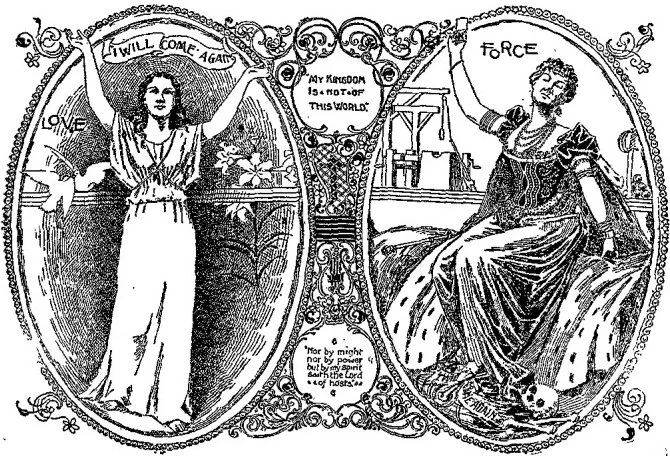
“I sit as a queen and am no widow and shall see no sorrow.” These are the boastful words of the fallen woman, the fallen Church of all the Christian centuries. She has been clothed with the purple and scarlet of civil power, and has seated herself as queen beside the Cæsars on the throne of earthly glory. Her waiting for the return of her loving husband is ended. He had given her His promise as the Prince of Heaven that he would return for her. With tender loving tones he told her of his infinite love and of his untold riches, and of his sure return. “Let not your heart be troubled. . . . In my Father’s house are many mansions, if it were not so I would have told you. I go to prepare a place for you. And if I go and prepare a place for you, I will come again and receive you unto myself, that where I am, there ye may be also.” To the plaintive reply, It will be lonesome when you are gone, he had quickly answered, “I will not leave you comfortless.” “I will pray the Father, and he shall send you another Comforter.” “He shall not speak of himself, but whatsoever he shall hear that shall he speak; and he shall show you things to come. He shall glorify me; for he shall receive of mine and show it unto you. All things that the Father hath are mine: Therefore said I that he shall take of mine and show it unto you.” “Lovest thou me?” “I have loved thee with an everlasting love.” “If ye love me keep my commandments.”
Oh what a divine story of infinite love! How could this woman so quickly forget “the chiefest among ten thousand,” the one “altogether lovely” who poured out his princely life to redeem her? How could she part with that snow white garment which had been given by her faithful Lover, every thread of which he had woven amid weariness and woe, and washed in his own blood—how could she bear to be clothed in that blood-stained robe of purple and scarlet which cruel hands had placed on her pale and patient Lord? How could she receive the crown of a queen from the power that had platted that crown of thorns? How could she forget his love? How could she send him that cold and cruel message of rejected love, “I sit a queen and am no widow.” Cæsar is now her accepted Lord, and she has ceased to look for the return of her lawful spouse.
This is the sad story as told by the Lord himself; let us now trace it in the annals of history. A single paragraph will tell how in the fourth century and onward, when the Church became wedded to the State, the doctrine of the personal second coming of Christ was rejected, and the adulterous union of the Church with the Roman empire was declared to be the fulfillment of the “blessed hope” of the apostolic church:—
“This state of matters, however [the general belief in the literal second coming of Christ], gradually disappeared after the end of the fourth century. The change was brought about by two causes,—first, Greek theology, which reached the West chiefly through Jerome, Rufinus, and Ambrose; and, second, the new idea of the Church wrought out by Augustine on the basis of the altered political situation of the Church. . . . He himself had at one time believed in it; he too had looked forward to the holy Sabbath which was to be celebrated by Christ and his people on the earth. But the signs of the times pointed to a different prospect. Without any miraculous interposition of God, not only was Christianity victorious on earth, but the Church had attained a position of supremacy. The old Roman empire was tottering to its fall; the Church stood fast, ready to step into its inheritance. It was not simply that the world-power, the enemy of Christ, had been vanquished; the fact was that it had gradually abdicated its political functions in favor of the Church. Under these circumstances Augustine was led, in his controversy with the Donatists and as an apologist, to idealize the political side of the Catholic church,—to grasp and elaborate the idea that the Church is the kingdom of Christ and the city of God. Others before him may have taken the same view, and he on the other hand never forgot that true blessedness belongs to the future; but still he was the first who ventured to teach that the Catholic church, in its empirical form, was the kingdom of Christ; that the millennium kingdom had commenced with the appearing of Christ, and was therefore an accomplished fact. By this doctrine of Augustine’s the old millenarianism, though not completely extirpated, was at least banished from the realm of the dogmatic. For the official theology of the Church it very soon became a thing of the past; certain elements of it were even branded as heretical. It still lived on, however, in the lower strata of Christian society.”—Encyclopedia Britannica, Vol. XVI, p. 317.
Turning now from the “mother” to the daughters, of the Reformation periods, let us see if they are not repeating the history of the mother of harlots. Through all the long night of apostasy the Lord has had a faithful bride who was true to his love and who was making herself ready, and patiently “looking for that blessed hope and the glorious appearing of the great God and our Saviour Jesus Christ.” As above stated, they were regarded as heretics by the reigning queen, and “confined to the lower strata of Christian society;” but this great truth lived in the same lowly “strata” in which Christ planted the truth, when he taught it to the fishermen.
At the dawn of the Reformation the “blessed hope” was revived.535
“The German and Swiss Reformers all believed that the end of the world was near.”—Ib. 318. After the successors of the early Reformers had become entangled with human governments “they took up the same ground in this respect which the Roman Catholic church had occupied since the days of Augustine.”—Ib. 318.
We will let the late Dr. A. J. Gordon, that godly Baptist minister, who though dead yet speaketh, state in his kindly way the present attitude of the daughters of the Reformation periods, on this subject:—
“It is to be regretted that our Protestant Christianity, in its separation from Rome, never passed entirely out of the baleful shadow of this pseudo-millennium. For many to this day confound the Church with the kingdom, and apply the promises of the glory of the age to come, to the present triumphs of the gospel. God forbid that in the slightest degree we should undervalue the missionary and evangelical victories which have so signally marked this century; but if we are tempted to predict the speedy conquest of the whole world to Christ through these successes, we need to be admonished to speak according to the Word. The present is the dispensation of election; the declared purpose of preaching the gospel to the Gentiles in this age is to take out of them a people for His name (Acts 15:14), and it is a premature grasping of the kingdom to apply to this period those glorious predictions of universal righteousness in the age to come, with which Scripture abounds.”
Next let a prominent Methodist clergyman, signing himself “Ignotus,” tell in his powerful style another phase of the same truth:—
“Our ministry have been dazzled and bewildered by the splendor of our unparalleled material progress. They have shared it and have been lifted by it out of the poverty and sacrifice of the fathers, clothed in purple and fine linen, and made to fare sumptuously every day. They have come to glory not in the cross, but that in preaching the gospel they have gotten beyond all its crucifixions and sacrifices, and that henceforth the world would be saved by our national progress and our splendid ecclesiastical equipage.
“All this we have accounted the good time coming, the breaking of the millennium. This is the style of boasting and conceit that has characterized our pulpits for the last twenty years, and now we awake—if we do awake—to find our progress has been material and selfish—progress toward death. I am not saying that our nation is near its downfall, but I do say we are rapidly hastening in this direction. We need only to make progress. The inevitable tendency of our current economics and politics is to anarchy through tyranny, rebellion, revolution.”—Christian Advocate, Feb. 14, 1895.
We will now submit a few quotations from the leaders in that gigantic movement of the churches called “Christian Citizenship,” to show that the control of civil affairs by the Church is now, as in the days of Augustine and onward, coming to be regarded as the fulfillment of Christ’s promise to come again:—
“Not until the kingship of Jesus is established over our land and the world, and his teachings made the rule in public affairs, will the Christian Citizenship League have achieved its purpose to prepare the way of the Lord. And then it shall be found that not only has the way for his coming been prepared, but that he has indeed and in truth come.”—The Christian Citizen, the organ of the National Christian Citizenship League, Dec., 1896.
This is exactly what the mother of harlots said in the fifth century when she had gotten control of public affairs and seated herself as a queen on the throne of the Cæsars. She said, “Christ has come.”
“We mean to lay hands on politics, we mean to wash politics clean and clothe her in white raiment, and make her an obedient handmaid to the Great King.”—“Official Report,” Boston Christian Endeavor Convention, p. 214.
This is just what the mother thought to do, but instead of clothing politics in “white raiment” she made her own white raiment scarlet with sin, and then she thought she had reformed politics, and that she was ruling as the handmaid of the Great King, when in reality she was ruling as the “great harlot” the arch-enemy of the Great King.
“What is my work as a member of a good citizenship committee? It is to enthrone Christ in every town and city in the State, to have every mayor and councilman a Christian, then Christ will rule.—Official Report, Boston Convention, p. 215.
An official description of the Christian Citizenship meeting of the Christian Endeavor Convention, held on Capitol Hill, Washington, D. C., July 11, 1896, reads thus:—
“Never before has our government permitted the area around the Capital, the very heart of the nation, to be used for other than governmental purposes. And indeed a governmental purpose was that, since the 50,000 represent nearly 3,000,000 young people whose force of character will make them the country’s governors before many a moon has passed. That grand exhibition of young manhood and womanhood is the clearest omen yet seen of the coming time when Christ, whose right it is to reign, shall be supreme on Capitol Hill.”—Official Report, p. 289.
Pages of similar quotations might be submitted, but these must suffice as samples, showing that the Roman Catholic conception of the kingdom of Christ pervades the Protestant churches. It is this papal conception that is spurring them on to gain control of civil affairs that they too may sit as queens and be widows no longer.
Meanwhile the faithful bride prepares and waits. Meanwhile she listens to the tender messages brought by the Holy Spirit from the loving Lord who shows her “things to come.” Like Stephen, filled with the Holy Ghost, she looks up to heaven and sees her husband seated at the right hand of God. As he passes from the holy to the most holy apartment of the heavenly sanctuary she follows with her loving looks. To the Spirit’s tender message from Him, “Surely I come quickly,” she lovingly answers, “Even so, come, Lord Jesus.”