The Youth’s Instructor, Vol. 27, No. 17.

A PICTURE AND A STORY

The Youth’s Instructor

Apr 30, 1879

S. D. A. Publishing Association · Battle Creek, Mich. (Pacific Coast Edition) · Apr 30, 1879

A PICTURE AND A STORY.

SIMPLE glass of home-made grape wine! Just grape juice and sugar! As if there could be any harm in that! I made it myself, too, and I should think you might drink it to please me, Uncle Will.”
“Not for my dearest and best. Not for any temptation, however great, shall a drop of wine ever pass my lips. If you love me, Marion, don’t try to tempt me, or any other man or woman. You don’t know what harm you may do.”
The fair young face was clouded, and the rosy lips curled with displeasure, as Marion Fielding turned away with the glass of untasted ruby wine.
“Uncle Will” had just returned from a long sea voyage, and great had been the rejoicing in Sunnyside at his longed-for home-coming. For he was a man greatly beloved in this pleasant country home, though he was “uncle” only in name, for he was the last of his family. He was not an old man, either, though his hair and beard were gray, and his face so grave as to be almost sad when in repose. But his smile was like sunshine, and his eyes looked out from beneath their shaggy brows, kindly and gently. All loved “Uncle Will.”
Marion’s words had touched him sorely, and he sat with his head upon his hands, and his eyes had a far-away look as if they saw things which we could not see, we young folks who had gathered to welcome our beloved wanderer home.
Somebody touched his shoulder, and a voice said, gaily, “A penny for your thoughts, Uncle Will. What do you see? You look a great way off.”
“I see a picture and—a story. But I am afraid it is too sad for you merry young people,” said Uncle Will, coming out of his revery.
Of course we did not think so, for Uncle Will’s stories were always much sought after. They were usually stories of adventure, or of far-off lands beyond the sea, from which we unconsciously learned some useful lesson while we listened with breathless interest to the story.
“This is a sad story,” he replied, “but it is true. And perhaps if I tell it to you, and show you the picture, Marion will forgive me for refusing her wine.”
“I am not angry, Uncle Will,” faltered Marion, “only a little hurt.”
“Perhaps,” he went on, “you will all agree to take my pledge, when you hear my story. Here is the picture: A low, wretched cottage beside a little stream, which is spanned by a rustic bridge. It is winter time, and the night is bright with soft moonlight, which throws weird shadows on the spotless snow, and on the water which is slightly frozen over. A little bird sits on the shore, and on the bridge a slight lad—he is little more than a boy—bends beneath a bundle of straw—” Here Uncle Will broke down, and covered his face with his hands. We all waited in silence, and directly he raised his head, and went on. But he had grown pale, and we could see traces of tears on his face.
“This is the story,” he said, in a faltering voice: “My father died when my only brother and I were little boys. It is not necessary to say much about him, only that drinking a glass of wine was the first step he took in the downward road which led to death. We had been rich, and my mother was a lady born and bred, a tall, dark, sad-eyed woman, a Christian, if ever there was one. Now we became poor, and after many changes we went at last to live in a little thatched cottage beside a brook, spanned by a rustic bridge. Here were passed some of my happiest days, for our mother was teacher, friend, and everything, next to God, to her two boys. But the times grew harder, and the winter that I was ten years old, and Leon, my brave, handsome brother, was twelve, the wolf was at the door. Daisy supplied us with milk, else we should have gone hungry many a day. But by-and-by poor Daisy had nothing to eat.”
“I will go up to farmer James’s house,” said Leon, “and borrow a bundle of straw or hay. I can bring it, I know, and poor Daisy shall not starve.”
The sun went down, and the moon came up, but Leon had not returned. We grew anxious, and, watching from the window, at length I saw him coming. His step was unsteady, and half way across the bridge he staggered, and fell down,—down through the thin ice into the deep water. He was dead when help reached us. It was only a glass of home-made grape wine, given him in mistaken kindness, which made his head giddy and feet unsteady. Poor Leon! Dear, brave little man! My mother died soon after. She never recovered from the shock. Beside her bed I knelt, and promised her and God that I would never drink a drop of anything that can intoxicate—not even a glass of home-made wine! Oh, such a wonderful brightness came into her dying face! I can never forget it or my promise. So, can you forgive me, Marion?”
“Forgive you!” said impulsive little Marion. “O Uncle Will, can you forgive me?”
“If you will take my pledge!” said Uncle Will, gravely.
Do you think Marion could refuse? No, indeed! So we became a band of teetotalers from that hour. And could anything better have resulted from a picture and a story? How many of my readers will join our band?—Little Star.

WHAT TO DRINK.

The lily drinks the sunlight; The primrose drinks the dew; The cowslip sips the running brook; The hyacinth, heaven’s blue; The peaches quaff the dawn-light; The pears, the autumn noon; The apple blossoms drink the rain, And the first warm air of June.
The wild flower and the violet Draw in the April breeze; And the sun and rain and hurricane Are the tipple of the trees; But not a bud or greenling, From the hyssop on the wall To the cedars of Mount Lebanon, Is steeped in alcohol.
From all earth’s emerald basin, From the blue sky’s sapphire bowl, No living thing of root or wing Partakes that daily dole. I’ll quaff the lily’s nectar; I’ll sip the cowslip’s cup; I’ll drink the shower, the sun, the breeze, But ne’er the poisoned drop.

From Sea to Sea: Mystery of the Carson Sink

FROM SEA TO SEA.—NO. 6.

I wonder how many of our readers have solved the mystery mentioned in our last, and are prepared to tell us what becomes of all the water flowing into that wonderful lake, or sink, which, as you will remember, we said had no visible outlet. There is, however, a small channel, which, in time of high water, carries the surplus water into the lower sink a few miles further down; but this can hardly be called an outlet, since this lower sink, into which another large river,—the Humboldt,—empties, has no outlet. So here are two large rivers, sometimes running hundreds of square feet of water per minute, constantly flowing into these two sinks to which no outlet can be seen.
There are various conjectures as to what becomes of the water. Some suppose that there is an underground connection between these and other bodies of water. Others claim that the water is absorbed by the dry atmosphere of the valley; and still others, that, as the soil of that country is gravelly and very porous, it passes off through the soil, and bursts out in springs at some point farther down the mountain.
Perhaps there is some truth in all these theories; the water may be disposed of in all three of the ways above mentioned. I was inclined to think so, when I viewed these wonderful lakes. I was told that they had tried to sound, or measure, the upper Carson sink, but that near its center no bottom had ever been touched.
Not far from these sinks there is another curiosity, called Borax Mine. During the process of evaporation, the water from borax springs has crystallized, and formed thick layers of borax. This article, as you doubtless know, is used very extensively by blacksmiths in welding iron, and by furnace men when working small scraps of iron into a solid mass for future use. I was told that the borax of this mine is of a very superior quality; but, as with the chalk mountain, it is too far from market to be profitably worked at present. This valley being situated between high ranges of mountains, it seldom rains here; but there are two or three days in almost every week when the wind whirls the sand through the valleys in a most furious manner, sometimes filling the whole atmosphere with it. At such times, it is most pleasant to remain in the house.
Were it not that the land along the streams, where water can be obtained for irrigating purposes, is very productive, this vast desert would probably be resigned by the whites to the Piute Indians, and the coyote,—a species of desert wolf.
Both the Piute and the coyote—pronounced kīōta—abound here. The howl of a pack of these coyotes in the dead of night reminds one of a score of children all crying at once. The Piutes are a very inferior-looking race, not at all worthy of the old appellation, “The noble Indian.” Their heads are flat on the top, and their general appearance is much like that of the “Digger Indians” we saw on the other side of the Nevadas. They do not appear like a warlike people; but rather seem inclined to be docile, and to seek the friendship of the whites.
Although the government, a few years since, placed these Indians on a reservation, many of them have returned, and made huts along the river where they once lived, and near the residences of the white people. When asked why they did not remain on the reservation, they say, “We heap more like him here.” “We heap more like worke here.” “We heap more cache food here.” It appears from their talk that the government agents on the reservation, instead of freely giving them the supplies sent to be distributed among them, sold them food, and exacted work of them at low figures. These unlettered Indians had wit enough to know that they could get more food for their labor among the whites than from the agents on the reservation, therefore they returned.
The Piutes, like all other Indians, do not like to work. They will work a few days, and then lie still until they have eaten up all that they have earned, when they will come and beg of the whites. As long as they can get food in this way, they will not labor; but rather than starve, they will work. They come with a whining, plaintive tone, and say, “Heap-hog-a-die,” meaning that they are very hungry. If nothing is given to them, they say, “We work. Heap-hog-a-die. We work.” That is, they are very hungry, and want to work so as to get something to eat. We will say more about these Indians soon.
J. N. LOUGHBOROUGH.

GOING TO SEA.

A boy of sixteen found Oliver Optic’s books in a Sunday-school library. He read them, and resolved to be a sailor. His father was wise enough to let him try the experiment. He got a place for him on a vessel that was going to Australia. The boy made the voyage before the mast, and has just returned. He is cured. He has lost faith in Oliver Optic. He don’t believe that his books are good reading for boys. He don’t want to be a sailor any longer. He don’t dream now about “a life on the ocean wave.” He says that six months at sea were just so much of his life thrown away. It was dreadfully monotonous; nothing, day after day, but the sea and the sky—no mental stimulus, no objects of interest—only a dull round of duty, and rations of salt junk and hard-tack.
That boy is glad enough to be at home again—glad enough to go to school again. He thinks the six months of his voyage, time wasted; but if it makes him contented, leads him to improve well his opportunities, and read better books, it may be profitable after all.
We have a good deal of juvenile literature that, without being positively immoral, is yet demoralizing. It gives the young false ideas of life. It cultivates morbid fancies. It unfits them for that patient industry and application which are the only guarantees of success.—Herald and Presbyter.

DON'T BE CRUEL.

We call a person cruel who loves to tease, torment, or put in misery anything which has life. This habit of teasing prevails most largely with boys, some of whom are even cruel with their playmates, seemingly most happy when causing them sorrow or pain. Although others may not venture to inflict severe suffering upon their fellows, yet their greatest delight is in tormenting dumb animals. Nothing which falls in their way escapes unmolested. If the unfortunate creature is an insect, its wings and legs are pulled off, and its body left with a pin or needle thrust through it, to bear the infliction as best it can. Birds are robbed of their nests and young; four-footed animals, chased and stoned.
We will here relate a circumstance of cruelty to animals which we think will touch a tender chord in many hearts; and do any of the dear readers of the INSTRUCTOR ever treat unkindly helpless animals, we trust it may be the means of preventing further acts of cruelty. It is a true story, which came to the Sunday School Advocate all the way from Copenhagen, Denmark. It reads as follows:—
A boy some weeks since, while walking beside a pond near this city, saw a frog before him, and, sharpening the stick he chanced to have in his hand, he cruelly inserted it through the flesh of the animal into the mud, thus pinning him to the earth, and went his way, supposing the frog would soon die.
Happening to pass the same way twelve days afterward, he was surprised and shocked to find the frog still alive; and its emaciated form and glaring eyes told plainly the story of its suffering.
This so impressed the boy with his own cruelty that he could not study, nor play, nor sleep. The eyes of the frog seemed to follow him wherever he went; and, notwithstanding all efforts to divert his mind, it so worked upon him that he was finally thrown into a fever, from which in less than two weeks he died.
Boys, are you addicted to cruel habits, cultivate kindly feelings toward all of God’s creatures, even though it be a dumb animal; for you cannot expect the great and holy God, who notices even the tiny sparrow’s fall, will hold those guiltless who inflict needless pain upon any thing which he has created.
M. J. C.

LESSONS FOR CHILDREN.

LESSON XVII.—GIDEON AND THE ANGEL.

GIDEON wished the angel to give him a sign, and begged him to wait until he should bring him a present. “And Gideon went in, and made ready a kid, and unleavened cakes of an ephah of flour; the flesh he put in a basket, and he put the broth in a pot, and brought it out unto him under the oak, and presented it.
“And the angel of God said unto him, Take the flesh and the unleavened cakes, and lay them upon this rock, and pour out the broth. And he did so. Then the angel of the Lord put forth the end of the staff that was in his hand, and touched the flesh and the unleavened cakes; and there rose up fire out of the rock, and consumed the flesh and the unleavened cakes. Then the angel of the Lord departed out of his sight.
“And when Gideon perceived that he was an angel of the Lord, Gideon said, Alas, O Lord God! for because I have seen an angel of the Lord face to face. And the Lord said unto him, Peace be unto thee; fear not: thou shalt not die.”
That same night the Lord told Gideon to throw down the altar of Baal which his father had, and to cut down the grove which was by it; to build an altar to God on the spot where the angel had brought fire out of the rock, and offer on it one of his father’s bullocks. All this, Gideon did in the night, because he feared his father’s household and the men of the city.
In the morning, when the men of the city saw what was done, they were very angry, and called upon Joash to bring forth Gideon to die. “And Joash said unto all that stood against him, Will ye plead for Baal! will ye save him? he that will plead for him, let him be put to death whilst it is yet morning; if he be a god, let him plead for himself, because one hath cast down his altar. Then all the Midianites and the Amalekites and the children of the east were gathered together, and went over, and pitched in the valley of Jezreel.”

QUESTIONS.

  1. What did Gideon ask the angel to do? Judges 6: 17, 18.
  2. What did he bring to the angel? Verse 10.
  3. What did the angel tell Gideon to do with these things?
  4. What miracle did the angel perform?
  5. Did the angel eat the food?
  6. What did become of it?
  7. What became of the angel?
  8. What did Gideon say when he perceived that it was an angel that had been talking with [him?
  9. Who answered him?
  10. What did the Lord say to him?
  11. When did the Lord speak to Gideon again? Verse 25.
  12. What did he tell him to do?
  13. When did Gideon do these things?
  14. Why did he take the night for such a work?
  15. How did the men of the city feel, when they knew what Gideon had done?
  16. What did they do?
  17. What did Joash say to them?
  18. What did the Midianites and Amalekites then do?
  19. Where did their army encamp?

BIBLE LESSONS FOR YOUTH.

LESSON XLIII.—THE PEOPLE LUST FOR FLESH.

1. AFTER the sanctuary was completed, what did the Lord tell the people to do? Num. 9.
2. What was the appointed time for keeping the passover?
3. How long had it now been since they left Egypt?
4. When did they journey out of the wilderness of Sinai? Num. 10:11, 12.
5. After journeying three days, to what place did they come? Num. 10:33–36; 11:1–3.
6. How did the people displease God at this place?
7. How were they punished?
8. How was the fire quenched?
9. Into what sin were the people afterward led by the mixed multitude that was among them?
10. What question did they ask?
11. What did they remember?
12. What bitter complaint did they make?
13. What did they seem to have forgotten?
14. Of what only did they think?
15. How did Moses feel when he saw them taking such a course?
16. What did he say to the Lord?
17. What did the Lord tell him to do?
18. What did the Lord promise to do for these men?
19. What was Moses to say to the people?
20. How was the flesh supplied?
21. How abundant were the quails?
22. Describe the gathering of the quails.
23. How did the people suffer for their gluttony?
24. What name did Moses give to this place?
25. Why did he name it thus?

SYNOPSIS.

After the work of building the tabernacle was completed, the Lord spoke unto Moses that they keep the feast of the passover at its appointed time. So on the fourteenth day of the first month, just one year from the time they left Egypt, they celebrated the passover. On the twentieth day of the second month the cloud was taken up from off the tabernacle of testimony, and the children of Israel journeyed out of the wilderness of Sinai, where they had now been nearly a year. “And they took their journey according to the commandment of the Lord by the hand of Moses.”
After three days they came to Taberah. Here the people complained, and it displeased the Lord, and his anger was kindled; and the fire of the Lord burned among them, and consumed them that were in the uttermost parts of the camp. “And the people cried unto Moses; and when Moses prayed unto the Lord, the fire was quenched.”
“And the mixed multitude that was among them fell a lusting; and the children of Israel also wept again, and said, Who shall give us flesh to eat. We remember the fish which we did eat in Egypt freely; the cucumbers, and the melons, and the leeks, and the onions, and the garlicks. But now our soul is dried away; there is nothing at all, beside this manna, before our eyes.”
They seemed to have forgotten their hard bondage, and the cruel treatment which they had received from the Egyptians, and thought only of the opportunities they had there for indulging their appetite.
Moses was greatly distressed at the course the people had taken, and he cried to the Lord, saying, “I am not able to bear all this people alone, because it is too heavy for me.” So the Lord told Moses to choose out seventy men whom he knew to be elders in Israel, and he would put on them of his Spirit, that they might bear the burden of the people with him. He also told Moses to say unto the people that they should have flesh to eat, not one day, nor two days, nor five days, nor twenty days; but even a whole month, until it should become loathsome unto them.
“And there went forth a wind from the Lord, and brought quails from the sea, and let them fall by the camp, as it were a day’s journey on this side, and a day’s journey on the other side, round about the camp, and as it were two cubits high on the face of the earth,” or, as the Vulgate renders it, “They flew in the air at the height of two cubits above the ground.”
The people stood up all that day, and all that night, and all the next day, and gathered quails; but the Lord was so displeased with their gluttony that he smote them with a very great plague. And Moses called the name of the place Kibroth-hattaavah, because there they buried the people that lusted.
G. H. BELL.

PROPER EDUCATION.

It is the nicest work ever assumed by men and women to deal with youthful minds. The greatest care should be taken in the education of youth to vary the manner of instruction so as to call forth the high and noble powers of the mind. Parents, and teachers of schools, are certainly disqualified to educate children properly, if they have not first learned the lessons of self-control, patience, forbearance, gentleness, and love. What an important position for parents, guardians, and teachers! There are very few who realize the most essential wants of the mind, and how to direct the developing intellect, the growing thoughts and feelings of youth.
Those who deal with the young should be very careful to call out the qualities of the mind, that they may better know how to direct their powers, and that they may be exercised to the very best account.
Vital godliness is a principle to be cultivated. The power of God can accomplish for us that which all the systems in the world cannot effect. The perfection of Christian character depends wholly upon the grace and strength found alone in God. Without the power of grace upon the heart, assisting our efforts, and sanctifying our labors, we shall fail of saving our own souls, and in saving the souls of others. System and order are highly essential, but none should receive the impression that these will do the work without the grace and power of God operating upon the mind and heart. Heart and flesh would fail in the round of ceremonies, and in the carrying out of our plans, without the power of God to inspire and give courage to perform.
There should be discipline and order in our Sabbath-schools. Children who attend these schools should prize the privileges they enjoy. They should be required to observe the regulations of the Sabbath-school. And even greater care should be taken by the parents, that their children should have their Scripture lessons learned more perfectly than their lessons in the common schools. If parents and children see no necessity for this interest, then the children might better remain at home; for the Sabbath-school will fail to prove a blessing to them. Parents and children should work in harmony with teachers and superintendent, thus giving evidence that they appreciate the labor put forth for them. Parents should have an especial interest in the religious education of their children, that they may have a more thorough knowledge of the Scriptures.
There are many children who plead a lack of time as a reason why their Sabbath-school lessons are not learned. There are but few who cannot find time to learn their lessons if they have an interest in them. Some devote time to amusement and sight-seeing, while others devote time to needless trimming of their dress for display, thus cultivating pride and vanity. The precious hours thus prodigally spent are God's time, for which they must render an account to him. The hours spent in needless ornamentation, or in amusements and idle conversation, will with every work be brought into judgment. E. G. W.

Gratitude, the Music of the Heart

GRATITUDE is the music of the heart when its chords are swept by the breeze of kindness.

A CURIOUS WAY OF TRAVELING.

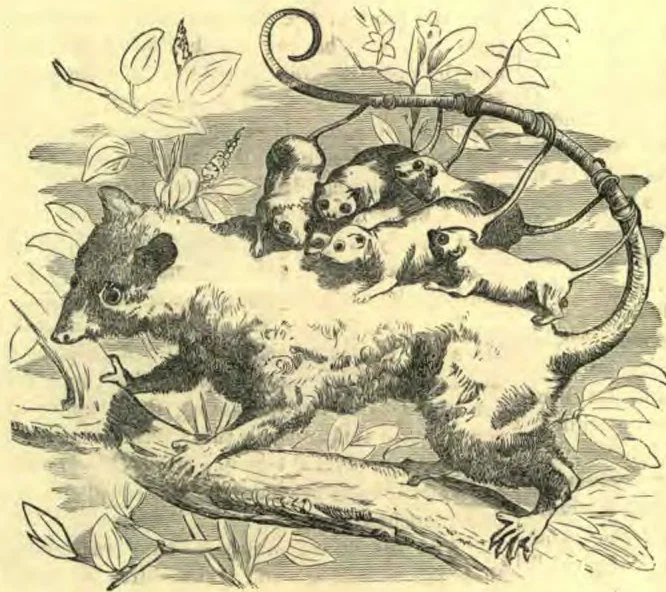
ONE kind of Opossum has a pouch in which it carries about its little ones, something like the Kangaroo; but there is a smaller kind which has no pouch in which to carry its young; so the mother lets them crawl upon her back, and twine their slender tails around hers, and cling with their feet to her soft fur; and thus carrying her family of little ones, she climbs the trees and goes about through the woods and fields in search of food for them. It is wonderful that the tiny little ones should have sense enough to get upon her back and curl their tails around hers, but most animals soon after birth know how to take care of themselves. Man is helpless and ignorant. But then animals do not grow wiser as they grow older, while man from babyhood to the latest days of his life in this world is continually learning; and if he lives in obedience to the will of his Father in Heaven, he will grow wiser and happier forever.

LETTER BUDGET.

SUMMER SHADE, KY.
DEAR EDITORS: I try to keep the Sabbath with pa and ma, although I am only seven years old. I attend Sabbath-school every Sabbath, and take the weekly INSTRUCTOR. I learn the lessons for children and youth, and the lessons on prophecy. Ma says she wants me to know the Holy Scriptures from a child. This is my first letter to the INSTRUCTOR. I like to read the letters, and then the answers. I will send a dime for the Tabernacle. I hope the INSTRUCTOR family will all be ready when Jesus comes.
FANNIE H. BRANSTETTER.
FAIR HAVEN, MINN.
DEAR EDITORS: I have often thought that I would write to you and express my gratitude for the INSTRUCTOR. I prized it very much when it came monthly, but much more since it comes weekly. I am ten years old. I keep the Sabbath with my parents, and am trying to be a Christian. We have no organized Sabbath-school, but four or five families meet every Sabbath and have a Bible Class and Youth’s Class. I get the lessons for youth that come in the paper each week. I have commenced reading the Bible through this year, for I want a knowledge of God’s word. I want to be an overcomer, and meet all the INSTRUCTOR family in the new earth.
Yours truly,
MYRTA MEAD.
ELVON, KANSAS.
DEAR EDITORS: I have been taking the INSTRUCTOR more than four years, and like it better than any other paper I have ever seen. My parents were the only ones that kept the Sabbath here for two years, until Eld. Bourdeau came here about four months ago, and raised up a church of twenty-four members. We have good Sabbath meetings and Sabbath-school, for which we are very thankful. Our church now takes twelve copies of the weekly INSTRUCTOR. I was baptized Jan. 4, 1879, by Eld. J. H. Cook. I am trying to overcome all my bad habits, that I may meet those who keep the commandments of God and the faith of Jesus, on Mount Zion. Yours in love,
MARTIN P. MANNY.

ONLY ONE.

There was but one crack in the lantern; the wind found it out, and blew out the candle. How great a mischief one unguarded point of character may cause us! One spark blew up the magazine, and shook the whole country for miles around. One leak sunk the ship, and drowned all on board. One wound may kill the body; one sin destroy both soul and body.

HOW TO THANK.

An old Scotchman was taking his grist to mill in sacks thrown across the back of his horse, when the horse stumbled, and the grain fell to the ground. Being an aged man, he had not strength to raise it; but he saw a horseman riding along, and thought he would appeal to him for help. But the horseman proved to be the nobleman who lived in the castle hard by, and the farmer could not muster courage to ask a favor of him. But the nobleman was a gentleman, and, not waiting to be asked, he quickly dismounted, and between them they lifted the grain to the horse’s back. John, for he was a gentleman, too, lifted his Kilmarnock bonnet, and said, “My lord, how shall I ever thank you for your kindness?” “Very easily, John,” replied the nobleman. “Whenever you see another man in the same plight as you were in just now, help him, and that will be thanking me.”

THE LONGEST WORD.

“Rob,” said Tom, “which is the most dangerous word to pronounce in the English language?”
“Don’t know,” said Rob, “unless it is a swearing word.”
“Pooh!” said Tom, it is stumbled, because you are sure to get a tumble between the first and the last letters.”
“Ha! ha!” said Rob. “Now I’ve one for you. I found it one day in the paper. Which is the longest word in the English language?”
“Valetudinarianism,” said Tom, with promptness.
“No, sir; it is smiles, because there is a whole mile between the first and last letter.”
“Ho! ho!” cried Tom, “that’s nothing; I know a word that has three miles between its beginning and ending.”
“What’s that?” asked Rob, faintly.
“Beleaguered,” said Tom.—Sel.

Rousseau on Natural Deportment and Personal Character

THERE is a deportment which suits the figure and talents of each person; it is always lost when we quit it to assume that of another.—Rousseau.

MARCH WINDS AND APRIL SHOWERS.

O'er meadows strewn with flowers, There can't be sunshine every day; At times the tempest lowers, We cannot always have our way.
There's work in life as well as play, There must be serious hours; Cold, blust'ring March winds lead the way To softer April showers.
And then will come the lovely May, That calls to woods and bowers, When both alike have sped away, March winds and April showers.
Hope comes before the sunshine ray; God gives to each the power To struggle bravely on the way, Through wind and rain and shower.
Then, little children, never fear, God knows each want of ours, And sure as comes the tempest drear, So surely come the flowers.
—Your Paper.

THE WAY TO WORK.

LITTLE by little, the sparrow said, As she brought a straw, a stick, a thread; Little by little, one by one, Till at last her nest was done.

You have reached the end of this edition.

The Youth’s Instructor · Apr 30, 1879