The Youth’s Instructor, Vol. 32, No. 30.

EACH DAY ITS VERSE

The Youth’s Instructor

Jul 23, 1884

S. D. A. Publishing Association · Battle Creek, Mich. · Jul 23, 1884

EACH DAY ITS VERSE.
In an old German village in the heart of Bavaria, in a queer old house, that looked as if it had never been built, but had sprouted and grown, and had never been pruned, one day sat by her sunny, deep window an old woman, who herself looked as if she had not only grown, but had ripened, and then been preserved, like a prune or a fig, into something sweet and good, that would keep forever.
She was knitting now, and had been knitting always, and it seemed she might continue to knit till the end of time. I dare say she had covered many hands and feet in her lifetime, and made them warm. How much of her had gone into needle and yarn, who can tell?
But other things are knitting and are knitted day by day. Heads and hearts and souls are knitting all the time.
Before her sat a young girl as fair of face as apple-blooms; white and pink and red blended from cheek to brow, and yellow strands of hair lay down her waist. A great Bible lay in her lap, from which she was about to read. Now she paused and listened, and lifted her clear, blue eyes to the aged face.
“No day without its verse,” said old Mathilde, as the needles flashed in the sunlight.
“They are Master Luther’s words; and good words they are, my Madchen, and true as the sun. “‘Stitch by stitch, Minute by minute, Verse by verse,’ that is the way all good work comes.
“‘No day without its verse’ turned the gospel of our Lord into the German, for every soul to feed upon and be made strong.”
The woman paused. The young girl went on reading the wonderful old words of inspiration that have thrilled millions of hearts down through all the centuries to this day. She read, “Let not your heart be troubled. Ye believe in God, believe also in me. In my Father’s house are many mansions. If it were not so, I would have told you. I go to prepare a place for you. . . . Whither I go ye know, and the way ye know.”
At every added sentence the old woman swayed back and forth, and murmured, “Yes, yes, yes! That is enough, my Madchen, for to-day—enough, and more than enough. To-day we will have, ‘Let not your heart be troubled;’ and our hearts will not be troubled. They will be quiet as the warm sunlight falling in at the window, untroubled as the birds flitting hither and thither through the vines without. We children of Christ may not be afraid, or dismayed, or discouraged, when he saith, ‘Let not thy heart be troubled.’ Ay, ’tis a precious verse; for he stands the other side, beyond our seeing, and sees the things we may not see, and knows the things we may not now know; and so he whispers all the day, ‘Let not thy heart be troubled;’ for he knows the worst that can come to any one is not fatal—no, not if this old body is tied to the stake, and the flames consume it;” and she dropped her knitting, and uplifted her two hard, old hands—“not fatal so long as this is secure,” and she laid her hand upon her heart, and her aged face was lit with a strange radiance. “For as Master Luther learned, ‘The just shall live by faith;’ why, therefore, be troubled? Why? And when he had learned that lesson, he goes on and on, with every day its verse, its blessed verse, until all are put in our hands too.
“To-morrow, child, we will think about the many mansions, and after that about the ‘Comforter,’ even the Spirit of truth, which in troubled times brings to the remembrance the precious words a poor old head cannot always hold when other things crowd in.
“So, so, so! little by little, stitch by stitch, day by day, and verse by verse, does everything go on, and truth is the same and forever, as the sun, and forever new and different, as the trembling leaves, and the bursting flowers, and the waters with the breeze across it.”
Little Madchen turned her blue eyes toward the casement, and wondered what good Mathilde could mean; and she wondered, too, why she liked always to be beside the lonely old woman, and read the good Book to her. And she wondered if she should ever be able to know what it was all about, from first to last. And then she thought, “Maybe I shall, if I go stitch by stitch, in patience and in love.”—Selected.

THE BRIDGE OF PLANKS.

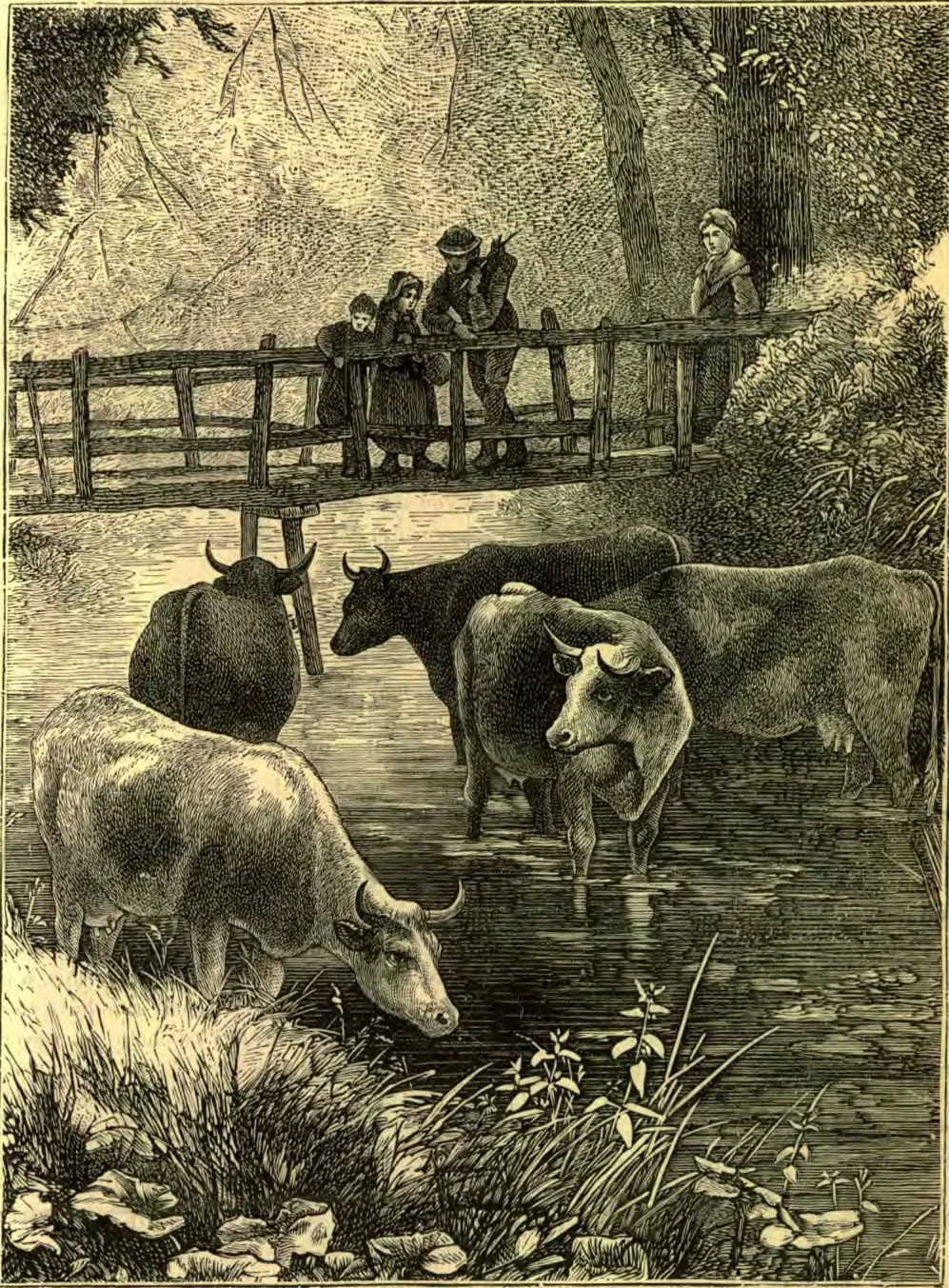
Spanning the streamlet’s grassy banks, Above the shallow brook, Stands the old-fashioned bridge of planks, In a cool and shady nook.
An alder and an aged thorn Over the waters meet, And the wooden path is thin and worn With the tread of many feet.
For from the hamlet on the hill That ancient footway leads, Over the narrow, brawling rill, Into the woods and meads.
The sturdy laborer, hale and strong, Crosses with heavy tread, While the lark trills out his morning song High o’er his dewy bed.
The sun-burned children, girls and boys, In wild and merry rout, In the full prime of childhood’s joys, Pass over with a shout.
The gray-haired patriarch loves the place, He sees it from his cot, And totters down, with feeble pace, To linger near the spot.
The peaceful cows come down to drink,— Escaped the summer’s sun,— And in the shade of elm and oak, Stand knee-deep in the run.
Through summer’s heat and winter’s cold, Spanning the grassy banks, It stands, the friend of young and old, The trusty bridge of planks.
—Selected.

ASHAMED OF MOTHER.

IN a small town in one of our Eastern States, occurred, quite a number of years ago, the incident I am about to relate. It is a true story; and we think carries with it a moral which many of our boys and girls of to-day may well apply to themselves.
A singing-school had been in progress for some time, and a concert was to be held to close the exercises. The professor who had conducted the school was a fine musician, and had for an assistant a young lady who was an accomplished organist and also a good singer. The scholars composing the school were to take part in the concert exercises, and their relatives and friends assembled to see what progress had been made.
Among those who had been learning to sing was a girl, about sixteen years of age, whom we will call Jennie, who especially admired Miss Smith, the teacher’s assistant. During the evenings they had been together, she became somewhat acquainted with her.
While Jennie was enjoying the singing-school and the social intercourse of young friends, her patient, careworn mother had stayed at home, and toiled far beyond her strength for the comfort of her family. She was an earnest, Christian woman, and cared less for the outward show of the body, than for the inward adorning of the mind.
On this occasion, she came with others to listen to the music, having a feeling of pride in the musical talent of the dear daughter for whom she had toiled since earliest infancy. At this time, unlike more fashionable ladies, she wore a plain hood, while all others wore hats or other head dresses of a later style.
The singers had already arrived, and had taken positions on the rostrum near the organ, waiting the hour of commencement. Meanwhile the audience were coming in; and as Miss Smith and our young friend were chatting together, she turned, and suddenly said, “Isn’t that a funny looking old woman sitting over there with a hood on?”
Alas, for Jennie! Instead of feeling proud of the dear mother, and owning their relationship at once as a rebuke to her newly formed acquaintance, she joined in the witticisms of her friend, and like another Peter, acted, if she did not say, “I know not the man.”
But the voice of conscience long reproved her for her sin; and in after years, by kind and loving words and deeds she strove to make amends for the shameful denial of that evening.
Dear young friends, are you ashamed of your quiet, godly, old-fashioned mother? Would you rather not be seen with your gray-haired, home-spun father? If so, you are unworthy of such good parents. You should thank God every day for giving them to you, and on every occasion possible you should let them know that you feel proud of them. Both have toiled long and hard for you. They have cared for you in sickness and in health, when other friends would have forsaken you. They have prayed for you, and loved you—how much you may never know.
Their hands have grown hard and rough toiling for you. Their hearts have ached when you did wrong, and they feared their hopes for you would be disappointed. They have denied themselves many comforts that they might give you superior advantages. Now will you, can you, be ashamed of them because they are old-fashioned perhaps, or have not had the privileges granted you? Or, will you stand by them, love and honor them—yes; be proud of them, as you are of no other friends on earth?
It is a sign of the times in which we are living that persons will be proud, disobedient to parents, unthankful, and unholy. Perhaps all who read this may not be of that class that are disobedient; but an examination may show that we are not as thankful as we should be.
Let us, then, show that love for our parents that we will wish we had when the time shall come to us, as it has to many, that we shall look on the patient face with the tender eyes closed forever, and see the hands folded to toil for us no more. May we have no sad memories to make more bitter the loss of father or mother. Besides this, a record is kept in heaven, and we shall soon have to meet all these things. May God help us never to be ashamed of our parents!
VESTA J. OLSEN.

A CURIOUS BOOK.

THE most curious book in the world is one that is neither written nor printed. Every letter of the text is cut into the leaf, and, as the alternate leaves are of blue paper, it is as easily read as the best print. The labor required and the patience necessary to cut each letter may be imagined. The work is so perfect that it seems almost as though done by machinery, but every character was made by hand. The book is entitled, “The Passion of Christ.” It is a very old volume, and was a curiosity as long ago as the year 1640. At this time it belonged to the family of the Prince de Ligne, and it is now kept at a museum in France.—Sel.

EDITOR'S CORNER.

We think it is safe to say there is hardly a school-boy in the United States who does not know something of the life and character of George Washington, our nation's first President,—of his noble, manly bearing, even in his childhood, and his firm purpose to do what was right, though he should suffer in consequence. He was one who, in making decisions, gave no place to self; he had but to settle in his own mind what was right, and what was duty, and then no outside influence could turn him from doing it.
If you have not already done so, dear reader, you should, at your first opportunity, read the life of this great man. You would derive benefit by reading it more than once; for we think you cannot hear or read of his purity and noble traits of character without admiring them, and determining in your minds that you will aim even higher in your own character-building.
In shaping our lives, we are all the time being influenced by those with whom we are most nearly associated; so, too, by what we read. If we avoid evil companions, evil books, and evil thoughts, we shall escape their defilement. If our minds are occupied only with what makes noble lives, the effect can but be good. Let us attend to Paul's admonition to the Philippians, “Whatsoever things are true, whatsoever things are just, whatsoever things are pure, whatsoever things are lovely, whatsoever things are of good report; if there be any virtue, and if there be any praise, think on these things.”
We here give you as a subject for thought an example of the General's fidelity. While he was President of the United States, a man with whom he had been very intimate during all the Revolutionary war, applied to him for a responsible and well-paying office. The gentleman was a lively, modest, and agreeable companion, whom the President regarded at all times with feelings of the utmost confidence and esteem. In applying for the office, he felt certain that he should receive it, and his friends, also, felt so sure of his success that they even congratulated him upon his future good prospects.
This gentleman had an opponent who belonged to the opposite party, one who was decidedly hostile to Gen. Washington's politics, and during the war had made himself conspicuous in that position. But for all this he was bold enough to stand as a candidate for the same office as the General's special friend. He could only urge in his own favor his honesty, promptness, and faithful business habits, and those qualities which, if called into exercise, would make his services valuable to the Government.
No one thought his appointment was possible. It was known that he was the General's political enemy, and that his opponent was his favorite; yet he boldly sought the office, and received the appointment, while Washington's friend was rejected. A mutual friend undertook to reprove the President for the injustice of the appointment, when he replied:—
“My friend I receive with a cordial welcome. He is welcome to my house, and welcome to my heart. But with all his good qualities he is not a man of business. His opponent is, with all his political hostility to me, a man of business. My private feelings have nothing to do in this case. I am not George Washington, but President of the United States. As George Washington, I would do this man any kindness in my power; but as the President of the United States, I can do nothing.”
M. J. C.

SOWING

We can never be too careful What the seed our hands shall sow; Love from love is sure to ripen, Hate from hate is sure to grow; Seeds of good or ill we scatter Heedlessly along our way; But a glad or grievous fruitage Waits us at the harvest day. Whatsoe'er our sowing be, Reaping, we its fruits must see.

IMPORTANT BIBLE SUBJECTS.

LESSON 4.—SIGNS OF CHRIST’S COMING.

[NOTE TO THE STUDENT.—Do not consider the lesson learned until you can give at least the substance of every text, with the correct reference for each. The references in black letters indicate those texts that should be committed to memory. A little diligent application each day will enable you to do this.]
  1. In our last lesson, what scripture was quoted concerning a time of tribulation?
  2. What was this time of trouble to follow?
  3. Show that the time of trouble referred to does not mean the destruction of Jerusalem.
  4. Prove that the predicted tribulation was to come upon the people of God alone.
  5. Repeat the words of prophecy that foretell such a period of tribulation. Dan. 7: 25.
  6. What power is here referred to as “wearing out” the saints of God?
  7. How long were the saints and laws to be given into his hand?
  8. To how many days is this equal? Rev. 12: 6, 14.
  9. In symbolic prophecy, what does a day represent? Eze. 4: 5, 6.
  10. Then how many years of papal supremacy and persecution were predicted?
  11. From what date are they to be reckoned?
  12. Then when would they end?
  13. How was the papal power broken in 1798?
  14. What did Christ say would be done to those days for the elect’s sake? Matt. 24: 22.
  15. What must be meant by this?
  16. What great movement produced a sentiment against persecution for conscience’ sake?
  17. What did the Lord say would immediately follow the tribulation of those days? Matt. 24: 29.
  18. How definitely is the beginning of these signs located? Mark 13: 24.
  19. When did the darkening of the sun and moon take place?
  20. When was the prophecy concerning the falling of the stars fulfilled?
  21. Is the shaking of the powers of the heavens a sign of the coming of the Lord, or something that occurs in connection with it? 2 Pet. 3: 10.
  22. Are there to be any signs besides those in the heavens? Luke 21: 25.
  23. When these signs begin to come to pass, what is near? Luke 21: 28.
  24. How can we tell when summer is approaching? Luke 21: 29, 30.
  25. Do the signs here considered just as surely prove that Christ’s coming is near? Verse 31; Matt. 24: 32, 33.
  26. Are we to admit of any doubt concerning it?
  27. If the Lord commands us to know, is it not a sin to remain ignorant?

NOTES.

Dr. Adam Clarke, on Dan. 7: 25, says: “To none can this apply so well and so fully, as to the popes of Rome. They have assumed infallibility, which belongs only to God. They profess to forgive sins, which belongs only to God. They profess to open and shut heaven, which belongs only to God. They profess to be higher than all the kings of the earth, which belongs only to God. And they go beyond God, in pretending to loose whole nations from their oaths of allegiance to their kings, when such kings do not suit them. And they go against God, when they give indulgences for sin.”
Until a time and times and the dividing of time.—“In prophetic language a time signifies a year, and a prophetic year has a year for each day. Three years and a half (a day standing for a year, as in chap. 9: 24), will amount to one thousand two hundred and sixty years, if we reckon thirty days to each month, as the Jews do.”—Ib.
The 1260 years of papal supremacy must begin in 538 A. D., in order that the facts may agree with all the specifications of the prophecy. For proof, see quotations from history in “Thoughts on Daniel,” on this text.
“The year 1797 was marked by a continuance of the same vexatious measures; and at length the Directory ordered the invasion of Rome; Berthier entered the city Feb. 10, 1798, and took possession of the castle of St. Angelo. Pius [VI.] was called on to renounce his temporal sovereignty, and on his refusal, was seized February 20, and carried away to Siena, and afterward to the celebrated Certosa, or Carthusian monastery of Florence. On the threatened advance of the Austro-Russian army in the following year, he was transferred to Grenoble, and finally to Valence, on the Rhone, where, worn out by age and by the rigor of confinement, he died in August, 1799, in the 82d year of his age, and the 24th of his pontificate.”—Chambers’ Encyclopedia, Art. Pius.
But for the elect’s sake those days shall be shortened.—“Of course this does not mean that the days of papal supremacy would be any less in number than was foretold in prophecy; that could not be. It can only mean, therefore, that the days of persecution, within the 1260 years, should be cut short, that some influence would be brought to bear upon the papacy that would cause it to cease its open warfare against the truth and saints of God. This was accomplished by the Reformation, which, beginning early in the 16th century, attained such proportions by the middle of the 18th century that the various powers of Europe refused to allow their subjects to be put to death for conscience’ sake. That the time of persecution was not to continue until the close of papal supremacy, is proved by the words of Christ in Mark 13: 24: ‘But in those days, after that tribulation.’”
The Dark Day, May 19, 1780.—So called on account of a “remarkable darkness on that day, extending over all New England. In some places, persons could not see to read common print in the open air for several hours together. Birds sang their evening song, disappeared, and became silent; fowls went to roost; cattle sought the barnyard; and candles were lighted in the houses. The obscuration began about ten o’clock in the morning, and continued till the middle of the next night, but with differences of degree and duration in different places. . . . The true cause of this remarkable phenomenon is not known.”—Webster’s Unabridged Dictionary.
Herschel, the astronomer, said: “The dark day in Northern America was one of those remarkable phenomena of nature which will always be read of with interest, but which philosophy is at a loss to explain.”
“Those who were so fortunate as to witness the exhibition of shooting stars on the morning of Nov. 13, 1833, probably saw the greatest display of celestial fireworks that has ever been seen since the creation of the world, or at least within the annals covered by the pages of history.”—Professor Olmstead, of Yale College.

OUR SABBATH-SCHOOL LESSONS

FOR THE REMAINDER OF 1884.

For more than three years the senior classes of our Sabbath-schools have been studying the New-Testament history. Whoever has studied this faithfully has found a continual blessing in the work; and although the study of this history has occupied more time than we expected, it is not without regret that we leave it for a time to study other subjects. But whatever shall be the subject of our future studies, we have in this blessed history, subject for daily meditation.
The question as to what books or what doctrines shall be the subject of future lessons is an important one, and will, no doubt, receive much attention at the next session of the General Sabbath-School Association. Meantime, it has been thought best by the members of the executive committee that the lessons for the next six months be upon doctrinal subjects.
At the annual sessions of 1880 and 1881, it was urged by many of the delegates that there should be a series of lessons written upon the leading points of present truth. These lessons, it was said, would be more beneficial than any others, first, because there are very many, in newly organized churches, that but partly understand the truth, and that not only need to study the doctrines of the message more thoroughly, but that have a much deeper interest in these subjects than in any other; secondly, because there are many of the young people who never heard a series of lectures, and who have a very imperfect knowledge of Bible doctrines; and thirdly, because many of the older members of our churches would be more interested in reviewing these doctrines than in any other study.
The time has now come when it is of the greatest importance to every one that he understand the reasons for his faith; and we believe it will be a great blessing to all to have the Sabbath-school lessons upon such subjects as, The Coming of the Lord, The Resurrection, Immortality through Christ, and The Sabbath. It is not thought best at this time to enter upon an exhaustive study of these subjects, because any one of them, studied thoroughly in all its bearings, would occupy the time set apart for several subjects.
At first, these lessons may seem to be more difficult than those we are accustomed to; but we think there will be little difficulty after a few weeks’ experience. It will be noticed that the verses designated to be memorized are less than two a day for each day in the week. We suggest as a good plan for study that the whole lesson receive a thorough examination on Sabbath afternoon, that two of the principal proof texts be taken as a subject for meditation on Sunday, two more on Monday, and so on till the lesson is mastered.
W. C. WHITE.

True Success Lies in Lasting Influence

That is true success which has a lasting influence, or which fixes right habits to affect the entire life thereafter. Better the draft-horse that pulls an honest load every day, than the racer whose only triumphs are on the course.

GENERAL SUMMARY OF S. S. REPORTS

For Quarter Ending March 31, 1884.
Names of States Names of State Secretaries No. Schools reported Membership Average Attendance New Members Enrolled Dropped from Record Number Under 14 Number Over 20 Church Members Number of Classes Number of Members in Primary Division Intermediate Division Senior Division Keep Complete Records Number of Instructors Taken Contributions Received Amount Sent State Association Amount Sent General Association
Alabama
California Mrs. G. D. Ballou 30 1338 1016 269 172 425 560 655 179 436 193 709 28 856 312 88 27 96 5 00
Colorado 14 497 240 27 17 156 240 242 55 143 105 213 14 106 17 07 1 28
Dakota Vesta J. Olsen 33 915 670 103 63 328 421 473 111 302 172 390 28 485 42 71 3 39 35
Indiana Leanna Morrell 39 616 390 33 32 239 334 332 89 140 73 295 18 255 24 36 2 41 24
Illinois Lizzie S. Campbell 30 660 390 33 92 239 334 332 89 140 73 295 18 255 24 36 2 41 24
Iowa Mrs. P. A. Holly 38 1318 665 149 99 493 634 636 149 388 162 558 34 262 53 02 4 56 40
Kansas Emma Enoch 37 963 655 132 100 333 373 516 114 237 117 456 24 312 27 56 5 54 50
Kentucky
Michigan Eva Bell Giles 69 2240 1752 95 112 200 395 1047 292 487 289 1240 56 1634 185 40 12 04 2 00
Missouri Vita Morrow 17 434 201 52 26 162 207 205 52 147 23 234 16 192 25 24 3 05 3 00
Maine Mrs. A. K. Hersum 11 208 170 4 78 103 83 33 50 18 106 4 90 7 99 1 51 20
Minnesota E. S. Babcock 47 1153 718 138 75 383 562 597 143 320 143 516 30 428 54 62 5 66 57
New York Mrs. N. J. Walsworth 16 325 192 74 157 161 48 75 21 185 10 139 13 40 1 36 20
North Pacific R. D. Benham 8 199 162 28 23 71 70 82 25 71 25 74 8 100 4 66 20
Nevada
New England Mrs. E. D. Robinson 20 391 302 38 35 112 237 220 56 96 22 251 17 366 52 22 6 01 1 00
Nebraska A. E. Shepherd 22 584 370 57 29 207 259 298 77 179 59 240 17 224 31 81 4 69
Ohio Verna M. Mason 21 515 339 36 39 164 239 272 64 157 56 246 18 253 35 08 3 36 35
Pennsylvania Mrs. F. C. Oviatt 27 464 299 40 27 149 154 183 66 145 37 210 22 114 29 89 1 40 14
Tennessee J. T. White 6 95 79 4 1 31 54 58 15 30 7 57 2 49 1 64
Texas Susie C. King 8 280 174 26 12 85 123 113 40 40 45 91 8 124 7 95 45 05
Vermont Ann E. Smith 10 218 121 18 33 50 143 135 29 58 5 155 8 82 10 00 92 09
Virginia Lillie D. Woods 5 129 78 10 5 61 37 45 18 32 14 66 4 45 3 57
Wisconsin Mrs. Nellie Taylor 55 1256 715 116 89 394 537 554 156 377 112 329 53 481 53 37 5 89
Upper Columbia Francis E. Jones 5 117 58 3 9 24 40 13 18 39 44 3 50 4 20
Totals 532 14299 9442 1373 998 4309 5869 6907 1824 3928 1732 6665 422 6647 998 64 91 68 14 09
WINNIE LOUGHBOROUGH, Secretary General Association.

Additional Notes on the Sabbath School Department

For additional notes, see the S. S. department in the Review for July 13.

LETTER BUDGET.

NORMAN D. MOLLENHOUR, of Kosciusko Co., Ind., writes: “I am eleven years old. I go to Sabbath-school, and study in Lesson Book No. 4. I like to read the INSTRUCTOR. I have three brothers. My papa and mamma keep the Sabbath. I want to be a good boy, so I can see Jesus when he comes.”
ULYSSES T. CADY writes from Waushara Co., Wis. He says: “I am sixteen years old. I keep the Sabbath with my parents, five brothers, and two sisters. I attend Sabbath-school. Ours is the largest school in this State, having a membership of ninety-three. I was baptized by Eld. White at the Neenah Camp-meeting. I hope to meet all the readers of the INSTRUCTOR in heaven.”
CORA BRISBIN, of Van Buren Co., Mich., writes: “I am thirteen years old. I go to Sabbath-school and learn lessons in Book No. 2. There are six scholars in my class, five in the Bible class, and one in Book No. 1. As there is no church building here, meetings are held in a private house. I want to be baptized when I have an opportunity. I have never been to day-school much, but papa wants to send me to school at Battle Creek this summer. I want to be faithful till Jesus comes.”
LINUS B JOHNSTON, of Collins Co., Texas, writes: “I am eight years old. I have been keeping the Sabbath with my parents two years and a half. My pa was a Methodist preacher when we embraced present truth. I have a half brother and sister who are Adventists. They are both married. I have a little sister six years old. We all attend Sabbath-school, about a mile from home. Sister has just begun in Book No. 2. We enjoy the nice pieces that come to us every week through the INSTRUCTOR. I want to be ready to meet the Saviour when he comes. My love to all the INSTRUCTOR family.”
MYRTIE BUSSEY writes from Washtenaw Co., Mich. She says: “Although I have never seen the dear INSTRUCTOR friends, I will try to write you a few lines. I am eleven years old. My uncle and aunt send me the INSTRUCTOR, and I like it much. I have three brothers. We keep the Sabbath. I study in Book No. 2.”

JOE'S EXPERIMENT

Written for the INSTRUCTOR.

JOE'S EXPERIMENT.

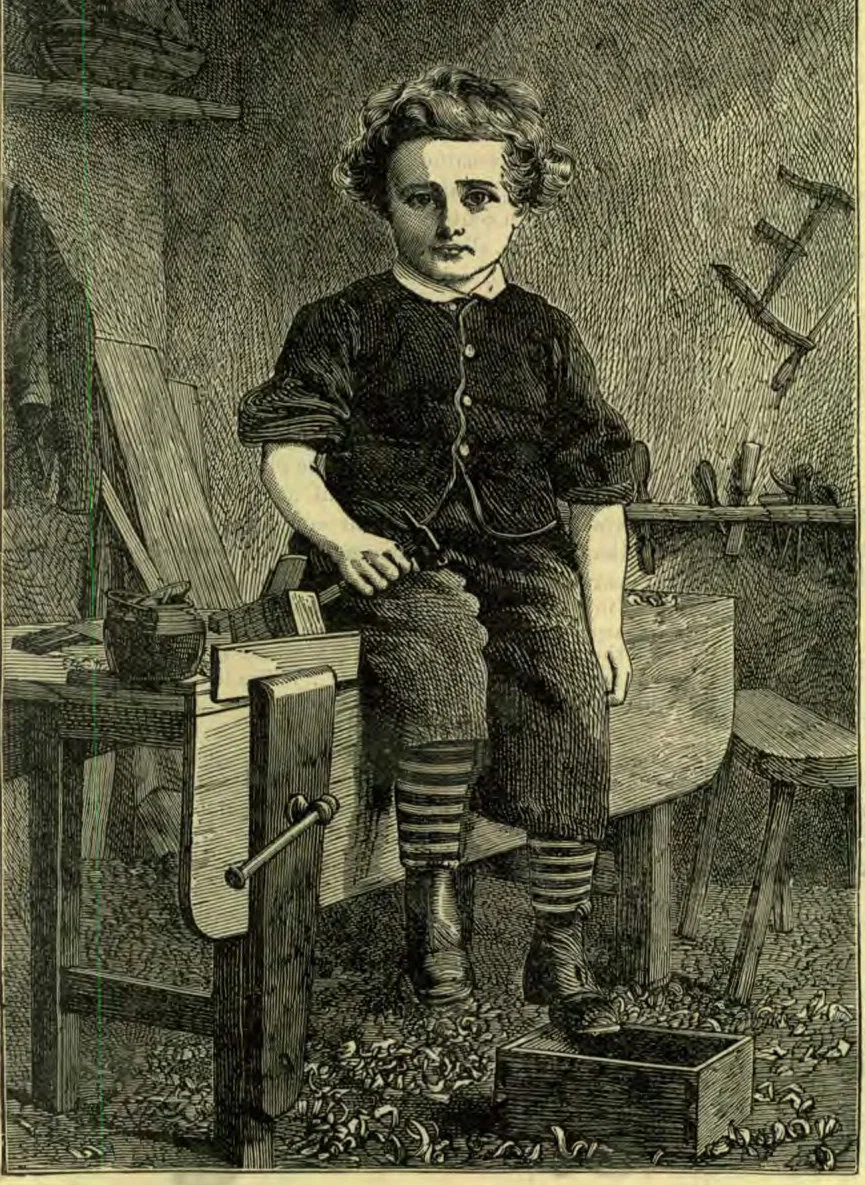
“WONDER,” thought Joe, “what I can do about it, anyway?” and he swung his feet in and out, as he sat perched up on his little work-bench in the woodshed. But he could see no way out of his trouble, so he fell to work on a box he was making, sending the chips and shavings flying all around, as if they could help him think.
The trouble was this: Joe couldn’t go to school. Not a very great trouble, did you say? It was to Joe; for he loved his books better than he did anything else except his mother.
His parents were not blessed with much of this world’s goods; but they loved books, and it was a great trial for them to keep Joe out of school. They had not told him what they intended to do, but he had overheard them talking one night after he had gone to bed. He did not mean to listen, he had too much honor for that; but mamma had left the door open between his room and theirs, and he could not help hearing what was said.
“I’m very sorry to take Joe out,” he heard his papa say; “but you know I have been sick and out of work for nearly a year; and I cannot even now get much to do.” Then mamma shut the door, and he heard no more.
The next day, after he had weeded out the onion bed, and brought in the wood for his mother, he went to his little “shop” in the corner of the woodshed, to finish the box he had begun. He wore a very sober face, for he was thinking, thinking what he could do so that he might not have to leave school.
His tools had been a Christmas present from his grandfather over a year ago; and Joe had already become very handy in the use of them. He was a pains-taking boy, and always took great care to have everything true and square, and to do his work just the best he knew how. He was very orderly, taking care always to have a place for everything, and to put everything back in its place when he was done using it; so that his mother did not mind having his bench in the corner of her neat woodshed.
After he had worked awhile, he heard his mother calling, “Joe, Joe! take this pail, and go over to Mr. Porter’s for some milk; and come right home, because I want it for dinner.”
“All right,” answered Joe, as he took the pail, and started off on his errand.
Just as he was going out of the yard, he met Mr. Porter driving down toward home, with a wagon full of empty boxes.
“May I have a ride, please, sir!” called out Joe.
“Yes; jump right up here,” answered the man good-naturedly, reaching out a hand to help him up onto the high seat.
“Fine morning,” said Mr. Porter, as he cracked the whip over old Dobin’s back; “splendid weather for the strawberries. Seems as if my patch never bore so well as they have this year.
“I’ve just been to town after some boxes,” he continued, pointing to the boxes behind him, “and got a letter that the firm that makes them found that it was impossible to fill all my order; and so I shall have to go without part of them, as nobody around here has any to spare.”
How Joe’s eyes sparkled when he heard this! “O sir!” he cried, “do you think I could make you some?” and then he told him what his father had said, and how badly he wanted to earn some money this vacation, that he might not be obliged to leave school.
“Well,” replied Mr. Porter, with a kindly twinkle in his eyes, “suppose you make one, and bring it over to let me see how good a workman you are. If they suit me, I will pay you well for them.
“But here we are,” he said, as they drove into the barnyard gate.
You may be sure Joe minded his mother this time, and hurried right home, anxious to begin the box. He worked very busily all that afternoon; and the next morning, he set out bright and early for the fruit farm.
Mr. Porter was out in the front yard, training up a wayward rose-bush, as Joe approached the house.
“You’re prompt, at any rate,” said he, laughing, as Joe came up. Then he took the box, and looked it over very carefully. “That is very well done,” he said, at last—“done much better than I expected a boy of your age to do. If you want to stick to the bargain, you may make me two dozen of them.” Then he paid Joe for the box, and cut a bunch of roses for him to take home to his mother.
After the boxes were all made, Mr. Porter was so pleased with Joe’s careful work that he let him help pick the berries, and after that the cherries and blackberries. So Joe kept busy nearly all summer; and when vacation was over, he found he had money enough to buy all his books for that year, and a new pair of shoes besides.
For three summers now he has helped Mr. Porter during the fruit season; and as he grows older, he does better and better work all the time. And he has proved to himself and his friends that boys can, if they will, help themselves a great deal more than they sometimes do.
W. E. L.

You have reached the end of this edition.

The Youth’s Instructor · Jul 23, 1884