Seventh-day Adventist Publishing Association · Battle Creek, Mich. · Jan 1862
The Curse of our Country.
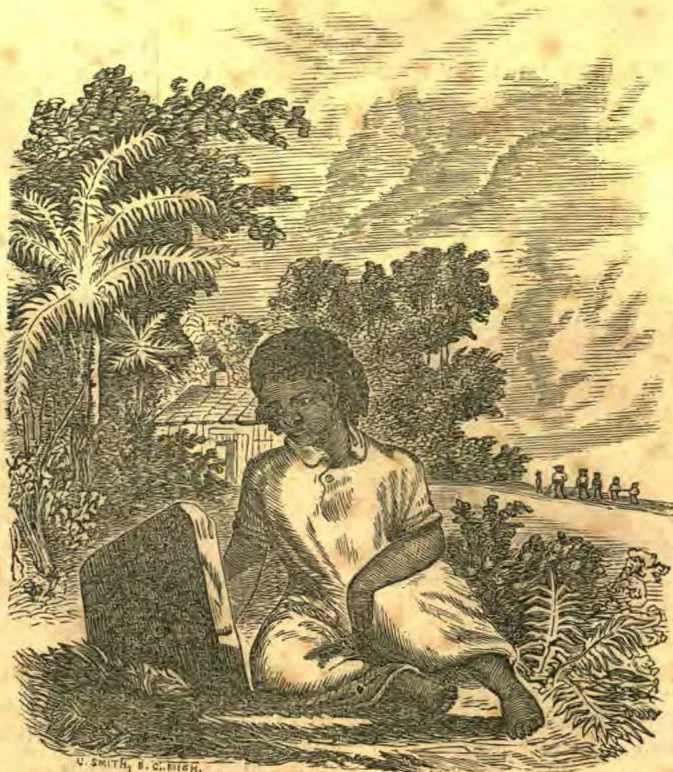
MY LITTLE READERS: I want to say a few words to you about one of the miseries of our country, which is as sinful in the eyes of the great God as it is vile and abhorrent to us. I mean the awful system of American Slavery. The scene in the engraving is not a familiar one to us; but if we lived in the Carolinas, in Georgia, Louisiana, or any of the Southern States, we might see slaves as plenty as cattle and sheep at the North. Did you know, children, that at this moment there are more than three million of colored people at the South, who are not their own masters as we are, but who are bought and sold, worked and whipped, like animals of the brute creation? Did you know that many of these have not so good food to eat, nor so comfortable places to live in, as your father's oxen and horses? And did you ever happen to think that among this vast throng are a multitude of children—little boys and girls like yourselves—except that they are slaves? This is a painful fact, if you have never thought of it; and may God open the avenues of sympathy in your tender hearts, that you may think of the little slave children at the South.
V. SMITH, E. C. BIRCH.
Look at the little African boy in the picture; perhaps he is sitting at his mother's grave. How sad he looks! he seems to feel as though he had not a friend in the world. Perhaps his father and older brothers are with that company of men in the field, which you see working under an overseer. Poor little boy! how we should pity him! He knows that if he was only a little older and stronger he would not be sitting by his dead mother's grave.
Oh, may kind heaven pity the poor slaves! and may we soon behold our King coming who will “rule in righteousness,” and put an everlasting end to this iniquitous work. These poor creatures in bondage do not get pay for their labor as we do; ah, no. They have their task assigned them, and then if they fail to perform it, they are often lashed and beaten till the blood wets the ground on which they stand. The little slave children, too, they have no pretty books and papers to read, no Sabbath-schools to attend, no kind teacher to teach them to read and spell. God's word is to them all, old and young, a sealed book, and about all they ever hear of it is, “Servants, obey your masters,” and, “Cursed be Canaan, a servant of servants shall he be to his brethren.”
But a day of awful retribution is rolling on, when men-stealers and men-buyers, and all traffickers in the image of God, will meet the reward of their hands. The perverters of God's truth will also be remembered then. The overflowing storm will sweep away “the refuge of lies” in favor of slavery, and priests and people who have connived at this atrocious crime will howl because of the fierce anger of the Lord.
Let us continually bear in mind the Golden Rule of the Saviour, “WHATSOEVER ye would that men2should do to you, do ye even so to them,” and “Remember them that are in bonds.”
“O Lord! whose forming hand one blood
To all the tribes and nations gave,
And giv'st to all their daily food,
Look down in pity on the slave.
“Oh, kindle in our hearts a flame
Of zeal, thy holy will to do;
And bid each child who loves thy name,
To love his bleeding brother too.”
Incidents in My Past Life. No. 37.
By Joseph Bates
BY ELD. JOSEPH BATES.
Revival at Sea—Arrive in New York—Bethel Ships and Meetings—Friendless Young Men—Arrival in New Bedford—Temperance Reform—Voyage Ended.
DURING our homeward-bound passage our crew seemed more thoughtful and attentive to the religious instruction we were endeavoring to impart to them. It was evident that the Spirit of the Lord was at work in our midst. One James S. gave good evidence of a thorough conversion to God, and was very happy during our voyage home. Religion seemed to be his whole theme.
One night in his watch on deck while relating to me his experience, said he, “Don't you remember the first night out on our voyage from home, when you had all hands called aft on the quarter-deck, and gave them rules for the voyage?” “Yes,” I replied. “Well, sir, I was then at the helm, and when you finished, and knelt down on the quarter-deck and prayed with us, if at that time you had taken up a handspike and knocked me down at the helm, I should not have felt worse; for I had never seen such a thing before.” Thomas B. also professed conversion at that time.
Our passage home was pleasant, with the exception of a heavy gale which troubled us some, but the good Lord delivered us from its overwhelming influence, and we soon after arrived safely in the harbor of New York city. The first news from home was, that my honored father had died some six weeks before my arrival. This was a trying providence for which I was not prepared. He had lived nearly seventy-nine years, and I had always found him in his place at the head of the family after my long voyages, and it seemed to me that I had not one serious thought but what I should see him there again if I lived to return home.
While in the city, I had the pleasure of attending an evening, Bethel prayer-meeting on board a ship lying at the wharf. I enjoyed it very much. Such meetings were then in their infancy, but since that time it is common enough to see the Bethel flag on Sunday morning on board the ships for meeting, on both the east and north sides of the river, for the benefit of sailors and young men that are often wandering about the city without home or friends. Many doubtless have been saved from ruin by the efforts of those engaged in these benevolent institutions, while other homeless ones have been driven to deeds of desperation, or yielded to feelings of despair. The trying experience of my early days made me familiar with such scenes.
On one of my previous voyages I had prevailed on a young man to accompany me to his home in Massachusetts. And while I was in the city this time, as I was passing through the park, among many others whom I saw was a young man seated in the shade, looking very melancholy, quite similar to the one just mentioned, and not far from the same place. I seated myself beside him, and asked him why he appeared so melancholy. At first he hesitated, but soon began to inform me that he was in a destitute state, nothing to do, and no where to go. He said his brother had employed him in his apothecary store in the city, but he had recently failed and broken up, and left the city, and that he was now without home and friends. I asked him where his parents lived. He replied, in Massachusetts. “My father,” said he, “is a Congregationalist preacher, near Boston.” I invited him to go on board my vessel and be one of my crew, and I would land him within sixty miles of his home. He readily accepted my offer, and on our arrival in New Bedford, Mass., his father came for him and expressed much gratitude to me for his safe return, and the privilege of again meeting with his son.
On our arrival in New York, my crew, with one exception, chose to remain on board and discharge the cargo, and not have their discharge as was customary on arriving from a foreign port. They preferred also to continue in their stations until we arrived in New Bedford, where the Empress was to proceed, to fit out for another voyage. After discharging our cargo, we sailed and arrived in New Bedford about the 20th of June, 1828—twenty-one years from the time I sailed from thence on my first European voyage in the capacity of a cabin boy.
Some of my men inquired when I was going on another voyage, and expressed a wish to wait for me, and also their satisfaction about the last as being their best voyage. It was some satisfaction to me to know that seaman were susceptible of moral reform on the ocean (as proved in this instance) as well as on the land; and I believe that such reforms can generally be accomplished where the officers are ready and willing to enter into it. It has been argued by too many that sailors continue to addict themselves to so many bad habits that it is about useless to attempt their reform. I think it will be3safe to say that the habitual use of intoxicating drink is the most debasing and formidable of all their habits. But if governments, ship owners, and captains, had not always provided it for them on board their war and trading ships, as an article of beverage, then tens of thousands of intelligent and most enterprising young men would have been saved, and been as great a blessing to their friends, their country and the church, as farmers, doctors, lawyers, and other tradesmen and professional men have been.
Having had some knowledge of these things, I had resolved in the fear of God to attempt a reform, though temperance societies were then in their infancy, and temperance ships unknown. And when I made the announcement at the commencement of our last voyage that there was no intoxicating drink on board, only what pertained to the medicine chest, and one man shouted that he was “glad of it,” this lone voice on the ocean in behalf of this work of reform, from a stranger, manifesting his joy because there was no liquor on board to tempt him, was cheering to me, and a strong evidence of the power of human influence. I believe that he was also deeply affected, and I cannot now recollect that he used it in any way while under my command, nor any of the others, except one Wm. Dunn, whom I had to reprove once or twice during the voyage for drinking while he was on duty on shore.
Then what had been considered so necessary an article to stimulate the sailor in the performance of his duty, proved a great blessing, in our case, by withholding it.
Some time after this voyage, being in company with a ship owner of New Bedford, who was personally interested in fitting out his own ships and storing them with provisions, liquors, and all the necessaries for long voyages, we had been agitating the importance of reform in strong drink, when he observed, “I understand, Captain Bates, that you performed your last voyage without the use of ardent spirits.” “Yes sir,” I replied. Said he, “Your's is the first temperance vessel I have ever heard of.”
My brother F. now took command of the Empress, and sailed again for South America, being fitted out to perform the voyage on the principles of temperance, as on her former voyage. During my last voyage I had reflected much on the enjoyments of social life with my family and friends, of which I had deprived myself for so many years; and I desired to be more exclusively engaged to better my condition, and those with whom I should be called to associate, on the subject of religion and moral reform.
Monterey, Dec. 12, 1861.
Mischief Versus Little Good
It is easier to do a great deal of mischief than to do a little good.
Rebellious Children.
By John Norton Loughborough
“A CHILD left to himself bringeth his mother to shame.” Prov. xxix, 15. As an illustration of the above proverb, I will relate a circumstance which happened where I was traveling a few days since. I sat reading my Bible in the front room of a house where I had been invited to tarry for the night. All at once my peace was disturbed by the stern statement, “I don’t care for you nor any of your relations!” It startled me. I thought, Who said that? You will think, I presume, that it must have been some very naughty, rebellious man, in a great delirium of excitement, and that he must have been speaking to some one who was no relation to him, and who had done him a great injury, or else he would not use such awful language as that. So thought I when I heard it. You may imagine my surprise, on looking around to see from whence proceeded the voice, to find that it came from a little lad only seven years of age! a son of parents who profess to be Christians!
You probably are thinking whom he could have talked to in that way. “Some of his play-fellows, or his brothers or sisters, I guess,” says one. No, worse than that: he was talking to his old blind grandmother, nearly eighty years of age! What had she done to arouse to such a pitch the rage of our blustering little man? Well, I will tell you: his sister was going after the cows, and could not get them through the field to the barn without help. His grandmother had kindly requested him to go with his sister and get the cows. He was busy with his play, and didn’t want to leave till he got ready, and because his grandmother spoke to him a second time in a stern manner for his disobedience, he said to her in an angry tone, “I don’t care for you nor any of your relations!”
As I heard those words, I thought of the little readers of the Instructor. I thought, Can it be possible that any of the children who read this paper talk in that way to their parents or guardians? I trust you do not. I hope you ever try to carry out in your daily life the excellent admonitions which you find in this little sheet. You should always speak with respect and reverence to your parents and guardians. Always think what shame it would cause your mother to hear you speak like the little lad mentioned above. To honor your parents, you must take a course that will not bring them to shame.
O, how disgusting was the scene I have described! I wished myself away from viewing it. May all the readers of this little paper ever take a course to cheer and smooth the declining years of their parents and guardians. Then instead of being as thorns in their path, you will be like olive trees around their table. And instead of being a shame to your mother, you will be an honor indeed, and as crowns of gold to her head. J. N. L.
The Law of God.
ABOUT four thousand years ago the Creator of all things came down to this earth, and gave its inhabitants a law. It was at mount Sinai, in Arabia, as you will find by looking on the map of Asia, where this wonderful occurrence took place. The Lord had just brought his people out from the land of Egypt, and they had got as far as mount Sinai on their way to the promised land. Here they encamped for many days, and during that time God gave the Israelites, and through them the whole world, his holy law plainly written on two tables of stone.
He first told his servant Moses what he was going to do, and commanded him to spend three days in preparing the people for what was to follow. At the end of this time the great Jehovah descended from heaven to earth to give mankind his law, which was to be the rule of life as long as heaven and earth should stand. As God came to the earth he was accompanied by a multitude of angels, and mount Sinai seemed like a mountain of fire. The sight was so terrible that the people drew back from the mountain, and even Moses, who was accustomed to speak with God, trembled and shook. Then God spoke and began to deliver them his law saying, “Thou shalt have no other gods before me.” And then he pronounced the second, the third, fourth, fifth, and all the commandments, until he had given them the ten. As he spake his law, his voice shook the ground like a terrible earthquake. And as the Israelites saw the lightnings and the burning mountain, and heard the voice of the trumpet and the mighty thunderings, they were so terrified they drew farther back, and said to Moses, “Let not God speak with us, lest we die.”
Then Moses went up into the mountain where God was, and he gave him the same law which he had spoken to the people, written on tables of stone. By its being written on stone, it signified that it was to continue forever. As Job said, “Oh that my words were now written! that they were graven with an iron pen and lead in the rock FOREVER.”
There are many people in these days who tell us God’s law has been changed; but this is one of the greatest mistakes that men could make in religion. All the prophets and patriarchs and holy men in the Old Testament testify that this law never should be changed; and Jesus Christ, with all the apostles and prophets and good men in the New Testament, say it never has been changed. Read the fourth commandment, children, and you will see that it says the seventh day is the Sabbath of the Lord our God, and not the first day, Sunday, as the world and church now teach.
Which will you do, my young reader, “keep the Sabbath day as the Lord thy God hath commanded thee,” or keep Sunday according to the custom of the land? Oh, be wise and obey God. “Believe his prophets and you shall prosper; believe his word and you shall be established.” It was that wicked man, the Pope of Rome, that first kept Sunday in place of God’s holy Sabbath; and he taught others to do so; and now nearly all the world are his apt scholars. But turn and read the commandment again, and see whom you will obey—God, or the Pope. And if you choose still to keep Sunday, remember that the Pope’s Sunday-keepers are God’s Sabbath-breakers.
The Old and New Year.
By M. D. A.
Happy am I, dear children, to greet you at the commencement of another New Year. How glad may we all be that God has spared us till 1862, and also that the Instructor, the little medium through which we hear from one another, lives and blesses its readers.
My heart responds fully and freely to the sound which seemingly echoes through the wintry breeze, that God is good. I love to repeat it, and who among the Instructor family does not love to? I hope not one. But what does the old year5tell us as it passes us by, and the new year bring one day to us?
Certainly we hear and know that we are one year nearer home than we have ever been before. It has told us all the way through of coming days which are cold and dark for this world. As 1861 came, we heard the sound of war in the land; and it has multiplied and increased until we are almost in the midst of it. A fearful tale of woe has rung in the ears of many a one since that time, and what else may be heard, 1862 will soon tell.
But what does it bring to God's dear children who are looking for and loving the appearing of Jesus? As it tells of days cold and dark for the world, it tells of bright and joyous ones for them. Already they seem to lift their heads to greet their coming King.
Yes, dear children, it is a bright picture which hangs out before us, if we love God and keep his commandments. We may see trouble all around us, but Jesus left us word that when we see these things, we may know that he is nigh, even at the door. Then if we only look for and love the appearing of Jesus, we are safe. War may come, and trouble, such as this world has never known, but there is a place of refuge for those who keep God's commandments. Even the smallest child may safely bide the storm.
Dear children, what a hope is this! Do you not want it to be yours? Then delay not to secure it now. Make every effort you can. Watch and pray. Are you not glad that God has a people with whom you may feel safe? who will lead you on from step to step till you will find yourselves beyond the reach of sin and danger? Will we not all begin anew with the New Year to serve God, and be more faithful than ever before? May the Lord help us all, and may we outride the storms of this world, and anchor safe in the port of heaven.
M. D. A.
A Chapter in my Early Experience.
By Moses Hull
I CANNOT recollect when I did not want to be a Christian. At the age of four years I told my mother that when I got to be a man, I was going to be a preacher. “Why do you want to be a preacher?” she asked. Said I, “Because, preachers are good men, and I want to be good.” I thought ministers were never tempted, but in this I have found myself greatly mistaken. But I never changed my mind with regard to trying to be a good man, or a minister.
At the age of fourteen I began in earnest to seek the salvation of my soul. I left my wicked playmates and united with a church. My former companions now forsook me, and pointed the finger of scorn at me. They said every thing evil of me that they could. One of my former associates met me one day as I was returning from the prayer-meeting, and swore that he was going to pound my religion out of me. With that he commenced beating and kicking me, and pulling my hair. I do not know but that he would have hurt me very much, if his comrades had not pulled him off from me.
Many said that I would backslide in a few days. Some said that I was too young to know anything about religion; but I tried to live near the Lord, and enjoyed many happy seasons that no one besides myself knew any thing of. I learned by experience that it was good to hold communion with God when no eye was looking upon me, nor any ear was open to my cries but that of my Father in heaven.
Elder Miller, the minister under whose labors I joined the church, did all he could to help me along. He often invited me to go with him to his appointments, especially when he was going to preach on some disputed point. He spent much of his time in teaching me to argue. He boasted that he was going to make a great man of me.
In about one year from the time I joined the church, a protracted meeting commenced in the neighborhood, and though I was but fifteen years old, I was an instrument in the hands of God of bringing several of my young companions into the church. I have often taken six or eight of them into the woods and prayed with and for them. My young associates had great confidence in me, and I in them. So we lived in sweet harmony.
But this was not to last. Some papers containing advent doctrines were providentially thrown into my hands. I read them with interest. Here I learned new truths in which I rejoiced night and day. I embraced the first opportunity to tell my minister what I had been learning, expecting him to embrace the same truths and rejoice with me. But in this I was disappointed. For instead of praising God for the new light, as I had done, he went to ridiculing it. But still the truth looked good to me, and I kept talking about it to all of my friends. For a while I hoped many of them would embrace it, but in this I was also disappointed.
More next month. MOSES HULL.
Are You Ready?
By Ellet Joseph Waggoner
DEAR CHILDREN: This constitutes an important question when applied to the coming of the Lord. “Are you ready?” is a familiar phrase with children, and they understand what it means when addressed to them as they are starting to school; and it is not until the dinner basket is packed, the mittens on, and everything made secure to protect them from the storm, that they can answer, “Yes.”
I am going to tell you about a little girl I once saw as I was traveling on the cars. I had put up for the night at Forest Junction, a place indeed6rightly named, for although the cars came in from four directions, they could not be seen until they approached very near the station-house, so thick was the forest around. While waiting for the train a short time, a ruddy little girl of about ten years came in, with a rude bundle under her arm, and sat down near me. I inquired if she was traveling. She answered that she was going a few miles north to work out. This was said with such an air of womanliness and self-possession, that I became interested in the little girl, and kept my eye on her.
It happened that the train on which we were going was delayed, and many times the waiting company rushed to the platform expecting to get aboard, but were disappointed in the train. Thus was our zeal for going gradually cooled, and it was only when quite a bustle was made that we approached the platform. However, this little girl was an exception. She was not in the least daunted by the disappointment and sneers of the by-standers, but at the first signal, with bundle in hand, was at the platform ready to get aboard, providing it was the right train; and the consequence was, when the right train did come, she was the only one who got aboard, while we were left to stand gazing after the “chariots” moving from us with lightning speed. It was the Cincinnati and Cleveland Lightning Express, and only paused. I thought of these words, “And they that were ready went in, and the door was shut.” And I could but realize that the men and women who stood by had greater reason for mortification than the little girl whose zeal had been the same from the time she had set out. Fortunately for us there was another train just in sight, and we had a second chance.
But it will not be so when Jesus comes. There is but one train running to the city of God, and all who miss this, will miss forever. And neither will any get aboard but those who are all ready and waiting. I hope the Lord will bless the children, and help them to pack up for heaven, that they may stand waiting for Jesus and the train of holy angels, and be escorted to that beautiful city above.
E. J. W.
Battle Creek.
Sabbath and Sunshine.
By Sarah J. Thayer
“It is Sabbath day when the sun shines, isn't it mamma?” said my little girl of three years, to me last Monday forenoon. “No,” said I, “sunshine does not make it Sabbath.” ’Twas a simple, childish question, but afforded me a subject for serious thought and meditation. This child some way has the ideas of Sabbath and sunshine so associated in her mind, that the hearing of one mentioned, usually brings to mind the other. Surely, thought I, “a pleasant thing it is for the eyes to behold the sun.” How much of happiness it brings to us, when on a shady day the sun breaks forth, as it were, from its hiding-place, and smiles upon us. So it should be with the Sabbath. It should come to us as a day of sunshine, amid days of gloom; only a brighter, lovlier light should encircle it, than makes the difference between sunshine and shade, because blest and set apart for holy purposes.
If the bright shining of the sun brings gladness to our hearts, scatters the gloom from our minds, and revives and encourages us, how much more should the dawning of each holy day fill our hearts with joy and peace, chase away each worldly thought, and revive our drooping faith.
Little children, it is our privilege to enter into that rest remaining for the people of God. There will be no need of the sun in the New Jerusalem, for the glory of God and the Lamb will be the light of that city which hath foundations, whose builder and maker is God. SARAH J. THAYER.
The Willing and Obedient.
By M. H. Lyon
“If ye be willing and obedient, ye shall eat the good of the land.”Isa. 1, 19.
What sight on earth is more lovely, more highly gratifying to our moral sense, than a well trained child, who obeys those who have the rule over it willingly and obediently, with no “I can’t,” “I shan’t,” and “Don’t want to;” with no pouting lip and angry scowl; no “Wait a minute till I get this or that done;” no “I won’t unless you will give me a stick of candy, or something;” or what is still worse, give you to understand by its manner that it intends obeying, and then either pays no attention, or obeys in such a careless way that its obedience is worse than none at all.
It is no wonder to me that God’s promise is to the willing and obedient; for with the little experience I have had in dealing with children, I am sure I would not confer equal favors upon the willing and unwilling, the obedient and disobedient. True, God says he causes the sun to rise on the evil and the good, and the rain to fall on the just and unjust; but this refers to the present world and not the final distribution of reward hereafter, when we read the righteous will be recompensed, and much more the ungodly and the sinner.
It is also no wonder to me that God loves to employ the willing and obedient—those whose ready response is, “Speak, Lord, thy servant heareth,” whose feet run in the way of his commandments, and are swift to do his will—in preference to the heedless, careless, inattentive one, upon whom no calculation of obedience can be made; and whose reply when asked the reason of their disobedience is, “Oh, I forgot!” as if that ought to be entirely satisfactory.
I consider that the beautiful promise in our text7is made for you, dear children, as well as grown people. God has so arranged his will concerning you, that he requires no more than you have understanding and ability to perform. Hence the beauty and consistency of the parental relation, which is designed to prefigure our relation to God. Therefore when children honor, obey, and love their parents and guardians, he graciously accepts it as if directly bestowed upon himself.
Think of this, children, when you are tempted by the Evil One to disobey your parents, that you may be of the willing and obedient class, that the reward offered in the beautiful New Earth may be yours—the good of the land—the milk and honey—the fruits of all kinds—the beautiful flowers—the green fields—and above all, the Tree of Life yielding its twelve manner of fruits every month, to which the finally willing and obedient, small and great, will have a right. M. H. LYON.
The Righteous and the Wicked.
By A. S. Hutchins
“Say ye to the righteous, that it shall be well with him; for they shall eat the fruit of their doings. Woe to the wicked! it shall be ill with him; for the reward of his hands shall be given him.” Isa. iii, 10, 11.
EXCEEDING great and precious promises are made to the righteous, therefore it is well with him. It is well with him in sickness, and in health; in prosperity, and adversity. In the day of the Lord’s fierce anger, it will be well with the righteous. Well with the righteous in the resurrection morning. Well with him when the saints are caught up to meet the Lord in the air. Well, forever well with the righteous, as they enter in through the gates into the city of God. No more death, neither sorrow, nor crying, neither shall there be any more pain; for the former things are passed away.
But woe unto the wicked! it shall be ill with him. The poor sinner carries this woe with him through life. He sinks beneath it in death, and in the second resurrection comes forth to receive the reward of his hands; not to life eternal, but to die the second death. The righteous are like a tree planted by the rivers of water; but the ungodly are like the chaff which the wind driveth away. Ps. i.
We further learn of the favor and approbation with which God looks upon the righteous from the contrast by comparison. The righteous are compared to the sun, stars, lights, mount Zion, a treasure, jewels, silver, precious stones, little children, lively stones, members of the body, soldiers, runners in a race, wrestlers, good servants, sheep, lambs, thirsting deer, good fishes, watered gardens, unfailing springs, branches of a vine, good figs, lilies, willows by the water courses, cedars in Lebanon, palm trees, corn, wheat, salt, obedient children.
The wicked are compared to dross, early dew that passeth away, evil figs, fading oaks, fools building upon sand, fuel of fire, garden without water, goats, horses rushing into the battle, idols, melting wax, moth-eaten garments, passing whirlwinds, raging waves of the sea, reprobate silver, scorpions, smoke, stubble, swine, tares, wayward children.
Who would not prefer the life and reward of the righteous? and would not pray, “Gather not my soul with sinners, nor my life with bloody men.” “Righteousness exalteth a nation; but sin is a reproach to any people.”
A. S. Hutchins.
Little Girls Inquiring the Way.
By Miles E. Cornell
SOME time ago two little girls went with their mother to meeting, and heard about Christ’s second coming, and believed. One day while seriously reflecting upon it, they asked their mother what they ought to do to be ready for his coming. The mother replied that she could not then tell them, but when she found out she would let them know. After she heard the law and Sabbath questions thoroughly presented she was satisfied that the ten commandments were binding, and told the girls she had found out what to do. She spoke to them especially of the fourth and fifth commandments, and although it was a cross, they consented to stay at home from school on the Sabbath. They also promised to obey their mother in all things. One day one of them hesitating to obey her mother, was admonished by her sister with, “Why don’t you obey ma?” She remembering the commandment and her promise immediately obeyed. The fear of God was before her eyes, and she wanted to be saved when Jesus comes.
Here is a good example for all the readers of the Instructor. When you are tempted to disobey your parents, think of the commandment and Jesus’ coming, and do not dare to disobey. “CHILDREN, OBEY YOUR PARENTS.”
M. E. CORNELL.
Peace-makers
By M. Wilkerson
For the Youth's Instructor.
Peace-makers.
“Blessed are the peace-makers; for they shall be called the children of God.” Matt. v, 9.
LITTLE READERS: Do you all understand what it is to be a peace-maker? Little children as well as grown people, can if they will, be peace-makers. For instance, while playing with your brothers and sisters, or playmates, if you see them differ in any thing that causes hard feelings, perhaps if you should say a few words to one of them against the other, it might lead them to be still more angry, and end in a quarrel. But if you had tried in a kind and gentle way to persuade them each to yield to the other, and to love each other, you might have made peace between them, and you too, would have felt at peace in your own heart. Then you would have been a peace-maker. You would also be much happier than to have helped them quarrel.
Dear children, always try and make peace wherever you are, and then you will always be happy. And now while the war spirit is raging throughout the land, and there are so few peace-makers, will not the children who read this paper try to be peace-makers? Will they not try, too, and be obedient to their parents, respectful to the aged, kind and obliging to all; and what is more than all else, will they not give their young hearts to God, and love him and keep his commandments? Then they will be fitting up for that home soon to be given to the children of God, where all will be peace and joy forever more. M. WILKERSON. Sharon, N. H.