The Youth’s Instructor, Vol. 33, No. 47.

Elspie's Thanksgiving

The Youth’s Instructor

Dec 9, 1885

S. D. A. Publishing Association · Battle Creek, Mich. · Dec 9, 1885

Elspie's Thanksgiving.
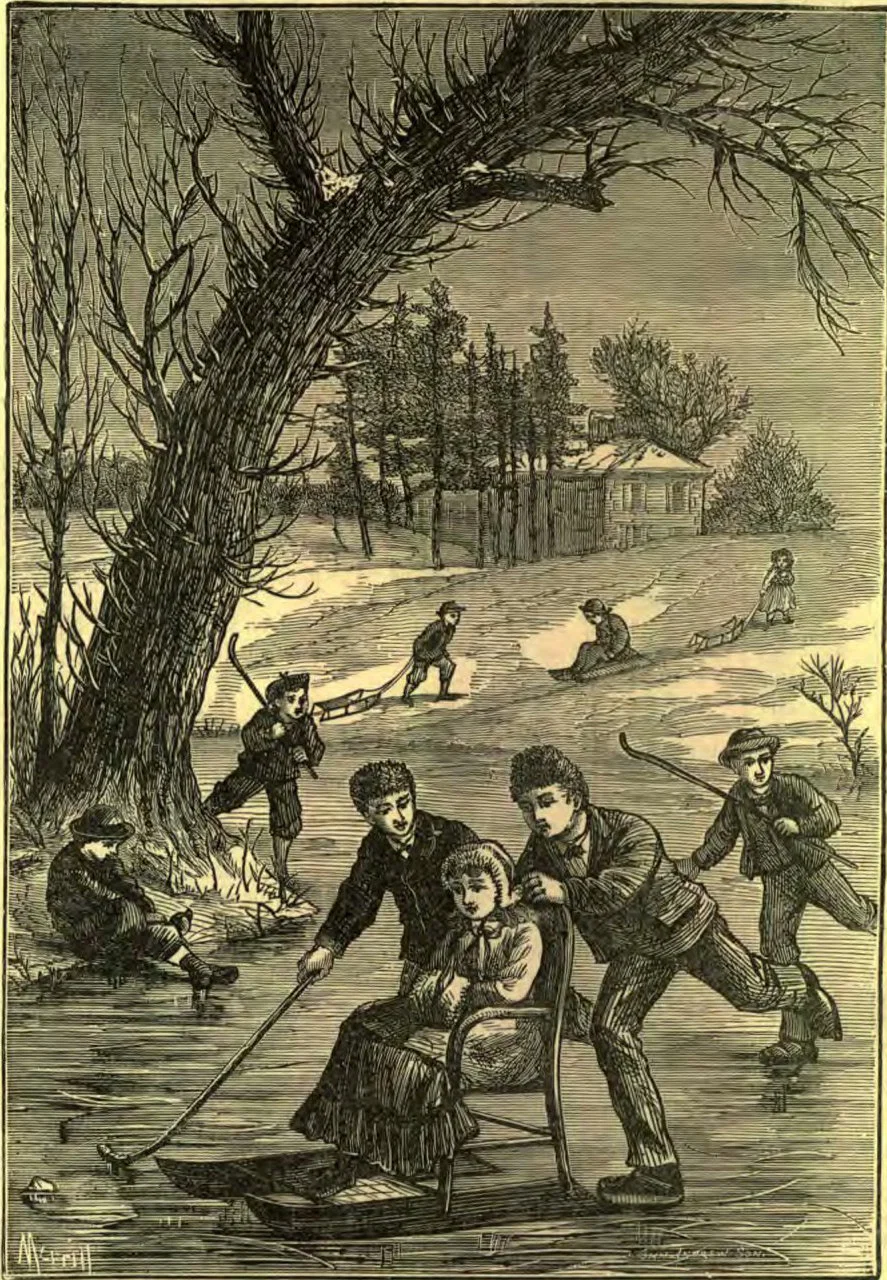
Snow, snow, and sleet, with the weather growing colder every moment. How the wind shrieked and moaned in the tall pines on the north side of the house! The lone rosebush, bereft of every leaf, stretched out its long, scraggy briers, and tapped, tapped, disconsolately at the window. Elspie turned from viewing the storm without, with a face no less gloomy than the dark clouds that hid the short afternoon sun, and drawing the little shoulder shawl closer around her, sat down in the shadows at the corner of the fire-place. All the afternoon Elspie had been watching the storm, hoping it would clear away; but as evening closed in, it only increased in fury.
“I declare!” thought Elspie, “it's too bad that just as I get something nice planned out, something always turns up to spoil it all. I wanted so much to go over to Jennie Brown's, and now mother won't let me go out in this storm for fear I'll have a sore throat again. I never can have a good time anyway;” and tears of vexation and disappointment chased down her cheeks.
Just then the door blew open, and in came Ben, shaking the snow from cap and overcoat, and bringing with him a great gust of cold air. Elspie shivered. “Dear me!” she exclaimed petulantly, “why can't you make a little more noise! You've let in all the cold outdoors. Boys are a regular nuisance!” Ben paused in his operations. The merry look died out of his face, and resentment flashed from his brown eyes. “They're no more of a nuisance than girls,” he returned hotly. “Here, take your book,” he added, as he tossed her the library book he had just brought home for her; “when you want any more favors from nuisances, you can do them yourself.” And with that he stalked out of the room.
“Pshaw!” he said to himself, as he banged the door behind him. “I don't see as Christians are any better than other folks. Elspie gets as cross as ever, and I don't believe there is anything to it.”
Elspie picked up the book that had fallen to the floor, and as she did so, an illuminated card slipped out from between the leaves. Some one had used it for a book-mark, and had forgotten to take it out on returning the book to the library. Elspie glanced at it, and put it back again. Then she took it out, and read the texts slowly. On one side it said, “Above all things put on love, which is the bond of perfectness;” and on the other, “Let your speech be always with grace, seasoned with salt, that ye may know how ye ought to answer each one.”
“That's a queer motto for a card,” thought Elspie. “‘Seasoned with salt;’ I wonder what that can mean.” And then she fell into a brown study.
“Yes,” said she at length, “it must mean that. It must mean that we are to have Christ shining in us, so that when we say or do anything, folks will know by our manner and looks that we are trying to be Christians. Everything we do will savor of Christ.” And then she thought, with a sudden smiting of conscience, of the cross words she had just said to Ben. She had been hoping and praying that he might give his heart to the Saviour. What if her cross words had forever turned him away! The thought seemed terrible to her; and falling on her knees in the gathering darkness, she prayed earnestly that God would forgive her for her hasty words, and turn Ben's heart to him.
She did not see Ben again until bedtime; for he had not come around where she was, all the evening. She met him in the hall, just as he was going into his chamber.
“O Ben,” she cried, “won't you forgive me for being so cross to you this afternoon? It wasn't as He would have done; and I'm so sorry.”
Ben gave a low whistle of surprise. He had hardly looked for his proud-spirited sister to do this. “Yes, there must be something to it,” he thought. “That's all right, Elspie,” he said; and turning on his heel, he shut the door. He did not go to sleep very early that night.
The next morning dawned clear and bright, and the ground lay covered deep with a soft mantle of snow. It was Thanksgiving Day. Elspie was quite surprised when Ben put on his cap and overcoat, and offered to go with her to church. He was very sober all through the service, and very busily thinking, but not of the sermon. Elspie wondered what she had to be specially thankful for.
In the afternoon, Ben came in with his skates over his shoulder. “Come, Elspie,” he said; “let's go down and have a slide on the pond. The ice is plenty thick enough, and the wind has blown the snow all off.”
Elspie was deep in a story book, and did not want to be disturbed. She was about to give Ben another hasty answer. But something in his looks made her think of the strange text; and at the same time there flashed through her mind, a verse that she had read only that morning, “Even Christ pleased not himself.”
“All right,” she said cheerfully, as she rose to put up her book and get ready to go out.
Ben had fastened an old chair on his coaster, and in this Elspie took her seat. What a delightful slide that was! By and by Ben skated away from the rest, down to the other end of the pond; and wheeling up in front of Elspie, he said abruptly, boy-fashion, “I've been thinking about what you said last night, Elspie; and I thought you'd like to know I mean to try, too.” And then he was off again.
The tears sprang to Elspie's eyes; and she thought it the happiest Thanksgiving Day of her life. When she numbered her blessings that night, she remembered to count the card with its strange text, that in such an unexpected way had been instrumental in leading Ben to the Saviour.
W. E. L.

LYING AND ITS RESULTS.

Two lads were seated at one desk in a certain academy, when, during recess, their teacher said to one of them: “Oswald, did you leave the boat unfastened on the beach last evening?”
“No, sir!” the boy replied, with emphasis.
His seat-mate, to whom he had that morning confessed that he had forgotten to fasten the academy boat to the little wharf on the bank of the river, and that, being left unfastened, the boat had floated off, on hearing this barefaced lie, looked at him with a glance of intense contempt; and when the teacher had ceased to observe his guilty companion, he said, in a hoarse whisper:—
“Oswald, how could you tell such a contemptible lie?”
The lad spoke truly in calling Oswald’s denial a contemptible lie. It was clearly spoken, not with thoughtless haste, but with a deliberate intention to deceive his teacher. His companion abhorred it, as every uncorrupted mind always abhors a lie. Just so Oswald would have done, perhaps, if his cowardly soul had not been more afraid of being held accountable for the loss of the boat than of telling that detestable lie. His fear had made him a liar. Had he been morally brave and manly, he would have owned his neglect to fasten the boat, and declared his readiness to do what he could to recover it.
Lying is a vice which does not naturally spring up in the mind like a plant from its proper seed. A child naturally tells what he sees and knows, exactly as it appears to him; that is, he tells the truth so far as he understands it. Why, then, do so many children and youth tell lies? Usually they begin to lie through fear of punishment. They commit a fault, and try to hide it because they shrink from reproof, or from the rod. Nor is fear its only parent, since, as the child grows into the youth, pride, vanity, envy, covetousness, hatred, and other bad passions produce it. Oliver Wendell Holmes says that “Sin has many tools, but a lie is a handle which fits them all.”
A first lie generally makes the second one necessary to hide it. Hence, one who begins to speak falsely is apt to continue lying until it becomes a habit. A very shrewd observer of youth once said, “that after a tongue has once got the knack of lying, it is not to be imagined how impossible, almost, it is to reform. I once had a tailor whom I never knew to be guilty of but one truth. No, not even when it has been to his advantage to speak it.” Merely to think of being such a slave as this tailor was to this vile habit is shocking. Yet there are many lads and even lassies, who wear this degrading chain.
The way in which the first lie becomes the parent of more appears in the case of a youth named Reginald, of whom an English writer tells that when he was finishing a pencil-drawing to take home from school at the Christmas holidays, he took it to his cousin, who was more advanced than himself, and asked him to “touch up” his work a little.
His good-natured cousin gladly consented; and finding two windows in a Gothic castle very poorly done, he rubbed them out and drew in others. When the drawing was shown at the close of the term, it was much praised. When taken home, the lad’s father was delighted, and said: “Well done, my son! I will buy you a new drawing-book.”
Reginald was so unwilling to lose this praise that he said nothing about what his cousin had done to the drawing. His silence made his friends think that it was all his own work, and, by being silent, he knowingly deceived them; that is, he had become a silent liar.
His reputation, thus falsely won, led a young lady in the neighborhood to bring him her album, and request him to draw a little castle in it, with windows exactly like the one in his large picture. Ashamed to confess that he could not do it, he carried the album to his cousin, and begged him to draw the castle for him, yet without telling him who owned the album. His cousin consented, and drew the castle, but finding the lady’s name on the fly-leaf of the album, rightly guessed that Reginald meant to palm off the castle as his own work. This he actually did, thereby acting a second lie, which was blacker than the first.
Not long after, his aunt, after seeing his picture, for which his pleased father had procured a frame and had hung it on the parlor wall, asked him to copy its castle on six little cards. Ashamed to betray himself, Reginald took the cards to his cousin, begging him to draw the castles for him, intending again to pass off his cousin’s work as his own.
But his lies were stinging his conscience like a brood of scorpions. Shame and remorse made him so miserable that he finally ran to his cousin’s house, took back the cards, took his false picture out of its frame and put it into the fire, confessed his lie to the young lady who owned the album, told the whole truth of his case to his friends, and bravely said:—
“I will never let anybody praise me again for anything that is not my own. I will not be a liar, but a truthful and true boy.”
This was true repentance both for the first silent lie, and for all the blacker ones which had grown out of it. Having been guilty of those base and foolish lies, the best thing he could do was to repent as he did, and to seek forgiveness both of God and his friends. Had he not done so, his tongue would probably have acquired that “knack of lying” which is not only hard to conquer, but which, by making a youth a habitual liar, places him in the deep shadows of general scorn and contempt. It would have been better, however, for him had he never lied; better had he been so ignorant of that vice as to have been able to say,
“My unpractical heart, Is so unknowing of dissimulation, So little skilled to seem the thing it is not, That if my lips are mute, my looks betray me.”
“The lip of truth shall be established forever; but a lying tongue is but for a moment.” Proverbs 12:19.—S. S. Classmate.

THANKSGIVING DAY.

“Every day will I bless thee.”—Psalms 146: 2.
SINCE daily the great God above Doth make his mercy known, And all the blessings of his love Are on our pathway strown, Let thanks each day to him be paid And mention of his mercy made, While songs attend his throne.
His creatures for a single day He never did forget; Ah, who might ever hope to pay

—R. M. Offord

He never did forget; Ah, who might ever hope to pay The overwhelming debt? His mercy doth all thought exceed: How readily our every need Hath that rich mercy met.
Yet it is good to set apart One day of all the rest, On which, with universal heart, Our thanks may be confessed; To turn aside from daily care, To throng each holy place of prayer While there God’s name is blessed.
Yea, let the nation bend the knee, Let all the people praise; High let his name exalted be, Make this the day of days; For at this season of the year Which he hath crowned with all good cheer ’Tis meet our songs to raise.
And it is meet around the board That we should merry make; His are the gifts by which ’tis stored, His bounty we partake; These fruits that industry doth bear Are proofs of his unceasing care Bestowed for his name’s sake.
Nor should the debt of thanks we owe Our tongues alone express, Our deeds as well as words should show How truly we profess, Let mercy in our hearts have sway, And on this glad Thanksgiving Day Seek other hearts to bless.

—R. M. Offord

SHOULD HE TELL?

“Hullo, Tom!”
“Hullo, Rob!”
“Come on up!”
“Wait a minute, then!” And Tom bounded into the house to ask his Aunt Kate if he might go to the post-office with Rob.
“Yes, Tom,” said she, “you may go; but be sure to come right back as soon as the mail is distributed, and don’t lose any of the letters.”
“All right!” called Tom, as he ran to overtake Rob.
Tom was a city boy, who was spending the summer with his aunt in a little country village.
Rob was employed to carry the mail bag back and forth from the post-office to the railway station; and as his path lay past Tom’s house, the two boys had formed quite a friendship.
As they went up the pleasant village street, Tom talked fast, telling of the two new birds’ nests he had found, and promising to show them to Rob if he would come down.
“One is a robin’s nest,” said Tom. “It’s made of mud, you know, and coarse roots; but, oh, my! the other’s just too pretty! Aunt Kate says it must be a Phoebe’s, for they always build such nests. It’s made of the softest moss and fine hair, and the eggs are white—not speckled a bit.”
But now they had reached the office, where several other boys were already waiting for the mail.
When it was distributed, there was a rush among the boys to see which would get his mail first; then they all started off together, full of talk and fun.
Pretty soon one of the larger boys called Tom a “city chap,” and tossed his hat over the fence into an old graveyard. It stuck on one of the stones, at which there was a great laugh.
Tom’s blood was up, and in an instant he had sent two or three other hats over the fence after his own.
Soon all the boys had leaped over, and then followed a chase after a turkey which had strayed into the yard.
All this time, Tom didn’t once think of what his aunt had said about coming right home, nor of the letters which he had thrust into his pocket when he took them from the office.
When he did start for home, he could find only two letters, though he knew he had had three. What should he do?
Now came his temptation.
“Perhaps there weren’t but two letters, anyhow,” began a naughty voice within.
“Yes, there were,” said Tom’s better self; “I remember counting them.”
“What a memory you have!” said this same voice.
“What’s the use of remembering so much? Anyway, you needn’t say anything to your aunt about it!”
At this Tom stopped. He had gone back and looked all along the path, without finding anything; and not seeming to think of the graveyard, he turned toward home.
“She’ll never know anything about it,” went on the voice.
“That’s so,” admitted Tom; “there’s no one to tell her how many letters there were in the box. But then,” after a minute, “perhaps there was something important in it,—money, or somebody dead, or something. Oh, dear! what shall I do?”
“Don’t do anything,” said the voice. “Just run in with the letters, and then come out to play again.”
“But I can’t tell a lie,” said Tom; “and Aunt Kate’ll be sure to say: ‘Is this all?’ ’Cause she always does.”
“Well, it is all, isn’t it?” persisted this disagreeable voice; “you haven’t got anything else, have you?” with what Tom fancied an unpleasant chuckle.
Just then these words came into Tom’s mind: “Cease to do evil. Learn to do well.”
“Cease to do evil!” Tom knew it would be evil to deceive his aunt, and without giving that disagreeable voice inside him a chance to say another word, he ran home as fast as he could go.
“Why, Tom, what made you so long?” asked his aunt.
“I lost a letter, and I’ve been trying to find it,” said Tom, bravely.
“Are you sure you lost it? How did it happen?”
“Yes; I know I put three in my pocket. Then Jack Graves threw my hat into the graveyard, and I had to get it again, and then I stopped to play a minute.”
“A long minute!” said his aunt. “But come, we must find the letter.”
They started out together, and soon discovered the letter, lying on one of the old graves. How relieved Tom felt! especially when his aunt said: “I am glad the letter is found, but still more glad, Tom, that you told me the truth about it. Now I can always trust you.”
But Tom thought: “It was the verse that made me tell.”
—The Well-Spring.

Wealth Without a Rich Heart

WITHOUT a rich heart, wealth is an ugly beggar.

THE BEST SOCIETY.

She was only a mill-hand, compelled to “earn her own living,” yet desiring to mingle with the best society. There's an old saying that “where there's a will, there's a way.” This may be true if the will is so intense that it resolves not to be baffled. This girl had the will; she found the way. How?—By fitting herself for such society.
Perhaps I have not made you clearly understand the society she sought. It is very exclusive, for it cannot admit the sinful, even if it desires to do so. It is among the wise of all ages, the kings and queens of thought. Let me give you an illustration of the method by which she fitted herself for their companionship. I copy it from a recent number of the Atlantic Monthly. “A near relative of mine, who had a taste for rather abstruse studies, used to keep pinned up on the post of her frame, a mathematical problem or two, which she solved as she paced up and down, mending the broken threads of the warp. Books were prohibited in the mills, but no objection was made to bits of printed paper; and not wishing to break a rule, she took to pieces her half-worn copy of ‘Locke on the Understanding,’ and carried the leaves about with her at her work, until she had fixed the contents of the whole connectedly in her mind. She also, in the same way, made herself mistress of the argument of one of Saint Paul's difficult epistles.”
We are told by the same writer that it was a common thing for the mill-girls, at that date, to have a page or two of the Bible beside them, committing its verses to memory while their hands went on with their work.
If ever you feel that circumstances have shut you out from the acquaintance of good books, ask yourselves if a strong will might not find a successful way, just as it did for these Lowell girls. But remember that the will must be strong and resolute, resolved, where one plan fails, to try another. You will be likely to mingle with “good society,” if you decide to “know no such word as fail.”—S. S. Classmate.

THANKSGIVING

Lord, for the erring thought Not into evil wrought; Lord, for the wicked will Betrayed and baffled still; For the heart from itself kept, Our thanksgiving accept. For ignorant hopes that were Broken to our blind prayer; For pain, death, sorrow, sent Unto our chastisement; For all loss of seeming good Quicken our gratitude. —W. D. Howells.

HOW THE BOY WAS MESMERIZED.

HAVING an opportunity, a few evenings since, I went to see an exhibition of mesmerism. I will tell you just what I saw. Ten or twelve young men and boys volunteered to go forward for the experiment. The operator then requested all in the house to keep quiet. He asked these boys to close their eyes, keep perfectly still, and submit their minds to his control as far as they could. Then he passed his hands over their heads and faces several times. He did this three times to each boy. The third time he found some who began to fall under his influence. These he selected out, and repeated the operation upon them.
Finally he selected one, and had him stand up and clasp his hands over his head. He looked the boy right in the eye, and told him he could not get his hands down. After a hard effort, he succeeded; then the operator had him try it again, until finally he could not get them down at all. Now he had him fully under his control, and could make him do anything he chose. He could make him forget his own name, so that he could not possibly tell it, and would think his name was something else. He thought his coat was all muddy, when there was no mud on it. Then he imagined it was on wrong side out, and took it off and turned it. He thought his nose was bleeding, and that the chair was the wash-dish; and he washed his face over it vigorously, wiping it on a broomstick which he supposed was a towel. Then he thought the broomstick was a red-hot poker, and ran away from it, or rubbed his limbs where it touched him, as though he were burned. He thought he was playing marbles, when there were no marbles there. He imagined he was driving a team, and that the chair was his dog, and he whistled to it, and tried to play with it.
Several others were mesmerized, and went through similar performances. The operator was able to control them way across the room. When they came out of the spell, they knew nothing of what they had been doing.
How is this done? That is indeed a mystery; yet it is a fact which none can deny. In some way the operator gets control of the mind of the other person,—the medium. Then, whatever the operator chooses, he can make the medium think and see.
Now it is in just this way that Spiritualist mediums are controlled. Several persons go into a room, sit down quietly, and let the spirits control them. Then Satan mesmerizes them, and has full control of them, just as the operator had of this boy. Satan can make these mediums see, think, talk, and act anything he chooses. They think they see their dead friends, when really there is nothing there at all, any more than there was anything real in what the boy thought he saw. Always remember this when they tell you what they have seen and heard from the spirits.
This also shows what an influence one person may have over another. We may not be mesmerized by another person so that he can wholly control us, and yet he may influence us greatly. If we closely associate with any person, we unconsciously come to think more or less as he does. So we should be very careful as to whom we associate with. Choose those who fear God and do right, and then you will be out of danger.
D. M. CANRIGHT.

IMPORTANT BIBLE SUBJECTS.

LESSON 14.—PAGAN AND PAPAL DOMINION.

[NOTE TO THE STUDENT.—Do not consider the lesson learned until you can give at least the substance of every text, with the correct reference for each. The references in black letters indicate those texts that should be committed to memory. A little diligent application each day will enable you to learn them, although this need not be considered a test of scholarship.]
1. What period of the world's history is covered by the vision of the eighth chapter of Daniel?
2. For what part of this time was paganism the prevailing religion?
3. At what time did the papal religion gain the ascendancy, and suppress the pagan forms of worship?
4. When was the Papacy fully established?
5. How long did it exercise both temporal and spiritual power?
6. What took place at the end of this time?
7. In what year was this?
8. When was another pope placed in power?
9. What may be said of the temporal power of the popes since that time?
10. What scripture has thus been fulfilled?
11. How long will the Papacy continue?
12. How will it be destroyed? 2 Thess. 2:8.
13. What do we mean by pagan Rome?
14. What do we understand by the term Papal Rome?
15. In the vision of the second chapter of Daniel, is there any distinction made between pagan and Papal Rome?
16. What distinction is made in the seventh chapter?
17. What does the little horn itself denote?
18. How is pagan Rome represented in the twelfth chapter of the book of Revelation?
19. How is Papal Rome represented in the thirteenth chapter of the same book?
20. How are the pagan religion and forms of worship represented in Dan. 8:11–13?
21. What may be said of the word “sacrifice,” as found in this passage?
22. In the same passage, what term is applied to the Papacy?
23. How is the suppression of the pagan forms of worship represented?
24. What important question is asked in verse 13?
25. In what other words might the same meaning be expressed?
26. What answer was given to this question? Verse 14.

NOTES.

Pagan Supremacy.—The vision of the eighth chapter covers that period of the world's history embraced by the kingdoms of Medo-Persia, Grecia, and Rome. Paganism was the prevailing religion during the reign of Medo-Persia, of Grecia, and of Rome until A. D. 508. At this time the Papal party gained the ascendancy, and pagan forms of worship were suppressed.
Papal Supremacy.—In the year of our Lord 538, the Papacy was fully established, and continued to exercise not only temporal but spiritual power for 1260 years. At the end of this time the pope was taken prisoner, and soon died in captivity. This was in A. D. 1798. Two years later, another pope was instated; but from that time, the temporal power of the popes has been gradually taken away, as predicted in Dan. 7:26. The Papal power is to continue in some form until the coming of our Lord, when those who adhere to it will be destroyed by the brightness of his coming. 2 Thess. 2:8.
Pagan and Papal Rome.—By pagan Rome, we mean the Roman kingdom during the earlier part of its history, when the pagan religion prevailed, and was sustained by the government. By Papal Rome, we mean the Roman kingdom under Papal rule, when the Papacy was upheld by the civil power.
Symbols of Paganism and the Papacy.—In the second chapter of Daniel no distinction is made between pagan and Papal Rome; but in the seventh chapter, pagan Rome is represented by the fourth beast in its first form, before the little horn came up; while Papal Rome is represented by the same beast in its second form, after the little horn came up. The little horn itself denotes the Romish Church, the Papacy. In Rev. 12:3–6, pagan Rome is represented by the great red dragon; and in Rev. 13, Papal Rome is represented by the leopard beast.
The Daily, and the Transgression of Desolation.—In Dan. 8:11–13, pagan Rome, or rather the pagan form of worship, is represented by the term “daily sacrifice,” or more properly, the “daily;” for the word “sacrifice,” like all other italicized words in the Bible, is not found in the original, but was supplied by the translators. In the same verses, the Papacy is called the “transgression of desolation.” The suppression of pagan worship is represented as “taking away the daily.” Verse 11.
How Long.—Verse 13 contains an important question: “How long shall the vision concerning the daily sacrifice, and the transgression of desolation, to give both the sanctuary and the host to be trodden under foot?” This is the same as to say: “How long shall these false religions be exalted above the true religion of the Bible, and how long shall pagans and Papists be allowed to persecute the people of God?”

A PECULIAR TALENT.

PROBABLY there are but few natural whittlers; but if a person has a special talent for some particular business which is honorable, no doubt he succeeds best to give his attention to it. But he has often to yield to circumstances which prevent his following his calling. He must not then become discouraged, but give his best efforts to the next best opportunity, determined that his life shall not be a failure although he cannot have his choice in trades or professions. If we can credit the story of “Bill the Whittler,” as given in Treasure-Trove, we must believe that he possesses unusual talent in the line of whittling; for no ordinary whittler meets with like success. The story reads:—
“William Yohe, of Kirkwood, Mo., known as ‘Bill the Whittler,’ claims to be the champion whittler of the world. With an ordinary pen-knife he can make almost anything a carpenter, a cabinet-maker, or a wood-carver can make with a full set of edged tools. He occupies an old church in Kirkwood, which he has filled almost completely with curiosities of a novel and useful character, with the aid of his trusty bone-handled knife. This museum is as interesting as a famous art gallery. He has no false modesty concerning his ability, and said to a reporter that called on him, ‘I am willing to whittle anything against any man living. There is only one other whittler on the face of the earth who can even approach my work; and that person would not whittle against me, for he and I have whittled together, and he knows what I can do. I was born at St. Louis. When in my teens I became the apprentice of a millwright; but before my time was out, at the beginning of the war, I ran away and joined the Union army. I never knew I had any extraordinary gift for whittling until I had reached my twenty-third year. Then I made a toy house for my sister, which was so universally admired that I determined to manufacture other curiosities. The first piece of importance I whittled was a complete model of the Castle Bingen on the Rhine. This piece was finished in 1873, and contained 560 windows. It is now owned by a gentleman residing in Clay County, Texas. The next piece was the model of the steamship Bristol, copied from an engraving on a hand-bill.”
“An artist may draw a picture as perfectly as he possibly can, and hand it to me to reproduce in wood, and I will improve on the picture. There is no trick in making a simple chain, as the man who makes one link can make forty. Scrolling is by far the most difficult work a man can do with a knife. I can carve perfectly a leaf or an animal. With a simple pocket-knife I have made over 300 models, which occupy places in the Patent Office. About a year ago I made the model of a steamship for parties in Europe. They were so well pleased with it that they paid me $850 for my work. This model was run by steam, and could travel through the water at the rate of 16 miles an hour. My aptitude for whittling is a gift as natural to me as an ear for music is to some other men. I cannot draw, and know next to nothing about mathematics, yet my proportions in every piece of work I make are always correct. When I look at a picture which I intend to represent in wood. I unconsciously measure its proportions with the eye. Until this year I was not aware that anything more than a living could be made by a whittler, but now I entertain a different opinion. In two weeks I can complete in every detail the model of any ship ever built; and I will construct any kind of a machine ever invented, and make it run in an eight-ounce bottle.”

THANKSGIVING

THANK God for pleasant home, Thank him for many a friend, For mercies which we cannot count, For mercies without end.

SOME THINGS ABOUT QUICKSILVER.

This interesting substance was discovered a long, long time ago, a few hundred years before the birth of Christ. Because it was a fluid, and of a silvery color, it was called quicksilver; and because it passed through so many changes when experimented with, it seemed to some like a thing of life, and so one name given it was “living silver.” For instance, if one tried to pick it up, it would slip through his fingers; if he shook it thoroughly, it would separate into thousands of little globules; if placed in contact with certain metals, it swallowed them up; or if subjected to very powerful heat, it soon disappeared entirely.
It has a place now among the metals, and is known as mercury. It is the only natural liquid metal discovered. But it is not always found in a pure state. With sulphur, it sometimes forms a soft, red rock called cinnabar. This rock is crushed, and exposed to great heat (662 Fahrenheit is its boiling point), when the metal passes off in the form of vapor, into vessels suitable for receiving it, where it is cooled. It is thus reduced to a liquid, and is pure, and fit for use.
It is said that when men, working quicksilver mines, heat the rocks, the metal will sometimes roll out in drops as large as pigeon's eggs, and fall to the ground in millions of sparkling globules. The scene is represented as very beautiful in contrast with the dark, red rocks, which are glittering in every crevice with this “living silver.”
One of the most curious properties of mercury is its power to dissolve other metals, and form amalgams, or mixtures, with them. Metals which the most powerful acids will not act upon, are readily dissolved by mercury. Scientists say that a sheet of gold foil dropped into quicksilver disappears almost as quickly as “snow flakes on a summer sea.” A writer in Fireside Science relates an interesting incident illustrative of its capability of forming amalgams with other metals. He says:—
“While lecturing before a class of ladies upon chemistry, we had occasion to purify some quicksilver, by forcing it through some chamois leather. The scrap remained upon the table after the lecture; and an old lady, thinking it would be very nice to wrap her gold spectacles in, accordingly appropriated it to this purpose. The next morning she came to us in great alarm, stating that the gold had mysteriously disappeared, and nothing was left in the parcel but the glasses. Sure enough, the metal remaining in the pores of the leather had amalgamated with the gold, and entirely destroyed the spectacle frame. It was a mystery which we could never explain to her satisfaction.”
Of the uses to which this metal is put, we can only tell you in this article how miners use it in separating gold and silver from their native quartz. Their method, as given by a writer in Golden Days, is as follows:—
“The quartz containing the native gold is placed in a stamping-mill and crushed to a powder, which is then put into a barrel or revolving drum containing mercury, and agitated for some time. The mercury attaches all the gold particles to itself, and in the apparatus when fully agitated, a semi-fluid mass is found, which is the mercury half congealed, and containing all the gold. All that is now necessary is to place the mass into a vessel, or retort, and apply great heat, when the mercury passes off, leaving the gold in the body of the retort. This is the only perfect way of separating the precious metal from the quartz, as in the old-fashioned method of washing through sieves, a great deal is lost, and more labor is required.”

A NOVEL HORSE.

You have heard of the iron horse, and of different novel ways for carrying people from one place to another; but perhaps the motive power used by Dr. Kane in propelling his ship is as novel as any. The narrator says:—
“One time when Dr. Kane was traveling in the Arctic regions in search of Sir John Franklin, he found that the current of water was carrying his ship toward the south, while he wanted to sail north. He needed a stronger force than any he then had to draw his ship safely against the tide and among the great blocks of ice that hindered him; and so what did he do, but harness an iceberg. He knew that deep down below the current that was carrying his ship south was another current moving in an opposite direction, and that the iceberg reached so far down into the water that it was moved by that lower current instead of the upper one; so he threw out his anchor, and made his ship fast to the berg. A grand ride, to be carried safely along in those terrible seas and among those great floating ice-fields by such a horse as that!”
“But such horses are not always manageable. Once when Dr. Kane, after much hard work, had fastened his ship to one of these icebergs, he heard a strange crackling; and in a few minutes the ship seemed to be surrounded by a hailstorm. Pieces of ice the size of a walnut were falling thickly all around it. Dr. Kane, knowing what this meant, got his ship away as soon as he could, and very soon the iceberg was broken in pieces and floated on the water, a splendid ruin. Had they remained a little longer, they would all have perished. They soon attached to another and larger iceberg, and were sailing on faster than ever.”
Continue reading: FOR AMBITIOUS BOYS