The Youth’s Instructor, Vol. 33, No. 30.

THE HAPPY FARMER

The Youth’s Instructor

Aug 12, 1885

S. D. A. Publishing Association · Battle Creek, Mich. · Aug 12, 1885

THE HAPPY FARMER.

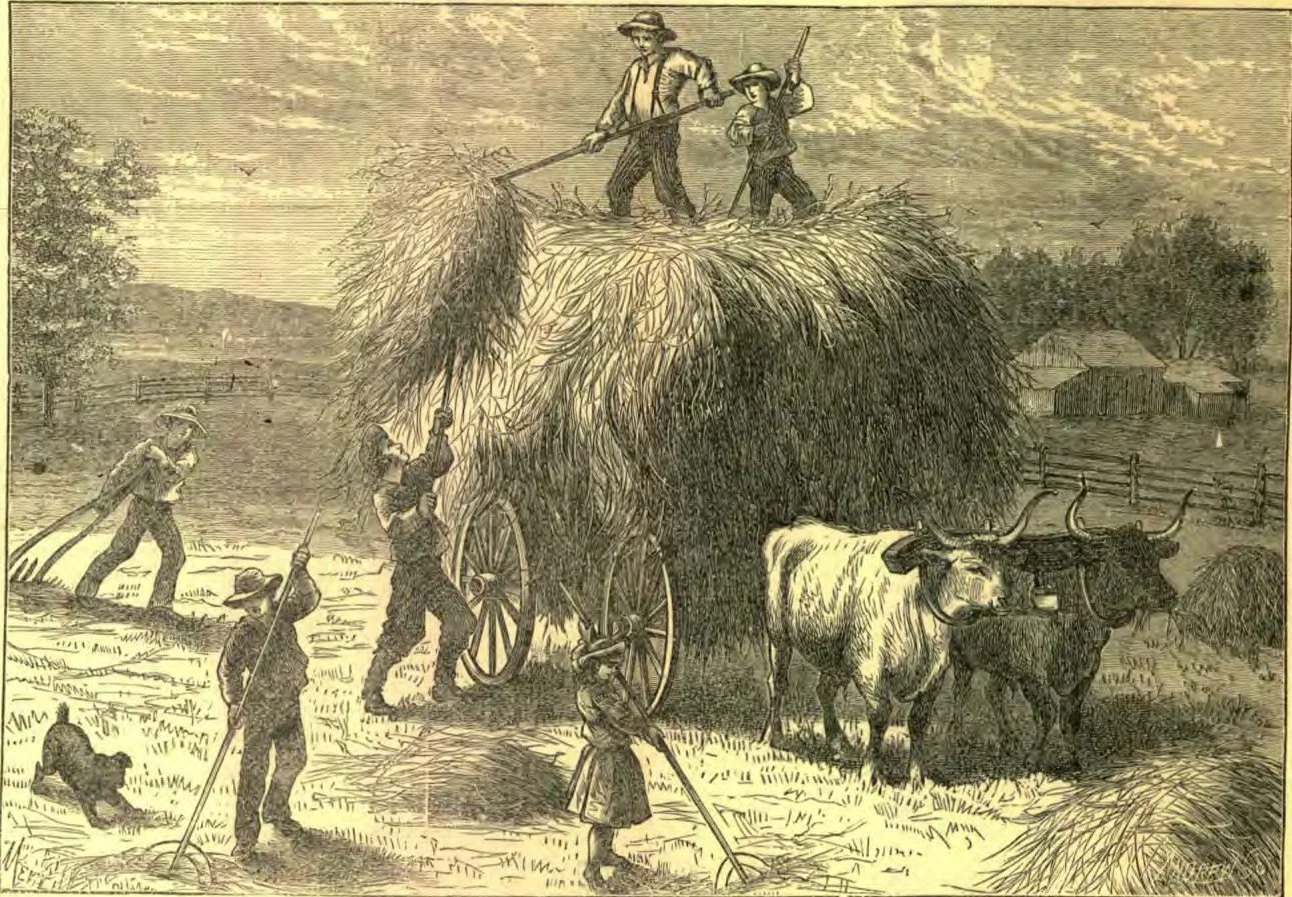
Saw ye the farmer at his plow As you were riding by? Or wearied ’neath his noon-day toil, When summer suns were high? And thought you that his lot was hard? And did you thank your God That you and yours were not condemned Thus like a slave to plod?
Come see him at his harvest home, When garden, field, and tree Conspire to fill with flowing stores His barn and granary. His healthy children gaily sport Amid the new-mown hay, Or proudly aid, with vigorous arm, His task, as best they may.
The dog partakes his master’s joy, And guards the loaded wain, The feathery people clap their wings, And lead their youngling train. Perchance the hoary grandsire’s eye The glowing scene surveys, And breathes a blessing on his race, Or guides their evening’s praise.
The Harvest-Giver is their friend, The mother of the soil: And Earth, the mother, gives them bread, And cheers their patient toil. Come join them round their wintry hearth, Their heartfelt pleasures see, And you can better judge how blest The farmer’s life may be.
—Mrs. Sigourney.

A STORY OF INVENTION.

Stephen Garnet and Aaron Ruby were fellow-workmen in a large iron works in one of the great manufacturing towns of England. A heavy order had just come in, and the hands were required to work on Sabbath. Stephen refused. He had a wife and baby, and it was hard for him to leave the factory where he had worked all his life. But he did not hesitate, and his wife approved of the sacrifice.
All Monday, Stephen went from factory to factory; but trade was dull, and although it was beginning to revive, no new hands were required.
So a bitter time of trial began. For three long weeks Stephen wandered about constantly, asking for work. Frequently he walked long distances, on vague rumors of employment, which always turned out to be false.
Stephen had tried each evening, as he neared his home, to put on a cheerful look he did not feel, but one look at Mary's anxious face put all his sham brightness to flight.
Their little stock of savings soon began to run low; and at the end of the three weeks, Stephen, with a heavy heart, drew his last pound from the bank.
The week that followed was full of misery and despair, and the next Saturday night found them with but a shilling left. Stephen often wonders now how he got through that week without yielding to temptation, and owns that nothing but the sustaining hand of God and his patient wife ever saved him.
When Saturday night came, Stephen, after much hesitation, asked the momentous question:—
“Have we any money left, Mary?”
“A shilling; but don't be low-hearted, we have three big loaves of bread and a bit of cheese, and some tea and sugar. Keep up your heart, Stephen, our Lord's sure to make 'way for us.”
So the fourth week ended.
Another Sabbath came around, and, perhaps, of all the sorrow laden souls that assembled at the church, none carried a heavier heart than the workingman who knelt with bowed head and passionately clasped hands in the shadow of the farthest pillar.
That afternoon Stephen was sitting silently by the fire, and Mary, singing a hymn, was trying to quiet the child, when the door opened and Aaron Ruby came in.
“Well, old chap, are you getting on middling?”
“No, not at all; I can't get a chance to work.”
“Ay, but that's bad. Have you tried old Mr. Wilson's? He's of your way of thinking.”
“Ay, but they've not work for their own hands.”
“I'm sorry for you, Steve. I've wished, many a time since, I'd been man enough to do the same.”
“Have you been working every Sabbath?”
“Ay, that we have; Hanworth comes down for an hour in the afternoon, looking so clean, and flowers in his coat. But what is a man to do?”
“Obey God rather than man,” said Stephen solemnly.
“Ay, it's well enough for you,” Aaron began, and then he stopped suddenly, for he caught sight of Mary's face, and his eyes were full of tears.
“You'll stop, Aaron, and have a cup of tea with us?”
“Yes, do, Aaron,” echoed Mary. “Here, Steve, hold baby while I get it ready.”
Stephen took the little creature, but it suddenly set up a pitiful cry. He rocked it and tried to quiet it, but all in vain. The more he rocked, the harder it cried.
“Whatever is the matter?” said Stephen, turning helplessly to his wife.
“You've run a pin into it,” said Mary, taking the baby.
The little one ceased to cry, and remained quiet until the meal was spread. Then, though Mary and Aaron talked cheerfully, Stephen became silent, and the rest of the evening seemed in a brown study, gazing thoughtfully at the child as it lay in the cradle. Suddenly he exclaimed:—
“Yes, that's how it could be done.”
“What done?”
“Why, I know how I could make a pin that wouldn't hurt.”
“Then do it, lad,” cried Aaron. “Lots of the women folks would buy them.”
“But I can't do it.”
“Why?”
“Because my money's gone, and we've naught even to buy pin wire.”
“Here, I'll lend it to you. Will ten shillings do?”
“Aye, and five shillings will; thank you, mate.”
After that a cloud seemed lifted from the party, and the dawn of the next day saw Stephen on his way to the wire sellers.
Very diligently and happily he worked, and before dinner he called to Mary.
“Wife, come hither; here are some pins finished. You must have the first.”
And he held toward her a handful of the now universally known “safety pins.”
“Will they do?” Stephen asked anxiously.
She looked at them, this first judge of his invention, and then cried:—
“Yes, grandly!” She hastily turned to the cradle, picking up the baby, tried one of the pins, and then covered its little face with kisses. “My little bairn, my lamb! I sadly feared for thee; but father can keep us both now.”
Two days later, with a work-box of his wife's filled with various sizes of the new pin, Stephen visited some of the largest drapers' shops in the town. He returned in two hours, with a handful of silver and an empty box, and set to work making more; and although Aaron joined him the following week, the demand could not be met.
Stephen is able to surround his Mary with every indulgence his warm love can wish to supply her with; and perhaps the reason why he remains so unassuming and humble a man, though now a rich one, is found in the fact that he actually feels all his prosperity has come to him—a most unexpected gift—from following resolutely the will of God. It was because he was at his wit's end for bread, that he was led to think out and find what proved to be a blessing both to himself and family, and to tens of thousands of mothers and their babes.
It scarcely needs to be added that Stephen is now the proprietor of a large factory known as the “Safety Pin Works,” and that his orders come in so fast that he is obliged to run his factory day and night to fill them.—Selected.

LIFE IN THE POOR-HOUSE.

About the worst calamity that could happen to a person, we would suppose, is for them to be sent to the poor-house. I hope no one of you may ever know by experience what it is. But thinking you would like to learn about it, I took pains to go to the county poor-farm. We were stopping at the pleasant home of Mr. Samuel Smith. He is the brother of Eld. Uriah Smith, editor of the Review and Herald, so I suppose you all know who he is. We are up among the mountains and woods of New Hampshire, at West Wilton. This is a very romantic place, with beautiful little streams of water, and such great stones, big boulders, and high hills. Mr. Smith took us with his team two miles over to the poor-farm and poor-house.
What do you suppose the poor-house is anyway? Probably you are thinking of a little shanty with a tumbled in roof, poor furniture, and an old broken stove, and a little ten-acre farm, all grown up to weeds. That would truly be a poor farm, but our poor-farm is not that kind of a one. In the first place, it is a very large one, containing over five hundred acres. The buildings are large and nice, and there are a good many of them,—barns, sheds, outhouses, and several large houses. Mrs. Styles, the superintendent’s wife, a very agreeable lady, kindly showed us all over the premises.
A poor-house, I said to myself. This is a good deal nicer house and better furnished than I could own. There is not one family in ten that has such a house. Then why do they call it a poor-house? It is because they send persons here to be taken care of who are too poor to take care of themselves. This farm is owned and supported by the county. Any one who owns any property has to pay something toward its support. It costs the county fourteen thousand dollars a year. Now I will tell you who live here. There are the superintendent and his wife; they have to look after everything. Then there are sixteen officers to help them. Each officer has charge of some building or work. The family consists of two hundred and seventy-two persons, from little babes up to old men. These are all paupers, or very poor persons who have to be supported by the town. Just think of it, two hundred and seventy-two such persons all together! That would fill a good-sized meeting-house.
As we go round through the different rooms in the house, we see that everything is kept just as clean as possible. Every floor and stairway is washed thoroughly each day. Then there are nice places where every one has to bathe at least once a week, and sometimes oftener. Mrs. Styles says that this is the worst punishment they can put upon these paupers. They come there ragged and filthy, and to have to wash up clean every week is pretty hard for them. I have wondered if the INSTRUCTOR children ever find any fault about washing, or wish they did not have to?
Just look here! Twenty-two little babies all in one room. Won’t they make a racket? We are in what they call the nursery. They have nice little cribs built up against the side of the wall, all round the room; then there are seven nurses employed to take care of the little ones. Here is a bright little thing, only three weeks old. Pretty young to be in the poor-house. Then here are two or three others only two or three months old, and so along up to those two years old. Sometimes they are real pretty little things, bright-eyed, curly-haired, and with chubby hands; just as bright as your own little brother or sister. No father to take care of them, no mother to look out for them, no brother or sister to play with; and so they are brought here. One little fellow has crawled under the crib, and fallen asleep on the floor; another sits over there rocking itself to sleep. They are all nicely taken care of. They are kept clean and healthy, only I do not see what they would do if they should all cry at once!
Out in the yard is a whole lot of boys, ten years old and younger. They are dressed plainly but neatly. They seem to be merry fellows, even if they are in the poor-house. One little fellow with bare feet sings a song for us. In the school room are many more, and they sing some for us too. They seem to be as contented as boys in any school, but they need a vigilant teacher to watch them, and keep them in order. I learned a valuable lesson here. Mrs. Styles says that the only teacher who can control these scholars is the one who always controls herself, and that is a fact which every one should learn; the person who controls others must first learn to thoroughly control himself.
Next we go into the hospital, where they take care of sick people. This is a large upper room, with a good many beds in it. They are all neat and clean. The next place we go into is where they keep the insane people. There are a good many here, and some of them look hardly human. Some look stupid, foolish, and repulsive; others look sorrowful and pitiful, while others look bright and happy. Here is one woman, bright and well-dressed; she says she is worth millions of money, and that she is not insane at all; that the people are wicked to keep her there. Here is a troublesome creature in a straight jacket. Now do you know what a straight jacket is? I did not examine it very closely. It is used in tying up the hands of a crazy person when he becomes unruly. It is made from heavy ducking or canvas cloth, and is something like a vest, only it opens on the back instead of the front. They put this jacket on just as a man would put on his vest back side to. There are heavy pockets into which the hands are put and tied so he cannot get them out. Then the jacket is laced up on the back with heavy cord. The person can walk around, but cannot do any harm.
We go into another room, and here are old men and women. Some of these had once been rich, but now they are paupers. They have a room down cellar where they allow them to smoke; and here I learned another thing. Mrs. Styles says that ninety-five out of a hundred of these paupers use tobacco. They have used it so long that they think they cannot live without it; so they provide them a room where they can smoke all they want to. Now you see what many tobacco-users finally come to—the poor-house. Many who come here are too lazy to make a living for themselves. They will not work unless they are compelled to; but they put them at it here, and make them stick to it as long as they are able. They do not like this very well, and some of them leave. They endeavor to have every one work who is able to do anything; some saw wood, others plough, and work on the farm; the women wash, clean the floors, mend the clothes, and do anything that needs to be done in so large a family. The poor-house used to be a bad place, the paupers were poorly cared for; but now they are much better provided for. Many good people who have been unfortunate are obliged to come here to end their days. We should be thankful that there are such nice places for poor people who have no home of their own. D. M. CANRIGHT.

HARRY'S MOTTO.

There was to be a shooting match at Westport, a place some miles distant from Harry's home, and all the boys of his school had been invited to take part.
Every moment that Harry could spare from his lessons he spent in practicing with the little gun that had been his last birthday present.
He was a remarkably good shot for a boy of his age, and he really had considerable foundation for his hope that he might be successful in winning the prize.
When the day of the shooting-match dawned bright and clear, he could hardly stop long enough to eat his breakfast, so eager was he to be off.
He had about two miles to walk to the school-house, where the boys had agreed to meet and ride over in a large wagon to Westport; and he walked briskly along, whistling cheerily as he thought of all the pleasure in store for him.
“Hello, here's a bad business!” he exclaimed, as he was passing a little cottage which stood by the side of the road.
In the garden surrounding it, where the early vegetables had just begun to grow, were two cows, who were wandering about at will, making great havoc with the tender shoots and leaves.
“I guess I had better tell old Mr. Pierson that he has visitors in his garden. May be he don't know it, and they will ruin everything if they are not driven out,” thought Harry, who knew that the old couple lived upon the produce of their garden.
No one answered his knock at first, but when he repeated it, he heard a feeble voice saying, “Come.”
He found old Mrs. Pierson sitting in her chair by the fireside, crippled with the rheumatism, and told her of the intruders in her garden.
“Won't you drive the cows out, Harry, and make the gate fast, so they can't come in again? I can't move, and Jim's gone over to Mr. Elliott's to do a spell of work, and won't be back this good while.”
“All right,” answered Harry cheerfully; but to his dismay, he found that it would take more than shutting the gate to prevent the cows from renewing their depredations after they had been driven out. A part of the fence was broken down, and they entered through this gap as soon as the gate was fastened.
“What shall I do?” cried Harry in vexation. There were those persistent cows returning to enjoy the meal he had twice interrupted, and they would undoubtedly finish their work of destruction if they were left to themselves.
He could not go away and leave the cows to destroy the livelihood of these two poor old people, yet he could not fix the fence in time to meet the boys. The words of the text he had chosen for his motto, flashed across his mind: “Even so Christ pleased not himself,” and with a little prayer for help, he set to work at the fence. He had just finished his task, when a voice called:—
“Why, Harry, how is it you are not with the rest of the boys on the way to Westport?” and looking up he saw the doctor.
Harry explained the cause of his delay, trying to make as light of his disappointment as possible.
“Jump in here with me,” exclaimed the doctor. “I am going there to see a patient, so you sha'n't lose anything by your kindness.” Harry was a happy boy when he won the prize; but his happiness was sweetened by the remembrance of his self-denial, and the thought that he had tried to follow in his Divine Master's footsteps.—Selected.

His Mother's Songs.

Beneath the hot midsummer sun The men had marched all day; And now beside a rippling stream Upon the grass they lay.
Tiring of games and idle jests, As swept the hours along, They called to one who mused apart, “Come, friend, give us a song.”
“I fear I cannot please,” he said; “The only songs I know Are those my mother used to sing For me long years ago.”
“Sing one of those,” a rough voice cried, “There’s none but true men here; To every mother’s son of us A mother’s songs are dear.”
Then sweetly rose the singer’s voice Amid unwonted calm, “Am I a soldier of the cross, A follower of the Lamb?”
“And shall I fear to own his cause”— The very stream was stilled, And hearts that never throbbed with fear With tender thoughts were filled.
Ended the song; the singer said, As to his feet he rose, “Thanks to you all, my friends; good night. God grant us sweet repose.”
“Sing us one more,” the captain begged; The soldier bent his head. Then glancing ’round, with smiling lips, “You’ll join with me,” he said.
“We’ll sing this old familiar air, Sweet as the bugle call, ‘All hail the power of Jesus’ name, Let angels prostrate fall.’”
Ah! wondrous was the old tune’s spell As on the singer sang; Man after man fell into line, And loud the voices rang.
The songs are done, the camp is still, Naught but the stream is heard; But ah! the depths of every soul By those old hymns are stirred.
And up from many a bearded lip, In whispers soft and low, Rises the prayer the mother taught The boy long years ago.
—Chicago Inter Ocean.

CALLS TO DUTY.

How much is there to win and do, How much to help and cheer! The fields are white, the laborers few; Wilt thou sit plaining here? A Red Sea may before thee flow, Egyptian hosts pursue; But he that bids thee onward go Will ope a pathway through. —Henry Francis Lyte.

ANCIENT DRESS.

Perhaps the Instructor readers may be interested in some facts about old-time dresses. The very first garments, aside from the first suits of fig leaves, were made from the skins of wild animals. For many years, skins were used by some nations; and even now the people in some Eastern countries wear such clothing. The mantles worn by the prophets are said to have been made of skins, with the hair left on. After a time, the people wove cloth out of hair. The sackcloth worn by the mourners was of this material. Wool was also used at quite an early date, and linen and cotton as early as the latter part of the fifteenth century before Christ.
It is uncertain when the art of dyeing became known to the Hebrews. At first the materials were left their natural white color. Garments were usually decorated with embroidery, or figures of some kind, either woven in the goods, or made of some other material, and fastened on. Some were decorated with gold or silver threads.
Customs in Eastern countries change but little, the Arabs of the present time dressing very much as did the ancient Israelites. There are still worn the flowing robes, consisting of outer and inner garments, the former thick and heavy, and the latter light; adapted to the sudden changes of temperature in those countries. Quite a distinction exists between the costumes of the rich and poor, the clothing of the wealthy classes being made of finer material. Garments embroidered with gold and silver were worn by royalty, or persons of great wealth. The Hebrews do not seem to have been skilled in this art; but the Egyptians and other Eastern nations excelled in it.
Dyed goods were also imported from other countries, and were very expensive. Purple and scarlet seem to have been the favorite colors, and were worn only by very wealthy persons.
It was considered a mark of special favor to present any one with a robe. After the prodigal’s return from the far country, his father commanded the servant, saying: “Bring forth the best robe, and put it on him; and put a ring on his hand;” and of Daniel we read: “And they clothed Daniel with scarlet, and put a chain of gold about his neck.” But in the Bible white robes seem to denote purity, and it is with such that the Lord has promised to clothe those whom he would especially honor; for he says, “He that overcometh, the same shall be clothed in white raiment; and I will not blot out his name out of the book of life, but I will confess his name before my Father, and before his angels.” Do you want the white raiment?
MAY WAKEHAM.

IMPORTANT BIBLE SUBJECTS.

LESSON 57.—INHERITANCE OF THE SAINTS. (Continued.)

THE KINGDOM RECEIVED.

[NOTE TO THE STUDENT.—Do not consider the lesson learned until you can give at least the substance of every text, with the correct reference for each. The references in black letters indicate those texts that should be committed to memory. A little diligent application each day will enable you to do this.]
  1. GIVE a brief outline of the kingdom of Israel from the time of Saul to its final overthrow.
  2. Into the hands of what power did the dominion then pass? 2 Chron. 36:11–20; Jer. 27:4–7.
  3. Into whose hands did it subsequently pass? (See note in last lesson.)
  4. How was this foretold by one of the prophets? Eze. 21:25–27.
  5. Who is the one “whose right it is?” Ps. 2:7, 8.
  6. What did Isaiah say concerning the continuation of the kingdom of David? Isa. 9:6, 7.
  7. Where is this successor of David named? Luke 1:31–33.
  8. Where had the promise of such a successor been made directly to David? 2 Sam. 7:10–16.
  9. Did David understand to whom this promise referred? Acts 2:29–31.
  10. Did Christ receive and restore this kingdom at his first advent? Acts 1:6, 7; John 18:36.
  11. To what did he liken the receiving of the kingdom? Luke 19:11, 12.
  12. Has Christ yet received the kingdom? Rev. 3:21.
  13. When will he have received it? Matt. 25:31.
  14. What will the righteous then also receive? Matt. 25:34.

NOTE.

“And thou profane, wicked prince of Israel, whose day is come, when iniquity shall have an end, thus saith the Lord God: Remove the diadem, and take off the crown; this shall not be the same; exalt him that is low, and abase him that is high. I will overturn, overturn, overturn it; and it shall be no more, until he come whose right it is; and I will give it him.” Eze. 21:25–27. These words were spoken to Zedekiah, the king who reigned in Jerusalem at the time of the final captivity. The taking off of the diadem was when the kingdom passed into the hands of the Babylonians. Then three overturnings were to take place; the first one resulted in the upbuilding of Medo-Persia; this being overturned, Greece came to the front; and upon the overthrow of this empire, Rome became supreme. After this, says the prophet, there shall be no more general overturning until the coming of Christ, to whom the uttermost parts of the earth shall be given.

Building to Overthrow.

Little Jamie was on the floor building palaces of blocks. Very carefully he arranged them in their places, balancing them that they might not fall. Yet before any one had time to admire the finished work, he overthrew it all with one blow of his tiny hand. In an instant the ruin was wrought, and Jamie’s shout of joy was more triumphant over the swift destruction than over the slow and patient building.
Jamie’s father was building too, slowly and surely building for himself a home that should be a place of refuge and of rest. No danger that he would attempt to overthrow his work! Jamie told the reason: “Mine is only play-building, you know; but papa’s is real, earnest building, and he must not make it fall.”
Fellow teachers, we are building, and ours is real, earnest work. It is the work of leaving noble impressions, and setting God’s seal upon living souls. We are laboring not for days alone, not for years alone, but for eternity. And yet too often we build carelessly, and overthrow our work hastily, as though it were play-work of our own, instead of real work for the Master Architect.
Remember that your life is a constant sermon. God has given you very precious, blessed work to do for him; win the young hearts wisely and well. Young souls are in your keeping. Live as you would teach them to live. While building these temples for your God, be very patient, very watchful, that by no deed of wrong you overthrow your work.—S. S. World.

THE MOST BEAUTIFUL BUILDING IN THE WORLD.

On the banks of the sacred Jumna, near Agra, in India, stands the most beautiful building on earth. It is the Taj-Mahal, which, though designed for a tomb, has more the appearance of a splendid palace. “This gem of all India” was built by the great Mogul Emperor, Shah Jehan, as a memorial to his wife, the beautiful Empress Mumtaz-i-Mahal, who died A. D. 1629.
It has been called “a poem in marble,” “a dream in marble,” “a floating palace,” “the sigh of a broken heart.” It is majestic and yet so beautiful that it is no wonder Bishop Heber says its architects “built like Titans and finished like jewelers.” The Taj was commenced in 1630, and completed in 1647, at a cost of $15,000,000, when money was at five times its present value. In its construction 20,000 men toiled for seventeen years, most of them without compensation. The whole building is of pure, polished marble. For over 200 years it has stood in its whiteness and glory, in its silence and grandeur, unchanged amid the changes of time, unharmed amid the ravages of war.
At her death, Mumtaz sent for the Emperor, and said, “O king, promise me that you will never marry again, and also promise me that you will build for me a tomb more beautiful than the world has ever seen.” The promises were made and kept.
The Taj stands in a beautiful park and garden, embracing about twenty acres, and filled with rich flowers, rare shrubs, stately trees, marble walks, and playing fountains. This inclosure is surrounded by a lofty wall of red sandstone, over a mile in circuit, with towers at each corner, and arched colonnades on the interior. Approaching this most impressive of the world’s great tombs, you behold a noble structure, so rich and massive that you involuntarily exclaim, “O, the Taj! the Taj!” But no. It is only the portal to a far more magnificent building. This superb and colossal gateway of red sandstone, over 100 feet wide and nearly 100 feet high, elaborately carved, inlaid with quotations from the Koran, and surmounted with its twenty-six white marble cupolas, is a fitting entrance to such an incomparable structure as the Taj.
In the farther end of the charming inclosure rises the Taj in all its glory. It stands upon two vast platforms or terraces, the lower one of rich red sandstone, four feet high, and nearly 1,000 feet broad; the upper one of pure white marble, 18 feet high, and over 300 feet square. From the four corners of the marble terrace rise four slender, graceful, yet strong minarets of white marble, each 137 feet high. On each side of the Taj is also a Mohammedan mosque of red sandstone, with marble domes, standing like sentinels to the wonderful shrine. In the center of the high marble terrace, surrounded by the minarets, and flanked by the mosques, stands the Taj itself. It is 186 feet square, or nearly square. From the marble platform to the golden crescent that tips the spire is 275 feet. Four smaller domes adorn the corners of the roof, while between them the great central dome of white marble, 70 feet in diameter and 80 feet high, swells upward in matchless beauty and grandeur.
The interior of the Taj is one grand rotunda. All the light the building has, streams in through screens of marble trellis work, but this is sufficient to reveal the amazing beauty of the place. Directly under the vast dome are the cenotaphs, which represent the tombs in the vault beneath. Sweeping entirely around, and inclosing these representative tombs, is a magnificent white marble screen six feet high, carved to represent delicate lace-work. A flight of marble steps leads into the dim crypt below to the real tombs. Each sarcophagus is of snow-white marble, covered with exquisite wreaths and garlands of vines and flowers, formed by inlaid precious stones. In the vast concave of the dome of the Taj is an echo as marvellous as the Taj itself. Every word, whisper, song, and foot-fall is caught up and repeated from side to side in prolonged, tremulous echoes, growing fainter, softer, sweeter, making that vault the most wonderful whispering gallery on earth. Bayard Taylor says of this echo: “A single musical note uttered by the voice floats and soars overhead in a long, delicious undulation, fading away so slowly that you hear it after it is silent, as you see, or seem to see, a lark you have been watching, after it is swallowed up in the blue vault of heaven.”—Treasure-Trove.

JOHN ELIOT AND HIS CLOCK.

A PROMINENT man among New England’s pioneers was the Rev. John Eliot, the “apostle to the Indians,” as he was called. He was born in 1604, and came to this country in 1631, in the ship Mary Lyon. Arriving at Boston, he began his labors as a minister at that place, but he was afterward associated with Mr. Wilde over a congregation at Roxbury.
But what distinguished Mr. Eliot was his work among the Indians, of whom there were about twenty tribes known to the English, all speaking nearly the same language. As he saw their spiritual destitution, his heart yearned to bring them to a saving knowledge of the truth. He at once set to work to learn their language. As soon as he could master it well enough to be understood by them, he began to preach to them, and was very soon encouraged by the good that was accomplished through his efforts. Mr. Lossing says of Mr. Eliot’s work, in “Our Countrymen:” —
“Although violently opposed by the Indian priests, whose ‘craft was in danger,’ and also by some of the sachems and chiefs, he was not dismayed, but penetrated the deep wilderness in all directions, relying solely upon his God for protection. Finally an Indian town was built at Natick; and a house of worship, the first for the use of the Indians ever erected by Protestants in America, was built in 1660.”
“Mr. Eliot translated the New Testament into the Indian language, and published it in 1661; and in the course of a few years he established several congregations among these children of the forest, extending even as far as Cape Cod. He obtained unbounded influence over them; and he was also their protector when, during King Philip’s war, the Massachusetts people wished to exterminate the Indians, without discrimination.
“It was estimated that there were five thousand ‘praying Indians,’ as the converts were called, among the New England tribes, when Philip raised the hatchet.”
Well, this good man brought with him, in the Mary Lyon, his clock, which was not long ago placed in the Memorial Hall of Hamilton College. G. B. G., in Golden Days, says it came to the college in this roundabout way:—
“On John Eliot’s decease, the clock fell into the possession of his son Joseph. Joseph handed it down to his son Jared; Jared to his son John; John to his son Edward; Edward to his son, John E. Eliot, of Clinton, the sixth in direct descent from the apostle to the Indians, who has presented it to the college.
“The clock is still in good order. During all the weary years since it was first placed in the Mary Lyon, it has ticked, ticked, the days in and the days out. It measured the hours while the old missionary was working on his translation of the Bible, of which but sixty copies are now in existence, and which but one man in the world can read.
“In Memorial Hall it still marks the passage of the minutes. It is, indeed, a venerable relic. It is certainly two hundred and fifty years old; how much older it is impossible to say.”

Easter Lily Bulbs.

The Easter lily, queen of fragrant flowers, grows in the open air the year round in Bermuda, and reaches a size and fragrance unknown elsewhere in the world. The great demand for this bulb in the New York and the London markets, has created quite an industry at Bermuda. Gen. Russell Hastings is the prime mover in this thriving business, as is stated by a correspondent of the Cincinnati Gazette. A writer in the Naturalist in Florida, who has visited Bermuda, in relating what he saw there, says:—
“Mr. Hastings began the cultivation of the Easter lily three years ago, and will send off 500,000 bulbs this year. I visited his lily farm, ‘Soucy,’ a sort of fairy land on the winding shores of the inner harbor. Scattered over the estate, arose the luxuriant tropical growths of the island—palms of many kinds, bearing fruity clusters, varieties of the cactus, the maguey, and many other sorts; the bamboo, tall and supple; the mangrove, standing tiptoe on its rooty stilts along the margin of the warm cove; the oleander, trimmed for a wind-break around the roses and lily fields. The lilies were cultivated in rows like onions, and thousands of them are now spreading their great snowy blossoms to the sky, and burdening the air with sweetness. These are of no value whatever, and sometimes they are torn off and destroyed systematically, in order to give vigor to the bulb beneath. In all the fields, even those containing several acres, all the lilies turn to the sun, like obedient soldiers to their commanders.”

ARCTIC SCENERY.

LIEUTENANT GARLINGTON, of the United States Army, who had charge of the Government relief steamer Proteus, that was sent to the Arctic regions two years ago in search of the Greeley party, says of the frozen North, in Golden Days:—
“When you get up among the glaciers and rocks, the scenery is one of terrific grandeur and picturesque beauty, but the extreme of dreariness. No sound or stir except now and then the terrific crash of a huge transparent boulder, as it grates on the bottom of the ocean and crushes to pieces. There is a dreary silence that courts loneliness; and one feels such a dull dread all the time, that it approaches misery.
“In the summer-time you can sometimes hear the piping of seagulls, the chatter of ducks, and the growl of walruses, but you only meet them occasionally. If you can describe a vast sea of ice and snow which is as irregular as anything you can imagine, you know what appearance that country has. The nearest comparison I can make to the appearance of one of those icebergs, is looking down on a city from the top of a mountain. The high and low houses, with an occasional church steeple, resemble very much one of these floating icebergs. The wind has no effect on them whatever.
“It is not an uncommon thing to see the ‘floe,’ or soft ice, going in one direction, driven by the wind, and an iceberg moving in an opposite direction, carried by the current.
“There is always seven times the bulk of ice under the water that is seen above, and one acquainted with the polar region can always tell by the color, rigidity, and appearance of an iceberg whether it comes from the North Sea or not. You will sometimes see a boulder three or four times as high out of the water as a house, and probably ten times as large, carried along by the current; and when two of them come together, the force is sufficient to crush the less rigid one.
“You can judge what a steamer would be like when caught between two such icebergs. No boat can ever be built that could withstand the pressure. Although they seem to be moving slowly, they have a terrific force, and are often crushed by their own weight.
“One of the most interesting sights in the whole northern region is the falling into the ocean of huge fields of ice. You will see thousands of acres of ice and snow that extend high in the air. The water wears this away on the under side; and when the point projecting into the water becomes so heavy as to force itself off, it breaks, with a loud report, and falls into the ocean.”

HOW TO ENJOY REVIEWING.

Some superintendents declare openly that review Sabbath is at once the most trying and the least profitable Sabbath in the quarter; many others confess to the same feeling privately; and probably a still larger number have the feeling, without ever having shaped it into words, or even into a definite thought.
But on the other hand, a constantly-increasing number really enjoy the work of reviewing; and, furthermore they are getting teachers and scholars to enjoy it also. The secret of this transformation may be openly proclaimed thus: Preparation. Preparation. Preparation.
1. Get the material for review, by faithful study, week by week.
2. Arrange that material according to some definite plan. A little knowledge well massed and in hand is better than a great deal scattered, and so unmanageable.
3. Do not attempt too much. Take a few leading points, and make them clear.—S. S. World.

SOUL-ENDEAVOR

There are blessings weightier than ore; Treasures brighter than the costly gem; Joys like pearls which stud a diadem; Hopes which thrill the heart forevermore, These are won by soul-endeavor; Treasures those which perish never.
—F. T. Pomeroy.
Continue reading: SOME THINGS JESUS TAUGHT