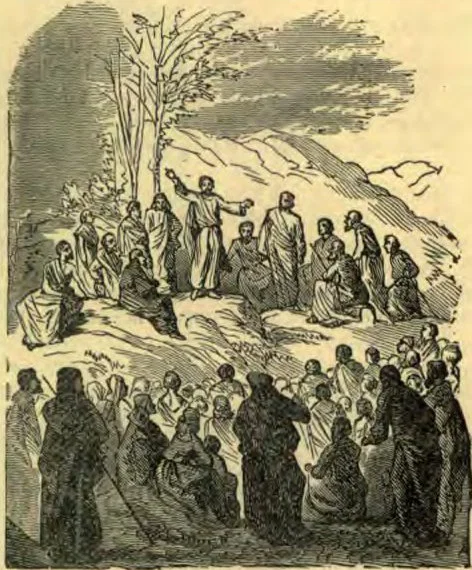
When Jesus was here on the earth, he went about among the people, teaching them, and healing the sick ones. Multitudes flocked to him, with all manner of diseases, praying him to make them well. Sometimes Jesus became very weary when so many people pressed around him, and then he would go away into the mountains or some desert place to be alone a little while. But he could not always be by himself, even then; for the people were so anxious to listen to every word that he said, that they would follow him long distances. At one time, Jesus was walking among the mountains and hills of Palestine, and a great multitude followed him. When he saw them, he stopped, and began to talk to them. The disciples came close to him, but the people stood a little way off, though they could hear every word.
Jesus told them many things that no doubt seemed very strange to them, because they were so different from what the priests and rabbis had taught.
The rabbis were wise men, who claimed to understand the Bible very well. They preached to the people in the synagogues, or meeting-houses, every Sabbath-day. They were very particular about a great many little things that were of no account, and were proud and exacting. They made long prayers on the street corners, where everybody could hear them, and think them very pious. When they gave anything away, they did it in a very public manner, and loved to have a trumpet blown so that people would know all about it. They often disagreed with one another, and hated their enemies sincerely.
Almost everything that Jesus taught was exactly contrary to what the rabbis did. They had a saying, “An eye for an eye, and a tooth for a tooth;” that is, if any one injures you, you may get angry and injure him in return. Jesus at this time said, “Whosoever shall smite thee on thy right cheek, turn to him thy left one also.” When people do us evil, we are not to “pay them back.” “Love your enemies,” Jesus said; “bless them that curse you, and do good to them that hate you.” You may be sure the people were astonished when they heard this, for the rabbis had taught them to love their neighbors and hate their enemies.
Then Jesus told them to do their almsgiving quietly, so that people would not know it; and he taught them how to pray,—not such long prayers as the Pharisees made, for they would often stand in some public place by the hour, and pray.
Jesus told the people many more things at this time,—so much that we could not begin to tell it all. How much we would have liked to walk with him in the green valleys and mountains of Palestine, and hear the words that he spoke! But that was long, and long, ago. Yet we can know what he said, for one of the disciples has written down the very words that Jesus at this time spoke, and we can read them in the fifth, sixth, and seventh chapters of the book Matthew has written. They were meant for us just as much as for the people to whom they were spoken. Some of it is for grown-up people, but a great deal of it is for the children too.
How much we ought to love Jesus, and how gladly we should do all that he requires of us! W. E. L.
LITTLE SCOTCH GRANITE.
Burt and Johnnie Lee were delighted when their Scotch cousin came to live with them. He was little, but very bright and full of fun. He could tell curious things about his home in Scotland and his voyage across the ocean. He was as far advanced in his studies as they were, and the first day he went to school they thought him remarkably good. He wasted no time in play when he should have been studying, and he advanced finely.
At night, before the close of the school, the teacher called the roll, and the boys began to answer, “Ten.” When Willie understood that he was to say ten, if he had not whispered during the day, he replied, “I have whispered.”
“More than once?” asked the teacher.
“Yes, sir,” answered Willie.
“As many as ten times?”
“May be I have,” faltered Willie.
“Then I shall mark you zero,” said the teacher, sternly; “and that is a great disgrace.”
“Why, I did not see you whisper once,” said Johnnie, that night after school.
“Well, I did,” said Willie; “I saw others doing it, and so I asked to borrow a book, then I lent a slate pencil, and asked a boy for a knife, and did several such things. I supposed it was allowed.”
“Oh, we all do it,” said Burt, reddening. “There isn’t any sense in the old rule, and nobody could keep it; nobody does.”
“I will, or else I will say I haven’t,” said Willie. “Do you suppose I would tell ten lies in one heap?”
“Oh, we don’t call them lies,” muttered Johnnie. “There wouldn’t be a credit among us at night, if we were so strict.”
“What of that, if you told the truth?” laughed Willie, bravely.
In a short time, the boys all saw how it was with him. He studied hard, played with all his might in play-time; but, according to his account, he lost more credits than any of the rest. After some weeks, the boys answered “Nine” and “Eight” oftener than before. Yet the school-room seemed to have grown quieter. Sometimes, when Willie Grant’s mark was even lower than usual, the teacher would smile peculiarly, but said no more of disgrace. Willie never told tales, but somehow, it made the boys ashamed of themselves, just to see this sturdy, blue-eyed boy tell the truth. It was putting the clean cloth by the half-soiled one, you see; and they felt like cheats and story-tellers. They talked him all over, and loved him, if they did nickname him “Scotch Granite,” because he was so firm about a promise.
Well, at the end of the term, Willie’s name was very low down on the credit list. When it was read, he had hard work not to cry; for he was very sensitive, and he had tried hard to be perfect. But the very last thing that day was a speech by the teacher, who told of once seeing a man muffled up in a cloak. He was passing him without a look, when he was told the man was Gen.—, the great hero.
“The signs of his rank were hidden, but the hero was there just the same,” said the teacher. “And now, boys, you will see what I mean when I give a little gold medal to the most faithful boy—the one really the most conscientiously ‘perfect in his deportment,’ among you. Who shall have it?”
“Little Scotch Granite!” shouted forty boys at once; for the child whose name was so “low” on the credit list had made truth noble in their eyes.—The British Evangelist.
THREE LITTLE NEST-BIRDS.
We meant to be very kind;
But if ever we find
Another soft, gray-green, moss-coated, feather-lined nest
in a hedge,
We have taken a pledge—
Susan, Jimmy, and I—with remorseful tears, at this very
minute,
That if there are eggs or little birds in it,
Robin or wren, thrush, chaffinch or linnet,
We'll leave them there
To their mother's care.
There were three of us—Kate, and Susan, and Jim,—
And three of them;
I don't know their names, for they couldn't speak,
Except a little imperative squeak
Exactly like Poll,
Susan's squeaking doll.
But squeaking dolls will lie on the shelves
For years, and never squeak of themselves:
The reason we like little birds so much better than toys,
Is because they are really alive, and know how to make a
noise.
There were three of us and three of them;
Kate—that is I—and Susan and Jim.
Our mother was busy making a pie,
And theirs, we think, was up in the sky;
But for all Susan, Jimmy, or I can tell,
She may have been getting their dinner as well.
They were left to themselves (and so were we)
In a nest in the hedge by the willow-tree,
And when we caught sight of three red little fluff-tufted,
hazel-eyed, open-mouthed, pink-throated heads, we
all shouted for glee.
The way we really did wrong was this:
We took them in for mother to kiss,
And she told us to put them back,
While on the weeping-willow their mother was crying
“Alack!”
We really heard
Both what mother told us to do and the voice of the mother-bird.
But we three—that is, Susan and I and Jim,
Thought we knew better than either of them;
And in spite of our mother's command and the poor bird's
cry,
We determined to bring up the three little nestlings ourselves on the sly.
We each took one,
It did seem such excellent fun!
Susan fed hers on milk and bread;
Jim got wriggling worms for his instead.
I gave mine meat.
For, you know, I thought, “Poor darling pet! why shouldn't
it have roast beef to eat?”
But, oh dear! oh dear! oh dear! How we cried,
When in spite of milk and bread and worms and roast beef,
the little birds died!
It's a terrible thing to have heart-ache.
I thought mine would break
As I heard the mother-bird's moan,
And looked at the gray-green, moss-coated, feather-lined
nest she had taken such pains to make,
And her three little children dead and cold as a stone.
Mother said, and it's sadly true,
“There are some wrong things one can never undo.”
And nothing we could do or say
Would bring life back to the birds that day.
The bitterest tears that we could weep
Wouldn't wake them out of their stiff cold sleep.
But then,
We—Susan and Jim and I—mean never to be so selfish and
willful and cruel again.
And we three have buried that other three
In a soft, green, moss-covered, flower-lined grave at the
foot of the willow-tree.
And all the leaves which its branches shed
We think are tears because they are dead.
—Selected.
Letter Budget.
AND now you are right in the midst of your summer vacation, when school books are for the time partly laid aside. We hope you are having a pleasant time, because following in the path of duty. During all the fine spring and summer days, you have seen Nature doing her work, from the first tiny leaves of spring until she has perfected some of her fruits. Like her, we hope you are perfecting every good work you have begun.
It is pleasant to watch the growth of the plants as they reach outward and upward for the air and the sunshine, and to see the fruits swell and ripen, ready for use. But it is still more pleasing to see little boys and girls reaching out for the sunshine of God's love, and growing up like Christ, to bear fruit to his glory. We hope all the Budget boys and girls are really growing wiser, and better, and more helpful. Valentine and Charles and Maud and Lillie and Nellie, who have letters in this paper, shall be remembered by us all. And now for their letters:—
Valentine Ferrel writes from Morrison Co., Minn. He says: “As I have not seen any letter in the Budget from where I live, I thought I would write one. I am thirteen years old. I have three brothers and two sisters; two brothers and one sister, with myself, live with our parents. We have a Sabbath-school of fifteen members, a family having joined our school a few months ago. Two weeks ago two Sabbath-keepers visited our school from Long Prairie. They report a good Sabbath-school there. I have read Eld. Butler's ‘Tithing System,’ and I am now saving up my tithe. I am trying to be a good boy, so that I may be saved when the Lord makes up his jewels. Pray for me.”
Charles J. Parish, writing from Barron Co., Ky., says: “I am a little boy eleven years old. I am not a Sabbath-keeper, though I have an uncle, aunt, and cousin who are. They were up here on a visit not long ago, and held a Bible Reading. I was very much interested in their reading.”
Maud Edgerton, a little girl nine years old, writes from Cuyahoga Co., Ohio. She says: “We came to this place last fall from Cleveland. There are no other Sabbath-keepers in this town. We are living on a farm, and I can gather wild flowers. I love to read the Instructor, and keep God's commandments, and I hope to meet the Instructor family in the home Jesus has gone to prepare.”
Lillie Davidson, of Auglaize Co., O., writes: “As I am always interested in reading the letters, I thought I would write one too. I am eleven years old. I go to Sabbath-school, and get my lessons in Book No. 2. I have learned the commandments, and the names of the books of the Bible. I am now learning other verses out of the Bible. I like the Instructor. I am trying to be a good girl. I want you to pray that I may meet with you when the earth is made new.”
Nellie May Young, a little girl ten years old, writes from Antrim Co., Mich. She says she was baptized about two years ago, and keeps the Sabbath with her parents. She goes to Sabbath-school with her oldest brother, who is eight years old. They learn their lessons in Book No. 2. She loves the Instructor. She studies reading, spelling, writing, grammar, geography, and arithmetic. She loves her teacher. Nellie has read the New Testament through. She wants to meet you all when Jesus comes.