The Youth's Instructor, Vol. LI, No. 52

The Creation of Light

The Youth's Instructor

December 29, 1903

Review and Herald Publishing Assn. · Washington, D. C. · December 29, 1903

The Creation of Light

Part II
“In the beginning God created the heaven and the earth. And the earth was without form, and void.” It hung amid impenetrable gloom; for “darkness was upon the face of the abyss.”
The shades of night enveloped the earth, and the dawn of the world seemed not like a birth, but like a funeral. Silence—as of the grave! darkness—as of the tomb! But across that inky blackness from the throne of God came the words of Divine Majesty, “Let there be light,” and light was. Thus in a few words we have the history of the creation of light, and, so far as its appearance to man is concerned, this is all we know of its origin.
To ask further for the origin of light is to ask for the origin of God; for “God is light, and in him is no darkness at all.” He dwells “in the light which no man can approach unto.” From everlasting to everlasting he is God. And from eternity to eternity, light has co-existed with God. His light has never gone out; “for in him is no darkness at all.”
From the presence of God emanates a visible glory that shames the moon and mocks the sun. All heaven is flooded with the effulgence; and even earth, in its far wanderings from God, is not left in utter darkness.
“God is light.”
Once man dwelt in the presence of God, and held converse with his Maker face to face. He reveled in the light of God; he was enveloped in its radiance; he was shrouded in its splendor. There was no chill of evening, no frost of winter. Man lived amid the warmth of summer; for he abode in the presence of God, who is a sun and a shield,—a sun to give warmth and light and life; a shield to protect from biting cold and withering heat.
How much it meant for man to dwell in the presence of God!
“And God said unto them.” How full the meaning of the words, “God said unto them”! God spoke with man! He talked with him face to face! As friend speaketh with friend, so God spoke with man. There indeed was a close communion!
We seek the presence of the learned of the land to-day to ask them questions, to listen to their words; but what a privilege was that! What an opportunity for study, for progress! What a school! Man could question God. With a mind that knew no fatigue, in a body that never knew pain, man communed with the all-wise God!
A Fool's Paradise
A Fool's Paradise
Nevertheless, man was not content. He was not satisfied with God’s paradise; he must make himself a fool’s paradise. Not pleased to receive all that God could give, not content to be all that he possibly could be, he sought to be something else, different and inferior. Deluded, caught with the fool’s bait that he could, by disobedience, be as a god, knowing good and evil, he left all, and lost all.
Leaving God, the source of light, his feeble taper immediately went out in a miserable darkness. Sin swept in between the creature and the Creator, and darkness of mind and soul became man’s awful portion.
But still the sun, the light in the heavens, shone on, giving its radiant beams by day, its reflected light by night.
We have seen how it came into existence.
God spake, and lo! it was.
Then he commanded, and it stood fast. Ps. 33:9.
And by the divine energy of that word, it stands fast unto this day.
Let me say it all over again. There are but two steps: God first commanded light to exist, and, obedient to the word of command, it was. And even so, it was but energy from God, a manifestation of his power. Now mark the second step: God now commands that, as light had come, so it was to continue, and still it is energy from God. The power that caused it first to appear, now causes it to continue to appear.
The shining of light, then, is a continuing of the creative power—a prolonging of its energy. Light thus becomes a fact. And the work of creation, though finished then, becomes permanent for all coming time. The work of creating light was confined to the first day of time, but the shining of light continues on through all the days that follow. L. A. REED.

Reading: Balancing Books and Life's Duties

Reading

How often is the thought expressed, O for more time to devote to reading, to storing the mind with thoughts that shall be of real service in the accomplishing of life’s best efforts! The busy worker in life’s field finds that his daily round of duties demands his attention to such an extent that often it seems there is little or no time to give to the cherished companionship of books. On the other hand, the bookworm persists in devoting his time so fully to his favorite pursuit that his real mission in life is neglected, and he becomes of little or no practical use in the service of humanity. One who is intemperate in his reading, who reads in spite of the legitimate demands upon his time, may become a sort of “walking encyclopedia;” but, after all, encyclopedias are of little worth in the proper shaping of human destinies. The printed story of one such life as that of Martin Luther, William Carey, or Adoniram Judson does more for the salvation of humanity than a whole set of encyclopedias.
The human encyclopedia may imagine himself an important factor among men; but the fact is, he employs very little time in active service in the great field of life. When a boy or a girl so loses all sense of obligation to others as to become metamorphosed into a bookworm, it is very evident that the God-given duties in the home and elsewhere are being sadly neglected.
“No man is born into the world whose work is not born with him;” and surely the proper accomplishing of that work in its every detail should be the absorbing theme of the life. But he who is careful to follow the path marked out for him by the finger of divinity will find time for reading not only “the law and the prophets,” but whatever is necessary as an aid in the upward trend of life.
We often hear of the importance of economy, and almost unconsciously we narrow down the meaning of the term to the proper expenditure of money. But “as every thread of gold is valuable, so is every minute of time;” and every one is responsible for the manner in which he spends it. He who makes the most of life, studies to economize his time to the very best advantage. If the odd moments, so often wasted, were devoted to good reading, one might be surprised, after even a year’s trial, to realize how much has been accomplished. A plowboy on a Western farm, finding the book which he wished to read too cumbersome to take with him to the field, procured a cheap edition, from which he removed the leaves as needed, and in this way he was enabled to read a few moments now and then while his tired horses rested at the end of a furrow.
Much space might be devoted to biographical sketches of those who, like Elihu Burritt, the “learned blacksmith,” became scholars simply by devoting spare moments to study. “The Backlog Boy” was once the interesting theme of a lecture, which was illustrated with cheerful scenes of the good old days when the boy who thirsted for knowledge was found quenching his thirst stretched out before the open fireplaces after the toils of the day were done. How familiar is the story of Abraham Lincoln, of whom it is said that he first obtained “a tolerable knowledge of grammar from a borrowed book, studied by the light of burning shavings in a cooper’s shop.” How many of those whose names form the skeleton of history in our own country, knew what it was in early life to struggle with the disadvantages of poverty; but their indomitable perseverance was sufficient to surmount the obstacles which hindered their quaffing at the fountain of useful knowledge. If this has been true of many in the past, why should it not be true of every one so inclined to-day, when good books may be had at such trifling cost?
“There is nothing that so refines the face and mind as the presence of great thoughts.” And one of the most powerful incentives to great thinking is the careful perusal of good books. A well-read mind is a thinking, active mind. Its possessor may not be noted for high-sounding phraseology, and the profuse use of polysyllables. His manner of expression may be noticeable because of its simplicity, but it reveals a depth of thought which is truly refreshing. What satisfaction is experienced in associating with such minds, either through the medium of the printed page or in verbal conversation. How pure and elevating the influence, urging one to higher and nobler attainments. On the other hand, how insipid the companionship of individuals or of books representing only the worthless materials to be found in the great printed quarries of the world. And yet there are multitudes of boys and girls to-day who are secretly cherishing the companionship of books of which they know their parents would not approve, and which are slowly robbing them of their frankness of expression, and their beauty and innocence of character.
Among the pleasant pastimes of Redondo, California, is that of searching for moonstones among the pebbles of the beach, many of which are beautiful in color, and worn smooth by the lashing of the ever-restless waves. Indeed, the pebbles are found to be so attractive that one is tempted to weigh himself down with them while looking for moonstones, although the latter are capable of receiving a polish, and consequently are considered of value.
My young friend, the banks of the river of time are thickly strewn with tinted literary pebbles, in themselves entirely worthless, but possessing a pleasing exterior, whose fascinations are so many and varied that if care is not exercised, many of them will be accepted in place of those of real worth,—those which are capable of taking a polish under the pumice-stone of truth. Remember that here, as elsewhere, “All is not gold that glitters;” that books, like friends, should be well chosen.
Choose your books as you would choose the atmosphere which is to surround your life. The printed word has its marshes and its uplands, its deserts and its oases. And often unwittingly the young reader, being tendered a pass by a friend (?), finds himself in some printed bog, far removed from where his Creator intended him to be; and a sad feature of it is that such passes are never good for a return trip. He who bids adieu to the innocent realm of childhood, to revel in the impure atmosphere of the stagnant literary districts, may come to the time when he will wish for a return passage, which it will be impossible for him to obtain. He may cease the forming of new acquaintances in the way of bad books; but he can never recall the precious hours that have been worse than wasted; he can never undo the influence which his life has had upon others; nor can he, of himself, erase from the tables of memory the lasting impressions of his earlier years.
Dear boys and girls, don’t choose the deserts and the stagnant slums, when you may just as well enjoy the “green pastures” and the “still waters.” Don’t feed your starving souls upon husks, when in the Father’s house there is food enough and to spare. Seriously consider the questions, What is your reading doing for yourselves and others? Are you becoming better fitted every day to deal out bread to those who are hungering after righteousness? Are you gleaning fragrant blossoms from the field of truth to carry to the bedside of the sick and suffering,—blossoms whose beauty is immortal, and can never fade? Make the decision now that you will dwell in the uplands of life, under the divine rays of God’s approval. MRS. M. A. LOPER. Pasadena, California.

William Ewart Gladstone

In discussing the many problems of the day which perplex English statesmen, a prominent bishop recently exclaimed, “O, for one hour with Gladstone!” Though the “Grand Old Man” made political mistakes, and his predictions have not fulfilled in every case, yet the confidence expressed in these words is the sentiment of millions of Englishmen, and is a greater monument than any statue of bronze or stone.
William Ewart Gladstone was born in Liverpool in 1809. His mother was descended from the Plantagenets and Robert Bruce; his father traced his lineage back to the reign of Edward I. The family could therefore claim “blue blood,” and the early tendencies of the boy William promised a life devoted to the interests of the upper classes. His parents were members of the Church of England; his father was a Conservative, or one who opposed radical changes in the government; he was surrounded by aristocratic influences while in college at Oxford, and, graduating in 1831, was sent to Parliament the next year as a Conservative. He knew but little, therefore, of the rights of the people; and even his first speech in Parliament was in favor of slavery. Public life, however, began to broaden his mind; and as he studied more earnestly the needs of the people, he found himself gradually separating from his old party. In 1865 he left the Conservatives, and became the Liberal leader in the House of Commons.
One of his first acts in behalf of the people was to secure a reduced railway fare of two cents a mile for third-class passengers. This was in 1844. Two years later he was active in bringing about the repeal of the Corn Laws. These, by placing a high duty on all grains from other countries, had raised the price of bread almost beyond the reach of the poor. The repeal brought great relief to thousands, and made its authors popular among the working classes. As is often the case, when reform works against the wealthy, the hatred of the land-owners and farmers fell upon the friends of the people. A bill enabling Jews to sit in Parliament, though temporarily defeated, received the support of Gladstone; and the next year, 1848, he voted for a bill enlarging the civil rights of Catholics. It was Gladstone, now Chancellor of the Exchequer, or chief minister of finance, who established the Post-Office Savings Banks. This was for the benefit of those who could save only a few pence each week. It has been so successful that its annual deposits now exceed four hundred million dollars.
In 1868 Gladstone was called to the highest position which England can bestow,—the Prime Ministry. Altogether he held the premiership three times, the last call coming in 1892, when he was eighty-three years of age.
But the world will best remember Gladstone by his efforts to obtain Home Rule for Ireland. Many of his plans to better the condition of the Irish were successful; but the great ambition of his life—an Irish Parliament for Ireland—was never gained. Whether this would have proved best for that people is still a matter of opinion, but it is certain to-day that every claim made for his bills which did pass, has been justified by the results. He was an old man when the fate of his Home Rule bill was decided in 1893; but having learned to bear defeat as well as victory, he retired to private life without a word of complaint.
At last, after a long life, full of lofty purposes and noble deeds, he died, May 19, 1898.
If, as has been said, genius is a capacity for hard work, we have the secret of Gladstone’s success. In his final college examinations, he received the unusual “double-first;” that is, honors both in the classics and mathematics. While chancellor, he was at the treasury office from ten to fifteen hours a day. In spite of this load of care, however, he found time to teach Latin to one of his children.
Another prominent characteristic was his strength of purpose. Walking was a favorite exercise, and it is said that if he planned to go a certain distance, no weather, however stormy, could turn him from the idea. When home from college one summer, he took part in an archery meet. Darkness came upon the competitors while they were searching for a lost arrow. The arrow was of no special value, but Gladstone had determined to find it; and early the next morning he was found by his friends, tramping about in the wet grass near where the missile had fallen. He found the arrow.
As an orator, Gladstone excelled. He had the power of clothing even familiar subjects with new beauty and meaning. His voice was clear and silvery, and he was spoken of as the only man in the House of Commons who could talk in italics. When he presented his first “Budget,” or annual statement of the Exchequer, the dull reading of which was famous for its power of bringing drowsiness over the Commons, Gladstone held the members spellbound for five hours. Speaking of the occasion, a writer has said: “We find ourselves in the enchanted region of pure Gladstonism,—that terrible combination of relentless logic and-dauntless imagination. We soar into the empyrean of finance.” Perhaps his most touching speech was one of four words, made in bidding his final farewell to the House. Years before, an earldom had been offered, which would have taken him to the House of Lords. But the “Great Commoner” declined it, saying that he could better serve the people in the Lower House. The chamber, therefore, which for over sixty years had rung with his eloquence, and witnessed his victories and defeats, had become very dear. After saying a few words in reply to remarks of appreciation, he said, in a low, faltering voice, “God bless you all.” The words were so impressive that as the members filed out of the room, not a word was uttered.
We have traced his political life. This was great because he was above all else a Christian. At college he was known as the most religious of students; in political life he was the most devout of statesmen; and he died true to his faith. The quiet retreat of his home, Hawarden Castle, situated in a wooded estate in North Wales, favored deep, spiritual growth; and in his home parish he was known as a diligent church worker, always ready to relieve the needy and to speak a kind word to the discouraged. It has been said of Gladstone that he was essentially a man of prayer. Each morning before breakfast he walked to the parish church, a mile distant, where he loved to commune with God.
How far the history of England has been influenced by such a life of faith and prayer, only He who hears and answers prayer can tell. We do know, however, that among those names which remain an inspiration to a noble, consecrated life, that of William Ewart Gladstone will occupy a foremost place.
T. C. O’DONNELL.

Patient Loyalty in Each Day's Work

WHOEVER tries to do each day’s work in the spirit of patient loyalty to God is weaving the texture whose other side is fairer than the one he sees.—Dean Stanley.

Peculiar Birds

In a preceding number of the INSTRUCTOR it was stated that many queer birds are found in the southern hemisphere. This is a fact at once noticed by all travelers and naturalists who cross the equator, but it is particularly noticeable in that part of the southern world known as Australasia.
The laughing jackass, before described, is classed as a kingfisher by naturalists, but he is quite different from the birds known by that name in England and America. The lyre-bird is another specimen, which, in the absence of any nearer relative, is called pheasant; but it is the only known species of its genus. It takes its name from the appearance of its long tail-feathers, whose arrangement resembles the stringed musical instrument of that name.
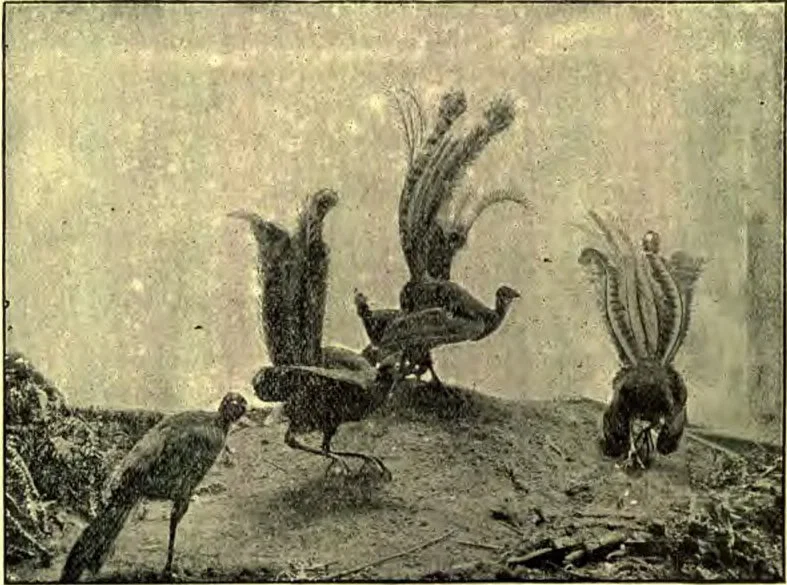
This bird has several peculiarities. It lives in secluded gulleys in Australian forests, and is very shy. Round hillocks, or mounds, are built by it, around which it dances morning and evening, uttering at the same time a loud musical whistle. It is insectivorous, never flies, but runs at an extraordinary speed, disappearing like a flash if discovered. The accompanying photograph shows five of these birds performing their morning waltz. They mock all other birds, but especially the magpie and the laughing jackass.
LYRE-BIRDS DANCING
LYRE-BIRDS DANCING
The cockatoo, often seen in captivity in all parts of the world, is a purely Australian bird. Once while on a visit to the forest of Gippsland, in southeastern Australia, unusual screeching sounds were heard; and on inquiry as to their source, the answer from one well acquainted with the country was, “Cockatoos.” Immediately overhead, at such a height as to be at first scarcely discernible, several of these white birds were pointed out as they were flying round and round, apparently for exercise. The person who directed attention to them, a man of undoubted veracity, stated that he had seen flocks of the birds so dense that they formed a cloud, also that he had seen a flock of them alight in a tree, and literally make it white and pink with their plumage.
These birds like to hang by their beaks and claws. There is an overland telegraph line from Port Darwin in the northern territory of Australia to the southern part of the continent. At one time two wires were placed one above the other, about eighteen inches apart, on the poles, but for some reason, messages were frequently lost, and communication was very difficult. Investigation revealed the fact that the cockatoos, taking one wire in their beaks and the other in their claws, made a connection between the wires, and thus disabled the line. It was found necessary to place the wires so far apart that the birds could not reach from one to the other.
The kiwi of New Zealand is a lonely bird, having no relative in the world. It sleeps during the day, and gathers its food during the night. It has a very long bill, but its wings are so small as to be of no use. It is supposed formerly to have been much larger than at present, as the female lays an egg out of all proportion to her size.
Although the kiwi is a very peculiar bird, New Zealand has, or did have, another that is even more odd,—the moa. As far as wings go, it was worse off than the kiwi, for it had not even a place for them. The bird is now extinct. The moa stood about twelve feet high, and could run faster than any other living animal. It had an enormous appetite, and could eat almost anything. In this respect it resembled the ostrich. There are legendary accounts among the Maoris that it swallowed men.
There is no record that any European ever saw one of these birds alive. They are supposed to have become extinct about four hundred years ago; and, this being so, some have even doubted whether such a bird ever existed. But there need be no doubt about the matter. In the natural history museum connected with the public library in Melbourne are two or three well-preserved skeletons of the moa. The head of the largest was several feet above the writer’s head as he stood beside it. Its leg bones are much larger than those of a horse.
The emu, still quite common in Australia, probably comes from the same family as the moa, although it has wings. It differs from the ostrich of Africa in that it has three toes instead of two on each foot. It stands about four feet high, not quite as tall as its African cousin. A heart-shaped design, with an emu on one side of it and a kangaroo on the other, with a few symbols of the stock- and sheep-raising and mining industries interwoven between them, is the sign, or seal, of Federated Australia. H. E. SIMKIN.

Won by a Bunch of Flowers

A FAITHFUL little Christian woman, who has charge of a day-nursery over on the East Side in the New York tenement-house district, was accustomed to visit a “shut-in” in one of the worst tenements. In the course of her visits to this house she came to know about a most drunken and wretched woman, whose door she passed every time she went into the building.
The woman hated her because she was a Christian, and if she looked in at the door, or acted as if she would like to come in, the door was always slammed in her face with a series of vulgar oaths.
Notwithstanding such treatment the little nursery saint, who had come down from the country with a conviction that she had a call from God, and had started a day-nursery in New York City on fourteen dollars, backed up by her faith, and had won a great success, felt growing in her heart a deep pity for the wretched woman. This grew upon her as the neighbors of the woman told of her family, and how the husband and the three children were all being dragged down to ruin by her.
The visitor prayed for her every day, and also prayed for wisdom to devise a plan by which she might reach the woman’s heart; for she was sure that, if she could only find the trail, down underneath all the oaths and brutality there was a woman’s heart that would prove her salvation if she could only get hold upon it.
One day she decided to try an experiment.
She went and bought a most beautiful bouquet of flowers. She was careful to see that they were the very best in the shop. She had them arranged nicely, and she carried them with her to that slum tenement-house.
The door of the wretched little apartment was open, as usual; and, as its inmate leaped forward with an oath to close it in her face, the little day-nursery woman held up the beautiful bunch of flowers before her, and said, in her sweetest tones, “My dear, are they not beautiful?”
The woman stopped as if she had been shot.
The one good, bright spot in her wicked heart was a love for flowers. She had been brought up in the country, where as a little girl she gathered the beautiful blooms on the hillsides, and all her life she had loved flowers. Though for years she had lived in the midst of squalid poverty and sin, there was a little green spot of memory left, when the flowers still bloomed.
She looked at the blossoms, then she timidly bent toward them, that she might smell their fragrance, and then, almost humbly, and with a new note of kindness in her voice, she said: “Yes, they are beautiful. They put me in mind of home when I was a little girl.”
After a moment the Christian woman said: “Take them, my dear. They are yours.”
There was a look of shocked and horrified excitement in the woman’s face for a moment, and then she burst into tears, and sobbed as if her heart would break.
“Mine!” she said. “You don’t mean these beautiful flowers are for me after the way I have treated you. I have been so mean to you. I have cursed you, and abused you, and hated you, and sometimes I felt like I could have killed you; and now you give me these flowers.”
Well, that was the beginning of better days. The Christian woman was welcome in that tenement afterward. In the course of the next three months the wretched woman was happily converted. The husband and children followed, and it is now a happy Christian family.—Selected,

New Year Askings

We know so dimly how to ask aright, Or if ’twere well that all our days be bright, And so we ask, dear Christ, this New Year’s day, “Lord, teach us how to pray.”
We know that Truth and Changelessness thou art, We lean our hearts upon thy faithful heart, And this our prayer for all the New Year through: “Lord, teach us to be true.”
We know the Father-Heart is love indeed, That thou wouldst have us live the simple creed Of love to thee and all our fellow men. Lord, make us loving, then.
— Selected.

JANUARY FIELD STUDY

The World in Review

(January 9)
Opening Exercises:—
Singing.
Prayer.
Scripture Reading. Isa. 61:1-11.
Field Study:—
Central and South America. Review and Herald, November 19, pages 14, 17; November 26, page 15; December 10, pages 13, 16; December 17, pages 14, 15, 16.
Europe. Review and Herald, November 19, page 17; November 26, pages 14, 18; December 3, pages 15, 16; December 10, page 15; December 17, page 13.
Asia. Review and Herald, November 26, page 14; December 3, page 14; December 10, pages 13, 15.
Africa. Review and Herald, November 19, page 15; December 3, page 17; December 24.
Island Fields. Review and Herald, November 19, pages 17, 18; November 26, pages 18, 19; December 3, pages 14, 18; December 10, page 15; December 17, pages 15, 16.
Remarks by Leader:—
What We Shall Do During 1904.
Closing Exercises.

Suggestions

Very brief indeed must be the consideration of each field, if our work in the world is reviewed in one hour. And yet this is possible, if each one gathers just the facts about the field assigned him, and presents them in the few minutes given him, in a clear, concise manner. The Reviews suggested, and other late numbers, will afford much material. A map will add very much to the interest of the meeting. Those who do not have access to a large map of the world can easily provide one in outline which gives very clearly a picture of our field, and the few places that have thus far been reached with the message.
The following statistical outline may aid somewhat in intelligently reviewing our work in the short time allotted to each speaker:—
Population Sabbath-keepers Total Laborers
Central and South America
Central America 2,587,000 159 6
Central America, South 1,000,000 71 3
British and Dutch Guiana 225,000 310 6
Brazil 15,000,000 742 16
River Plate 6,400,000 460 17
West Coast South America 10,000,000 150 4
Europe
German Union 255,365,000 4,079 280
Scandinavian 12,506,503 2,215 101
British Union 40,695,432 858 79
French-Latin Mission 78,643,078 571 19
Oriental Mission 30,623,900 201 16
Asia
India 204,000,000 75 23
Japan 45,000,000 43 12
China 425,000,000 22 13
Africa 170,000,000 725 43
Islands
Fiji 121,798 136 4
Jamaica 175,000 1,188 13
Lesser Antilles 400,000 191 11
Pitcairn 154 60 1
Porto Rico 954,000 2 2
Raratonga 7,500 50 3
Samoa 35,000 10 4
Society Islands 6,000 111 9
Sumatra 2,750,000 12 3
Tonga 25,000 20 2
Trinidad 208,030 260 5

What We Shall Do During 1904

Study the Field.—Knowledge precedes interest, and interest precedes sacrifice. One thing that is needed to-day is a higher degree of missionary intelligence. The person who knows about missions is the person who prays about missions; and the person who prays about missions is the person who gives, first himself, and then all that has been intrusted to him. Ample opportunities to study the fields in which we are operating are afforded through the columns of the Review and Herald, and the INSTRUCTOR.
Pray for the Work and Workers.—One way designated by our Lord Jesus, by which his work was to be forwarded in the earth, was through the medium of prayer. “Pray ye therefore the Lord of the harvest, that he will send forth laborers into his harvest.” An army of informed young people set to pray daily about this great need in the Lord’s work to-day, will bring results. “The effectual fervent prayer of a righteous man availeth much.”
Give to Missions.—Familiarity with our mission fields, followed by earnest prayer for the laborers and those for whom they labor, will always be followed by personal sacrifice for the work. And this must be our attitude during 1904. With Livingstone, every young man and young woman, as we stand upon the threshold of 1904, ought to be able to say, “I place no value on anything I possess except in relation to the kingdom of God.” The simple plan of weekly offerings is an excellent means of carrying out our good resolution to support the work in the world-wide field. Giving regularly, as we pray and study, serves to deepen our interest in the Lord’s work, and will fit us for more active service in the closing hours of the message. E. H.

From the Young People's Society at Battle Creek

IN a letter from the president of the Battle Creek Young People's Society, Brother O. R. Staines, we note the following items that will be of general interest to the young people everywhere:—
“Our Young People's work is progressing very nicely. You no doubt have learned of our Young People's Convention to be held here between December 31 and January 4. We have a Convention Committee appointed, and they are actively at work making definite plans for the Convention. We are hoping for excellent results from these meetings. The church is offering free entertainment to all delegates, and we are expecting some substantial help. Elder Warren, Professor Lamson, and nearly all the ministers in the West Michigan Conference will be here.
“We are also at work on the matter of reorganizing our work locally. At present we are holding meetings at the Marshall jail each Sabbath afternoon, and also with the small company of Sabbath-school workers who live in Marshall. My wife and I go over about every other week, and Brother Quinn goes nearly every Sabbath. Different ones go with us to assist in the singing, and giving such other help as they can. We are meeting with good results in the work, and are ourselves receiving a blessing from our efforts. We find that it is only in doing something for others that we receive definite blessings.”

Live Always as Under the Eye of the Lord

WHEN you think, when you speak, when you read, when you write; When you walk, when you talk, when you seek for delight; To be kept from all wrong when at home or abroad, Live always as under the eye of the Lord.
Whatever you think, never think what you feel You would blush in the presence of God to reveal. Whatever you say in a whisper or clear, Say nothing you would not like Jesus to hear.
Whatever you write, though with haste or with heed, Write nothing you would not like Jesus to read. Whatever you sing in the midst of your glees, Sing nothing that his listening ear could displease.
Wherever you go, never go where you fear Lest the great God should ask you, “How camest thou here?” Turn away from each pleasure you’d shrink from pursuing, If God should look down, and say, “What are you doing?”
To be kept from all wrong both at home and abroad, Live always as under the eye of the Lord.
— Selected.

Young People's Work Advances in Southern California

THE Young People's work is making progress in Southern California. At the time of the recent camp-meeting, a union meeting of the different Societies represented was held, and a general superintendent of the Young People's Societies of Southern California was appointed.

A. MEMBER

From St. Johns, Newfoundland

OUR society was organized about two years ago; but as there were not many youth in our church, we encouraged the older ones of the children to come. This put us to work on the material there was in the church, and we kept the interest up by giving Bible readings in the meetings, and teaching the children.
We now have a growing and working Society of about ten youth and seventeen children, under the leadership of Dr. Carrie Lemon. Several of the older members have been converted, most of the children say they want to be Christians, and all are at work selling our books, using the money earned in this way to buy pews for the church.
While this is being accomplished, the people are receiving our literature, and the children are gaining an experience.
When the part of the meeting devoted to the children is over, we take up the studies prepared in the INSTRUCTOR, and find them interesting and beneficial. We pray that God's blessing may rest upon all our Young People's Societies.

A. MEMBER

Continue reading: Harvest Ingathering Service