The Youth’s Instructor, Vol. 31, No. 40.

THE AUTUMN

The Youth’s Instructor

Oct 3, 1883

S. D. A. Publishing Association · Battle Creek, Mich. · Oct 3, 1883

THE AUTUMN.

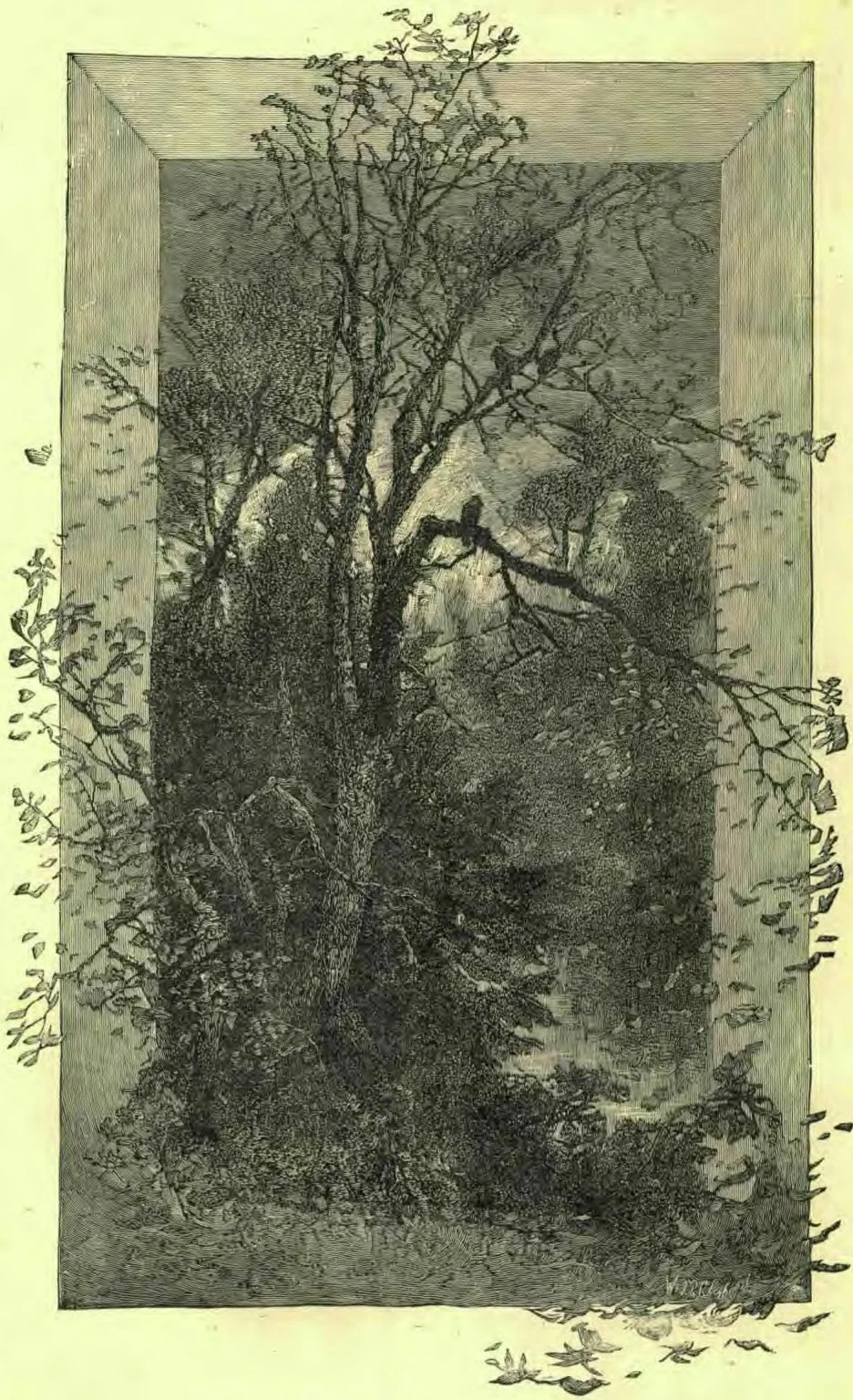
THE autumn time is with us. Its approach Was heralded, not many days ago, By hazy skies that veiled the brazen sun, And sea-like murmurs from the rustling corn, And low-voiced brooks that wander drowsily By purpling clusters of the juicy grape, Swinging upon the vine. And now ’tis here, And what a change hath passed upon the face Of nature, where thy waving forests spread, Then robed in deepest green!
All through the night The subtle frost hath plied its mystic art, And in the day the golden sun hath wrought True wonders; and the wings of morn and even Have touched with magic breath the changing leaves.
And now, as wanders the dilating eye Athwart the varied landscape circling far, What gorgeousness, what blazonry, what pomp Of colors, burst upon the ravished sight! Here, where the maple rears its yellow crest, A golden glory; yonder, where the oak Stands monarch of the forest, and the ash Is girt with flame-like parasite, and broad The dog-wood spreads beneath a rolling field Of deepest crimson; and afar, where looms The gnarled gum, a cloud of bloodiest red!
— William D. Gallagher.

AMONG THE HILLS OF GOD.

THE effect of mountain scenery upon the mind and heart of man has often been observed, and frequently commented upon, yet no one can fully understand this effect until he has himself experienced it. The quiet beauty of the gentle foot-hills, the awful grandeur of towering cliffs, and the deep solitude of rugged valleys and winding glens, sink into the soul so silently, and yet with such irresistible certainty, that hard indeed must be the heart that does not respond to their influence, and feel hushed by the presence of the Eternal One.
In the month of December, near the close of 1882, it was my good fortune to spend a few days in South Amherst, Mass., near the foot of the Mount Holyoke range. One morning at five, as was my custom, I sallied forth for an early walk. At once my eyes were attracted by the tall peaks and dark sides of the mountain. Almost unconsciously my steps turned in that direction, and so strong was the impulse that prompted me, and so intently was my mind fixed on the grand object of my contemplation, that before I was aware of any purpose, I had neared the foot of the mountain, and was following up a sled-road which the neighboring farmers had made in bringing their winter's fuel from the forests above.
The snow was crisp under my feet, and the air was so sharp and cold that my beard was soon a mass of frost-work. The road led up the mountain by the side of a dashing brook, whose waters were so warm and fresh from the depths of the hills, that the frost had not yet been able to cool and tame them, and a line of snowy vapor marked the course of the ardent stream.
The moon, large and clear, flooded forest and field, valley and cliff, with that peculiarly soft, copious, and bewitching light which is seldom seen more than once or twice in the year. The pure white snow, with shining crust and glistening crystals, was too beautiful for description; and on its fair surface the scattering trees of the lower slopes cast their phantom shadows in a tracery so delicate and graceful that no artist's pencil could imitate it. They threw their arms across my path; and as I trod upon their unresisting forms, I felt as if I were moving in a land of spirits.
The stillness was profound, except as it was broken by the gurgling of the brook, or the creaking of the snow as I trod upon it. Beyond was the deep forest, thickly set with dark evergreens, and ever rising higher and higher as I advanced; while far up to the right frowned the rugged brow of the mountain. Such a picture of mingled beauty, solitude, and grandeur, I never beheld until then. The effect upon my feelings it is impossible to describe. I seemed to be in another world. The presence of the Infinite appeared to rest on everything. The thought struck me: “I am among the hills of God.”
The winding road often presented new views, ever varying, ever delightful and sublime. As I entered the deeper forest, and wound this way and that, continually going up, up, up, and constantly overshadowed by the long branches, I felt shut out from all I had ever seen or known before. The exertion seemed to exhilarate rather than weary me, and my step grew constantly more elastic. So transported was I, that the vigor of perpetual youth seemed to be upon me.
Finally, to my surprise, I found myself almost face to face with the towering granite cliff which from the plain below had seemed utterly unapproachable. The brook was lost to sight, but in the deep, narrow cut just at the foot of the cliff, I could hear it faintly muttering under heavy banks of snow. Here, beneath “the murmuring pines and the hemlocks,” I knelt upon the snowy carpet, and poured out my heart to God in praise and adoration. What an insignificant creature I seemed to be! The greatness of God never was so apparent. A sense of his wisdom, his majesty, and power rested upon me.
Here I remained, lost in revery, till the broad, red sun gave the cliff a crown of glory, and clothed with fire the evergreen spires, as they rose in ever-descending succession, far, far below me, to the beautiful plain beyond; while on a commanding elevation were distinctly seen the towers and domes of Amherst College, peering above the grove that surrounds them. G. H. BELL.

DOING THINGS THOROUGHLY.

LAURA came into the disorderly sitting-room, put a sweeping-cap on her head, and began listlessly drawing a broom over the dirty carpet. In a few moments a goodly pile of dirt was swept out of the door, when she took a duster and looked around, quite puzzled where to begin.
“I almost wish I’d never been to Aunt Sarah’s,” she said, dropping down on the lounge with a more discontented look than before. “It’s all very well for her to talk about keeping things in order, but her children seem different from ours. Just look here!”
It was rather discouraging. On one chair lay some crusts of bread and molasses; on another, a torn picture-book and some paints over which the glass of water used with them had been spilt. On the table, mother’s ever-filled work-basket was running over, some spools of thread tangled among broken toys. The ashes from the grate were widely scattered, and every corner seemed to have its separate litter.
“Who sweeps a room well, does God’s service.” Something like this Laura had heard said while at her aunt’s house.
“I don’t believe God has much to do with such a room as this,” she said, fretfully, to herself. “And it don’t make much difference how it’s swept, I’m sure.” But her eye noted rather uneasily the untouched corners, and the dusty patch under the table, which her lazy broom had not reached. Aunt Sarah’s cheery watchword: “Thorough, my dear, thorough,” seemed to sound in her ears, as she remembered how she had come home with a firm determination to institute a better order of things.
“I’ll try it, anyway.” She dusted and carried out every movable article of furniture, sprang to her broom again, and this time wielded it with an energy which left little chance of peace to the seldom disturbed dust. And into the fire went many a fragment of broken playthings that would surely never be missed. Aunt Sarah believed in a judicious keeping down of worthless trash.
The dirt being gathered this time in a dust-pan and sent after the trash, Laura straightened and dusted the pictures, then the curtains. Books not needed were carried away, the others piled neatly in order. Newspapers were sorted, and those not to be saved taken to the kitchen for kindling. A basket was found for the toys, and the rubber shoes and a slate which had lain under the lounge were put away in the closet. There was not time for a thorough cleaning of finger-marked windows, but a quick rub with some soft paper brightened them amazingly. Then she washed up the oil-cloth before the grate, and when the furniture was back in place, sat down with the work-basket, glad of a rest.
“I do think it’s the most hopeless snarl I ever saw, but I’ll try what ‘thorough’ will do here.” A number of pieces for chance mending were rolled into a bundle, the thread untangled as far as it could be, wound and fastened. Needles were placed in the needle-book, and buttons in a box by themselves. A jumping-jack and tin horse on wheels were rescued from a woeful entanglement in a skein of darning yarn, which was wound up and laid with the stockings, mated ready for mending. Almost everything went back into the basket which had been there before, but it was not half full.
Lastly, Laura went to the parlor, and brought out a gay-colored tidy for the large chair, and a worsted mat for a vase, which she hastily filled with flowers. “I’m not going to keep all the pretty things out of sight,” she said, “and I’m going to have a cretonne cover for this old lounge. It won’t cost much, and will lighten up the room.”
Even baby gave a crow of delight as he came into the room on mother’s arm; then scrambled down and laughed aloud as he crept toward his tin horse, which had been lost for a week. And mother looked around the room with a brighter smile than Laura had seen on her face for many a day.
“Why, my daughter, have your hands done all this? Why, I didn’t know the old carpet could look so fresh, and what a cheery-looking, pleasant room it is after all. What a comfort you are, my darling!”
Laura looked around the tidy room with great satisfaction.
“I’ve tried to do it thoroughly, mother,” said she.
Try it, girls. Try what satisfaction there is in bringing order and sweetness out of confusion. Try what a joy there is in lightening mother’s cares, and in making dear faces brighter because the dear home is brighter. And be sure that the Master who has said, “Whatsoever thy hand findeth to do, do it with thy might,” will tenderly bless even a smaller service, conscientiously and heartily performed, than that of a “room well swept.”—New York Observer.

LIKE A MAN.

My little nephew could not talk plain—could not form sentences, in fact—when I saw him last summer; yet even then he would take delight in sitting bolt upright in his father's arm-chair, or would sit on the lowest step of the stairs and cross his chubby legs and say, “Tantan, ’Obbie, man!” which in grown-up language meant, “Look, auntie! Robbie is sitting up like a man.”
Even at that early age (fifteen months) he was showing a boy's usual ambition to do things “like a man,”—an ambition which in itself is praiseworthy, but may be shown in various ways.
For instance, you often meet boys of nine or ten years who are doing their best to smoke “like a man;” and a pitiable sight these boys present to a thinking mind. In ninety-nine cases out of a hundred, these boys are smoking on the sly, which is not like a man. In defiance of strict commands from parent or guardian this smoking is often done, and that, too, with the knowledge that when questioned, “Have you been smoking?” the answer will be a lie. Is this like a man?
Or a boy, when he gets a little older, thinks it very manly to go to a bar and order a glass of beer—perhaps something worse—for himself and a comrade or two. Well, that is like a man, but what man? What sort of a man will such a youth be apt to grow into? A clear-headed, strong-hearted man whom his friends will be proud of, or a miserable wretch, broken in health and spirits, and with conscience stupefied, who fills an untimely grave, if not a felon's cell?
And some little fellows feel so “grown up,” so manly, when they contemptuously disobey a mother's wishes, simply perhaps to prove to the other boys that they are not tied to their mother's apron-strings. When they order their sisters about, when they tease and torment them, they are quite sure that it is like a man to be superior to the weaker sex. But what sort of a man is he who thus shows his superiority?
Is it like a man, too, to object to go to Sabbath-school or church, or to pray in the morning or evening, or to read a chapter in the Bible? Why? Was not the way to heaven pointed out to boys as well as girls, to men as well as to women? Are men and boys so righteous by nature, so truthful and pure and generous, that repentance is not necessary for them?
But in spite of it all, boys, it is a noble ambition to be “like a man” in the best sense of the word, for man was created in the image of God; only, when you select the model man whom you intend to be like, do not select a drunkard, a liar, a scoffer, a deceiver. There are plenty of manly men and godly men,—men who strive to live up to the image in which Adam was created,—whom you can try to copy.
Yet all men are liable to err—none are perfect; so do not content yourselves with being exactly like some man, any man who excites your admiration; copy only his virtues.
There is but one man whom you can take as a faultless model—the man Christ Jesus. You will do nothing low, nothing mean, if it is he whom you have in mind when you try to be “like a man.”
—Frances E. Wadleigh.

MORNING HOURS.

Tom Jones was a little fellow, and not so quick to learn as some boys; but no one in his class could excel him in his lessons. He rarely missed in his geography, never in spelling; his arithmetic was always correctly done; and as for reading, no one improved so fast as he. The scholars were fairly angry with him sometimes, he outdid them so constantly.
“Why, Tom, when do you learn your lessons? You don’t study in school any more than the other boys.”
“I rise in the morning, and study an hour before breakfast,” answered Tom.
“Ah! that is it. ‘The morning has gold in its mouth.’”
There is a little garden near us, which is the prettiest and most fruitful spot in the neighborhood. The earliest radishes, peas, strawberries, and potatoes grow there. It supplies the family with vegetables, besides some for market. If anybody wants flowers, the garden furnishes the sweetest roses, pinks, and “all sorts” without number.
The soil we used to think poor and rocky, besides being exposed to the north winds; and the owner is at his business all day, yet he never hires any one to dig or to weed for him.
“How do you make so much out of your little garden?” he was once asked.
“I give my mornings to it,” he answered; “and I don’t know which is the most benefited by my work, my garden or I.”—Selected.

NEW-TESTAMENT HISTORY.

LESSON 155.—PAUL WRITES CONCERNING THE RESURRECTION.

In our last lesson, Paul was rejoicing in the steadfastness of the believers at Thessalonica. After this he exhorted them to purity, and to honest dealing. In these things they were not to follow the example of their Gentile neighbors; but were to be models of chastity, and were to be careful not to defraud another in any matter. Then, speaking of the crowning virtue,—that which should be the motive in all well-doing,—he says: “But as touching brotherly love, ye need not that I write unto you; for ye yourselves are taught of God to love one another. And indeed ye do it unto all the brethren that are in all Macedonia; but we beseech you, brethren, that ye increase more and more; and that ye study to be quiet, and to do your own business, and to work with your own hands, as we commanded you; that ye may walk honestly toward them that are without, and that ye may have lack of nothing.”
The latter part of this injunction enforces quiet industry and diligence in business with such earnestness as to imply that some of the brethren were already at fault in this matter. It would seem that, while Paul was preaching to them, their minds took such strong hold upon the doctrine of the second coming of Jesus, and the glorious immortality that was to be given them at his appearing, that they had come to expect him in their day. This undoubtedly led some to neglect their business, and perhaps to consider it a virtue to show the strength of their faith by dropping all labor, and waiting for that great event which they thought must be so near at hand. Paul evidently meant to correct this wrong course of action, and also to show that they were in error in expecting their Lord so soon. They had failed, too, in understanding the doctrine of the resurrection; so that those who had lost friends, mourned without hope, not knowing that they would ever come up from the grave. In view of this, Paul writes: “We would not have you ignorant, brethren, concerning them that fall asleep, that ye sorrow not, even as the rest which have no hope. For if we believe that Jesus died and rose again, even so them also that are fallen asleep in Jesus will God bring with him. For this we say unto you by the word of the Lord, that we that are alive, that are left unto the coming of the Lord, shall in no wise precede them that are fallen asleep. For the Lord himself shall descend from heaven, with a shout, with the voice of the archangel, and with the trump of God; and the dead in Christ shall rise first; then we that are alive, that are left, shall together with them be caught up in the clouds, to meet the Lord in the air; and so shall we ever be with the Lord. Wherefore comfort one another with these words.”
After thus instructing them, he says that it is not necessary for him to write to them concerning the times and the seasons; for they already understand that the day of the Lord will come as a thief upon those who do not watch; and at the very time when they shall be crying “Peace and safety,” sudden destruction shall come upon them, and they shall not escape.
He then calls those who do watch for the coming of their Lord, “children of light,” and “children of the day.” He says: “But ye, brethren, are not in darkness, that that day should overtake you as a thief. Ye are all sons of light, and sons of the day: we are not of the night, nor of darkness; so then let us not sleep, as do the rest, but let us watch and be sober. For they that sleep, sleep in the night, and they that be drunken are drunken in the night. But let us, since we are of the day, be sober, putting on the breastplate of faith and love; and for a helmet, the hope of salvation. For God appointed us not unto wrath, but unto the obtaining of salvation through our Lord Jesus Christ, who died for us, that, whether we wake or sleep, we should live together with him. Wherefore exhort one another, and build each other up, even as also ye do.”
He then begs of them to honor, esteem, and love those who labor among them, and to be at peace among themselves. In conclusion, the anxious apostle adds: “Admonish the disorderly, encourage the faint-hearted, support the weak, be long-suffering toward all. See that none render unto any one evil for evil; but alway follow after that which is good, one toward another, and toward all. Rejoice alway; pray without ceasing; in everything give thanks; for this is the will of God in Christ Jesus to youward. Quench not the Spirit; despise not prophesyings; prove all things; hold fast that which is good; abstain from every form of evil.”
“And the God of peace himself sanctify you wholly; and may your spirit and soul and body be preserved entire, without blame at the coming of our Lord Jesus Christ. Faithful is he that calleth you, who will also do it.”
Then the affectionate teacher and father asks them to pray for him; exhorts them to salute one another kindly and tenderly, charges them to read his letter to all the brethren, and closes with a benediction.

QUESTIONS.

  1. What caused Paul to rejoice when Timothy returned from his visit to the Thessalonians?
  2. To what did Paul exhort them? 1 Thess. 4: 1–8.
  3. What example were they not to follow?
  4. Of what were they to be models?
  5. With reference to what were they to be particularly careful?
  6. What should be the motive in all well-doing?
  7. What did Paul say to them about this crowning virtue? Verses 9, 10.
  8. What were they to make their special study? Verse 11.
  9. What would this enable them to do? Verse 12.
  10. What is implied by this injunction?
  11. What error in belief had led them astray in this matter?
  12. How were they probably brought into this error?
  13. To what neglect would this naturally lead them?
  14. What would they be likely to regard as a virtue?
  15. What did Paul evidently mean to do with reference to this matter?
  16. What doctrine had they failed to understand?
  17. In what sad condition were those who had lost believing friends?
  18. In view of these things, what did Paul say of the resurrection of the dead? Verses 13, 14.
  19. What is the meaning of the last part of verse 14?—That God will bring forth his saints from the grave, as he did Jesus from the tomb.
  20. How did he show that both the dead and the living would be equally favored in meeting their Lord at his coming? Verse 15.
  21. In what graphic words does he describe the coming of the Lord, and the resurrection of the dead? Verses 16, 17.
  22. What use does he tell them to make of these words? Verse 18.
  23. What does Paul say to them about the times and the seasons? Chapter 5: 1.
  24. Why was it not necessary for him to tell them about these things?
  25. What does he call those who understand about the coming of the Lord, and are anxiously waiting for that event?
  26. Will the day of the Lord overtake them as a thief?
  27. What admonition does he give them in view of their being the sons of light? Verses 6–9.
  28. What is God’s intention with regard to faithful believers in Christ? Verses 9, 10.
  29. In view of these things, what ought they to do? Verse 11.
  30. What duties does he then press upon them? Verses 12, 13.
  31. What mutual offices of kindness and discipline does he recommend? Verses 14, 15.
  32. What personal exercises in the Christian graces does he mention? Verses 16–19.
  33. How were they to guard against error and sin? Verses 20–22.
  34. What abundant blessings does he call down upon them? Verse 23.
  35. What favor does he ask? Verse 25.
  36. What does he recommend as a token of Christian regard?
  37. What does he charge them to do?
  38. With what benediction does he close his letter?

THE BEST COLLECTION.

CHILDREN generally like to make collections. One little girl is satisfied with the stray feathers the birds have dropped in the fields; another has picked up pretty round stones by the shore of the lake; another has pressed leaves of all the forms she can find, till she has a thousand differently shaped leaves in her collection; another has a book full of dried flower, with the colors almost as fresh as when they were gathered. With boys it may be shells, or minerals, or beetles, or stuffed birds, or something equally interesting.
This desire to gather collections is a good thing. It makes children observing and wide-awake, and keeps them from walking through the world without seeing anything. But you young people must remember when you make collections from nature that you are coming near to God in seeking after and touching what he has made. When you find a beautiful specimen of a flower, or a crystal, or a butterfly, or a shell, you can think that the great Creator admires it too, for he has pleasure in all his works.
Some of the largest collections that have been made by studious men have been scattered at their death, or burned by fire, or destroyed in time of war. It is with this as with all things we can lay up in this world; we do not know when our treasures may be swept away.
It is a pleasant thing to make collections from the works of God, but it is a dearer and a better thing to have a collection of his words; and the treasures we lay up in our minds neither fire nor foe can take from us. Now is the time for you to lay up a store of Bible verses to be a comfort and help to you all your life. Let no week go by that you have not added to your store. How many texts can you say that promise a blessing on earnest prayer? how many about the love of God to us? how many that are direct commands to be true, to be pure, to be loving?
Your texts must be perfectly learned, or you cannot be sure that you can keep them. A text that you stumble over does not belong to your collection.
In the olden times many a Christian had his Bible taken from him, and was shut up in prison for reading the word of God; but no jailer could take away from him the texts laid up in his memory. In the darkest cell he could comfort himself with their precious promises. How often a sick sufferer has lamented that he had no Bible verses or sweet psalms in his mind to cheer himself with in the long hours of wakeful nights! “Teach the children to lay up Scripture verses and psalms for such a time of need,” said a sick man who had made no such collection in youth when God had given time and readiness to learn.
A Bible verse is the best answer to temptation. When you are prompted, from without or within, to do something wrong, and are doubting what to do, how it decides the matter when you can say to yourself, “This I must not do, this I cannot do; for in that and that Bible verse it is forbidden!”
Yes, dear children, whatever you collect, let your Bible verses be your largest, your dearest collection. You may tire of shells or leaves or stones or flowers, but the words of Scripture will be more precious to you year by year. They will bring to your soul strength and comfort and gladness, and help you to lay up treasures in heaven.—Selected.

Jesus's Quiet Way of Working

We may learn a good lesson from Jesus's way of working. He did not parade his doings before men, but quietly went about his Master's business. It was by acts, not by words, that he worked. Words came only when necessary.

The First Step to Knowledge

THE first step to knowledge is to know that we are ignorant.—Cecil.

ROBIN REDBREAST.

GOOD-BYE, good-bye to summer! For summer’s nearly done; The garden smiling faintly, Cool breezes in the sun; Our thrushes now are silent, Our swallows flown away,— But robin’s here in coat of brown, And scarlet breast-knot gay. Robin, robin red-breast, O robin dear! Robin sings so sweetly In the falling of the year.
Bright yellow, red, and orange, The leaves come down in hosts; The trees are Indian princes, But soon they’ll turn to ghosts; The leathery pears and apples Hang russet on the bough; It’s autumn, autumn, autumn late, ’T will soon be winter now. Robin, robin redbreast, O robin dear! And what will this poor robin do? For pinching days are near.
The fireside for the cricket, The wheat-stack for the mouse, When trembling night-winds whistle And moan all round the house. The frosty ways like iron, The branches plumed with snow— Alas! in winter dead and dark, Where can poor robin go? Robin, robin redbreast, O robin dear! And a crumb of bread for robin, His little heart to cheer.
— William Allingham.

THE ISLAND HOME.

PAUL DENTON lived in the sea. Perhaps you will wonder how that could be. Well, I’ll tell you. Along the coast of the State of Maine are a great many small islands. Only a few of the larger ones are shown on your map. Some of them are not a mile across. They have all manner of curious names given to them. There is Rogue Island, Mistake Island, Burnt Coal Island, Cross Island, Cranberry Island, Saddleback Island, and many others. Now, Paul lived on a little island called Spoon Island, so named because it is shaped some like a spoon. The island is about two miles long and half a mile wide. Paul’s father and mother had come there to live when he was but a baby, because they could get land so cheap; and now, though the boy was ten years old, he had never trod the mainland. Most that they ate they raised on the island; but two or three times a year a boat would bring clothes, and kinds of food they could not raise, to the few families who lived there. The wind blows so hard all the time that no trees can grow there; so they had no wood to burn, but made their fires of peat, a kind of turf found in some low places. When dried, it makes a very good fire, though not so hot a one as wood.
At one end of the island was a little store, a blacksmith shop, and a school-house, and most of the people lived at that end of the island. But Paul’s father lived at the other end, where there was only one family besides his own. In the summer the island home was very beautiful, but when the cold winter winds blew over it so fiercely, and howled and beat at the windows of the poor little cottages, it would have seemed very dreary to any one who was not used to living in such a place. Sometimes in these winter days, when, gather about it close as they would, the peat fire did not keep them warm, Paul’s mother used to sigh, and wish they had never come to such a dreary, cold place to live. Paul liked to hear her tell about the pretty home where she used to live when she was a girl; but he loved his own wild home, and would stand for hours by the cottage window, clapping his hands for glee as the great white-capped waves dashed themselves on the shore of the island a few rods away.
Paul’s father and Mr. Carr, the the other man who lived at that end of the island, owned a fishing-boat together, and every few days through the pleasant weather, they would go fishing. They always went several days right along, and got all they could, just before the boats were to come from the mainland; for then they could sell their fish, and get money and clothes for them. They always expected a boat in October; but one year they looked in vain, and it was the middle of November before they heard, from some one who had been ashore, that the boat would be there in a week. The sky looked so dark and uncertain that Paul’s father hardly dared go fishing; but one morning dawned so bright and clear that he and Mr. Carr got out their boat and went. In the afternoon it began to cloud up, and soon a heavy storm came on. Paul and his mother kept close watch, thinking every moment that the boat would come in sight.
But as the night shut in, and no signs of the fishers were seen, Paul and his mother began to be worried, and they went down to Mrs. Carr’s, about a quarter of a mile from their house. She, too, was getting very anxious; and finally they made up their minds to all go down on the beach, and see what they could hear. They listened, but there was no sound except the dashing of the waters and the roll of the thunder; and as the flashes of lightning shone over the water for a moment, they could see no signs of a boat.
All at once they saw a bright light on one side of the island. They knew too well what it meant. “See there,” said Paul’s mother, pointing to it, “there is the wreckers’ light; and they will surely steer toward it, and be dashed on the rocks.” The people on the island well knew that on the rocky side of their coast a band of wreckers had their den, and in stormy weather would put out a false light to lead passing boats onto the rocks. Through the summer they did not have as good a chance to ply their trade, so they would leave the island till the stormy weather of the fall came on. So until they saw their light, the people on the island did not know the wreckers had come back.
“Oh dear! what shall we do?” cried Mrs. Carr, wringing her hands, when they saw the light. “They will not know it is the wreckers’ light, and will be sure to go onto the rocks, for it is so dark they cannot tell which way to steer.”
As soon as Paul saw his mother point to the light, he had started for the house, and now came back with a basket of peat and a lantern.
“What are you going to do?” said his mother.
“Make a fire to light father home.”
“Oh, we cannot do it,” said she. “We have nothing but peat to make it of; and that will make no blaze; besides, the wind blows so hard and it rains so that we couldn’t light it anyway.”
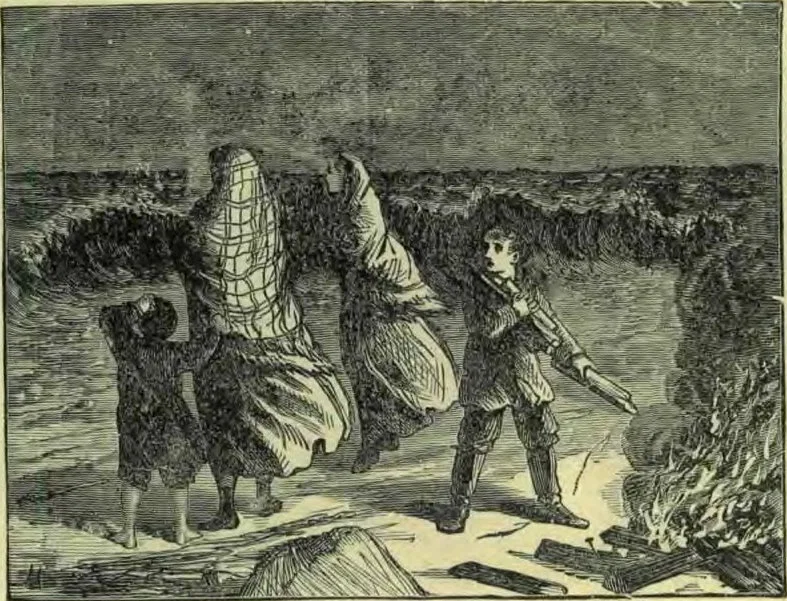
But Paul took his lantern, and found some pieces of driftwood down on the beach, and the others helped him carry them to a point which set out into the sea farther than the rest of the land; and with the peat for kindling, and his mother and Mrs. Carr to keep off the wind with their shawls and dresses while he lighted it, he did finally get a fire. He made it just in front of a tall rock, which helped to keep off the wind.
“There,” said Paul’s mother, as a flash of lightning shone over the dark waters, “there is a boat, and it is going toward the wreckers’ light.”
But just then Paul’s fire began to blaze up bravely; and as he heard his mother say this, he climbed up on the tall rock with his lantern, and swung it round and round above his head. When the next flash of lightning came, the women thought the boat had turned, and was coming that way; and at the next they were sure of it. Then they began to shout as loud as they could, and soon they were answered from over the waters. That was a glad moment for them all when the boat grated on the sands, and the fishers, wet and weary, stood around the fire with their dear ones.
“Well, well, my laddie,” said Mr. Carr, “if it hadn’t been for your fire, we should sure have gone onto the rocks. We were making straight for ’em when we saw your light.”
“Yes,” added Paul’s father, “the boy has saved us. And I’m thinking he’ll see many false lights before he is as old as I am; God grant that he’ll never go to harm by them.”
The time came when Paul went ashore to live; and in the after years he was able to give his mother even a prettier home than the one she told him of in his boyhood days. But they never forgot their island home, nor that wild night on the beach. E. B. G.

THE CARELESS WORD.

How many hours of sadness and sorrow have been caused by the utterance of careless, thoughtless words!
“A word unspoken, like a sword in the scabbard, is thine. If thou desire to be held wise, be so wise as to hold thy tongue.”

You have reached the end of this edition.

The Youth’s Instructor · Oct 3, 1883