The Youth’s Instructor, Vol. 31, No. 5.

GEORGE WHITEFIELD

The Youth’s Instructor

Jan 31, 1883

S. D. A. Publishing Association · Battle Creek, Mich. · Jan 31, 1883

GEORGE WHITEFIELD.
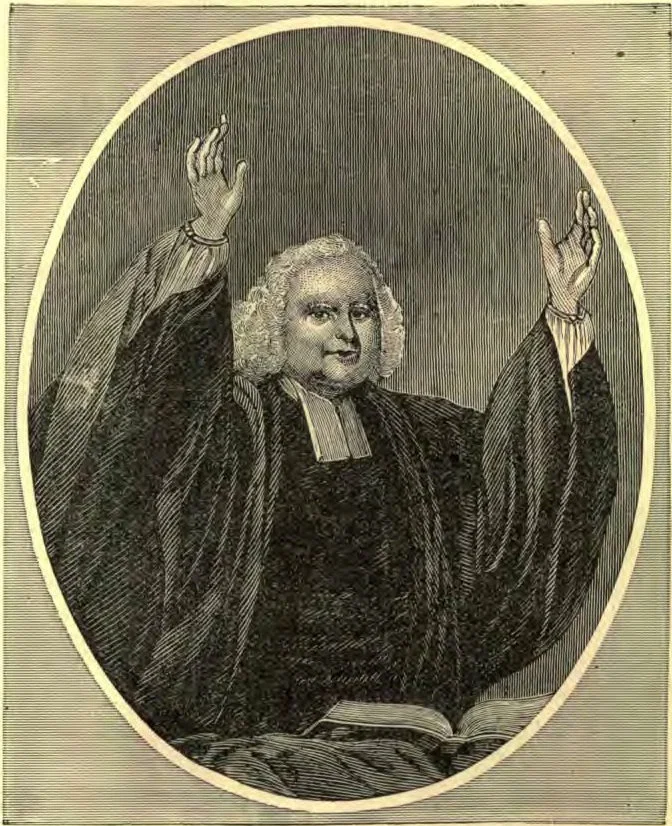
In the southern part of England, in the beautiful valley of the Severn, and on the banks of that noble stream, lies the ancient city of Gloucester, with its regular streets, its majestic cathedral and other relics of by-gone days. There are in this city three places which the traveler visits with special interest. One is the old church of Mary de Crypt, where lie the ashes of Robert Raikes, the founder of Sunday-schools; another is the little inclosure which marks the spot where the good Bishop Hooper was burned to death in the reign of the Bloody Queen Mary. The third, and to us just now the most interesting, is the Bell Inn, in which was born one of the greatest reformers that England ever gave to the world.
George Whitefield, the sixth son of Thomas and Elizabeth Whitefield, was born Dec. 16, 1714. His father died when he was but two years old, and George was ever afterward his mother's favorite child. The fact that he was born in an inn, like the Saviour of the world, seems to have made quite an impression on the boy's mind. When a mere child, he used to tell his mother that he wanted to be a minister when he was grown, because, having been born in an inn, he ought to be better than other men.
As the boy grew older, he was very anxious to learn, but as his mother was poor, he seemed likely to have no advantages except the schools of his native town. At the age of fifteen he left school and assisted his mother in the inn for two or three years. Finally, through the influence of some of his mother's friends, he obtained a situation at the University of Oxford where he could partly earn his own way. This was when he was in his eighteenth year. While at Oxford, Whitefield became acquainted with John and Charles Wesley, who were the leaders of a class of young men in the University who “lived by rule and method,” and were, therefore, called Methodists. Whitefield soon became one of the little company; and from this time on, he began to have a remarkable religious experience.
He now fully decided to devote his life to the ministry; and every hour was studiously given to preparation for the great work to which he had solemnly dedicated himself. Says his biographer: “He visited the prisoners in the jails, and the poor in their cottages, and gave as much time as he could to communion with God in his closet.” Whitefield was ordained to the ministry before he had completed his twenty-first year. He was anxious to spend more time at the University, and felt that he was not yet prepared to enter upon so important a work; but Bishop Benson and others in authority were so impressed with his piety and earnestness that they almost insisted upon his taking orders. He preached his first sermon in the church of Mary de Crypt, in his native town. Of this sermon, he himself says: “As I proceeded, I perceived the fire kindled, till at last, though so young, and amidst a crowd of those who knew me in my childhood days, I trust I was enabled to speak with some degree of gospel authority. Some few mocked, but most, for the present, seemed struck; and I have since heard that a complaint was made to the bishop, that I drove fifteen people mad the first sermon. The worthy prelate, as I am informed, wished their madness might not be forgotten before the next Sabbath.”
Perhaps no man since the days of the apostles has so completely devoted himself to the work of preaching the “gospel as it is in Jesus” to all classes of men, rich and poor, high and low, as did George Whitefield. He took for his motto: “This one thing I do;” and his life fulfilled these words. He was accustomed during the greater part of his ministry to speak to the people as many as forty hours in a week, and sometimes more. Outside the pulpit his labors in conversing and praying with his converts were almost incessant. During one week while in London, he is said to have received one thousand letters of inquiry from those who wished to be saved.
Shortly after he entered the ministry, he was invited to go to London, where he preached in some of the first churches in the city as well as to the prisoners in the jails, and in the open air to the poor people who gathered to hear him on the commons. He gained many warm friends among all classes. He traveled throughout England, Wales, and Scotland, his earnestness and eloquence everywhere bringing him great crowds. Says he, in speaking of his labors at one place: “It was wonderful to see how the people hung upon the rails of the organ-loft, climbed upon the leads of the church, and made the church itself so hot with their breath, that the steam would fall from the pillars like drops of rain. Sometimes almost as many would go away for want of room as came in, and it was with difficulty I got into the desk to read prayers or preach. Persons of all ranks not only publicly attended my ministry, but gave me private invitations to their houses.”
He was frequently obliged to preach in the open air on the moors and commons, where as many as twenty thousand people often gathered to hear him. These were solemn seasons to him, as his own words testify: “The open firmament above; the prospect of the adjacent fields; with the sight of thousands and thousands, some in coaches, some on horseback, and some in the trees, and all so affected as to be moved to tears together, to which sometimes was added the solemnity of the approaching night, were almost too much for me; I was occasionally all but overcome.”
Mr. Whitefield's labors were not confined to England. He came to America seven times, where he assisted the Wesleys in their missionary labors in Georgia, and labored and preached extensively in New York, Philadelphia, Boston, and other towns of the East. His success in this country was as great as in England, and he came to be greatly loved and venerated by all good people. He established an orphan-school at Savannah, Georgia, where children, black as well as white, found a home. He brought over from time to time quite large companies of homeless children from London to his Bethesda, as he named it.
It was while on his seventh visit to this country that he was called to lay down his armor, and go to his final rest. He preached and labored to the very last, and only went to his room a few hours before his death. His health had been failing for some time, but he could not bring himself to give up, and take needed rest. The day before his death he said, “I am weary in the work but not of it.” He died at the house of Mr. Parsons, first pastor of what is now known as the Old South Church, in Newburyport, Mass. At his own request, he was buried in the vault beneath Mr. Parsons's pulpit, where his bones still rest. One who attended service in this church during the past summer, writes in a letter: “After the sermon, the sexton took us down into the vault under the pulpit, and there we saw all that is left of George Whitefield. To think that that is all that remains of that great man, and that those bones and that little heap of dust was once a warm, living human being, that thought, and moved, and spoke, and loved just as fondly as we do! And he walked those very aisles, and spoke his wonderful words from that very pulpit! There are two other coffins in there. They contain the remains of Mr. Parsons and Mr. Murray, the first two pastors of the church. Whitefield's monument stands in the corner of the church, where everybody can see it.”
It must not be thought that this good man had no trials and persecutions in his long and successful ministry. His zeal in defending truth and pointing out wrong made him many enemies, and his experience was such as to well give him a place among the great reformers of the world.
E. B. G.

The Rain, Wind, and Snow.

Rain! rain! April rain! Bring the flowers back again; Yellow cowslip, and violet blue, Buttercups and daisies too, Rain! rain! April rain! Bring the flowers back again.
Wind! wind! Autumn wind! He the leafless trees has thinned; Loudly doth he roar and shout; Bar the door and keep him out. Wind! wind! Autumn wind! He the leafless trees hath thinned.
Snow! snow! pure white snow! O'er the fields thy cov'ring strow; Cover up the seed so warm, Through the winter safe from harm. Snow! snow! pure white snow! O'er the fields thy cov'ring strow.
Rain! wind! snow! all three Each in turn shall welcome be: Each and all in turn are sent On the earth with good intent. Rain, wind, snow, all three, Each in turn shall welcome be.

The Little Rills.

Once upon a time a man was traveling along over the Alleghany mountains, when he met a number of little rills skipping along, and he asked them where they were going.
“Oho,” they said, “just down the mountain.”
“And what are you going to do as you go down the mountain!” “Oh, we shall make friends with other little rills, and grow bigger.”
“And what will you do when you grow bigger?”
“Oh! we shall turn saw-mills and grist-mills; and when we get down through all the rocks on the plains, we shall set some great iron factories and cotton-mills in motion.”
“And what will you do then?” “Then, why, we shall make the Alleghany and Monongahela rivers; and when we are big enough, we shall make the great Ohio.”
“And what will you do when you get to be the great Ohio?” “Oh! then we shall take on our backs great rafts and steamboats, and help build up, all along, beautiful towns, and villages, and cities.”
“And what then?” “What then? Why, we shall unite our forces with the Missouri and Mississippi, and help them carry a thousand great boats to the ocean.”
“What! You going to do all this, you little rills?”
“Yes, sir, we are; but if you don’t believe us, we can’t stop to convince you of it, for we are in a hurry.” And off they ran on a jump.
If the little rills are going to do so much, what will the children, who are growing larger and stronger every day, do by-and-by in the world? Some who are bright and sparkling now, will, I am afraid, run into the first snug and sunny spot, and there stay until they dry up. An easy, selfish life, blessing nobody, at last shrinks to nothing. Others who are promising now, will by-and-by be diverted from the right way, and turn off into dark channels, where they will be lost; and others, a great number of our dear boys and girls, I pray God, may grow up, strong and good, to unite their forces with others, and bless the places where they live, and make the world better for their having lived in it.
“Little drops of water, Little grains of sand, Make the mighty ocean And the beauteous land.”
So, too, little deeds and words of love may do great and glorious things, making this earth of ours something like heaven.—Selected.

THE FALLS OF MINNEHAHA.

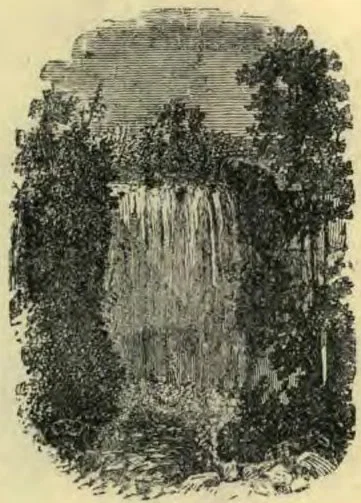
About nine miles above St. Paul, Minnesota, and about half a mile from the Mississippi River on the west side, are the beautiful and widely renowned Falls of “Minnehaha,” in a small river bearing the same name. The accompanying picture gives but a poor idea of this beautiful water-fall.
A semi-circular limestone cliff forms the brink of the falls, and partly encircles a chasm, or basin, into which the water plunges and flows away in a narrow, rapid stream. At the brink, the sheet of water is said to be about eighty feet in width, and it is about sixty feet in perpendicular descent, and is so thin, and in such a constant quiver, as to suggest the idea of the shaking out of the folds of white lace, and fully justifies the beautiful appellation, Minnehaha (Laughing Water.)
A flight of sixty-one steps leads down to the bottom of the chasm, where a small bridge crosses the river a few rods below the falls. The sandrock underlaying the limestone cliff has been so worn away that one who has sufficient nerve to do it may pass completely round behind the falls.
The pleasing and yet sad traditions associated with the place, and the picturesque scenery surrounding it, rendered it a sacred and favorite camping-ground of the Indian in the past, and now make it a popular place of resort for the race that has supplanted him in its possession. Longfellow, in his poem entitled “Hiawatha,” relates an Indian tradition in which a young Ojibwa brave is represented as having won as his bride a beautiful Dakota maiden, whose father, an arrow-maker, lived near the falls whose name she bore:—
“Homeward now went Hiawatha; Pleasant was the landscape round him, Pleasant was the air above him.
  • *
Only once his pace he slackened, Only once he paused or halted, Paused to purchase heads of arrows Of the ancient arrow-maker, In the land of the Dacotahs, Where the falls of Minnehaha Flash and gleam among the oak-trees, Laugh and leap into the valley.
“There the ancient arrow-maker Made his arrow-heads of sandstone, Arrow-heads of chalcedony, Arrow-heads of flint and jasper, Smoothed and sharpened at the edges, Hard and polished, keen and costly.
“With him dwelt his dark-eyed daughter, Wayward as the Minnehaha, With her moods of shade and sunshine, Eyes that smiled and frowned alternate, Feet as rapid as the river, Tresses flowing like the water, And as musical a laughter; And he named her from the river, From the water-fall he named her, Minnehaha, Laughing Water.”
But those who figured in the traditions circling round the sacred name have long since gone to the “happy hunting grounds,” and other feet tread within the precincts of the hallowed place. From this scene of beauty, we revert, in thought, to that happy land of which the poor Indian has such rude conceptions, where no shadow shall dim, and no sorrow circle around the lovely places of the earth. Reader, will you be there? A. SMITH.

THE TRUE LIGHT.

In one of the country districts of England, many years ago, there stood a lonely forge. The man who worked it was obliged often to remain there late at night, and to walk to his home through the dark country lanes and roads. He had often watched the gas from the coal which he used in his furnace, and knew that it gave a clear, bright light. Then he thought to himself, “Why not have a light on my way home these dark nights?” So he procured a large bladder, filled it with the waste gas from the forge fire, secured it, fastening in a small pipe-stem, through which there came out a stream of gas; this he lighted, took the bladder under his arm, and walked home with a light to guide his feet, that they should not stumble or lead him where he might fall.
This same man had an apprentice boy named James Clegg, who saw this singular night-lamp, but thought nothing of it until, being grown to manhood, he came to live in the city of London. That was many, many years ago, when people had not yet heard of gas-lights. The great city of London was lighted by lamps filled with oil, and in their houses people used candles. The rich used the beautiful, clear wax-lights, but the greater number burned common tallow candles, molded or dipped, and the very poor had only the farthing rush-lights, which were sold four for a penny.
When Clegg saw how dimly the streets of this great city were lighted, for the light of a smoking oil lamp will not shine very far on dark or stormy nights, he remembered his old master's night-light, and began to think it might be possible to light the city of London in that way. He asked leave of Parliament to try the experiment. At first he was laughed at, but, persisting in his applications, he at last obtained permission to make the trial. Having completed his arrangements, he invited the members of Parliament, and the principal gentlemen of the city, to witness the first lighting of this new illuminator. It was successful. The light was clear and beautiful; but the judges feared it might explode by some chance spark, and cause death and destruction. To prove that this could not happen, Clegg caught up a light, and, throwing it into the gas-tank, the whole mass burned with a brilliant flame, lighting up the gazing crowd as they had never been lighted before.
These stubborn wise heads, however, were not to be convinced. They accused him of a treasonable intention to destroy the members of Parliament, lords, and honorable gentlemen, by calling them together under this pretense, that he might put them all to death by his horrible invention, which, they said, had failed of its object. They would not listen to anything more he wished to say, but seized him and threw him into prison, and for many years longer the city of London held to her cherished darkness.
Does not this make you think of the way in which Christ the true Light of the world, has been treated by men. He came into the world to be a “lamp unto our feet and a light unto our path;” but he was rejected of men, and suffered a cruel death on the cross. “He came unto his own, and his own received him not.” Since that time many prophets and apostles have come to tell men of this wonderful Light; but they, too, have been sent to prison and to death. All through the ages men have rejected the true Light, and chosen rather to walk in their own darkness. Let us be careful that we, too, do not try to go through the world without this Light to show us the way!—S. S. Advocate.

SCENES IN THE LIFE OF CHRIST.

LESSON 106.—PILATE TRIES TO RELEASE JESUS.

The Roman governors had a custom of releasing to the people one prisoner every year, at the time of the Passover, allowing them to choose the one to be released. Now at this time, Pilate had in prison a noted outlaw by the name of Barabbas. This man, who was a robber, had made much disturbance, and had even gone so far as to commit murder.
When the people came up to ask that a prisoner might be released, Pilate asked them whether he should release Barabbas or Jesus. He knew that it was only because of envy that the priests had arrested Jesus, and that he was really not guilty of any crime. He thought the people would choose Jesus rather than such a bad man as Barabbas, and thus Jesus would be released.
While Pilate was sitting on the judgment seat, his wife sent word to him, saying, “Have thou nothing to do with that just man; for I have suffered many things this day in a dream because of him.” This made Pilate all the more anxious to set Jesus free; but the chief priests persuaded the people to choose Barabbas as the one to be released unto them.
Then Pilate said, “What will ye then that I shall do with him whom ye call the King of the Jews?” And they cried out, “Crucify him! crucify him!” Pilate said, “Why, what evil hath he done? I have found no cause of death in him; I will therefore chastise him, and let him go.” But the people became the more turbulent, and cried out with loud voices, saying, “Crucify him! crucify him!”
“When Pilate saw that he could prevail nothing, but that rather a tumult was made, he took water, and washed his hands before the multitude, saying, I am innocent of the blood of this just person; see ye to it. Then answered all the people, and said, His blood be on us, and on our children.”
“And so Pilate, willing to content the people, released Barabbas unto them, and delivered Jesus, when he had scourged him, to be crucified.”
After this, the soldiers led Jesus away into the common hall, called Praetorium; and there they called together the whole band of soldiers. Then they put on him a bright-colored robe, platted a crown of thorns, and put it about his head, and bowing the knee, offered mock worship, saying, “Hail, King of the Jews!” They also spit upon him, and smote him upon the head. Pilate then took Jesus forth again, and urged the chief priests and officers to let him go, saying, “I find no fault in him.” But they cried out, “Crucify him! crucify him!” They claimed that he ought to die because he made himself the Son of God.
At this, Pilate was all the more afraid, and calling Jesus aside, he questioned him again, urging him to answer, and saying, “Knowest thou not that I have power to release thee, and have power to crucify thee!” Jesus said, “Thou couldest have no power at all against me, except it were given thee from above.”
Pilate now used every endeavor to release the Saviour, but the Jews would not yield, and said, “If thou let this man go, thou art not Cæsar’s friend.” Then Pilate brought Jesus forth, and sat down in the judgment seat, saying to the Jews, “Behold your King!” But they said, “Away with him, away with him, crucify him!” Pilate said, “Shall I crucify your King?” The chief priests then said, “We have no king but Cæsar.” So Pilate delivered Jesus unto them to be crucified.

QUESTIONS.

1. What custom had the Roman governors with reference to releasing prisoners? Matt. 27:15; Mark 15:6; John 18:39.
2. What noted outlaw did Pilate have in prison at this time?
3. What was the character of this man?
4. What question did Pilate ask the people when they came, at this Passover, to have a prisoner released unto them?
5. What did Pilate know about the reason why the chief priests had arrested Jesus?
6. What choice did he think the people would make?
7. What word did Pilate’s wife send him while he was sitting on the judgment seat?
8. What effect did this message have upon Pilate’s mind?
9. What decision did the people make?
10. How were they led to make such a decision?
11. What question did Pilate then ask?
12. What reply was made?
13. How did Pilate expostulate with them?
14. What did he propose to do?
15. How did the people receive this proposition?
16. In what way did Pilate show that he was determined to be free from all blame in the condemnation of Jesus? Matt. 27:24.
17. What did he say?
18. How did the people answer him?
19. How did Pilate try to satisfy them?
20. Where did the soldiers then lead Jesus?
21. What did they put upon him?
22. In what other way did they try to make him appear like a king?
23. What mock worship did they then offer him?
24. In what other ways did they insult him?
25. What further effort did Pilate make to release Jesus? John 19:4.
26. What did he say to the Jews?
27. How did they oppose him?
28. How did they plead for his condemnation?
29. How was Pilate’s mind affected by this argument?
30. For what purpose did Pilate again call Jesus aside?
31. When Jesus refused to answer his questions, what did Pilate say to him?
32. How did Jesus reply to these remarks?
33. For what did Pilate now put forth his best endeavors?
34. How was he resisted?
35. Where did Pilate then place himself and Jesus?
36. What did he say to the Jews?
37. What wild cry did the people raise?
38. What did the chief priests say?
39. What final action did Pilate then take?

SABBATH-SCHOOL LESSONS.

It will be seen that at the General Conference, it was thought best to unite the two divisions in the INSTRUCTOR while going over the remainder of the New-Testament History. And since the “Scenes in the Life of Christ” are not quite finished, some review lessons are furnished to the more advanced division till the two can start together on the Acts of the Apostles. The convenience of uniting these divisions will be obvious to all. G. H. BELL.

NEW-TESTAMENT HISTORY SERIES.

LESSON 120.—REVIEW: FROM THE CAPTIVITY TO MALACHI.

1. What remarkable dream did the Lord give Nebuchadnezzar? Dan. 2.
2. What difficulty did he have in getting an interpretation of it?
3. What interpretation did Daniel give?
4. How did Daniel’s three companions come to be cast into a fiery furnace?
5. Tell how they passed through the furnace, and what decree was made?
6. What noted works did Nebuchadnezzar perform in Babylon?
7. To what pitch of pride did he finally come?
8. What warning did the Lord then give him?
9. How long was it before this dream was fulfilled?
10. Who was the last monarch of the Babylonian empire?
11. Tell how Babylon was conquered by the Medes and Persians.
12. What two visions did Daniel have during the reign of Belshazzar?
13. Relate the substance of these visions.
14. Give a brief account of the interpretation of these visions.
15. What remarkable trial of faith did Daniel have during the reign of Darius the Mede?
16. What caused Daniel to plead with God during the first year of Darius? Dan. 9.
17. What was the burden of his prayer?
18. How was this prayer more than answered?
19. What point in the former vision had Daniel failed to understand?
20. Tell what Cyrus did for the Jews. Ezra 1.
21. How many of them returned under this decree? Ezra 2:64-67.
22. When did they begin to rebuild the temple? Ezra 3:8-10.
23. How long before they completed it?—Twenty years.
24. Tell what difficulties they encountered.
25. Who encouraged them in the work?
26. How was the way finally made clear for them to go on, and complete the temple?
27. What good priest went up to Jerusalem about fifty-eight years after the temple was completed? Ezra 7.
28. Who went up with him?
29. For what purpose did he go up? Verses 10, 25.
30. Who gave him a letter containing a decree that enabled him to carry out his purpose?
31. How did Ezra carry out this purpose? Ezra 8.
32. What name is given in history to the king that gave Ezra this decree?—Artaxerxes Longimanus.
33. With whom is this king supposed to be identical?—With the Ahasuerus of the Book of Esther.
34. Relate the story of Esther.
35. What remarkable man went from the court of Ahasuerus up to Jerusalem about thirteen years after Ezra went up? Neh. 2.
36. What special work of importance did Nehemiah accomplish?
37. What difficulties did he have to encounter in the prosecution of the work?
38. Give some account of the energy and perseverance manifested by this man of God.
39. What remarkable success crowned his efforts?
40. What work did he and Ezra prosecute together?—That of teaching and enforcing the law of their God. Neh. 8.
41. Who was the last of the Old-Testament writers?
42. What things did he foretell?
Continue reading: CHICKADEE-DEE