Pacific Press Publishing Company · New York · May 30, 1895
THE GEORGIA COURTS AND THE SUNDAY LAW.
An interesting question, though by no means a new one, has been raised by the case of J. Q. Allison, at Douglasville, Ga., an account of which is given elsewhere in this paper.
Mr. Allison produced a Bible in court and proposed to show from it his authority for holding that the seventh day is the Sabbath. But he was stopped by the judge, who told him: “That won’t do in this court.” “We allow every man his own religious opinions, but this is simply a civil law.”
Mr. Allison then read from Section 6, Article 1, of the constitution of Georgia, which is as follows:—
Perfect freedom of religious sentiment shall be, and the same is hereby secured, and no inhabitant of this State shall ever be molested in person or property, or prohibited from holding any public office or trust, on account of his religious opinion; but the liberty of conscience hereby secured shall not be so construed as to excuse acts of licentiousness or justify practices inconsistent with the peace or safety of the people.
Mr. Allison was interrupted by the court before he had finished reading this section, and was informed that the only question before the court was, whether he had worked on the first day of the week or not, at the time charged in the indictment. And in this connection the judge said:—
I would not interfere with you in any way in the enjoyment of your religion; this is simply a law of the State, and we are bound thereby. The State could say that you should keep Wednesday or Thursday or every other Thursday, that it would be a crime to work on every other Wednesday or every other Thursday, and we would be bound to obey that law.
This statement by the judge would be true if the law were indeed a merely civil regulation based upon civil reasons; but according to decisions of the Supreme Court of Georgia, his statement is not true. The Supreme Court of that State has sustained Sunday laws upon distinctively religious grounds. And the reasons given could not by any possibility apply to Wednesday or Thursday or to every other Wednesday or Thursday. Moreover, the judge cannot find in American law anywhere an enforced civil holiday. The prohibition of secular labor and business on Sunday has absolutely no other basis except the supposed sacred character of the day. No other reason could possibly exist for forbidding a man to plow in his own field on Sunday; and Judge Janes can ascertain for himself that this is the ground upon which the Supreme Court of Georgia has sustained the Sunday law.
In 1852 Judge Lumpkin, of Georgia, said: “All agree that to the well-being of society stated intervals of rest are absolutely necessary. We should not tempt mankind, therefore, to yield obedience to municipal arrangements which overlook and disregard the moral law of the great Jehovah, who, from the smoking top of Mount Sinai, proclaimed to all the world, ‘Remember the Sabbath day to keep it holy; in it thou shalt not do any work.’”
This is a direct acknowledgment of the religious character of Sunday, and likewise of the laws which sustain it, and the same could never be true of Wednesday or Thursday, for nobody claims that the fourth commandment has any reference to those days. Again, as recently as 1871, Judge Lochrane said that he felt sustained in presuming the law of Kansas to be the same as that of his own State (Georgia) in this regard, because the contrary view would suppose the people of Kansas to have annulled the Decalogue and to have permitted by law the disregard of Christian obligation; and not only to have forgotten, but violated the injunction, “Remember the Sabbath day, to keep it holy; in it thou shalt do no manner of work.”170
Again, in the same year (1871) it was held by the same court that the power to enact a Sunday law was collected from the general powers delegated to maintain good order, but added: “The power is a very high prerogative, and is supported by the principle involved in the preservation of morals and the duties of citizens upon the Lord’s day.” In 49 Ga., 436, Bass vs. Irvin, it is said that “the code denominates it [the first day of the week] the Lord’s day, and as the Lord’s day, all courts and magistrates are to consider it.”
It is quite evident from these authorities that while the Sunday law of Georgia is a “civil” law in the sense that it has a place upon the statute books of the State and is enforced by the civil courts, it is no more civil than would be any other law requiring the observance of any other religious institution. The terms “Lord’s day,” and “Sabbath” occur no less than eight times in the several sections of the Georgia code referring to Sunday, while in Section 4582 it is provided that “all moneys arising from fines for offenses, the gist of which consists in their being committed on the Sabbath day, shall be paid to the ordinary of the county, to be by him distributed for the purpose of establishing and promoting Sabbath-schools in the county.” This language is conclusive as to the character and intent of the law; it has no other purpose than to honor Sunday as a religious institution.
It will be observed that under this Sunday law there are certain offenses, “the gist of which consists in their being committed on the Sabbath day.” The gist of these offenses is not that they invade the rights of other people, or even that they injure the person himself who commits them, nor that they are licentious nor that they disturb the public peace, but that they are violations of “the Sabbath.” And yet the courts of the State refuse to allow one accused of Sabbath-breaking to show from the Bible which day is the Sabbath, telling him that “that [the Bible] won’t do in this court;” “we allow every man his own religious opinions, but this is simply a civil law.” And so, and in exactly the same sense, would be a law requiring all parents to have their children sprinkled, as was once the case in Massachusetts, and that too, for the protection of morals.
Religious persecution has always been defended on exactly the same grounds. Robert Baird, the church historian, says:—
The rulers of Massachusetts put the Quakers to death and banished “Antinomians” and “Anabaptists,” not because of their religious tenets, but because of their violation of civil laws. This is the justification they pleaded, and it was the best they could make. Miserable excuse! But just so it is; wherever there is such a union of Church and State, heresy and heretical practices are apt to become violations of the civil code, and are punished no longer as errors in religion, but infractions of the laws of the land. So the defenders of the Inquisition have always spoken and written in justification of that awful and most iniquitous tribunal.—“Religion in America,” p. 94.
It is in precisely this way that Cardinal Gibbons defends the Inquisition. He says:—
The Spanish Inquisition was erected by King Ferdinand, less from motives of religious zeal than from human policy. . . . It must be remembered that in those days, heresy, especially if outspoken, was regarded not only as an offense against religion, but also as a crime against the State, and was punished accordingly.—Faith of Our Fathers, pp. 292, 293.
It is the same to-day and among so-called Protestants. Rev. Robert Patterson, D. D., says in defense of Sunday laws:—
It is the right of the State to protect by law such a fundamental support of government. This attack on the Sabbath is treason against the very foundations of government. As such, let it be resisted by every American citizen. The American Sabbath is essential to American liberty, to our Republic and to God’s religion.—“The American Sabbath,” by the Rev. Robert Patterson, D. D.; Presbyterian Board of Publication, Philadelphia.
This is only putting into slightly different phrase the papal “argument” in justification of the Inquisition. It is neither better nor worse in the one case than in the other. In the days of the Inquisition the Roman Catholic faith was regarded as the bulwark of social order, and therefore to be protected by civil law; now, the Sunday institution is declared by professed Protestants to be essential to good government, and so to be jealously guarded by the State. In these Sunday-law prosecutions, history is simply repeating itself.
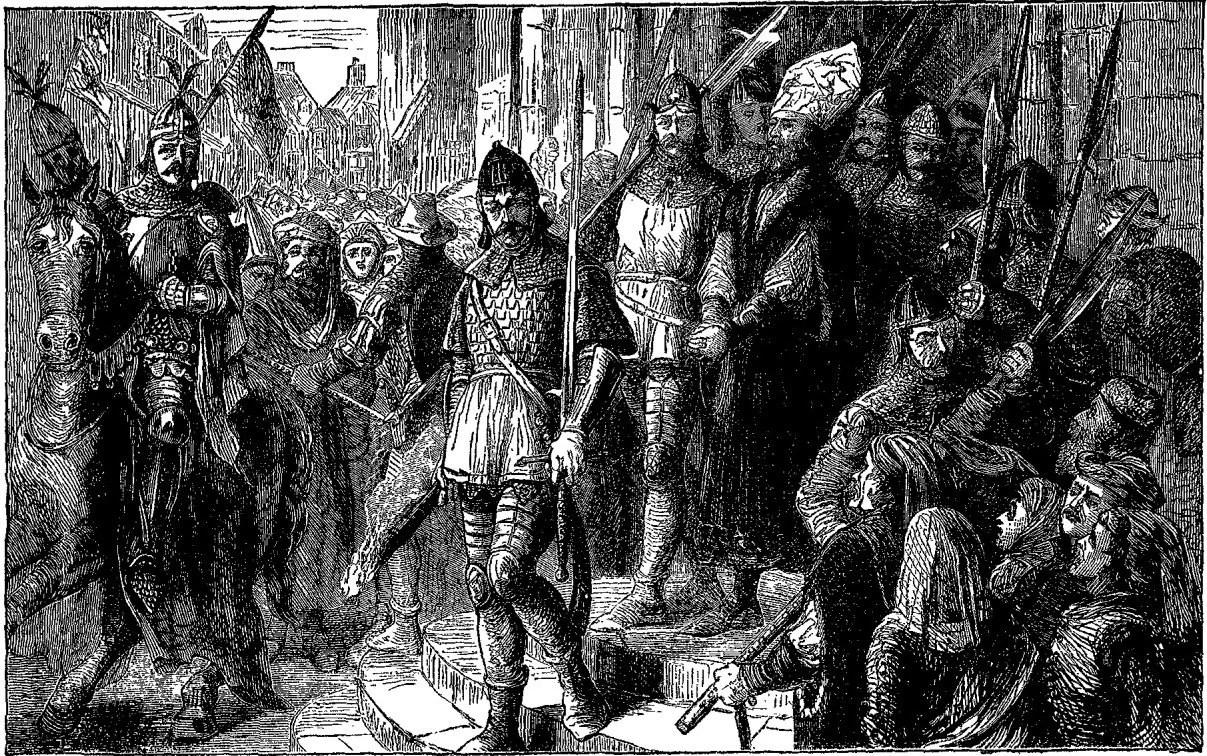
Jerome, the subject of our illustration, was not burned at the stake by the Roman Catholic Church any more than are Seventh-day Adventists in Georgia and Tennessee imprisoned and sent to the chain-gang by the so-called Protestant churches whose influence created and sustains the Sunday laws. The Roman Catholic Church simply declared Jerome a heretic, and as such he was regarded as an enemy of the State; and our illustration shows him being led to the stake, not by ecclesiastics, not by officers of the church, but by the civil authorities—officers of the State—just as Adventists are to-day imprisoned and driven in chain-gangs by authority of the State, but none the less in obedience to the behest of professed Protestants. The religious sentiment of the community was then crystallized into civil law precisely as it is to-day, and that not for the protection of civil rights, but for the enforcement of religious dogma.
It was not pretended in this Allison case that anybody was interfered with in the least degree. There was no disturbance, no infringing upon the rights of others. The gist of Mr. Allison’s offense was that he worked on Sunday, the day which the State of Georgia has declared is the “Sabbath,” “the Lord’s day,” and which it has decreed must be kept “holy.” There is absolutely no civil element in it except the fact that the day is intrenched in the civil law. A law requiring everybody to be baptized and to join a church would be civil in just the same sense as is this law requiring the observance of Sunday in the State of Georgia; and such a law would be no more in conflict with the constitution of that State than is the Sunday law.
The assertion that Mr. Allison or anybody else is left perfectly free in religious matters under a Sunday law is false. How free would the Sunday-keepers of Georgia consider themselves if they were taxed one-sixth of their time for the benefit of Mr. Allison’s religion?
Moreover, the fact that Mr. Allison is in the minority does not alter the case one iota. Judge Parks, of Tennessee, has well said: “If there were only one of them he would be entitled not only to his honest belief, but to the exercise of that belief, so long as in so doing he did not interfere with some natural right of his neighbors.”
This is the touchstone to which all such laws and all such questions ought to be brought, namely, the equal rights of others. Does one man, by working on Sunday, thereby infringe the equal right of another man to rest or to worship? If not—and he certainly does not—any law forbidding such work is simply an expression of intolerance and despotism, none the less intolerable, because instead of being the intolerance and despotism of one it is the intolerance and despotism of the majority.
Heresy as a Crime Against the State
Civil Officers Leading Jerome to Martyrdom for Heresy—“A Crime Against the State.”
“It must be remembered that in those days, heresy, especially if outspoken, was regarded not only as an offense against religion, but also as a crime against the State, and was punished accordingly.”
—Cardinal Gibbons.
TRIAL OF J. Q. ALLISON.
THIS trial, referred to in these columns last week, took place in the Superior Court at Douglasville, Ga., May 15, before Hon. C. G. James, Presiding Judge. W. T. Roberts, Solicitor General, appeared for the State. Mr. Allison conducted his own case. Two witnesses were sworn for the State, both of whom testified that they lived near Mr. Allison, and that they had seen him plowing in his field on Sunday, the 21st day of April, as charged in the indictment.
Mr. Allison did not deny doing the work, but offered to show that it was not of a nature to disturb anybody, and that in fact nobody was disturbed thereby. Both the witnesses testified on direct examination that they would not have seen Mr. Allison at work had they not gone to the place where he was, on purpose to see him.
Mr. Allison attempted to cross-examine the second witness, as follows:—
Q. How near is your place to mine? where does your land come up to it; your field?
A. I suppose it is a hundred yards, or something like that.
Q. You worked there on the seventh day?
A. Yes, sir, I worked on Saturday.
Mr. Allison. I want to prove whether I disturbed him, or whether I had complained about his disturbing me.
The Court. Never mind about that; that has nothing to do with this case. The only question in the world is whether you worked on the first day of the week; that is the only question in the case; I mean, worked in your ordinary employment.
The solicitor general then asked the witness two questions to establish the fact that Mr. Allison was working at his usual employment; after which the judge asked Mr. Allison if he had any statement to make. From this point onward we copy verbatim from the notes of the official stenographer:—
The Court. What statement do you want to make?
Mr. Allison. I want to show where I get the authority that the seventh day is the Sabbath. (The defendant had produced his Bible, as if to read.)
The Court. That won't do in this court.
Mr. Allison. I am not allowed to give the reasons?
The Court. No, sir; we allow every man his own religious opinions, but this is simply a civil law.
Mr. Allison. Will you allow me to read a piece from the constitution of Georgia?
The Court. If it applies to this case—any law of the State—if you want to read it.
Mr. Allison. (Reading from the code.) “Freedom of Conscience.—All men have the natural and inalienable right to worship God each according to the dictates of his own conscience, and no human authority should in any case control or interfere with such right of conscience. Religious Opinions.—No inhabitant of this State shall be molested in person or property—”
The Court. If you want to make any statement about the facts of this case, you can do so;—you have no lawyer to represent you:—if you do not want to, you need not do so, as to whether you did this work on this day.
Mr. Allison. I work on the first day of the week, and rest the seventh day. I keep it. I do nothing but feed my mules and water them, and some such things. We don't even do our cooking on the seventh day; we try to keep that holy. God has said we shall work six days, and rest the seventh. I rest the seventh, according to the commandment. I know that is the right day to keep, and I try to keep it.
The Court. You want to make any statement as to whether you did this work as charged against you?
Mr. Allison. Yes, sir, I do; I said I worked on the first day of the week; I do that.
The Court. I mean in this case, whether you did the work that the State has charged you with, and as sworn to by the witnesses?
Mr. Allison. Yes, I don't deny that; I don't deny working on the first day of the week, but I deny working on the Sabbath, that is, the Lord's day.
The Court. You don't deny doing the work that the witnesses swore to?
Mr. Allison. No, sir,3
The Court. You mean to swear that you did do it?
Mr. Allison. Yes, sir; I did the work.
The Court. That these witnesses said you did?
Mr. Allison. Yes, sir; but I claim that I have a right, under the Constitution and under the laws of God, that I have a right to work or not work and keep the day that he wants me to keep; that is the way I do. I claim I could not work on the seventh day, and then go right on and keep the first day of the week without displeasing God.
The Court. There is nothing in that. I have as much respect for your religion as anybody in any church in the country, or good men in the country. I would not interfere with you in any way in the enjoyment of your religion; this is simply a law of the State, and we are bound thereby. The State could say that you should keep Wednesday or Thursday, that it would be a crime to work on every other Wednesday or every other Thursday, and you would be bound to obey that law. I have a perfect respect for every man's religion, and I think every man has a right to his religion, whether he is a Mohammedan, or Jew, or Christian, or a Buddhist, and whether he believes in the seventh day, or the first day, or any other day.
Mr. Allison. Don't you think I would be worshiping some other god, if I was to obey the law in this matter believing as I do? Why God would not protect me, I would be worshiping another god.
The Court. Probably I would not be competent to argue this question with you, when you come to the Bible. This is an act of the State, and if you live in the State of Georgia, you must obey its laws.
Mr. Allison. Don't you remember where you read about Daniel? They made a law special for Daniel, and they cast him into the lions' den, and he broke the law, and God protected him in it.
The Court. I believe I have heard something about that, but the day of miracles is past. I am here simply to enforce the laws, and no matter what a man's religious opinions are, if the laws of the State are that he shall not work on a certain day, and he continues to work on that day, I am bound to enforce the law; I am simply bound to do that; that is my duty; that is my oath. I state to you that you are guilty, according to your own statement, of the violation of the law, and you cannot live in the State of Georgia and do that. The trouble is this, that if you are allowed to do this—I understand you are a good man, your neighbors say you are, there is nothing in the world against you—but if you are allowed to do this, bad men would claim the same privilege, and desecrate what the great majority of people consider the Sabbath; but outside of any reason for it, that is the law.
As appears from the record, the verdict of guilty was entered without the jury leaving their seats. The court then took a recess until afternoon; and, upon reassembling, the judge proceeded to pass sentence upon Mr. Allison, prefacing it with the advice that if the defendant's religion prevented him from obeying the Sunday laws of Georgia, he would better move out of the State and go where he would be allowed to live out his religion. He said if Mr. Allison persisted in working on Sunday, and came up before him again, he would put him where it would be a long time before he could get out of the State. Then, repeating what he said about Mr. Allison's being a good man and a good citizen, and there being nothing in the world against him, he said: “I will let you off easy this time with the costs, $22.05, or in default thereof, twelve full months in the chain-gang.”
For some discussion of the principles involved in this case, see article on first page of this paper.
THE BOYS' BRIGADE.
ONE of the founders of the “Boys’ Brigade” movement, describing the origin of the movement in a recent number of the Independent, says:—
All healthy boys have a love of soldiering born in them.
This intended defense of the military spirit that is permeating the churches, is the strongest condemnation of it. It is very true that boys are born with a love for war, but it is also true that these boys must be “born again” before they can enter the kingdom of heaven. John 3:3. And to the Church was committed the teaching of this vital truth; but instead of condemning the fruits of the natural heart, among which are “emulation, wrath, strife,” the concomitants of war, and teaching that all these belong to the natural heart, to escape which all must be born again, the Church is fostering the natural heart and stamping it with the approval of the Christian Church. The excuse is made that this natural desire of the carnal heart is taken advantage of to get the ear of the boy to teach him that he must be born again. But to do this is to “do evil that good may come,” a proposition condemned by the Scriptures. Rom. 3:8. With the one hand the Church is building what with the other it professes to destroy. “Ye cannot serve two masters.”
FOUND AT LAST AND LAST FOUND IN TENNESSEE.
Some divine authority for Sunday observance has been a want of many centuries, and many have been the efforts to supply it. Scripture has been wrested, history has been falsified and perverted, letters have been forged and tomes have been written, but all to no purpose; the fact still remained that Sunday was, as Neander says, “always only a human ordinance;” but now the lack has been supplied(?) and that in the very place where most needed, namely, in Tennessee, as is witnessed by the following from the Memphis Weekly Commercial:—
Milan, Tenn., May 28.—Mr. J. A. Warner, of this city, has in his possession a wonderful letter, which is probably one of the oldest specimens in existence. It has been in the Warner family 173 years. It is written on material resembling parchment, and yellow with the age of two centuries. The copy and letter are presented as follows:—
COPY OF A LETTER
“Written by our Lord and Saviour Jesus Christ, and found eighteen miles from Iconium twenty-five years after our blessed Saviour’s crucifixion and transmitted from the holy city by a converted Jew, and faithfully translated from the original Hebrew copy now in possession of Lady Cubass.
“This letter was found under a stone, both round and large, at the foot of the cross eighteen miles from Iconium near a village called Mesapotamia. Upon this stone was written and engraved: ‘Blessed be he that shall turn me over.’ All that saw it prayed to God earnestly and desired that he would make known unto them the meaning of this writing, that they might not in vain turn it over. In the meantime a little child of about six or seven years of age turned it over to the admiration of all present, and under the stone was written the command of Jesus Christ in a letter published by the angel Gabriel ninety-eight years after the death of our Blessed Saviour and carried by a person belonging to Lady Cubass, and made public in the city of Iconium.”
THE LETTER.
“Glory to God on high and on earth good will to all men, whosoever worketh on the Sabbath day shall be cursed. I command you to go to church and to keep the Lord’s day holy without doing any manner of work. You shall not idle or misspend your time in decking yourselves in superfluous and costly apparel and vain dressing, for I have ordained a day to be kept holy that your sins may be forgiven; you shall not break My commandments, but observe and keep them written with My own hand. You shall not only go to church yourself, but your man servant and your maid servant, to observe My word and learn My commandments. You shall finish your labor every Saturday at six o’clock in the afternoon, from that time the preparation of the Sabbath begins.
“‘I advise you to fast five days in the year, beginning with Good Friday, and so continue the four first days following, in remembrance of the five bloody wounds received for mankind.’
“You shall diligently and peacefully labor in your respective vocation wherein it has pleased Almighty God to place you.
“‘You shall love one another with brotherly love and cause them that are not baptized to come to church and receive the holy sacrament, and be made members thereof; and in so doing I will give many blessings, and comfort you in great temptation, and surely he that doeth to the contrary shall be cursed and unprofitable. I will also send hardships of heart upon them, but especially upon impenitent sinners and hardened unbelievers.
“‘He that giveth not to the poor shall be unprofitable.’
“Remember to keep the Sabbath day, for the seventh day I have kept to Myself, and he that hath a copy of this letter and keepeth it without publishing it to others, shall not prosper, and he that publish it to others shall be blessed of Me, and if their sins be in numbers as the stars in the firmament and believe in this they shall be pardoned, and if they believe not in this writing and keep not My commandments I will send My plague upon them and their children and their cattle, and whosoever shall have a copy of this letter and keep it in the house nothing shall do them any damage, neither pestilence, lightning or thunder shall hurt them, and if a woman be with child and in labor and she firmly puts her trust in Me, she shall be delivered of her birth; you shall hear no more of Me, but of the blessed spirit, until the day of judgment.”
“JESU HOMINUM SALVATOR.”
—Memphis Weekly Commercial.
This is not the first time that documents of this kind have been discovered(?) in remarkable ways; and that they have a common origin is evident from their marked similarity; and yet they are not free from contradictions, which circumstance however is never taken seriously by the slave of tradition.
As related by J. N. Andrews, in his “History of the Sabbath,” pp. 287–390, there visited England in the year 1200 A. D., one Eustace, the abbot of Flave in Normandy, and the burden of his preaching seems to have been Sunday observance. “At London also, and many other places throughout England,” remarks Hoveden, “he effected by his preaching that from that time forward people did not dare to hold market of things exposed for sale on the Lord’s day” [Sunday].
The abbot met much opposition, however, even from the clergy, and some were so inconsiderate as to demand of the zealous preacher that he cite some divine authority for the observance upon which he so strenuously insisted. The result was that he for a time abandoned the field and “returned,” says Hoveden, “to Normandy, unto his place whence he came.”
But the Sunday-breakers were to enjoy only a short respite. The following year, as the same author relates, the abbot returned with the authority demanded in the shape of the following document:—
THE HOLY COMMANDMENT AS TO THE LORD’S DAY,
Which came from heaven to Jerusalem, and was found upon the altar of Saint Simeon, in Golgotha, where Christ was crucified for the sins of the world. The Lord sent down this epistle, which was found upon the altar of Saint Simeon, and after looking upon which three days and three nights, some men fell upon the earth, imploring mercy of God. And after the third hour, the patriarch arose, and Acharias, the archbishop, and they opened the scroll, and received the holy epistle from God. And when they had taken the same, they found this writing therein:—
“I am the Lord who commanded you to observe the holy day of the Lord, and ye have not kept it, and have not repented of your sins, as I have said in my gospel, ‘Heaven and earth shall pass away, but my words shall not pass away.’ Whereas, I caused to be preached unto you repentance and amendment of life, you did not believe me, I have sent against you the pagans, who have shed your blood on the earth; and yet you have not believed; and because you did not keep the Lord’s day holy, for a few days you suffered hunger, but soon I gave you fullness, and after that you did still worse again. Once more, it is my will, that no one, from the ninth hour on Saturday until sunrise on Monday, shall do any work except that which is good.172
“And if any person shall do so, he shall with penance make amends for the same. And if you do not pay obedience to this command, verily I say unto you, and I swear unto you, by my seat, and by my throne, and by the cherubim who watch my holy seat, that I will give you my commands by no other epistle, but I will open the heavens, and for rain I will rain upon you stones, and wood, and hot water in the night, that no one may take precautions against the same, and that so I may destroy all wicked men.
“‘This do I say unto you; for the Lord’s holy day, you shall die the death; and for the other festivals of my saints which you have not kept: I will send unto you beasts that have the heads of lions, the hair of women, the tails of camels, and they shall be so ravenous that they shall devour your flesh, and you shall long to flee away to the tombs of the dead, and to hide yourselves for fear of the beasts; and I will take away the light of the sun from before your eyes, and will send darkness upon you, that not seeing, you may slay one another, and that I may remove from you my face and may not show mercy upon you. For I will burn the bodies and the hearts of you, and of all those who do not keep as holy the day of the Lord.
“‘Hear ye my voice, that so ye may not perish in the land, for the holy day of the Lord. Depart from evil, and show repentance for your sins. For, if you do not do so, even as Sodom and Gomorrah shall you perish. Now, know ye, that you are saved by the prayers of my most holy mother, Mary, and of my most holy angels, who pray for you daily. I have given unto you wheat and wine in abundance, and for the same ye have not obeyed me. For the widows and orphans cry unto you daily, and unto them you show no mercy. The pagans show mercy, but you show none at all. The trees which bear fruit I will cause to be dried up for your sins; the rivers and the fountains shall not give water.
“‘I gave unto you a law in Mount Sinai, which you have not kept. I gave you a law with mine own hands, which you have not observed. For you I was born into the world, and my festive day ye knew not. Being wicked men, ye have not kept the Lord’s day of my resurrection. By my right hand I swear unto you, that if you do not observe the Lord’s day, and the festivals of my saints, I will send unto you the pagan nations, that they may slay you. And still do you attend to the business of others, and take no consideration of this? For this will I send against you still worse beasts, who shall devour the breasts of your women. I will curse those who on the Lord’s day have wrought evil.
“‘Those who act unjustly towards their brethren, will I curse. Those who judge unrighteously the poor and the orphans upon the earth, will I curse. For me you forsake, and you follow the prince of this world. Give heed to my voice, and you shall have the blessing of mercy. But you cease not from your bad works, nor from the works of the devil. Because you are guilty of perjuries and adulteries, therefore the nations shall surround you, and shall, like beasts, devour you.”
The promulgation of this document greatly stimulated Sunday observances in England as indeed its modern prototype may possibly do in Tennessee.
It will be noted that there is some conflict between the two documents as to the proper time to begin the observance of Sunday. The Sunday commandment, which now turns up in Tennessee, commands those to whom it is directed that “You shall finish your labors every Saturday at 6 o’clock in the afternoon, from that time the preparation of the Sabbath begins.” The document brought to England by the abbot names the “ninth hour [three o’clock] on Saturday” as the hour at which all work must cease, and many remarkable things are related as happening to those who disregarded this injunction. Hoveden relates some of these stories as follows:—
One Saturday, a certain carpenter of Beverley, who, after the ninth hour of the day, was, contrary to the wholesome advice of his wife, making a wooden wedge, fell to the earth, being struck with paralysis. A woman also, a weaver, who, after the ninth hour on Saturday, in her anxiety to finish a part of the web, persisted in so doing, fell to the ground, struck with paralysis, and lost her voice. At Rafferton also, a vill belonging to Master Roger Arundel, a man made for himself a loaf and baked it under the ashes after the ninth hour on Saturday, and ate thereof, and put part of it by till the morning, but when he broke it on the Lord’s day blood started forth therefrom; and he who saw it bore witness, and his testimony is true.
At Wakefield, also, one Saturday, while a miller was, after the ninth hour, attending to grinding his corn, there suddenly came forth, instead of flour, such a torrent of blood, that the vessel placed beneath was nearly filled with blood, and the mill-wheel stood immovable, in spite of the strong rush of the water; and those who beheld it wondered thereat, saying, “Spare us, O Lord, spare thy people!”
Also in Lincolnshire a woman had prepared some dough, and taking it to the oven after the ninth hour on Saturday, she placed it in the oven, which was then at a very great heat; but when she took it out, she found it raw, on which she again put it into the oven, which was very hot; and both on the next day and on Monday, when she supposed that she would find the loaves baked, she found raw dough.
In the same county also, when a certain woman had prepared her dough, intending to carry it to the oven, her husband said to her, “It is Saturday, and is now past the ninth hour, put it one side till Monday;” on which the woman, obeying her husband, did as he commanded; and so, having covered over the dough with a linen cloth, on coming the next day to look at the dough, to see whether it had not, in rising, through the yeast that was in it, gone over the sides of the vessel, she found there the loaves ready made by the Divine Will, and well baked, without any fire of the material of this world. This was a change wrought by the right hand of Him on high.
“The historian [Hoveden] laments that these miracles were lost upon the people, and that they feared the king more than they feared God; and so, ‘like a dog to his vomit, returned to holding markets on the Lord’s day.’”
It is by such subterfuges as this Tennessee discovery and its legitimate predecessor invented by the Abbot Eustace, that the Sunday institution, now hoary with age, was first foisted upon the Christian Church; and it is by means little less dishonest that it is now maintained as a sacred day.