The Youth’s Instructor, Vol. 27, No. 23.

A BRIEF HISTORY OF BELLS

The Youth’s Instructor

Jun 14, 1879

S. D. A. Publishing Association · Battle Creek, Mich. · Jun 14, 1879

A BRIEF HISTORY OF BELLS.

The bells of China rank next in size to those of Russia. It is the opinion of persons prepared to judge, that China is the country whence large bells have their origin. It is said to be not uncommon throughout the Celestial Empire to see enormous bells lying upon the ground, their great weight having broken down the towers in which they were suspended.
The “Great Bell of China,” in Pekin, weighs 120,000 pounds, and is 14 feet high, and 12 feet in diameter. It is used to denote the watches of the night. In Nankin there is a bell now fallen to the ground which weighs 50,000 pounds.
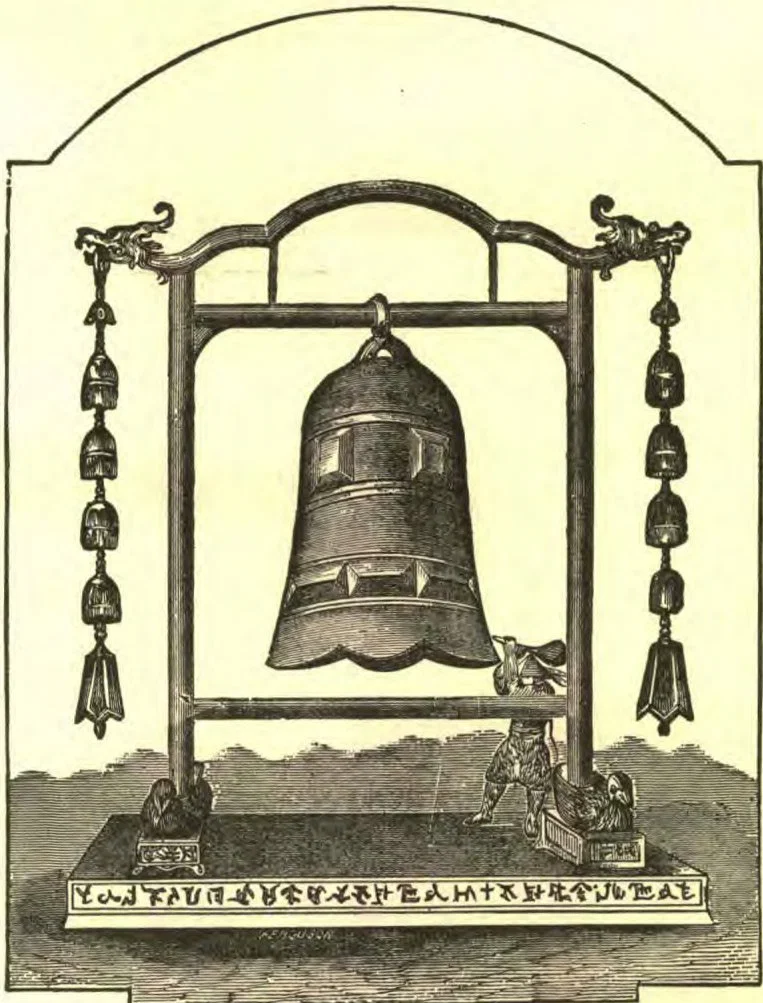
In Japan, bells are very commonly used. In form and composition they greatly resemble the bells of China, and are found of every size, and in great numbers. They are suspended in low towers, near the temples. At the commencement of worship, the bell is sounded to arouse the deity, and have him wide awake to listen to the calls of the devout. Our engraving on the next page shows a Japanese bell mounted after the custom of that people.
The bells of Holland and Belgium are remarkable for their size and number. Says a writer of the Netherlands, “The inhabitants are enthusiastic in their fondness for bells, which they never leave at rest.”
The weights of several of the so-called large bells of the world are as follows:—
A bell in Vienna, Austria, weighs 40,000 pounds. Another, in Olmutz, is of equal size. A bell in Rouen, France, weighs 36,000 pounds. The largest bell in England, at Westminster, weighs 30,000 pounds. There is a famous bell at Erfurt, Germany, named Susanne, of the same weight. Its tone was long regarded as without equal in all Europe. It was cast in 1497. Martin Luther, when a schoolboy, must have listened to its earliest peals.
The largest bell in America is in the cathedral at Montreal, and weighs 25,000 pounds. Another in the church of Notre Dame, Paris, is of the same weight. The bell in St. Peters, at Rome, weighs 17,500 pounds, and “Great Tom,” at Oxford, is nearly the same size. This last bell strikes 101 times every evening at nine o’clock.
The largest bell in the United States is the Alarm Bell on City Hall, New York. It was cast in Boston, and weighs 23,000 pounds. Its diameter is 8 feet, its height, 6 feet, and it is 7 inches thick.
But the bell of special interest in this country, is the famous old “Liberty Bell,” now standing on a pedestal in the State House in Philadelphia. It was imported from England in 1752, and being cracked on trial, was re-cast. On its brazen sides are the following words of the Bible: PROCLAIM LIBERTY THROUGHOUT THE LAND UNTO ALL THE INHABITANTS THEREOF. It was under this very bell that the brave representatives of the Thirteen Colonies first “Proclaimed Liberty,” and this bell, with its iron tongue, started the tidings throughout the land. It was afterwards cracked when being rung in honor of Henry Clay in Philadelphia.
On the continent of Europe, chimes frequently consist of forty or fifty small bells, and are played by means of a barrel like that in a hand organ, or by clock-work.
THE “GREAT BELL OF CHINA.”
The system now generally adopted in chime ringing is that of having each bell mounted stationarily, with cords leading from the ends of the clappers to manuals, arranged in the forms of levers, and operated by a single player.
The number of changes which can be played upon a chime of bells is almost marvelous, twelve bells allowing a no less number than 479,001,600.
In former times, it was a common belief that the ringing of bells would drive away demons and evil spirits. One old writer even asserting that if all the bells of England should be rung together at a certain hour the devil would have no abiding-place in all England!
Akin to superstition, there has always been a sincere affection connected with the chiming of bells. It is recorded of a friar, that upon the destruction of his monastery he regretted nothing so much as the loss of a favorite bell, which, after diligent search, he found had been removed to a village church. He then submitted to become a common laborer that he might end his days within the hearing of it. Even the ambitious Napoleon was ever deeply stirred at the sound of bells. “How often,” says Bourrienne of the emperor, “has the booming of the village bell broken off the most interesting conversation!” the monarch refusing to move lest the action of the feet should interfere with the sacred sounds.
Formerly it was quite customary to ring bells to avert tempests, or to drive away pestilence. Even at present, in France, it is usual throughout the vinelands to ring the bells at the approach of storms, to break the clouds. In Switzerland, it is said that the muleteers, at certain passes, tie up their little bells, lest their tinkle should shake the delicately poised snow, and bring down an avalanche.
Most touching is the tradition told in connection with the peal in Limerick cathedral. It was said to have been brought from a convent in Italy, for which place it had been manufactured by an enthusiastic native with much labor and skill. The Italian, having acquired a competency, fixed his home on the convent cliff; and for many years enjoyed the chimes of his beloved bells. But in some political revolution, the monks were driven from the monastery, the Italian from his home, and the bells were carried to the Emerald Isle. After a long interval the course of his wanderings brought him to Limerick. On a beautiful evening, as the vessel which bore him floated on the Shannon, he suddenly heard the bells peal forth from the cathedral tower. They were the long-lost treasures of his memory! Home, happiness, friends,—most tender recollections, were in their sounds. Crossing his arms on his breast, he lay back in the boat. When the rowers looked round they saw his face still turned toward the cathedral, but his eyes had closed forever on this world.
We will conclude this sketch with the apt remark of the noted Robert Southey: “Great are the mysteries of bell ringing. And this may be said in its praise, that of all devices which men have sought out for obtaining distinction by making a noise in the world, it is the most harmless.”
O. W. A.

CONTENTMENT

The following stanzas are more than two hundred and sixty years old. They were written by Robert Southwell:—
My conscience is my crown, Contented thoughts my rest; My heart is happy in itself, My bliss is in my breast.
My wishes are but few, All easy to fulfill; I make the limits of my power The bounds unto my will.
I fear no care of gold, Well-doing is my wealth; My mind to me an empire is, While grace affordeth health.
I clip high climbing thoughts— The wings of swelling pride; Their fall is worst that from the height Of greatest honors slide.

IN DEMAND.

One day Tommy had been asked to do several “chores” about the house. He was wanted to bring in wood, hunt eggs, run errands, etc. He grew tired of it at last, and upon some new request he said, half-impatiently, half-jokingly, “Well, I think here's a boy that's in pretty good demand to-day.”
“Good articles are always in demand,” replied one who heard him.
“O, yes, I s’pose so!” said Tommy, as he marched off to do this favor also, evidently thinking it was a little tiresome. The “demand” seemed to press a little hardly upon the “supply.”
Yes, Tommy, “good articles are always in demand.” This is true the world over. People like to choose the best they can find, not only the best things, but the best men. Good lawyers, good doctors, good teachers, good merchants, good mechanics, good farmers, good editors, good preachers, will all find that the great world has plenty for them to do. They are in demand.
But worthless things have poor sale. They may go a-begging. Men don’t want them. The lazy, the disobliging, and the careless are not often asked to do much when better hands may be had.
If you would succeed in life and be considered a useful member of society, strive to be obliging, helpful, and careful. Learn to do with your might what your hands find to do. And this must be done not merely for the sake of being praised or receiving ready pay, but because it is right, and manly, and Christ-like. Do it bravely and “heartily, as to the Lord, and not unto men.” Men will often be thankless, but the Lord’s reward is sure. The pay will be all right at just the right time; God will remember all.
He who serves most shall be accounted greatest. But only he who loves much can serve much, without growing weary and “giving up.” But if we love Christ, we shall be strong to do all duties and endure all things.—Era.

THE SIN OF LYING.

Did you ever think, dear children, what a dreadful sin it is to tell an untruth? A story illustrating how God looks at a lie has been preserved and handed down to us that we may know how sinful it is, and what a dreadful punishment befell those who lied to him. There was a man and his wife who lived in an ancient city where the apostles of the Lord Jesus preached his word, and where God worked many miracles. There were many true disciples there who would rather die than deny that Jesus was their Saviour. These people loved each other and the Lord so much that they sold their farms, and brought the money and placed it in a common fund for the support of all, both rich and poor.
The man and his wife just mentioned thought it would be a great honor to thus appropriate a large sum of money. But while they wished the honor of doing much, they really wished to do but little. So they sold a possession, and brought only a part of the money to devote to this sacred use. A very good man was present, and he knew their motives and the wickedness of their hearts, so he said, Why do you keep back part of the price? Before it was sold was it not yours, and afterward was it not in your own power? You have not lied to men, but to God.
Soon both this wicked man and his wife fell down dead before the people assembled, who were much frightened at this visible manifestation of God’s wrath. They were then taken out and buried, where they must rest till God calls them forth to share the fate of all liars in the lake of fire.
If after hearing this story you wish to read the original account, just take your Bible and turn to the fifth chapter of Acts, and read the account of Annanias and Sapphira.
It was written for you and I, dear reader, that we may shun this sin, and escape the terrible fate awaiting the liar. In stating a matter let us be careful not to step over the bounds of truth, but in plain language tell the matter just as it is whether it condemns us or not. We should be careful not to tell a falsehood to shield ourselves from punishment, nor should we speak an untruth when speaking of others. God’s word gives many warnings to liars, and praises the virtue of speaking the truth.
The poet beautifully remarks in a hymn found in your new “Song Anchor”:—
“Be the matter what it may, Always speak the truth; Whether work or whether play, Always speak the truth. Never from this rule depart, Grave it deeply on your heart; Written ’tis in Virtue’s chart, Always speak the truth.”
VESTA J. OLSEN.
Belmont, Wis.

The Value of Time

OF our gold and our silver, most of us are careful; but of time, which, once lost, can never be recalled or regained, we lavish a large portion, even while we are uttering complaints of the quantity allotted to us.

LESSONS FOR CHILDREN.

LESSON XXIII.—SAMSON'S EXPLOITS AND DEATH.

SAMSON was so angry at the way in which his wife and the Philistines had treated him, that he went to his own home, and left her with her father a long time. Finally, he went to see her, but found that her father had given her to another man. This made him so angry that he caught three hundred foxes, and tied their tails together, two by two, with a firebrand between. Then he let the foxes go into the fields of ripe grain.
When the Philistines saw all their fields in flames, they inquired who had set them on fire, and were told that Samson had done it because his wife had been taken from him. Then they took Samson's wife and her father, and burned them alive.
Then Samson went among the Philistines, and slew a great many of them because they had killed his wife. Afterward he went and dwelt upon the top of a rock in a lonely place.
But the Philistines were so angry at what he had done, that they raised an army, and marched into the land of Israel, threatening to make war against them if Samson was not given into their hands. Then three thousand men of Israel went to Samson's home, and he allowed them to bind him, and take him down to the camp of the Philistines. But when he got among his enemies, he snapped the ropes as if they had been threads, and taking up the jaw-bone of an ass, he slew a thousand men.
Now Samson loved a Philistine woman whose name was Delilah, and her countrymen offered to give her eleven hundred pieces of silver if she would induce Samson to tell her the secret of his strength. So she persuaded Samson, and at last he told her that if his hair was shaven off, he would be no stronger than other men. Then she got him to sleep with his head upon her knees, and a man came in, and shaved off all Samson's hair. So when he awoke, his strength was gone, and the Philistines took him, bored out his eyes, bound him with fetters, and made him grind with a hand-mill in their prison-house.
Finally the lords of the Philistines made a great feast to their god, and brought out Samson to make sport for them. But his hair had begun to grow again, and praying to God to give him strength, he laid hold of the two main pillars of the house, and pulled them down, killing himself, the lords of the Philistines, and more people than he had killed before in all his life; for there were about three thousand persons on the roof.

QUESTIONS.

  1. Why did Samson go home and leave his wife with her father?
  2. When he finally returned to her, what did he learn? Judges 14:20.
  3. How did Samson feel about having his wife given to another?
  4. What did his anger cause him to do? Judges 15:4, 5.
  5. When the Philistines found out why their fields had been set on fire, what terrible punishment did they inflict on Samson's wife and her father?
  6. How did Samson punish the Philistines for killing his wife?
  7. Where did he then go to dwell?
  8. What course did the Philistines take to get Samson into their power?
  9. Who went to the top of the rock to get Samson?
  10. What did he allow them to do?
  11. What did Samson do when he was brought into the camp of the Philistines?
  1. Who finally betrayed Samson into the hands of his enemies?
  2. What did they do to him?
  3. On what occasion did they bring out Samson to make sport for them?
  4. What terrible destruction did he bring upon them? Judges 16:30.
  5. How many did he kill?
  6. What caused Samson to lose his strength?
  7. What caused him to regain it?
  8. How did his hair come to be cut off?
  9. What reward did Delilah receive?

BIBLE LESSONS FOR YOUTH.

LESSON XLIX.—DISOBEDIENCE OF MOSES AND AARON.

1. WHAT did the people do on the next day after Korah, Dathan, and Abiram, and the rebellious princes, were destroyed? Num. 16:41.
2. What did the Lord tell Moses to do?
3. How did the Lord punish the people for their terrible sin?
4. How was the plague stayed?
5. How many perished?
6. What did the Lord require the people to do in order that he might more fully convince them that he had chosen Aaron for the priesthood?
7. What was Moses to do with these rods?
8. What did the Lord say should come to pass?
9. What did Moses discover when he entered the tabernacle the next day?
10. What was done with this rod? Verses 10, 11; Heb. 9:4.
11. Where was Miriam buried? Num. 20:1.
12. What caused the people to murmur at this place?
13. What did they say? Verses 3–5.
14. What did the Lord tell Moses to do?
15. What did Moses and Aaron say to the people when they had gathered them before the rock at Kadesh?
16. In what other way did Moses manifest his impatience?

SYNOPSIS.

On the next day after the Lord had destroyed Korah, Dathan, and Abiram, all the congregation of the children of Israel murmured against Moses and against Aaron, saying, “Ye have killed the people of the Lord.”
“And the Lord spake unto Moses, saying, Get you up from among this congregation, that I may consume them as in a moment.”
Then Aaron, at the command of Moses, took a censer, and ran into the midst of the congregation, and standing between the living and the dead, burned incense as an atonement for the people; for the plague had already begun. Thus the plague was stayed, but not until fourteen thousand and seven hundred of the people had died.
In order to more fully convince the people that Aaron was chosen for the priesthood, the Lord commanded that twelve rods should be taken, and laid up in the tabernacle. Each tribe was to bring a rod bearing the name of the prince of that tribe, and Aaron’s name was to be inscribed on the rod taken from the tribe of Levi.
And the Lord said, “It shall come to pass, that the man’s rod, whom I shall choose, shall blossom.”
So Moses laid up the rods in the tabernacle as the Lord had commanded; and on the next day, when he went in he found that Aaron’s rod had budded, blossomed, and yielded almonds. And this rod was kept in the tabernacle to prevent murmuring against the priesthood.
When they came into the desert of Zin, the people abode at Kadesh; and Miriam died, and was buried there.
While here, the people murmured for water. They said, “Would God we had died when our brethren died before the Lord.” They said it was no place of seed, or of figs, or of vines, or of pomegranates, and there was no water; that Moses had brought them out into the wilderness to kill them.
Then the Lord told Moses and Aaron to gather the people before a rock, which, when they spoke to it, should give forth water in the eyes of all the people. But Moses and Aaron were impatient; and when they had gathered the people together, they said, “Hear now, ye rebels; must we fetch you water out of this rock?” “And Moses lifted up his hand, and with his rod, he smote the rock twice: and water came out abundantly, and the congregation drank, and their beasts also.”
G. H. BELL.

AN ARMY OF EXEMPTS.

Get your most efficient men and women to enlist in this work. As Moses called about him the elders of Israel, so do you. In all our churches, there are some old professors tall as cedars. Such teachers were around me forty years ago, but now such men say, We are too old, and we are weary, and we are too much occupied to visit the scholars. Upon the experienced women also fall the cares of home, and other cares, which prevent their engaging in the Sabbath-school. Herein is a great defect, an army of exempts, and not a wound upon them. Their strength for money-getting is unabated, and yet, when Jesus asks their toil,—though there be ten vacant classes in the school,—still they hold back. Standing pools are these, which soon are covered with the green and slimy tokens of decay, and which become stagnant, and offensive to all around. So far as my observation goes, a heart too close to let out its love in active work, is far too close to let in grace. The epitaph of many an able woman might be this: A woman devoted to pot-boiling. The great and good Abraham was willing to leave the ass with the young men, while he and his boy went up into the mountain to worship. All our churches should profit by this example, and send their leaders into this most sacred work.
We need teachers intelligent in condition, advanced in education, and ripe in Christian experience; teachers who know Christ, and the power of his resurrection, and can so plainly and patiently set it before the pupils, that misapprehension of Christ's work shall be impossible.—Stephen H. Tyng, D. D.

TO TEACHERS.

ONE word to you, teachers! You who are so often absent from Sabbath-school. Have you a good excuse? Do you realize how much harm you are doing by staying away? Your class expect you there, and when you are not present, they are disappointed. It is no encouragement for them to study the lesson, when the teacher, whose place it is to instruct them, is so often missing.
The Superintendent has to supply the class as best he can, and it too often happens that the one whom he selects to fill your place, not expecting to act as teacher, has hardly looked at the lesson. The class are dissatisfied, and it is no wonder that they soon begin to stay away, too; and thus the school grows smaller, the interest wanes, opportunities for doing good are lost, and whose fault is it? Teacher! think of these things, and resolve to be punctual, and do your whole duty to the class intrusted to your care.—Sel.

Machinery, Method, and Sabbath-School Discipline

THE proper use of machinery and mechanical methods does not impair the originality and vitality of those making use of them. This is evident in the case of an army which is a powerless mob without drill and tactics. Many Sabbath-schools are like an army without discipline, and they are failures.

“OH, I FORGOT!”

HAVE a little girl whose great fault is forgetting. She forgets to hang up her dresses; she forgets to put strings in her shoes; she forgets where she left her mittens, or the scissors, or her thimble; she forgets to do her errands; she forgets to come home when she is told to come; yet she always seems sorry when I talk to her, and means, I think, to improve; but she does not. Every week, if it finds her no worse, does not find her better.
In other respects, Maggie is a good child. She is neither fretful nor ill-tempered. She is an industrious little girl, and speaks the truth. But all these fine qualities are almost spoiled by forgetfulness. It leads to much disorder, as you may suppose.
I could not for a long time think how she could forget so. I have found out now—the Bible told me. God says in it, “My son, forget not my law, but let thy heart keep my commandments.” Now, I see Maggie does not use her heart in this matter. She wishes to mind me, but wishes are not strong enough. Maggie means and intends to mind; but intentions are not strong enough—they easily break. Meaning to do right is never enough. Children will not improve if they do nothing but mean to. Nor will fear do it, nor hearing, nor knowing. What will, then? God knew when he said, “Let thy heart keep my commandments;” for what we love to do, we do.
Poor Maggie, alas! has no heart in it, therefore she forgets and disobeys. And many and many a mother is grieving over this same fault in her dear child; and perhaps many a poor child is grieving for it too. My dear child, I can only tell you to beg of God to give you that “new heart” which the Bible tells of, filled with the spirit of humble, faithful love. That will remember.—Sel.

FACTS ABOUT VARNISH.

There are three ingredients used in the manufacture of varnish,—linseed (or flax-seed) oil, turpentine, and gum copal, which, as we have already noticed, is the chief.
For the best quality of varnish is required a superior quality of flaxseed, and this it is difficult to obtain. If it is harvested before quite ripe, or if injured in any way while coming from Calcutta (where the best varieties are obtained), the value of the oil is much diminished.
The process of making this oil is quite simple. The seed is first ground, and the meal placed in hollow iron cylinders, which hold about half a bushel. It is then subjected to very powerful hydraulic pressure, and the liquid expressed. After this has had time to settle, the oil is separated from the sediment.
Before it is fit for the varnish maker's use, however, it must pass through another process, that of boiling and bleaching. The oil becomes so hot when boiling that it will scorch a feather, and great care must be taken lest it take fire, and be consumed. Should it become ignited, it cannot be extinguished by applying water, but must be smothered by placing over it a closely fitting lid.
Turpentine is made from the gum of the long-leafed pine of North Carolina, Georgia, and Florida. The trees are hewed square on two sides, for a distance of eight or ten feet from the ground. The rising sap oozes out upon the smooth surface, and is scraped off, and placed in a turnip-shaped still which is made of copper, set in brick work, and which holds from ten to fifty barrels. When the still is full, they fit on the cover. This is connected by an arm to the worm, which is constantly surrounded by cold water, and fire is kept directly underneath the still.
As the process of stilling goes on, the turpentine becomes condensed in the worm, and, mingled with water, runs out into a tub, where it settles to the bottom. When it has reached a certain temperature, the distiller draws out the fire and allows it to cool. The cap or cover is then removed, and the liquid is skimmed to remove all impurities.
If the cover is removed too soon, the whole mass will at once take fire. When the turpentine is ready for shipment, it is drawn off from the tubs into well glued barrels by means of a syphon.
The largest distillery in this country is said to be located at Wilmington, North Carolina. C. N. STUTTLE.

CURIOUS DERIVATIONS.

THE word pamphlet is derived from the name of the Greek authoress, Pamphylia, who compiled a history of the world into thirty-five little books.
“Tabby cat” is all unconscious that her name is derived from Atab, a famous street in Bagdad, inhabited by the manufacturers of silken stuff called Atab or taffeta; the wavy markings of the watered silks resembling pussy’s coat.

Lines on Hiding Wrong Where God Is Present

If ever you incline to do— Aught false, unkind, or worthy blame, First find a spot where God is not, In which to do the same.

LETTER BUDGET.

WE have just room for three letters, without note or comment.
STOUGHTON, WIS.
DEAR EDITORS: I am a little girl eight years old. We have no Sabbath-school here, but mamma hears me recite the lessons at home. I have been going to school this winter, and have read in the Third Reader, but our school has closed. We have a Sunday-school. C. E. GOULD.
WEST SIDE, IOWA.
EDITOR YOUTH’S INSTRUCTOR: My kind auntie, Mrs. Metcalf, of Oakland, Cal., sent me the monthly paper two years. I carelessly let the time run out, and I miss it so much that mamma says I may change to the weekly, so that I may have it oftener. Please begin with the January number, as pa says if I keep them nice till the close of the year I may have them bound. I learn some of the pieces to speak at the Blue Ribbon Society. This is my first effort at writing to an editor. I am nine years old. I have three brothers and two sisters. I attend Sunday-school nearly every Sunday. Yours truly, JESSIE C. DEAN.
GROVE LAKE, MINN.
DEAR EDITORS: I am a little girl seven years old. I am keeping the Sabbath with papa and mamma, and my sisters and brother. Sister Jennie took the monthly INSTRUCTOR in her name last year, and this year I take the weekly in my name. We are so glad to have it come every week. We read the “Letter Budget” first. We are going to try to do some missionary work with our little paper. We don’t go to day-school, but we have a good Sabbath-school to go to. We hope to be ready to meet the INSTRUCTOR family in Heaven by-and-by. JESSIE EMMERSON.

SPRING-TIME

Oh, how I love the spring-time, So pleasant and so sweet, The bright blue sky above me, The daisies at my feet; The joyous birds are singing, The air is full of glee, God surely made the spring-time For a little child like me.
The primroses are beautiful, The buttercups are bright, The streams are music making, The world is filled with light; I feel so very gladsome, I wish that I could fly, With yonder lark upsoaring Away into the sky.
On the green grass I sit me, And there I play for hours, And loving little fingers Deck my young head with flowers. Oh, yes, I love the spring-time, Soft breezes toss my hair, New life in all its beauty Is round me everywhere.

You have reached the end of this edition.

The Youth’s Instructor · Jun 14, 1879