Pacific Press Publishing Company · New York · Jun 4, 1896
SUN WORSHIP.
Sun worship was doubtless the earliest form of idolatry, as it was also the most debasing.
In all probability the orb of day was first adored, not as God, but as his most fitting representative. That it soon came to be regarded as God was not only the logical but even the necessary result.
To the sun was early ascribed life-giving power. His rays shining on the earth caused her to bring forth her fruits in their seasons. All nature responded to his genial warmth. What was more natural than that man, forgetting the Source of all light and life, into whose presence he was no longer permitted to come, should change “the truth of God into a lie,” and worship and serve “the creature more than the Creator”?
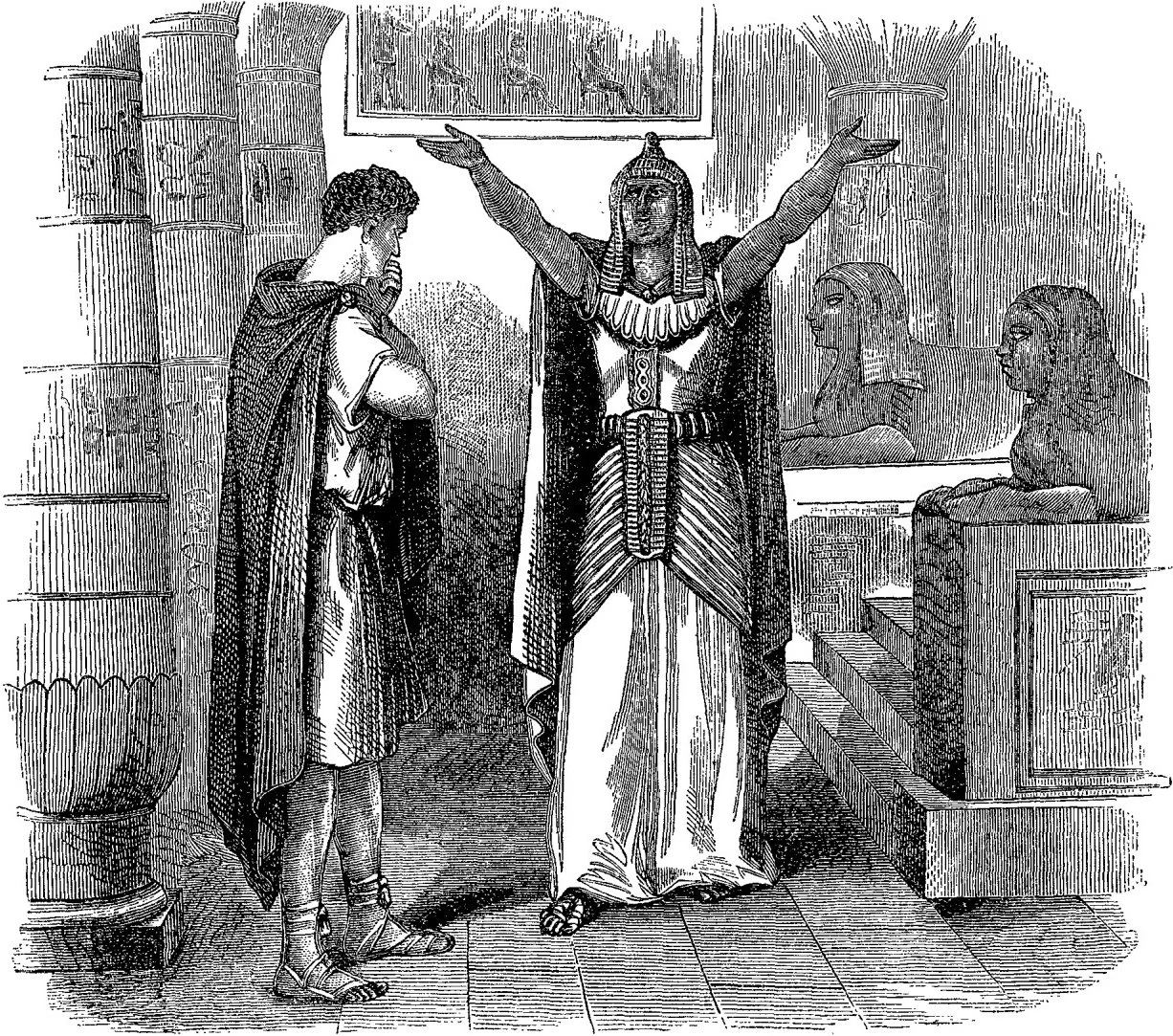
In the Temple of Osiris.
The visitor from the city of Romulus finds in the Egyptian Osiris simply another phase of Hercules, and having offered his petition to this God of Kem, he receives with all the humility at the command of a Roman, the blessing of the Egyptian priest ministering at the altar of “the lord of the lower world.”
“A dark cloud stole over man’s original consciousness of the Divinity,” says Döllinger, “and, in consequence of his own guilt, an estrangement of the creature from the one living God took place; man, as under the overpowering sway of sense and sensual lust, proportionally weakened, therefore, in his moral freedom, was unable any longer to conceive of the Divinity as a pure, spiritual, supernatural, and infinite Being, distinct from the world, and exalted above it. And thus it followed inevitably, that, with his intellectual horizon bounded and confined within the limits of nature, he should seek to satisfy the inborn necessity of an acknowledgment and reverence of the Divinity by the deification of material nature; for even in its obscuration, the idea of the Deity, no longer recognized, indeed, but still felt and perceived, continued powerful; and in conjunction with it, the truth struck home, that the Divinity manifested itself in nature as ever present and in operation.” But how terribly has the truth of God’s presence in nature been perverted!
The phenomena of nature differ but little in various countries, and the human heart is everywhere the same. Whether in the valley of the Nile, on the banks of the Euphrates, on the shores of the Mediterranean, or in the valleys of Mexico or the mountains of Peru, the sun appeared as the great benefactor of the race, and was worshiped under various forms and titles.
More properly speaking, certain functions or powers supposed to reside in the sun were worshiped,—indeed, sun worship was simply the worship of the power of reproduction in nature, including man.
“The influence of the sun on nature,” says the “Encyclopedia Britannica,” “either brightening the fields and cheering mankind, or scorching and destroying with pestilence, or again dispelling the miasma collected from marshes by night, was . . . taken to be under the control of a divine being, to whom men ascribed, on human analogy, a form and character in which were reflected their own sensations.”
All ancient religions except Judaism and Christianity (and they are really one), were almost wholly sun worship, or nature worship, which is the same thing, as the sun plays so important a part in all the processes of nature.178All pagans were polytheists, but the chief deity everywhere was the sun, or, as we have already explained, some real or fancied power of that great luminary, and all others were honored because of their fancied relation to him.
Ammon-Ra.
One of the gods of Egypt was Ammon, which name “is said to have meant, etymologically, ‘the concealed god;’ and the idea of Ammon,” says Rawlinson, “was that of a recondite, incomprehensible divinity, remote from man, hidden, mysterious, the proper object of the profoundest reverence. Practically, this idea was too abstract, too high-flown, too metaphysical, for ordinary minds to conceive of it; and so Ammon was at an early date conjoined with Ra, the sun, and worshiped as Ammon-Ra, a very intelligible god, neither more nor less than the physical sun, the source of light and life, ‘the lord of existences, and support of all things.’”
The Greeks worshiped the sun under various names, among which was Adonis. The same name was also applied to the sun by the Babylonians by whom it was associated with Tammuz. But both were sun gods, the former being the father of the latter. Tammuz was the “sun when obscured by night or in winter.” That is to say, Adonis was the sun shining in his strength; Tammuz, the same luminary, wholly or partly obscured. Hence the custom of weeping for Tammuz and rejoicing at his “resurrection.” A similar relation was by the Egyptians supposed to exist between Ra and Osiris, namely, that of father and son.
The Feast of Tammuz.
The annual festival of Tammuz, “which celebrated his supposed death and resurrection, was a time of mourning followed by one of joy.” It was one of the most abominable of festivals, being a season of prostitution as a religious rite. It was upon the occasion of the celebration of this festival that Babylon was taken by the Medes and Persians, as recorded in the 5th chapter of Daniel. Reference is also made to this most abominable of religious customs in Ezek. 8:14.
Sun worship always involved a multitude of gods. Probably no people ever exceeded the Egyptians in the number of their objects of worship, but they were all more or less remotely connected with sun worship.
Like other nations of antiquity the Egyptians attributed to the sun life-giving, or reproductive power, and like the Babylonians, some of their religious rites were too vile for description. They worshipped both the male and female principle in nature, the former residing in the sun and derived from him; the latter belonging to the earth, moon, etc.
The most sacred symbol of divinity was the bull-god Apis. This beast was kept at Memphis and was attended by nude women. But Ra or Ammon-Ra was preeminently the sun-god of the Egyptians “and was,” says Rawlinson, “especially worshipped at Heliopolis. Obelisks, according to some, represented his rays, and were always, or usually, erected in his honor.”
Osiris was a form of Ra, and corresponded in some respects to the Babylonian Tammuz, the Roman Hercules and the Greek Adonis. “He was the light of the lower world,” says Rawlinson, “from the time he sinks below the horizon in the west to the hour he reappears above the eastern horizon in the morning. This physical idea was however, at a later date modified, and Osiris was generally recognized as the perpetually presiding lord of the lower world, the king or judge of Hades or Amenti,” hence was specially worshiped by penitents.
A Roman at the Altar of Osiris.
Our illustration is a scene in the temple of Osiris at Abydos. The visitor from the city of Romulus, finds in the Egyptian Osiris simply another phase of Hercules, and having offered his petition to this god of Kem, he receives with all the humility at the command of a Roman, the blessing of the Egyptian priest ministering at the altar of “the lord of the lower world.”
Sun-worship has left its indelible mark upon the civilization of the race. Even modern Christianity is largely influenced by some of its customs. At a very remote period the days of the week were dedicated to the principal heavenly bodies. The sun being regarded as the source of all things was honored with the first place; and his day, identical with the modern Sunday, was esteemed the most sacred of festivals. It was not however, a period of rest but one of festivity; nor was it until the early centuries of the Christian era that it came to have any sabbatic character whatever, which was first attached to it by Gentile “Christians” in opposition to the Sabbath observed by the Jews.
The Sabbath of the Hebrews was the seventh day, and was given to them by the Jehovah as a memorial of the finished creation. Sunday was the sign, rather, of the continual activity of the sun, and was by the pagans contrasted with the Sabbath rather than likened to it. The Sabbath testified that “the works were finished from the foundation of the world”; the Sunday, that the creation was still in progress under the divine energy of the Sun. The two days were the signs of rival systems.
Reason for Sunday Observance.
When the early Christians, from reasons of expediency, adopted the Sunday of paganism in lieu of the Sabbath of the Lord, they adopted likewise the pagan reason for its observance, conjoining it, however, to some extent, with reasons for the true Sabbath, and of course ascribing the work which it was supposed to commemorate to Jehovah instead of to the sun, as did the pagans. For instance, Justin Martyr, in his apology for the Christians, addressed to the Emperor of Rome, said: “Upon Sunday we all assemble, that being the first day in which God set himself to work upon the dark void, in order to make the world.” Of course, to the pagan the sun was God, and the reason assigned by Justin Martyr was the pagan reason for honoring the sun’s day.
It will be seen that Sunday in its every phase is opposed to the Sabbath of the Lord, and it is for this reason that Sabbatarians uniformly refuse to pay it any regard. Instead of being the Christian Sabbath, it is, and always has been, the symbol of a false god and a false and debasing worship—a worship the most hateful to God of any form of idolatry. (See 8th chapter of Ezekiel.)
SPIRITUALISM IN BALTIMORE.
THE Catholic Mirror, of May 23, devotes a column of editorial comment to the prevalence of Spiritualism in Baltimore. “Every morning,” says the Mirror, “in the [Baltimore] Sun we find half a column of announcements of where wonderful mediums are to be seen and séances are to be held, and all over town one hears of signs and wonders. Last week Spiritualism even figured in a murder trial, and at least one juryman was governed in his contribution to the verdict by his belief in the reality of certain incidents that were sworn to as having occurred at a sitting where spirits were called up. . . .”
“Everybody, it is said, attends these séances, and many do beyond doubt; otherwise the mediums, who, while dealing in unsubstantial things otherwise, handle only hard cash, would not flock here in such numbers. Some of them are declared to be coining money, and in their waiting rooms, as described to us, are gathered, morning after morning, crowds of visitors of all classes, the scene not unlike that at some fashionable physician’s.”
What seems to have called forth this comment from the Mirror, is the fact that Roman Catholics are included among these visitors to the haunts of professed intercourse between the living and the dead; and at this the Catholic organ professes some surprise. “Catholics among the rest,” it says, “are said to go to these places; but one naturally wonders what sort of Catholics. By the church, dabbling in Spiritualism is distinctly forbidden, and Father Clarke, S. J., of England, in an interesting pamphlet, has pointed out why. Any one who consults mediums positively imperils his or her spiritual welfare. The sincere Spiritualists frankly admit that at least nine-tenths of the operators are frauds and their exhibitions the dreariest sort of humbuggery. . . . But if any part of the exhibitions given belongs to the other world, what world is it? Father Clarke plainly tells us that such manifestations can only come from a diabolic source, with which any God-fearing and sensible person wishes as little to do as possible.”
This view given by “Father” Clarke and indorsed by the Mirror is undoubtedly true; but what consistent ground has either of these Catholic authorities for advocating it? Do they not both believe in communication between the living and the dead? Is not the Roman Catholic religion based upon the doctrine of prayers to the dead, which bring aid from the latter to the living? Does that religion not hold that prayers to the Virgin Mary and a large number of “saints” who have been many years dead, are of vital importance to our welfare? Does it not also countenance many tales of the miraculous appearances of the Virgin and these dead “saints” to the living? There can be no denial upon these points. How then can Roman Catholics consistently oppose the idea that the dead appear and communicate with the living in the manner which Spiritualism sets forth?
We think it not at all strange that the city which is the seat of the highest papal authority in this country, should also be distinguished as a center of the manifestations of Spiritualism. The two religions are founded upon the same idea, and naturally belong together.
The time will come,—has indeed all but come,—when false religions and religious bodies which have fallen away from God and retain merely the forms of godliness, will join hands with Spiritualism for mutual support and advancement. The testimony of the dead, who are supposed to know so much3more than do even the wisest of the living, and especially of men noted for their high moral standing in this life, is a source of power which the politico-religious “reformers” of our time cannot much longer afford to pass by. And while not much evidence(?) of this nature may have come to the surface as yet, it is as certain as that Scripture is true that there will be plenty of it forthcoming when these “reform” movements shall have progressed a little further. It is in such communications that Sunday “laws” and other oppressive enactments against such as adhere to God’s moral code, will yet find one of their chief sources of support.
SUPERSTITION AND THE PAPACY.
“That was certainly a most remarkable procession,” says the Christian Work, of May 14, “which marched through the streets of Madrid one day last week.” Spain had been suffering from a protracted drouth. Added to this misfortune was the drain upon Spain’s military and financial resources caused by the Cuban war, with the dark prospect of the loss of this last of her American possessions. In such an emergency, papal superstition suggested, as usual, an appeal to some dead “saint.” This procession, we are told, “constituted an appeal to the patron saint of the city, St. Isidore, to put an end to the drouth from which Spain has been suffering, and at the same time to put an end to the Cuban rebellion. It was a magnificent affair. Both civic and military organizations participated, and there were nearly a thousand priests in line, all carrying lighted tapers. The route was lined with enthusiastic spectators, who threw so many flowers that the very streets were filled with them. At the head of the procession were carried the remains of the saint, who died six hundred years ago.”
The scene is one thoroughly characteristic of the papal religion. That religion is built upon the idea that we are to look to the dead for that aid which it is beyond human power to give. The idea is essentially pagan, as an examination of any pagan religion will show. The Lord’s testimony concerning it may be seen from the language of Isa. 8:19: “And when they shall say unto you, Seek unto them that have familiar spirits, and unto wizards that peep and that mutter: should not a people seek unto their God? for the living, to the dead?”
The Scriptures nowhere sanction the idea of seeking to the dead for aid. The Almighty declares himself to be the source of our strength and wisdom and righteousness, and directs us to seek unto him. From many texts in his Word we learn that it is utterly useless to seek unto the dead for anything; since they “know not anything” (Eccl. 9:5), have no “more a portion forever in anything that is done under the sun” (verse 6), their thoughts have perished (Ps. 146:3, 4), etc. Any such demonstration, therefore, as this religious procession to invoke the aid of some dead man whose bones are carried at its head, is simply nothing else than an exhibition of superstition.
The idea that when people die they are still alive, knowing more and having more power than they ever did before, is well calculated to foster superstition of the grossest kind. Worship of the dead was one of the earliest marks of apostasy from the true God. The civil power, through the common belief in the consciousness and superhuman power and wisdom of departed spirits of men, which imagination and superstition had transformed into gods, very early came to look to these “gods” for aid in times of emergency, and to connect their worship with the affairs of the State. Probably nothing has contributed more powerfully than this superstition to the union of Church and State.
WHAT NATIONAL REFORM HAS NOT DONE FOR GERMANY.
According to the National Reform theory, Germany ought to be one of the most moral countries in the world, for there the nation has a religion; God is recognized as supreme, and the emperor reigns by “divine right.” But what are the facts as to morals in Germany? They are as bad probably as in any civilized country in the world.
May 23, in a meeting of the Baptist Missionary Union, at Asbury Park, the Rev. F. A. Remley delivered an address, in which he attacked social and religious conditions in Germany. The question on which he spoke was, “Are Missions Needed in Germany?”
“Although the question seems to be preposterous,” said Mr. Remley, “a more than four years’ residence and study of the condition of things in Germany showed me a deplorable condition of affairs.”
“My heart bleeds to disclose it, for I love the German people. In Germany every one belongs to some church. In 1890 there were 31,000,000 Protestants, 17,500,000 Roman Catholics, and 500,000 Jews. The people are grouped together in monstrous churches, and no adequate arrangements are made for their religious and spiritual instruction.
“In 1891 I attended services in a Lutheran church, in Hamburg, and there were eighteen persons present. That church has a membership of 41,000. In a suburb of Leipsic, in a church of 10,000 membership, they frequently hold the principal services of the day with from twelve to forty-five persons present. The average attendance at all the services on Sunday in all the churches in the city of Leipsic, according to a Lutheran pastor, ranges from 5,000 to 8,000. For the great masses in Germany religion and morality have no necessary connection, and they see nothing improper in thieves, drunkards, and debauchees remaining members of the church.”
“It may be stated on competent German authority that in 1888 there were 200,000 women in Germany who made their living by immorality; that in Berlin there are as many such women as seats in all the churches of the city; that in large cities 90 per cent. of all men are impure, and that most of the unmarried men of all classes are fallen. A Leipsic paper is authority for the statement that in the empire between 1880 and 1890 an annual average of over 166,000 illegitimate children were born. This is not the place to give more of this hideous picture. Only think of it. All this is within the pales of the Jewish Church and the churches of Jesus Christ!”
“The Lutheran Church, in its ‘homes’ for tramps and its hotels for travelers, is engaged in the sale of intoxicating liquors. The drink habit holds the German people in its iron grasp. Of the three drinks—wine, beer, and whiskey—in 1890 there was consumed in Germany an average of over twenty-eight gallons per inhabitant. Nearly a barrel was the share of every little babe! German authorities estimate that annually not less than 10,000 people in the empire fall victims to delirium tremens. Twenty-seven per cent. of the inmates of the insane asylums of the Rhine Provinces became insane through drink. Of the 32,837 prisoners in Germany (1885), 41 per cent. committed their crimes while under the influence of liquor. Of the 300,000 or more persons annually convicted of crimes and offenses in the empire, it is estimated that drink is responsible for 70 per cent., and this, too, is all within the Church.”
“At Sunday-school picnics, temperance meetings, and social religious meetings, beer and wine are freely used. A brewery in Leipsic has the following inscription in large gold letters on a marble slab over the front door: ‘To the Lord is this brewery intrusted; only there is prosperity and blessing where his hand labors.’ Social life centers in the beer glass. Hospitality without beer or wine is impossible. A theological professor, at whose home I was being entertained, said to me: ‘It is sad, Mr. Remley; one does not know how to entertain you, for you do not drink or smoke.’”
“Gambling is rampant in Germany. The different States and the churches, Protestant and Catholic, conduct lotteries; and gambling in lotteries is considered to be the respectable, proper thing to do.”
“Having received their religious and philosophical instruction in the universities, many pastors have their own private philosophy of life and views of the Bible and Christianity which they cannot give to the people, for the dogmas of the Church have been accepted by the State and are made binding upon all pastors. So there is a tendency toward one faith or belief for the pastor and another for the people. The Church is crippled by being united to the State, and being made a prop for monarchy. Germany, it seems to me, stands before a religious crisis. The Church is losing its grip upon the people. That large and increasing power—Social Democracy—is opposed to the Church and in the main hostile to Christianity. The spiritual life of the Church is at a very low ebb, and great waves of rationalism, materialism, and infidelity threaten to overwhelm her.”
CONFUSION WORSE CONFOUNDED.
By Editor
The California Standard, an A. P. A. paper, published in San Francisco, has in its issue of May 2, an editorial paragraph, which runs as follows:—
An earnest friend requests us to define the bad results of uniting State and Church. We are glad that he has changed the common expression of “Church and State,” thus half answering the question by placing State first. The Church could not exist without the State well organized to support it. To understand this proposition thoroughly it is necessary to go back to first principles and accept the declaration of the head of the Church, and the person upon whom it is founded in a spiritual sense. Christ declared in most emphatic terms, “My kingdom is not of this world,” and through all ages since the era from which all dates in the civilized world are taken, the civil and political powers have been recognized as nurseries of the Church. Wherever the Church has wielded power over the civil and political concerns of a nation, and assumed temporal power, that country has been overthrown and its people held in gross ignorance. There is but one nation of any importance at this time where the Church and State are united, and that is Spain. Its decadence marks the effects of papal rule. Its history is a sad one. Once the grandest in the world; now the weakest and most despised. Italy is only emerging from dense ignorance since the civil power dissolved the unity of Church and State. One is liberty and progress, the other is ignorance and slavery.
The thought underlying this paragraph is4as mischievous as is the papal idea of the State subservient to the Church; in fact, it is in effect the same thing. The Catholic position is that the State exists for the sake of, and to serve the Church. The California Standard asserts, and evidently approves the idea, that “civil and political powers have been recognized as nurseries of the Church.”
Civil governments have been recognized as nurseries of the Church only where they have been perverted from their true purpose. Civil government is properly recognized only as the conservator of civil rights. The State can properly be the nursery of the Church only in the same sense that it is the nursery of any other institution with which it has no connection whatever any more than to guard its rights. The State should sustain no different relation to the Church than it sustains to Oddfellowship or Freemasonry. The State guarantees to every organization and to every peaceable assemblage protection from disturbance. The State guarantees property rights to every properly organized association or society regardless of the object for which it is incorporated; it does this alike for the Church and for the Liberal club. The moment the State makes any difference between the Church or between churches and other organizations not destructive of civil society, it is upon dangerous ground.
Our contemporary says that the Church could not exist without the State; that is true only in a limited sense. The Church could exist as well or better without the State than could any other association of individuals. But of course the State is necessary for the preservation of civil order, and churches share, and are entitled to share, the benefits equally with individuals and with other associations.
We think, however, that the Standard has been unfortunate in expression rather than in thought, and that the editor believes and desires better than he has stated.
SALVATIONIST ARRESTED.
A sensation was caused in Tottenville, Staten Island, last week, by the arrest and imprisonment of a Salvation Army captain for “obstructing the streets.”
“The prisoner,” says the Journal of the 26th inst., “is Captain James Fairbrother, who commands the English Salvation Army Corps, located at Perth Amboy. Sunday afternoon Captain Fairbrother, with twenty-five members of his corps, came here to hold services. The Salvationists took a position on Main Street, and with drums and tambourines, songs and exhortations, soon attracted a crowd numbering several hundred. They were within earshot of the principal hotels in the village.
“Private Stumbles was engaged in fervent prayer when a policeman forced his way through the crowd and the ranks of the Army and tapped the soldier on the shoulder. Private Stumbles stopped and turned in surprise to the policeman, who quietly asked him to suspend the meeting on the public street. The only answer of the soldier was the continuance of the prayer. He was brought to a stop, however, when the bluecoat informed him curtly that he was under arrest. The prisoner was taken to the station, but the meeting continued with even greater fervor than before. After a consultation the police decided that they would not hold a mere private, and released the prisoner. Private Stumbles hastened back to the meeting, followed leisurely by the policeman, who found Captain Fairbrother making an address.
“The policeman made his way again into the circle and requested the captain to desist. This the Salvationist leader refused to do, and he was arrested and the meeting was broken up. When Captain Fairbrother was arraigned in court he declined to make any defense except to declare that he was serving God. Justice Smith found him guilty and imposed a fine of $10. In default of the payment of this fine he was sentenced to ten days’ imprisonment in the County Jail. He will serve out his sentence, as he says the Army’s policy is not to pay fines of those imprisoned for such offenses.”
PRESENT-DAY PROTESTANTISM.
THE spokesmen of the Papacy have much to say at the present time, and with much apparent reason, concerning the decay of Protestantism. We say “apparent” reason, since in reality Rome has no reason whatever to congratulate herself upon the prospect of her victory over Protestantism.
It is true that vast numbers of people, nominally Protestants, are indifferent to the distinctive principles of Protestant belief. It is true that the number of such persons is increasing, and that Rome is rapidly gaining adherents from all classes of the people. It is true also that the Protestant churches as such are fast placing themselves upon papal ground by their advocacy of religious legislation, and that by this course and their adherence to the papal dogma of Sunday sanctity they give Rome all the advantage in the contest for supremacy, so far as they themselves are concerned. But Protestantism has a strength entirely above that which these human elements can supply; and that strength, despite all contrary appearances, will give Protestantism the victory.
Protestantism cannot be represented by an army of men, or by a creed evolved from the conceptions and deductions of original minds. Protestantism is religious truth, and as such is represented by the word of God. Over that word the Papacy will never triumph; but that word will triumph completely over the Papacy. And when the Papacy and all the powers of earth which it will have drawn to its support, and even the very earth itself, shall have passed away, the word of the eternal God will still remain, a sure foundation for all who shall have made that word their trust.
The truth is that Protestantism is not declining in the earth, but rising, and the present generation is to see such a manifestation of its power as no generation ever yet beheld. For truth—the eternal truth of God which is given to set men free from every yoke—is to shine forth with a brightness that will lighten all the earth. It is to be proclaimed with a voice so loud that every ear shall hear. It will be the word of God—“the Scripture and the Scripture only,” and will go with all the power of that word, which is the power that created all things. It will proclaim God’s eternal law—that law which the Papacy has thought to change. The conflict with papal error will be short, sharp, and decisive, and God’s own voice will give it a fearful and glorious termination.
The God of truth will not keep silence for ever. The same voice which spoke against sin from the flaming summit of Mount Sinai, is to be heard once more. “Whose voice then shook the earth; but now he hath promised, saying, Yet once more I shake not the earth only, but also heaven. And this word, Yet once more, signifieth the removing of those things that are shaken, as of things that are made, that those things which cannot be shaken may remain.” Heb. 12:26, 27.
Let it be ours to stand with Protestantism upon the foundation which cannot be shaken.
IF NOT, WHY NOT?
[South African Sentinel, Cape Town, May, 1896.]
The Commission appointed by the Raad in the Orange Free State to draft a law for a better sabbath observance, recommend the prohibition of the following, as recently published in a Free State paper: “Slaughtering, baking, catching fish, planting, sowing, and work of all kinds at public diggings, riding loaded vehicles (except passenger vehicles), races, giving or attending dancing parties, concerts, processions, cricket, tennis (except in closed grounds at distance from churches). Penalty for contravention not exceeding £20 or two months.”
Such proposed legislation leads naturally to the inquiry, does not the State go beyond its rightful jurisdiction in enforcing religious observances? The Sabbath is not an institution of the Free State; it was ordained by Jehovah before the fall of man. The observance of the Sabbath, therefore is a religious duty that man owes to his Creator. God has never delegated to the Raad the right to incorporate into its statutes the laws of his Government, and to enforce them by fines and penalties. If they may enforce the Sabbath, why may they not also enforce baptism, the Lord’s supper, or any other religious duty? Sabbath-keeping is a religious duty, and as such it is rendered, not to man but to181God. Man is responsible to God alone for the observance of a Sabbath, just as well as for every other act of worship. If he chooses to use that day in recreation or work, instead of in rest or worship, who has the right to say that he may not do so? If he chooses to bake, to plant, to play cricket, or to have a game of tennis on the Sabbath, who is injured? Are not these things lawful on any other day of the week? Every one must see that these things are not wrong in themselves, but they are wrong because they are considered irreligious. No man’s civil or religious rights are infringed by these acts; for one man’s work does not interfere with another man’s rest, nor does one man’s irreligion deprive another man of his religious rights.
When civil governments enact laws touching religious duties, or dictate to man in reference to his duty to his Creator, they overstep the bounds of their lawful jurisdiction; they assume the prerogative of Deity, a right to judge even the consciences of men. Every such act is a step backward, and if carried to its logical end, will result in the erection of another inquisition, and a repetition of the scenes of the “Dark Ages.” If not, why not?
HOW THE POPE REGARDED IT.
SPEAKING of the recent move made by the Catholic cardinals of England, Ireland, and America, toward the establishment of a court of international arbitration, a writer in the Western Watchman, of May 14, says:—
At the Vatican the scheme proposed has been highly applauded. It is the practical deduction from the Pope’s teaching and the continuance and outcome of his aims toward universal peace. Indeed, reference is made to this in the appeal itself. “Such a court [of international arbitration] existed for centuries when the nations of Christendom were united in one faith. And have we not seen nations appeal to that same court for its judgment in our own day?”
The incident referred to here was the selection of Leo XIII. by the Emperor of Germany to arbitrate between Germany and Spain regarding the right of proprietorship in the Caroline Islands. Leo XIII. did not consider it fitting, in the circumstances, that he should arbitrate between the two Powers. He consented to be a mediator between them. His mediation was accepted and his conclusions received as binding.
When the matter was settled Leo XIII. sent to Prince Bismarck the insignia of the very distinguished Order of Christ, accompanied by a kindly letter. And so important did the Pope deem this selection of himself as mediator that it formed the subject of the medal cast in the following year on the feast of St. Peter. The figure of the Pontiff bearing an olive branch stands between the figures of Germany and Spain; around the border of the medal are the words: “Controversia de insulis Karolinis ex aequitatis dirempta,” and beneath the feet of the figures are the words: “Pacis arbitra et conciliatrix,” with the date “MDCCCLXXXV.”
The Pope was quite right in regarding the selection commemorated by this medal as an important one; and he now aims to give a practical character to this importance by extending the idea to the formation of an international papal court of arbitration.