The Youth’s Instructor, Vol. 37, No. 36.

CONSIDERATE

The Youth’s Instructor

Sep 4, 1889

S. D. A. Publishing Association · Battle Creek, Mich. · Sep 4, 1889

CONSIDERATE

One simple method of oiling the machinery of life lies in doing promptly those little things, the delay of which causes hindrance or trouble to others.
“I always did like that boy,” said an old lady of a departed summer visitor. “He never once forgot to wipe his feet when he came into the house, and that saved Mary a lot of trouble.”
It was Mary’s business to keep the floors clean, but she had profited daily by a care and attention, the lack of which would have increased her work appreciably.
A horse-car conductor was one day overheard, as he compared his present experience with that of past years.
“It’s an easy route, mine is,” said he. “Most of the passengers is workin’ folks, and they have their change ready in their hands. Now last year I had the B Street car, and I used to think I never should get through collectin’ my fares. It took some o’ the women half an hour to find their pockets, and when they’d found ’em, they’d nothin’ but five-dollar bills to give me.”
The ladies in question would doubtless have returned that it was the conductor’s business to wait for their fares, and so, indeed, it was. Still, there was no reason, except that of thoughtlessness, for trying his patience unnecessarily.
No one needs to be prompted to think of his own rights; self-preservation, even in matters of detail, has become instinctive. We elbow our neighbors merely because we have a right of passage in the path of life, and use wastefully those goods which we have “bought and paid for.” We may not all be able to assert that “the world owes us a living,” but most of us insist, with unwearying persistency, upon obtaining all our just dues.
Yet there are concessions owing to our neighbors, not, perhaps, under the fiat of justice, but through the law of love.
A gentleman living in a city “flat” was accustomed to arrange his fire for the night by putting on the coal piece by piece, with the tongs.
“Why do you do that so noiselessly?” asked a visitor one night.
“Oh, the people downstairs retire very early,” was the answer, “and I try not to disturb their dreams.”
It was, of course, nothing to him that his neighbors chose to go to bed at nine, while he preferred eleven; he had an undoubted right to rattle coal over their heads as long as he pleased, but he preferred to take such precautions as would leave their rest unbroken.
“What you can do you may do in fairyland,” says an old story, but the fanciful axiom does not apply to real life.
“What you can do without disturbing others, that you may do,” is an amendment better suited to daily living.—Companion.

SPONGES

HAVE you ever thought where sponges come from? They are so common that I am afraid most of us have used them all our lives without giving more than a passing thought to their curious structure or their home in the depths of the sea.
Until recent years, it was supposed that the sponge belonged to the vegetable creation; but it has been established now, beyond contradiction, that it belongs to the lowest order of living creatures, where the difference between the animal and vegetable is almost imperceptible.
The skeleton is the only part of the sponge that reaches us. The living creature is quite different. Although, strictly speaking, it has neither mouth nor stomach, it draws its food from the water into its numerous small pores, and sends out the refuse from the larger cavities, and grows and thrives on this meager nourishment.
Live sponges attach themselves to rocks at the bottom of the ocean. They consist of jelly-like bodies united in a mass, and supported by the frame-work which we see and handle in our common sponges. This flesh, or jelly, covering all parts of the skeleton, is about as thick as the white of an egg, but it decays immediately after the death of the sponge.
While it is alive, the flesh presents many beautiful colors, in different species being green, red, orange, yellow, etc. Their manner of producing their young is similar to that of the sea-anemone. Their eggs are furnished with fine threads at one end, which constantly wave to and fro like arms. As the sponge casts these eggs into the water, they are rowed about by these delicate threads until they finally sink, and attaching themselves to some stone or shell in the bottom of the ocean, grow up into perfect sponges.
Some are cup-shaped, some round, and some are branched like a bush. I saw in a drug store recently a species of glass sponge called “Venus’s flower basket.” It was about six inches long, and horn-shaped, and looked like spun glass. It grows in the deep sea, near the Philippine Islands, and is exceedingly beautiful. Coarse varieties are found in comparatively shallow water off the coast of Florida, but the finest sponges come from the Mediterranean Sea and the Red Sea.
The Florida sponges are obtained by fishers, who go out in crews of from five to fifteen men, in vessels which have two or three small boats in tow. When they reach the “fishing ground,” the men take the small boats and a water-glass—which is a long box with a glass in the lower end of it, that enables them to see down many feet under water, and search the bottom. Each sponger has a pole from twenty to thirty feet long, with three iron prongs fastened to the end of it, to tear the sponges from the rocks.
When a boat-load is gathered, they are placed roots down and eyes up, till they are dead. This part of the work is most disagreeable, as the bloody, slimy matter gives off an extremely offensive odor after the death of the animal. They are then taken ashore, and buried in the sand for a week, after which they are thoroughly washed, and strung for the market. About five hundred men are engaged in the business daily when the sea is calm.
The fine sponges are obtained by divers, who go down and carefully cut them from the rocks and cliffs; these are the kind used in delicate surgical operations, and always bring a high price. This industry is carried on mostly by the Turks, who employ four or five thousand men every year.
The value of the sponges collected annually is estimated at nearly a hundred thousand dollars. The demand has increased until it is feared the supply may give out, and some successful attempts have been made in southern seas to raise sponges artificially, by means of cuttings from full-grown sponges, taken and fastened to other rocks. It is a difficult operation, as pains must be taken not to bruise the flesh, nor at any time to lift the cutting out of the sea water.
There are many other varieties, that are of no use to mankind, in a commercial sense, but they awaken in us an admiring awe of God’s skill and goodness as manifested in the works of his hands.
L. E. ORTON.

RESPONSIVE

MOST the smiles you get from others Are reflections of your own; You may think the world at pleasure With you, but when wiser grown, You will find ’tis but responsive To the giving you bestow. So ’tis well to give your kindness, If more kindness you would know.
Selected.

By the River.

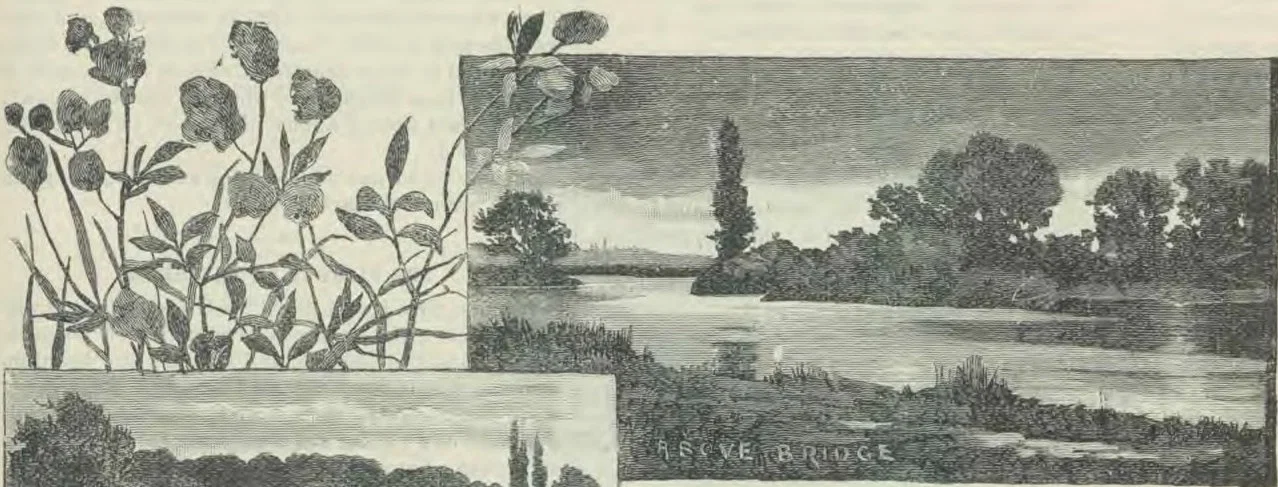
Oh to be idle one long day! Before the summer's over; When these great giants, gaunt and gray, Are green; when roundhead clover And purple thyme-tufts fill the air, And fields are gay with daisies; When, blushing, dies the hawthorn fair, Just as your poet praises.
When overhead the lark's far song, And thrushes in the hedgerows, And hidden linnets piping long Where rank the river sedge grows.
Oh! to be idle one sweet day, To muse in wood or meadow; Glide down this river, 'twixt the play Of sun and trembling shadow!
I'd see all wonders 'neath the stream, The pebbles and wet grasses; I'd lean across the boat and dream, As each scene slowly passes.
The tide should ripple welcomes low, And dance the kingcups bravely, And flags in purple stately bow, And nod the tall reeds gravely.
I'd rest an hour the willows by, And say a prayer in pity, For all who stifle, groan, and die This day in crowded city. —Selected.

A SHORT SERMON ON ETIQUETTE.

One hardly likes to say the word “etiquette” when the question is that of being kind and lovely in one’s own family. Yet if members of the same household used a little more ceremony toward each other, no harm would be done.
What true gentleman would treat his mother or his sisters with less courtesy than he would a chance acquaintance?
No one would greatly respect a boy whose custom it was to let his sister trot about on his errands—run upstairs for his handkerchief, fly hither and thither to bring his bat or his racket.
I well remember the surprise of a young lady, when, in a certain family, the brother sprang up to light the gas for his sister, and when the latter attempted to put some coal on the open fire, quickly took the hod from her hand, and did the work himself.
“You wouldn’t catch my brother being so polite to me!” she said.
“So much the more shame to your brother!” I thought.
Every boy ought surely to feel a certain care over his sister, even if she be older than he. As a rule, he is physically stronger, and consequently better able to bear the burdens of life than she.
There is nothing more charming than the chivalrous protection which some boys (bless them!) lavish on their fortunate “women folk.” And nothing is so attractive to other girls as to see a boy gentle and tender to his sister.
As for you, dear girls, you would never be so rude as to fail to acknowledge any courtesy which your brother paid you? If you would deem it extremely unlady-like not to thank any person who gave up his seat in the horse-car to you, or who helped you across an icy spot on the sidewalk, you would blush to be less grateful for a similar kindness on the part of your brother.
If he is ready to place a chair or to open a door for you, to make sure that you have an escort after dark, to take off his hat to you on the street, surely you are eager to please him. To sew on a stray button, or mend a rip in his gloves; to thank him for taking pains to call for you, and bring you home from a friend’s house; to bow as politely to him, and to accept him as a visitor with the same pleasant smile which you would have for some one else’s brother.
A boy should learn the habit of easy politeness in all circumstances, but if there be one place on earth where one should use freely his very best manners, it is in his own home.—Harper’s Young People.

A TOUCH OF NATURE.

A Boy ten years old or thereabouts, pulling a heavy cart loaded with pieces of boards and laths, taken from some demolished structure, was an every-day sight in one of our large cities.
One day, tired and exhausted, he halted under the shadow of a tree. His feet were sore and bruised; his clothes in rags; his face was pinched, and looking years older than it should. The boy lay down on the grass, and in five minutes was fast asleep. His bare feet just touched the curb-stone, and the old hat fell from his head, and rolled on to the walk.
In the shadow of the tree his face told a story that every passer-by could read. It told of scanty food, of nights when the body shivered with cold, of a home without sunshine, of a young life confronted by mocking shadows.
Then something curious happened. A laboring man—a queer old man, with a wood-saw on his arm—crossed the street, to rest a moment under the same shade. He glanced at the boy, and turned away; but his look was drawn again, and now he saw the picture and read the story.
He, too, knew what it was to shiver and hunger. He tiptoed along until he could bend over the boy, and then he took from his pocket a piece of bread and meat, the dinner he was to eat if he found work, and laid it down beside the lad. Then he walked carelessly away, looking back every moment, but keeping out of sight, as if he wanted to escape thanks for the deed he had done.
Men, women, and children had seen it all; and what a leveler it was! The human soul is ever kind and generous, but sometimes there is need of a key to open it.
A man walked down from his steps, and left a half-dollar beside the poor man's bread.
A woman came along, and left a good hat in place of the old one.
A child came with a pair of shoes, and a boy with a coat and vest.
Pedestrians halted and whispered, and dropped dimes and quarters beside the first silver piece.
The pinched face suddenly awoke, and he sprung up as if he thought it were a crime to sleep there.
He saw the bread, the clothing, the money, the score of people waiting around to see what he would do. He knew that he had slept, and he realized that all these things had come to him as he dreamed. Then what did he do? Why, he sat down, and covered his face with his hands, and sobbed. His heart was stirred by these manifestations of kindness as it never had been before; and when he went on his way, he was seized with a nobler impulse to be somebody in the world.
Oh, why do we not oftener bring sunshine and gladness to sorrowful hearts?—Sel.

“NOTHING TO LIVE FOR?”

NOTHING to live for? Soul, that cannot be, Though when hearts break, the world seems emptiness; But unto thee I bring, in thy distress, A message, born of love and sympathy, And may it prove, O soul, the golden key To all things beautiful and good, and bless Thy life, which looks to thee so comfortless! This is the word: “Some one hath need of thee.”
Some one—or who or where I do not know: Knowest thou not? Then seek! make no delay! And thou shalt find, in land of sun or snow, Who waits thee, young child or pilgrim gray; For, since God keeps thee in his world below, Some one hath need of thee, somewhere, to-day. —Emma C. Dowd.

COMPARING SCRIPTURE WITH SCRIPTURE.

There are many reasons why children should early learn to love God’s precious word. God has promised, “Those that seek me early shall find me,” and the good Book contains much especially for children. Shall I tell you where to find some of these passages?
First there are the words of the dear Jesus, addressed to the children. Matt. 19:13. Please take your Bible, and turn to them: “Then were brought unto him little children, that he should put his hands on them, and pray: and his disciples rebuked them. But Jesus said, Suffer little children, and forbid them not, to come unto me; for of such is the kingdom of heaven. And he laid his hands on them.”
Now if yours is a reference Bible, there is a very small letter “1” before and a little above the first word of verse thirteenth, and in the margin you will see the same small letter “1,” and after it, Mark 10:13. This is to show that Mark 10:13 has something on this same subject. Please turn to this passage, and read it carefully. It is a little more accurate than the account given by Matthew; for it says (verse 16), “And he took them up in his arms, put his hands upon them, and blessed them.”
Just before verse 13 there is a small letter “g” referring to the margin. There, after a reference to the passage we have read in Matthew, is another, referring to Luke 18:15. Please turn to it, and read Luke’s account of our Saviour’s words to the children. In these three passages we have read all that is recorded in the Bible about this act of the Lord Jesus.
This is called comparing scripture with scripture, and its use is to find just what the Bible says on any given subject. I think, children, if you will try in this way to study God’s Word, and will always ask him to help you understand, you will become much interested, and will soon learn to love the good Book and its teachings, and will at length become truly God’s dear children and heirs of the kingdom of heaven.
MRS. A. W. HEALD.

THE PILOT IS AT THE HELM.

The first time I went down the Hudson River, I was a very little girl, but I remember with how much interest I watched the new and strange and beautiful scenes through which we were passing. After going down into the cabin for a time, I came on deck while the boat was among the highlands; and I saw that we were in what appeared to be a lake, surrounded by high hills, before, behind, on either side; and so far as I could see, there was no way out.
I ran to my father, and cried out,—
“Father, father, what shall we do? There is no way for the boat to get out.”
He smiled, and said, “You cannot see it, my daughter, but there is a way out. Do not be afraid; the pilot has been here before; he knows the way, and will steer the boat safely.”
Oh, how many times through life have those words returned to me! When hemmed in by difficulties on every side, and there seemed “no way out,”—“Do not be afraid, my daughter; the Pilot has been here before,” came in tones of love upon my ear.
Yes; the Saviour has the helm, and there is not a spot in life’s pathway but he has been over it; there is not a temptation but he knows all about it. He “was in all points tempted like as we are, yet without sin.”
And did you ever think, reader, of the childhood of Jesus?—that he was once a child? that he remembers how children feel, and how children suffer? that his heart has been grieved as only a child’s heart can be grieved? that he was tried by his companions, and tempted to do wrong?
Yes; whatever trials you may have, Jesus has been here before you; he knows all about it. He can steer your little vessel in the roughest sea.—Young Harper.

A CENTURY PLANT IN BLOOM.

IN Shaw's botanical gardens, St. Louis, Mo., may now be seen a rare sight,—something that has never been seen there before, although the garden has been kept up for many years. The proprietor, Mr. Henry Shaw, who is now more than eighty-nine years old, has spared neither money nor labor in collecting, arranging, and cultivating a very choice collection of trees and flowering plants.
The graceful, curving leaves of more than two score of the beautiful century plants adorn the grounds, but until now not one of them has deigned to lift its head, or attempt to add anything to the floral splendor by which they are surrounded.
The gate-keeper told me that the specimen now in bloom has been in the garden for thirty-five years, and is probably forty-five years old. It has recently pushed up from among its thick, narrow leaves a stiff green stalk about two and one-half inches in diameter at the base, without leaves, and about ten feet high. Branching out from about two feet of the upper portion of the stalk are sixteen bunches of light yellow flowers, which are a curiosity, not only for their rarity, but also for their beauty.
Wm. Evans.

ONE ROBIN REDBREAST.

How dared that little bird jump out of the nest? When its papa and mamma went away, didn’t they tell it to be sure to stay at home till they came back?
But this little robin redbreast had been taking lessons in flying; and that morning he had done so well that his mamma praised him, and said if he kept trying, he would soon fly as well as she.
That made little robin feel very proud; and when his papa and mamma had been gone a little while, he became tired of staying in the evergreen tree, and decided he would fly around a little, and by the time they came back, surprise them by flying higher than ever before.
To be sure, any child would have known that no smart thing he might do would please his papa and mamma so much as for him to do as they said; but this silly little bird did not seem to know that. At any rate, he was so foolish and naughty as to disobey and run away from home; or rather, he jumped away.
When he landed on the ground, he felt almost frightened at being all alone, with no one to tell him how to do; even his little brothers and sisters were still up in the nest.
Then something terrible happened! A little girl from a house near by came right toward him. She seemed very large to the tiny bird, and he was afraid of her. She came up near to the bird. She was very much pleased that she could get so close to it, but expected each moment that it would fly away.
Poor little robin! He would have been very glad to fly away; but he was so frightened that the best he could do was to hop along a little. How he did wish he had minded his papa and mamma!
But worse and worse things happened to him. He could hop fast enough to keep away from the little girl; but soon her papa noticed her tiptoeing about, and came to see what was the matter. She supposed that if she made a noise, the bird would fly away; so she only said to her papa, in a whisper, “Bird!”
He thought she would enjoy holding the robin redbreast in her hands a few minutes: so he went to catch it. Then it did fly a little, but alas! it stopped right above the cistern, and down, down it went, away into the water.
Poor birdie! and poor little girl! She had not thought of hurting it; she only meant to hold it a little while, and then let it go. She would not grieve its papa and mamma by stealing it away.
But now the poor little thing was in the cistern; and she expected it would drown. She felt very sorry, and wished she had not chased it.
Her papa got a pole, though, and put it into the cistern, and the birdie climbed on to the pole, and was drawn up. He had not sunk into the water, because his feathers kept him up.
Then the little girl took the wet robin in her hands, and wiped its feathers with her handkerchief, and petted and loved it for quite a time; but the poor bird was frightened all the time, and would have been very glad to be home in his nest again.
Pretty soon her mamma thought it would be best to put it on the tree, where its papa and mamma could find it. It could not fly now, with its wet feathers; and if she should put it on the ground, the cat might catch it. So her papa put it into the tree, as near to the nest as he could reach.
And now, sometimes, that little girl sees a bird hopping about under the evergreen, and wonders if it is the same birdie; but I do not think it is, because that poor little robin had such a hard time when it ran away that it will not want to go again for a long while, unless its papa and mamma are with it.
MRS. ADA D. WELLMAN.

A QUEER FOUNTAIN.

Some people who go to Europe write about the palaces, and the grand people that live in them; but I think I enjoyed seeing the children of those far countries better than any thing else; and I would rather have the love of a child than the love of a king.
I was in St. Petersburg last year. That is a long name; but it is the name of a great city, the capital of Russia, one of the largest and most powerful countries in the world. In front of my hotel in St. Petersburg was a large public garden, and in the afternoons I used to walk through it to watch the crowds of children at play.
In one part of this garden was a little shed, with trees all about it; and I used to see many children go to the door of it, and buy glasses of something to drink. One day I said to myself, “I will go and see what it is that these children get to drink at that old shed.” So I walked up to the door; and what do you suppose I saw?
Was it a soda fountain?—No. Was it a great bowl of lemonade?—No. Was it a spruce-beer fountain?—Oh, no indeed! It was something much better than any of these. There was a cow in the shed, with a woman in charge of her; and when the children came for a drink, the woman would sell them a glass of milk, drawn fresh from the fountain in the cow’s bag.
I drank a glass of it myself, for which I paid five kreutzers, or about three cents; and I thought, “How nice it would be for the children in New York, if there were a cow-fountain in Central Park! and how nice it would be for the children in Boston, and Chicago, and other large cities, if they could get pure milk in the parks when they go to play in them!”—The Nursery.

"FIGS FROM THISTLES."

I've lately been doing some thinking— Turning things round in my mind; There are lots of things to think of, When once you get at it, I find. I've never been much of a thinker, But what can a fellow do Who's stuck a rusty nail in his foot, And vacation not half through?
There are some of the Bible verses That sound at the first real queer, But when you just work them over, The queerness will disappear.
Now 'bout "gathering figs from thistles," "'T has a curious kind of a sound: But I've been thinking it over, And the meaning is plain, I've found.
I don't know as I can tell it, But it means that a thing won't grow On or from something that's different— The Lord has made it so.
You can't get plums from a peach-tree, And a kitten will grow to a cat; A puppy will surely be a dog, And nobody wonders at that.
If we plant in the spring the grain of corn, We know that it won't grow wheat, And you can't, from the stalk of a rose-bush, Expect something good to eat.
And so I carry it farther, And surely I can see, That an idle, useless, troublesome boy Won't grow to the man for me.
"Whatsoever we sow, that shall we reap, Is only saying the same: If I sow "wild oats" in my springtime I can only harvest shame.
I've got to be first a splendid boy— From good boys grow such men; It just as surely follows, As the sun will rise again.
—Emily Baker Smith.

The Mind as a Garden: Planting in Youth

THE mind is a garden, and youth's sunny morn the season for planting.

THE UMBRELLA BIRD.

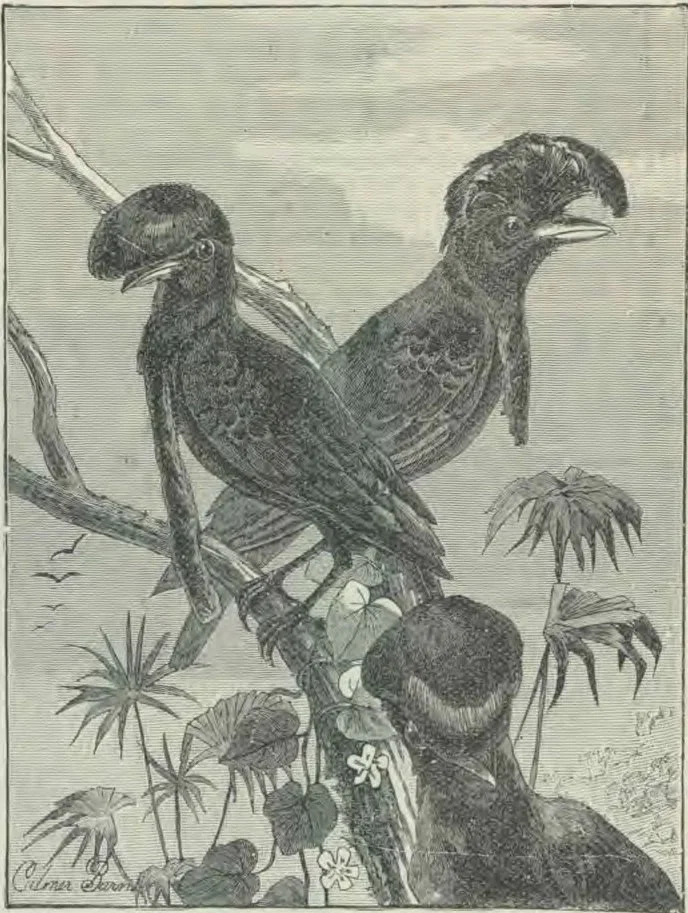
Do you think he carries an umbrella, this bird from Australia, because he is called so? Oh, no! But he does carry over his head a sort of helmet of feathers, which answers for one. It is more than two inches in length when it is spread.
These pretty, hairy plumes, curved gracefully at the end, cover the head of this pretty bird all over, even going beyond the beak. Each one stands out, just as you have often seen the downy seeds of the dandelion.
This curious bird is as black as a raven in body. The edges of the wings are tipped with a glossy hue. He is only the size of the jay, but his wonderful crest makes him unlike any other bird, big or little.
“Shouldn’t you think any bird might be proud of such a royal covering?” And yet the umbrella bird has another gift, in a sort of fan on his breast. A large, hanging tassel of feathers grows from a sort of quill of flesh. When this is spread, it is just like a fan, and covers the whole front of his body.
Did you ever hear of a bird before that carries a fan and umbrella all ready made for use?
These birds are seldom seen, because they live on the highest branches of the fruit trees where they get their living. But their cry is often heard. It has so deep a sound that the Indians call them “Trumpet Birds.”—Mrs. G. Hall.

THE LITTLE PREACHERS.

“You always remember the text, Uncle Charlie,” said Harry. “I don't see how you do it. I try, and try, and say it over and over; but when I get home, it has gone.”
“I can remember most always,” said Julia, “but Harry is so little; when he can read in the Bible, he will remember better. I think the text is just the easiest part to remember. I don't always know what the minister says in the sermon—except some ministers,” added Julia. “The one that preached last Sabbath was real easy all through.”
“That was the best sermon I ever heard,” said Master Harry. “I think he is just the greatest preacher that ever lived. I know his text; it was, ‘God is love.’”
“Some texts are easier to remember than others,” said Uncle Charlie, “because we understand them better. Then there are some texts you can see, and these are the easiest to remember of all.”
“How can you see a text, Uncle Charlie?” cried both the children at once.
“I will show you one,” he answered, “which was preached upon by the greatest of all preachers eighteen hundred years ago, in a land far away from this.”
“It must have been Jesus,” said Julia softly; “but I did not know that he preached sermons with texts to them, like the ministers.”
“Look around you now, Julia,” said her uncle, “and tell me if you do not see the text of one of our Saviour's sermons.”
They were in the garden, and close by them was a lovely bed of lilies in full bloom. The spikes were bending over, laden with pure blossoms. Uncle Charlie raised one of the drooping sprays, and pointed to the velvety petals and the rich yellow stamens within.
“O, I remember,” said Julia, looking up into his face. “Jesus said, ‘Consider the lilies of the field.’ Was that a text? I never thought of that.”
“The lily was a text,” said her uncle. “Now think what the sermon was. Even the little children around understood.”
Julia thought a moment, and then repeated: “They toil not, neither do they spin; yet I say unto you, that even Solomon in all his glory was not arrayed like one of these. ‘If God so clothe the grass of the field, which to-day is, and to-morrow is cast into the oven, shall he not much more clothe you, O ye of little faith?’”
“That was a very short sermon, uncle,” said Harry; “anybody could remember that.”
“It was a very long sermon to come from one text, Harry; for the lilies have been preaching it ever since. All these hundreds of years the lilies—white, red, and yellow—have been calling upon us to consider their beauty, and remember how God cares for them, and how much more he cares for us. Every time one of God's children sees a lily, he has before his eye the same text from which Jesus taught that beautiful lesson, and his heart must go up in love and trustfulness to him.”
“I like the lilies better than ever, Uncle Charlie,” said Julia. “It is nice to think that Jesus loved to look at them, and that he should make them a text for a sermon.”
“He told us to consider them—to think about them, and admire their beauty; and then, when our hearts were full of their loveliness, to remember that they were made by the hand of our Father. Is it not pleasant to say, ‘My Father made them all?’”
Sweet lily of the field, by thee This lesson I am taught:— “God cares for little flowers like me; Take, then, no anxious thought.” —Selected.

CLEANING DAY.

Hear those earth-folks there complain 'Bout the gray clouds and the rain; We should think they would have seen That we're making the world clean. We have got to bathe the ground, Wash the flowers, and sprinkle round All the grasses. Course we're gray; Can't wear white on cleaning day. —Julia M. Lippmann.
Continue reading: SMALL DUTIES