Pacific Press Publishing Company · New York · Jun 6, 1895
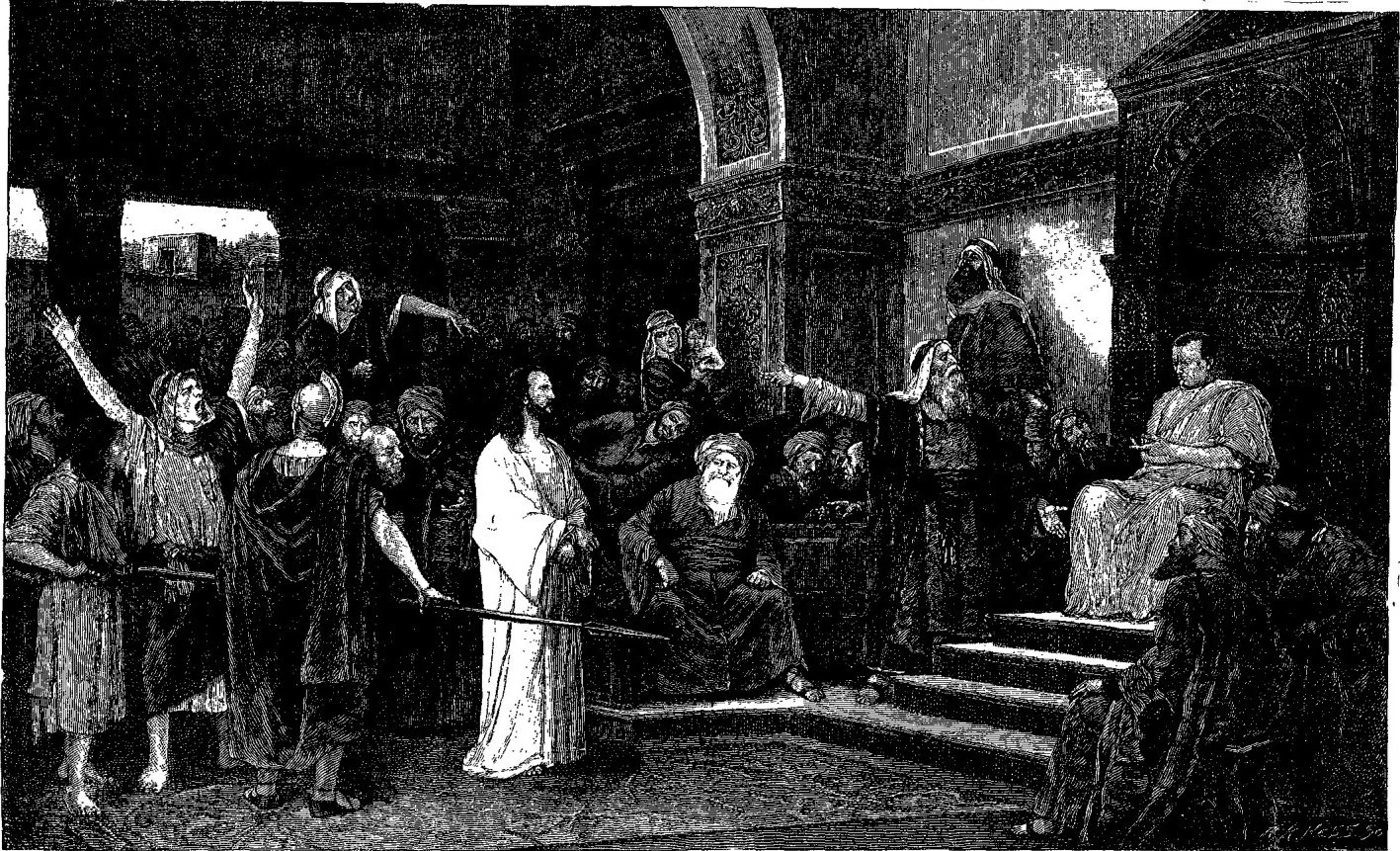
“WHY, WHAT EVIL HATH HE DONE?”
“We have a law, and by that law he ought to die,” has always been regarded by bigots, whose creeds were crystallized into civil law, as an all-sufficient reason for demanding the death of the dissenter.
The question, “Why, what evil hath he done?” is answered with the cold, cruel statement from the law-favored priests, “We have a law, and by that law he ought to die.”
The answer of Justice, “I find no fault in him,” only enrages the accusers to answer the more vehemently, “We have a law, and by that law he ought to die.” “If thou let this man go, thou art not Cæsar’s friend.”
Men of all creeds now look back upon the scene, which is the subject of our illustration, and condemn the demand of the Jewish leaders for the life of a faultless man. They condemn the time-serving Pilate for yielding to their haughty threats. Yet while this is true there are many of these who, while cursing those who crucified Christ under the guise of loyalty to law, are to-day repeating in principle the same sin against God and man.
On May 15, J. Q. Allison, a Seventh-day Adventist, of Georgia, was sentenced by the Circuit Court of Douglas County, Ga., to pay costs amounting to $22.05, or in default of payment, to serve twelve months in the chain-gang.
What was his crime? Let the report of the court stenographer answer: “State vs. J. Q. Allison. Misdemeanor—Sabbath-breaking.”
The specific act here designated as “Sabbath-breaking” is thus described by one of the State’s witnesses:—
Question. About how much did he appear to plow that [Sunday] morning?
Answer. I suppose nothing hardly but a small garden spot, not more than that.
Q. That was about a quarter from the big road?
A. It was a little over a quarter from the nearest big road from there.
Q. Was it in sight?
A. No, sir; a man could not see him from where I was at, unless he went to him.
It was for this Sunday-Sabbath-breaking, for this invasion(?) of the natural rights of mankind that Mr. Allison was sentenced, in default of the payment of costs, to twelve months in the chain-gang.
And now, to ascertain officially what Mr. Allison was not sentenced to twelve months in the chain-gang for, we quote again from the official report of the trial; this time from Mr. Allison’s cross-examination of one of the State’s witnesses:—
Mr. Allison. Have you [Mr. Strickland] worked near my house on the seventh day? . . . Haven’t you worked close to my house on the seventh day?
Ans. Yes, sir.
Q. Have I ever found any fault with you about that?
A. If you have, I have not heard of it; you have never bothered me.
Q. I have never complained of your disturbing me?
A. No, sir; you never have at all; I say that.
Q. You know of my ever disturbing you or anyone else?
A. No, sir.
The Court. You are not on trial for disturbing anybody else.
Here we have it announced from the bench2that Mr. Allison was not sentenced to the chain-gang for injuring his neighbors; no, not even for disturbing them.
Since he had not injured any one, either in reputation, person, or property, what had he done so heinous as to take him from his family and business and consign him as a felon to twelve months’ chain-gang labor with the vilest of malefactors? “Why, what evil hath he done?”
In reply to this grave question, let the words of the presiding judge be submitted as they appear in the official record of the trial:—
The Court. . . . The trouble is this, that if you are allowed to do this—I understand you are a good man your neighbors say you are, there is nothing in the world against you—but if you are allowed to do this, bad men would claim the same privilege, and desecrate what the great majority of people consider the Sabbath; but outside of any reason for it, that is the law.
In this single sentence we have combined the admission of innocence, the secret reason for condemnation, and the retreat behind the law, which characterized the trial and condemnation of the Son of God.
The secret reason given by the rulers for desiring the death of Christ, was: “If we let this man thus alone, all men will believe on him; and the Romans shall come and take away both our place and nation.” John 11:48. Thus it is seen that the secret reason for his death was that they could not sustain their creed against the teaching and example of his life. So in this case it is admitted in an unguarded moment that Mr. Allison’s irreproachable life will teach other men the truth that the State-enforced Sabbath is not the Sabbath of the Bible, contrary to the belief of “the great majority of the people.” But immediately perceiving that this “reason” betrayed the ecclesiastical nature of the law and its administration, the court hastens to take shelter behind the law, thus: “Outside of any reason for it, that is the law.” “We have a law, and by that law he ought to die.”
Let those who condemn the rulers of Israel for demanding the life of an innocent man, because “we have a law,” explain why they can to-day condemn an innocent man to the chain-gang because they are the “great majority” and “have a law” which makes it possible.
A strange feature of all these cases is that the accusers, and in some instances, State officials, look upon the conscience of a Seventh-day Adventist as a kind of weather vane to be shifted to accord with every human ordinance. Do they think that faithfulness to conscience has perished from the earth, that God has abdicated the throne in favor of human law?
It is passing strange that they do not shrink from the awful responsibility of attempting to crush a dissenting minority. Do they not dread to add to that torrent of tears, that ocean of anguish, represented in the Apocalyptic vision as pouring into the ear of Omnipotence, with the eloquent voice of woe, that imploring question, “How long, O Lord, holy and true, dost thou not judge and avenge our blood on them that dwell on the earth?” Rev. 6:10.
Should Seventh-day Adventists weary of courts, fines, confiscation of goods, imprisonments and chain-gangs,—should they yield to the demand that they treat the Sunday-Sabbath, which they for sufficient reasons regard as the mark or badge of papal apostasy, with the same outward regard which they pay to the Sabbath of the Lord, the sign of the true God; will the representatives of these persecuting States appear in judgment with the statement that since they declared Sunday to be the Sabbath of the Lord and compelled the Seventh-day Adventists to observe it, therefore they demand in the name of the commonwealth that the condemned be pronounced guiltless?
At that great and final judgment there will be no foreign minister to unfurl his country’s flag over the violator of heaven’s law, and demand and enforce protection in the name of his government. States may secure for their citizens safe conducts through a country with which they have diplomatic relations, but not through the country of the “King of kings.” Yet, in the face of all this, man, mortal man, whose life is as a vapor that appeareth for a little time and then vanisheth away; this puny man that must himself stand at the bar of God and answer for his own acts, this same man will presume to interpret the Word of God and force his fellow-mortals to accept of his interpretation, or suffer in prisons and chain-gangs. Could anything be more presumptuous?
Ye rulers of States and of nations,
Who trace with a fallible pen
“Infallible” creed-born statutes
To fetter the conscience of men;
Whose laws conflict with Jehovah’s,
And brand on the brow or the hand
A counterfeit seal of that statute
Proclaimed from the mountain-top grand;
If we sever our sign of allegiance
To the King of kings on high,
If we’ll wear thy sign of rebellion,
And our Maker and Saviour deny;
If we yield to thy chain-gangs and prisons,
If we bow to thy cruel decree,
If we take our allegiance from heaven
And join it forever to thee;
Wilt thou promise to meet us in judgment,
When the Court is in session on high,
And enforce the decision thou’st rendered,
And the judgments of heaven defy?
Wilt thou hoist o’er the shelterless sinner
Thy glorious banner of State
And demand the verdict “not guilty,”
In the name of thy commonwealth great?
Wilt thou rally thy minions to battle,
And march on the City of Light,
Whence angels excelling in power
Were hurled to the regions of night?
Wilt thou compass the City Eternal,
Its towers and battlements raze,
And train thy batteries brazen
On the throne of the Ancient of Days?
Canst thou brook His glory consuming,
Or challenge the bolts of His wrath,
And drag Him, a trophy adorning
Thy chariot’s conquering path?
Canst thou fetter the feet of Jehovah
And chain him with breakers of stone?
Will Omnipotence bow to your statute,—
Surrender His right to the throne?
Dost thou shrink from a contest so awful,
And tremble at thought of His might;
Wouldst thou hide ’neath the rock and the
mountain
Away from his presence so bright?
Then ask not of subjects who serve Him
With love that scorns at the grave,
To violate laws of His kingdom,
And trust in your power to save.
PATERNALISM.
By Editor
A PROPOSED ordinance has been presented in the Chicago Council forbidding female persons “to ride or attempt to ride any bicycle or tricycle or to publicly promenade in the streets, avenues, or public highways of said city while dressed or arrayed in costumes commonly known as bloomers, knickerbocker, baseball attire, or trousers.”
The reasons given in the preamble for the passage of the ordinance, are:—
WHEREAS, this craze [for wearing bloomers] has assumed such proportions that it menaces the public morals of this good city; and WHEREAS it is unhealthy, un-American, and unlady-like to appear in such costumes.
We are not so much concerned about this so-called bloomer “craze” as we are with the craze among would-be statesmen to make of the State a kind of foster mother, whose business it is to feed, clothe and catechise its citizens. There was a time in the history of England when the government prescribed certain apparel for its citizens on the ground of protecting their health, but we supposed we had outlived such paternalism. But it seems that in this matter we were mistaken, for one branch of the Minnesota Legislature actually passed a bill compelling men to act patriotically on Memorial Day. But a law forbidding women to wear bloomers on sanitary grounds, and a law enforcing patriotism are less unreasonable than is a law compelling all citizens to act piously on Sunday. The first two are unreasonable and un-American, the last is not only unreasonable and un-American, but positively unchristian.
WHAT IS ROME'S SYSTEM?
By Editor
The Monitor took upon itself the task of defining in what the ritual of the sect to which the AMERICAN SENTINEL belongs, was “summed up.” We replied, showing that we have no ritual at all, and also showing the distinction between Christianity and ritualism, which is simply the difference between Christianity and Catholicism. In this we said that “the whole Roman Catholic system is only one of forms, of ceremony, of ritual. In that system all such things are used as means—as ‘means of grace’—with the hope of thereby obtaining Christ. Rome’s is a system of salvation—justification—by works.”
Upon this the Monitor says:—
To which we reply that the SENTINEL knows nothing—absolutely nothing about Rome’s system.
How does the Monitor know this? How is it that the Monitor knew so much about the “ritual” of the SENTINEL as to be able to sum it up in a single sentence? How is it that the Monitor knows anything at all about the SENTINEL or its “ritual”? Perhaps the Monitor will say that it has read and studied the subject. Very good. But is it a fact already decided by the Monitor that the editors of the SENTINEL cannot—absolutely cannot read or study at all? If the Monitor admits that the editors of the SENTINEL can read and study, then in that it certainly admits that our means of knowing about Rome’s system is precisely as good as is that of the editor of the Monitor to know about the “ritual” or anything else pertaining to the SENTINEL.
This is remarked, however, merely in passing. The material point of the Monitor’s reply is as to whether in the Catholic system, forms and ceremonies—ritual—are “means of grace.” This the Monitor vigorously denies in these words:—
We do not look upon forms or ceremonies or ritual as means of grace. There is only one source of grace and that is Jesus Christ. There is only one giver of grace and that is Jesus Christ. Now, as Christ is the dispenser of grace, can’t he dispense it as he wills and how he wills? If he will have it flow through certain channels, who is Alonzo T. Jones that he will say nay to Omnipotence? If Christ’s virtue went out through the hem of his garment, what is to prevent it from going out through the waters of baptism? And if Catholics believe that the employment of baptism is the way appointed by the Lord for the conferring of regeneration—the way by which—not the water, not the form, but—Christ himself confers regeneration, what right has the AMERICAN SENTINEL to accuse us of barren ritualism?
This would-be denial is a full confession of all that the SENTINEL charged. We never179said nor intended to say that in the Catholic system any forms or ceremonies were looked upon as sources of grace, nor as givers of grace. What we said is, that these things are looked upon and “used as means—‘means of grace’—with the hope of thereby obtaining Christ.” That is what we said; and what we meant in that expression is precisely what the Monitor says that Catholics believe, namely: that these forms are channels through which they hope to obtain the grace of Christ. We used the word “means” in no other sense than “channel.” And the clause which said that these forms are “used as means—‘means of grace’—with the hope of thereby obtaining Christ,” would express our thought exactly if it said that these forms are used as channels through which the grace of Christ is expected to be obtained.
In that article we said in so many words that “the form of baptism, the form of the eucharist, etc., are employed in the Catholic system as ‘means of grace.’” In the attempt to deny this the Monitor says that the grace of Christ “flows through certain channels,” and that “Catholics believe that the employment of baptism is the way appointed by the Lord for the conferring of regeneration—the way by which Christ himself confers regeneration.”
Now, if there be anybody who, after reading our statement and the Monitor’s denial, cannot see that the Monitor says just what we said—who cannot see that the SENTINEL’s word, “means,” and the Monitor’s words, “is the way,” “the way by which,” and “channels,” say the same thing,—then let such an one read these definitions:—
“MEANS: That through which, or by the help of which, an end is attained; something tending to an object desired; intermediate agency or measure.”
“CHANNEL: That through which anything passes; means of passing, conveying, or transmitting.”
Thus it is as clear as anything needs to be that the Monitor’s would-be denial is nothing else than a confession of all that we charged upon the Catholic system as to ritualism.
In closing we cannot do better than to write again what we first said—February 14, 1895—on this subject, and write it now in the Monitor’s own words on the subject. As so written it runs thus: He who has Christ has the very life and substance of all the forms of service and of worship which he has appointed. Then these cease to be mere ceremonies or rites, and become the expression of the living presence and power of Christ himself in the life of the believer. This is the end of ritualism, of ceremonialism; the end of a form of godliness without the power; the end of any employment of the form of baptism, or the form of the eucharist, etc., as “means of grace,” as “channels through which grace flows,” as “the way in which Christ confers regeneration” or any other grace, as these are employed in the Catholic system.
“The law came by Moses, but the reality and the grace came by Jesus Christ.” John 1:17 (Syriac). Now, the whole Roman Catholic system is only one of forms, of ceremony, of ritual. In that system all such things as baptism, the eucharist, etc., are used as means with the hope of thereby obtaining Christ; that is, as “means of grace,” “channels through which,” “the way by which,” the grace of Christ is conferred and obtained; whereas with us any such things are used altogether as the expression of the grace, the presence and the power of Christ, which we already have, by faith. Rome’s is a system of salvation—justification—by works; while ours is the divine truth of salvation—justification—by faith.
That is what we said February 14, 1895, to the Monitor on this point, only with the Monitor’s would-be denial inserted. And thereby it is made as plain as A B C that by the Monitor’s own words Rome’s system is exactly what we said it is.
THE ONTARIO LORD'S DAY ALLIANCE.
By Eugene Leland
BY EUGENE LELAND.
THIS organization was formed early in the spring of the present year for the purpose of promoting the observance of the “Lord’s day” in the Province of Ontario. The means which it proposes to adopt in order to meet the purpose of its organization have been so well stated in an article signed by the president and secretary of the association, and published in the Toronto Star, of April 8, that I shall not be charged with misrepresentation if I take the work of the Alliance to be just what it is there stated to be, especially as the object of the article referred to was to correct some misrepresentations concerning it. It says:—
The Alliance is formed, not for the purpose of advancing any particular religious view respecting the nature and obligation of the Sabbath, but for the purpose of protecting the individual God-given right of every one to rest and worship on the Lord’s day.
This is the only passage in the article which I shall take the time to notice. The “nature” of the Sabbath, respecting which the Alliance purposes to take no particular religious view, is rest; and as to its “obligation,” we find that it is simply a requirement of God to do on the Sabbath what its nature demands, and that is rest. So far, then, as the “nature and obligation of the Sabbath” are concerned, we find simply rest, and religious rest at that; for the “obligation” is to “keep it holy.” If it is not kept holy, it is not kept at all; and therefore the only “view” which can be taken “respecting the nature and obligation of the Sabbath,” is a religious view. It is impossible to take any other view of it. To view the Sabbath from a secular standpoint, or to speak of it as being a “civil” institution, is as absurd in principle as it would be to speak of the Queen’s birthday, or of any other national holiday, as being sacred or religious in character.
The Sabbath is called in the Bible “My holy day,” “The Lord’s day.” It is a sacred, not a secular, day; and the only “view” of the Sabbath which can possibly be advanced that will cause the people to “honor it,” is the religious view. But “it is not the purpose of the Alliance to advance any particular religious view respecting the nature and obligation of the Sabbath.” Officially, and publicly, the Alliance announces to the world its purpose to disregard the only view of the Sabbath that can truthfully be taken, and to treat the sacred institution of the Lord’s day from a secular point of view. It announces its purpose to use the power of civil law to compel men who are Sabbath-breakers to act as if they were Sabbath-keepers.
But if a man has the God-given right to rest and worship on the Lord’s day, does it follow that he must be compelled to exercise that right? Isn’t it possible for him to exercise that right without the protection of civil law? Every one in the world has the God-given right to breathe, to sleep, to eat; but does he need the power of civil law to assist him in the exercise of these rights? If so, in what way? The answer comes: The law protects him in his right to breathe by prohibiting any unwholesome business locating in his vicinity, such as a slaughter-house or a tannery. It protects his right to eat by forbidding the sale of decayed or adulterated foods, such as would produce disease; and it protects his right to sleep by prohibiting boisterous or unbecoming conduct which would disturb his sleep. But does it protect a man in his God-given right to breathe, to eat, or to sleep, by compelling every one else to do these things in the same way?
And so it is of rest and worship on the Lord’s day. Does it protect a man in his right to rest and worship on the Lord’s day by compelling every other man to rest and worship on that day? The man who has the desire and the disposition to rest and worship on the Lord’s day can do so whether any other man on the face of the earth does or not. It is not necessary that every other man, nor any other man should be compelled to rest and worship on the Lord’s day simply because I want to rest and worship on that day. It is an act of arbitrary power, of usurpation, of tyranny, to compel one man to perform an act of religious worship because some other man, or some association of men, wishes to worship in that manner.
And that we have not misrepresented the work of the Alliance will be plainly seen by reading the quotation from their official announcement as given above. The object of the Alliance is thus stated: “The Alliance is formed . . . for the purpose of protecting the individual, God-given right of every one to rest and worship on the Lord’s day. The legislature does not create this right, but recognizes and safe-guards it.” That is a very worthy object, if by the protection, recognition, and safe-guardianship, is meant simply the protection of the individual from injury and incivility which is afforded by the governmental power on the Lord’s day the same as on other days of the week, and no more so; but that is not what the Alliance means. It means by “protection,” the power which the State exercises to compel the individual to observe the Lord’s day. But such protection and safe-guardianship does not protect the individual in any right, but it does protect the day.
The person who is thus under the guardianship of the governmental power “rests,” and perhaps(?) “worships” on the Lord’s day, not because he has a God-given right to do so, but because he is compelled to do so; not because God commands him to observe the day, but because the State requires it; not because he loves God, but because he fears man; and it is time that people should know that such rest and worship is sheer hypocrisy!
“The individual, God-given right to rest and worship on the Lord’s day,” or on any other day, can have no existence without the existence at the same time of the individual, and equally God-given, right not to rest and worship, if the individual does not choose to do either. What kind of a right, forsooth, is it which one is compelled to exercise? Does the man who is drafted into the army, or who pays his taxes, exercise any right in doing either? A right can have no existence where there is not a freedom of choice. The volunteer exercises a right when he joins the army, because he has the freedom to choose whether he will go or stay at home; but the man who is drafted into the army exercises no right when he goes, because he has no choice in the180matter; he must go. The volunteer may go. In the observance of religious practices,—in the service of God,—volunteers are wanted, not conscripts. “Whosoever will” may come.
But carry this point further. The government exercises a right when it demands the payment of taxes from the individual, but the individual does not exercise a right when he pays them; and for the very simple reason, if for no other, that he has no right to refuse to pay them. He must pay them. The same reasoning is true with reference to the observance of the Lord’s day. If the governmental power has a right to demand Sabbath observance of the individual, then the individual has no right to refuse to render it, and therefore he has no “individual, God-given right to rest and worship on the Lord’s day.”
But, on the other hand, if the individual has a God-given right to rest and worship on the Lord’s day, as he has, and as the officers of the Alliance admit, then the governmental power has no right to demand either rest or worship from him. The government has no right to exercise any power which has not been delegated to it by the people; and the right to rest and worship on the Lord’s day can never be delegated by the individual to the government.
Rights are of two kinds, natural and artificial. Natural rights are such as are possessed by every one in the world without distinction as to age or sex, race or creed. They are inherent in the individual alone, and consequently cannot be delegated to another. With such rights no government can justly have anything to do, further than to protect the individual in his exercise of them. One of these rights is “the individual, God-given right to rest and worship on the Lord’s day.”
Artificial rights are such as are created by the government. If there were no such thing as government, these rights would not exist. Such rights are possessed only by the favored few. As for instance, the right to vote is granted only to males who have attained to the age of twenty-one years. The right of the government to demand taxes of the individual is another example of artificial rights; but it is a just claim, for the State is supposed to render an equivalent to the individual for them in the protection of person and property. He has the right to demand the services of the police force, or of the entire fire department of the city for his protection, if need be, and they have no right to refuse the demand, because his taxes have been paid for that very purpose. In the payment of his taxes, he exercises no right, but in the demand for their equivalent, he does. A right is a just claim, but there can be no just claim where an equivalent is not rendered.
Now, if the government has a right to demand Lord’s day observance of the individual, he has no right to refuse to render it, but he has a right to demand an equivalent. But this can never be given, and therefore the government, in demanding Lord’s day observance, is demanding something for nothing. The government does not exercise a right in this demand, but it does perform an act of usurpation of the individual’s right. It is simply an act of tyranny on the part of those who demand it, and an act of slavery on the part of those who render such Lord’s day observance.
The man who observes the Lord’s day because it is right, needs no law to compel him to do it; and the man who observes it simply because he is afraid that some one will lay violent hands on him if he doesn’t do it, is in servile bondage to just that extent. What he needs is to have more love preached to him and less law, for “love is the fulfilling of the law,” and “by the deeds of the law there shall no flesh be justified in his sight.”
173 Dundas St., Toronto, Ont.
RELIGIOUS PERSECUTION IN AMERICA.
*[From Die Rundschau (Chicago), May 22.]*
Die Rundschau deems it her duty to again call public attention to the persecution of Adventists for violating Sunday laws. Recently we were informed of a new case of this character. This time a Sabbatarian, by name, J. Q. Allison, of Douglasville, Georgia, is the victim. A telegram of the 16th inst. briefly, yet with terrible distinctness, announces: “ALLISON IN THE CHAIN-GANG!”
The Sunday law of Georgia—entire and verbatim before us—does not essentially differ from those of other States. It prohibits every kind of Sunday labor, with the exception of works of necessity and charity. No exceptions are made in favor of Sabbatarians. But peculiar to it is the penalty against violators. Anyone convicted of Sabbath desecration, “shall be punished as prescribed in Section 4310 of this Code.” And what does this section prescribe?—A fine not to exceed one thousand dollars, imprisonment not to exceed six months, work in the chain-gang not to exceed twelve months; and, forsooth, any one of these penalties separately or more of them combined, in the discretion of the judge. Consequently there might have been imposed on the ill-fated Allison by an ill-disposed judge the whole of this barbarous penalty. It has been his good fortune, however, to have had enforced upon him only(!) the penalty, “to work in the chain-gang on the public works, or on such other works as the county authorities may employ the chain-gang.” The “county authorities” have also the right to “hire out” a member of the chain-gang to some private contractor, manifestly to the highest bidder. Allison might, too, under certain circumstances come into the position of being compelled to do servile labor for a private individual. Thus does Section 4582 of the glorious Code of the State of Georgia prescribe.
But what if Allison, after having been sentenced to compulsory labor for Sabbath desecration, were to refuse to do work on Saturday? It is very probable that such a case will come to pass; because Allison is an Adventist who believes the seventh day of the week to be the divinely enjoined day of rest upon which no secular labor may be performed. His conscience is bound to this alleged divine injunction, and experience teaches that Sabbatarians will rather suffer the worst than wantonly act contrary to their conscience. Then what will be the consequence? The State of Georgia has in its wisdom also provided for such a case. Then Mr. Allison would be guilty of the crime of “insurrection,” as may be read in Section 4821. And if convicted of this crime, that is, if he be convicted before the supreme court of his county of having, as a member of the chain-gang, obstinately refused to obey orders by not doing convict labor on Saturday, then,—listen and marvel!—shall he “BE DEEMED GUILTY OF A CAPITAL OFFENSE, AND PUNISHED WITH DEATH, OR SUCH OTHER PUNISHMENT AS THE JUDGE IN HIS DISCRETION MAY INFLICT.” Then he is, consequently, guilty of a capital offense; then he is, consequently, altogether exposed to the clemency or inclemency of the county judge; then this judge may in his discretion SENTENCE HIM TO DEATH!!
Presumably our readers know that Georgia belongs to the United States of America. Here, too, old and young sing:—
My country ’tis of thee,
Sweet land of liberty!
A precious liberty, forsooth! Let everyone clearly put before his mind the case under discussion. A citizen of this country, whose Constitution warrants and guarantees him perfect religious liberty, conscientiously believes he must perform the duties of his daily occupation on Sunday. It is not the province of the State to investigate if he has an erring conscience; for the State has nothing whatever to do with the conscience of its citizens. What Allison conscientiously did and for which the State tried him, is not at all a crime against the body and life of his fellow-citizens; by his Sunday work he did not at all encroach upon the equal rights of his fellow-men, so that it became the duty of the State to protect these against him. Notwithstanding he was deprived of that religious liberty and liberty of conscience which is guaranteed to him as well as to all. For what is religious liberty? According to the perfectly correct definition of the sainted Dr. Walther, this:—
It is the liberty the State grants to its citizens to privately and publicly EXERCISE WITHOUT RESTRAINT the religion each one conscientiously believes to be true and to publicly declare and defend its principles. In such a country, therefore, religious liberty exists, in which there be not one or more religious faiths that be exclusively tolerated therein and recognized as State religions and one of which all those must, therefore, profess who wish to enjoy the protection of the State, but in which every one is entitled to the rights and privileges of a citizen whatever may be the religion he professes.
But just this religious liberty, one of the brightest stars in the banner of our country, is, as much as is in their power to do so, manifestly destroyed by the Sunday laws of most States, and especially by the Sunday law of Georgia.
The State of Georgia demands of one of its citizens whose faith prohibits Saturday labor and enjoins Sunday labor to slight his conscience and unconditionally submit to the religious convictions of the majority of his fellow-citizens concerning the Sabbath. Now because he does not submit—and he may not submit even though his be an erring conscience—he is indicted, sentenced to disgraceful convict labor, stamped a disreputable criminal,—possibly, too, an insurgent and rebel, guilty of death and his neck forfeited to the rope of the hangman.
Ought not the entire liberty-loving press of the country to denounce the savagery of Georgia and take an energetic stand against the tyrannical, murderous, puritanical Sunday laws, the existence and occasional enforcement of which bring shame and ignominy upon our whole country, in which at one time religious liberty and liberty of conscience were made the fundamental law of the States?
And so much more, for the reason that just in the course of the previous week the General Assembly of Presbyterians assembled in Pittsburg passed the liberty-hating resolution: “WE HEARTILY COMMEND ALL SUNDAY LEGISLATION DESIGNED TO PROTECT THE CHRISTIAN SABBATH AS A DAY OF REST AND WORSHIP.”
From all of which every one may perceive: the enemies of the true liberty of our country are powerfully bestirring and preparing themselves to battle against the greatest treasure of our nation. Their battle cry is, Union of religion and State. They possess influence, and “their followers do fall in line with5them.” For God’s sake, let us not be inactive, but let us make preparations for the battle. The most precious liberty of our country is at stake!