The Youth’s Instructor, Vol. 38, No. 36.

THE TITMOUSE FAMILY

The Youth’s Instructor

Sep 3, 1890

S. D. A. Publishing Association · Battle Creek, Mich. · Sep 3, 1890

THE TITMOUSE FAMILY.
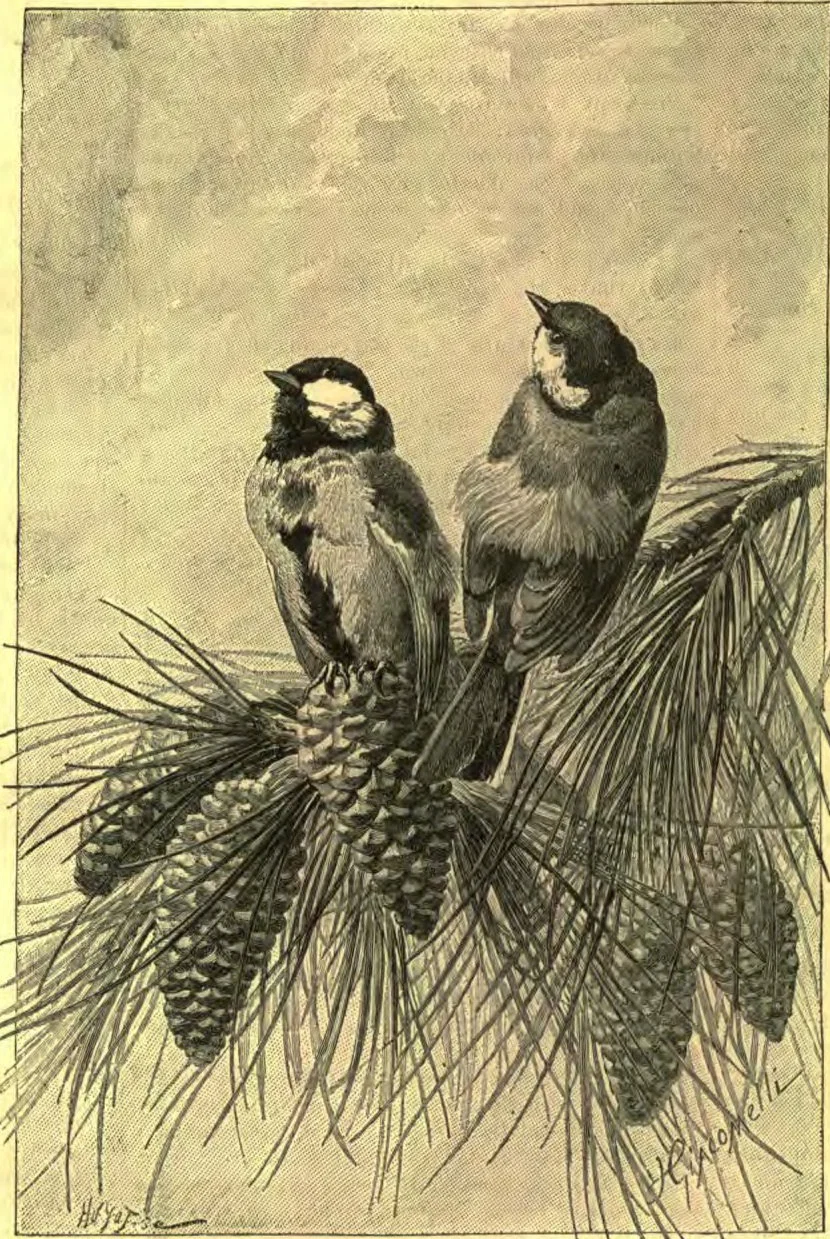
During the first rainy days of October, when windows however yet remained open, I could hear the low warbling of the titmice in the pines and firs of the garden. They had come there in troops ever since the last of September, and they were actively engaged in picking spindle-trees, yews, and larches. Ever alert, they flutter about from one group of trees to another, skipping on the branches, turning the leaves, climbing along the bark, suspending themselves with their back downwards, so as to be able to pick more easily the crevices in the bark, where they know that worms and insects hide their chrysalis.
All these titmice differ in color, size, and general appearance; still they offer certain general characteristics which do not allow us to have the slightest doubt about their common parentage. They all have a short, cone-shaped bill, which is slightly flattened on the sides, and covered up to the nostrils with feathers which bristle easily, and give an impertinent expression to their countenance. All titmice have very robust muscles in the neck; their skull is very thick; they also have much strength in the muscles of their feet and toes; this explains the suppleness and agility of their wonderful gymnastic feats, when they destroy caterpillars on the branches, pick hard seeds, and pierce the shell of hazelnuts. It has even been said that they take advantage of the sharpness of their bill, which can be compared to a blade of steel, in order to pierce the skulls of small birds when they find them dead or weakened by illness, so as to feast on their brains. Ordinarily, however, titmice are satisfied with more innocent food; they live chiefly on caterpillars, the eggs of butterflies, and also on hazelnuts, beech-nuts walnuts, and in general on all kinds of oil-seed.
During the fine season they live in the depths of hilly woods; but as soon as the first cold sets in, and the first snow falls on the mountains, they draw nearer inhabited regions. Nearly all titmice are remarkable for their talent in nest-building, which is truly extraordinary in such small birds. They employ in the construction of their nest choice materials, such as small blades of grass, flexible roots, soft, silky moss, bits of wool, feathers, and vegetable down, and they use their bill in a most skillful manner for interweaving, rounding off, smoothing, and shaping these materials so various in texture and form.
Titmice are all very prolific. Their family instinct is also very much developed. Both males and females display untiring zeal in feeding their large family, and unequaled energy in defending it against the attacks of owls and other rapacious birds. In the main, the disposition of titmice is naturally violent, daring, and warlike.
Their fondness for live flesh has often been cast at them as a reproach,—live flesh which they tear with their nails, just like the shrike and the raven; but one is apt to forget that their small body is only a bundle of muscles and nerves, and needs very substantial food to resist the wear and tear of life. Why do we not cast the same reproach at that beautiful singer, the nightingale, which also lives on quivering flesh? Titmice are very sociable. Whether they have a taste for society, or whether the sense of their weakness makes them congregate together, is more than we can say; but sure it is that they are fond of their equals, and take their flight in larger or smaller troops. When perchance some accident has separated them, they quickly utter their call, and are promptly reunited.
While I was meditating on the faults and qualities of titmice, I happened to be an eye-witness to a sample of those beautiful relations which are established among the different members of the family. In the pines and firs, in the hawthorne and barberry bushes already stripped of their leaves, which I could see from my window, all the different species of titmice were represented, seeming to live in perfect harmony. They formed various groups, all very busy and very restless.
There was the great black-headed titmouse, easily recognized by its square build, its black hood, and black breast-plate. When the weather is unsettled, and it is going to rain, it utters a cry which is like the grinding of a file on a piece of iron. But generally it has a pleasing warble. It builds its nest in the holes of walls, in the trunks of trees, sometimes also in coal-sheds, abandoned by coal-burners.
Besides the great black-headed titmouse, the blue titmouse is very busy, the prettiest, the boldest, the bravest of the family. It is a lovely bird, with its delicate head covered by a blue hood, its bluish wings, its white cheeks, and its dark blue collar. This bird is the most terrible destroyer of caterpillars. It has been calculated that it eats daily half an ounce of the eggs of butterflies.
Then comes the ash-colored titmouse, or nun, which stores away seeds in its hole, and makes war on wasps. Then the great titmouse, which weaves its mossy nest in a marvelous manner, and suspends it on the boughs of trees, just like the gold-hammer. Lastly, the long-tailed titmouse, with its rapid, elegant flight, which can only be compared to the shooting of an arrow.
All these minute folks were hopping, skipping, and springing about, and warbling peacefully in the green boughs. Suddenly the whole troop took wing with a startled cry; at the same time the report of a gun was heard. I recognized there one of those characteristic traits of man, that mild and benevolent animal who is so very much shocked at the ferocity of titmice. Fortunately these birdlings are wise and experienced; they had foreseen the shot, and had taken wing in time.—From Song Birds and Seasons, by Andre Theuriet.

THE LAMP AND THE LIGHT-HOUSE.

A Scotch fisherman, while out one night in his smack, was overtaken in a terrible storm. He could not tell where he was or how to find his way to the landing-place. At length his son caught sight of a small light, glimmering through the wild darkness. He set sail toward the light, and soon found himself right before his own cottage, which stood on a cliff above the sea.
When he got home, he found that his little boy had set the lamp in an upper window, by whose light both father and brother had been saved from shipwreck.
Every stormy night afterward that same lamp was set in the window to guide other fishermen who might be caught out in the thick darkness. By and by it was determined to build a light-house on the cliff. But the big, blazing burner grew out of the little boy's lamp.
A poor child in Philadelphia, the daughter of a very poor widow, died a year or two ago. During her long sickness her heart was full of peace and the sweet love of the Saviour.
Just before she died, she put into the hands of her minister a small paper box that had contained some of her medicine. In the box were fifty three-cent pieces which she had been saving up for a long time, and she had earned each piece by hard work. She said to her minister,—
“After I am dead, I want you to take this money and build with it a church for the poor people in this neighborhood.”
The minister could not keep back his tears as the box was given to him; and I could not either, when I saw it last summer.
The minister took the box of coins, and showed it to a rich lumber merchant, who had never cared anything about religion. The merchant at once offered to give lumber for building the church. Other people who saw the box, and heard its touching history, gave money, and very soon the pretty mission church will be finished. The poor Christian child's lamp will grow into a large light-house to guide many souls to heaven.
No person can tell how much good may come from loving, yet apparently insignificant acts. The lamp they light, even if it is small, may grow into a light-house, and shine long after they are dead.—Youth's Companion.

TREASURES

The fields are all sweet with the gifts of the Lord. And home from the meadow the children come Bringing,—oh, me! so withered and shrunk— Their treasures for dear ones that wait at home.
The lavender plumes of the wild vervain, The daisy calm, and the sunflower bright Were fresh in the dews of a happy morn, When the wee hands plucked them for our delight.
Are the treasures we bring to the Lord at eve All faded with sun-heat and fevered hands? We gathered them, childlike, with loving thoughts, And surely the All-Father understands!
—M. E. H. Everett.

PLUCK, THE BULGARIAN BOY.

Pluck was the son of a poor Bulgarian shepherd—not an American boy, as one would imagine from his name. I called him Pluck because it was so characteristic of the boy, and because I could not recall the Bulgarian name Dr. Hamlin gave him. A little hut in Bulgaria, made of mud and stones, was Pluck’s home, and his father was so poor that he could hardly get food enough for his large family. Their clothes cost little, as they all wore sheep-skins, made up with the wool outside. Just imagine how funny a flock of two-legged sheep would look! Pluck was a bright, ambitious boy, with a great desire for study. And, when he heard of Robert College, at Constantinople, he determined to go there. So he told his father one day, when they were away together tending sheep, that he had decided to go to college. The poor shepherd looked at his son in amazement, and said,—
“You can’t go to college. It’s all I can do to feed you children. I can’t give you a piaster.”
“I don’t want a piaster,” Pluck replied, “but I do want to go to college.”
“Besides,” the shepherd continued, “you can’t go to college in sheep-skins.”
But Pluck had made up his mind; and he went—in sheep-skins and without a piaster. It was a weary march of 150 miles to Constantinople, but the boy was willing to do anything for an education. He found kind friends all along the way, who gave him food and shelter at night. So Pluck trudged sturdily on day after day until he reached Constantinople. As he was not one to let the grass grow under his feet, he soon found his way to the college, went into the kitchen, and inquired for the president.
Pluck asked for work, but the president kindly told him there was none, and he must go away. “O, no,” Pluck said, “I can’t do that. I didn’t come here to go away.” When the president insisted, Pluck’s answer was the same, “I didn’t come here to go away.”
He had no idea of giving up. “The king of France, with forty thousand men, went marching up a hill, and so came down again;” but it was no part of Pluck’s plan to go marching home again. And three hours later the president saw him in the yard patiently waiting.
Some of the students advised Pluck to see Professor Long. “He knows all about you Bulgarian fellows.” The professor, like the president, said there was no work for him, and he had better go away. But Pluck bravely stuck to his text, “I didn’t come here to go away.”
The boy’s courage and perseverance pleased the professor so much that he urged the president to give Pluck a trial. So it was decided that he should take care of the fires. That meant carrying wood, and a great deal of it, up three or four flights of stairs, taking away the ashes, and keeping all the things neat and in order.
The president thought he would soon get tired of such hard work. But a boy who had walked 150 miles for the sake of an education, and was not ashamed to go to school in sheep-skin and without a piaster, would not be easily discouraged.
After a few days, as Pluck showed no signs of “weakening,” the president went to him, and said: “My poor boy, you cannot stay here this winter. This room is not comfortable, and I have no other to give you.”
“O, I’m perfectly satisfied,” Pluck replied. “It’s the best room I ever had in my life. I didn’t come here to go away.”
Evidently there was no getting rid of Pluck, and he was allowed to stay.
After he gained this point, he settled down to business, and asked some of the students to help him with his lessons in the evening. They formed a syndicate of six. That was good old Dr. Hamlin’s way—so none of the boys found it a burden to help Pluck one evening in a week. It was a success on both sides. The boys were patient and kind; and Pluck was painstaking and persevering in his lessons as in other things, so that he made great progress.
After some weeks he asked to be examined to enter the preparatory class.
“Do you expect,” asked the president, “to compete with those boys who have many weeks’ start of you? And,” he continued, “you can’t go to class in sheep-skins. All the boys would cry ‘baa.’”
“Yes, sir, I know,” Pluck said; “but the boys have promised to help me out. One will give me a coat, another a pair of trousers, and so on.”
Nothing could keep back a boy like that, who overcame all the obstacles in his way.
After the examination the president said to Professor Long:—
“Can that boy get into that class?”
“Yes,” was the reply; “but that class can’t get into that boy.”
It was not all plain sailing yet. Although Pluck had passed the examination, he had no money; and the rules of the college required each student to pay $200 a year. That was a question in mathematics that puzzled the good president.
“I wish,” said Professor Long, “that the college would hire Pluck to help me in the laboratory, and give him $100 a year. He has proved himself very deft and neat in helping me there, and it would give him much more time for other things.”
Pluck became the professor’s assistant, and was perfectly delighted with his good fortune. But where was the other $100 coming from?
President Washburn sent an account of Pluck’s poverty and great desire for an education to Dr. Hamlin, the ex-president of Robert College, who was in America. The doctor told the story to a friend one day, and she was so much interested that she said,—
“I would like to give the other $100.”
And that’s the way Pluck gained the wish of his heart.
He proved the truth of the old saying that “where there is a will, there is a way;” but his way was so hedged in that no boy without a strong will and great perseverance would have found it.
Of course such a boy would succeed. To-day Pluck is head-master of one of the schools in his own country.—Frank E. Loring, in Independent.

WHAT ARE THE STARS?

PART II.—THE PLANETS.

In our solar system the earth is about the average size of the planets which comprise it, and occupies an average, or relative position to the sun. It is not scorched by the heat of the sun, as it is assumed is Mercury, which lies very near to it, or chilled by distance, as Uranus and Neptune are thought to be. It is possible, however, that distance may have little influence in this respect, as will appear in the next article.
Astronomers have in all ages been extremely curious to learn the truth about our neighbor planets, Mars, Mercury, Jupiter, Saturn, and Venus. Do they have seasons as our earth does? Are there lakes, rivers, seas, oceans, and other familiar objects? Is there life upon them? is, perhaps, the all-absorbing question.
Little or nothing, however, can be discovered. By the aid of even the largest and most powerful telescopes, it would be impossible to discover moving objects, or habitations, or villages, or even great cities. It is only possible to detect huge masses, like continents or oceans, and environing clouds, if such exist.
The most tantalizing of all the planets in this respect is our “next-door neighbor,” Venus. She is so near, and so lovely and bright, one would fancy that from her proximity and brightness important discoveries would certainly be made; but the glorious splendor of the sunbeams in which she is clothed is the very thing that baffles astronomers in their efforts, the brilliant light making, in the telescope, a glare impossible to penetrate, and so little is known of this planet.
Mars often draws very near to the earth, and clouds have been distinctly seen covering it, while masses, believed to be oceans, have been detected on its surface. Enthusiastic astronomers have even drawn geographies of its surface. Bays, lakes, straits, and long, dark canals, connecting seas, are apparently shown. We may never know what is the real nature of these objects; but it is tolerably certain that, at the poles, water, changed to ice and snow, actually exist, and that, as the accumulation changes with the seasons, patches of what is presumed to be snow are left in summer on elevations believed to be mountains,—all of which goes to confirm the presence of seas and oceans. The atmosphere surrounding our earth is very dense, but that of Mars is so thin, and its few clouds so light, that it requires very delicate tests to discover them.
Jupiter is so completely swathed in a mass of dense clouds that are practically impenetrable, that little is known about it. These clouds make it appear larger than all the other planets combined. What its actual size is cannot be learned, but this much is known, that while its apparent diameter is twelve thousand times larger than our earth, the planet is only three hundred times heavier, its weight being not much greater than would be that of a globe of water of the same size; while our earth is five times as heavy as would be a globe of water of equal size. It is therefore inferred that Jupiter’s great bulk is due to environing clouds.
The discoveries made as to these two planets, Mars and Jupiter, seem to prove the existence of oceans and clouds in our sister planets, and so the question naturally arises, Are they inhabited? Man has been organized to exist in the special atmosphere surrounding the earth. Is there an equivalent for it around the other planets? The opinions respecting the possibility will be given in the next article.
W. S. C.

PRAYING AND WAITING.

“It's all clear to me now,” said Ruth Parker to Susie Dean. “I never could understand it before. Ever since I began to serve Jesus, I've been praying for different things, and I don't believe I've ever had one prayer answered.”
“Why, Ruth!” said Susie in surprise, “I'm sure Jesus hears me when I pray. He helps me every day.”
“What do you ask him for?” asked Ruth abruptly.
“To watch over me with his loving care, and to give me an unselfish heart; and for ever so many other things, just as I need them,” answered Susie in a low voice.
“I only pray at night,” said Ruth. “Then I ask for the things I want most, but as I do not receive them all, I was beginning to think it a mistake about Jesus hearing and answering our prayers, until to-day, in Sabbath-school, when our teacher made it all plain by telling us a story he had read.”
“What was the story?” asked Susie.
“It was about a poor man who had weak faith, and who thought prayer was of little use. After awhile he was taken to 'Redeemed Land,' and shown the Lord's treasure-house. There he saw, in the 'Missing Blessing Office,' many blessings marked for him, which he might have had, only his faith did not expect them, and his door was closed when they were brought.
“Then he was shown another store-house, called the 'Delayed Blessing Office,' full of good things for which those who were to receive them were not yet prepared, or which were not fully ripened for their best use. They were growing, and would be sent in good time.
“So you see,” said Ruth, brightly, “all the things that I've been praying for may be in the Lord's treasure-house, waiting for me to be prepared to receive them. I shall not doubt any longer, but keep the door of my heart open, ready to receive the blessings; and if they don't come at once, I shall only think they are ripening for me.”
“Ruth,” said Susie, tenderly and reverently, “let us always trust in God's love and his promises; for they will never fail us.”
“Yes, and serve him with thankful, happy hearts,” Ruth added, earnestly.—Selected.

Of Making Many Books: Reflections on Print Abundance

When Solomon wrote, “Of making many books there is no end,” his knowledge of literature was confined to cumbrous rolls of parchment or of papyrus. What would the wise king have said could he have foreseen book-making in these days of steam-presses which throw off from twenty to thirty thousand sheets an hour? Allibone’s “Dictionary of Authors” tells us that if a man were to read a hundred average pages a day, without missing a single day, it would require a life-time of sixty-five hundred years to read all the books published in the English language alone up to the year 1880.

Your Neighbor Is Anyone You Can Help

Your neighbor is any one to whom you can do good.

A GRIEVOUS COMPLAINT.

"It's hard on a fellow, I do declare!" Said Tommy one day with a pout; "In every one of the suits I wear, The pockets are most worn out. They're 'bout as big as the ear of a mole, And I never have more than three; And there's always coming a mean little hole That loses my knife for me.
"I can't make 'em hold but a few little things— Some cookies, an apple or two, A knife and pencil and bunch of strings, Some nails, and may be a screw, And marbles, of course, and a top and ball, And shells and pebbles and such, And some odds and ends—yes, honest, that's all! You can see for yourself 'tisn't much.
"I'd like a suit of some patent kind, With pockets made wide and long; Above and below, and before and behind, Sewed extra heavy and strong. I'd want about a dozen or so, All easy and quick to get at; And I should be perfectly happy, I know, With a handy rig like that!" —St. Nicholas.

PUSSY'S QUEER BABIES.

THIS story is as true as it is queer.
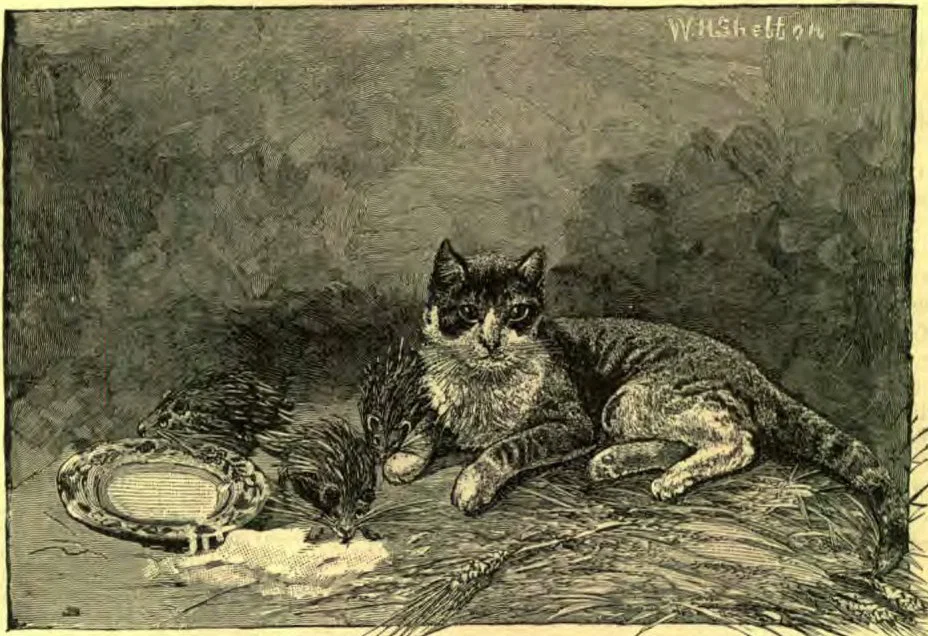
Poor pussy had lost her own kittens, and felt sorely troubled. When three foster-babies were brought to her, she welcomed them very kindly, and let them nestle in her soft fur. She fed and cared for them just as if they were kittens.
But they were not kittens at all. They were young porcupines. Did you ever see such creatures?
They look a little like pigs, and have sharp quills all over their backs. These they can keep laid down, and they usually do. But if they are frightened or angry, they bristle them out, and become a sort of live nettle. You can no more handle them than you can a nettle, without getting badly pricked or scratched.
Pussy seemed to enjoy her strange family while they were little, and they grew very fond of her. They followed her everywhere, and at night nestled by her side, and kept warm in her fur.
They played with one another and with mother-pussy. They would roll over her back, when she was trying to get a nap, and cuff her ears, pull her tail, and give her sharp little nips and bites, till poor pussy could bear it no longer.
Then she would get up, reach out her long, slender paw, and slap her naughty children.
But the moment her paw was raised, the piggies curled themselves into balls, and up came the sharp quills.
Pussy was apt to get the worst of it. She would shake her poor, smarting paw, and bound away, to find a corner where she could sleep in peace. But in a minute the three prickly balls were all unrolled, and dancing after her.
Poor pussy! her family drove her nearly distracted. It was very hard work to bring up these prickly piggies in the way that they should go.—Our Little Ones.

KITTY'S CRISS-CROSS DAY.

KITTY TILTON was having a pretty hard time of it, at least so she thought.
She always did have a hard time when things went any other than a certain way, and that way was Kitty Tilton's own way. Anything that went contrary to that was a very “criss-cross” affair, to her mind, and she generally spoke her mind loud enough for mamma and auntie to hear.
“I can't help it,” she said to mamma in a pouting tone; “this just seems to be one of my criss-cross days! Nothing has gone as I wanted it to, since I got up. The buttons weren't on the particular dress I wanted to wear, and Teddy had to come in for me to button his shoes, and that made me late for breakfast; and now it's do this errand, and miss going to school with Nellie, when I haven't missed a morning with her for two terms, and we did have something 'tickaler to talk about to-day; Nellie's going to s'prise her mamma on her birthday. I think it has been one of the hatefulest mornings, mamma; criss-cross, criss-cross all the time!” And Kitty was almost ready to burst into tears when she stopped.
“Mamma thought it a lovely morning, dear.”
“But you haven't had any criss-crosses, mamma.”
“I should be sorry if I had not, daughter.”
“Sorry? Why Mamma Tilton!”
“If I had no cross to bear, I should not be like my Master, or worthy to be called his follower.”
“O, but that isn't what I mean; not that kind, of course.”
“But I mean the same ones you do, Kitty—Christ-crosses, or as you call them, ‘chris-crosses.’ Suppose you make them Christ-crosses, Kitty, by bearing them for him, and see what a beautiful morning this will be.”
“But I never knew you could do that with such little things, mamma.”
“They are the very things, Kitty. Try it.”
And Kitty did, and found after that her “criss-cross” days were the happiest ones to think about afterward when she remembered to make the things distasteful to her “Christ-crosses.”—S. S. Advocate.

SOME SECRETS ABOUT AIR TRAVELERS.

“See that fine fellow? Away above your kite he goes, Fred. I wonder why that swallow doesn’t go up there? I wonder why all the little birds stay low, and all the big ones sail high? Are the little fellows afraid, do you think, Fred, like the little boys in swimming, who are afraid to go into deep water?”
“No, they are not afraid; little birds are bravest, at least some are. Haven’t I seen king-birds whip hawks? The big ones are stronger and have wider wings, that is why they can fly higher,” said Fred, with a very wise air.
“I believe they are some afraid, ’cause why can’t our old turkey fly higher, then? Don’t you think they are afraid, mamma?”
“Now you want me to decide which is right, I see. Neither of you have found out the whole. It is not the size of the bird or wing, or the amount of confidence it has in the air. I don’t believe birds ever think anything more about being in the air than men do about being on the ground, nor do they get dizzy, no matter how high they fly. The shape of the wing chiefly decides how high they fly.”
“But aren’t all bird’s wings shaped just alike, mamma? I thought they were.”
“That shows that you have not thought about it. See here; when you try to push my sunshade against the wind, which way does it go easier?”
“Why, it pulls hardest, because the wind gets in the hollow place.”
“Yes, it pushes more air ahead of it, or displaces more air that way. Well, the birds that soar high, have wings made very hollow, or concave, and as they have to displace, or push away so much more air, it makes it easy for the bird to keep up. That bird up above Bob’s kite is a vulture. He can sail for hours without flapping his wings.”
“But the swallow can beat him, mamma. I saw a race one day, and the swallow got away.”
“That is because the smaller bird has flat wings, narrow and sharp-pointed. He can work them faster. If you try to fan yourself with your hat, you cannot make as rapid strokes as with a flat fan.”
“But, mamma, some fans move quicker than others, I know.”},{
“Yes, because some are stiff, and bend. The stiff, flat fans are like the swallow’s wings; this pliant silk fan fringed with feathers is like the owl’s wings.”
“What is the name of that pretty fellow who wavers so—see him?”
“He’ll tell you his name when he gets where he is going; listen for it. The reason for his wavering is that he first closes his wings and then opens them—there!”
“Do you mean that pounding? O, I know, it’s a woodpecker.”
“Well, I can’t see yet why our old turkey can’t fly as well as any of them. His wings are hollow.”
“Yes, they are hollow, but not concave and long, like the eagle’s.”
“Then I can tell after this by their wings how high or how fast birds can fly.”—Youth’s World.
Continue reading: I PITY CAIN