Your ShelfYour Projects

The Youth’s Instructor, Vol. 31, No. 42.

MY LEGACY

The Youth’s Instructor

Oct 17, 1883

S. D. A. Publishing Association · Battle Creek, Mich. · Oct 17, 1883

MY LEGACY.
They told me I was heir: I turned in haste, And ran to seek my treasure, And wondered, as I ran, how it was placed,— If I should find a measure Of gold, or if the titles of fair lands And houses would be laid within my hands.
I journeyed many roads; I knocked at gates; I spoke to each wayfarer I met, and said, “A heritage awaits Me. Art not thou the bearer Of news,—some message sent to me whereby I learn which way my new possessions lie?”
Some asked me in; naught lay beyond their door; Some smiled, and would not tarry, But said that men were just behind who bore More gold than I could carry; And so the morn, the noon, the day, were spent, While empty-handed up and down I went.
At last one cried, whose face I could not see, As through the mists he hasted: “Poor child, what evil ones have hindered thee Till this whole day is wasted! Hath no man told thee that thou art joint heir With one named Christ, who waits the goods to share?”
The one named Christ I sought for many days In many places vainly; I heard men name his name in many ways; I saw his temples plainly; But they who named him most gave me no sign To find him by, or prove the heirship mine.
And when at last I stood before his face, I knew him by no token Save subtle air of joy which filled the place; Our greeting was not spoken; In solemn silence I received my share, Kneeling before my Brother and “joint heir.”
My share! The right like him to know all pain Which hearts are made for knowing; The right to find in loss the surest gain; To reap my joy from sowing In bitter tears; the right with him to keep A watch by day and night with all who weep.
My share! To-day men call it grief and death; I see the joy and life to-morrow; I thank my Father with my every breath For this sweet legacy of sorrow; And through my tears I call to each “joint heir” With Christ, “Make haste to ask him for thy share.”
—Helen Hunt Jackson.

EBAL AND GERIZIM.

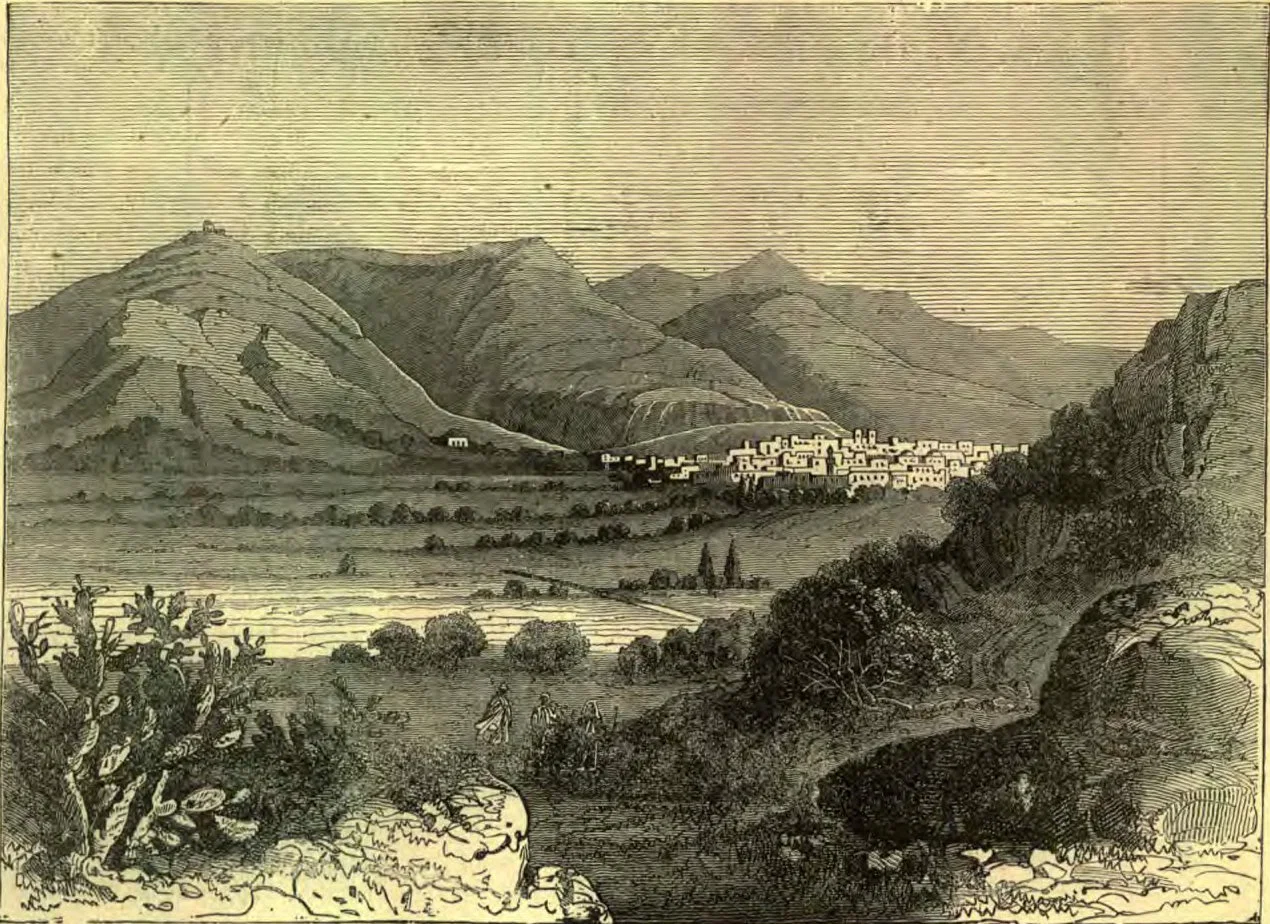
ABOUT thirty miles north from Jerusalem, the great road which you have traveled all the way makes a sudden turn to the left, and passes between two mountains,—Ebal on the north and Gerizim on the south. These two mountains stand on either side of the valley of Shechem, or Nablous,— the Shechem and Sychar of old,—beautiful with its streams of flowing water and gardens of olives and pomegranates, and fields of wheat and barley. It will be remembered that these mountains were pointed out by Moses, while the children of Israel still stood on the plains of Moab, as the place to which they were to come after conquering the land of Canaan, and pronounce the blessings and curses.
It is a well-known fact that the atmosphere of Syria and Palestine is so peculiarly clear as to make it possible for one to see a long distance; and objects that are really many miles away often appear to be within an hour's ride. So the following statement made by Mr. Prime, a traveler in the Holy Land, may not be improbable, and is certainly interesting. He says: “As we rode up the narrow pass between the mountains, we looked behind us; and there, right down the valley, which went sloping away thirty miles to the Jordan, lit in the red rays of the setting-sun, were the mountains of Moab and the summit of Pisgah. It was evident that the very words of the great lawgiver were accompanied by a gesture of his hand pointing to Ebal and Gerizim, at the head of that valley. I could then understand how he came to describe their situation so minutely, and to speak of them so familiarly.” Deut. 11:29.
It is interesting to notice how peculiarly fitted these mountains are for the purpose to which they were set apart by Moses. Travelers say that in the front of each mountain, where the valley narrows to the least width, is a recess, making a platform, natural indeed, but capable of holding a hundred thousand persons, as if arranged expressly for the scene of blessing and cursing which there took place. Says Dr. Fish: “Descending along the side of Gerizim, I saw just how the blessings and curses of old took place as described. Skeptics have asked, ‘How could the voices be heard from one mountain to the other?’—Easily enough. It was not on their tops, but on their sides, that the representatives of six tribes stood on Gerizim to bless, and those of the other six tribes on Ebal to curse, while the two millions of people below responded Amen. Half-way down Gerizim, Ebal seemed in our very faces. To descend and go up to the spot opposite would have been an hour’s hard work; but we could talk across from one mountain to the other, and be heard also in the valley below, which is here only about six hundred feet across, while where the village (Nablous) stands, it is fifteen hundred feet.”
It has often been said that Ebal, the mount of cursing, is entirely barren, while Gerizim, the mount of blessing, is extremely beautiful and fertile. There is, however, in truth no foundation for this statement. There is some vegetable growth on both, yet they are alike naked, as a rule, until we approach the base, where they are remarkably fertile.
The history of Ebal has nothing of special importance connected with it after the event referred to—the pronouncing of the blessings and curses; but on Gerizim for many years stood the temple of the Samaritans, who worshiped here instead of at Jerusalem. These people were descendants of the heathen colonists sent thither by the king of Assyria to inhabit the country after the captivity of the Israelites. They accepted some points of the Jewish religion, as, for instance, adopting the Pentateuch, or five books of Moses; but as we are told in 2 Kings 17: 33, “they feared the Lord, and served their own gods.” For this reason, the Jews, after their return from captivity, refused to let the Samaritans have any part with them in rebuilding the temple at Jerusalem. This led not only to the building of a rival temple on Mount Gerizim, but also to a bitterness of feeling between the two nations which never passed away.
A mere handful of these Samaritans, something less than two hundred, are now found at Nablous; and they are still looking for the Messiah to come and establish his throne on Mount Gerizim, and so reign over them. The five books of Moses compose their entire Scriptures. They reject all else as belonging to the hated Jews, and not really inspired. They have in Nablous a synagogue, which is decidedly more famous than elegant. Here is kept the venerable “Samaritan Pentateuch,” which they claim is the veritable copy of the five books of Moses, written by the grandson of Aaron. It is written on sheep-skin parchment, and is rolled upon two rods so as to present by unrolling the successive columns to the eye of the reader. Their scant treasury is not a little helped by the money which travelers pay for the privilege of seeing this relic.
E. B. G.

Perseverance in Well-Doing Unrewarded in This World

Our work may be unnoticed, unappreciated, unrewarded in this world; but He who remembers the cup of cold water, given in the disciple's name, will not forget us, if we persevere in well-doing to the end.

AUTUMN LEAVES

Written for the INSTRUCTOR.

AUTUMN LEAVES.

The fresh young leaves of spring are beautiful indeed. Their delicate texture and perfect outline are suggestive of youth and innocence. Coming, as they do, in the time of fragrant flowers and singing birds, they are closely linked with pleasant memories, and are the more charming because of these delightful associations.
All this delicate beauty, however, is eclipsed by the unparalleled splendor of the leaves of autumn. Their bewildering variety of color defies imitation. They seem to have accumulated a store of light and warmth for cloudy days and coming cold; to have caught the evanescent glory of the sunset, and transfixed it where the admiring eye may feast upon it for days together.
It has often been supposed that the rich coloring of autumn leaves is the effect of frost; but any one who will observe closely, may discover that the leaves take on the brightest hues in seasons when frost holds off the latest; and that many of them attain their highest glow, and even fall, before any frost appears. Bright clusters are sometimes seen even in June, but this premature ripening is caused by some blight or injury. Whole branches, however, often turn red about the middle of August. Thus early does autumn hang her blood-red banner out, and warn us of the approach of the frost-king, although, as yet, his steps are far.
Leaves, like fruit, take on the richest hues when they ripen under the most favorable circumstances, and nearly the same variety of coloring may be noticed in both.
It is quite possible that the autumn woods borrow some of their interest from being associated with ripe fruits and abundant harvests; yet in themselves they present a scene of almost unrivalled beauty. The side of a semicircular mountain rising gently from a sweet valley, and covered to the top with forest trees, partly arrayed in the garb of summer, and partly in the gorgeous robe of autumn, is an enchanting sight; and the more so when a clear lake at its base serves as a mirror to the flaming trees that overhang its crystal waters. While gazing at some of these miracles of nature, who has not thought of the bush of old, that burned, and yet was not consumed! Why does the Creator clothe the earth at times with such resplendent beauty, unless it is to give us a glimpse of the glories of heaven, and cultivate in us an appreciation of the things that will tend to make us happy in the world to come?
“Oh what a glory doth this world put on For him, who, with a fervent heart, goes forth Under the bright and glorious sky, and looks On duties well performed, and days well spent! For him the wind, ay, and the yellow leaves, Shall have a voice, and give him eloquent teachings.”
The effect of leaves in spring-tide may be more animating, but in autumn there is more of peace and quiet restfulness, mingled with a tinge of melancholy, that renders the impression more lasting, if not more delightful. But when the bright leaves, “like flakes of light,” have fallen to the ground, and been discolored by rain, or crisped by drought; when—
“Heaped in the hollows of the grove, the autumn leaves lie dead; And rustle to the eddying gust, and to the rabbit’s tread,”
we feel that indeed,—
“The melancholy days have come, the saddest of the year, Of wailing winds, and naked woods, and meadows brown and sere.”
But though dead, the leaves have still a mission of love, in making warm shelter for the tender plants that nestle beneath them, ready to shoot up and blossom at the first call from the welcome voice of spring. G. H. B.

THE SAFE GUIDE.

Perhaps some of our readers sometimes say, “What is the good of always telling us we must start on the road to heaven, we must follow the path of the kingdom? How can we find the way?” Well, I am going to tell you now of a guide for the journey. You know when people travel up the Swiss mountains, or through the deserts in the East, they need a guide; they do not know the way or the dangers, so they hire a man who does, to show them the way; and the more they trust him, the more fully they follow him. He has been over the whole way before, and so he knows how to guide the people through. Now the Lord Jesus is our guide. He says, “I will instruct thee, and teach thee in the way that thou shalt go. I will guide thee with mine eye.” Follow him in the way.

SUMMER CHANGES.

SANG the lily, and sang the rose, Out of the heart of my garden close, “O joy! O joy of the summer tide!” Sang the wind, as it moved above them, “Roses were sent for the sun to love them,— Dear little buds in the leaves that hide!”
Sang the trees, as they rustled together, “Oh, the joy of the summer weather! Roses and lilies, how do you fare?” Sang the red rose, and sang the white: “Glad we are of the sun’s large light, And the songs of birds that dart through the air.”
Lily and rose, and tall green tree, Swaying boughs where the bright birds nestle— Thrilled by music and thrilled by wings, How glad they were on that summer day! Little they thought of cold skies and gray, And the dreary dirge that a storm-wind sings.
Golden butterflies gleam in the sun, Laugh at the flowers, and kiss each one, And great bees come, with their sleepy tune, To sip their honey and circle round; And the flowers are lulled by that drowsy sound, And fall asleep in the heart of the moon.
A small white cloud in a sky of blue, Roses and lilies, what will they do? For a wind springs up and sings in the trees! Down comes the rain—the garden’s awake, Roses and lilies begin to quake, That were rocked to sleep by the gentle breeze.
Ah, roses and lilies! each delicate petal The wind and the rain with fear unsettle; This way and that way the tall trees sway. But the wind goes by, and the rain stops soon, And smiles again the face of the moon; And the flowers are glad in the sun’s warm ray.
Sing, my lilies, and sing, my roses, With never a dream that the summer closes; But the trees are old, and I fancy they tell, Each unto each, how the summer flies; They remember the last year’s wintry skies. But that summer returns the trees know well. —St. Nicholas.

TRUE MANLINESS.

EVERY young man considers it high praise to be called a “manly fellow;” and yet how many false ideas there are of manliness!
Physical strength is not the test. Samson was endowed with tremendous bodily powers. He was a grand specimen of humanity. See him rending the lion as he would a kid, or carrying away the gates of Gaza! But he was a weak creature after all, unable to resist the wiles of an artful woman.
Great intellect is not the test of true manhood. Some of the most intellectual men who have ever lived were not manly. Lord Francis Bacon was a prodigy of intellect. The sciences sat at his feet, extolling him as their benefactor; yet we see him led down Tower Hill, a prisoner, for swindling.
Some men think that to strut, and puff, and swear is to be manly. To some the essentials of manliness are to “toss off their glass like a man,” “spend money freely like a man,” “smoke like a man,” “drive a fast horse like a man,” forgetting that virtue is true manliness. Temperance, chastity, truthfulness, fortitude, and benevolence are the characteristics and essentials of manliness.
To be manly is to be honest, generous, brave, noble, and pure in speech and life. The highest form of manliness is godliness. Some one has said, “An honest man is the noblest work of God;” but the man who is honest toward God and toward his fellow-man—in short, a Christian man—is the noblest work of God.—J. B. Gough.

Principles Strengthened by Exercise, Habits by Indulgence

Every good principle is more strengthened by its exercise, and every bad habit is more strengthened by its indulgence.

THE NEW MICHIGAN CENTRAL BRIDGE OVER THE NIAGARA RIVER.
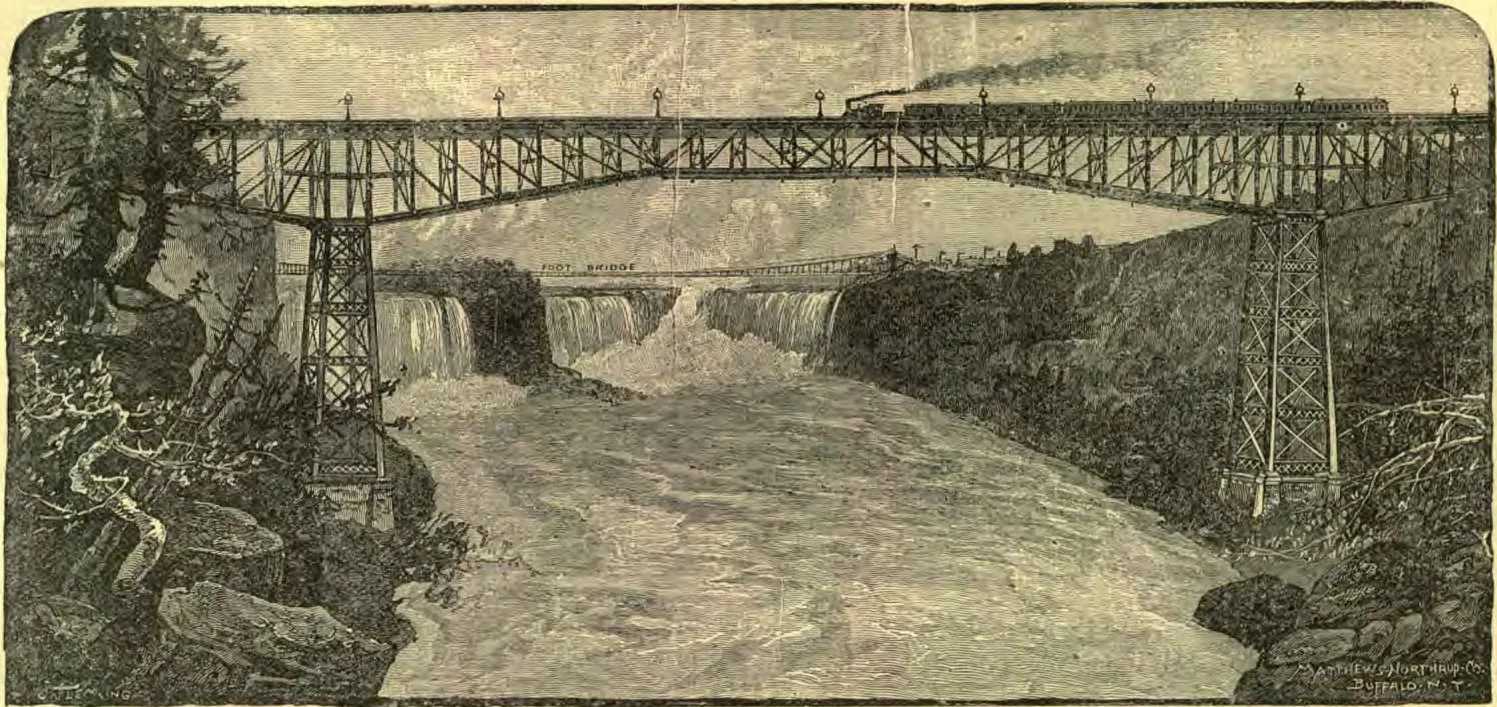
FEELING the need of an independent crossing of the Niagara River over which to handle their increasing traffic, the Michigan Central Railroad is now having built a new bridge across the river, which at the present time is occupying considerable attention, and is thought worthy of mention in the INSTRUCTOR. The accompanying cut indicates how the structure will appear when completed. The bridge is being erected at a point below Niagara Falls, and just at the head of the rapids, and will be 895 feet long; the track on the bridge will be 245 feet above the surface of the water. The Central Bridge Works of Buffalo were awarded the contract for building the entire structure April 11th, 1883, and they are to complete it ready for the passage of trains by December 1, 1883, under a forfeiture of $500 per day for each day's delay after that date.
The design selected is what is known as the canti-lever bridge, the principle of which is that of a trussed beam, supported at or near its center, with the arms extending each way, and one end anchored or counterweighted to provide for unequal loading. It is in practice an entirely new design, no bridge as yet having been completed upon this principle. The Firth of Forth bridge in Scotland, with a clear span of 1,600 feet, is being built upon this plan, and in this country the Fraser River bridge, 315 feet clear span, on the Canadian Pacific, is now being constructed on the same plan. These are the only examples of this design yet undertaken, but the principle especially recommends itself to long-span bridges, that must be erected without temporary scaffolding.
The bridge is to be a double-track steel bridge built to carry upon each track at the same time a freight train of the heaviest kind extending the entire length of the bridge, headed by two “consolidation” engines, and a side pressure of thirty pounds per square foot, which pressure is produced by a wind having a velocity of seventy-five miles per hour. Under the above loads, the structure is strained to only one-fifth of its ultimate strength. The bridge proper is divided into two canti-levers of 375 feet on the Canadian and 395 feet on the American side, supported on steel towers rising from the water's edge. A fixed span of 125 feet is suspended from and connects the river arms of canti-levers. The clear span across the river is 500 feet, being the longest double-track truss span ever yet built.
In the execution of this work no pains or expense will be spared to secure the best possible results in every department. The excavations are carried down until solid rock is reached, when blocks of “Biton Coignet” (an artificial stone) twenty feet wide and forty-five feet long and ten feet thick, will be put in. These form one single mass that will withstand a pressure almost equal to the best Quincy granite, and will so distribute the load of 1,600 tons that comes upon each pair of steel columns, that it will produce a pressure of but twenty-five pounds per square inch on the natural formation.
Upon these Biton blocks, four in number, is built masonry of the most substantial character, carried up fifty feet above the surface of the water. On these the steel towers rest, rising 130 feet above the masonry, and upon these is set the steel superstructure. The material for this was subjected to the most rigid inspection and tests, from the ore until it entered the completed structure.
So accurate is the design and workmanship that no two pieces are put together until placed in their final position in the bridge, yet every member must fill its place to the hundredth part of an inch. By the powerful machinery used here, the steel is cut, punched, bored, and planed with as much ease as though it were but pine. After it is completed, it is loaded on cars by aid of steam derricks—enabling three men to handle the heaviest pieces with perfect ease—and sent to location.
Written for the INSTRUCTOR.
For erection at the bridge site, temporary scaffoldings of timber, using some 600,000 feet of timber, will be built from the bluff on either side out to the edge of the water on a level with the top of the bluff. Upon these the shore arms of the canti-levers will be erected, one end resting on the steel towers, and the other upon masonry on the bluff. The shore end will be firmly anchored to this masonry, so that it will take an uplifting force of 400 tons at each end to displace it. This constitutes the counterweight to balance the unequal loading on the river arm referred to above. As this, under the most unfavorable conditions, can never equal 200 tons, the provision is ample.
After the structure is completed from the shore to the steel towers, comes the difficult portion of the work, i. e., to span the 500 feet across and 245 feet above a roaring river whose force no earthly power can stay. No temporary structure can survive a moment, and here the skill of the engineer comes in play. The design of the canti-lever is such that after the shore arm is completed and anchored as described above, the river arm may then be built out, one panel or section at a time, by means of great traveling derricks, and be self-sustaining as it progresses. After one panel of twenty-five feet is built and has its bracing adjusted, the traveling derrick is moved forward and another panel erected. Thus the work progresses, section by section, until the ends of the canti-lever are reached, when there still remains a gap of 125 feet to close. Into this will be swung, and suspended from the canti-lever arms, an ordinary truss bridge, forming the connecting link and completing the structure.
Expansion and contraction is provided for by an ingenious arrangement between the ends of the canti-lever and fixed span, allowing the ends to move freely as the temperature changes, but at the same time preserving perfect rigidity against side pressure from the wind. There will be no guys, or wire ropes, for this purpose, as in the suspension bridge, but the structure will be complete within itself. Neither will there be any of that wave motion noticed on a suspension bridge as a train moves over it. As it took over three years to build the present suspension bridge, which is for a single track, and this bridge, for a double track, must be finished within seven and a half months from the execution of the contract, some idea may be formed of the magnitude of the undertaking. The successful completion of the work within the specified time will reflect great credit upon the advancement of American engineering, and the ability and skill of the Central Bridge Works.

LIME MAKING

Written for the Instructor.

LIME MAKING.

PERHAPS all of you have seen lime, and many, no doubt, have seen the kilns in which it was burned. You also probably know that it is made of a whitish stone called limestone; but did you ever think of the labor it costs to convert this stone into lime? If not, let me tell you.
To give you a better idea of how it is made, I will first give you a description of the kiln in which it is manufactured. The kiln is composed of stones (usually granite), which are laid up in a cone-like shape, with a small opening in the top. The inside of this cone is then lined with fire-brick. When completed, the inside has the form of an egg. A small opening is then made in the side of the kiln near its base. Over this, and extending from six to eight feet into the kiln, a limestone arch is erected. This arch is for the purpose of protecting the fire, which is placed underneath. When this is completed, the kiln is ready to receive the limestone, which is usually dug from a quarry near by.
After being broken into small pieces so that it can be easily handled, the stone is taken to the top of the kiln, where it is thrown in on top of the arch. When the kiln is full, fire is placed through the opening in the side. This fire, which is usually kept burning from sixty to eighty hours, gradually changes the stone into lime. When the stone is sufficiently “cooked,” the fire is taken out, and the lime is allowed to cool, after which it is drawn to market, where it is disposed of for various purposes.
FRANK M. WILCOX.

Gather Sunshine Instead of Clouds

GATHER sunshine about you instead of clouds.

NEW-TESTAMENT HISTORY.

LESSON 157.—REVIEW.

1. What places did Paul visit on his first tour of preaching? Acts 13; 14.
2. Where did he suffer persecutions, and what were they?
3. At which of these places is he supposed to have raised up churches?
4. How was a question raised concerning circumcision? Chapter 15.
5. How was it settled?
6. Who accompanied Paul on his second tour? Acts 15:40; 16:1–3.
7. What parts did they visit in Asia Minor? Verses 4–8.
8. How did they come to go over into Macedonia? Verses 9, 10.
9. Where were they imprisoned? Verses 12–24.
10. How did they escape? Verses 25–39.
11. Give a brief account of their labors at Thessalonica and Berea. Chapter 17.
12. Where did Paul make a remarkable speech in Athens? Verses 19–22.
13. What were some of the chief points in that discourse? Verses 22–31.
14. How was Paul encouraged to continue his work in Corinth, through manifold persecutions? Chapter 18:9–11.
15. Tell how some of those persecutions came to naught? Verses 12–17.
16. What intimate friends accompanied Paul to Ephesus? Verses 18, 19.
17. Why did Paul make his first stay at Ephesus so brief? Acts 18:20, 21.
18. What tour did he make after leaving Jerusalem? Verse 23.
19. Describe the visit of Apollos to Ephesus. Verses 24–28.
20. What good work did Paul do for the believers at Ephesus, when he came among them? Chapter 19:1–7.
21. How did Paul then spend about three months in Ephesus?
22. What opportunity for teaching did Paul find after he had been driven from the synagogue? Verse 9.
23. How long did he teach at this time in Ephesus and its vicinity?
24. What wonderful miracles bore witness that God was with him? Verses 11, 12.
25. Give the experience of certain bad men who tried to cast out devils in the name of Jesus. Verses 13–16.
26. How did many of the Ephesians show that they were sincere in turning away from their errors? Verses 17–19.
27. To what church did Paul write letters, while he was preaching and suffering severe persecutions at Corinth?
28. What prompted him to write them?
29. How had he become quite well acquainted with their condition and wants? 1 Thess. 3:2, 6.
30. For what things did he praise them? 1 Thess. 1:3, 6–10; 2:13.
31. How did he call their attention to the labors of himself and Silas among them? Chapter 2:1–12.
32. What did he say of their patient endurance under affliction, and of the people who were chiefly instrumental in persecuting the followers of Jesus? Verses 14–16.
33. What did he say of his regard for the disciples at Thessalonica? Verses 17–20.
34. What did he say about Timothy’s visit to them? Chapter 3:1–6.
35. How did he express his satisfaction at Timothy’s report concerning them? Verses 7–13.
36. How did he exhort them to honesty, brotherly love, and industry? Chapter 4:6–12.
37. What error in belief had led them to neglect labor, and become slack in business?
38. How did he correct their errors concerning the resurrection? Verses 13–18.
39. Why does he call them children of the light, and children of the day? Chapter 5:5.
40. What obligation is brought upon them by being thus enlightened? Verses 6, 8.
41. With what earnest admonitions and kind wishes does he then close this letter?
42. What seems to have called forth Paul’s second letter to the Thessalonians?
43. How does the first part of this second letter resemble the first part of the former letter?
44. In which does he praise them most heartily?
45. Which letter contains the most fearful denunciations of wrath against their wicked persecutors?
46. Which has the most encouraging promises?
47. Which contains the strongest expressions of love and tenderness?
48. Which contains the strongest reproof for the erring?
49. On what points did he give them special instruction in each letter? 1 Thess. 4:9–18; 2 Thess. 2:1–12; 3:6–15.
50. What mighty system of error was to arise before they could look for the coming of their Lord?
51. How was it to be destroyed?
52. What course did he recommend toward those who should persist in disobedience?
Continue reading: SABBATH-SCHOOL COLLECTIONS: ARE THEY WRONG?