THE path of Life, beginning at the gateway of Birth, passes through the sunny meadow land of Childhood, and also through a strange, mysterious country, called the Land of the Teens, before reaching the Heights of Maturity. It is peculiarly a mysterious land, in that the inhabitants are neither children nor adults, and yet, with the inexperience of children, they have many of the desires and emotions of grown-up people; and this constitutes an element of great danger. Another source of danger is the fact that adequate guidance is not always given to children in this transition period, or, if proffered, is proudly rejected by those who think that being in their "teens" makes them "wise above that which is written."
When we visit foreign lands, we are grateful for guidance and direction, especially if we are not acquainted with the language; and if we do not hire a guide, we at least buy a guidebook. It seems to me, then, that we ought not to rebel against guides into and through the Land of the Teens, realizing that one who has traveled through a country can point out beauties and warn against dangers which would not be recognized by the inexperienced traveler who is without guidance.
We can visit England, Italy, or Germany many times, and at each journey can profit by former experiences, but we pass through the Land of the Teens but once, and the lessons we learn in that journey we can only utilize for the benefit of others. This is why many people on the Heights of Maturity are anxious to light a beacon for those who are still in their "teens." It is because they873would gladly help others to shun the bypaths where they met disaster, and also because they have learned the very solemn truth that in youth one is determining what maturity shall be. The seeds sown in the sunny meadows of Childhood and the broader fields of the Land of the Teens are harvested in maturity, and the harvest is always greater than the seed sown. The petulance and pouting of the child hardens into the gruffness, bad temper, and moroseness of the man. The idleness and shirking of the youth become the shiftlessness and unreliability of the adult. The boy's neglect of duty and unwearied search for pleasure is harvested in dissipation and ruin in mature life. It is, then, a very serious thing to be passing through one's "teens;" and the wise youth will welcome any guide who will show him a safe path.
Let us pause a moment on the border of the land and survey its topography. We see that it is a rolling country, rising gradually into the rougher Heights of Maturity. It is a land of singing birds and fragrant flowers, and even its deadliest things wear an outward aspect of beauty. Its rough paths are often the safest, while some that look bright and sunny are full of danger. There are pleasant, open meadows presided over by Hygeia, the goddess of health, and there are plains that to the eye are just as fair, but which are full of pitfalls to catch the unwary, and Disease and Ruin are lurking there. It is quite evident that a guide may be of advantage. May I claim the privilege of acting for a little time in that capacity?
The King of this land has made laws for its government, and Wisdom has builded paths wherein one may walk in safety. The laws made by the King are not harsh and cruel, but are beneficent; and he denies no real good. He says to the traveler: "You belong to me, and I am desirous of your highest good; therefore obey me and you shall be rewarded. Disobey me and you shall be punished."
So deeply is he interested in the welfare of his subjects that his laws concern themselves with the food they eat and the clothes they wear, with their exercise, sleep, rest, and amusements; and those who regard these laws walk with a firm step, and laugh in heartiest pleasure; but those who disobey are left in maturity with pain and weariness to repent their disobedience, or they sink into untimely graves; and so we find tombs even in the bright Land of the Teens.
I firmly believe that the King does not wish that the young and the strong shall leave his active service to lie down in the grave. I believe that the ten years we must pass in this land he intends shall be but preparatory to that glorious, active life of grand achievement which is only possible in maturity.
It needs some moral courage to stay bravely in the path of Wisdom when there are so many allurements to leave it, more particularly as the inexperience of the traveler does not warn him of the danger of following Pleasures that lead from the path of Wisdom. It is hard to resist when the spirits of Desire and Self-indulgence throng about the youth, offering him tempting food, of which he has no need, or urging him to enjoy the pleasures of sense by partaking of forbidden fruits. The spirits of Greed and Destruction are busy turning the golden grains and luscious fruits into poisonous drinks, which are displayed with all the glitter of crystal and silver, while the glamour of seductive music and the wiles of Evil Desire add to the allurement. The same spirits roll up the leaves of poisonous plants, and tempt men to inhale the vapors that lull the brain into oblivion, and the young traveler in the Land of the Teens, seeing not the dangers that threaten his strength, his growth, his brain and nerves, ignorantly partakes of the things so attractively presented. Then, alas! the vital forces that are so busy in keeping him alive and in repairing loss, are hindered in their work, or, it may be, are overpowered altogether.
Intemperance in eating and drinking bring around him a ghastly crew, characterized by Milton as—
"Maladies
Of ghastly spasm, or racking torture; qualms
Of heart-sick agony; all feverous kinds,
Convulsions, epilepsies, fierce catarrhs,
Intestine stone and ulcer, colic pangs,
Demoniac frenzy, moping melancholy,
And moon-struck madness, pining atrophy,
Marasmus, and wide-wasting pestilence,
Dropsies, and asthmas, and joint-racking rheums."
And modern science corroborates his catalogue. The guide worthy of trust must not fail to point out these dangers, and the prudent youth will listen to the warning voice, and walk in Wisdom's ways, for all "her ways are ways of pleasantness, and all her paths are peace."—The Advance.
GO FORWARD.
By Faithful Witness
The Lord never builds a bridge of faith except under the feet of the faith-filled traveler. If he built the bridge a rod ahead, it would not be a bridge of faith.
There is a self-opening gate which is sometimes used in country roads. It stands fast and firm across the road as a traveler approaches it. If he stops before he gets to it, it won't open. But if he will drive right at it, his wagon wheels press the springs below the roadway, and the gate swings back to let him through. He must push right on at the closed gate, or it will not open.
This illustrates the way to pass every barrier on the road of duty. Whether it is a river, a gate, a mountain, all the child of God has to do is to go for it. If it is a river, it will dry up when you put your feet in its waters. If it is a gate, it will fly open when you are near enough to it, and are still pushing on. If it is a mountain, it will be lifted up and cast into the sea.—Faithful Witness.
Seven Rules for Speaking
SEVEN is the perfect number, and if the following seven rules were faithfully observed, they would do something toward making a perfect man.
Before thou openest thy mouth think:—
1. What thou shalt speak. 2. Why thou shouldst speak it. 3. To whom thou art to speak. 4. Concerning whom or what thou art about to speak. 5. What will result therefrom. 6. What benefit it can produce. 7. Who may be listening.—Boston Gazette.
THE LITTLE ARMCHAIR.
By Margaret E. Sangster
Nobody sits in the little armchair;
It stands in a corner dim;
But a white-haired mother, gazing there,
And yearningly thinking of him,
Sees through the dust of the long ago
The bloom of her boy's sweet face,
As he rocks so merrily to and fro,
With a laugh that cheers the place.
Sometimes he holds a book in his hand,
Sometimes a pencil and slate,
And the lesson is hard to understand,
And the figures hard to mate;
But she sees the nod of his father's head,
So proud of the little son,
And she hears the words so often said,
“No fear for our little one.”
They were wonderful days, the dear, sweet days,
When a child with sunny hair
Was hers to scold, to kiss, and to praise,
At her knee in the little chair.
She lost him back in the busy years,
When the great world caught the man,
And he strode away, past hopes and fears,
To his place in the battle's van.
But now and then in a wistful dream,
Like a picture out of date,
She sees the head with a golden gleam
Bent over a pencil and slate.
And she lives again in the happy day,
The day of her young life's spring,
When the small armchair stood just in the way,
The center of everything.
—Margaret E. Sangster.
WHEN TIRED.
By Dr. C. W. Lyman
WHAT is one to do if overtaken by fatigue when the day is but two-thirds through with, or if by supper time one's spirits are quite ebbed away, and nothing remains with which to enjoy the program for the evening? The chief point of counsel is that one should not try to do too much in the line of expelling fatigue in short order. Is not being tired an entirely natural condition, and one to be accepted patiently, and not impatiently sought to be rid of by means that are not natural?
While it is imperative that one should work with such strength as his body produces (and, fortunately for most of us, we have to), it is equally necessary that when that force is spent and the cup that was full is well-nigh empty, we should then promptly call a halt and let the empty cup have a chance to fill up again. Of course, if one can work easily and steadily quite to the day's conclusion, enjoy a quiet evening, sink to sleep when the proper time arrives, and wake fresh and strong next morning, nothing more is to be desired. But it is when one becomes quite fagged out along in the afternoon that he is tempted to think he ought to "drive it off" somehow, like an intruder; or there is more restlessness and faintness at supper time than honest appetite, and for that condition too many seek for some means to give them a better heart for their food. Others, again, feel that they need to be "brightened up" for the evening. And what is then to be done?
Of all things, at such a time do not stimulate. Look upon the scene of weariness and the invitation to quiet and relaxation that accompanies it as a message direct from headquarters, issued entirely in your own interest. The last thing to do in your own behalf is to answer that message by dispatching in a ruffian carrying a poison-tipped goad, who is to force work out of the machine after all the vital steam in the "boiler" is spent. Certain substances there are which will for a time act in this way, to force the body to an extra action, born of excitement; and this excitement is merely distress at the contact of some irritating poison in the blood. What force we get then comes out of the machine's own substance, and is most disastrously expensive to its elasticity and tone in days to come.—Dr. C. W. Lyman.
TRAINING CHILDREN HOW TO GIVE.
By Alice Packard Luick
BY ALICE PACKARD LUICK.
WE mothers hardly appreciate the wonderful change we may bring about in a little child by constant and careful training. Although there are many desirable qualities that it would pay to promote, there are none more worthy than that of giving. This may be begun very early by inducing the little one to share his cooky or candy with mamma or others; when he is older, he may be taught to use judgment in giving by holding up the virtues of the worthy rather than the failures of the unworthy—that will follow all too soon—his mind being directed to the recipient rather than to his own virtues of giving. In this way he will be brought to give something of real value to himself, which, indeed, bears with it the true spirit of benevolence. We will soon see the good results by interesting him in individual cases; his sympathies will at once be aroused, and he will wish to help the distressed one by his own effort. Then will come the joy. He will soon get the impression that he owes something to the world; Christ gave his life to save it, and he must do his part to complete the purchase.
What a delightful world this would be were there no stingy selfishness to be found! Let us labor to dispel every sign of littleness from our children, and cultivate in them true benevolence, true magnanimity, whereby their lives may become more beautiful in the sight of the Master, and the world better, by the true spirit of philanthropy which we will thus promulgate.—Christian Work.
LONDON'S LORD MAYOR.
THE lord mayor of London has far more important and responsible duties to perform than any American mayor. He is, by virtue of his office, the chief judge of the city, alike in civil and criminal cases, as well as the supreme head of the police. Every day, save one legal holiday, he sits at the mansion house to dispense justice, and, inasmuch as all the great interests of the immense British Empire center in the city of London, it will naturally be understood that the cases which he has to decide are often of a weighty character.
In addition to being a judge he will become, from the moment of his installation, in November next, the admiral of the port of London, a general of militia, a dictator of the public markets, a controller of weights and measures, a conservator of the river Thames, and a member of the queen's privy council. He has an official salary of $50,000 for the year of his office, besides a number of allowances, but the expenses of his office are so big that every incumbent of the post is forced to spend at least $100,000 out of his own pocket for the purpose of maintaining its dignity unimpaired. The knighthood or baronetcy which is granted to nearly every lord mayor may be regarded in a measure as a return for this great financial outlay.
The lord mayor maintains a household organized on an absolutely regal scale, the members of which are, fortunately for him, paid by the city. They include a chaplain, secretaries, chamberlains, marshals, sword bearers, physicians, train bearer, and, last but not least, a hangman. The power vested in his hands is simply inconceivable. No government functionary can control him, nor can his actions in any way be questioned by the central power. With his common council he administers public funds and disposes of communal property, and applies and even makes laws without reference to Parliament. Even if the queen wishes to pass the boundaries on her way to St. Paul's Cathedral or to lay some corner stone, she has to ask permission of the lord mayor, and the same formality must be gone through by the Secretary of State for War each time he has occasion to send half a dozen men and a corporal through Fleet Street.—Western British-American.
THE PILGRIM FATHERS OF ALASKA.
By Emma Hildreth Adams
II.
THE island of Annette, the largest of the Gravina group, is about fourteen miles long and between three and four miles wide. Northeast of it lies the large island of Revilla Gigedo, with Loring, an important fishing station, its principal if not only port of call. On the west, with beautiful Clarence Strait intervening, stretches great Prince of Wales Island, with territory sufficient to form a respectable State. In the south Prince of Wales Island is occupied by communities of the Hydah people, who are distinguished for their fine carvings in slate, bone, gold, and silver.
The greater portion of the island of Annette is studded with noble trees, chiefly of the pine and fir varieties, while about one-sixth of its surface is handsome valley land, level and fertile. The center is traversed by elevations between two and three thousand feet high. Viewed from the deck of an approaching steamer, the island is picturesque, and the added charm of its association with the Tsimpsean race renders it a point of great interest to most persons who make the summer trip to Alaska.
The harbor, a delightful bay nearly semi-circular in form, and called Port Chester, indents the western coast. It opens into Clarence Strait through channels which wind among numerous small islands, producing some enchanting scenery. On this pretty bay stands New Metlakahla, the second tribal home of the civilized Tsimpseans.
After the exodus of the Tsimpseans, August, 1887, there tarried at Old Metlakahla numerous aged and infirm persons, with some others, who shrank from the sacrifices and hardships incident to founding new homes in an unbroken forest, on foreign soil. Some of these, it has been said, no longer inspired by their indomitable leader, and perhaps deprived of the occupations which had engaged their time and thoughts, lapsed gradually into their old modes of life, and finally joined the ranks of their unreclaimed brethren.
The eight hundred pilgrims, however, to whom civil and religious freedom were dear, had barely landed on the island of Annette before the tall forest began to melt away, and temporary shanties to spring up in its stead. And here again the imperial courage, ceaseless oversight, and remarkable executive ability of the missionary worked wonders for them.
An immediate step after getting under shelter was the civil organization of the new community. This was effected, with Mr. Duncan sustaining, as before, the relation of chief executive. His aids in the administration of this class of affairs are a council of twenty native men, elected annually, and a police or constabulary force of twenty, on whom, Mr. Duncan asserts, they can depend for prompt and faithful service. The organized defenders of the little State are a military guard of thirty-five, if we are correct, while a well-drilled fire brigade looks after the preservation of property from the flames. Twenty church elders are charged with the religious concerns of the little flock. Music, on public occasions, is furnished by a band of twenty young men chosen for their attainments in this direction.
"Thus," wrote Mr. Duncan, in March, 1891, "in one capacity or another, has every man whose heart and hand are ready to advance the public weal, an opportunity to be useful to the community."
A more difficult task, and one which required nearly two years for its accomplishment, was the plotting of the land at Metlakahla so as to enable every householder to erect his permanent home on a corner lot. This was a privilege greatly desired by the most of them. The problem baffled their leader for some time, since not all the lots were equally valuable, and no man was willing to build behind his neighbor. Numerous were the plans devised and abandoned before a satisfactory solution was reached. Finally, time, patience, and a resolve to please all, succeeded, and now every cottage in Metlakahla stands on a corner. No man can exclude from his neighbor his full quota of sunlight and fresh air.
A remarkable feature of the affair was that, during all this tedious delay, although anxious to erect better homes, the pilgrims dwelt patiently in their temporary shanties, exhibiting neither signs of distrust nor disposition to return to their native land. When not employed abroad, they continued to uproot the stumps, to extend the streets, and to make other requisite improvements on the village site.
Meanwhile, perhaps because the wish was father to the thought, cruel villifiers of the enterprise prophesied deep disaffection and final defeat of the whole scheme. But the Tsimpseans bore the long strain admirably, and were stronger and nobler when it was over. Toward the close of 1889 one hundred and forty lots, eighty by ninety feet, and each a corner site, were assigned, and before Christmas eleven neat cottages were erected thereon and occupied.
Of the festivities of that Christmas season Mr. Duncan wrote, in substance. It was a joyous time. Carols were sung around the village in the early morning hours. The young people decorated the streets with arches of evergreen and banners displaying Christmas greetings. Many were present at the morning service. We sung the Christmas hymn in Tsimpsean. "Let Us Now Go Even unto Bethlehem" was the subject of the address. The collection at its close was $133.35, given toward building a church.
The story of the preceding Christmas thus runs (we abridge most liberally): It is Christmas eve. The houses are illuminated, but outside there is a noticeable stillness. Deputations from the council, elders, constables, brass band, and fire brigade drop in to interrogate the missionary concerning the proceedings of to-morrow. Late at night two artists are secretly decorating the temporary house of worship.
Next morning, in the early hours, the voices of thirty young men are heard singing hymns of praise, some in English, some in Tsimpsean. At the eleven o'clock service the house is crowded with the well-dressed natives, singing heartily, worshiping with bowed heads, and paying devout attention to the preaching. Writing of the scene, Mr. Duncan exclaims: "It was a sight to gladden the heart of a Christian. What hath God wrought! What a transformation since I first saw this people in their savage attire, and heard their horrid yells!"
Early in 1891 the council of Metlakahla took in hand the work of framing a new "declaration" for the people. The matter was felt to be one of no trifling import, since the instrument would really comprise the constitution of their little State, and thereto would every settler be compelled to subscribe. Below we transcribe the document. It will be seen that in some important particulars it differs from the declaration put forth at Old Metlakahla. A broader catholicity, a deeper loyalty, and a truer sense of paternal obligation, are features which we note particularly.
THE DECLARATION.
We, the people of Metlakahla, Alaska, in order to secure to ourselves and to our posterity the blessings of a Christian home, do severally subscribe to the following rules for the regulation of our town affairs:—
1. We promise to reverence the Sabbath, to refrain from all unnecessary secular work on that day, to attend divine worship, to take the Bible as our rule of faith, to regard all true Christians as our brethren, and to be truthful, honest, and industrious.
2. To be faithful and loyal to the government and laws of the United States.
3. To render our votes when called upon to elect the town council, and to promptly obey the by-laws and orders imposed by the council.
4. To attend to the education of our children, and to keep them in school as regularly as possible.
5. To totally abstain from gambling, and from all intoxicants, and never to attend heathen festivities, nor to countenance heathen customs in surrounding villages.
6. To identify ourselves with the progress of the settlement and to utilize the land we hold.
7. Never to alienate, give away, or sell our land or building lots, or any portion thereof, to any person or persons who have not subscribed to these rules.
By the last article, intemperance, and, consequently, nine-tenths of the crimes usually committed in such villages, are made forever impossible in Metlakahla. The temperance sentiment of the place is all-pervading. All the residents are total abstainers. Indeed, one need mingle but a few hours with the Metlakahlians to discover the fact that strong convictions and sentiments are characteristic of the race.
In November, 1887, Mr. Duncan issued from its own press in Metlakahla, the first number of The Metlakahlian, a small eight-paged sheet of two columns each, devoted to the interests of the colony, and forming the fifth newspaper printed in Alaska. From that date, owing to the pressure of labors upon its editor, Mr. Duncan himself, the little journal has appeared at irregular intervals, but has, nevertheless, been the means of disseminating no little information concerning the industries, home building, educational affairs, and civil progress of his people.
Enlarged, issued regularly and frequently, and with its list of themes extended, the Metlakahlian would greatly increase the intelligence of a people like the Tsimpseans. Numbers of the lower class, as well as of the more intelligent, read and speak English, and in that tongue the education of the children is progressing. Mr. Duncan knows the value of a good paper. He is aware also that such property demands money if it be made available.875The visitor to Metlakahla, sent ashore on one of the small boats of the steamer on which he is a passenger, will be landed on the gravelly beach, at the foot of the main street of the village. Making his way up the low, inclined shore, and taking the narrow plank walk, he approaches, first, the single store of the place, filled from front to rear with an astonishing assortment of general merchandise. Therein he will find every article imaginable, from a doll to a coal-oil stove. The keeper speaks English, is very polite, and does not object to customers.
Opposite, on the right side of the street, is the stand from which the band of skilled musicians play on public occasions. The musical talent possessed by some of the Metlakahlians is surprising. Mr. Marsden, a young man of the race, now taking a college course at Marietta, Ohio, is a prodigy in this respect, and also a person of very great promise in some others. Mr. Marsden, it is said, readily plays a church organ with one hand while accompanying himself on a cornet held in the other. His remarkable ability is in nowise due to exceptional training, for such he has not had, but is simply the expression of a wonderful genius.
Before going East Mr. Marsden was the instructor of the Metlakahla band. Acting in that capacity he has been known to step to the blackboard, in the auditorium of the building now used as a church, and to write thereon several bars of music which none of his pupils ever saw. Immediately they entered the room, took seats before the board, and, without the slightest hesitation, played the notes correctly. The lad who succeeded Mr. Marsden as organist in the place, also writes music readily, and is regarded as a youth of great promise.
Returning now to the sidewalk, and proceeding a little way, the visitor comes to the residence of Mr. Duncan, a simple cottage commanding a view of the village, of the beautiful bay, and of the islands near. The front room is the man's workshop. Here he does most of his thinking, his planning for the thousand interests of his people, conducts his correspondence, which must be immense, studies for the pulpit, acts as peace-maker for irate men far and near, welcomes scores of strangers from calling steamers and from all parts of the world, and finally, when the bugle call sends the villagers to bed at night, reads awhile for mental rest and refreshment, and, perhaps, before seeking his couch takes a look at the star-illumined sky.
The next attraction is the building erected for a Girls' Home, which offers accommodations for about twenty young women from fourteen to eighteen years of age.
Next this stands the Boys' Home, commodious and comfortable, opened in the spring of 1890, superintended by Mr. and Mrs. McKee, teachers at Metlakahla, and affording shelter to sixteen young men who are taking industrial training.
Then follows the fine day-school building, the last of the series, in form twelve-sided and twelve-angled, admirable for its acoustic properties, capable of seating six hundred, and, with the village church yet unbuilt, occupied as a house of worship.
All these edifices line the left side of the street, overlook the greater portion of the village, and control charming views of land and sea. In the foreground of the vast picture appear some of the rude shanties put up so hastily in 1887. But there are also seen many comfortable cottages, quite artistic externally, with their porches and verandas, while within exist tokens of a growing taste and of nice home keeping. A recent letter from Mr. Duncan states that, during the past autumn and winter, great improvements have been made in the aspect of the settlement.
Of the Alaskan towns Metlakahla is the third in size, being exceeded only by Juneau and Sitka. Up to date its chief industries are canning salmon and sawing lumber. Cabinet work has received some attention. A limited order of Metlakahltian handiwork has been received from Portland, Oregon. It is Mr. Duncan's purpose to introduce, as rapidly as possible, a sufficient number of occupations to employ his people fully on their own territory. As these pursuits multiply, trading relations will be established with outside points. Considerable quantities of salmon are now annually shipped from the place.
During one of my visits to the island I had the pleasure of attending both the Sunday afternoon meeting, conducted by the native elders, and the evening service, at which Mr. Duncan preached in Tsimpsean. On both occasions the attendance was large for the summer population, numbers of people being absent at the distant fishing stations. The decorum could not have been exceeded by that of the most refined congregation. From the moment of entrance to the utterance of the benediction attention to the exercises was unbroken. As different parties came in from the great steamer anchored off the shore, not one of the worshipers turned even to cast a glance at the white strangers. It was evident that the Metlakahlians had assembled to worship God.
Mr. Duncan receives neither for himself nor for his mission support from any missionary organization. He is bound by no denominational ties. Throughout the great archipelago, one hears only cordial commendation of his enterprise.
IN OUR DAILY PATH.
Say not: "Were I that man or this,
I would create a world of bliss
For someone. I would upward lift
The saddest heart, and bring a gift
And lay it down at weary feet.
Oh, I would live to make life sweet
To such as in their sharp distress
Have said, 'Life is all bitterness'!"
Whate'er we are, whate'er our place,
God's gifts to us—his gifts of grace—
We may with all the suffering share
Till faces smile with answered prayer.
Our very presence virtue hath
For those who daily cross our path.
If eyes are kind and hearts are true,
We can all blessed, good things do.
We need not reach our hands afar,
But drop our blessings where we are.
—Demorest's Magazine for October.
Angels of God
"Angels of God." (Spanish.) A collection of five Bible readings on the following subjects: 1. The Angels of God. 2. Satan and His Work. 3. Christ the Resurrection and the Life. 4. The Second Chapter of Daniel. 5. Signs of the Coming of Christ. Two illustrations; paper; price, 6 cents. Address, PACIFIC PRESS PUBLISHING Co., Oakland, Cal.
ANGELS; THEIR NATURE AND MINISTRY.
Contains also some hints on the origin, history, and destiny of Satan as gleaned from the Scriptures. Bible Students' Library, No. 8. Pacific Press Pub. Co., Oakland, Cal. 140 pp.; 20 cents.
THE STORY OF PITCAIRN ISLAND.
By Editor
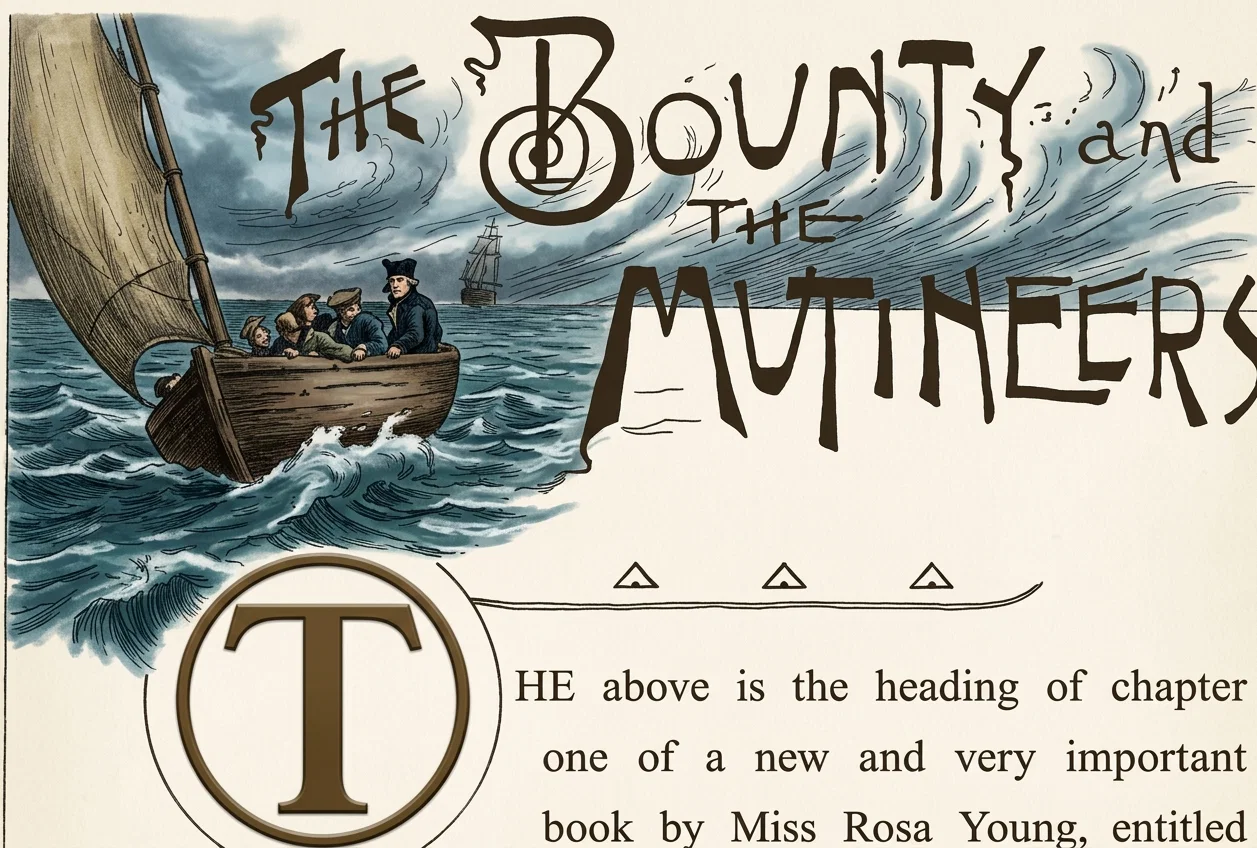
MISS YOUNG, although a native daughter of Pitcairn Island, wields a facile pen, and tells with all the ease and grace of those whose opportunities for education have been better than hers, a most interesting and truthful story of Pitcairn, the far-away "Gem of the Pacific."
Beginning with the account of the mutiny on board the Bounty, she relates the story of the arrival at Pitcairn, describes the experiences of the survivors, tells of the removal to Norfolk Island and the return to Pitcairn again, describes the wreck of the Cornwallis and of the Oregon, gives an account of the various missionary efforts put forth by different denominations in behalf of the Pitcairners, and finally the arrival of the missionary ship Pitcairn and the conversion of the islanders to a new and unpopular religion.
The book is embellished with
18 FULL-PAGE HALF-TONE ENGRAVINGS
made from original photographs, and contains 256 pages. In addition to its being a reliable history of Pitcairn Island, this book will certainly prove a valuable acquisition to the missionary literature of the day.
PRICE, ONE DOLLAR, POSTPAID.
Neat vellum cloth binding, embossed in black and gold.
Persons who can canvass their own neighborhood before the holidays, please write for terms to agents.
Address, Pacific Press Publishing Co.,
Oakland, Cal. Kansas City, Mo. New York City, N. Y.
Ready at Oakland, Cal., November 15, and at our branch houses about December 1, 1894.
LARGE TYPE BIBLES
By Editor
FOR THOSE WITH POOR EYESIGHT
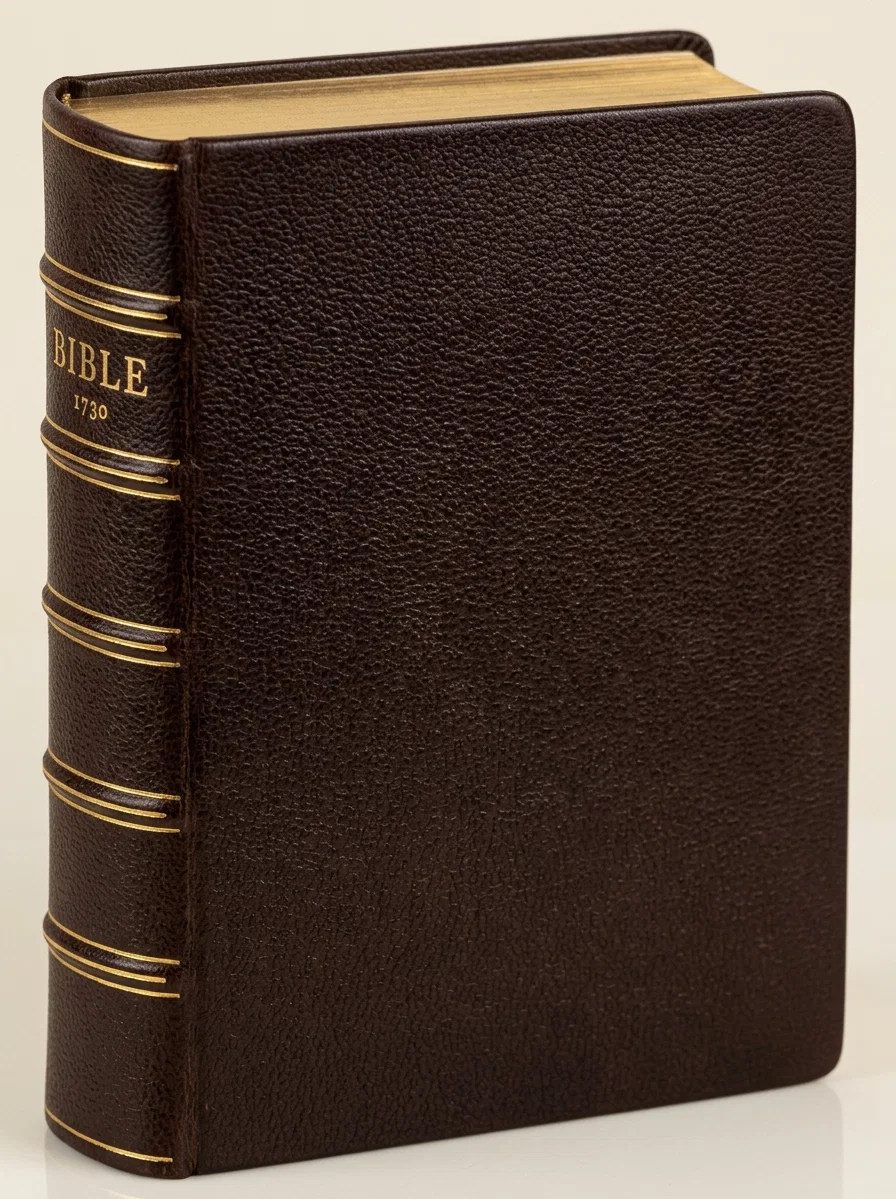
WE HAVE many inquiries for a Bible of convenient size to use and carry, and with large clear print. The Bible, specimen type of which is shown below, we think will meet the requirements of the case. Persons desiring such a Bible as this are usually elderly persons, and want simply the Scriptures themselves, without helps or ref-
SPECIMEN OF SMALL PICA TYPE IN BIBLE NO. 1730.
erences. This Bible contains a FAMILY REGISTER, Tables of Weights and Measures, and 16 Excellent Maps, but has no References or other additional matter. It is printed from clear, new, small pica type, and is bound in French Morocco, limp round corners (see cut) and has gilt edges. Sent postpaid on receipt of price. Order by number.
PRICE:
No. 1730. French Morocco, Limp Covers, Round Corners, Side and Back Title in Gold, Gilt Edges, Postpaid, $2.00.