The Youth's Instructor, Vol. LI, No. 6

The Story of Our Matabele Mission

The Youth's Instructor

February 19, 1903

Review and Herald Publishing Company · Battle Creek, Michigan · February 19, 1903

The Story of Our Matabele Mission
(Concluded)
THE marvelous blessings of the Lord, which were manifested during the closing months of 1899, continued to mark the work in Matabeleland until the summer of 1901, when it was the privilege of Elder G. W. Reaser, who visited this field, to organize the first church among the Matabeles, with a membership of twenty-nine, twenty-two of whom were natives. He thus describes this event:—
“While at the mission station, it was my privilege to organize a church of twenty-nine members, twenty-two of whom were natives. Of this number, twenty-one were baptized at the time of my visit, one having previously followed the Lord in this blessed rite. There were about three hundred natives present who witnessed the baptismal scene, a number of these being indunas, or native chiefs, who beheld their own children led into the water by Elder Sturdevant, to be planted together in the likeness of our Saviour’s death. Some came from the kraals to be baptized, well knowing that they must endure persecution on their return to their homes.”
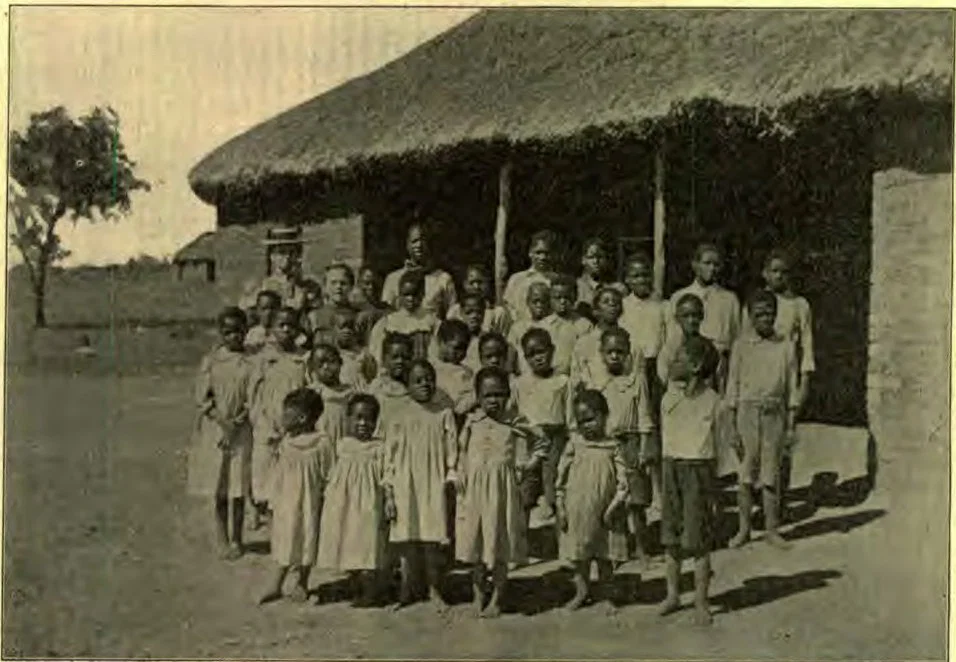
MISSION SCHOOL AT THE FARM
In this connection, the last report from the mission farm will be appreciated:—
“The boys from the kraal were in to the quarterly meeting last week, and report a good work being done. They brought one candidate for baptism; but as we did not know him, we told him to wait until we had a chance to know more about his case. There were also three more with whom we were not satisfied, so we had them wait also.”
“Thirty-one were baptized and united with the church. This swells our numbers to sixty members. Last night I had a good meeting with them. The thought presented was ‘The Church a Force, and Not a Field for Missionary Work.’”
We hope to accomplish much with them this year.
“Our converts are ostracized socially, and made the objects of all sorts of abuse and derision, but thus far they have proved faithful. For this we thank the Lord. Others are inquiring the way of the Lord, and we have more than we can do. There have been love and harmony among us all, and the Lord is fulfilling his promise that if we are one, the world will know that he has sent us.”
The progress that has been made by these native boys is marvelous. It is only a tribute to the mighty transforming power of the Spirit of God when allowed to operate on human hearts. Those mentioned as having come in from the kraal for the quarterly meeting service are boys who, having been trained in the mission school, are now engaged in teaching schools in the kraals.
At the end of the first school year after Elder Mead joined the work in Matabeleland, four young men out of a class of ten went out to work among their own people. Two of them had a school of twenty-five, and the other two had thirty pupils enrolled. They had good success, and rejoiced because they could give to others what had been given to them.
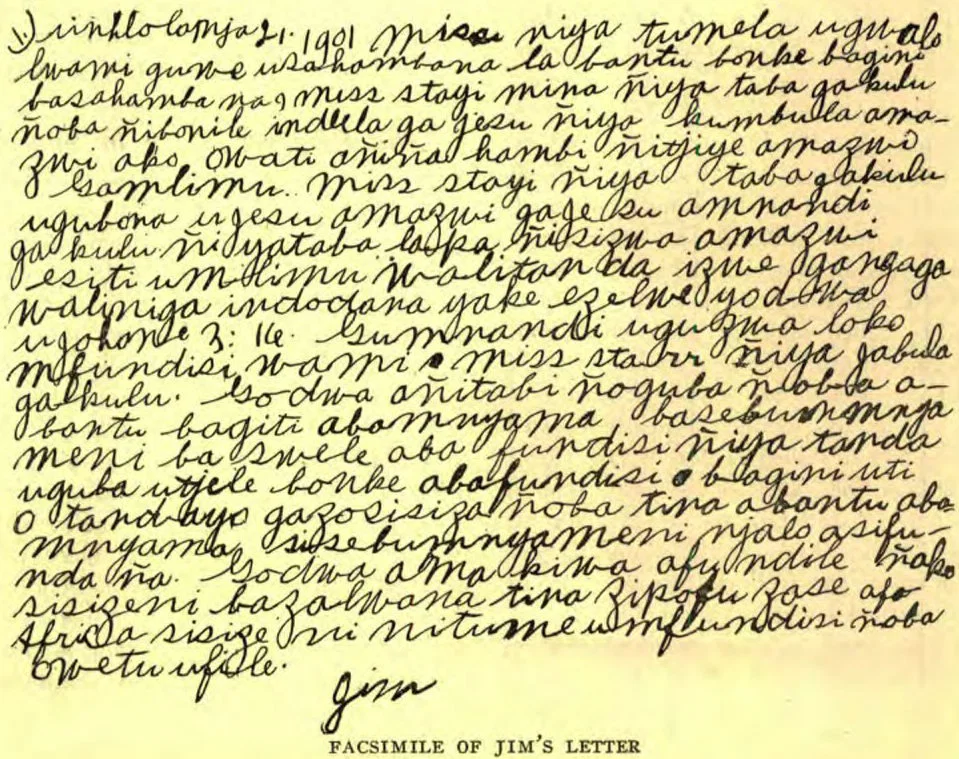
FACSIMILE OF JIM’S LETTER
In October, 1901, the hearts of our people not only at the mission farm, but all over the world, were made sad by the death of one whom God had chosen to hasten the message in this dark land. Elder F. L. Mead, when apparently in health, was suddenly called to lay aside his burdens and rest a while. But the work which God used him to strengthen in Africa continues. Soon after his death, which occurred at Kimberly, when he was on the way to the conference to be held at Cape Town, one of the boys at the mission farm wrote to his former teacher, who had been compelled to return to her home on account of failing health:—
“To Miss ——, from Jim. Miss: I send my letter to you. Are you well and all the people at your home are they well? Miss ——, me, I am very glad because I have seen the path of Jesus. I remember your words which said, ‘If I go I leave the words of God.’
“Miss ——, I am very glad to see Jesus. The words of Jesus are very sweet. I am glad when I hear them, the words that say, ‘God so loved the world that he gave his only begotten Son.’ John 3:16. ’Tis sweet to hear that. My teacher, Miss ——, I am very happy, but I am not glad because the people of our home, the blacks, they are still in the dark; they need teachers. I wish you to tell all the teachers at your home, you say, Him that likes, let him come and help us because we black people are in the dark, also we have [or are] not learned. But white people have learned, and by that, help us friends. We of Africa are blind. All help us. You [people] send a teacher because ours is dead.”
“JIM.”
He also referred to the death of Elder Mead. When Jim came to the mission farm, he could neither read nor write; but he had an earnest desire to learn to do so, that he might teach the black people around the mission. After working hard all day, he would spend his evenings in study. He never grew tired of his books, nor had any idea how late he was studying, so he would have to be told. The gospel has thoroughly changed him.
JIM
JIM
The presence of Jesus has made a difference in his every-day life. The sweet regard with which he speaks of the words of Jesus certainly gives evidence that he has experienced something of the power of these precious words in his life. Besides helping the missionaries, as teacher, preacher, and general standby, Jim assists in the home school in the morning, and goes out to teach in the afternoon.
We are glad to report that Jim’s plea for a teacher was answered in the sending of Elder Sturdevant and his wife, of Georgia, to that field. They are most happy in their work, and feel that they are where the Lord wants them.
What the gospel has done for Jim and many others in our schools, it might do for millions more, if it were carried to them. There is a population of seventy million in Africa, and only a very few have been reached by the message of salvation, and fewer still have ever heard about the near coming of our Saviour.
Just as we finish this little outline of our first mission station among the heathen peoples of the Dark Continent, the appointment of other laborers for this field is under advisement. So many opportunities have been lost for lack of help, that our hearts rejoice to know that God’s chosen people are arousing to the great privilege that awaits them in carrying the last message of mercy to the many peoples who sit in darkness and the shadow of death.
To the young people of our ranks, especially, is this privilege offered. “Lord, what wilt thou have me to do?” should characterize every plan for the present and the future. Soon a large company must be hastening to the ends of the earth, for the coming of our Saviour draws nigh. The Master calls, “Whom shall I send, and who will go for us?” Shall we respond, “Here am I; send me”? ESTELLA HOUSER.

IV—The Different Sides to a Word

You know that there are always at least two sides to a house, or a mountain, or a question; and one side of any of these is usually more pleasant to look at than the other. This is true with people, and just as true with words. Little Tommy Smith, the newsboy, goes about his business with a dirty face, a cigarette in his mouth, and fights and swears. That is the side that he presents to the public. Yet I know he will divide his last dime with a hungry friend, and cheerfully give of his scant daily earnings to help support a sick boy who has been selling papers on another street. I know he is kind at heart, and more ready than many a millionaire to help a penniless unfortunate. That is the other side of the newsboy, and the side that fewer see; for he is not, as with the Pharisee, given to parading his good deeds before the world. Now whoever goes along the street looking for boys who are depraved beyond all hope of making into useful men, is sure to single out Tommy Smith; but whoever is looking for boys who are generous to the last degree, and who, with kind and patient teaching, may be made into useful men, is also sure to find Tommy Smith.
You are wondering what all this has to do with words. Well, words, like people, have some good and some bad traits of character. I will give you a single illustration; you can find many others if you are on the watch. “Evolution” is a word that to many people calls up but one idea, and that the repulsive one that man has evolved, or developed, from an ape. In that sense “evolution” is a demoralizing and anti-Christian word. But this is only one side of it. Its broader and deeper meaning is “a process of unfolding, of developing, of attaining perfection.” And so all of us who believe that the seed that Christ plants in the heart will grow and make our lives beautiful and change us from glory to glory, must conclude that Christianity is a process of evolution. When I hear the word, instead of suggesting unbelief and heathenism and atheism to me, it says, “Ye must be born again.” “First the blade, then the ear, then the full corn in the ear.” “Till we come . . . unto the measure of the stature of the fulness of Christ.”
I have in mind a certain lawyer,—Mr. Brown. People who lived between Mr. Brown’s home and place of business knew him as a neatly dressed, business-looking man walking past their doors twice a day. Those who visited his office knew him as a keen, far-seeing, quick-witted attorney, who could be relied upon to make them conquerors in the dispute between themselves and their neighbors. But to me, whose barnyard was adjoining his, he was neither a neatly dressed business man nor a skilled doctor of law; for I saw him only as he came to the barn, clad in overalls and faded, tattered coat, to care for his cow and chickens. And yet the plain, farmer-like man I knew was just as truly Mr. Brown as was the learned lawyer at the office.
And so with words. If we could always remember that words do not look the same to everybody, many a foolish quarrel, many a useless argument, would be avoided. For instance, to the backwoods farmer, “education” may mean a thorough drill in reading, writing, and arithmetic, with perhaps a little history and geography; to the university professor it means a long course of training and instruction in science and art and philosophy; while to the sincere Christian it means the restoring of the image of God in the soul. Shall we say the first is not education?—No; it is elementary education. Shall we say the second is not education?—No; it is a classical education. Shall we say the third is not education?—Certainly not, for it is Christian education.
So you will see that a noun without a qualifying adjective is a broad, and sometimes a vague term, and it is as reasonable for us to insist that one meaning of a word is the only one, as it would be to insist that the lawyer was Mr. Brown only when in his law office. L. T. CURTIS.

A Walk with the Wind

COME with me to the open road, And let the woodland write the ode— Come for the hill-wind takes my arm, And laughs away the heart’s alarm, Drawing me on from ridge to ridge, By field and ford and rocky bridge.
Down from his wide, tree-darkened hall The gray owl sends his Saga call, And here a field-mouse leaves his home, His labyrinthine catacomb, And prints the snow with little tracks, Like hackings of an elfin ax. I see a spider by a stream Bridge his small Nile with swaying beam— See on my path a bold ant dare His Chimborazo hung in air.
I pass an old, decaying fence, Turned to a rare magnificence, For gold of lichen and green of moss Have paid with beauty all the loss. Ha, landlord Fox, alert and lithe, Is out to get his morning tithe, With thrifty eye to oversee His unstaked principality. Circling, the high crows swing and caw, Poised by the same impartial law That traced the orbit of the star Wide wandering on the dark afar.
The snows are heaped along the ground, Bright kingdoms builded without sound. The cleansed air tingles in my blood, The joy pours through me like a flood! I tread on Hellas as I go, Wrecking her Parthenons of snow; I sweep across imperial Rome, Wasting her glories dome by dome. And yonder, at the wind’s footfall, Crashes a jeweled Taj Mahal, An irised miracle of white, Built by what spirits of the night! And yet those shut-in mortals choose To peer into the Press for news, Thinking the great events are hurled On lightnings round about the world!
—Edwin Markham, in December Success.

The Emperor Moth in Sumatra

IN our walks through the rice fields we found a big emperor moth in the larval state. We broke off the branch on which we found him, and took him home, curious to see how he would develop. He was a fat, pale-green, dusty, sluggish fellow, and seemed to regard the eating of guava leaves as the only important work in the world.
One day he spilled out all his blood on the table,—enough to wet a big space on the tablecloth,—then he began weaving his silken bed, using the hollow of a leaf as the foundation. He worked fast, now that he was smaller and lighter, turning about in that narrow place with great dexterity. He worked all day and one night, and then was quiet. For three months he slept. One day our delight knew no bounds to find on his empty cradle a lovely emperor moth, measuring six inches across the wings. He soon flew away in the sunlight. CARRIE L. MUNSON.
Padang, Sumatra.

On the Frontier

Extracts from a Letter to the Mt. Vernon Academy Missionary Society.
You will, no doubt, be pleased to get a communication direct from the land of the Pharaohs, the pyramids, and the sphinxes. So here, almost under the shadow of those mighty monuments of ancient greatness, I write a few lines, hoping that in your hearts may thereby be developed a stronger desire to give your lives for those who are now sitting in darkness.
After a profitable visit in Europe, and a pleasant voyage across the Mediterranean Sea, we arrived safely in Cairo, the capital and largest city of Egypt. All the workers in Egypt, six in number, were at the station to meet us, and gave us a most hearty welcome. We went immediately to the Vegetarian Health Home, which is in charge of Brother Louis Passebois and wife, and have been making this our home since. We find it very difficult to get rooms or a house to suit both our needs and our pocketbook. House rent is very high here, though not more so than in some cities in America.
The tourist season is just beginning, and the city is as fully alive and noisy as similar cities in other countries. Cairo is a city of over seven hundred thousand inhabitants, although in extent I do not think it is as large as Columbus, Ohio. You can imagine the conditions. In the native portions the people literally swarm in the daytime, and at night, to use an American expression, they are packed away “like sardines in a box.”
The combination of smells constantly arising from some of these quarters is indescribable; and one wonders why cholera and other filth diseases do not rage here continually. And, by the way, the terrible mortality of the cholera during the past season may be appreciated by the following item from the Egyptian Gazette, the only English daily in this country: “The total number of cases since the commencement of the outbreak on July 15 is 39,673; of deaths, 33,809; and of recoveries, 5,856.” That means that over eighty-five per cent of all who took the disease died. Here is surely a needy field for the medical missionary. Any one planning for missionary work in the Orient should take a course in hygiene.
MONUMENTS OF ANCIENT GREATNESS
The climate here at this season is delightful, neither too hot nor too cool. The air is dry, and the sky cloudless. Last week at Luxor (five hundred miles up the Nile from Cairo), I picked oranges and lemons from the trees, and most beautiful roses are in full bloom, and in profusion. A few days ago Brother Passebois bought four bouquets, mostly roses, for five cents. They would have sold for two dollars in Columbus. Nice oranges can be bought on the street for five cents a dozen, and lemons, small ones, for ten cents a hundred. But common potatoes sell for $1.25 a bushel, and dairy butter is very scarce.
I got my first experience with real native country life in the vicinity of Thebes, where, with the men of the family, I sat at the dinner table, and dipped my piece of bread into one central dish filled with a vegetable stew, seasoned with olive oil, and plenty of black pepper. I ate with more or less relish, for I had been jolted on the back of a native donkey for four hours, over sandy wastes and rocky steeps, and was very hungry.
Our host is a man of means, owns thousands of dollars’ worth of property, and is one of the chief supporters of the American Mission (Presbyterian) at Luxor. He lives in a house made of sun-dried brick and stone, a part of which has no roof,—none is needed, for it seldom rains,—and within the same inclosure live his chickens, turkeys, camels, donkeys, etc. This is true Oriental style. This man has a number of grown-up sons, two of whom have said that they would keep the Sabbath. We spent Sunday and a part of Monday with them, and they seemed to enjoy having us with them. They listened with profound reverence to our presentation of the Scriptures, and asked a number of questions, urging us to remain longer with them, and to return at a later date.
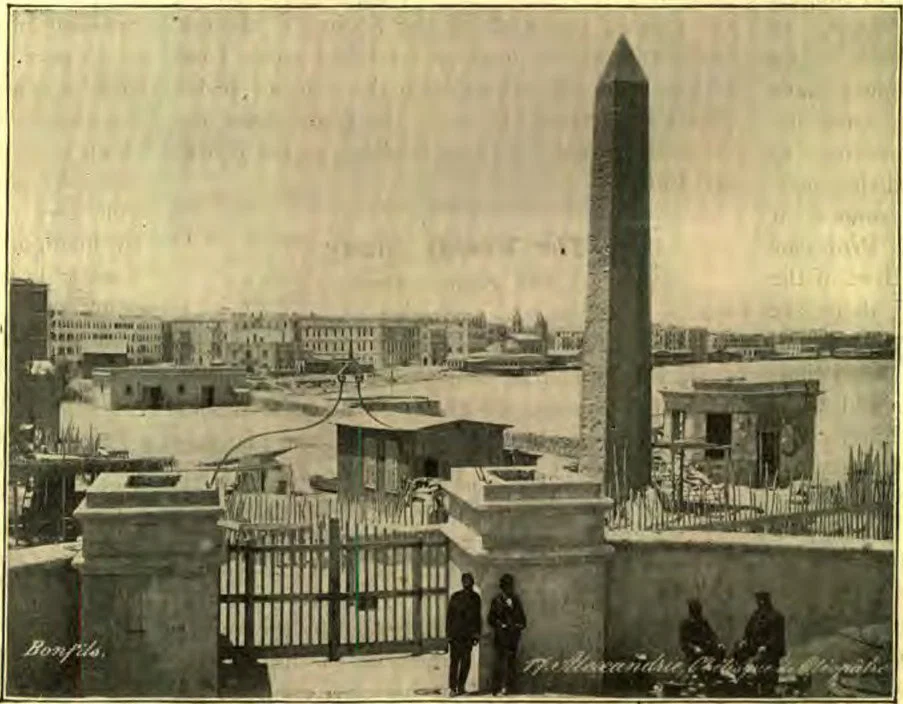
ALEXANDRIA
ALEXANDRIA
I have just returned from Alexandria, where I held Sabbath meetings and celebrated the ordinances with the little company in that city. This is where our brother, Dr. Ribton, was killed by a mob of natives who were bent on driving all foreigners out of Egypt in 1882. The third angel’s message is here represented by five Sabbath-keepers, who seem very earnest and devoted. They are all Armenians from Turkey.
We are now planning to get out literature in the Arabic language, which is the language of nine tenths of the people in Egypt. We hope to have a printing-press after a time, but for the present we must hire our printing done here. Our greatest immediate need is a tent in which to hold our meetings in the native towns and villages. This is a much better country for tent work than any place I have seen in America or Europe, and we hope that in some way this need will be speedily supplied.
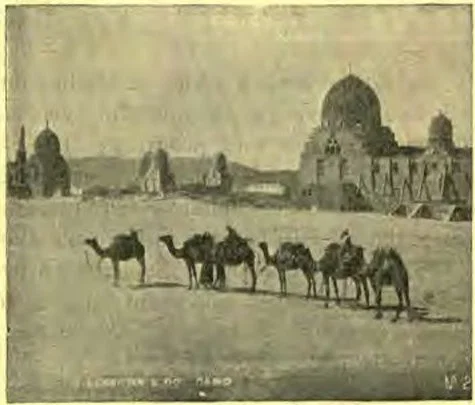
A CAMEL TRAIN
A CAMEL TRAIN
A more pressing need, however, and one much more difficult to meet is consecrated young women of experience in real Christian endeavor, who will devote their lives to the “shut-in” women of the Mohammedans and Copts. No man can reach these women, many of whom are starving for the Bread of life. Every day I see their sad, mournful eyes looking out over veils that must always cover their faces, emblems of the veils of spiritual darkness that shut out the blessed Light of life.
There are millions of them. Who will go behind the curtains and carry to them the message of peace and comfort? May God inspire the hearts of young women in America to consecrate themselves to this blessed work.
Yours in the Master’s service,
W. H. WAKEHAM.

As the Savages Saw It

WHEN we stop to think of it, it appears only natural that savages should fail to understand the motives which prompt missionaries. The reasons which the natives themselves assign are often curious. At first the savages of New Guinea thought the missionaries had left their own land because they were hungry. Chalmers, the famous missionary pioneer among the cannibal tribes, reports a conversation with some of them:—
“What is the name of your country?” inquired the savage.
“Beritani.”
“Why did you leave your country?”
“To teach you, and to tell you of the great loving Spirit, who loves us all.”
“Have you cocoanuts in your country?”
“No.”
“Have you yams?”
“No.”
“Have you taro?”
“No.”
“Have you sago?”
“No.”
“Have you sweet potatoes?”
“No.”
“Have you breadfruit?”
“No.”
“Have you plenty of hoop iron and tomahawks?”
“Yes, in great abundance.”
“We understand now why you have come. You have nothing to eat in Beritani, but you have plenty of tomahawks and hoop iron with which you can buy food.”— Selected.

The Young People’s Work

As we enter upon the duties of the new year, with all its possibilities for good, it is fitting that we review some of the blessings God has bestowed upon us during the past year. The work of the young people has progressed, in spite of many failures and mistakes. To-day there are in Iowa nineteen societies, most of which are laboring earnestly to carry out the aim of the organization. As a result, hundreds of pages of literature have been distributed; branch Sabbath-schools established; day schools operated on the same plan as the church schools; Christian Help bands organized; a considerable sum of money raised for the work in foreign fields; and some of our young people have gone to those fields to carry the message of the cross; while the prayers of those remaining ascend daily for God’s blessing upon them. This, and much more, has been accomplished through the working of the Spirit of the Lord upon the hearts of the youth. Why should we not praise his holy name?
But much remains to be done. Some of our Societies have become discouraged, and have discontinued their meetings because they did not understand how to conduct them successfully. What can be done to help them? “All ye are brethren.” If a brother were discouraged, what would be our duty toward him? — We should do all in our power to encourage him. Encouraging letters should be written, teaching them how to work successfully. How many will do this this year? How many have a real burden for the discouraged members of their own Society? Do you try to make them feel that their presence is an important factor in the meetings, and that you are interested in them, and praying for them? If not, why not? Often we find those in the church and Sabbath-school who long to join the Society, but who are too timid to apply for membership. These should be sought out, and urged to unite. Then there are the isolated ones. A letter of loving interest would do them much good; for they seldom see a young person of like faith. And then, have the absent members been remembered with interesting letters telling about the Society’s meetings, and how they have been missed, and asking them to contribute items of interest from their own experience?
These are little things, but they go a long way in binding the hearts of the young people together, and making the work of the Society a success. God’s call means hard, persevering work from first to last. He has wrought through our feeble efforts in the past; let us in the future press the battle to the gates.—Della Wallace, in the Workers’ Bulletin.

The Weekly Study

The Former Days

(February 22-28)
The special topic suggested for the weekly study will, of course, consume but a portion of the time of the meeting. The prayer and testimony service, the hearing of reports, and the planning of work, are expected to form the greater part of the weekly program. With this in view, we are suggesting outlines for only a brief study, as an aid to the leader of the meeting. Each one chosen to lead will accept or reject such suggestions, as may seem wise, guided by the knowledge that whatever is presented to the meeting must be made his own by his own study of the subject.
Let us give some attention to the story of the rise of this advent movement and the early days of the work, using as helps “Early Writings,” “Rise and Progress of Seventh-day Adventists,” and “Great Controversy.” Not all three of these books may be in every home, but they must certainly be in every company of believers, so that access may be had to them by the one in charge of the studies. If not, by all means send to your tract society office for any one of these books which may not be available for use. No young Seventh-day Adventist should fail to read these works.
First, let us notice the benefit of the study of God’s dealings in past days, and then review the events of the time of the end demanding the rise of just such a movement as the advent message has developed.
God’s Hand in the Past.—Ps. 44:1-3; Joshua 4:21-24; Judges 2:7-12; Heb. 10:32-39.
We are not to forget how it has come about that there is a people called Seventh-day Adventists in the world.
Heralds of the Morning.—This is the title of chapter 17, of “Great Controversy.” Notice how the Reformers regarded the doctrine of Christ’s second coming, and follow the leading signs of the second advent down to the falling of the stars in 1833.
It will be helpful to fix the date of the beginning of the “time of the end,” making sure that all understand it. Dan. 7:25; 11:35; 12:4; Mark 13:20, 24. We should every one know how to answer the question, When did the time of the end begin? and should be able to give the facts without delay. Let us go over the prophetic landmarks until we shall know how to answer inquirers in a few words. As we distribute literature on the coming of the Lord, we shall need to know how to give brief and plain replies to questions asked.
There is so much in this, as in every topic suggested, that much time might easily be spent upon it. But the design is to press a few minutes only full of earnest, thoughtful study, all joining in, and the result in this study will be to impress hearts anew with the fact that events of the time of the end were leading up to a special advent message, and that we young people should become acquainted with God’s hand in the message in the days of our fathers. W. A. S.

Series on Early History of Our Work

We begin this week a series of studies on the early history of our work, and the events connected with its rise and progress. These lessons will cover ground with which every young Seventh-day Adventist should be familiar, and we feel sure that all will be glad to have the Weekly Study of the Young People's Societies turned to a consideration of this important subject for a few weeks.

Georgia Youth Raise Funds Picking Cotton

THE Young People's Weekly is authority for the statement that during the last season the young people of Georgia earned upward of ten thousand dollars by picking cotton in the fields, and turned the money over to the North and South Georgia Methodist Conferences, for the benefit of two orphans’ homes. And this is one more example of what young people who are willing to work can do.

Another Missionary Enterprise

THE Young People's Societies of the Upper Columbia Conference have undertaken to support a missionary in the Fiji Islands. Prof. C. B. Hughes and his wife, who taught in Walla Walla College the first year of its establishment, have lately returned to this country from Australia. The especial need of Fiji has been presented to the young people in College Place, and they conceived the idea of raising means to support at least one native missionary there. Professor Hughes says the natives in Fiji have tired of the Catholic religion, and that many of them are ready to receive the truth. Our workers have all been called away from there, but native Christians have been educated by our workers, and these could carry the truth to their people, if they could only be supported. The small sum of thirty-five dollars will support one of these for a year.
So the call has been sent out to the young people, and already there has been received enough to support one of these native workers for a year, and all the Societies not yet heard from.
Once more we ask, Why should not the young men and women throughout our ranks feel the joy of the message in their own hearts, and with steady purpose share in the burdens of the hour? Can not the young people in each State band together in a missionary enterprise of this kind? Certainly none of us wish to expend all our resources of means, time, and strength in the home field. Mrs. L. Flora Plummer.

Hobart, Louisiana

OUR young people's meetings continue with a growing interest. We arrange the program so as to give as many of the young people as possible a practical part in each meeting. This is securing individual growth. All have done something in missionary work, some more than others. We take a club of Gospel Heralds, and have a volunteer paper band to distribute these papers by loaning, giving, or selling them. Six of our number became responsible for this work. About four copies are sold weekly, occasionally more. Our members report their work to the church tract and missionary society. Some have bought tracts and are loaning them. We have special seasons of prayer for individuals whose names are presented by some one of the members. Since we organized, four of the members have become converted, baptized, and identified with the church. This binds the hearts of the parents to our work. Their presence at our meetings, their expressions of interest, and hearty amens, add much to the general interest. We hope we may not miss but few copies of the INSTRUCTOR on account of the fire which we so much regret. The lessons are very helpful to us.
We do everything we can to make our meetings for, by, and of the young people. We try to emphasize the thought that they are a part of the body of Christ,—the church,—and therefore have a work to do; “for the love of Christ constraineth us,” as the motto on the Membership Card says. One of our members is now in the Southern Training School preparing to be a church-school teacher. We are all of good courage, and believe that we are soon through faith to inherit the kingdom of peace.
MARK PERDUE.

Question Hints

(To be given to different members, and answered in the meeting.)
Why is it well to consider the former days?
Why should we not forget the early history of the Seventh-day Adventist Church?
Give a brief outline of the signs that show that Christ’s coming is near, down to 1833.
What notable sign occurred in that year?
When did the “time of the end” begin?
What should all who help sound this message be able to do?
Continue reading: Character-Building