Review and Herald Publishing Company · Battle Creek, Michigan · February 26, 1903
Buzz, a Pet Humming Bird
By F. W. Field
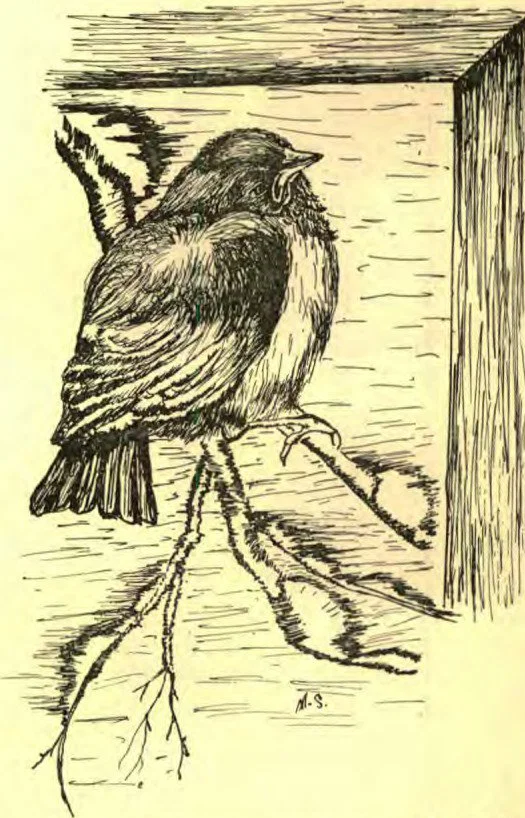
ONE day in early spring, several years ago, I was seated in the parlor of our academy home, when a student entered with a humming-bird, a ruby-throat, in his hand. The little fellow had come into the chapel through an open window, but in trying to escape had flown against the glass. He fell to the floor, stunned; but now his bright eyes showed that he was not seriously hurt. I gladly received him, and took him to my room. Here he dashed about quite frantically for a time. I arranged perches in the two windows of the room, and on these he rested from his vain efforts to escape through the glass.
When I was a boy, I used to wonder if humming-birds ever rested; they always fly so swiftly from flower to flower, taking their food without lighting. But now I could observe the habits of my pet both while at rest and in flight. Whenever I entered the room, he would leave his perch, and continue on the wing as long as I was moving about. When I became quiet, he would sit upon the perch very contentedly.
It would be cruel to keep him long without food, I thought. But what could I feed him? It is a popular notion that humming-birds live entirely upon the honey they gather from flowers. I named my pet Buzz, after one of his kind that I had recently read about in a popular magazine; and as this bird had taken kindly to a sirup made of sugar and water, I prepared some of the same, filled a fountain-pen filler, then mounted a chair, and presented the sweet liquid to Buzz. He was very shy at first, and I had to hold the tube at arm’s length; but he finally got a taste, and ever after seemed to enjoy the feast very much.
Little by little he became more tame, until he would fly down to the tube when he saw it in my hand. Then, very gently, I brought a finger of my other hand close to his feet as he fed from the tube. At first he resented this, and flew away to his perch, but soon returned. At last he was induced to alight upon my finger, where he remained until the tube was emptied. After this he would perch on my finger whenever it was presented, remaining only while sipping the sirup from the tube. He also learned to make his wants known; for when hungry, he would leave his perch, and fly close about me until he was fed.
The pet I had read about had died in a most unaccountable manner after a captivity of two or three weeks. But really, was it any wonder? How could the activity of such wonderful wings be maintained on a “starvation diet” of sugar and water? Then, too, I learned that humming-birds live almost entirely upon insects that take refuge from other birds in the deep corollas of certain flowers, the long, slender bill and tongue of the ruby-throat being well adapted to this work. But I dared not trust Buzz to seek his own food, lest he should not return; so I secured some well-cooked oatmeal from the kitchen, thinned it to a gruel, and sweetened it well. When Buzz first tasted this new “health food,” he promptly left it, and returned to his perch in evident disgust. Like many boys and girls, he had been eating food that pleased his palate, regardless of its quality to maintain health and strength. But I insisted on his adopting the reform, and he soon received the new food with relish. It constituted his sole diet during the remainder of his stay with me.
Whenever I entered the room, I was greeted with the whirr of Buzz’s wings. Too rapid in their motion for the eye to follow, it seemed like folly to think of counting the number of strokes they made in a second. But one day a bright thought came to me. The motion of his wings was rapid enough to produce a distinct musical tone. I took the pitch with my voice, and ran down-stairs to the organ. The tone proved to be “A” in the second octave below middle “C.” A simple computation based on the scale of vibration for musical tones (found in every text-book on physics), gave the interesting result,—Buzz’s wings vibrated one hundred and ten times in a second! Truly wonderful; yet this is slow indeed when compared with the motion of some insects’ wings, whose vibrations each second number up into the thousands.
I was becoming quite attached to my little roommate, and apparently he was fond of me. We had many callers, who were much interested to see him sip his food from the pen-filler while sitting on my finger. He had been with me now for two weeks or more. The spring days were becoming very pleasant; yet I was loth to part with my pet. One afternoon I went out botanizing, leaving the windows carefully closed; but I thought it safe to leave open the transom over the door into the hall; for I had never seen Buzz fly about the room except from one window to the other. Returning, I missed the hum of the tiny wings. How deserted and lonesome the room seemed without him! Yet I could not blame him, and my regret was mingled with a pleasant satisfaction that he was free again,—free to enjoy the bright sunshine and the pleasant fields, free to follow the instincts implanted by a loving Creator.
F. W. FIELD.
Some Winter Birds
THERE are three birds that at any time, if it is not very stormy, will help to make many a winter’s day merry. These are the two nuthatches and the chickadee. They are often found together,2and are as much features of the season as withered leaves or snow and ice. Everybody knows the chickadee. Emerson, in a poem, has been its best biographer. But the lively nuthatches have been too much neglected. Perhaps it is because they do not sing; yet they are not mute, and their querulous cries fit well with many a wild winter day. But what we can see is as much to be considered as what we hear, and so I wish to say a word about sights that at this season so largely take the place of sound.
These three birds are always busy, and this is significant. If never idle, it behooves us to know what is the meaning of their ceaseless activity. Watching them closely, we find they are searching for food. Like ourselves, they must eat to live, but the trunk of a tree does not appear to be a promising field for food. This is because our eyes are not so sharp as theirs, and we get a valuable hint from this simple fact. If we looked at all objects more closely than we are apt to do, we would see more. In winter nature does not display herself for our ready recognition. Only in the glory of summer days is she on dress-parade. With few exceptions, nature’s bright uniforms have been laid aside in midwinter. A plainer dress befits the winter season, and it is one so plain at times that sharp eyes are needed to distinguish the figures from the background.
Over the gray trunks of trees, gray birds creep; or, if they tarry a moment at one spot, the wrinkles and black knots on the bark blend with the black-and-white markings of the birds, and so the general resemblance in color of tree and bird is preserved.
Why, as the nuthatches and chickadees are gray and black and white, are not all birds colored in this inconspicuous way? The question opens up a long series of problems, and the way to solve them is to spend days in the woods. I can give only a hint here. If there were no other birds in the woods, then it would not matter much what their color was. They might be bright-red and find food just the same. But there are other birds about, and hunting-birds at that. Hawks have sharp eyes, but not often sharp enough to see a nuthatch, unless very near. If the bird was bright-red, it would have a sorry time of it dodging the little falcons that are ever darting about.
“But the cardinal grosbeak is red, and yet is here all winter, too,” as some one reminded me recently.
“True,” I replied; “but it does not go scrambling over tree-trunks, thus making itself unnecessarily conspicuous.”
It is a fact that the cardinal does not make itself conspicuous in winter, in spite of its bright plumage. There are many constantly near my home; yet they go dodging in and out among the blackberry and smilax tangles, or flit from base to summit of cedars, but always keep out of view for much of the time. We catch glimpses of them on the wing far more often than we actually see them sitting perhaps at the end of an outreaching branch, as the song-sparrows do when singing. Now this song-sparrow is very much the color of the stick it perches upon. If it did not move at times, it would be very hard to distinguish from a knot on a tree.
“Then why should not all the birds be green in summer, so we could not see them at all?” asked my young friend.
I confess that I could not tell him, and could only suggest that it would be better to study birds where they are found, and learn each for himself all that he can. A few facts, personally acquired, are worth a great deal. They help us to think for ourselves, and what we learn through our own efforts will be longest remembered and go farthest to enable us to understand the beautiful world in which we live.—Selected.
II—Soil Resources
By J. C. Rogers
WHEN we speak of “resources” in business affairs, the cash value of a certain kind of property is meant. Suppose the property to be a farm of one hundred acres, valued at seventy-five dollars an acre, with improvements worth two thousand five hundred dollars. This would give the farm a real value of ten thousand dollars. But the owner has hired four thousand dollars, and given a mortgage upon his farm for that amount. This man’s resources are ten thousand dollars, but his liabilities are four thousand dollars. So his business is worth only six thousand dollars. The soil resources of his hundred acres are the elements needed to feed the plants grown upon it for the purpose of producing wealth for the use of man. These elements, which are food for the plants we choose to grow, are stored in the soil by the Creator. Fortunately, no man can mortgage this plant food, though it may be wasted by a lack of knowledge in management of the soil.
What, then, are these elements that are able to bring wealth out of the ground? It has been found that plants contain fourteen chemical elements. Ten of these are said to be necessary to growth. The fourteen are, carbon, oxygen, hydrogen, nitrogen, phosphorus, sulphur, chlorine, silica, calcium, iron, potassium, sodium, magnesium, manganese. Some parts of the four first named are given to the soil by the air. But as we find them also in the soil, we shall speak of them among its resources. In this lesson, we can not study all the fourteen elements, so we shall select those found in greatest abundance, and those most used by the plants grown for food.
Silica stands at the head of our list, because it is most abundant. It is a hard, strong substance, and comes from flint and other rocks. Before any plant can make use of silica, it must be dissolved. This is done by water, as you may dissolve sugar and salt by pouring water upon them. Of course the silica dissolves much more slowly. In the soil we find it ground almost as fine as flour, then it is dissolved as the plant needs it. In plants its use is like that of the bones in our bodies. It gives strength to the straw of grains, and to the wood of trees and shrubs, and the stems of all plants. Each acre of ordinary soil one foot deep contains seventy-three tons of silica. Plants use but little of it, and the supply is said to be sufficient for over seventeen thousand years.
Nitrogen is next in abundance, and is considered the most important of all the soil ingredients. While all plant life urgently demands this food element, it also easily escapes from the soil under bad management. Three eminent chemists found by the analyses of thirty samples that the average amount of nitrogen contained is over three tons an acre in the surface foot. Some rich prairie soils contain much more than this. In Manitoba four samples were analyzed, and their average was over five tons an acre in the surface foot. The amount in the first four feet was above eleven tons an acre. Most soils contain nitrogen enough to supply the needs of ordinary crops for many years, if it be not wasted. And men have lately discovered that an arrangement is made by the Creator constantly to renew the soil’s nitrogen. How is this done?
Let us first find the source of this valuable plant food. We can then better understand how its supply is replenished. I think you know that the air we breathe is composed of oxygen and nitrogen. Oxygen is usually mentioned first, because it is regarded as more important for the use of human beings, especially in breathing. But the air contains almost four times as much nitrogen as oxygen.
Plants also breathe, and it has been found that they take nitrogen into their circulation, and add it to their structure, much as our blood receives oxygen for use in the body.
By far the greatest part of the nitrogen found in the soil is now understood to be gathered from the air by certain plants, and stored there for the use of other plants. The products of plant growth furnish our food, while the plants themselves furnish continual feasts for our eyes. Plants feed mainly upon nitrogen. There is so much that is important and interesting about this element in its relation to soil and seed that we must give it further study in another lesson. Let us here note that ordinary soil has a resource of nitrogen sufficient for more than a hundred years.
Let us now write out in tabular form the reserve fund, or resources, of our three relatives,—the Clays, Sands, and Mucks. Remember, the table shows the amount of each element of plant food in the ordinary soil of one acre, one foot deep. It will help you to understand the proportion of these elements to the whole soil when you know that the common soil of an acre, one foot deep, weighs about one thousand seven hundred and fifty tons:—
PLANT FOOD
TONS (Aprox.)
YEARS
Silica
73
17,650
Nitrogen
5
100
Magnesia
4
2,300
Potash
4
1,521
Phosphoric Acid
2
542
Lime
2
4,387
Soda
1.5
4,050
Sulphuric Acid
1
292
Study this table, examine your soil samples, and consider their value to man. J. C. Rogers.
Walla Walla, Washington.
Lessons from Nature: Verses on Finding Rest
“If thou art worn, and hard beset
With troubles that thou wouldst forget,
If thou wouldst read a lesson that will keep
Thy heart from fainting and thy soul from sleep,
Go to the woods and hills! no tears
Dim the sweet look that Nature wears.”
Fed by Air
A FLEMISH physician planted in a pot of earth weighing two hundred pounds a willow branch weighing five pounds. He kept the plant well watered, and in five years the willow had gained one hundred and sixty-four pounds in weight, while the earth in the pot had lost only two ounces. Van Helmont inferred that the plant’s gain was due only to the water which had been supplied. Modern botanical science proves that the gain was in a great measure due to the carbon absorbed from the air.
So it is true that strong spiritual characters are built up out of the spiritual atmosphere in which they live.—The Bible Advocate.
Tired of Waiting
By E. L. Paulding
“I’m tired of waiting for papa,” said my little girl the other day.
I had promised her a drive to the beach. Now and then she looked off across the mesa to where, three miles away, the blue waters of San Luis Bay were breaking in a long line of white surf, and drew a deep breath, letting it out in what sounded much like a sigh.
If there is one thing the children like better than another, it is a drive to Pismo beach. There the long lines of breakers run in the sweeping, beautiful curve of the bay way down to Point Sal, fifteen miles away. The sands are hard and firm, and the buggy glides over them with a motion much like the smoothest sleighing.
“There is always something new to be seen at the beach,” is a frequent saying, but I believe that Ruth loves the old things best. She is a conservative little body, and never ceases to love what she once enjoys. She loves the hundred-yards-wide and miles-long stretch of gleaming sands that reflect the blue of the glorious sky. She loves to watch the circling flight of the gull, as he makes his sturdy efforts after his living, watching with one eye the buggy and its occupants, while with the other he notes the actions of a flock of pelicans as they take their straightforward way up the shore. All at once there is an awkward pause in a pelican’s flight, and suddenly he falls with a great splash into the water. No, he is not shot. That is his way of fishing. Soon he comes up with a smelt or a herring in his bill. But his pouch is full of water. As he drops his head to let the water run out, Mr. Gull, who has glided gently down by his side, pops his bill into the pouch, and makes away with the fish before the pelican has time to gulp it down.
Ruth loves to watch the long-legged and long-curved-billed curlews as they hunt for sand crabs along the shore. Above all she loves the little mouse-colored sandpipers, whose twinkling feet move so fast that the birds look as if gliding over the sand without the aid of either feet or wings. As they mount on wing, they look like white scuds of flying foam, for their under parts are white as snow.
She hunts over the piles of kelp that the storms have broken loose from the outlying reefs of rock, for the roots. The top of the immense seaweed floats on the surface, supported by long lines of stems, held up by a tiny bladder of air every few inches along the stem or vine. From the center of the floating mass there goes, deep down in the water, a central stem, or trunk, that takes hold upon the bottom in a tangled mass of roots. The storms tear out the whole mass at times, and it comes to shore laden with its treasure-trove of deep-sea starfish, shells, etc.
She loves to climb the white sand dunes that lie next the beach, and hunt for “tunitas,” a sweet, salty, sandy fruit that grows upon a long, trailing, succulent-leaved vine, or for the beach strawberries, the only wild strawberry in this part of California. These berries are so covered with sand that they have to be washed before they can be eaten.
Time would fail me to tell of the gamboling porpoises, the great schools of sardines, the whales, the skip-jacks, the smelt fishing, the clam-digging, the Portuguese men-of-war, etc., etc., to say nothing about the Rocky Beach, with all its wealth of shells and mosses, of sea-urchins, anemones, rock oysters, starfishes, etc. Some day, perhaps, I will take you there with me, and we will explore the treasures at our leisure.
No wonder that Ruth exclaimed, “I am tired of waiting,” for papa had so many chores that morning that it was a long time before he was ready for his little girl. “If you are tired of waiting, Ruth,” he said, “you may just go to work, and give the chickens a pan of wheat, and feed and water the little chicks, and by that time I think we will be ready.” And with her help, in a very short time, we were off behind John Wigwam, who also enjoys a canter on the beach.
“Tired of waiting!” Several times of late I have heard that refrain, “I am tired of waiting; I want to go home,” from some of our old workers at our camp-meetings. To such, and to all, the Father says, “If you are tired of waiting, lay hold of my work, and help, and I will soon be ready to come for you.” It is with joy that we note the sounds of preparation for the soon ending of our Father’s work on earth. May it be ours to have a part in the work, and ours to share in the glories and beauties of the new earth.
E. L. PAULDING.
“The Blind Receive Their Sight”
“I AM going to be blind, and I shall never forgive him; do not let us mention it again.”
The words were spoken quietly by a young woman to her minister. Her eyes were bandaged as the result of an injury received from a golf ball. It had been struck by her own brother, and by accident had inflicted the blow which had had such terrible results.
The girl was strong, ambitious, pleasure-loving. That the joy of life should stop for her at twenty was the most terrible tragedy possible.
The black despair in which she was living was scarcely greater than that into which her rebellion had plunged her whole family. Her father and mother heard with horror the bitterness of her tone, and saw the hardness of her face whenever she spoke of the accident. She would not permit her brother to enter her room. She would bury her ears in her pillows if she heard his voice. In short, she was in the grasp of the monster of unforgiveness. Could any word be spoken that would lift her out of darkness into light? The clergyman who had watched her since she was a child, who knew her faults and loved her in spite of them, was seeking that word.
“Kate,” he said, “you are right in saying it does no good to talk. But before silence falls, you must hear the truth once.
“You have claimed the world. It was made, you believed, for your pleasure. Parents, friends, servants, above all, your brother, sprang to do your wish. Now you are blind, and you declare that you will not forgive. I tell you—for I dare—that your blindness is your one chance to win a nobler self. While you could see, you saw no human pain, you felt no other’s need. Now your eyes are closed to outward things, that you may learn to see deeper. We have but half-known the dreadful truth, but we now know that you were on the way to be a curse. Now you may be a blessing if you will. It may come to pass for you that, losing your sight, you shall find it.”
The minister stopped, and went quietly out, and the stricken girl was left alone—in the dark.
Days passed, and it became evident that a terrible struggle was going on in her spirit.
At last the moment came when she gave way before the voice of conscience and the call of love.
She asked to see her brother. What passed in that long-deferred meeting no one knew; but out of it came sunshine for the whole suffering family. That she had received spiritual sight was to them and to her as if she had regained physical sight. One and all addressed themselves to the cheerful acceptance of the affliction. Kate’s room became the gathering-place of the household.
As she slowly learned to move about the house and to occupy herself, they all rejoiced in each new accomplishment. Her whole nature seemed transformed by her loss. Selfishness and pleasure-seeking4became patience and considerateness. She was so bright and appreciative that pity scarcely woke at thought of her.
When three years had passed, some chance expression of sympathy caught her ear. “Don’t say that!” she exclaimed. “I am really like the poor man in the Bible, and can truthfully say, ‘Whereas I was blind, now I see.’ I can’t be grateful enough for the courage of the friend who touched my eyes. He told me the truth—and the truth made me free.”—Companion.
To a Child
By Robert Burns Wilson
DEAR little face,
With placid brow, and clear, uplifted eyes,
And sweet young lips that speak no evil thing,
And dimpling smiles, free of fair-seeming lies,
Unschooled to ape the dreary world's pretense!
Sweet imager of cloudless innocence!
The tenderest flower of nature's fashioning,
A dewy rose amid the wilderness,
Amid the desert a clear-welling spring—
So is thy undissembling loveliness,
Dear little face!
Dear little heart,
That never harbored any ill intent,
That knows no bitterness, nor doubt, nor care,
But only young life's opening wonderment,
And strange, new joys, amid thy incomplete,
Unfledged emotions and affections sweet!
Veiled, by the unlived years, thy field; but there
The sowing for the harvest hath begun.
When thou shalt reap and bind, may no despair
Rise from that ground betwixt thee and the sun,
Dear little heart!
—Robert Burns Wilson, in The Century.
THE WEEKLY STUDY
By W. A. S.
A World-Wide Awakening
(March 1-7)
FOLLOWING the opening of the “time of the end” and the unsealing of the prophetic word, God’s providence prepared the way for the great awakening that was designed to prepare men for the next great event of prophecy, the opening of the judgment court in heaven. Note, first, the Scripture teaching as to a definite hour of judgment, and then the heralding of the message calling attention to it.
World-Wide Proclamation.—Rev. 14:6, 7. See “Great Controversy,” chapter XX, “A Great Religious Awakening,” and “Rise and Progress,” chapters II and III.
Use a map in showing how wide-spread was the movement calling attention to the approaching advent of Christ, which sprang up so suddenly under the inspiration of the Spirit of God. The whole story may be briefly and clearly presented if the chapters referred to are studied. Make it plain that such a work was not organized by any preconcerted plans of men, but that as the time came for the word to go forth, God impelled his witnesses to take up the work.
Particularly notice the quotation which Brother Loughborough makes in “Rise and Progress” from the “History of the Reformation,” beginning: “Germany did not communicate the truth to Switzerland, nor Switzerland to France, nor France to England. All these countries received it from God,” etc. Just so God worked in raising up witnesses in the proclamation of the first angel’s message, and so is he now working for us. We see it more and more clearly every year that he is preparing hearts in all the world to respond to the final message.
While passing over the story of the child witnesses, raised up in Sweden when adult voices were silenced, bear in mind the statement in Testimony, Volume VI, to the effect that this movement for the Christian education of our children is to prepare some of the little ones to witness again when parents’ voices are silenced by the decrees of men. We shall yet live the old times over again.
In this world-survey it will not be possible to deal at all in detail with Mr. Miller’s work, which we will take up next week.
W. A. S.
“The Sprightliest Bit of Life in All the Winter Landscape”
“If I were asked to name the sprightliest bit of life to be found in all the winter landscape,” said William Hamilton Gibson, “I think my choice would have to be, not the mouse, nor chickadee, nor even the hare, but a dweller in the pond or brook, . . . the little black whirligig-beetle known as the Gyrinus. They take little account of the changes in the calendar. It is apparently summer all the year round. I fancy their idea of the seasons must be summed up simply as ‘green summer’ and ‘white summer.’”
They surely put a large amount of summer into the winter, as do some of the common flowers that bloom even under the snow. The little whirligigs have none of the sluggishness of the caterpillars, thaw-butterflies, and other insects that we sometimes find moving about in the warmest days of winter.
We can readily find them in the “January thaw.” Their whirling swarms have surprised many a winter walker, as they surprised Thoreau. January 24, 1858, he wrote in his journal:—
“I see forty or fifty circling together in the smooth and sunny bays along the brook. . . . What a funny way they have of going to bed! They do not take a light and go up-stairs; they go below. Suddenly it is heels up and heads down, and they go to their muddy bed, and let the unresting stream flow over them in their dreams. Sometimes they seem to have a little difficulty in making the plunge. Maybe they are too dry to slip under.”
It’s true that they “do not take a light and go up-stairs;” but as they go “down-stairs,” they take a bubble of air under the tips of their black wing-covers, that glistens like a diamond. Down, down they go, till they reach some aquatic plants, or some sticks or leaves on the bottom, and there they hold fast till they again come up for their many games on the surface of the water.
I have found it very interesting to keep several in an aquarium, and watch their habits on the surface and among the water-plants. As the little beetles can fly, though loth to do so under ordinary circumstances, it is necessary to cover the aquarium with mosquito-netting, cheese-cloth, or something similar.
The Gyrinus not only has an advantage over most insects in its active life in winter and in summer, but in being adapted to air by its wings, and to the water by its polished water-proof armor and by legs especially formed for securing a firm hold on the water.
One remarkable adaptation to this life of air and of water is the two distinct sets of eyes. There is one pair of large goggle-like compound eyes under the head; another pair of smaller ones on the upper side of the head keeps on the watch for enemies in the air or for some young naturalists coming along with a net. It is very difficult for us to get near them, and I presume the big under-the-water eyes tell equally well of the approach of a fish.
Seeing both up and down at the same time, enjoying both water and air and all seasons, why shouldn’t the Gyrinus be happy and sprightly?—Selected.
Thoughts That Help!
By Mrs. L. Flora Plummer
To find our future mission, we have but to be faithful wherever God puts us for the present.
Just in proportion as the organization of our young people may be a power for good, if rightly conducted, so there is in it the possibility of harm, if the true spirit of the work is perverted.
The best things — faith, peace, love, joy, contentment — can not be purchased. The best things are absolutely free. “Whosoever will” may have them.
There is work within reach of every hand. The humbler things must not be neglected; for if they are, we shall never be ready for a larger or more particular service.
It is not the kind of work in which we are engaged that makes it acceptable to God, but the willingness, the faithfulness, the earnestness, with which we labor.
The young person who does that which is not worth doing, is squandering his time just as surely as he who is doing nothing. The question is not, How much time have I? but, How shall I use the time I have?
Just before the volunteers in Theodore Roosevelt’s company took the oath of allegiance at Tampa, he thus addressed them: “Gentlemen, you have now reached the last point. If any of you do not mean business, let him say so now. An hour from now will be too late to back out. Once in, you’ve got to see it through. You’ve got to perform without flinching whatever duty is assigned to you, regardless of the difficulty or danger attending it. Think it over.” The spirit of that little speech ought to be in the heart of every volunteer in the army of the Lord. There is no better place to learn to “endure hardness, as a good soldier of Jesus Christ,” than in our young people’s organizations.
MRS. L. FLORA PLUMMER.
Wilcox, Washington
By Mrs. A. D. Schlotthauer
The meetings of our Society are held evening after Sabbath. After the opening exercises, each member repeats a text of Scripture on some subject announced at the previous meeting. Then a Bible reading is held, in which all participate. This is generally followed by a short social meeting.
At a recent meeting the letter was read from our State secretary, calling for money to support a native missionary in Fiji, and requesting each Society to raise five dollars for that purpose. After some remarks, fourteen dollars was given. Two weeks ago our Society raised $132.76 in cash and pledges for the erection of a church building.
We are glad to mention that these young people take an active interest in the Sabbath-school, and although few in number, as yet, they are of good courage.
MRS. A. D. SCHLOTTHAUER.
Young People's Society at Welsh, Louisiana
By Opal Saxby
From Welsh, Louisiana
The Young People's Society at Welsh was organized about three years ago. One year ago we received Membership Cards, and have found them quite a help. Our meetings are held every Sabbath afternoon, and we use the lesson-outlines found in the INSTRUCTOR, and enjoy them very much. Twenty-five copies of the Gospel Herald are taken by the Society. Some of our young people send these through the mail, and correspond with the readers. We feel that the Lord is blessing our efforts. OPAL SAXBY.
Question Hints
For what did the unsealing of the prophetic word prepare the way?
How definite is the teaching regarding the time of judgment? Give outline of texts?
How widely was the message, “Fear God, and give glory to him; for the hour of his judgment is come,” proclaimed?
In what way does God give his truth to men when the time is ripe for it? Cite instances.
How was the message given in Sweden when men were forbidden to speak it? What ground have we for expecting that this experience may be repeated? In view of this, what should we be careful to do?
Blind Bet
By Aunt Betty
MR. BRONSON had said, more than once, that he would certainly have to sell Buttercup if she did not grow better-natured. He did not like to part with her; for, aside from her ugly temper, she was a good cow. When she kicked over the bucket of milk, he forgave her; when she ran after Shep, he knew the dog could get out of her way; even when she shook her head at her master, he overlooked it, for the sake of her rich milk and golden butter. But when she chased ten-year-old Edna across the barnyard, the offense was neither to be overlooked nor forgiven. Go she must, and go she did, the very next day.
Edna looked after her complacently.
“Now,” said she, “I can go down into the pasture, and get some pinks; the field is covered with them, but Buttercup would never let me gather them. Old Blind Bet won’t chase me;” and catching up her little basket, she was off to the pasture.
When she came back, her basket was full of the pretty, fringed pinks, white with blue centers, white with pink centers, white with blue edges, white with pink edges, blue ones, purple ones, and red ones, such an endless variety!
But next day when she went to the pasture, she did not stay long, and her kind little face was troubled when she came back.
“Mama,” said she, “what is the matter with Blind Bet? I couldn’t bear to be in the pasture, she bawls so.”
“Why, I suppose she is lonesome for Buttercup. You know she has never been alone before,” said mama.
“But how can she be lonesome for Buttercup, when she could never see her?”
“She could hear her bell, and now she misses its sound.”
Edna was very thoughtful all the afternoon. Her kind little heart ached for the lonely old cow. She almost wished Buttercup were back, even if she did prevent her gathering pinks. Once she went out slyly to the barn, took the cowbell, and going to the pasture, rang it gently a few times. Blind Bet, who had been bawling disconsolately the moment before, set her ears forward to listen, lowed in a soft, pleased way, and fell to grazing contentedly.
“A SHIVERING LITTLE HUDDLED THING”
“O, dear! I can’t do that every day,” she said, to herself. “School begins next week, and Bet will be lonesomer than ever.”
But good Nurse Sleep often puts bright, new ideas into our heads while we are under her care, and next morning Edna had one.
Climbing upon papa’s knee for a five-minute visit after breakfast, she said, “Papa, is Bet only lonesome for the bell?”
“Yes, I think so.”
“And if she could hear the bell, would she be satisfied?”
“I believe she would.”
“Then, papa, why don’t you put the bell on Bet?”
“Why, to be sure,” said papa; “who’d have thought of it, but a little girl so kind that she takes even the old cow’s trouble to heart? Come along, Honeysuckle, and we’ll try it.”
So the bell was strapped on old Bet’s neck, and she found its “ding-a-dong, ding-a-dong, dong-dong” such good company that she has not been lonesome since, and I do believe Edna is even better pleased than Old Blind Bet.