The Youth’s Instructor, Vol. 28, No. 11.

THE RICH NOBLE, AND POOR LAZARUS

The Youth’s Instructor

Mar 10, 1880

S. D. A. Publishing Association · Battle Creek, Mich. · Mar 10, 1880

THE RICH NOBLE, AND POOR LAZARUS.

IN the sixteenth chapter of St. Luke’s Gospel, our Saviour gave a remarkable lesson concerning RICHES and POVERTY. It is found in the history of the rich man and Lazarus. In this narrative, or parable, we are taught the great difference between a wicked rich man and a godly poor man, in this world and the world to come.
The account says :—
“There was a certain rich man, which was clothed in purple and fine linen, and fared sumptuously every day. And there was a certain beggar, named Lazarus, which was laid at his gate, full of sores, and desiring to be fed with the crumbs which fell from the rich man’s table; moreover the dogs came and licked his sores. And it came to pass that the beggar died, and was carried by the angels into Abraham’s bosom; the rich man also died and was buried; and in hell he lifted up his eyes, being in torments, and seeth Abraham afar off, and Lazarus in his bosom. And he cried and said, Father Abraham, have mercy on me, and send Lazarus, that he may dip the tip of his finger in water, and cool my tongue; for I am tormented in this flame. But Abraham said, Son, remember that thou in thy lifetime receivedst thy good things, and likewise Lazarus evil things; but now he is comforted, and thou art tormented.” Luke 16:19–25.
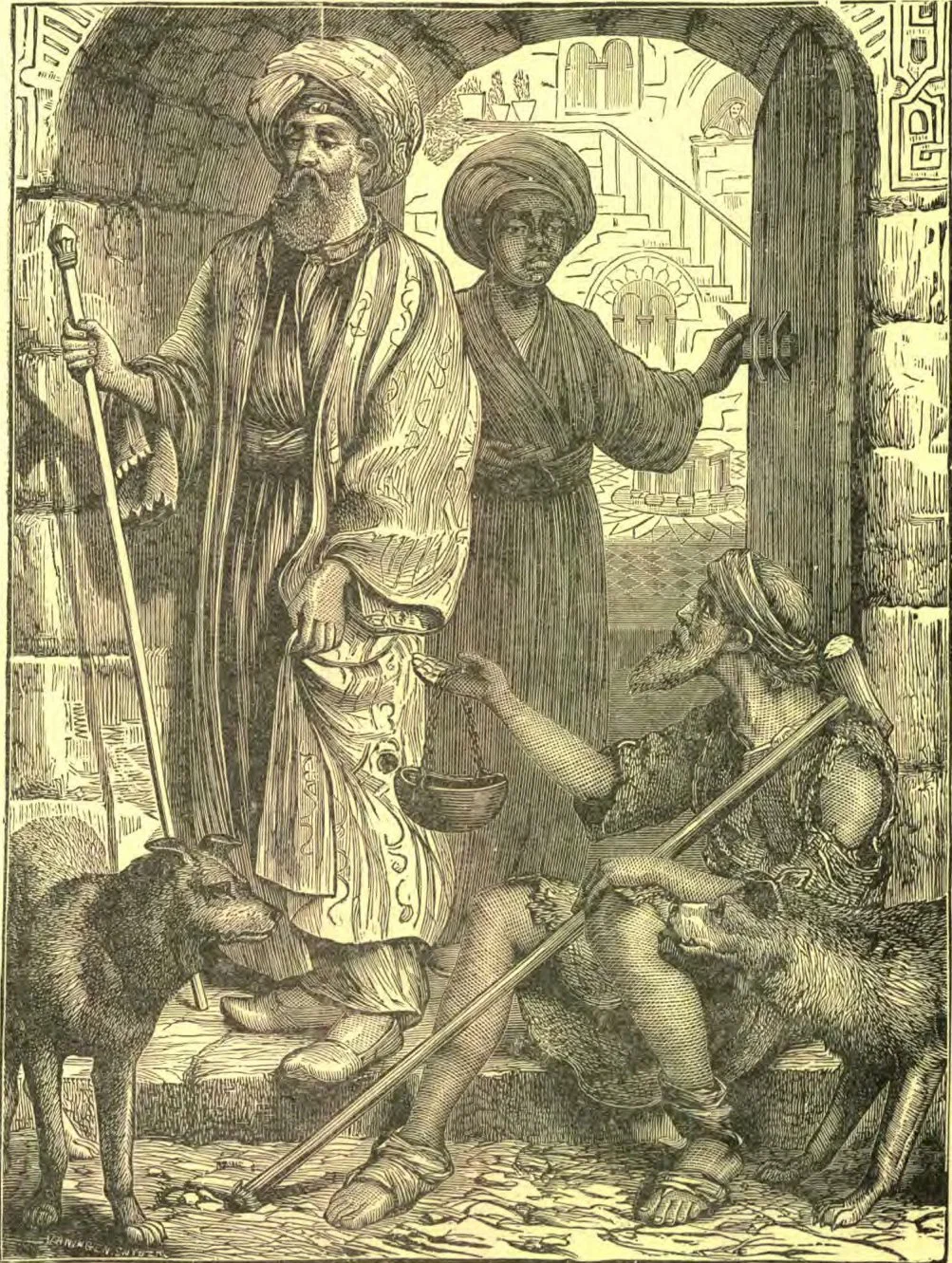
The lessons which we would learn from this story are practical, and not doctrinal. From the dress of the individuals in the engraving, we should judge that the persons were Jews. Perhaps the lordly man in front is some rich Pharisee; for it says in verse 14 of this chapter, “And the Pharisees also, who were COVETOUS, heard all these things, and they derided Jesus.” See how disdainfully he pulls his robe, lest he should be contaminated by the poor figure crouching at his feet! He seems to be a man of consequence, for his Ethiopian servant is at his heels.
The name of the poor cripple is Lazarus, but the rich man’s name is not given. We call him DIVES (pronounced Di’-vĕs,) because in the Latin Testament the word for “rich” is dives. In this we have a fulfillment of those texts which say, the righteous shall be had in everlasting remembrance, but the name of the wicked shall rot. Ps. 112:6; Prov. 10:7.
It is said that the rich man “was clothed in purple and fine linen.” The purple color was worn only by princes, nobles, and those who were very rich. It was exceedingly expensive and very beautiful. The linen here mentioned was one of the finest of fabrics, made from the flax that grows on the banks of the river Nile. It was an Egyptian article, called byssos, and sold for twice its weight in gold. Truly, this great man was clothed gorgeously; but under his purple and linen vestments there was a cold and selfish heart.
It says that the rich man “fared sumptuously every day.” That is, he lived in splendid style, made feasts, had fine equipage, servants, etc., at his command. Probably in the eyes of his neighbors he was a great man; but in the sight of the Lord, he was worse than a beggar.
Poor Lazarus was laid at his gate, and desired the crumbs which fell from the rich noble’s table. These “crumbs” were not the scanty mites of food which occasionally fell from the table at meal-time, but they were pieces of thin, soft bread with which the rich wiped their fingers, before knives and forks were invented, and which were then thrown aside. Lazarus desired merely these cast-off portions; but whether he obtained even these is a question.
The dogs came and licked his festered limbs. These poor canine creatures showed more real affection than the haughty rich man. Probably this refers to the troops of homeless dogs which have no masters, and which are very numerous in Oriental cities, going in packs.
But after all, Lazarus was a very rich man. Poor in this world, but rich toward God. He had faith in God. He trusted in him, served him, and died in hope, and will be raised at the resurrection of the just. The word “beggar,” as applied to him in verses 20, 22, simply means that he was a poor man, but not a beggar in the sense that we now understand the term. The same word is applied to our Saviour, when it says, “Though he was rich, yet for our sakes he became poor.” 2 Cor. 8:9. And again in Luke 6:20: “Blessed be ye poor, for yours is the kingdom of Heaven.”
The name Lazarus is contracted from the Hebrew name Eleazar, and means “one helped of God.” This is certainly a very beautiful name for a poor, trusting child of the Lord.
The rich man also died—died as he lived—without hope. Probably he had a rich funeral, an eloquent oration, great procession, and costly tomb, while poor Lazarus was merely thrown into a pauper’s grave.
But hold, wait a little! The Life-giver comes, the voice of the archangel pierces the galleries of the dead. Now what do we see? Angels of God joyfully bear Lazarus away to Abraham’s bosom, while the rich man, on awakening at the second resurrection, finds himself in the lake of fire. Yes, he who hobbled on crutches in this mortal life now rides in shining chariots, while the selfish rich lord, who spurned the poor object of charity, turning him over to the mercy of the dogs, now prays that Lazarus may be sent with a few drops of water to cool his parched tongue.
Let us learn from the foregoing two important lessons: 1. We must not desire our portion in this life; 2. The poorest child of God may have a hard lot in this world, but in the great day of rewards, “the lame will take the prey.” Isa. 33:23.
G. W. A.

SCRAPS FROM HISTORY.

THE FOUNDING OF THE CITY OF ROME.

As we shall say much in regard to the city of Rome, a few facts concerning its establishment may not be out of place.
If you will look at the map of Europe, you will see that the city of Rome is in Italy, a peninsula of Southern Europe, extending into the Mediterranean Sea. The history of the early inhabitants of ancient Rome is obscured in the darkness of uncertainty, the most that is known being gathered from tradition, which cannot be wholly depended upon.
At an early date, the Latins in the district of Latium in central Italy formed a confederacy of thirty cities, principal among which was the city of Alba Longa. Romulus, who at that time was the chief of a warlike band of men from Alba Longa, founded the city of Rome 752 years before the birth of our Saviour. The city was named Rome in honor of Romulus, who traced with a plow the place of its first walls. He little thought that the city he was founding would at length become the mistress of nations—the capital of the civilized world.
When Romulus and his men first settled the city of Rome, its buildings were mere huts; but several hundred years after, it became famous on account of its splendid public buildings. The city reached the summit of its splendor in the reign of Augustus Cæsar. One historian says that “he found the city brick and left it marble.”
The circumference of Rome inclosed by walls was nearly twenty miles. Outside these walls were extensive suburbs which contained beautiful parks and wide streets shaded by large, spreading trees.
In the next article, we will tell you about the aqueducts and some of the public buildings of Rome. S. H. LANE.

Fords of the Jordan.

In connection with the history of the Jordan, the fords of the river have always been important. The first ford on the southern section of the Jordan, that is, below the Sea of Galilee, is about half a mile from the lake, where the ruins of the Roman bridge now lie. It was the means of communication between Tiberias and Gadara, and it was doubtless at this point that our Lord crossed when he went from Galilee to Judea “by the farther side of Jordan.”
One of the best fords is at Succoth. At this point a barren, sandy island divides the channel, and with its bars on each side forms a ford, probably the one by which Jacob crossed with his family and his cattle, after his interview with Esau, on his return from the service of Laban. We read, too, that he made booths for his cattle at Succoth. This was a wise choice; for no other place in the great plain equals it in richness. This, too, is the “Beth-barah,” “house or ford of passage,” where the Israelites intercepted and slew the Midianites. Gideon passed here in his pursuit of the kings of Midian. He asked the people of Succoth for bread for himself and the people that followed him, as they were faint, but was refused with taunting words. On his return he tore the flesh of the principal men of the city with thorns and briers. Judges 8:16.
It was probably here that the men of Gilead slew the Ephraimites. The men of Gilead fought the Ephraimites because they called them “fugitives of Ephraim,” a term of reproach. “And the Gileadites took the passages of Jordan before the Ephraimites: and it was so, that when those Ephraimites which were escaped said, Let me go over, that the men of Gilead said unto him, Art thou an Ephraimite? If he said, Nay; then said they unto him, Say now Shibboleth; and he said Sibboleth: for he could not frame to pronounce it right. Then they took him, and slew him at the passages of Jordan; and there fell at that time of the Ephraimites forty and two thousand.” Judges 12:5, 6.
The only other fords of note are those in the plains of Jericho, one above and one below the pilgrim’s bathing-place.
E. D. ROBINSON.

WESTWARD BOUND.

Monday afternoon, Feb. 22, in company with several others, we left our home in Battle Creek for a brief visit to California. During the first part of our journey, the weather was as warm and pleasant as in summer. In Nebraska the farmers were plowing for summer crops. Here we saw quite a number of prairie fires. These, of course, were not as large as those which are liable to occur in the fall, when the grass is tall and dry, but as the distant flames lit up the sky, the sight was grand indeed. We noticed that nearly every farmer had protected his house, barn, haystack, etc., either by plowing several strips around them, or by burning the grass close to them.
As we began gradually to ascend the Rocky Mountains, it became colder, until a hail-storm dashed down upon us. This soon turned to snow, which increased till we reached the summit. This point passed, we descended more rapidly, dashing down and around the mountains of Echo and Webber Canyons. The scenery of these canyons is generally admitted to be the grandest of any on the route, while that of the Sierras is the most beautiful. Here the massive rocks tower from five to eight hundred feet above us on either side, standing as perpetual monuments of the Almighty’s power.
After beholding these lofty rocks one can easily understand why they have been the refuge of the persecuted in all ages. Elijah, when his life was threatened by Jezebel, traveled all day and all night until he found a hiding-place in Mount Horeb. David fled from the wrath of Saul to the mountains, where he found shelter in the rocks. And so we might mention many others in more modern times who have sought protection from the rocks. But space fails.
Our train is now climbing up the Sierras, and to-morrow morning about ten o’clock we shall probably be safely landed at our home in Oakland. M. K. W.

LESSONS FOR CHILDREN.

LESSON LXIII.—ELIJAH PRAYS FOR RAIN.

When the people saw this great miracle, they fell upon their faces, saying, “The Lord, he is the God; the Lord, he is the God. And Elijah said unto them, Take the prophets of Baal; let not one of them escape. And they took them; and Elijah brought them down to the brook Kishon, and slew them there.”
“And Elijah said unto Ahab, Get thee up, eat and drink; for there is a sound of abundance of rain. So Ahab went up to eat and to drink. And Elijah went up to the top of Carmel; and he cast himself down upon the earth, and put his face between his knees; and said to his servant, Go up now, look toward the sea. And he went up, and looked, and said, There is nothing. And he said, Go again seven times. And it came to pass at the seventh time, that he said, Behold, there ariseth a little cloud out of the sea, like a man's hand. And he said, Go up, say unto Ahab, Prepare thy chariot, and get thee down, that the rain stop thee not.”
“And it came to pass in the meanwhile, that the heaven was black with clouds and wind, and there was a great rain. And Ahab rode, and went to Jezreel. And the hand of the Lord was on Elijah; and he girded up his loins, and ran before Ahab to the entrance of Jezreel.”
When Ahab told his wife Jezebel what Elijah had done, she threatened to take Elijah’s life. When the prophet knew this, he fled. On reaching Beersheba, he left his servant there, and went on alone a day’s journey into the wilderness. There he sat down under a juniper tree, and asked the Lord that he might die. “And as he lay and slept under a juniper tree, behold, then an angel touched him, and said unto him, Arise and eat. And he looked, and, behold, there was a cake baken on the coals, and a cruse of water at his head. And he did eat and drink, and laid him down again. And the angel of the Lord came again the second time, and touched him, and said, Arise and eat; because the journey is too great for thee. And he arose, and did eat and drink, and went in the strength of that meat forty days and forty nights unto Horeb the mount of God.”
And Elijah lodged in a cave in the mountain, and the Lord appeared unto him, and said, “What doest thou here, Elijah?” Then Elijah told how the people had turned unto idols, and slain the prophets of the Lord; that he alone was left, and had fled to this place to save his life. And the Lord said, “Go forth, and stand upon the mount before the Lord. And, behold, the Lord passed by, and a great and strong wind rent the mountains, and brake in pieces the rocks before the Lord; but the Lord was not in the wind; and after the wind an earthquake; but the Lord was not in the earthquake; and after the earthquake a fire; but the Lord was not in the fire; and after the fire a still small voice.”
Then the Lord talked with Elijah, and told him to go and anoint Hazael to be king over Syria, Jehu to be king over Israel, and Elisha to be prophet in his room. He also told him that there were yet seven thousand in Israel who had not bowed the knee to Baal, and that he would destroy those who had killed his prophets.

QUESTIONS.

  1. What did the people do when they saw this great miracle? 1 Kings 18:39.
  2. What did they say?
  3. What did Elijah tell them to do?
  4. What became of these wicked prophets?
  5. What did Elijah say to Ahab? Verse 41.
  6. What did Elijah then do?
  7. After he had remained thus in silent prayer for a time, what did he tell his servant to do?
  8. What did the servant say when he returned from looking toward the sea?
  9. How many times did the prophet send him on the same errand?
  10. How many times did he bring the same report as at the first?
  11. What did he say when he returned the seventh time?
  12. What message did the prophet then send to Ahab?
  13. How did the Lord answer Elijah’s prayer for rain?
  14. How far did Elijah run before Ahab’s chariot?
  15. How was he enabled to do this?
  16. Who was Jezebel?
  17. What threat did she make, when she heard that Elijah had killed the prophets of Baal? 1 Kings 19:2.
  18. What did Elijah do?
  19. Where did he leave his servant?
  20. Where did he go himself?
  21. Where did he lie down?
  22. What did he ask of the Lord?
  23. What happened as Elijah lay sleeping under a juniper tree?
  24. Why was this same thing repeated as soon as he lay down to sleep again?
  25. How long did he go in the strength of that food before eating again?
  26. To what place did he go?
  27. Where did he lodge?
  28. What did the Lord say to him there?
  29. What reply did Elijah make?
  30. What did the Lord then tell Elijah to do?
  31. What happened as he stood upon the mount?
  32. After the wind, the earthquake, and the fire had passed, how did the Lord manifest himself?
  33. After this, what command did the Lord give Elijah?
  34. How many did the Lord say were left in Israel who had not bowed the knee to Baal?
  35. What did he say he would do to those who had slain his prophets?

BIBLE LESSONS FOR YOUTH.

LESSON LXXXIX.—THE DECLINE OF THE KINGDOM OF JUDAH.

1. How did Josiah lose his life? 2 Chron. 35:20-24.
2. Who was made king in Josiah's stead? Chap. 36:1.
3. How did the king of Egypt interfere in the government of Judah?
4. Who was Eliakim?
5. What change was made in his name?
6. Who came up against Jerusalem during the reign of this wicked king? Verse 6.
7. What action did he take in regard to Jehoiakim?
8. On what conditions did he allow Jehoiakim to reign longer?
9. What and whom did Nebuchadnezzar take to Babylon? Dan. 1:1, 2.
10. Who was among the captives? Verse 6.
11. What noted period began with this action?
12. Describe the character and course of Jehoiakim.
13. How did the Lord try to lead him to repentance and reformation? Jer. 22; 26; 36.
14. How did he treat the prophets who thus tried to help him?
15. What did he do when the chief of the people undertook to have one of the prophecies of Jeremiah read to him?
16. What did Jehoiakim do in the eleventh year of his reign?
17. What consequences followed?
18. How did Nebuchadnezzar fill his place upon the throne of Judah?
19. When and how was Jehoiachin displaced? 2 Chron. 36:10.
20. By whom was he succeeded?
21. How was Jerusalem at this time despoiled by the Babylonians? 2 Kings 24:13.
22. What was the probable number of captives taken?
23. What does the sacred historian say in regard to the classes of persons that were carried away? Verses 14, 16.
24. Did the Lord forget them in their captivity?
25. What help did he give them?
26. Who still declared the word of the Lord in Jerusalem?
27. How long did Zedekiah reign? 2 Chron. 36:11.
28. How did he treat God's prophet, even to the close of his reign?
29. What may be said in regard to the sufferings of Jeremiah?
30. What in regard to his life and writings?

SYNOPSIS

In a battle with Necho, king of Egypt, Josiah was mortally wounded. “Then the people of the land took Jehoahaz, the son of Josiah, and made him king in his father's stead in Jerusalem.” After a reign of only three months, he was put down by the king of Egypt, and Eliakim made king in his stead.
Eliakim was an older brother of Jehoahaz. The king of Egypt changed his name to Jehoiakim. During his evil reign, Nebuchadnezzar, king of Babylon, came up against him and made him prisoner, with the intention of taking him to Babylon; but afterward released him, and allowed him to reign on condition that he would be loyal to the king of Babylon, and be faithful in paying tribute. At this time, Nebuchadnezzar took part of the vessels of the house of God, and also the chief among the people, including some “of the king's seed and of the princes,” and carried them away to Babylon. Among the captives was the youthful Daniel, who afterward became such a noted prophet.
At this time, about 606 years before Christ, began the seventy years of Jewish captivity, foretold by Jeremiah.
Jehoiakim was a very wicked king, and shed much innocent blood in Jerusalem. The Lord sent him many warnings and severe reproofs through the prophets Urijah and Jeremiah; but instead of receiving the reproofs and heeding the warnings, he took the life of Urijah, and would have slain Jeremiah, had not the Lord protected him. When one of the prophecies written by Jeremiah was read before the king, he snatched the roll from the scribe when it was only partly read, and threw it into the fire.
In the eleventh year of his reign, Jehoiakim rebelled against the king of Babylon; and as a consequence, lost not only his kingdom, but his life. Nebuchadnezzar then raised Jehoiachin to the throne, but in a little more than three months, deposed him, and put Zedekiah in his place. At this time the Babylonians took away “all the treasures of the house of the Lord, and the treasures of the king's house, and cut in pieces all the vessels of gold which Solomon king of Israel had made.” It is supposed by some that the whole number of Jewish people taken captive to Babylon at this time, was not less than forty thousand; but Josephus makes the number much smaller. The sacred historian says that “he carried away all Jerusalem, and all the princes, and all the mighty men of valor,” as well as all the craftsmen, and all the smiths, and all that were skilled in war, leaving in the land none but the poorest class of people. Yet even in their captivity the Lord did not forsake his people, but spoke to them by the mouth of the young prophet Ezekiel, while Jeremiah remained in Jerusalem to declare the word of the Lord to the wicked Zedekiah, and his still more unprincipled advisers.
“Zedekiah was one and twenty years old when he began to reign, and reigned eleven years in Jerusalem. And he did that which was evil in the sight of the Lord his God, and humbled not himself before Jeremiah the prophet speaking from the mouth of the Lord.”
The sufferings of this faithful prophet are almost without a parallel in the history of mankind. His life and writings should be studied by every one.

MARCH, AND THE BOYS.

MARCH, you're a jolly old fellow, I know; They may call you a blustering old chap—but you blow For us boys and our kites, and we don't care a fig For the hats and the dust that go dancing a jig.
Puff out, you old fellow, blow hard or blow high, At our kites you may bluster, and “blow them sky-high!” Nobody will find any fault but the girls— And they make a fuss ’cause you “blow out their curls!”
You're just our own season—we've waited for you; Our kites are all ready, so strong and so new! You jolly old fellow, if you were a boy, You'd know why the March-month gives us such joy.
It is fun to stand high on the top of a hill, And pay out your string—let it run with a will; It is fun to “hold hard” while your kite pulls away, And the wind blows a gale! ah, kite-flying is gay.
The ladies complain that you “blow off their veils;” But never you mind, give no heed to their tales, Devote yourself wholly to boys and their kites, And trust to the boys to fight hard for your rights:
For, March, you're the jolliest old fellow we know, And we like you the better the harder you blow! When you marched in upon us we gave you a shout, And we'll miss you at last when ’tis time to march out!—Wide Awake.

LETTER BUDGET.

LEROY, MICH.
DEAR EDITORS: I have seen a great many letters from little girls about my age, so I thought I would write one. I am nine years old. I go to school every day. My studies are reading, spelling, and arithmetic. I have two sisters, May and Myrtle. We have no Sabbath-school here. I have taken the INSTRUCTOR for a year, and like it very much. I want to be a good girl and meet the INSTRUCTOR family in Heaven. Please pray for me.
Yours truly, LYDIA A. DURKEE.
Lydia, we are glad to learn that you like the INSTRUCTOR, and we hope that it will help you to be a good girl, by teaching what is right, and how to do right.
FAIRVIEW, CAL.
DEAR EDITORS: I am seven years old. This is my first letter. I keep the Sabbath, and go to Sabbath-school with my sister and brothers. Pray for me.
ELIZA HUTCHINGS.
This is a nicely printed letter, and we shall be glad to hear from you again, Eliza.
ST. CHARLES, MICH.
DEAR EDITORS: I am nine years old. I take the INSTRUCTOR, and like it very much. I go to Sabbath-school with my mother, who is a teacher with twelve scholars. My grandmother, my mother, and myself are all that keep the Sabbath in our family. I try to be a good boy, obey my father and mother, and keep all of God’s commandments. I want to live in such a way that my parents will love me and the Saviour will love me and take me to Heaven when he comes to this earth after the saints. I hope to meet all the INSTRUCTOR family in Heaven.
ELMER J. ORTON.
We are glad to learn that you are trying to be an obedient boy. We say amen to the hope of meeting all the INSTRUCTOR family in Heaven.

STANDING FOR THE RIGHT.

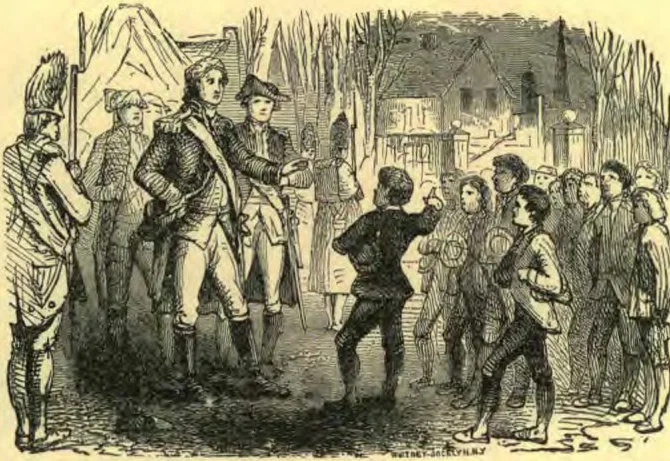
WHAT do you suppose that boy in the picture is talking about, that he dares to stand up so boldly before the great general? He seems to be very much in earnest, and the boys behind him are all looking to see what the general will say about it. The fine-looking officer is General Gage, who commanded the British troops that were in Boston just before the Revolutionary war. The boys are the sons of the people who lived in Boston, and they have come to complain of the soldiers who had torn down their snow forts and houses on the common, and called the boys little rebels, because their parents were in favor of liberty.
The boys were very bold to come before the general with such a complaint, but they knew they were in the right, and that took away all their fear. The general was so much pleased with their courage that he gave orders to his soldiers to let the boys and their snow forts alone.
I hope all the INSTRUCTOR children will remember that when they stand for the right, they need never fear, and may always be bold in the Lord; for if he is for us, he is more than all that can be against us.
W. C. G.

THE PROPHET JEREMIAH.

Jeremiah was one of the most distinguished prophets mentioned in the Sacred Records. He lived some 600 years before Christ. His native place was Anathoth, a small town situated not far from Jerusalem, and belonging to the tribe of Benjamin. He was of the tribe of Levi, and of the family of the priests.
At an early age he was called to be a prophet; and in the reign of the good king Josiah, he began to prophesy. In him, the youthful and pious king must have found not only a congenial friend, but a strong helper in his work of ridding the land of its idolatries, and establishing the down-trodden worship of the true God. We may imagine the grief of the prophet at the sudden and untimely death of his beloved king, the sole prop and pillar of God’s cause in the land. There is a great fullness of meaning in the simple words of the record, “And Jeremiah lamented for Josiah.” Josephus says, “And Jeremiah the prophet composed an elegy to lament Josiah, which is extant to this time also.” Not tenderer nor more touching are the words of David for Jonathan, than must have been the lament of the prophet for his friend.
It was doubtless a source of much grief to Jeremiah to see the sons of Josiah forsaking the God of their fathers, and, with the people, turning again to the abominations which had been cast out of the land. The prophet did not, however, leave the people unwarned in regard to the consequences of their wicked course. He told them that unless they repented, the king of Babylon would come and destroy their city, and take them away captives; but he seemed to them as one that mocked, and they heeded him not. He suffered terrible persecutions at the hands of these wicked kings; and even when his prophecies were fulfilling before their eyes, they refused to listen to his advice. Jehoiakim burned the roll of the prophet, to show his utter contempt of the prophecies written therein. Zedekiah, yielding to the clamors of the people, allowed him to be cast into a loathsome pit, where he sank to the neck in the mire; and here he would have perished, had it not been for the kindness of the Ethiopian who appealed to the king in his behalf. Jeremiah was then drawn up from that horrible place, although he was still kept in prison. But for all this ill usage, he did not cease to declare unto his people the word of the Lord.
When Nebuchadnezzar finally destroyed Jerusalem, and carried away most of the people, he gave commandment that Jeremiah should be kindly treated; and Josephus says that he had his choice between going to Babylon in honor, or remaining in Judea. He chose the latter, going with the remnant of his people to Mizpah, whence they fled from Jerusalem. There he continued to warn and instruct the people, telling them that if they obeyed the word of the Lord and remained in Judea, they should be protected. But in spite of all the prophet could say against it, they persisted in going to Egypt, carrying him with them. They came to Taphanhes; and there Jeremiah dwelt with them, faithfully advising and reproving them until the end. We have no certain knowledge of the fate of this remarkable prophet; but tradition says that his countrymen, offended by his plain testimony, finally put him to death.
There is probably not on record another such example of faithfulness, devotion, and patience under continued persecution, as that of Jeremiah. He is sometimes called the “weeping prophet,” and he certainly had reason to weep. For more than forty years he steadfastly maintained the cause of truth and of God among his rebellious people. Though naturally mild, sensitive, and retiring, he shrank from no danger when duty called; threats could not silence him, nor ill-usage alienate him. Tenderly devoted to his countrymen, he shared with them the woes which he could not induce them to avert. E. B.

You have reached the end of this edition.

The Youth’s Instructor · Mar 10, 1880