We find the following forcible truths expressed in a little volume entitled “The Baptism with the Holy Spirit,” by R. A. Torrey (F. H. Revell & Co., Chicago). They appealed so forcibly to our heart, that we gladly take the liberty to place them before our readers for their earnest consideration:—
“If ye then, being evil, know how to give good gifts unto your children: how much more shall your heavenly Father give the Holy Spirit to them that ask him?” The asking of this verse is the asking that springs from real and intense desire. This is brought out by the context: “Ask, and it shall be given you; seek, and ye shall find; knock, and it shall be opened unto you.” Note also the parable of the importunate friend that immediately precedes. Evidently the asking that Christ has in mind is not the asking of a passing and half-hearted whim, but the asking of intense desire. There is a very suggestive passage in Isaiah, the forty-fourth chapter and third verse: “I will pour water upon him that is thirsty. . . . I will pour my Spirit upon thy seed.” What does it mean to be thirsty? When one is thirsty, there is but one cry: “Water! water! water!” Every pore in the body seems to have a voice, and cry out “water.” So when our hearts have one cry, “The Holy Spirit, the Holy Spirit, the Holy Spirit,” then it is that God pours floods upon the dry ground, pours his Spirit upon us.
To what a pitch of longing the early disciples had been brought by the tenth day of their eager waiting, and their thirsty souls were filled that day when “Pentecost was fully come.” As long as one thinks he can get along somehow without the baptism with the Holy Spirit, as long as he casts about for something in the way of education or cunningly concocted methods of work, he is not going to receive it. There are many ministers who are missing the fulness of power God has for them, simply because they are not willing to admit the lack there has been all these years in their ministry. It is indeed a humiliating thing to confess, but that humiliating confession would be the precursor of a marvelous blessing. But there are not a few who, in their unwillingness to make this wholesome confession, are casting about for some ingenious device of exegesis to get around the plain and simple meaning of God’s word, and thus they are cheating themselves of the fulness of the Spirit’s power that God is so eager to bestow upon them; and, furthermore, they are imperiling the eternal interests of the souls that are dependent upon their ministrations, that might be won for Christ, if they had the power of the Holy Spirit which they might have.
But there are others whom God in his grace has brought to see that there was a something their ministry lacked, and this something nothing less than that all-essential baptism with the Holy Spirit, without which one is utterly unqualified for acceptable and effective service; and they have humbly and frankly confessed their lack; sometimes they have been led to the God-taught resolution that they would not go on in their work until this lack was supplied; they have waited in eager longing upon God the Father for the fulfilment of his promise, and the result has been a transformed ministry for which many have risen to bless God.
It is not enough that the desire for the baptism with the Holy Spirit be intense; it must also have the right motive. There is a desire for the baptism with the Holy Spirit that is purely selfish. There is many a one who has an intense desire for the baptism with the Holy Spirit simply that he may be a great preacher, or great personal worker, or renowned in some way as a Christian. It is simply his own gain or glory that he is seeking. After all, it is not the Holy Spirit that he seeks, but his own honor and the baptism of the Holy Spirit simply as a means to that end. One of the subtlest and most dangerous snares into which Satan leads us, is that where we are seeking the Holy Spirit, this most solemn of all gifts, for our own ends. The desire for the Holy Spirit must not be in order to make that sublime and divine Person the servant of our low ends, but for the glory of God. It must arise from a recognition that God and Christ are being dishonored by my powerless ministry and by the sin of the people about me, against which I now have no power, and that he will be honored if I have the baptism with the Spirit of God. One of the most solemn passages in the New Testament bears upon this point (Acts 8:18-24, R. V.): “When Simon saw that through the laying on of the apostles’ hands the Holy Ghost was given, he offered them money, saying, Give me also this power, that on whomsoever I lay my hands, he may receive the Holy Ghost.” Here was a strong desire on Simon’s part, but it was entirely unhallowed and selfish, and Peter’s terrific answer is worthy of note and meditation. Is there not many a one to-day who, with equally unhallowed and selfish purpose, desires the baptism with the Holy Spirit?
“LABORERS TOGETHER WITH GOD.”
By J. B. Scott
BY ELDER J. B. SCOTT.
(Shamrock, Wis.)
Doubtless many ask themselves the question: How can the officers and members of our churches co-operate with the ministers and other workers in the salvation of souls? None need remain in darkness on this point. We learn from late testimonies that the workers should not spend so much time with the churches as some have been doing, but should go out upon the cold, dark mountains, seeking the lost, that, like the Good Shepherd, they may bring the wanderers out of the cold and danger. As they come in, they will need a warm place and tender care. Therefore our churches should be in the best condition possible. A good fire should be burning upon the altar of every heart, with an abundance of the bread of life and a supply of the living water freshly drawn from that fountain of which Jesus spoke to the woman as he sat at Jacob’s well.
God desires to divide the work equally among the workers, giving to “every man his work,” that all may share in the precious rewards he is to bring with him at his coming. When I was a boy, and at work out in the cold until late in the evening, my dear mother used to keep the supper and room warm for me, and place invitingly in the window the brightly burning lamp, which, long before I could discern the outlines of the old home, told me in the silent language of its flame that a welcome warm and full awaited my coming.
Now, dear brethren and sisters, this is the spirit God wishes us to manifest in laboring together; let the fires of love be kept brightly burning in every heart, and watch to receive, with outstretched arms, those whom the under-shepherds bring home to the fold, as well as those whom the church should be drawing to Christ through her own efforts. And then, in the meekness and gentleness of Christ, fill the church home with such sweet and hallowed influences that none would ever desire to venture again out upon the cold, barren wastes of sin and unbelief. Not until the final redemption shall we fully realize what it means to be laborers together with God, and how it is that he has given to every man his work.
OLD ROME.
By M. B. C.
BY M. B. C.
Rome, of all the cities of the world, has made the most history. She was the seat of the greatest military despotism of the world, the capital from which all nations were ruled. Rome was also the seat of what she attempted to make the universal religion, and whoever differed from her tenets, went to the beasts, and made an idle hour amusing to an idle populace. When Rome had killed whom she might kill of all the differing sects, she changed her religious garments, and again began to kill. The people must be amused; and the great Colosseum still stands to remind the world of the former days. Rome is a city of memories.
But if ancient Rome is interesting from an artistic and historical point of view, modern Rome is no less so — if there be such a thing as modern Rome. There are new buildings in Rome, built in modern style; but still there is enough of the masonry and architecture of pagan times remaining to make one feel when there as if he were living back in the days when history was a making. There are some quarters in Rome where modern thought and nineteenth-century life would be as little understood as would be Sanskrit. The people of at least one quarter of the city pride themselves on having kept pure the traditions and blood of their forefathers of great Caesar’s time. The world to them is Rome, and all people but Romans are barbarians. They live in medieval homes, and their feet press the ancient paving-stones. If they themselves were the ghosts of their ancestors who saw Brutus slay Caesar, they could not feel very strange in their Rome to-day.
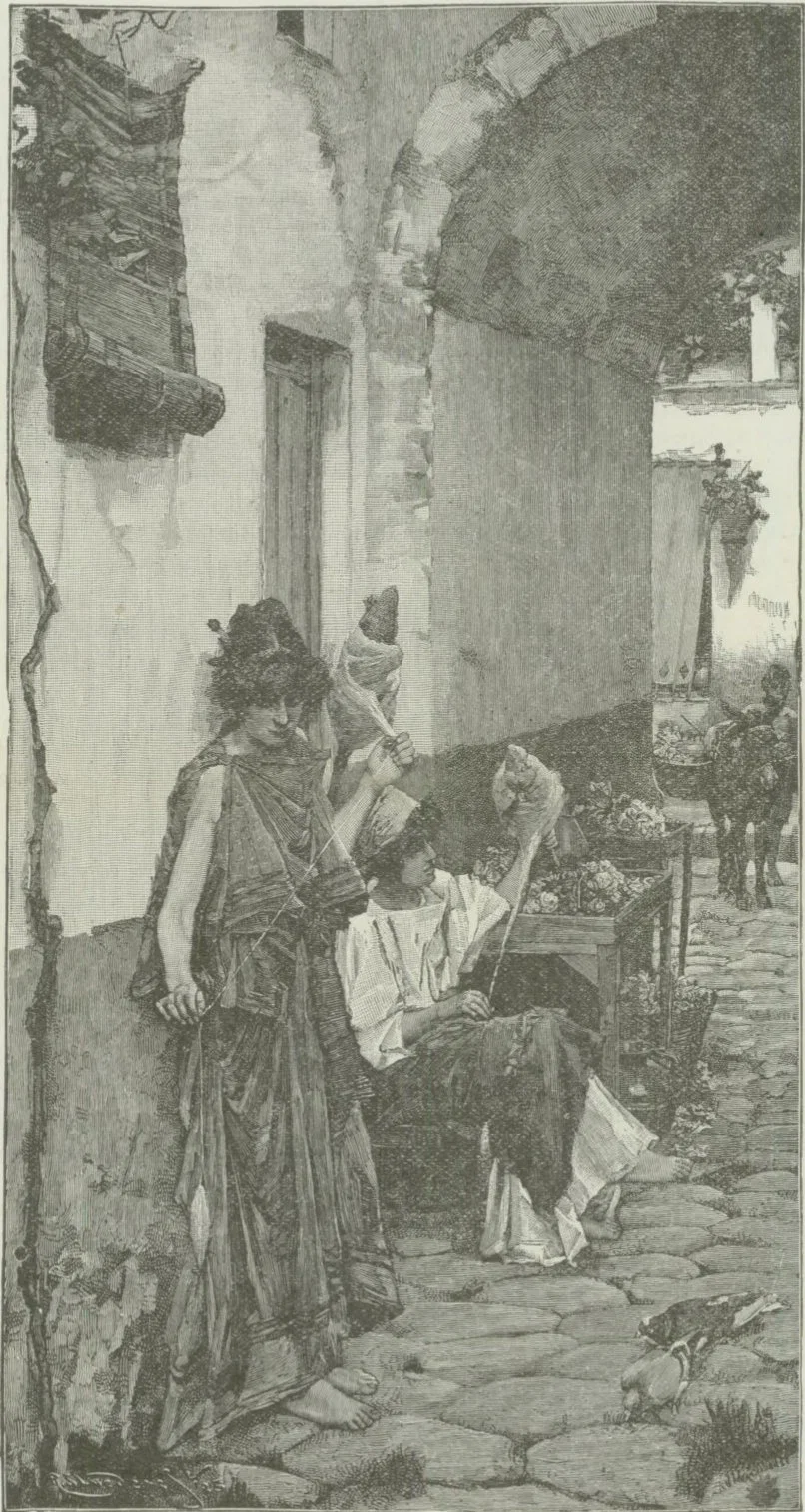
The Roman maidens sit along the walls by their fruit stands, and spin flax in the intervals of trade; but their primitive life and untaught thoughts make them very shy of the strangers who stray into their narrow, winding alleys. They hide in their homes, and will not be seen. The only way missionaries or any one else could reach these people would be by doing in that particular quarter of Rome as that particular class of Romans do. As these children of a past age could not understand our every-day thoughts (for while we may know something by tradition and history of their life, they cannot jump down into ours), whoever goes to them must go with the manners and thoughts of the time when Christ taught in Galilee, and sent out his disciples to teach the Gentiles.
THE DOCTOR AND HIS PATIENTS.
By John Harvey Kellogg
FROM SANITARIUM PARLOR TALKS BY
J. H. KELLOGG, M. D.
(Reported by David Paulson, M. D.)
Question.— Of what does the deposit on a coated tongue consist?
A BY-WAY IN OLD ROME.
Answer.— It consists of germs and molds. It is a growth of fungi very closely allied to the mold that grows on the wall. It grows more upon the tongue than anywhere else in the body, because the tongue is exposed to the air, and the germs are brought in by the air and deposited upon the tongue, and the moisture which is constantly maintained in the mouth promotes the growth and development of germs. It seems to be a surprise to some people to learn that the coating on the tongue is allied to toadstools, mushrooms, etc. I don’t object to people’s making the discovery, because then they will be likely to get rid of the coating as quickly as possible. One day I planted a little of the coating from a man’s tongue on a sterilized potato, and covered it with a bell jar. In a few days the man came in to examine the potato, and found a growth on the potato like that on his tongue.
This growth, as I have said, is due to germs brought into the mouth by the air; but when the mouth is in a healthy condition, these germs disappear, because nature has supplied a disinfecting mucus. The mucus which is secreted in the nose is capable of destroying germs. The mucus which is secreted in the eyes destroys germs; the eye is protected in this way until the mucous membrane becomes diseased, so that the glands do not secrete healthy mucus.
These same germs which are found on the tongue are found in the stomach, because the saliva which contains germs is carried down into the stomach; and if the stomach does not make gastric juice strong enough to destroy the microbes, they gather in the stomach. That is the reason some persons have the heartburn, butyric acid and lactic acid fermentations taking place in the stomach. The one thing to do is to keep the mouth clean. There are many persons suffering from mouth and stomach indigestion, because they don’t take good care of the mouth.
I might tell you of an experiment made by Dr. Sternberg, of Washington, after an outbreak of yellow fever in the South. He had been down in New Orleans investigating yellow fever, and he set out to find, if possible, the yellow fever germ. He examined every nook and corner of New Orleans to find the germ of yellow fever, but he didn’t find it. When he got back to Washington, he tested his own saliva to see if he had in it any of the germs which abounded in New Orleans. He took a drop of his own saliva, put it in a test-tube with a little beef tea, and let it grow a few days. He then injected some of that growth into a rabbit, and it promptly died. He tried it again with the same effect. Then he became somewhat alarmed. He then extended his investigations, and found that when grown in beef tea the saliva of a majority of people would kill a rabbit.
The housewife raises her bread at blood heat. At that temperature the bread rises rapidly, and if kept there too long, emits a bad odor, and after a few hours it becomes putrescent, and begins to fall. Now the same thing would happen to this bread inside the body unless there was something to prevent it. Down in the stomach the gastric juice prevents this destructive process; then the intestinal juice of the small intestines, and the bile, have an antiseptic effect, and preserve the food. But in the mouth there is no preservative except the saliva, and the saliva has no preservative power,—at least not to any great extent in the mouth. The first germs discovered in a person were discovered in the mouth. That was a long time ago, and before bacteriology was taken up. The man who invented the microscope found some germs in the mouth, some in the tartar about the teeth, and some in the mucus. If you will examine, by the aid of182the microscope, a little of the substance which collects around the teeth and gums, you will find that “there are millions in it.” Now here is a man who comes to the table and eats his breakfast, and swallows all this mass of germs. If the gastric juice should destroy these germs, there is a new supply of germs the next day, so the stomach cannot get into a clean and healthy state. So if a person wants to have his stomach clean, he must keep his mouth clean. He must first cleanse his mouth in the morning. He should cleanse it before breakfast and before dinner, before he eats and after he eats; and he should take great pains not to eat food that is filled with germs.
Cheese swarms with germs. Every kind, almost, is to be found in cheese, unless it is too old, when the odor of the cheese and the quality of it is too much even for consumption germs; but they have been found in cheese after three months. The same is true of milk unless it has been sterilized, and possibly of water, unless it comes from a good source or has been sterilized. In washing the mouth, the teeth and the tongue should be cleansed as well. A tooth-brush with a little fine Castile soap is an excellent means of cleansing the teeth; there is nothing better than this, with clean water. One should disinfect also the back of the throat, and the whole of the oral cavity, so that it will be thoroughly clean. It would be a good plan to wash the mouth with a teaspoonful of cinnamon essence in a half a glassful of water, swashing the water about until it has gone everywhere through the mouth and throat. It is well also to use a little carbonate of magnesia, and a little precipitate of chalk is good if you want to cleanse the mouth thoroughly.
Q.— How about listerine?
A.— That is wholesome; it is a watery solution of antiseptics, but it is no better than cinnamon essence. The oil of cinnamon is not destructive to germs unless it is taken in a very concentrated solution, but it has the effect of preventing the germs from growing. If you discourage the germs from growing and keep your mouth clean, the result will be satisfactory.
Q.— What about peroxid of hydrogen?
A.— It is very good; but if it is exposed, it will very soon be converted into oxygen.
Q.— What is the effect of a cholagogue?
A.— The effect of a cholagogue is to destroy the coating on the tongue. Cholagogue is an antiseptic; but suppose a person takes a cholagogue,—a dose of calomel. The tongue gets cleaner, for the calomel is an antiseptic, and when in contact with the chlorin of the gastric juice, a small portion of this calomel is converted into corrosive sublimate, and this is a very powerful disinfectant. However, I don’t use calomel for this purpose, except in extremely small doses. It is very bad to get into the habit of using it, especially in the old-fashioned way,—in ten-grain doses, for instance. A large part of it is retained by the liver, and causes it extra work.
Q.— Is “cottage cheese” nutritious?
A.— Yes, provided it is properly made. It ought to be sterilized, however. In making cottage cheese the milk should be scalded, so that the germs would be killed. Cottage cheese when made in this way is more wholesome for many people than is milk in the ordinary form.
Q.— What are the antitoxins? Are they a part of the body, or are they an organism within the body?
A.— “Antitoxins” is a name applied by bacteriologists to substances which are formed in the body to neutralize the toxins previously formed in the body. Pathological microbes in the body, when they first form toxins producing a fever (typhoid fever, perhaps), at a later period produce antitoxins. When a person is infected with typhoid fever germs, they produce a sickness—a fever; after a while other germs are associated with them which neutralize the first toxins. That is nature’s method of limiting the action of germs. Otherwise in twenty-four hours we would have a million raised to the fifth power, and then multiplied by a thousand or a trillion squared, and then multiplied by a million. You see at this rate we should soon be overwhelmed by germs. Animal life would also be swept off the face of the globe, if it were not for nature’s method of limiting the power of these deadly enemies of the human race and of animal life.
HERE AND HEREAFTER.
By L. D. Santee
BY ELDER L. D. SANTEE.
(Princeville, Ill.)
The hills give their streams to the ocean,
The billows roll in from the sea,
And my soul with a tender emotion,
Muses oft on the glories to be;
And like those bright streams in their welling,
Or the waves that strew sands on the beach,
There's a joy in my heart beyond telling,
Beyond language or speech.
Though I walk in the pathways of danger,
I shall rest in the garden of God;
I shall there feel at home, not a stranger,
Where the footsteps of sin never trod;
Where the sweet face of youth ne'er grows older,
And the flowers of heaven never fall;
Where the warm hearts of friends ne'er grow colder,
But love governs all.
How many the families severed,
To meet upon earth not again,
But nearing the glorious forever,
Where is recompense sweet for all pain,
Let us help, let us pray, for each other,
In this world of temptation and sin,
That the children and father and mother
Be all gathered in.
I think of the promises gracious,
That free from the thraldom of wrong;
Of the home,—“many mansions,”—so spacious,
Reserved for the glorified throng;
And like the bright streams in their welling,
Or the waves that strew sands on the beach,
There's a joy in my heart beyond telling,
Beyond language or speech.
HABITS IN CHILDHOOD.
By Mrs. E. M. Peebles
BY MRS. E. M. PEEBLES.
(Cincinnati, O.)
It is easier than most people imagine to keep the little ones from forming unpleasant habits. For instance, that most disagreeable habit of crying, that is so common, can, in most cases, be avoided. The mother of John Wesley, who had a large family to care for, is said to have had such excellent management that she could say, “That odious noise of the crying of children is seldom heard in our house.”
It is true that the poor little creatures who find themselves entirely out of joint with the world in general, and their own existence in particular, are certainly deserving of our sincerest pity, and it is to be hoped that their lives will be cheered and brightened by love and kindness; but to speak on true general principles, the actual needs of the little one should be attended to before it becomes fretted and impatient. Often, however, the mother or nurse is busy when it begins to make its wants known, so they are not attended to. The demonstrations are finally more decided, and at last he is obliged to make himself heard; then some one comes to the rescue. This process continues until the habit is established, and he cries for everything he needs and everything he happens to fancy, and the whole household is rendered uncomfortable.
The better, and in the long run the easier, way would have been to care for him properly at first, and then never to grant a request if he cried, until his pet was over, and he could ask cheerfully. Show him that a bright, pleasant face will bring about his wishes if they are proper, and he will very soon profit by his experience. Then as he grows older, the polite “thank you” and “if you please” will come naturally and easily, instead of the rough, commanding way so often seen both in children and in older people.
A quiet, well-regulated home where love is the ruling principle, and where obedience is prompt and cheerful, is a little heaven on earth; but of course it needs great wisdom and patience on the part of the older members to make it so. The principles of obedience, however, can be instilled into the minds of the little ones at a very early age. They know more than we usually give them credit for knowing, and quickly discern whether or not mama and papa mean just what they say. Children can read the expression of the face, and understand the tone of the voice. The habit of prompt and cheerful obedience will save both parents and children a world of trouble. “Obedience is the child’s religion,” and is certainly the basis of Christian experience, so that those children who are taught to obey without questioning will be much more likely to yield obedience to the Father above.
Parents should realize that they stand in place of God to their children, and that the things which endure only for a day, as it were, and then pass away and are forgotten, are very insignificant when compared to the care and discipline of these priceless treasures that have been intrusted to them; they should realize that they may be the means, with the blessing of God, of fitting up jewels that will shine in the kingdom of God throughout the ceaseless ages of eternity. O sacred work! O holy commission! How few realize its importance!
THE INDIANS OF CENTRAL AMERICA.
From an article in the Missionary Review, by C. I. Scofield, with the above heading, we take the following excerpts:—
“The entire population of the five Central American republics approximates 3,250,000, distributed as follows: Costa Rica, 243,205; Guatemala, 1,471,025; Honduras, 431,917; Nicaragua, 312,845; Salvador, 777,895. Speaking broadly, this population is composed of pure whites, inconsiderable in number, but of great influence; pure Indians, of whom hereafter; and mestizos, or people of mixed white and Indian blood, and these are in numerical majority over both the other classes. In religion, the whites and mestizos are Roman Catholics but with this qualification,—the better educated of both classes are deeply tinctured with modern forms of skepticism, open infidelity, and spiritism. Alienated from the traditional faith by the shameless lives of many of the priests, and by the childish superstitions which they impose upon the people, and knowing little or nothing of the simplicity that is in Christ, they follow the unfaith of the German, Swiss, and French instructors in the state colleges. The number of those of this class who have already been converted affords proof of the readiness with which they will hear the pure gospel.
“In some parts, notably in Nicaragua, the Indians have practically lost their tribal organizations, and have not only merged with, but actually compose the mass of, the population. Of this class the Masaya, Matagalpa, and Ometepe Indians of Nicaragua are examples. In every political and religious sense they are indistinguishable from the mass of the Central American peoples. From them come many of the priests, of whom their towns are full, and they are the soldiers and minor officials of the republic. In Nicaragua the only distinctively Indian tribe is the Mosquito, among whom the Moravians have long conducted a heroic and fruitful work.
“Beginning with the southernmost of the republics, Costa Rica, the expedition visited the Chiripo, Talamanca, Tucuriqui, and Coj tribes. The interesting Chiripo Indians, who furnished the first-fruits unto God from the aborigines of Costa Rica, inhabit a high, mountainous region in east-central Costa Rica, which is accessible only by narrow paths through the dense tropical jungle, and across rivers which are deep, swift, and destitute of bridges.
“The Chiripos were found to be about five hundred and twenty in number; to have a well-defined tribal organization, with first and second chiefs, whose authority within traditional lines is absolute; to live in scattered habitations simply built, with roofs of grass thatch; and to subsist in part by small cultivations, but mainly by hunting, fishing, and by the natural growths of edible fruits and vegetables. In character they were found to be suspicious of whites; but, their confidence once gained, they are open, cheerful, and hospitable. They seem to be almost destitute of religion, having turned from their immemorial idolatry without having been as yet indoctrinated with the corrupt form of Romanism prevalent in Central America.
“The numerous and degraded tribe of the Talamanca Indians, living in the low-lying lands and foothills of southeastern Costa Rica and northeastern Colombia, present in most respects a striking contrast to the Chiripos. There is some affinity in the languages of these two tribes, but they are otherwise most dissimilar. The Talamancas are about two thousand in number; live in clusters of huts, which are little more than thatched roofs; avoid contact with the whites, from whom, in the persons of runaway183sailors, rubber-hunters, and cattle thieves, they have suffered unspeakable outrages. They have a tribal organization, but a representative of the government lives among them, and is the real ruler. Some slight attempts at the most primitive agriculture are made; but the Indians subsist principally on fish, wild animals, and wild fruit. Very few of them speak Spanish. To the vices of heathenism have been added nameless degradations, brought in by the bestial whites who have been among them. Fortunately the rubber trees have mostly disappeared, and they are now spared the incursions of the rubber-hunters, who are to the Indians of Central America what rum-traders are to the native African. The climate is trying and dangerous. Fevers prevail,—even the Indians having no immunity,—and poisonous serpents are numerous. Yet these conditions have not prevented the residence in Talamanca of white persons, impelled by greed or lust, and it cannot be conceded that the trader can go where the missionary cannot.
“The Tucuriqui Indians, numbering some five hundred, live in a river valley in eastern Costa Rica, and may be reached on horseback by a ride of seven miles from the railway station of Tucuriqui, on the railway connecting San José with Port Limon. They are settled in one village, have some slight admixture of Spanish blood, and are mostly nominal Romanists, and are visited at intervals by priests from Cartago. The climate is good, if care is taken about exposure to night air. The elevation above the sea is about twenty-five hundred feet. No missionary has ever resided among them. Who will go?
“The Coj Indians, inhabiting the very high lands of central Costa Rica, have a considerable mixture of Spanish blood, live by agriculture, are nominal Romanists,—and inclined to be fanatically so,—and have almost lost the native language, speaking Spanish instead. They are reached with comparative ease, except for the last few miles of the journey, which is a mere trail through the jungle. They number about twenty five hundred. They have no distinctively tribal organization, and have a resident governor. No missionary has gone to this tribe.
“The Guatosos Indians, numbering perhaps twelve hundred, and living for the most part along the Frio River, in northwestern Costa Rica, are reported by Mr. Dillon to be most pitifully in need of the gospel—the dirtiest and lowest of all the Indians whom he visited. Very few of them speak Spanish; they have had no chief for thirty years, and are so remote, degraded, and useless that the government has been able to accomplish but little in their behalf. For two hundred years they were able to resist the incursions of the whites, killing even priests in their efforts to penetrate their country; but the rubber-hunters—those pitiless scourges of all tropical America—overran and subdued them, and taught them the unspeakable vices of the degraded white man. Now their spirit is thoroughly broken, and the country is defended only by its inaccessibility. Perhaps no natives in all America have suffered more from the whites than these Indians; but once assured that the expedition meant good and not evil toward them, they were found to be friendly and hospitable. Their religion is a rudimentary belief in a future state, and they are wholly uncorrupted by debased forms of Christianity. Of the many routes by which this tribe may be reached, the best, all things considered, is up the river Frio from Lake Nicaragua by canoe. Under favorable circumstances, the trip can be made in five days from the mouth of the river. This tribe was visited in March, 1895, by Mr. William A. Arthur, of Philadelphia, who has since founded the Central American Industrial Mission.
“What has been said above of the Indians of Nicaragua will, in the main, apply to the Indians of Salvador. Indians of pure blood form the bulk of the population. They have no tribal organization, and are, in fact, the people, though neither so well educated nor so influential as the whites of pure blood among them. They are the laborers, soldiers, petty officials, and agriculturists of the country. In religion they are fanatical Romanists. To the lasting disgrace of this great Protestant land be it said, there has never been a resident missionary in this republic. The population is dense, eight hundred thousand living in a territory of twenty thousand square miles. In the capital and larger towns a liberal element is found, which earnestly desires that missionaries be sent.”
USELESS APOLOGIES.
By Vesta J. Farnsworth
BY MRS. VESTA J. FARNSWORTH.
(College View, Neb.)
There are times in every housekeeper’s experience when her home is not in the best condition to receive callers. Circumstances may prevent her work being done at the time or in the manner she would wish. Just then some friends come for a call or visit. What shall she do?
Some are so anxious to appear at their best that their annoyance at having callers at such times takes away all the pleasure they would otherwise derive from their visit. Others will begin a lengthy explanation as to why everything is not in apple-pie order, and call the attention of the visitor to different parts of her work which are yet undone. Others seize the broom and begin sweeping so vigorously that the room is filled with dust, and the caller is tempted to ask for a suspension of operations till after his departure.
If a visitor comes unannounced to dinner, he is sometimes compelled to listen to a constant stream of remarks and apologies concerning the food. This article was overbaked, the other underdone. If excuses would remedy defects, it would be well to make them; but they never do. The conscientious housekeeper will do her work every day in the best manner possible. If her friends call, she will take it for granted that they came to see her, and not to criticize her housekeeping. The time of their stay will not be taken up with worse than useless apologies, and her annoyance at disorder of any kind which is unavoidable, will not be so manifest that her visitors will regret that they came at all. At the table the conversation will be such as to divert attention from the accident which has spoiled the flavor of some favorite dish, or will make up in a large degree for the common fare. The wise housekeeper, who possesses tact, will not continually apologize and deprecate, and thus call attention to that which would otherwise pass unnoticed.
The following sensible advice on this point, taken from the Boston Herald, is worth reading and heeding: “A young married woman was visited by an older and more experienced one. When the visitor arose to go, the hostess came with her to the door, and out upon the pleasant piazza, which, however, looked a little dusty in the corners. ‘Oh dear,’ said the young wife, ‘how provoking the servants are! I told Mary to sweep the piazza thoroughly, and now look how dusty it is.’ ‘Grace,’ said the older woman, looking into the disturbed young face with kindly, humorous eyes, ‘I am an old housekeeper. Let me give you a bit of advice: Never direct people’s attention to defects. Unless you do so, they will rarely see them. Now, if I had been in your place and noticed the dirt, I should have said, “How blue the sky is!” or, “How beautiful the clouds are!” or, “How bracing the air is!” Then I should have looked up at that as I spoke, and should have gotten you safely down the steps and out of sight without your seeing the dust.’”
This advice does not apply to those whose homes are always disorderly. They would better reform by being more careful every day, trying to have their work done all the time as they would if callers were expected. In this way they will be prepared to receive their friends, and they will not need to resort to apology.
BUT
Of all the detestable thieves in this wicked world, that word “but” is the worst. Of course the word itself is only what we make it. It is often slipped in at the close of what would otherwise be an expression of noble-hearted benevolence and kind appreciativeness, where it plunders and robs all that precedes it of every particle of virtue, and stamps on the speaker the brand of cowardice and insincerity. How often we hear, “Neighbor A. is a real good man; I believe his intentions are the best. He is kind in his family; he is honest in his deal; he tries to live as a Christian; but—” Without that last word, that would be a noble speech, but that word is a cruel thief. It takes away every shred of comfort, and leaves the would-be commendation as barren as a desert. It sweeps that desert with a sharp, withering blight. How many good resolutions are thus blasted! How many meritorious desires are thus quenched! How much charity and encouragement have been forever snuffed out by an untimely but! When we are speaking words of love, confidence, or appreciation, of hope or courage, let us look out for the thief.
LEGUMES
By Mrs. D. A. Fitch
BY MRS. D. A. FITCH.
(Sanitarium Cooking-School.)
By “legumes” we mean the mature peas, beans, and lentils. They contain eighty-five per cent. of nutrition, while the succulent vegetables, with which they are rather erroneously classed by some cooks, contain only from six to thirty per cent. Legumes contain from fifty to sixty per cent. of the growth and tissue-repairing material, or more than twice as much as the lean flesh foods. In point of total nutrition, they contain three times as much as the average flesh food, while costing much less.
Containing, as they do, so large an amount of the nitrogenous element, there is of necessity a lack in the legumes of the requisite amount of the carbonaceous element, of which, we have learned, we need six times as much as of the nitrogenous element. When we have a food deficient in one element, it should be supplemented by another in which there is an excess of that element. For instance, rice, potatoes, and white bread contain a large amount of the carbonaceous element in the form of starch; so it is very proper that they be used with legumes. On the other hand, it would be very much out of place to use legumes in connection with lean flesh; for they both contain a large excess of the nitrogenous elements, and there would not be enough of the carbonaceous element taken into the system to produce the needed heat and force.
A BREAKFAST DISH.
Bird’s-Nest Toast.—Toast evenly a slice of bread for each member of the family. When the slices are delicately brown, pour scalding water over them, and turn it off as soon as they are softened. Have the dressing, made as follows, already prepared:—
Break as many eggs as there are slices of bread, and remove the yolks without breaking. Add a pinch of salt to the white of the eggs, and beat to a stiff froth. Pile the frosting on the bread in the form of nests, and turn the yolks in the centers. Add salt. Bake quickly, and serve. If butter is used, spread it on the bread before adding the dressing.